The Quiet Veteran’s Defense: How One Man Dismantled a Power-Hungry Suburban Tyrant
CHAPTER 1: LINE IN THE DIRT
The low, steady hum of fifty thousand honeybees vibrated through the humid afternoon air, a sound that usually cleared my head after a long week.
I kept my thumb moving across the chipped wooden handle of my steel hive tool, scraping off a stubborn crust of dark propolis.
Then the sandals crunched against the dry clover.
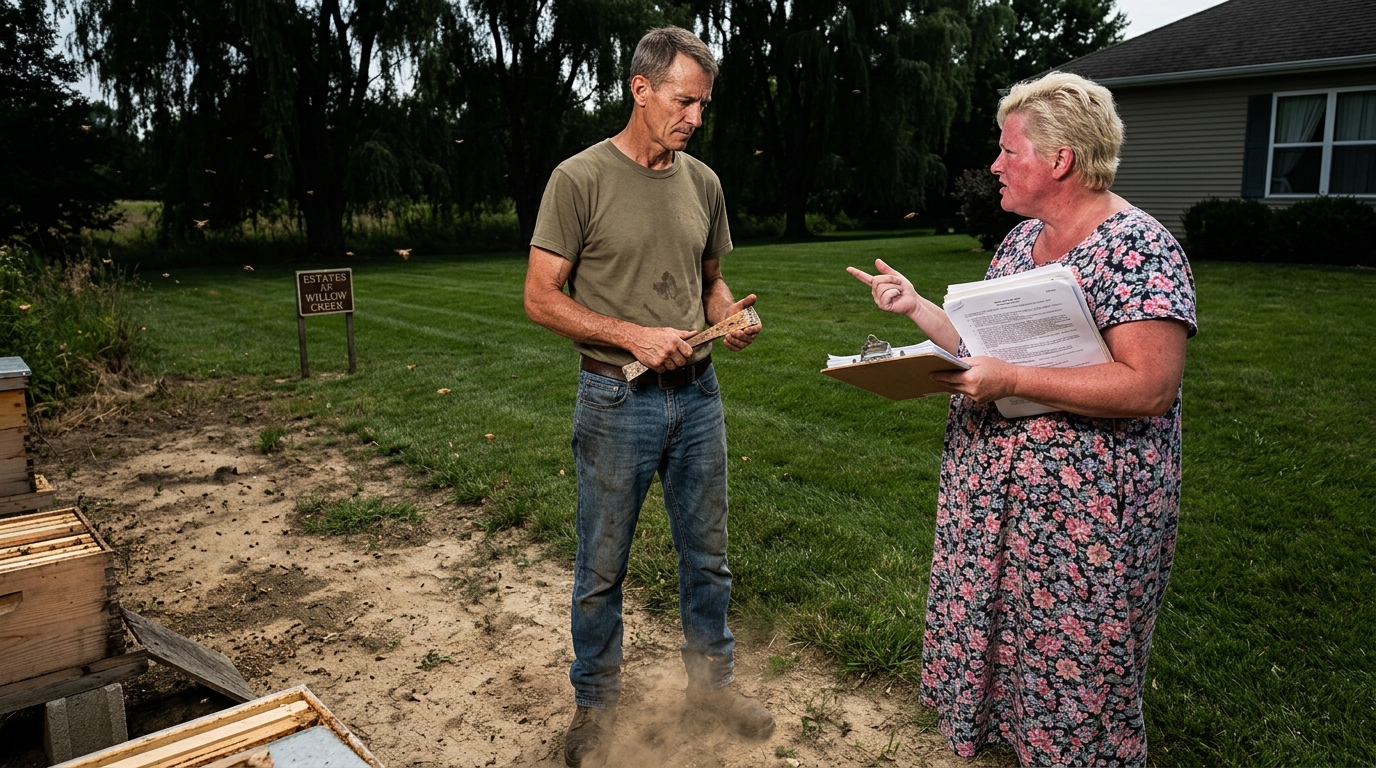
“Your bees are a menace, and I’m shutting you down,” Karen said.
She stood at the exact border where my grandfather’s unpaved acre met the manicured grass of the Estates at Willow Creek.
Her floral print muumuu was pulled tight across her arms, which were locked over a thick plastic clipboard.
Her face was blotchy red, her bleached hair stiff in the quiet breeze that carried the scent of my black willow trees.
“This is your final official warning, Mr. Thorne,” she added, her voice carrying that sharp, practiced pitch of someone used to people folding just to make her go away.
I didn’t answer right away.
I kept my eyes on the hive tool, turning the flat edge over in my hand, letting the steel press cold against my palm.
Twenty years in the Air Force taught me one basic truth about people who yell early: they are testing the fence to see if it’s wired.
“A menace, Karen?” I said, keeping my tone flat.
“Don’t you use that dismissive tone with me,” she snapped, stepping forward until the plastic soles of her sandals pressed directly onto the small wood sign marking my boundary. “I have received multiple complaints. Agnes Miller in lot 42 can’t even sit on her porch without risking an attack. Little Timmy Garcia was stung twice last Tuesday.”
Agnes Miller’s only ongoing fight was with gluten at the summer potlucks, and I’d picked Timmy Garcia out of his own sweetgum tree three days ago with a cedar splinter in his palm.
“These are Italian honeybees,” I said softly, pointing the flat tip of the steel tool toward the white Langstroth boxes sitting two hundred yards back near the tree line. “They don’t care about Agnes, and they don’t care about Timmy. They care about clover.”
“The rules do not care about your clover, Mr. Thorne.”
She unclipped a sheaf of papers with a loud snap of the metal hinge and slapped them against her forearm.
“Section 7, paragraph 4, sub-D. No livestock, poultry, or unauthorized animals. Your commercial bee farm is an illegal operation, and it is in direct violation of our community standards.”
“My land isn’t in your subdivision,” I said.
“Your nuisance affects our property values,” she shot back, her chest heaving as she planted one foot squarely onto my side of the dirt. “This is a cease-and-desist notice along with a five-hundred-dollar initial fine. You have thirty days to clear these hives out, or we will file a lien against this title.”
My fingers tightened on the iron tool until my knuckles turned white.
A lien meant frozen credit, red tape, and months of administrative filth on a title my grandfather had cleared in 1954.
“You step back over that line, Karen,” I said, my voice dropping into the lower register that used to stop arguments in noisy maintenance hangars.
She flinched for a fraction of a second, her eyes darting down to the boundary stake, but her mouth twisted right back into that familiar, arrogant sneer.
“We’ll see who has the last laugh when the county sheriff serves the paperwork,” she said.
She tossed the papers down onto the dry grass at my boots, turned on her heel, and marched back toward the rows of identical beige houses, her muumuu flapping behind her like a battle flag.
I didn’t bend down to pick them up right away.
I stood there in the quiet hum of the apiary, watching her cross the asphalt, feeling the hot pulse of anger settle deep into my gut, turning cold and heavy like lead.
She thought she was starting a legal paperwork fight with a quiet neighbor.
She had no idea how much documentation a retired logistics sergeant could pull together when someone tried to touch his home.
CHAPTER 2: PAPER TRAILS AND QUIET MAPS
“What did she say, Marcus?” Sarah set a heavy twelve-ounce jar onto the cardboard box with a dull thud.
“She gave us thirty days to move the hives,” I said, flattening the crease of the deed against the wooden table. “Five hundred dollar fine for a ‘nuisance.’ Another two hundred for breathing her air.”
Sarah stopped. Her hand hovered over a roll of packing tape, her knuckles tense. Without legal representation, hiring an attorney out of town would eat through our entire fall equipment budget before we even got a hearing date.
“We can’t afford a lawsuit right now, Marcus,” she said, her voice dropping so our daughter wouldn’t hear from the next room. “You know what the winter feed costs are going to be.”
“We aren’t hiring anyone,” I said, tapping the edge of the deed. “The county records office opens at eight. I don’t need a lawyer to read a survey line.”
The basement of the county courthouse smelled like old toner and damp concrete.
I leaned over a high steel counter, watching a clerk named Dennis run his finger across an oversized ledger book bound in cracking black leather.
“Estates at Willow Creek, Parcel B,” Dennis muttered, adjusting his wire-rimmed glasses. He pulled up the original plat map on a flickering monitor, the amber light reflecting off his bald head. “And your parcel is the old Thorne homestead, Section 14?”
“Section 14,” I said. “Ten acres.”
“Well,” Dennis grunted, pointing a stubby finger at the glowing screen. “The developer filed the HOA covenants in ’03. They drew their eastern boundary right up to your drainage ditch, but they never acquired an inch of your soil. You aren’t in their grid. You aren’t in their registry.”
“Can she file a lien without a court judgment?”
“She can try to drop a wild affidavit at the registrar’s window,” Dennis said, leaning back till his swivel chair squeaked. “It’s illegal as hell, but if the clerk behind the desk doesn’t check the parcel numbers, it sits on your title until a judge wipes it off. Costs fifty bucks to file, costs you thousands to clear.”
I didn’t answer. I just stared at the boundary map on the screen.
Right at the edge of Karen’s lot, marked as Lot 12, a heavy black line showed an elevation change where a natural creek bed used to run.
“Where’s the county extension office?” I asked.
“Third floor,” Dennis said. “Dr. Vance is up there.”
Dr. Eleanor Vance didn’t look like a bureaucrat. She sat behind a desk stacked high with soil sample bags and dried plant pressings, a magnifying glass resting on a stack of local agricultural statistics.
“An HOA trying to cite an apiary?” She let out a short, dry laugh that sounded like dry leaves rustling. “Mr. Thorne, our state legislature expanded the Right to Farm Act three years ago specifically to protect small-scale pollinators from suburban sprawl.”
She turned her monitor toward me, pulling up a regional GIS satellite overlay.
“Look here,” she said, tapping the glass. “The developer cleared three hundred acres of native brush when they built Willow Creek. They put in non-native turf grass and hybrid pear trees. The wild bumblebee population in this quadrant dropped to zero by 2021.”
She zoomed in on the satellite map, highlighting a cluster of bright green dots scattered across the beige subdivision grid.
“Those are registered fruit-bearing residential lots,” Dr. Vance said, her eyes sharp behind her lenses. “Apples, plums, ornamental sweet cherries. Your fifty thousand bees are the only managed foraging colony within a three-mile radius. Without your hives, those trees don’t set fruit. Period.”
I looked at the green dots scattered across Karen’s street.
“She has pear trees in her backyard,” I said quietly.
“Then she’s feeding her family on your back,” Dr. Vance said flatly. “And if you look closer at her lot on this elevation grid—” She clicked a layer toggle on the GIS map, revealing a steep red contour line directly along Karen’s back property line. “—that new stone retention wall she built last summer shifted the natural watershed. It’s pushing runoff right toward the public road ditch.”
I stared at the red line on the screen.
“That wall isn’t on the original developer’s grading plan,” I said.
“Nope,” Dr. Vance said, pulling a fresh sheet from her printer and sliding it across the desk to me. “And if it’s over four feet high without a county drainage permit, it’s a civil code violation that carries a daily fine.”
I folded the paper carefully and slid it into my jacket pocket alongside my grandfather’s deed.
“Thank you, Doctor,” I said.
“Don’t thank me, Mr. Thorne,” she said, turning back to her microscope. “Just keep those girls flying. The county needs the honey.”
I walked out to my truck, the cold steel of the hive tool resting in my pocket alongside the printed maps.
Karen had a clipboard, a fake fine, and a lot of loud words.
I had the parcel numbers, the agricultural code, and a map of her own unpermitted backyard.
CHAPTER 3: THE DOORSTEP DELIVERY
“Are you sure about doing this without a warning?” Sarah smoothed a white label over the curved glass of a jar, her fingernail tracing the outline of a honeybee icon.
“A warning gives her time to write another fake letter,” I said, stacking four filled flats into a heavy wooden crate. “We aren’t asking for her approval. We’re giving her neighbors something to calculate.”
The labels read simply: Thorne Apiary — Free Local Honey & Pollination Overview.
Tucked into each flat was a folded two-page printout featuring the county extension office map, showing the three-mile flight radius of my hives and the one hundred and twenty-four fruit trees mapped across the subdivision.
“Carlos Garcia called while you were washing the jars,” Sarah said, setting her printer alignment grid on the counter. “He said Karen went door-to-door on Lot 30 today telling people your hives are swarming.”
“Carlos can look at his own plum trees,” I said, wiping a stray drop of amber liquid off the wooden table with my thumb. “Let Karen keep talking. It makes the printouts easier to read.”
The asphalt streets of the Estates at Willow Creek were dead quiet at eight o’clock.
Streetlights threw long orange pools of light across manicured turf grass, reflecting off identical beige garages and silver sedans.
I kept my steps light, moving down the sidewalk with a canvas tote bag slung over my shoulder, dropping one two-ounce jar and one folded map onto every front porch mat.
No knocking. No speeches. Just the physical proof of what my land brought to theirs.
At Lot 38, a porch light clicked on as I set the jar down near a pair of muddy kids’ sneakers.
The screen door swung open three inches, caught by a brass security chain. Carlos Garcia stood in the gap, wearing a grey work shirt with his name stitched over the pocket.
“Marcus?” Carlos squinted into the dark, his hand resting on the aluminum door frame. “What are you dropping off?”
“Just facts, Carlos,” I said, stepping back two paces onto his concrete walkway. “And some honey for the kids.”
He unhooked the chain and stepped out onto the porch, picking up the folded paper. He held it up under the yellow porch light, his eyes scanning the county extension stamp at the top.
“Karen told my wife yesterday that your bees were classified as a commercial hazard,” Carlos said, his voice quiet as he read down the column of figures showing property value premiums for fruit-bearing lots. “She said the board was filing an injunction.”
“She can file whatever she wants,” I said. “Read page two. Look at the county drainage overlay for Lot 12 while you’re at it.”
Carlos turned the page over, his thick thumb tracing the red contour lines marking Karen’s unpermitted stone wall. “This is from the county courthouse?”
“Certified copy,” I said. “Emergency board meeting is tomorrow night at seven, right?”
“Yeah,” Carlos muttered, his eyes narrowing as he read the economic estimate for subdivision crop yield. “She said it was an executive session. Closed to non-members.”
“The bylaws say open floor for adjacent boundary disputes,” I said, resting my hand in my jacket pocket against the cold steel handle of the hive tool. “Section 12, paragraph three. Tell your wife to bring her copy.”
Carlos looked up from the paper, his face hard in the overhead light. “She will.”
I turned and walked back toward the street line, my empty canvas bag resting light against my hip.
Behind me, across the dark street, a curtain twitched in the second-story window of Lot 12, but nobody came down to the porch.
Karen could watch from behind her blinds all night. Tomorrow at seven, she was going to have to talk to the whole street at once.
CHAPTER 4: THE BOARDROOM TRAP
Carlos Garcia walked in right ahead of me, his wife Maria holding a stack of my folded printouts against her sweater.
Metal folding chairs scraped loudly against the linoleum floor as over sixty residents packed into the narrow room.
At the front table, Karen sat behind a wooden gavel, her red blazer tight around her shoulders, her fingers tapping rhythmically on a black binder.
“This is an executive session,” Karen called out, her voice cutting through the noise before the clock even struck seven. “Non-members are required to leave the hall immediately.”
I didn’t turn back toward the exit. I stepped down the center aisle, pulling the steel hive tool from my jacket and placing it flat on the corner of the front table with a quiet metal clink.
“Section 12, paragraph three,” I said, keeping my posture resting heavy on both feet. “Any adjacent property owner subject to a board enforcement action or fine has an explicit right to address the assembly prior to any vote.”
Karen’s jaw tightened. She shot a quick glance at Brenda, the secretary sitting to her left.
Brenda didn’t look back at Karen. She had a thick, blue-bound copy of the subdivision bylaws open on her knees, her finger resting directly on the third paragraph of page eighteen.
“He’s right, Karen,” Brenda said, her voice dry and completely clear across the quiet room. “We can’t take the vote on the legal retainer without giving him his five minutes.”
Karen slammed her hand flat against the table, her plastic clipboard shifting an inch to the side. “Fine. Five minutes, Mr. Thorne. But this board will not tolerate non-member grandstanding.”
I picked up my manila folder, opened it, and laid three enlarged sheets flat over her black binder.
“I’m not grandstanding,” I said, turning to face the rows of folding chairs. “I’m giving you your property math.”
A quiet hum went through the room as Carlos held up his copy of the GIS overlay from his seat in the second row.
“For five years, my apiary has run fifty thousand bees two hundred yards from your boundary,” I said, pointing to the blue circular radius on the printed map. “According to the county agricultural extension office, those bees provide one hundred percent of the pollination for the hundred and twenty-four registered fruit trees in this subdivision.”
“This is completely irrelevant!” Karen snapped, her knuckles turning white against her wooden gavel. “The covenants restrict commercial livestock! Your bugs are a safety hazard!”
“Your fruit yields are up four hundred percent since 2021,” I continued, ignoring the gavel as she brought it down once with a dull thunk on the wooden table. “That fruit density adds five to seven percent to the resale curb appeal of every lot along Willow Creek Drive. Across this room, that’s one point five million dollars in collective home value.”
An old man in the third row—Mr. Miller, the retired accountant—pulled out a small pair of reading glasses and leaned over his wife’s shoulder to look at the chart.
“If this board votes tonight to spend your monthly dues on an injunction,” I said, looking directly at the three board members sitting alongside Karen, “you aren’t protecting your neighborhood. You are paying out of your own pockets to strip seven percent off your own appraisal values.”
“That’s enough!” Karen stood up so fast her metal folding chair screeched backward against the floorboards. “You don’t dictate policy to this board! We have three signed nuisance affidavits from residents—”
“You have zero affidavits,” Maria Garcia spoke up from the middle aisle, standing firmly beside her husband. “You wrote those slips yourself, Karen. My Timmy fell out of a tree.”
The entire room went dead silent.
Karen’s face flushed a deep, blotchy purple, her chest rising and falling hard against the edge of the display table.
She opened her mouth to speak, but Mr. Miller was already standing up, a separate stack of white ledger paper held tightly in his right hand.
“Before we take any vote on Mr. Thorne’s hives,” Mr. Miller said, his quiet voice instantly drawing every eye in the room away from the stage, “I think we need to discuss why the HOA landscaping budget jumped thirty percent this spring.”
Karen didn’t answer. Her fingers twitched against the wooden handle of her gavel, but she didn’t bring it down.
CHAPTER 5: THE UNRAVELING
“You are completely out of order, Henry!” Karen shouted, bringing the wooden mallet down against the table three times in rapid, violent cracks.
“I’m a member in good standing presenting a financial point of inquiry,” Mr. Miller said, dropping a thick white binder directly onto the front table next to my hive tool. “Section 4, paragraph two requires annual disclosure of all vendor contracts over five thousand dollars.”
The nervous treasurer sitting to Karen’s right wiped a sheen of sweat from his forehead with the back of his sleeve, staring down at his feet.
“We hired a certified contractor for slope retention along Willow Creek Drive,” Karen said, her chin jutting out as her voice rose an octave higher. “The board approved that expenditure in May!”
“Lawn and Order Landscaping,” Mr. Miller read off the top page, his pencil tracing a line down the expense column. “Registered to your nephew, Karen. Eighteen thousand dollars for stone fill.”
A loud gasp rippled through the middle rows of folding chairs.
“And sixteen thousand of that stone fill ended up behind your house,” I said, stepping up to the table and sliding the county extension drainage map under Brenda’s nose. “Building a four-foot retaining wall that redirects six hundred gallons of storm runoff into the public road ditch.”
“That is a lie!” Karen slammed both palms onto the table, her plastic clipboards rattling. “That wall was built on private property with private funds!”
“The county engineering office doesn’t have a permit on file for Lot 12,” Brenda said quietly, turning the satellite overlay page over in her hands. She looked up at Karen, her face pale. “And this invoice matches the stone delivery ticket for the HOA main gate.”
“This entire meeting is an illegal ambush!” Karen grabbed her purse, her fingers trembling as she tried to pull her black binder toward her chest. “I am adjourning this assembly right now under presidential authority!”
“You can’t adjourn,” Carlos Garcia shouted from the third row, standing up alongside four other homeowners. “I motion for an immediate vote of no confidence in the board president!”
“Seconded!” Maria Garcia called out.
Karen didn’t wait for Brenda to take the count.
She shoved her folding chair backward until it hit the drywall behind her, grabbed her heavy plastic clipboard, and shoved her way down the side aisle toward the double doors, her sandals slapping hard against the linoleum.
“Let her run,” Mr. Miller said, turning to Brenda and taking the wooden gavel off the table. “We have seventy percent of the voting membership in this room. Let’s take the roll.”
I picked my steel hive tool off the corner of the table, wiping the handle against my jeans, and walked out into the cool night air behind the crowd.
Across the street at Lot 12, Karen’s front porch light was switched off, but the headlights of her SUV flickered on in her driveway, engine revving in the dark.
She wasn’t going to resign quietly. A cornered suburban president with eighteen thousand dollars of unpermitted stone in her yard was going to fight with whatever dirt she had left.
CHAPTER 6: THE QUIET NORMAL
The early sun hit the damp oak grains of the sign Carlos had finished carving the night before.
Welcome to The Estates at Willow Creek — A Pollinator-Friendly Community.
Beneath the lettering, a single honeybee rested over a carved apple blossom branch.
Across the ditch, a white pickup truck sat idling near Karen’s driveway.
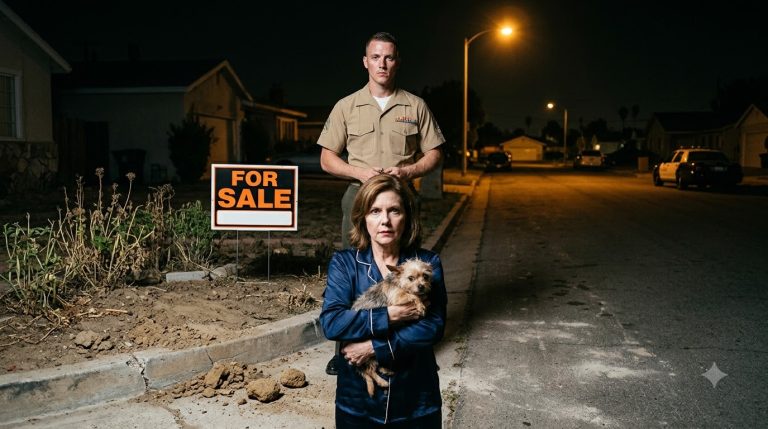
Two workers were loading the last of her lawn furniture into a covered trailer while Karen stood by her mailbox, a real estate ‘For Sale’ sign sticking out of the turf behind her.
She wore a faded grey sweater instead of her red blazer, her plastic clipboard nowhere in sight.
When she saw me standing by the fence line with my mug, she didn’t yell about fines or call for a sheriff.
She turned her face toward her front door, her shoulders hunched against the morning dampness, and climbed into her front seat without looking back over the line.
The county drainage inspector had spent three hours at Lot 12 on Tuesday afternoon.
By Wednesday morning, the unpermitted stone wall was cited for drainage diversion, and the new board under Mr. Miller had already voted to freeze all vendor contracts linked to Lawn and Order Landscaping.
Carlos walked down his driveway carrying a small wooden post hole digger over his shoulder.
“Ground is soft enough after the rain, Marcus,” he said, setting the iron blades down near the survey stake.
“I’ll hold the post,” I said, setting my coffee mug on a flat rock near the drainage culvert.
We set the heavy oak legs two feet deep into the soil, exactly four inches on their side of the deed line, packing the red clay tight around the base until the frame stood straight and firm.
The steady, low hum of fifty thousand honeybees drifted over the willow trees behind my farmhouse, rising as the morning air warmed the hive boxes.
I pulled my steel hive tool from my back pocket, wiped a speck of dry dirt from the flat edge, and slid it neatly back into my toolbox.
No lawyers. No affidavits. Just ten acres of grandfathered dirt, a clear survey line, and fifty thousand working neighbors minding their own business.