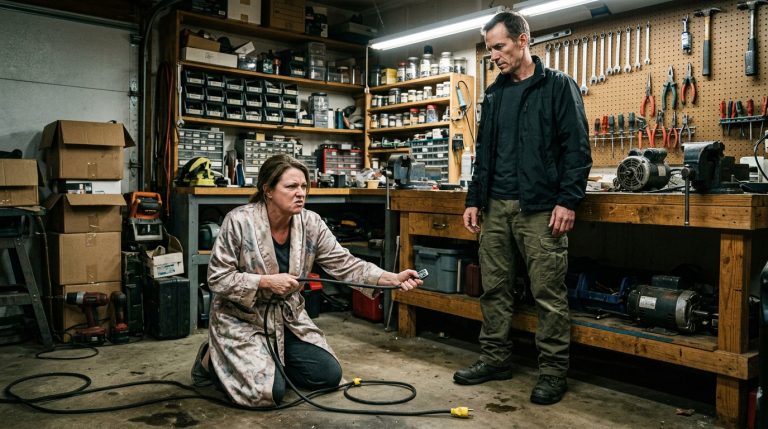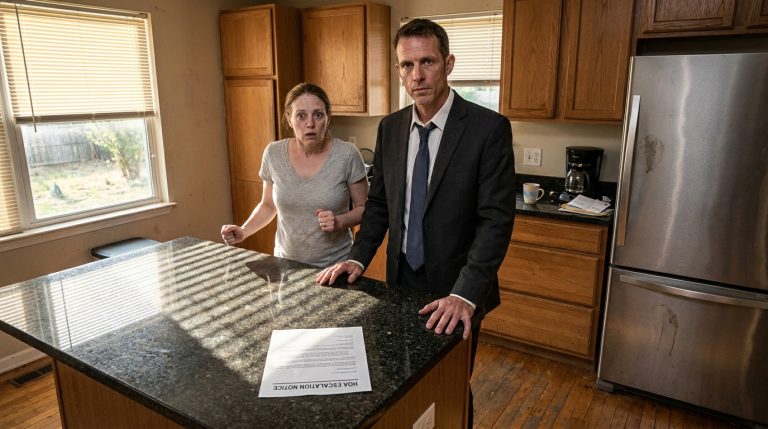
The Concrete Line in the Virginia Dirt Proved That Some Roots Run Deeper Than Suburban Spite
CHAPTER 1: THE PASTEL DECREE
The coffee in my ceramic mug had gone cold twenty minutes ago, but I hadn’t touched it.
I sat on the front porch step, watching the loose gravel of the driveway settle after the mail carrier’s truck bounced past.
A shadow cut across the bottom step, blocking the morning sun.
Karen Miller stood at the edge of the property line, her pristine white sneakers planted firmly in the Virginia clay like she was planting a flag.
“I hope you brought your checkbook, Arthur,” Karen said, her voice cutting through the quiet morning air with the sharp edge of a kitchen knife.
She held a clipboard pressed against her pastel pink tracksuit jacket, tapping a manicured fingernail against the metal clip.
I didn’t stand up right away.
I let my gaze drop from her face down to the clipboard, then slowly back up to her eyes.
“Morning, Karen,” I said, keeping my voice flat and even. “That’s a long walk down my private drive just to deliver bad news.”
“It’s not bad news, it’s an enforcement notice,” she snapped, lifting the clipboard higher. “Five thousand dollars. Payable by Friday. And the county approved our emergency abatement order for that eyesore in your backyard.”
She pointed a rigid finger past my shoulder toward the old stone root cellar sitting fifty yards away against the tree line.
My grandfather built those stone walls by hand over a century ago.
Karen saw a liability; I saw the only piece of family history I had left after twenty-two years away in the Army Corps of Engineers.
“That root cellar isn’t hurting anyone, Karen,” I said, leaning my forearms against my knees and locking my fingers together. “It’s been there longer than this subdivision was a gleam in a developer’s eye.”
“It lowers property values, and it violates three distinct neighborhood aesthetic codes,” she fired back, stepping one inch closer to the forbidden boundary line. “That dirt hole is coming down, or we will lien this entire five-acre parcel until you’re forced to sell.”
She turned on her heel, her sneakers grinding against the gravel, and marched back toward her idling crossover parked half on my grass.
I didn’t chase after her or raise my voice.
I just watched the dust kick up behind her bumper as she backed out, letting the silence settle back over the porch.
CHAPTER 2: THE RED TAPE WALL
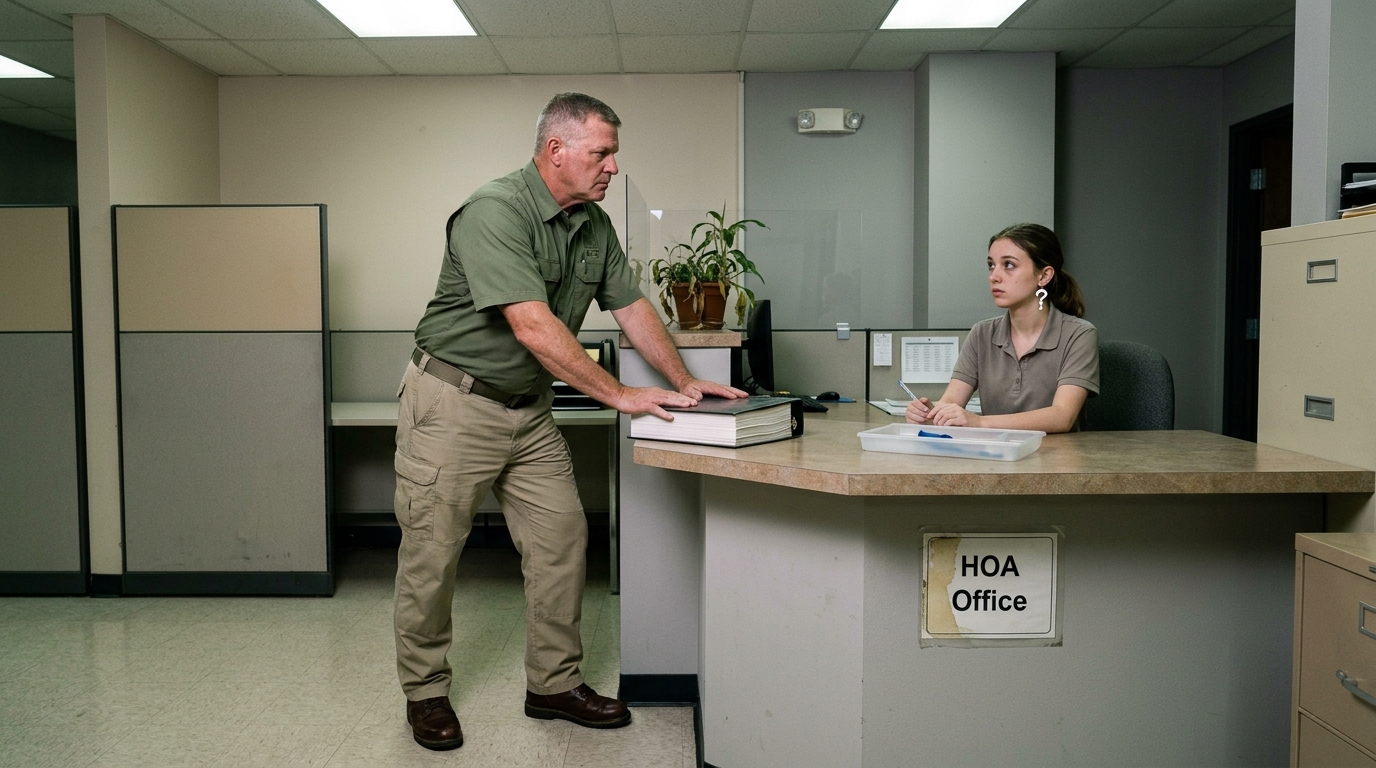
The HOA office smelled like fresh carpet glue and cheap lemon cleaner.
I dropped the heavy stack of papers onto the laminate counter with a dull, echoing thud that made the receptionist blink behind her plastic nameplate.
“I’m here to file an appeal and architectural modification request for the stone root cellar,” I said, leaning my weight against the edge of the desk.
The receptionist, a young woman with silver earrings shaped like question marks, looked at the five-inch-thick binder like it was a live grenade.
“You’re going to need to fill out Form 104-B for structural alterations,” she mumbled, tapping a plastic tray.
“Already did,” I replied, flipping the heavy binder open to reveal color-coded divider tabs, soil compaction logs, pest control certificates, and a ten-page narrative summary of historical stonemasonry. “And I added a complete engineering load analysis, just so the board has all the facts before they make a decision.”
She flipped the cover back, her eyes widening slightly as she scanned the dense, single-spaced typewritten pages.
“This is… a lot of paperwork for a dirt hole,” she muttered, her fingers hesitating over the spine.
“It’s a structure built to code and grandfathered into county records before this entire plat was surveyed,” I said, keeping my voice low and level. “Make sure Karen gets it on top of her stack tonight.”
I didn’t wait for her to answer.
I turned on my heel, listening to the heavy thud of my work boots against the linoleum as I walked back out into the bright Virginia sun.
Karen wanted a fight over rules and compliance, so I was going to give her a stack of paper so heavy it would break her desk.
CHAPTER 3: THE KANGAROO COURT
The overhead fluorescent lights buzzed with a low, grating frequency that made the air feel thin.
Karen cleared her throat, her eyes sweeping over the committee board members seated to her left and right before landing squarely on me.
“Item four on the docket, the unauthorized earthwork and structural violation at the old homestead parcel,” she announced, not even bothering to open the thick binder I had submitted the day before.
She pushed the five-inch dossier aside like it was an empty paper plate, leaving it closed and unread near the edge of the table.
“The architectural committee has reviewed the neighborhood impact assessments, and we find the structure constitutes an undeniable public nuisance,” Karen continued, her voice dripping with practiced administrative authority.
I kept my hands resting flat on the table, my fingers brushing against the cold, smooth plastic of the folder holding my carbon-copy receipts.
“Did you review the engineering load analysis and soil compaction logs I attached to that binder, Karen?” I asked, keeping my tone completely flat.
She blinked, a faint twitch of annoyance breaking through her composed facade as she adjusted her collar.
“The committee is not required to pore over amateur paperwork when the visual evidence of decay speaks for itself,” she snapped back, leaning forward over her clipboard.
“You haven’t opened the cover,” I said, pointing a finger directly at the sealed dossier sitting untouched under her elbow.
“We are voting to uphold the fine and demand immediate compliance,” she declared, cutting me off with a sharp wave of her hand toward the other board members.
All three nodded in unison without a single question asked, exactly as expected.
I let out a slow, deliberate breath through my nose, watching the transactional indifference on their faces.
“Let the record show the committee denied the engineering review without opening it,” I said, looking straight at the automated digital recorder sitting in the center of the table.
Karen’s pen snapped in half between her fingers, scattering plastic ink fragments across the agenda sheet.
CHAPTER 4: THE DUSTY ATTIC
The air up here tasted dry, thick with the scent of old paper and dried cedar shingles.
I crouched beside a row of water-stained crates labeled in my grandfather’s bold, sloping handwriting, my fingers brushing against brittle cardboard.
A sharp draft from the roof vent made a loose sheet of yellowed ledger paper flutter against the floorboards.
I pinned it down with my thumb, shining the light across ink-stained entries detailing grain yields, tool purchases, and names written in a completely different, hurried script.
“1854,” I muttered, tracing the faint margin notes with the tip of my finger.
The dates didn’t align with simple farm chores; they tracked midnight arrivals, hidden cellar rations, and safe passage markings across the Virginia line.
I pulled a tongue-and-groove floorboard back from the base of the chimney stack, revealing a small, recessed compartment hidden beneath the insulation.
Inside sat a heavy iron latch and a stack of damp-sealed abolitionist broadsides confirming the cellar’s true purpose.
Karen thought she was fighting over a simple zoning violation and a patch of unkept weeds.
She had no idea she was trying to bulldoze a federal sanctuary built by men who valued freedom far more than HOA compliance.
CHAPTER 5: THE CONCRETE ARRIVAL
The engine noise vibrated straight through the old timber framing, rattling the loose glass panes in the gable window.
I set the ledger down inside the floor cavity, dropped the hatch back into place with a hollow snap, and descended the stairs two at a time.
By the time my boots hit the front porch, a massive twin-axle cement mixer was already halfway up the gravel lane, throwing white dust into the morning air.
Karen Miller stepped out from behind the passenger door of a silver pickup idling behind the mixer, her pastel jacket buttoned tight against the damp morning chill.
She walked with the stiff, purposeful stride of someone who believed she had already won the war before the first shot was fired.
“Save yourself the trouble of filing another useless appeal, Arthur,” Karen called out, folding her arms across her chest as she stopped ten feet short of my porch steps. “The county gave us the green light this morning, and this concrete is going straight into that eyesore of yours whether you like it or not.”
The truck driver climbed down from his high cab, wiping his greasy hands on a blue rag while looking back and forth between Karen and my front door.
“You got a demolition permit signed by the commissioner, lady?” the driver asked, squinting against the sun.
“We have an emergency neighborhood abatement order,” Karen snapped, stepping forward and tapping her manicured fingernail against the driver’s heavy leather sleeve. “Just back that chute up to the root cellar and empty the drum right now.”
I walked down the porch steps, the frosty gravel crunching loud and clear beneath the rubber soles of my boots.
“You don’t have jurisdiction over this parcel, Karen,” I said, keeping my hands loose at my sides as I crossed the yard to stand directly between the truck chute and the historic stone wall. “And you certainly don’t have federal clearance to bury a registered historic sanctuary.”
Karen let out a sharp, breathless laugh, her face flushing a deep, angry crimson under her styled blond hair.
“You delusional old fool, there is no federal protection here, and if you don’t move out of the way right now, I’m having the sheriff haul you off for interfering with a legal township order!” she screamed, pointing a shaking finger straight at my chest.
CHAPTER 6: THE FEDERAL STOP
The truck driver killed his diesel engine with a sudden pneumatic hiss, dropping his hands from the controls as local sheriff deputies pulled their cruisers across the lane.
“Step away from the vehicle, ma’am,” the lead deputy said, resting his hand on his duty belt as he stepped past the frost-covered grass.
“You can’t arrest me, I represent the board!” Karen shrieked, her voice cracking as she swung her arm toward the historic stone cellar. “That man is harboring an illegal public nuisance and refusing community orders!”
“We received confirmation from the state preservation officer five minutes ago,” the deputy replied, tapping a yellow legal folder against his thigh. “Destroying this foundation violates federal protection statutes. Your neighborhood bylaws don’t override federal law.”
Karen’s mouth opened and closed silently, her pastel blazer trembling as the reality of her overreach finally collapsed around her.
She lunged toward the truck door, screaming at the driver to ignore the officers, but the driver shook his head and climbed down on the opposite side, unhooking his safety harness.
Within two hours, the county commissioners initiated an emergency review of the board’s entire budget, uncovering months of financial overreach that forced an immediate recall election.
Karen’s reign of administrative terror ended not with a grand courtroom drama, but with a quiet, mandatory resignation letter left on the community office desk.
The concrete truck backed down the drive, its tires crushing the last remnants of the morning frost.
I walked back across the yard, stepping past the old stone cellar walls that had stood firm against a century of weather and a morning of sheer arrogance.
I sat back down on the front porch step, picked up my cold ceramic mug, and took a slow, quiet sip of water.
The morning air felt steady, the gravel drive was quiet once more, and history stayed right where it belonged.