The Silent Circuit: A Precise Engineering Project to Dismantle a Suburban Dictatorship, One Volt at a Time
CHAPTER 1: THE RELAY
The garage hummed with the steady, familiar rhythm of cooling fans—a sound I hadn’t heard in five years. Under the crisp LED glow, the Raspberry Pi board sat mounted on a custom-etched PCB, its green status light pulsing like a steady heartbeat. It was a simple circuit, built with the cold precision of my defense-industry past, designed to do one thing: terminate the connection before the voltage reached the threshold required for a charge.
Outside, the neighborhood was a canvas of shadows. The air was dry, carrying the scent of cut grass and the faint, ozone tang of a late-summer storm that refused to break. I stood at the workbench, my hands steady, watching the monitor. At 2:13 a.m., the motion alert pinged a soft, digital chime that seemed deafening in the stillness.
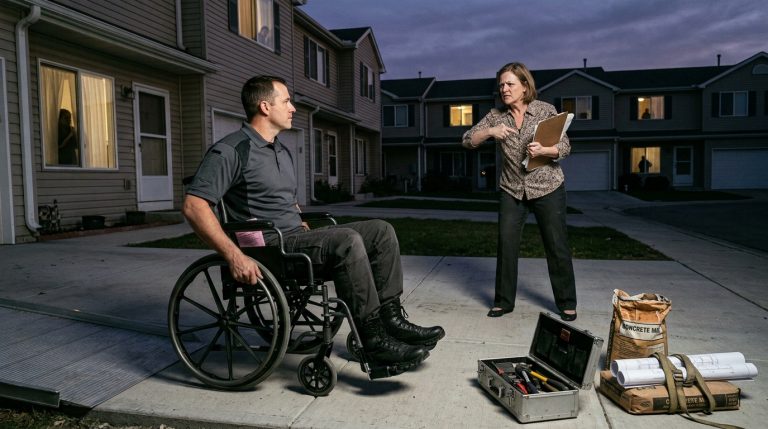
On the screen, a figure drifted across the grainy, high-definition frame. Karen. She didn’t walk so much as glide, the fabric of her bathrobe fluttering like moth wings against the dark siding of the shed. She held the heavy-duty extension cord like a lifeline. She didn’t look back, didn’t scan the yard for cameras. She had never needed to. In her world, the rules were obstacles for others, not barriers for her.
I watched her reach for the outlet. I felt the familiar, clinical detachment of a pilot reviewing a flight path. She plugged it in.
I waited. One second. Two seconds. The current spiked on my graph, a sharp, jagged peak of demand. Then, the relay clicked—a sound so minute it existed only in my imagination—and the graph plummeted into a flat, dead line.
On the monitor, she froze. She stared at the golf cart’s dashboard, her brow furrowing as the charging indicator flickered out and remained stubbornly dark. She jiggled the plug. She whistled—a sharp, impatient sound that carried through the external mic—and then she bent down, gripping the cord with both hands, giving it a violent, frustrated yank.
It didn’t matter. The circuit was open. The power was cut.
I didn’t smile. I didn’t feel the adrenaline of a victory. I felt only the cold, sharp satisfaction of a sequence correctly executed. But then, my eyes caught something else on the screen. As she pulled the cord, the light from the shed door illuminated her hand. She wasn’t just holding the plug. She was holding a small, metallic key fob—one I hadn’t seen before—and as she turned to leave, she didn’t head for the street. She walked toward the back fence, where a section of the perimeter was obscured by a row of overgrown arborvitae. She pressed the fob, and a hidden door, flush with the wooden fence, clicked open with a quiet, mechanical hiss.
My breath hitched. The petty theft of electricity was a distraction, a glaringly obvious decoy. That shed wasn’t just a place to charge a cart. It was a staging ground.
CHAPTER 2: THE PERIMETER BREACH
The screen glowed with a ghostly, monochromatic light, casting long, angular shadows across the workbench. I didn’t move. I couldn’t. The image of that hidden door—flush with the fence, perfectly camouflaged against the cedar slats—seemed to burn into my retinas. I scrubbed the footage back, frame by agonizing frame, watching the way Karen’s movements changed once she stepped into that blind spot.
There was no hesitation. She didn’t look for a latch. She didn’t fumble. She pressed that fob with the muscle memory of someone who performed the action daily.
My pulse settled into a slow, rhythmic thrum against my collarbone. I had been focused on the electric bill, treating this like an engineering problem that could be solved with a simple relay switch. But the relay was just a way to see what was behind the curtain. The theft of electricity was the bait, and I had been just foolish enough to bite.
I stood up, the chair scraping sharply against the concrete floor—a sound that felt like a gunshot in the midnight silence. I walked to the window. Outside, the cul-de-sac was a graveyard of suburban perfection. Every lawn was a uniform green, every driveway pristine. Karen’s house sat at the center of this, a silent, white-trimmed fortress. From here, I couldn’t see the fence line, but I knew exactly where it was.
My mind began to race, calculating variables. The shed sat 22 feet onto my property, but the fence… the fence was the boundary. If that door was hidden behind the arborvitae, then it opened into the narrow, dead-space buffer between our properties—the “maintenance easement” the HOA board constantly referenced in their threatening emails.
I needed to see it.
I didn’t grab a flashlight; light would only signal my presence. I slipped on a dark windbreaker, my movements practiced and efficient. I exited the garage, the cool night air biting at my skin. The silence of the neighborhood was absolute, save for the distant, rhythmic chirping of crickets that sounded less like nature and more like surveillance.
I moved along the shadow-line of my own home, hugging the brickwork. My training in the defense industry hadn’t just been about circuitry; it had been about threat assessment. I knew how to move without disturbing the landscape. I bypassed the motion-sensor floodlight I’d installed last month, reaching up to flick the power switch to off before I even stepped into the side yard.
The grass was damp with dew, soaking into the hem of my trousers. As I approached the fence line, the scent of cedar and damp earth grew stronger. I crouched behind a decorative stone planter, my heart rate steadying as I entered the familiar, cold headspace of the “predator-prey” dynamic.
I reached the arborvitae. The trees were dense, their needles matted together to form a wall of green. I pushed gently against the foliage, feeling the rough texture of the wood fence behind them. My fingers danced over the grain, searching for the seam I’d seen on the monitor.
There. A hair-thin vertical line, almost invisible to the naked eye.
I leaned my ear against the wood. Silence. Not even the hum of a distant refrigerator. But then, a faint, rhythmic clack-clack echoed from the other side. It wasn’t the sound of an engine or a tool. It was the sound of a heavy, metal object being shifted across a concrete floor.
My intuition flared, a cold, sharp warning. If the HOA board was just a group of bored, entitled retirees, they wouldn’t have a hidden door. They wouldn’t have security protocols. And they certainly wouldn’t be moving heavy objects at 2:00 a.m.
I felt a sudden, sharp urge to kick the door in, to confront whatever was behind that wood. The rage—that righteous, boiling indignation—was right there, sitting in the back of my throat. But I clamped down on it. Impulsivity was the enemy of the engineer. I was currently a ghost, invisible and unknown. If I breached that door, I would be a suspect.
I backed away slowly, my eyes scanning the ground for any sign of foot traffic. The mulch was undisturbed, except for the slight, unnatural depression where the grass met the fence.
I retreated to the house, every step calculated, every movement measured. Once inside, I locked the back door and leaned against the wood, the adrenaline beginning to ebb, leaving behind a cold, crystalline focus. I wasn’t just fighting a neighbor anymore. I was auditing a criminal. And if my suspicions about that hidden storage were correct, the electric bill wasn’t the only thing they were skimming.
I returned to the monitor. I didn’t play the video again. Instead, I pulled up the HOA’s digital filing system—a public-facing, yet convoluted, mess of PDFs I’d downloaded weeks ago. I began to cross-reference the “maintenance fees” mentioned in the meeting minutes against the dates of those late-night spikes in electricity.
The correlation wasn’t just a pattern. It was a ledger. Every time the usage spiked, a “common area infrastructure repair” charge was logged to the community account the following morning.
The game had changed. I wasn’t going to stop at cutting her power. I was going to follow the money, and by the time I was done, I wouldn’t just be reclaiming my electricity—I’d be dismantling the entire foundation of her little empire.
CHAPTER 3: THE CLUBHOUSE THEATER
I left the monitor glowing in the dark, the screen reflecting off the polished tools on my workbench. The numbers in the digital ledger—the “maintenance repair” costs—had a rhythm, a mathematical cadence that screamed of systematic exploitation. Every peak in power usage matched a drop in the community’s reserve funds, a correlation so precise it felt like a signature.
I pulled on a collared shirt, smoothing the fabric with palms that felt unexpectedly clammy. It was 7:00 p.m. The HOA meeting was scheduled for the top of the hour at the clubhouse. I didn’t reach for my keys immediately. Instead, I stood in the center of the garage, breathing in the scent of sawdust and machine oil, the familiar, comforting smell of order. I needed to be the version of myself that Karen expected: the frustrated, slightly unhinged newcomer. It was a role I played with growing ease.
The drive to the clubhouse was short, the streets winding through a neighborhood that felt more like a movie set than a living space. Every lawn was perfectly clipped, every mailbox stood at the same height, and the silence felt heavy, enforced. When I arrived, the clubhouse glowed with artificial warmth. Through the floor-to-ceiling windows, I saw the familiar arrangement: the mahogany table, the velvet-backed chairs, and the trio of board members—Karen and her two granite-faced satellites—already seated, their water glasses filled, their clipboards aligned with surgical precision.
I pushed the heavy oak doors open. The sound was muffled by the thick carpet. As I walked into the room, the conversation—a low, rhythmic murmur—died instantly.
Karen looked up. Her eyes were sharp, scanning my posture for weakness, for the “aggressive” behavior she’d complained about in her falsified report. I kept my shoulders relaxed, my pace steady, and my expression blank, mirroring the cool indifference of a man who had already discovered the trap and was merely waiting to watch it spring.
“Mr. Thorne,” Karen said, her voice dripping with practiced, patronizing hospitality. “We have a strict agenda tonight. If you are here to discuss your property’s compliance, I suggest you wait until the public comment period, provided you’ve filed the necessary paperwork.”
“I’m just here to listen, Karen,” I replied, pulling out a chair at the back of the room. I kept my voice low, devoid of the heat she was expecting.
She paused, her gaze lingering on me for a second too long. She didn’t like the lack of friction. The board members exchanged a glance—a flick of the eyes, a subtle tightening of the lips—that confirmed my suspicions. They operated as a single unit, their communication so rehearsed it felt like a dance.
The meeting began. It was a masterclass in obfuscation. They spoke in dense, bureaucratic jargon, masking the reallocation of thousands of dollars behind phrases like “landscape contingency adjustments” and “infrastructure lifecycle maintenance.” As they droned on, I pulled out my tablet. I wasn’t there to argue; I was there to observe. I began mapping their facial expressions against the figures in the ledger I’d saved to my local drive.
When Karen reached the section on the “Common Area Electrical Upgrade,” she didn’t just speak; she performed. She launched into a detailed, entirely fabricated narrative about the necessity of increased wattage to power the new security lighting she claimed to be installing. It was a lie, pure and simple. There were no new lights.
I looked up from my screen and met her gaze. She was watching me, waiting for me to stand up, to protest, to give her the ammunition she needed to have me formally barred from the property. I didn’t bite. I simply gave a slow, deliberate nod, a gesture of mock approval that seemed to unsettle her.
As the meeting proceeded, I noticed the detail I had missed on the monitor: the way Karen’s hand went instinctively to her pocket every time the finances were discussed. The key fob. It was there, a hard, metallic lump beneath the silk of her blazer.
The meeting drew to a close with a motion to approve the new maintenance budget. No one else spoke. The two board members voted with a mechanical, synchronized “aye.”
“Motion carried,” Karen said, her voice crisp and final.
She didn’t dismiss the meeting immediately. She lingered, her eyes tracking me as I stood. I didn’t rush. I gathered my things with slow, agonizing deliberation, feeling the weight of their collective scrutiny. As I reached the door, I paused, turning back to see her leaning over to whisper something to the board secretary—a frantic, sharp movement that shattered her veneer of composure.
I didn’t need to hear what was said. The shift in her posture, the way she gripped the edge of the mahogany table until her knuckles turned white, told me everything I needed to know. The game had shifted. They weren’t just covering their tracks; they were starting to realize that the tracks were being followed.
I walked out into the cool evening air, the scent of the freshly manicured hedges feeling suffocating now. I had the ledger, I had the visual proof of her nightly habit, and now, I had seen the theater of their corruption firsthand. I started my car, the engine purring to life, and drove away from the clubhouse, my mind already calculating the next move. They thought they were holding all the cards, but they didn’t know the engineer was already rewriting the rules of the game.
CHAPTER 4: THE DIGITAL SHADOW
I didn’t step out of the car. I killed the headlights and sat in the dark, watching the front of my house. The porch light cast a pale, jaundiced glow over the siding, but the rest of the structure was wrapped in shadow. If someone was inside my network, they weren’t just looking at the electricity logs. They were looking at the surveillance feeds.
My hands tightened on the steering wheel, the leather grain pressing into my palms. I forced myself to count to ten, the old engineer’s trick for lowering a spiking heart rate. Panic was a waste of energy; it blinded the internal eye. I needed to know exactly what they saw, and more importantly, what they didn’t.
I pulled out my phone and tapped into the bypass shell I’d coded into my home server. The interface was sparse, a command-line window that felt like home. A quick query showed the intrusion: a localized, encrypted handshake originating from a device linked to the HOA’s master network. It was crude—a brute-force attempt at a handshake—but it was targeted.
They were looking for the footage.
I didn’t rush to the door. I sat there, calculating the response. If I cut their access, I would signal that I knew they were there. If I let them continue, I risked them seeing the archive of the last three weeks—the hours of footage of Karen, the golf cart, and the secret door. I quickly executed a diversion script, creating a loop of “corrupted” data on the primary partition, and redirected the intruder toward a honeypot folder I had pre-populated with harmless, outdated electrical schematics.
It took forty-five seconds. In the digital world, forty-five seconds is an eternity. When the connection terminated, I finally opened the car door and stepped out into the night.
The walk to the front door was a study in restraint. I kept my gait natural, even though every instinct screamed at me to sprint. I checked the perimeter—the windows were locked, the cameras active and recording the yard. Nothing was disturbed. I moved inside, the silence of the house pressing against my eardrums.
I went straight to the garage, the heart of my operation. I didn’t turn on the overhead lights. I navigated by the glow of the server rack, the cooling fans pulsing softly. I sat at the terminal and began to decompile the intruder’s trace. It wasn’t Karen. The signature was too clinical, too precise. She was the face of the dictatorship, but she wasn’t the architect of its security.
The trace led back to a sub-node within the clubhouse server—a hidden partition I hadn’t noticed before. I dug deeper, peeling back layers of obfuscated code, and my breath caught. It wasn’t just a database of HOA rules or budget files. It was an access log for the entire neighborhood’s smart infrastructure.
Every doorbell camera, every smart thermostat, every connected gate in the cul-de-sac was linked to this central node. They weren’t just running a petty HOA; they were running a surveillance state. And they had been watching all of us.
My fingers hovered over the keyboard. I had found the decoy—the stolen electricity, the petty power plays—and behind it, the truth was far larger and more terrifying than I’d anticipated. They weren’t just embezzling funds. They were harvesting data, building profiles on every resident to ensure total compliance.
I looked at the screen, the lines of code scrolling like a waterfall of secrets. I had the ledger, I had the proof of the surveillance, and I had a direct line into their master network. I could wipe it. I could expose them tonight. But the rational, defensive-industry part of my brain pulled me back. If I moved too fast, I would be flagged, blocked, and potentially evicted before I could secure the final proof needed to dismantle the entire structure.
I needed more than just a digital footprint. I needed physical evidence of the embezzlement. I needed to prove where the money was going.
I closed the command window and sat back, the cool air of the garage brushing against my damp skin. My reflection in the dark monitor looked tired, the lines around my eyes etched deep by the strain of the last few hours. I wasn’t just an observer anymore; I was a target.
I leaned toward the screen, a new plan crystallizing in the quiet of the garage. I would give them what they wanted. I would “fix” the corrupted data, leaving a backdoor open that would allow them to see exactly what I wanted them to see. I would feed them a false trail, lead them toward a fabricated conflict, and while they were busy hunting a ghost, I would be inside their clubhouse, mapping the physical reality of their vault.
The petty war was over. The real siege had begun.
CHAPTER 5: THE DIGITAL DEAD END
I didn’t blink. The screen was a wash of amber code, rapidly shifting as the system purged its own history. They weren’t just blocking me; they were scrubbing the evidence of the surveillance state I had uncovered. My breath hitched in my throat as I watched the directory containing the “common area infrastructure” logs vanish, line by line.
My fingers flew across the mechanical keyboard, the keys clicking with a frantic, rhythmic intensity. I tried to initiate a local cache dump, but the connection was severed with a sharp, electronic chirp. I was locked out. The screen went black for a heartbeat before displaying a single, mocking message: Unauthorized Access Detected. HOA Enforcement Protocol Initiated.
I pushed back from the desk, the chair legs shrieking against the garage concrete. My mind raced through the implications. They hadn’t just secured the server; they had activated a physical protocol. In the quiet of my garage, the air suddenly felt thin, charged with the static of an impending confrontation.
I didn’t wait for the inevitable. I grabbed my toolkit, the weight of the metal familiar and grounding in my hands, and moved to the side door. I had to reach the clubhouse before they scrubbed the physical evidence—the paper trails, the signed contracts, the physical keys that unlocked the true purpose of their “maintenance” fund.
The night air was biting, a stark contrast to the stifling heat of the garage. I sprinted along the shadow-line of the fence, my lungs burning as I navigated the familiar path toward the back of the clubhouse. I ignored the main entrance, where the lights were still dimmed from the earlier meeting. I headed for the utility access, a small, unassuming service door hidden behind a row of overgrown boxwood hedges.
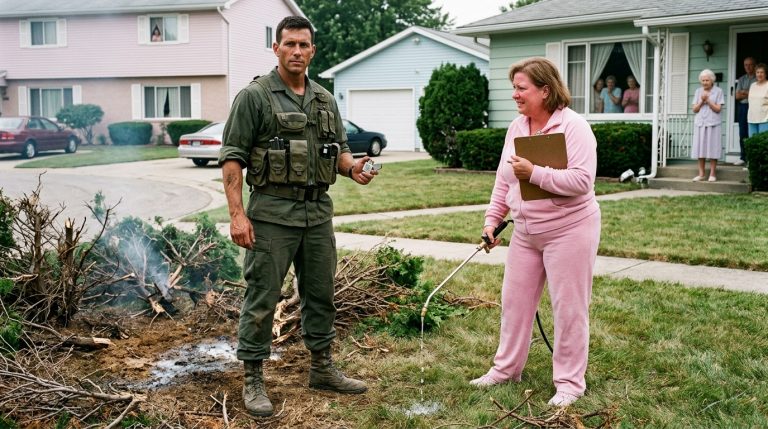
It was here, in the dark, that I saw it: a black sedan parked with its lights off, tucked into the maintenance bay. Karen stood by the door, her silhouette sharp against the moonlight, holding a heavy, reinforced briefcase. Beside her, one of the granite-faced board members was unloading crates—not maintenance supplies, but high-end consumer electronics, each box emblazoned with store logos from three towns over.
My pulse spiked. This was the decoy. The “petty” theft of electricity, the neighborhood dominance—it was all designed to mask this. They were using the HOA to facilitate a fence for stolen goods, turning our quiet cul-de-sac into a warehouse for a sophisticated, regional theft ring.
I flattened myself against the brickwork, watching them. They worked with a practiced, callous efficiency. As the board member carried another crate into the service entrance, the heavy steel door swung open, revealing a hallway lined with rows of expensive equipment—tablets, cameras, specialized drone gear. It was more than just a storage facility. It was an distribution hub.
My hands shook, but not from fear—from the cold, crystalline clarity of the reveal. They weren’t just stealing power; they were laundering the overhead of their illicit operation through the community’s maintenance budget.
But then, the board member stopped. He turned his head, his gaze sweeping the shadows where I was hidden. He held a high-powered flashlight, and he began to sweep the beam across the hedges.
I didn’t move. I shifted my weight, feeling the gravel beneath my boots, and froze as the light caught the edge of the brickwork just inches from my face. My heart felt like it was hammering against my ribs, a loud, intrusive sound in the suffocating silence.
Therefore. I had found the decoy, but I was now trapped in the very infrastructure I was trying to audit.
But. I had left my tablet in the car, and the car was three blocks away. I had no backup, no remote access, and they were actively searching the perimeter.
I realized then that the “HOA Enforcement Protocol” wasn’t just a digital warning; it was a physical threat. They had security patrols. They had people on the ground.
I gripped my toolkit, a small, heavy wrench nestled in my palm, and forced myself to take a shallow, silent breath. I couldn’t run—not without being seen. I had to wait for them to enter the clubhouse, to commit themselves to the storage room, and then I would make my move.
The beam of the flashlight flicked past me, illuminating the overgrown boxwood. I watched as the board member grunted, signaled to Karen, and turned back to the door. They were inside.
I moved. I reached the door just as it began to click shut. I didn’t push it; I caught it, my fingers sliding into the gap, and slipped into the darkness of the hallway. The air inside smelled of ozone and expensive plastic. I was in.
But as I stepped forward, the floorboard beneath my feet let out a high-pitched, melodic creak that echoed through the entire, hollow corridor.
From the end of the hall, the sound of movement ceased. Then, a voice—Karen’s voice, cold and devoid of its usual suburban affectation—cut through the dark. “Who’s there?”
The game had shifted from a digital audit to a physical confrontation. I stood in the dark, the wrench cold and hard in my grip, and prepared for the only outcome that mattered: the moment they would finally see me coming.
CHAPTER 6: THE ARCHITECTS FALL
I stood motionless, pressed against the cold, unyielding brick of the hallway’s interior wall. The wrench in my hand felt suddenly inadequate, a pathetic tool against the weight of the shadow that moved toward me. I wasn’t just facing an HOA president; I was facing the personification of every petty tyranny I had spent my professional life trying to avoid.
Karen’s footsteps were rhythmic, deliberate. Clack. Clack. Clack. She was wearing heels, despite the hour, the sound sharp and metallic against the industrial tiling.
“I know you’re here, Mr. Thorne,” she said, her voice lacking the practiced, suburban lilt. It was flat, utilitarian. “You were always the variable I couldn’t account for. The engineer. The man who trusts numbers over authority.”
She stopped ten feet from where I stood. I could smell her perfume—something floral, stifling, and utterly out of place in the sterile, ozone-scented air of the storage bay. I didn’t breathe. I watched the beam of her flashlight dance across the crates of stolen equipment, a frantic search for my silhouette.
Psychological Phantom: For a fleeting second, I didn’t see Karen. I saw the faces of the neighbors I had spoken to—the woman with the “non-compliant” mailbox, the man with the flamingo decorations. They weren’t just victims of an eccentric; they were prisoners of a system that thrived because they believed they were alone in their defiance.
That was the leverage. That was the core truth of her power. It wasn’t the surveillance or the fake maintenance fees; it was the isolation.
I shifted my weight, the metal of the wrench biting into my palm. I had to end this now, but not with force. If I struck her, I became the villain of her narrative—the aggressive, unstable neighbor. I had to dismantle her authority by exposing the sheer, fragile farce of it.
I stepped out of the shadow. The flashlight beam swung toward me, blindingly bright, pinning me against the wall. I didn’t raise my hands, nor did I lower the wrench. I just looked at her.
“You’re not an architect of order, Karen,” I said, my voice steady, cutting through the hum of the facility’s ventilation. “You’re just a thief with a clipboard.”
She didn’t flinch. She laughed, a sound that held no humor, only cold, tactical dismissal. “And you’re a man trespassing on private property, holding a weapon. The police are already on their way. I triggered the silent alarm the moment you entered the corridor.”
“Did you?” I asked, a thin, sharp smile touching my lips. “Because I didn’t come here to steal your goods. I came here to verify my logs.”
I pulled my phone from my pocket—not to call for help, but to show her the screen. It was a live feed of the HOA’s master server. I hadn’t just been running a diversion; I had synced a broadcast-capable script that was, at this very second, pushing the ledger of her embezzlement—the signed contracts, the bank transfers, the lists of residents’ private data—to every smart device in the neighborhood.
The color drained from her face. The flashlight flickered, her hand suddenly trembling.
“You wouldn’t,” she whispered.
“I’m an engineer,” I replied, stepping toward her. “I don’t deal in would-nots. I deal in architecture. And yours just collapsed.”
Outside, in the quiet cul-de-sac, the first set of sirens wailed—a distant, lonely sound that rapidly grew in intensity. She turned toward the service door, a desperate, panicked movement, but she stopped when she realized the alley was already blocked by the flashing, rhythmic strobes of patrol cars.
She wasn’t looking at me anymore. She was looking at the end of her world. She collapsed the briefcase, the latches snapping open, and for the first time, her mask—that perfectly, surgically manicured mask—shattered. She wasn’t the president of an HOA. She was just a woman, caught in the gears of her own machine.
I didn’t move to stop her. I didn’t need to. The weight of her own actions was already crushing her. I walked past her, toward the crates of stolen goods, and felt the heavy, lingering static of the room begin to dissipate. The conflict wasn’t resolved, but the structure had been breached. The truth was out in the open, and there was no amount of maintenance that could ever repair the damage.
I stepped through the service door, out into the cool, night air, leaving her in the cold, flickering light of her own warehouse. The officers were swarming the parking lot, their voices sharp and demanding, but as I walked toward the edge of the property, the world felt remarkably quiet.
I was an engineer. I had built a solution. Now, I just had to watch the collapse.
CHAPTER 7: THE UNRAVELING
The night air, once crisp, now smelled of ozone and damp asphalt. I stood near the edge of the clubhouse parking lot, my hands buried deep in my windbreaker pockets, watching as the officers moved with methodical precision. They weren’t just arresting a neighbor; they were dismantling a syndicate.
Karen sat in the back of a cruiser, her face illuminated by the intermittent strobe of the light bar. She wasn’t fighting anymore. She was staring straight ahead, her expressionless mask finally hollowed out by the sheer, undeniable weight of the evidence I had pushed to every tablet, smartphone, and smart-hub in the development. The neighbors were beginning to emerge from their homes, bathed in the blue-and-red light, looking at their own devices, then at the clubhouse, their whispers rippling through the cul-de-sac like wind through dry grass.
My phone chimed—a notification from my server. The broadcast was still active. I scrolled through the data streams, my eyes widening.
The embezzlement wasn’t limited to the storage of stolen goods. I saw digital signatures connecting the HOA accounts to a series of shell companies registered in an offshore jurisdiction. They had been siphoning the maintenance fees, the non-compliance fines, and even the “community improvement” assessments into a private slush fund that hadn’t been touched for years. The storage facility, the golf cart, the petty power plays—those were just the friction of their operation, the minor costs of doing business.
The core truth was cold and institutional: the HOA had been a front for a decade-long siphoning of the residents’ own wealth.
I looked back at the clubhouse. One of the board members—the granite-faced one—was being escorted out in handcuffs, his face twisted in a mixture of confusion and genuine rage. He was shouting something about “authorized signatories,” his voice cracking as the reality of his own liability began to sink in.
I didn’t feel the surge of triumph I had expected. Instead, I felt a heavy, resonant silence settle in my chest. I had won, yes. The circuit was broken. But the cost of the repair was the destruction of the community’s trust. Everyone around me was looking at the neighbor standing next to them—not with camaraderie, but with suspicion. Was he involved? Was she in on the fund?
I turned toward the service door. I needed to see the office one last time, to ensure the physical ledger—the paper backup that Karen had guarded so fiercely—was in police custody. I slipped through the perimeter, past the distracted officers, and entered the administrative suite.
The office was a mess. Files were strewn across the mahogany table, and the digital consoles were still glowing, a graveyard of lost data. I walked to the safe, which stood half-open, its heavy door swinging with a metallic protest. Inside, there was nothing but a stack of blank letterhead and a single, leather-bound notebook.
I picked it up. It was a diary of sorts, but not of thoughts. It was a list of names—the names of residents who had been “managed” over the years. Beside every name was a value, a dollar amount, or a specific “compliance” issue that had been leveraged to keep them silent.
It was a map of our fear.
I stared at the pages, the ink looking dark and indelible. They hadn’t just stolen our money; they had harvested our anxieties. They had monitored our homes, our habits, our private failures, and used them as currency to ensure we never looked too closely at the numbers.
The door creaked behind me. I didn’t turn around. I knew the cadence. It was the lead detective, a man with a tired face and a badge that looked too heavy for his uniform.
“Mr. Thorne?” he asked, his voice rough.
“I’m here,” I said, closing the book.
“We’ve got the board members in custody,” he said, stepping into the light. “But you’re going to have to explain how you managed to pull a real-time data dump of an entire secure network without triggering a shutdown.”
“I’m an engineer,” I repeated, the phrase feeling like a hollow echo of my earlier confidence.
“I’m sure you are,” he replied, gesturing to the room. “We need a full statement. And you’re going to need to turn over all the hardware you used to pull this off.”
I looked at the notebook in my hands. The physical evidence of their control. I held it out to him, feeling the weight of the paper, the binding, the secrets locked within. “Take it,” I said, my voice barely above a whisper. “But you’re not going to find a simple crime here. You’re going to find a system that was designed to make people complicit in their own exploitation.”
He took the book, his eyes scanning the cover, and for a moment, the room was perfectly still. The sirens had stopped, the street was quiet, and the only sound was the low, steady hum of the building’s HVAC system.
“I’ll see you in the morning, Mr. Thorne,” he said, turning back to the hallway.
I remained in the office, the smell of ozone fading into the stale, corporate scent of cleaning solution and old paper. The, “maintenance” of the neighborhood had been exposed, but the foundation was still broken. I had provided the truth, but the settlement was still to come.
CHAPTER 8: THE CIRCUIT BREAKS
The detective left, his heavy tread fading down the linoleum hallway. I stood alone in the center of the office, surrounded by the wreckage of a decade-long illusion. The silence of the building felt profound, no longer filled with the hum of surveillance or the mechanical click of unauthorized access.
I walked to the safe, my movements deliberate. The ledger I had handed over was only the physical evidence; the true resolution, the final structural collapse, lay in the digital trail I had left behind in my final broadcast. I checked my tablet one last time. The data had reached the regional district attorney’s office, the local press, and every resident’s private inbox. The embezzlement wasn’t just a suspicion anymore; it was public record.
Karen was gone, swept away in the back of a cruiser, but her legacy remained in the air, in the uneasy stillness of the cul-de-sac outside. I walked to the glass doors that overlooked the neighborhood. The porch lights were all on, but the streets were empty. People were huddled in their living rooms, reading the evidence of the theft they had been blind to for years.
I felt no satisfaction. I had dismantled the dictatorship, but I hadn’t restored the peace. That would take time, perhaps years.
I looked down at my hands. They were stained with the dust of the office and the nervous sweat of the last few hours. I needed to move. I exited the office and walked out into the cool, biting night. The walk back to my house felt long, the distance between the clubhouse and my own driveway a chasm of broken expectations.
When I arrived at my property, the house stood as it had for months: dark, silent, and unassuming. I stepped into the garage and walked to the workbench. The Raspberry Pi board still pulsed with a soft, green light, but it felt like a relic of a different life. I reached out and pulled the plug.
The screen went black. The circuit was truly open now.
I went to the shed, the scene of the petty war that had started this entire collapse. The extension cord was still there, coiled neatly on the workbench where I had left it. I picked it up, the rubber casing cold and lifeless. I began to wind it around my arm, the familiar, mechanical motion calming the jagged edges of my mind. It was a simple task, a return to the basics of my training.
I caught a glimpse of my reflection in the shed’s window—a tired man, standing in the dark, surrounded by the tools of a trade he hadn’t used in years. I looked at the workbench, at the wood I had promised myself I would work, at the projects I had abandoned in favor of a vendetta.
I didn’t smile, but I felt a loosening in my chest.
I walked out of the shed and across the lawn, my boots crunching on the dew-soaked grass. Near the edge of the property, I stopped by the fence, where the arborvitae hid the scar of the forced entry into the maintenance easement. I stood there for a long time, watching the first light of dawn begin to bleed over the horizon.
The cul-de-sac was waking up, but it was different. Doors were opening. Neighbors were stepping out onto their porches, looking at each other—not with the practiced, polite smiles of the HOA era, but with the tentative, wary caution of people who had just realized they were finally free to speak.
I leaned against the fence, the wood solid and bracing beneath my back. The project was finished. The architecture of their control had been dismantled, piece by piece, volt by volt. I turned and headed back toward my porch, my steps firm, steady, and entirely my own. I had no more rules to follow, no more compliance to fake, and for the first time since I moved into this house, the silence wasn’t something to be monitored. It was simply the sound of a morning, waiting to be lived.