The Weight of a Clipboard: Why Quiet Common Sense Always Outlasts Unearned Petty Authority
CHAPTER 1: THE STOLEN KEYS
The sun hadn’t cleared the ridge line yet, leaving the asphalt cold and gray. My truck sat in the driveway with the driver’s side door cracked. A wooden carpenter’s pencil rested in my calloused palm, turning over and over between my thumb and forefinger.
Then came the jingle of brass.
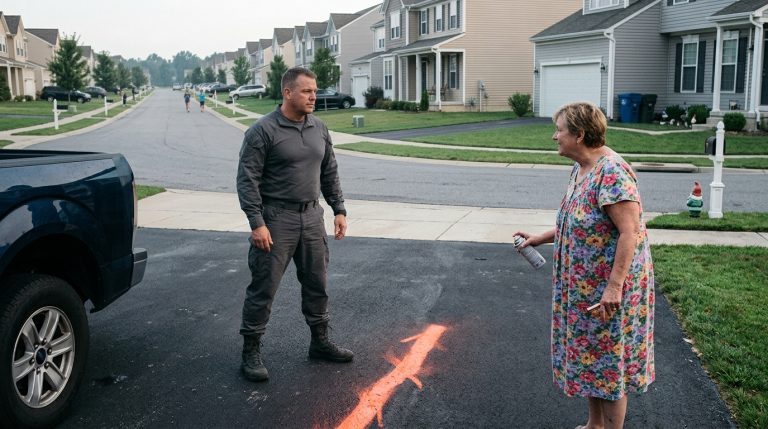
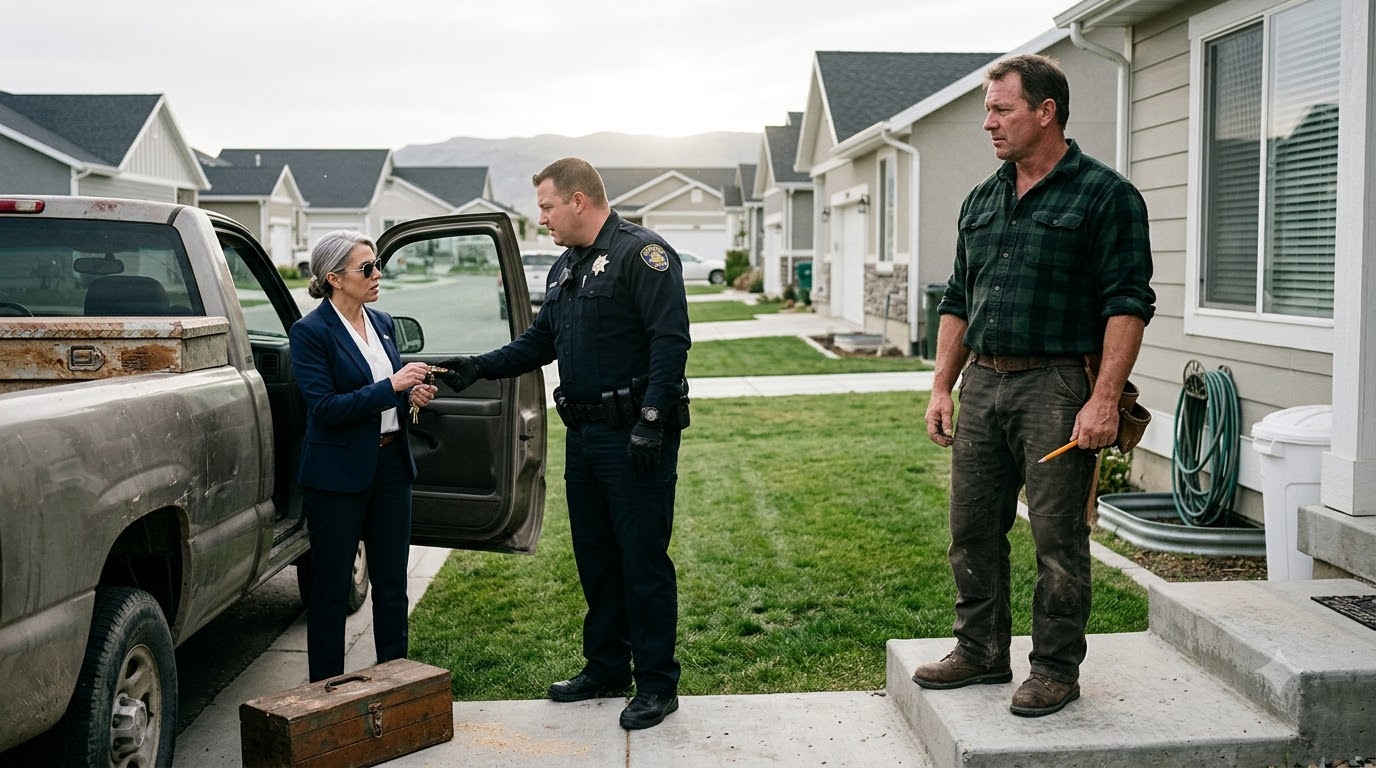
Mara Kensington stood by the fender, her fingers wrapped tight around my ignition ring. Her sunglasses reflected the dull morning light.
Your vehicle is in violation, she said, her voice flat like a grocery list read aloud. I am confiscating these until further notice.
I did not move off the porch step. My boots stayed planted on the concrete.
Those are my keys, I said evenly.
She didn’t blink. She pivoted sharply on her heel, pulling a slim black phone from her pocket with her free hand. Her thumb punched numbers with practiced speed.
Yes, she projected, raising her voice so it carried across the manicured lawns. There is an aggressive male here. He is threatening me.
Across the street, vertical blinds twitched open behind a smudged windowpane. A front door clicked two houses down, then stopped. You could feel the air tighten in the cul-de-sac.
She paced the pavement, feeding dispatch a script born entirely of her own imagination. I stood still, rolling the wooden pencil once more between my fingers.
Sirens started a low, climbing wail three streets over. Mara smiled faintly into the receiver, her posture stiffening like a soldier on parade.
She had no idea who she had just called the deputies on. Or what she had just set into motion.
CHAPTER 2: THE EMPTY HAND
Deputy Morgan stepped out of the lead cruiser first, his heavy boots crunching hard into the asphalt. Behind him, Officer Diaz shut his door with a dull thud.
Mara pivoted instantly, her heels clicking across the concrete as she rushed toward them like a plaintiff seeking refuge.
Thank goodness you are both here, she cried, her voice trembling with manufactured panic. He has been threatening me for twenty minutes straight.
Morgan looked past her shoulder, his gaze locking onto my boots and the toolbox resting by the porch. He didn’t draw a weapon, but his hand rested flat against his utility belt.
Is there a reason you are holding his keys, Mara? Morgan asked, his tone level.
They are in violation of community standard section four, she shot back, holding my ignition ring tighter against her chest. He was being combative the moment I approached.
I leaned my weight against the fender of the truck, keeping my hands empty and visible. I didn’t reach for my pocket. There was no digital video file waiting on a screen this time. The phone remained dark inside the house.
I haven’t moved an inch, I said quietly.
Diaz stepped up beside Morgan, his eyes narrowing as he looked from my calm posture to Mara’s over-projected distress. He glanced at the ground, searching for the hardware she claimed I was brandishing.
Ma’am, Diaz said, his voice dropping into that flat register officers use when they smell a bad call. Where is the weapon you reported?
She blinked, her defense stuttering for a fraction of a second before she doubled down. His attitude is the weapon. He refused compliance.
Morgan exhaled a slow breath through his nose, the morning air turning to mist in the cold shade of the maple tree. He looked at me, recognizing the quiet stillness of someone who had spent decades watching people invent crises out of thin air.
He didn’t ask for my phone. He didn’t ask for a playback. He just stepped forward, extending a gloved hand toward Mara’s locked fingers.
Hand over the keys, Mara. Now.
Her breath hitched, her fingers refusing to uncurl from the brass ring.
CHAPTER 3: THE BROKEN LEDGER
Deputy Morgan watched the movement, his eyes shifting from the dark grain of the billfold to Mara’s clenched fists.
I didn’t open a glowing screen or hold up a digital file. There was no video evidence to save the moment this time.
Give them back, Mara, Morgan repeated, his voice carrying the dry, unyielding weight of an officer who was entirely done arguing with morning theater.
She dropped her hand, the brass ring sliding into Diaz’s palm with a metallic clatter. Her chin stayed high, though a thin sheen of sweat caught the early sunlight near her temple.
This neighborhood has standards, she muttered, backing away toward her porch step. You are enabling a breakdown of order.
The cruisers rolled away down the asphalt, their tires hissing against the damp pavement. The street went quiet again, save for the distant hum of a lawnmower three blocks over.
I walked past the front window and stepped into the dim interior of the house, my thumb hooked in my belt loop. The wooden carpenter’s pencil stayed heavy in my pocket, the graphite dull against the cedar.
A shadow fell across the glass of the side door.
Mara’s husband, Dennis, stood on the porch with a clipboard tucked under his arm, looking like a man carrying an anchor in a rising tide. He didn’t knock, but his knuckles tapped twice against the frame before he pushed it open an inch.
She left the ledger on the community desk, Dennis said quietly, his eyes fixed on the floorboards. The 2024 records.
I stepped closer, leaning against the kitchen counter where the morning light cut through the blinds in thin, dusty stripes.
What kind of records? I asked.
Not maintenance logs, Dennis said, his fingers tightening around the edge of the clipboard. Assessment ledgers. Three homes on our cul-de-sac haven’t paid dues in two years. Yours isn’t one of them.
He slid a folded yellow sheet across the counter. At the bottom, highlighted in orange marker, was a single address that didn’t belong to a neighbor. It belonged to the board president herself.
CHAPTER 4: THE PACKED CLUBHOUSE
By late afternoon, the community room smelled of stale coffee and trapped panic. Folding chairs scraped against the linoleum floor as neighbors filed in, their shoulders hunched against the sudden spring downpour drumming hard on the flat roof outside.
No one sat in the front rows. People clustered toward the back, arms crossed tight over heavy jackets, avoiding eye contact with the empty podium up front.
Mara sat at the side table with her arms glued to her sides, her posture rigid. Her clipboard lay face down beside a plastic cup of water.
I took a seat near the center aisle, resting my palms flat on my knees. The room was heavy with the specific kind of quiet that comes right before a storm breaks open.
Dennis stood near the light switch, his fingers tapping an uneven rhythm against his thigh. He didn’t look at his wife. He looked at the floorboards near the door.
We have an emergency agenda item, Dennis said, his voice bouncing off the cinderblock walls without a microphone. Assessment tracking discrepancies.
A murmur rippled through the middle rows like wind moving through dry grass. A woman three seats down shifted her weight, her nylon windbreaker rustling sharply in the quiet room.
The books haven’t been audited in two fiscal cycles, Dennis continued, his voice dropping an octave. And certain properties flagged for constant code violations are carrying balances that were never processed.
Mara stood up so fast her metal chair screeched against the floor.
This is an internal administrative matter, she snapped, her voice cracking slightly at the edge. You have no authority to present financial summaries outside the board schedule.
Authority isn’t a shield for missing ledgers, Mara, I said from the center aisle.
CHAPTER 5: THE UNRAVELING WALL
Mara stood behind her table, her hands flat on the laminate surface as if she could hold the entire room down by sheer weight of will.
You have no right to question my administration, she spat, her voice tight and trembling with a sudden surge of raw fury. I built this community from the ground up.
Dennis didn’t flinch. He stayed by the light switch, his thumb hooked into his pocket.
You didn’t build it, Mara. You just kept score, he said quietly. And you stopped paying your own dues two years ago.
A sharp intake of breath rippled through the front rows. Neighbors who had spent months avoiding eye contact now leaned forward, their expressions hardening from fear into cold realization.
That is an absolute lie, Mara shouted, her fingers curling over the edge of the clipboard until her knuckles turned white. It’s a clerical oversight by the bank.
It’s right there in the assessment log, I said, stepping into the center aisle. Every fee, every hidden notice, every warning you weaponized against everyone else while your own accounts sat empty.
She turned her anger directly toward me, her eyes flashing with a desperate, trapped defiance. You think you’re clever, don’t you? Coming in here with your quiet routine, acting like you’re above the rules.
Order isn’t control, Mara, I said, my voice steady. And a clipboard doesn’t make you a leader.
She opened her mouth to snap back, but the words caught in her throat as she looked around the room and saw not a single ally willing to meet her gaze.
CHAPTER 6: THE QUIET PORCH
The clubhouse hummed with a heavy, restless energy as the board members turned toward the ballot box.
There was no shouting left in the room, only the dry scrape of pens scratching against paper and the steady rhythm of rain hitting the wide glass windows.
Dennis stood by the side table, his hand resting flat against the wood next to the uncollected assessment ledgers.
The vote is unanimous, Dennis said, his voice carrying clearly across the quiet rows. Mara Kensington is relieved of her position as association president, effective immediately.
Mara did not look up. Her fingers loosened around the crushed plastic cup, letting it drop into the recycling bin with a hollow clatter.
She turned and walked out through the side exit before anyone else could speak, her posture rigid but hollowed out by the sudden, undeniable weight of reality.
The following morning broke clear, the air smelling sharp and clean after the storm.
I stepped out onto the front porch with a ceramic mug of black coffee, my boots quiet against the concrete step.
Across the street, children rode their bicycles past the curb without glancing sideways or checking behind them for a clipboard.
An older neighbor down the row waved a pair of pruning shears in a silent, easy greeting.
Even Mara stood near her front steps, watching the traffic roll by without a binder in her hands.
Authority doesn’t come from fear, I murmured into the cool morning air, wrapping both hands around the warm ceramic. It comes from restraint.
I took a slow sip of coffee, listening to the quiet hum of the neighborhood settling back into its own natural rhythm.