The Iron Gate of Willow Creek: How a Weary Rancher Stood His Ground Against Unyielding Corporate Greed and Built an Enduring Legacy
CHAPTER 1: THE MORNING MUD
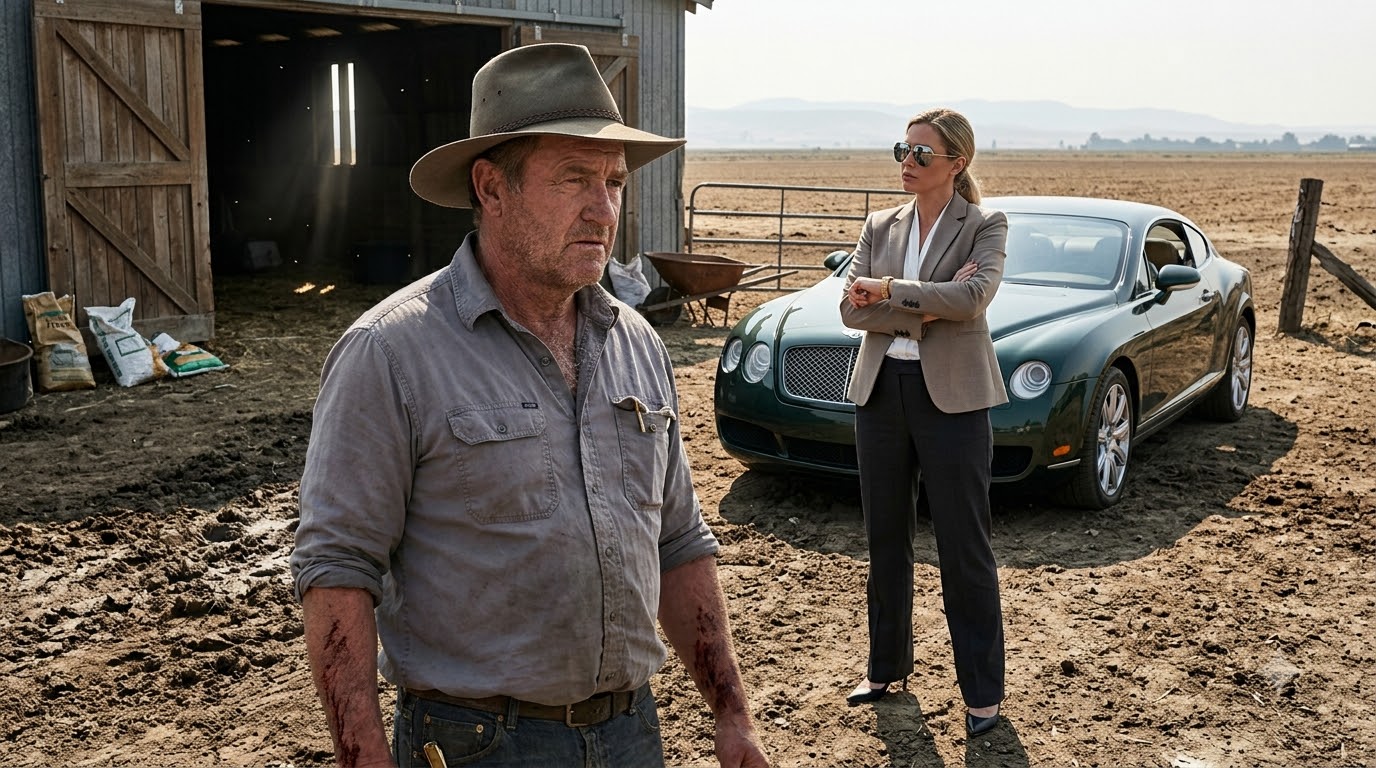
The smell of diesel and damp hay hung heavy in the August air as I wiped the calf’s flank with a rough towel. My forearms were stained dark with blood up to the elbows, the raw evidence of a brutal, botched birth that had cost us a young life. Outside the weathered oak doors of the barn, an immaculate, three-hundred-thousand-dollar Bentley sat angled sideways, its polished chrome catching the pale morning light and mocking the surrounding mud.
Vivven Blackstone stood near the fence line in pristine designer shoes, her arms crossed tight over a tailored blazer. She wore oversized mirrored sunglasses that hid her eyes, though I could feel the sharp, calculated weight of her gaze from ten paces away.
“You’re violating three separate neighborhood ordinances just by keeping that livestock within sight of the access road,” she called out, her voice clear and completely untouched by the morning’s crisis.
I didn’t dignify her with a shout. My boots squelched in the muck as I stepped out of the shadow of the barn door, the heavy brass pocketknife in my pocket digging into my thigh as I clenched my fist around it. My lungs burned with the stale taste of adrenaline and too much cheap coffee, the kind of deep, physical fatigue that only comes from twenty years of working forty acres alone since Sarah passed.
“Move the car, Vivven,” I said, keeping my voice low and flat, stripped of any warmth. “The vet needs to get his truck through to check the mother.”
She tilted her chin up, a thin smile touching the corners of her mouth. “Maybe you should have thought about community property values before letting your animals make such a racket at dawn. The HOA board has already processed your latest fine.”
The county road behind her was empty, the quiet morning stretching out across the valley where my grandfather had laid the first fence posts back in eighty-seven. Behind me, the exhausted cow gave a low, trembling groan from the stall, a sound that cut through the crisp air like a rusted blade. Vivven didn’t flinch; she just checked her gold watch as if waiting for a curtain to rise on a play she had already paid to see.
I reached into my pocket, my thumb pressing hard against the scarred metal casing of the knife until the edges bit into my skin. There were no digital cameras working today to catch her trespass, and my phone battery had died hours ago while I was knee-deep in the straw fighting for the calves. It was just her, her imported steel, and forty acres of dry dirt that my family had bled into long before her foundation was ever poured.
CHAPTER 2: PAPER TRAILS
The cold air from the open back door swept across the yellowed pages of county tax assessments spread out before me. My fingers, still stiff from the morning’s harsh work in the barnyard, traced the faded margins of documents dating back to the late eighties. There were no digital scans to rely on today; every boundary dispute and historical easement had to be verified by hand, line by ink-stained line.
Emma stood by the counter, quietly pouring black coffee into a chipped mug without saying a word. She didn’t have to ask what the legal notices meant; she had watched the bills pile up beside the kitchen sink ever since her mother passed.
“They’re missing the quarterly maintenance logs from ninety-four,” she said, sliding the cup across the laminate surface toward my hands.
“County clerk’s office kept those in the basement archives,” I muttered, taking a slow sip of the bitter brew to clear the dry taste from my throat. “If Vivven’s developers want to claim our southern fence line encroaches on their new subdivision, they have to prove the survey markers haven’t shifted since the initial plat was filed.”
I reached into my pocket and pulled out the scarred brass pocketknife, flipping the blade open with a dull snap to clear a bit of dried mud from my thumbnail. The metallic click echoed sharply in the quiet kitchen, a small, grounding noise that kept my focus steady against the rising tide of frustration.
Outside the window, a lone magpie picked at the gravel near the rusted oil drum by the tractor shed. The silence of the property felt heavy, broken only by the steady hum of the ancient refrigerator in the corner.
“There’s something else in this box, Dad,” Emma said, reaching into the deep cardboard carton that sat between us on the floor.
She pulled out a folded piece of heavy cardstock covered in grease pencil markings and municipal stamps. It wasn’t a family record or a tax bill; it was a discarded municipal planning map bearing the logo of Willowbrook Estates, complete with pre-drawn commercial zoning lines cutting straight through the middle of our hay barn.
The date on the corner stamp was from three weeks ago, long before Vivven had ever filed her first official nuisance citation with the county board.
CHAPTER 3: THE GOLDEN LETTERHEAD
The kitchen window rattled as a sharp gust of late-summer wind swept across the dry fields, carrying the faint, metallic scent of distant rain. A heavy, cream-colored envelope sat squarely in the center of the table beside the municipal map, stamped with gold lettering from a downtown law firm that charged more per hour than I made in a week.
Emma stood across from me, her arms wrapped tight around her waist as she stared at the thick stack of formal demands.
“They’re asking for twenty-five thousand in damages,” she said, her voice dropping to a tense whisper. “Plus an order to tear down the eastern half of the barn before the month is out.”
I didn’t answer right away. I pulled the scarred brass pocketknife from my pocket, flicking the blade open with a sharp snap that cut through the silence of the room. The cold steel felt steady against my thumb as I scraped a speck of dried mud off the edge of the table.
“Paper doesn’t build houses, Emma,” I said, keeping my tone flat and stripped of panic. “And threats don’t change where the property stakes were driven forty years ago.”
The letter was a clear squeeze play designed to finish what Sarah’s hospital bills had started, leveraging legal fees to force a desperate surrender. Vivven Blackstone wanted the land cleared for her developer partners, and she was willing to bury us in court costs to do it.
Outside, the yard remained still, the shadows lengthening across the dirt driveway where our old feed truck sat parked.
“We can’t afford a lawyer who charges like that,” Emma said, her eyes fixed on the gold-embossed seal.
“We aren’t paying for fancy lawyers,” I said, closing the blade with a crisp click that echoed off the cabinets. “We’re going to the county extension office to find someone who knows how to read the old books.”
CHAPTER 4: THE QUIET ALLIANCE
The old pickup bounced down the washboard county road, tires throwing up small clouds of gray dust that settled into the dry grass along the fence lines. Beside me, the cab smelled faintly of stale coffee and sun-baked vinyl, a familiar workspace that hadn’t changed in thirty years.
The county extension office sat behind the municipal courthouse, a low brick building surrounded by overgrown cedar bushes and a parking lot full of dented utility trucks.
I pushed open the heavy glass door, the cool blast of air-conditioning hitting my face after the sticky afternoon heat.
Mrs. Henderson looked up from behind her cluttered desk, her wire-rimmed glasses slipping down the bridge of her nose as she recognized my boots on the linoleum.
“You look like a man carrying forty acres of bad weather, Jake,” she said, sliding a stack of green intake forms across the scarred counter.
“Got a developer-backed HOA president trying to paper-whip us out of the valley,” I said, leaning my palms against the counter’s edge.
She didn’t offer empty sympathy or polite corporate platitudes; she just reached into a metal filing cabinet and pulled out a clean card with a handwritten name scuffed on the back.
“Tom Bradley’s upstairs in room four,” she said, tapping her pen against the laminate. “He handles agricultural protection claims for the state. If anyone can untangle Vivven Blackstone’s legal knots, it’s him.”
CHAPTER 5: THE VELVET TRAP
The pages of the state agricultural statute book rustled dryly as Tom pointed a thick finger at a highlighted paragraph near the bottom. Outside the small second-floor window, the afternoon sun beat down mercilessly on the asphalt, baking the town square into a shimmering haze.
“Vivven’s husband and his development group are heavily overleveraged on the Willowbrook expansion,” Tom said, his voice dropping as he tapped the page. “They need your forty acres cleared out before the bank calls their construction loan due next month.”
I adjusted my grip on the scarred brass pocketknife in my pocket, feeling the familiar cold weight of the metal against my palm.
“She’s been weaponizing the neighborhood board to squeeze us out piece by piece,” I said, leaning closer over the metal desk.
“More than that,” Tom replied, folding his arms. “Her online posts are whipping up local complaints about health and zoning inspections, hoping to drain what little cash you have left.”
The phone on his desk buzzed sharply, breaking the heavy silence of the room.
Tom glanced at the screen, gave a dry huff, and slid a fresh printed complaint across the metal surface toward my hands.
“Just came down from the county health inspector,” he said flatly. “Anonymous tip about commercial runoff from your barn. They’ll be out at dawn tomorrow.”
CHAPTER 6: THE IRON VERDICT
The diesel exhaust rolled out across the wet gravel as the sun began to edge over the eastern tree line. Deputy Martinez stood near the open door of his cruiser with his body camera blinking a steady red, while Doc Martinez idled his veterinary truck right behind him.
Vivven Blackstone stepped out from her paved drive in another immaculate designer suit, her arms folded tight as she marched straight toward my tractor.
“You’re violating county emergency rules by blocking the subdivision access,” she snapped, her voice piercing the morning air.
I didn’t turn off the engine. I reached into my pocket, my thumb resting against the scarred brass pocketknife while my right hand gripped the heavy steel gear shifter.
“Federal easement, Vivven,” I shouted down over the roar of the diesel. “Section D gives us every right to clear an obstructed path.”
Her face flushed a deep, violent crimson as she stepped directly in front of the massive rubber tire, refusing to yield an inch.
“You wouldn’t dare touch this car,” she screamed, her composure cracking completely as she pointed a manicured finger at her imported sedan.
Deputy Martinez stepped forward, his voice carrying clearly across the yard. “Maam, you are standing in a designated agricultural zone blocking lawful operations. Move aside or assume full liability.”
She didn’t move, her jaw clenched in stubborn fury as she tried one final, desperate bluff to hold her ground.
I pushed the clutch down, eased the heavy machine forward, and let the steel blade meet the polished chrome fender with a heavy, grinding crunch that echoed down the valley.
Vivven shrieked and scrambled backward out of the muck as her expensive vehicle was shoved aside like a broken toy.
The county committee blocked her development permits by noon, and her overleveraged mortgage collapsed under the weight of the resulting legal fines within the week.
Back in the quiet kitchen that evening, the smell of fresh coffee replaced the dust of the old disputes, and Emma sat across the table sorting through college catalogs without a single worry on her mind.