A Cold Perimeter: One Man’s Defiance Against a Suburban Machine Designed to Erase His Only Legacy
CHAPTER 1: THE PORCH ENCOUNTER
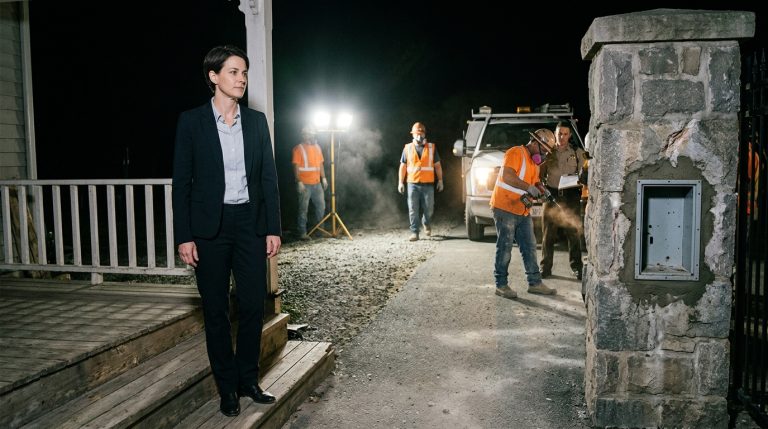
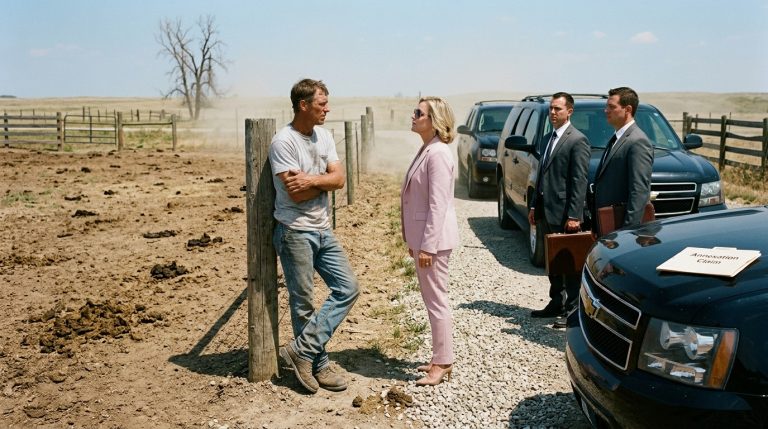
The woman in the gray suit stood on my porch like she was auditioning for a role that didn’t exist in this ZIP code. Her posture was razor-sharp, a stark contrast to the sagging cedar planks beneath her heels. Behind her, the two men in dark windbreakers mirrored her silence, their eyes scanning my property not with curiosity, but with the flat, predatory detachment of appraisers.
“We’ll see who has the right,” she said.
Her voice was polished, a smooth, manufactured sound that felt invasive in the quiet of my woods. She smiled, but the expression didn’t travel past her mouth—it was a practiced shape, the kind meant to disarm rather than comfort. She held a glossy folder toward me, the edges catching the morning light like a blade.
I didn’t take it. I leaned against the doorframe, feeling the familiar, grounding splinter of the wood against my palm. “You’re standing on private property, Alice. And you’re trespassing on a conversation I never started.”
She didn’t flinch. She just adjusted the folder, her gloved fingers pressing into the paper with a precise, calculated pressure. “Maple Ridge is expanding, Mr. Sloan. We’ve mapped the most efficient corridor to the highway. It happens to be your woods.”
The audacity was so cold it almost made me laugh. I looked past her, toward the tree line where the sunlight struggled to pierce the thick canopy of oaks my grandfather had protected for decades. Those trees were anchors, living history that didn’t know how to negotiate with a zoning committee.
“My land isn’t for sale,” I said, keeping my voice low, stripping away the urge to shout. “Not for the pittance you’re likely hiding in that folder, and not because you’ve decided my life is an inconvenience to your commute.”
Alice tilted her head, the motion fluid and rehearsed. “Everything has a price, Aiden. Usually, it’s just a matter of timing.”
As she spoke, I caught a flicker of movement near the edge of the woods—a glint of something metallic, hovering just above the brush line. A drone. It was barely a whisper in the wind, but it was there, watching, recording.
A sudden, sharp headache pulsed behind my eyes. I looked down at the ground near the porch steps. The soil there was dark, strangely damp despite the week of dry heat, and that chemical tang hit me again—a metallic, biting scent that made the air feel thin. It wasn’t the smell of nature. It was the smell of something rotting, buried just deep enough to pretend it wasn’t there.
Alice noticed my gaze, her smile shifting just a fraction, a shadow of something more dangerous crossing her face.
“We’ll see,” she repeated, turning on her heel.
As they walked back toward the manicured perfection of their development, I felt the silence of the woods return, but it was heavy now—unsettled. I stepped off the porch and walked to the spot where they had been standing. My boots sank into the earth, and I realized with a sudden, sinking dread that the soil didn’t just smell wrong; it looked oily, shimmering with a sickly, iridescent sheen that defied the morning light.
They weren’t just here for a road. They were hiding something, and they needed me gone to bury it.
CHAPTER 2: THE FIRST BREACH
I didn’t move for a long time. The silence that followed Alice Strange’s exit was not the peaceful, rhythmic quiet of the woods I’d known for years. It was an absence. The birds, usually raucous and territorial in the early morning, had gone completely mute. Even the wind seemed to hesitate, snagging on the canopy above like it was afraid to touch the ground near the porch.
I crouched lower, my knees popping in the quiet. I reached out a gloved finger—a heavy, nitrile work glove I used for soil sampling—and touched the iridescent oil. It didn’t behave like water. It was viscous, dragging against the soil, refusing to soak in. Beneath the oily film, the earth had a sickly, grayish pallor, as if the life had been leached out of it by an invisible current.
“What are you hiding?” I whispered to the dirt.
My voice sounded small, thin against the sheer scale of the three hundred acres behind me. I stood up, my muscles tight with an instinctual, sharp-edged alertness I hadn’t felt in years. The Predator-Prey lens clicked into place. If they were marking my land for a road, they were doing it with an arrogance that suggested they didn’t expect me to look closely at the ground. They expected me to look at the paperwork, the glossy maps, the legal threats. They didn’t expect a biologist.
I walked to the edge of the porch, my eyes sweeping the boundary line. The orange “Authorized Personnel” markers were still there, hammered into the soft, loam-rich earth. They looked like fresh wounds. I marched to the nearest one and yanked it out. The ground here, only thirty yards from the house, felt different—tighter, somehow. I pulled a small trowel from the pocket of my work pants and began to dig.
I didn’t need a lab to know something was fundamentally broken. Five inches down, the dirt turned black, a deep, synthetic, ink-like stain that clung to the trowel. A sharp, stinging odor—acetone mixed with something stagnant—wafted up, stinging my eyes. I froze, my breath catching in my throat.
This wasn’t runoff. This was industrial waste.
I heard the whine before I saw it. A low, electronic buzz, oscillating in pitch as it cut through the dense oak branches. The drone was back.
I dropped the trowel and stepped back, retreating under the shadow of the porch eaves. The drone didn’t move toward the house; it hovered directly over the spot where I had just disturbed the soil. It was a predator watching its prey move, a calculated, unblinking eye. My heart hammered against my ribs, a dull, thudding rhythm that matched the pulsing in my temples.
They weren’t just surveying. They were monitoring the contamination.
I turned and ducked inside the house, the screen door snapping shut with a sharp, familiar crack. I didn’t lock it—locking a door was for people who thought they were safe inside. I went straight to my office, a room cluttered with topographical maps, soil survey logs, and the lingering scent of stale coffee and old paper.
I pulled out the county survey map I’d annotated the day I inherited the land. I laid it over the desk, my hands steadying as I pressed my palms against the edges. I needed to map the perimeter of the scent. If the contamination was originating from Maple Ridge, there had to be a point of ingress, a drainage line or a buried pipe that had failed.
I grabbed a red marker. My mind raced, calculating the slope of the land, the natural drainage patterns toward the creek bed that cut through the lower third of the property. If they were dumping here, they had to be using the topographical low points to mask the movement of the material.
The phone on my desk rang—a sharp, aggressive sound that cut through the silence of the house. I let it ring. It would be them, or someone representing them, checking the progress of their little experiment.
I picked up the receiver and held it, listening to the monotone chime. I didn’t say hello. I just waited. The caller hung up after four rings. They were testing the waters, checking for a reaction, or perhaps confirming that I was home and watching.
I pushed the phone away and looked back at the map. The “road” they wanted—the “direct corridor to the highway”—wasn’t just a path. It was a cover. A fifty-meter wide strip of land would provide them with a massive, cleared construction zone where they could dig, bury, and pave over the evidence of their negligence.
The realization sat in my gut like lead. It wasn’t just a land grab. It was a crime scene. And I was the only witness.
I walked to the window, peering through the gap in the blinds. The drone was still there, a tiny, buzzing insect against the vast expanse of the morning sky. I looked at the tools on my workbench—the cameras, the sensors, the notebooks. I had spent my life studying the life cycles of flowers, the quiet, slow growth of an ecosystem. Now, I would have to use that same precision to map a death.
I reached for my field kit, packing the essentials: pH test strips, a handheld GPS, and a digital camera with a high-zoom lens. I wasn’t just a biologist anymore. I was a surveyor of secrets.
I stepped out the back door, moving into the tree line, staying under the heavy shadow of the oaks. I had to reach the drainage point before they decided to “sanitize” the area. The ground felt different beneath my boots now—not just soil, but a liability. Every step was a calculation, every shadow a potential camera. I moved with a deliberate, slow-motion grace, mapping the path of the oily sheen, tracing the line of least resistance, following the evidence straight toward the heart of their lie.
CHAPTER 3: THE PAPER TRAIL
The walk back to the house felt longer than the trip out. Every shadow cast by the oaks seemed deeper, the branches knitting together to form a canopy that felt less like a protective shelter and more like a cage. My lungs burned—not from the exertion, but from the adrenaline still coursing through my system, the fight-or-flight response stuck in a permanent, grinding loop. I kept my field kit clutched against my chest, the glass vials containing the tainted soil samples rattling against each other like dice in a cup.
When I reached the back door, I didn’t stop. I walked straight through the kitchen, the linoleum cold beneath my boots, and back into the office. I didn’t turn on the overhead light. The room was bathed in the harsh, blue-white glare of my laptop screen, which had remained open, glowing like an altar to the chaos consuming my life.
I sat down and pulled the files I’d received earlier that afternoon from the private investigator, Marcus Thorne. They had been sitting on my desk, an unopened manila envelope that now felt like a detonator. I ripped the clasp open and dumped the contents out. Photographs. Documents. A thin stack of printed emails.
My hands trembled slightly as I spread them across the desk. Thorne was thorough. He hadn’t just tracked the HOA; he’d tracked the contractors. There were photos of men in high-visibility vests meeting in the back lot of a local diner, heads bent low, exchanging thick envelopes. Another photo showed a black sedan, registered to a shell company in the city, parked idling near the drainage culvert that fed into the lower reaches of my forest.
I flipped to the emails. They were internal—stolen, likely, or leaked—correspondence between the HOA board members.
“Cost-effective solution,” one of the board members had written, referring to the “corridor project.” “The Sloan property offers the natural filtration we need. We don’t have to deal with the EPA if we process the runoff through the low-lying wetlands before the state audit.”
My breath hitched. They weren’t just building a road. They were using my land’s natural ecosystem as a biological filter for whatever toxic sludge was leaking from their poorly maintained drainage systems. If they could get a legal easement for the “road,” they would have a permanent, state-sanctioned way to dump their runoff into my woods, and I wouldn’t be able to say a word without risking the entire project being tied up in court for years.
The cynicism was staggering. It wasn’t about the road. The road was a shell, a convenient legal cover for the ultimate act of suburban convenience: offloading their environmental sins onto the guy who lived next door and didn’t have the legal budget to fight back.
I reached for the phone, my thumb hovering over the speed dial for Thorne. He answered on the first ring, his voice low and professional.
“I have the samples, Marcus,” I said, my voice sounding raspy, unfamiliar. “And I have the link. It’s not just a road. It’s a filtration system. They’re dumping runoff into the wetlands.”
“I thought that might be the case,” Thorne replied. His tone was calm, a sharp contrast to the churning nausea in my stomach. “I’ve been digging into the permit history of Maple Ridge. Their main drainage system is twenty years overdue for an upgrade. It’s failing, Aiden. Every time it rains, they’re pumping millions of gallons of untreated waste into the surrounding ecosystem. They need somewhere to put it that isn’t their own property.”
“So they kill mine instead.”
“It’s a pattern,” Thorne said. “I’ve found three other instances where this shell company, ‘Apex Development,’ used similar tactics. They identify a ‘buffer zone’—usually an individual property owner—and pressure them into an easement. Once the easement is signed, they start the ‘construction.’ By the time the state figures out the drainage levels are off, the land is already too degraded to support a claim.”
I looked at the map again, tracing the red lines I’d drawn. The road was designed to cut right through the most sensitive part of the forest, the area where the endangered wild flowers bloomed. If they destroyed that, they destroyed the primary reason the land held protected status in the first place.
“They’re not just taking the land, Marcus. They’re dismantling the evidence,” I said.
“Which means you have to be the evidence,” Thorne replied. “Don’t go to the police yet. If this is tied to the board, they’ll have someone on the inside. You need to gather enough proof to make it impossible for them to suppress. I’m sending over a contact in the state environmental office. Don’t mention the HOA. Don’t mention the road. Just tell them about the soil runoff.”
I hung up, the silence of the office pressing in on me. I looked at the window. The drone was gone, replaced by the deep, indigo darkness of twilight.
I leaned back in my chair, the wood creaking beneath me. I was tired—a deep, marrow-level exhaustion—but the clarity was starting to settle in. They wanted a fight. They wanted to wear me down, to make me so tired that I’d take the money and disappear. But they had made a mistake. They thought I was a hermit who kept to himself. They didn’t realize that in this forest, I was the one who noticed every leaf, every change in the water, every shift in the wind.
I turned to the drawer of my desk and pulled out a small, handheld recorder. I had been documenting the bird calls for years. Now, I hit ‘record’ and began to speak, dictating everything I had seen, every detail I had documented, and every suspicion I held.
If they wanted a war, I would give them one. And I would make sure that when the dust settled, it wouldn’t be my forest that was buried. I stood up and walked to the door, checking the lock—a gesture of defiance more than security. I was awake now. And for the first time in my life, the silence of the woods didn’t feel like a comfort. It felt like a countdown.
CHAPTER 4: THE DECOY LEDGER
I didn’t sleep. The hum of the computer fan and the periodic, rhythmic scratch of the drone circling somewhere in the distance kept my nerves frayed, tight as a piano wire. When the first gray light of dawn bled through the blinds, painting the room in sickly, washed-out tones, I was still sitting at the desk. My coffee had gone cold hours ago, a dark, stagnant pool in the mug.
I reached out and pulled the manila envelope back toward me. If Marcus was right, and this was an orchestrated campaign by Apex Development, there had to be a paper trail—not just for the road, but for the money.
I sifted through the copies of emails again, my eyes scanning for names, dates, or signatures I might have missed in the frantic hours of the night. Then, I found it. Tucked into the back of a folder labeled “Phase 4 Expansion: Logistics” was a single, photocopied page from a ledger. It was handwritten, scrawled in hurried, jagged ink. It wasn’t an official document; it looked like a field note.
The columns were marked: Drainage Maintenance, Site Remediation, Buffer Acquisition.
Beside “Buffer Acquisition,” there was a series of numbers—latitude and longitude coordinates that pinned directly to the creek bed on my property. But it was the note scribbled in the margin that stopped my blood cold: Level 3 alert. Capacity exceeded. Immediate rerouting to sector 4 required to avoid regulatory inspection.
My finger traced the ink. Sector 4. That was my forest.
The realization hit me with the force of a physical blow. They weren’t just using my land as a filter; they were actively dumping the excess of their failure into it. They had reached “capacity” at their own site, and instead of calling a specialized waste management team—which would have cost a fortune and invited the EPA’s scrutiny—they had decided to use my grandfather’s forest as a cheap, hidden dumping ground.
The road was the decoy, a perfectly legal reason to clear-cut and dig up the land, allowing them to bury the evidence of their toxic spill under the guise of “construction debris.”
I grabbed my camera and focused the lens on the ledger entry, snapping a series of crisp, high-resolution photos. I needed to know if this was just a projection of their greed, or if it was already happening at the scale they were describing.
I stood up, the chair scraping sharply against the hardwood floor. I moved to the equipment locker by the back door, pulling on my heavy, mud-caked boots. I didn’t reach for the shovel this time. I reached for the laser rangefinder and the pH testing kit. If they were rerouting to Sector 4, there would be a physical bypass—a valve, a pump, or a modified culvert that didn’t appear on any of the original site plans.
I stepped out into the morning air. The forest was waking up, but the usual birdsong was disjointed, hesitant. I walked toward the creek, moving with a deliberate, low-profile gait. I avoided the trails, stepping on stones and fallen logs to leave as little trace as possible.
I reached the creek bed, the water running thin and sluggish over the mossy rocks. It looked clear, but as I crouched at the edge, the smell hit me—the same sharp, synthetic bite from the day before, only stronger. I held the pH strip to the surface of the water. Within seconds, the paper turned a deep, bruised purple. It was highly alkaline.
Too high.
I followed the creek upstream, my eyes scanning the banks for anything out of place. About fifty yards up, hidden behind a dense screen of wild rhododendrons, I saw it: a section of black, corrugated pipe, partially buried in the bank, half-hidden by a deliberate heap of loose branches and soil.
I climbed down the bank, my boots slipping on the slick, oily mud. I shoved the branches aside, my pulse drumming in my ears.
There, protruding from the bank, was a makeshift outfall pipe, fitted with a heavy-duty, modern valve. It was rigged with a crude, battery-operated pump, humming with a low, barely audible vibration. It was pumping water from somewhere behind the Maple Ridge boundary directly into my creek.
I froze. My camera hung around my neck, the weight of it pulling at my skin. I didn’t reach for it. I stared at the valve, at the rust-colored stains bleeding into the soil around it, and at the way the surrounding ferns were already yellowed and dying.
The decoy secret—the road—was a masterstroke. It was so big, so obvious, that I had been looking at the wrong threat. I had been looking at the property line, the legal notices, the corporate intimidation. I hadn’t been looking at the physical infrastructure of the crime.
I heard a twig snap on the bank above me.
I didn’t turn around. I stayed completely still, my hands hovering over the valve. The drone’s hum seemed to intensify, shifting from a background buzz to a sharp, aggressive whine, like a wasp trapped in my ear.
Someone was watching me. Not from the sky, but from the trees.
I slowly reached for the camera, my fingers wrapping around the grip. I had the ledger entry, and now I had the source. The truth was no longer just a suspicion; it was a physical fact. And whoever had put that pipe there knew that I had found it.
The silence of the woods returned, deeper than before. I counted my breaths, keeping my eyes fixed on the muddy bank. The game had shifted. I wasn’t the one being observed anymore; I was the one who had walked into the trap. And I realized, with a cold, clear focus, that the only way to get out of it was to keep moving.
CHAPTER 5: THE SIEGE
I didn’t scramble. I didn’t run. I pressed my back against the damp, slick earth of the creek bank, pulling the rhododendrons tighter around my shoulders. My heart was a frantic bird against my ribs, but my hands—my hands were rock-steady. I knew this land. I knew the hollows, the way the sound carried through the valley, and the blind spots where the canopy was thickest.
Above me, the crunch of boots on dry leaves moved slowly. Not a sprint. A patrol. They were looking for the source of the vibration, or perhaps just ensuring the valve was still hidden.
I stayed motionless, my breathing shallow, my eyes tracing the slope toward a dense thicket of old-growth bramble thirty feet away. I waited for the rhythm of the boots to change, for the hesitation that signaled a target in sight. Ten seconds passed. Twenty.
The person above stopped. I could hear the sharp exhale of someone lighting a cigarette—a thin, acrid plume of blue smoke drifted down, cutting through the damp scent of the mud.
“Nothing here,” a voice muttered. It was low, muffled by the distance, but distinctly impatient. “The pump’s running fine. The sensor must be glitching again.”
“Check the valve housing,” another voice replied, closer.
I looked at the pipe, at the valve I had just exposed. I had seconds. I reached out and carefully, agonizingly slowly, moved the pile of branches back over the valve. My movements were calculated, mirroring the natural debris flow of the creek. I backed into the shadows of a large, rotting oak stump, pressing myself into the crevice between the roots.
The footsteps moved closer, the weight of a man shifting the earth just above my head. I could see the tip of a black tactical boot dangling over the edge of the bank. Then, silence.
I felt a sudden, sharp intrusive thought: my grandfather, years ago, standing on this very spot, explaining how a healthy creek was the pulse of a forest. You take care of the water, Aiden, and the water takes care of you. The memory was a sudden, freezing contrast to the reality of the toxic sludge currently humming through that pipe. The dissonance was almost enough to make me shudder, to break the stillness that was my only defense. I pushed the memory down, locking it away behind the same cold, rational wall I used for my field research. There was no room for ghosts right now. There was only the physics of survival.
The man above kicked at the dirt, sending a cascade of pebbles tumbling down. They bounced off the pipe, a hollow, metallic clink that echoed like a gunshot in the confined space.
My breath hitched.
“Just debris,” the man said. “Let’s get back to the perimeter. The drone’s picking up some movement near the main gate. Sloan’s out there.”
They retreated, the sound of their boots fading into the distance, eventually replaced by the distant, muffled engine of a truck. I didn’t move for another ten minutes. I waited until the forest returned to its natural state—the rustle of a squirrel, the distant caw of a crow. Only then did I ease out of the roots, my joints aching from the tension.
I scrambled up the bank, emerging back into the light. I felt exposed, vulnerable, like a specimen under a microscope. I needed to leave. I needed to get the data to Thorne, to the environmental contact, to anyone who could force an intervention before they moved to the next stage of their “construction.”
When I reached the edge of the woods, I stopped.
My gate was standing open. The orange markers I had pulled up were back in the ground, and in the center of the driveway, sitting in the middle of a fresh, meticulously raked patch of gravel, was a stack of legal documents.
They weren’t mailed. They weren’t served. They were displayed, a warning left in plain sight.
I walked toward them, my boots crunching loudly on the gravel. I reached the papers and saw the header: Injunction for Trespass and Interference with Authorized Development.
They weren’t just reacting to me. They were weaponizing the legal system to define my own land as a restricted zone. The document included a map—a digital, high-resolution rendering of my property, with a red polygon drawn around the creek bed where I had just been standing.
They knew.
The drone’s hum returned, louder this time, hovering directly above my house, a black, mechanical eye staring down at me. I stood there, the wind whipping the paper against my leg, and for the first time, the “pragmatism” I’d relied on felt like a thin, fraying thread. They were escalating, moving from surveillance to legal siege. They were going to suffocate me in paper, force me into a battle of attrition where every legal filing cost a thousand dollars I didn’t have, and every day I fought was another day they could continue the dumping.
I walked to the house, entered, and locked the door behind me. I didn’t look at the files again. I went to the wall where I kept my grandfather’s old surveyor tools—the transit, the tripod, the brass compass. I picked up the heavy compass, its cold metal surface biting into my palm.
I had been playing by their rules—the rules of the law, the rules of evidence, the rules of the civilized world. But they weren’t playing by those rules. They were using the law as a front to facilitate a crime.
I looked at the drone on the monitors, its camera feed cutting in and out as it circled. I walked over to the closet, pulled out a heavy, multi-layered signal jammer I’d built for remote wildlife sensing, and flipped the switch.
The screen in front of me flickered and died. A sudden, sharp silence returned to the office—the electronic whine cut off, leaving only the sound of my own pulse.
I didn’t feel safe. I felt dangerous. I pulled out my phone and dialed Thorne. “Marcus,” I said, my voice steady, stripped of the fatigue. “The injunction is just a distraction. They’re using the legal process to secure a perimeter. We don’t have time for the state environmental contact. We need to go public, and we need to do it now. If they want to treat this land like a dump, I’m going to make sure the whole world sees exactly what they’re throwing into it.”
The line was quiet for a heartbeat. “That’s a point of no return, Aiden. Once you cross that, they’ll stop the legal games and start the real ones.”
“They already have,” I said, looking out the window at the empty, silent sky. “Let them come.”
CHAPTER 6: THE HIDDEN TRUTH
The loss of power wasn’t a flicker—it was an erasure. One moment, the monitors were glowing with their steady, green-lit diagnostic data, and the next, the entire house was plunged into a suffocating, heavy ink. I stood in the center of my office, the smell of ozone and burnt plastic hanging in the air. Someone hadn’t just jammed the signal; they had physically severed the feed.
I didn’t reach for the light. I knew where everything was in this room by touch alone. I moved to the wall, my fingers brushing the cool, rough plaster, and gripped the heavy brass compass I’d set on the shelf. It was a heavy, reassuring weight, a remnant of a time when the world was measured by land and sun, not data packets and remote access.
I heard it then—the crunch of gravel under heavy tires, moving slowly up the drive. No headlights. They were coming in the dark, confident in their invisibility.
I didn’t wait to be found. I stepped out of the office and moved through the house, keeping to the shadows. The floorboards, which usually groaned under my weight, were silent, each step calculated to distribute my pressure. I reached the mudroom and slid the heavy bolt of the back door, slipping out into the night. The air was colder now, biting and sharp, and the sky was a featureless, starless vault.
I reached the tree line and stopped, pressing myself into the jagged bark of an old oak. A pair of silhouettes moved toward the house. They weren’t moving with the hurried aggression of a raid; they moved with the practiced, predatory calm of an eviction. They were carrying heavy-duty tool bags and long, metallic canisters. They were here to “remediate”—to finish what the pipe had started and bury the last of the evidence.
I felt a surge of cold, razor-edged clarity. They thought I was inside, terrified and waiting for them to break down the door. They didn’t know I was watching them from the periphery.
I moved along the perimeter, circling toward the creek. If they were heading for the valve, they would be distracted by the task of rerouting the flow. I reached the creek bank, the mud pulling at my boots, and navigated the familiar path I’d scouted only hours ago.
When I reached the rhododendrons, I stopped. The area around the pipe was illuminated by a single, powerful floodlight, mounted on a tripod. It cast long, grotesque shadows that danced against the dying ferns. Two men were there, their faces obscured by dark, form-fitting headlamps, working the valve with heavy wrenches.
“The state inspectors are coming on Monday,” one of them said, his voice carrying clearly over the sound of the running water. “The HOA president said the Sloan property needs to be ‘sanitized’ before then. We’re pushing the load into the sub-strata. It won’t show on the surface readings.”
My hands tightened on the compass until the metal bit into my skin. Level 3 alert. It wasn’t just a leak. It was a surge. They were pumping the entirety of the failure into the bedrock, effectively poisoning the groundwater for everything downstream.
I looked at the tripod holding the light. I looked at the loose, precarious earth of the bank, and then at the rusted valve. If I could cause a structural failure, if I could trigger a collapse of the bank, the weight of the soil would crush the pipe, forcing the flow back into their own system.
It was a gamble—a reckless, violent intervention that flew in the face of everything I believed about protecting this forest. But there was no “pragmatism” left. There was only the defense of the roots.
I grabbed a heavy, discarded branch—a thick, hardened limb—and waded into the creek, staying in the shadow of the bank. I circled behind the floodlight. I could see the men’s hands, the way they gripped the wrenches. I waited for the lead man to lean in, to commit his weight to the valve.
I didn’t shout. I didn’t announce myself. I moved with the silent, decisive force of a storm.
I swung the branch, not at the men, but at the tripod. The light shattered with a violent, electric pop, showering the creek in sparks.
The bank disintegrated.
The vibration of the impact, combined with the unstable, water-logged earth, triggered the collapse. A massive shelf of the bank—the one the men were standing on—gave way, sliding into the creek with a sound like a tearing mountain. The men scrambled back, shouting, their headlamps spinning in the dark.
The pipe didn’t just bend; it snapped. The pressurized rush of the toxic flow, suddenly deprived of its outlet, buckled inward, the force of the earth slamming it into the bedrock. There was a sickening thud of shifting weight, followed by a low, guttural moan of collapsing soil.
The bank settled, sealing the pipe completely beneath tons of wet, heavy clay.
The men backed away, their flashlights frantically scanning the dark. I didn’t wait. I retreated into the trees, moving with the speed of an animal. I didn’t look back to see if they’d seen me. I kept running, my lungs burning, the taste of dirt and cold fear in my mouth.
I reached the house and ducked into the cellar, the one place they wouldn’t think to look—the original stone foundation my grandfather had laid. I sat in the dark, listening to the men scrambling in the woods, their voices angry and confused, echoing off the trees.
I pulled out my phone. The signal was back, the bars flickering on the screen. I opened the folder containing the photos of the ledger, the photos of the pipe, and the video of the bank collapse. I hit “Send” to the state environmental agency, then to the local paper, and finally, to Thorne.
The house grew quiet. The searchers were moving further away, their voices fading into the rustle of the wind.
I leaned my head against the cool, damp stone of the foundation. The forest was still breathing. I could feel it through the soles of my boots—the vibration of the earth, the slow, persistent pulse of the soil. It was bruised, damaged, and struggling, but it was still mine. I closed my eyes, the cold stone grounding me, and waited for the night to end. The war wasn’t over, but the terrain had finally shifted. And for the first time, I knew I wouldn’t be the one losing ground.
CHAPTER 7: THE COURTHOUSE CONFRONTATION
The courtroom air was thin, recycled, and carried the faint, antiseptic tang of furniture polish—a sharp contrast to the damp, earthy reality of the forest I had just left. I sat at the mahogany table, my hands resting on the scarred leather of my briefcase. My blazer felt stiff, the fabric pulling at my shoulders, and the weight of the evidence inside—the ledger photos, the soil reports, the GPS coordinates of the destroyed pipe—felt like an anchor.
Alice Strange sat across the aisle. She was immaculate, her gray suit pressed to a knife-edge, her expression one of polite, slightly bored detachment. She didn’t look like a woman who had spent the night watching her cleanup crew fail. She looked like a woman waiting for a board meeting to conclude.
The judge called the room to order, his voice a dry, rasping sound that barely carried over the hum of the ventilation.
“Counsel, you may present your opening arguments,” the judge said.
My lawyer, Ben, rose slowly. He didn’t look at the jury; he looked directly at Alice. He began to lay out the case, not with the dry recitation of property law, but with the raw, structural reality of the threat. He spoke of the drainage failure, the Apex Development shell company, and the systematic poisoning of the land.
Alice’s attorney stood, his face a mask of practiced indignation. “Your Honor, this is irrelevant. Mr. Sloan’s land is the subject of a standard development easement. The ecological claims are speculative at best, and frankly, a desperate attempt to stall a legitimate community expansion.”
I watched Alice as he spoke. She didn’t blink. But I noticed something: her hand, resting on the table, was pressed down with such intensity that her knuckles had turned a pale, bloodless white. She was holding on to the narrative of the ‘road’ with everything she had, because if that narrative broke, the truth—the toxic dumping ground—would be exposed in full.
Ben stepped up to the podium, his demeanor shifting from formal to urgent. “Your Honor, we have more than speculation.”
He pulled the ledger entry from the file. He handed a copy to the judge, and another to Alice’s attorney. “We have the board’s own internal records, detailing the rerouting of untreated toxic waste into Sector 4 of the Sloan property, dated to exactly three days before the initial easement request was served.”
The courtroom went quiet. The air seemed to leave the room.
Alice turned her head slowly, looking at the ledger copy. For a fleeting second, the mask slipped. Her eyes, usually cold and calculating, darted toward the side door, toward the exit—a brief, involuntary movement of a trapped animal realizing the cage had finally been opened.
“This is forged,” she said, her voice sharp, cutting through the silence. “A complete fabrication.”
“Is it?” Ben asked, stepping closer to her table. “Because we also have the state inspector’s preliminary report, filed this morning, regarding the structural collapse of a clandestine bypass pipe located on the plaintiff’s property.”
I leaned forward, my pulse thudding in my ears. This was the moment. The decoy—the road—was collapsing, and with it, the entire infrastructure of their deception.
The judge looked at Alice, his gaze heavy and skeptical. “Ms. Strange, is there an unauthorized pipe on the Sloan property?”
Alice stood up, the chair scraping against the hardwood with a sound like a scream. “The HOA is responsible for the integrity of the Maple Ridge infrastructure. We were merely mitigating a potential flood hazard!”
“By burying a bypass pipe and dumping waste into the sub-strata?” Ben pressed.
“I have done nothing that wasn’t in the interest of the community!” Alice snapped, her composure shattering. She wasn’t talking to the judge anymore; she was defending her own existence. “If I hadn’t managed the capacity, the entire development would have flooded! I saved those people! I saved their investments!”
The courtroom erupted. Whispers rippled through the gallery—Maple Ridge residents sitting in the back, their faces twisting from confusion to horror as the implication of her words landed. They weren’t protecting a road; they were protecting their own property value, built on the foundations of a toxic dump.
Alice looked around, her eyes wide, searching for an ally, a loophole, a legal pivot. But there were none. She looked at me, her gaze locking onto mine, and in that moment, I saw the truth of her: she was just as afraid as I was, just as desperate, just as lost.
She turned back to the judge, her voice trembling. “It’s not what it sounds like. It was a temporary solution. We were going to fix it. We just needed time.”
“Time you bought with fraud,” the judge said, his voice cold. He turned to the clerk. “Bailiff, please ensure the defendant remains in the courtroom. We are going to recess for ten minutes, after which I want a full accounting of all Apex Development contracts.”
Alice didn’t sit down. She stood, swaying slightly, as the lawyers crowded around her. I remained in my chair, the weight of the evidence finally sliding off my shoulders. I felt hollowed out, empty, as if the last few weeks had been a marathon of adrenaline that had finally left me at the finish line with nothing left to burn.
I looked at the courtroom—at the lawyers, the judge, the angry residents—and I felt a strange, quiet distance. The mystery was gone. The secret was out. But the land, my forest, was still there, waiting for me to come home and start the long, slow work of repair.
CHAPTER 8: THE QUIET AFTERMATH
The courtroom didn’t erupt with a shout; it dissolved into a hum of frantic activity. Alice Strange’s final move was as predictable as it was pathetic: she attempted to bolt through the side door, her poise finally shattering into the frantic, uncoordinated movements of someone who had lived her entire life behind a mask. She didn’t get five feet before the bailiffs blocked her path, the sharp click-clack of their holstered gear acting as the final punctuation mark on her narrative.
I watched her go limp, her shoulders collapsing inward as if the starch had been drained from her suit along with her authority. She didn’t fight back. There was no grand monologue, no final retort—just the hollow, vacant look of someone who had been defined by the machine she served, and who now found herself discarded by it.
The judge did not grant a recess. He stayed on the bench, his expression granite, as the facts were entered into the record: the ledger, the bypass pipe, the soil reports, the emails, and the final, catastrophic structural failure of the drainage system. The courtroom was no longer a place of debate; it was a place of autopsy. We were dissecting a carcass of corporate greed.
By early afternoon, it was over. The judge issued an immediate cease-and-desist on all Maple Ridge development, pending a federal investigation. The $400,000 in damages was just the beginning; the cleanup costs for the soil remediation alone would bury the HOA in debt for a generation. Alice was led out in cuffs, the polished gray of her suit looking dull and lifeless against the fluorescent glare.
I walked out of the courthouse alone. The city air was thick, tasting of exhaust and hot pavement, but it felt like freedom.
I drove back to the forest, the long road home stretching out like a vein. When I reached the gate, the orange markers were gone. The “Authorized Personnel” signs had been taken down, replaced by a single, official notice from the county environmental board, marking the area as a protected study site.
I parked the truck and walked to the boundary line. The forest was eerily quiet, the air heavy with the scent of pine and damp earth—a smell that had become synonymous with survival. I walked to the spot near the creek, the site of the bank collapse.
The earth was scarred, a raw, open wound in the bank where the soil had slid away, but already, the recovery was beginning. The creek was clear. The water, once tinged with the sickly sheen of industrial neglect, ran cold and bright over the moss-covered stones. The toxic pipe was buried deep beneath the clay, crushed into useless junk, silenced by the very ground it had sought to poison.
I reached out and placed my hand against the trunk of the massive oak that had sheltered me during the siege. The bark was rough, immutable, and sturdy. It had seen drought, fire, and the creeping rot of human arrogance, and yet it stood.
I spent the next three days working on the fence. I didn’t use the prefab plastic panels or the chain link they had tried to enforce. I used cedar, hand-cut, reinforced with stone foundations. I didn’t rush. I set each post into the earth with a slow, deliberate precision. It was an act of repair, a physical manifestation of the boundary that had been threatened, and a promise to myself that it would never be breached again.
In the late evening, a few of the Maple Ridge residents came by. Not the ones who had signed the petitions or attended the HOA meetings to demand my land, but the older folks—the ones who had lived there before the pastel houses and the manicured lawns. An elderly man stood at the edge of my property line, holding a weathered bottle of whiskey.
“You did what we were too scared to touch,” he said, his voice rough. He didn’t offer a compliment; he offered a recognition of a shared, heavy truth.
I took the bottle, nodding, but I didn’t offer an apology for the conflict. I didn’t need to. “I just protected the roots,” I said.
He left, and I sat on the porch, the sun bleeding gold through the trees just as it had that morning so long ago. The house felt solid beneath me, the creaks of the wood settling into a rhythm that felt like a heartbeat. The fence stood firm, a silent, unyielding sentinel at the edge of the world I had fought to keep.
I opened the whiskey and poured a small measure into a glass. I toasted the darkening woods, to the endangered wildflowers that would bloom tomorrow in their quiet, stubborn corners, and to the forest that had survived the storm. The struggle had left its marks on me—the calluses on my hands, the hardness in my eyes, the weight of the knowledge of what people would do for comfort—but I was whole.
I turned off the house lights, leaving the dark of the forest to its own devices. There would be more challenges, more threats, more storms. But as I sat there, listening to the night birds and the steady, rhythmic flow of the creek, I realized the lesson wasn’t about the fight. It was about the refusal to be moved. Some things were not for sale, not for progress, and not for fear. I took a slow sip of the whiskey, the heat of it grounding me in the cool, evening air. I was home. And for once, the silence was perfect.