Rusted Fences and Paper Tigers: How One Independent Farmer Stopped a Corporate HOA Land Grab
CHAPTER 1: RUSTED WIRE AND BLACK SUVS
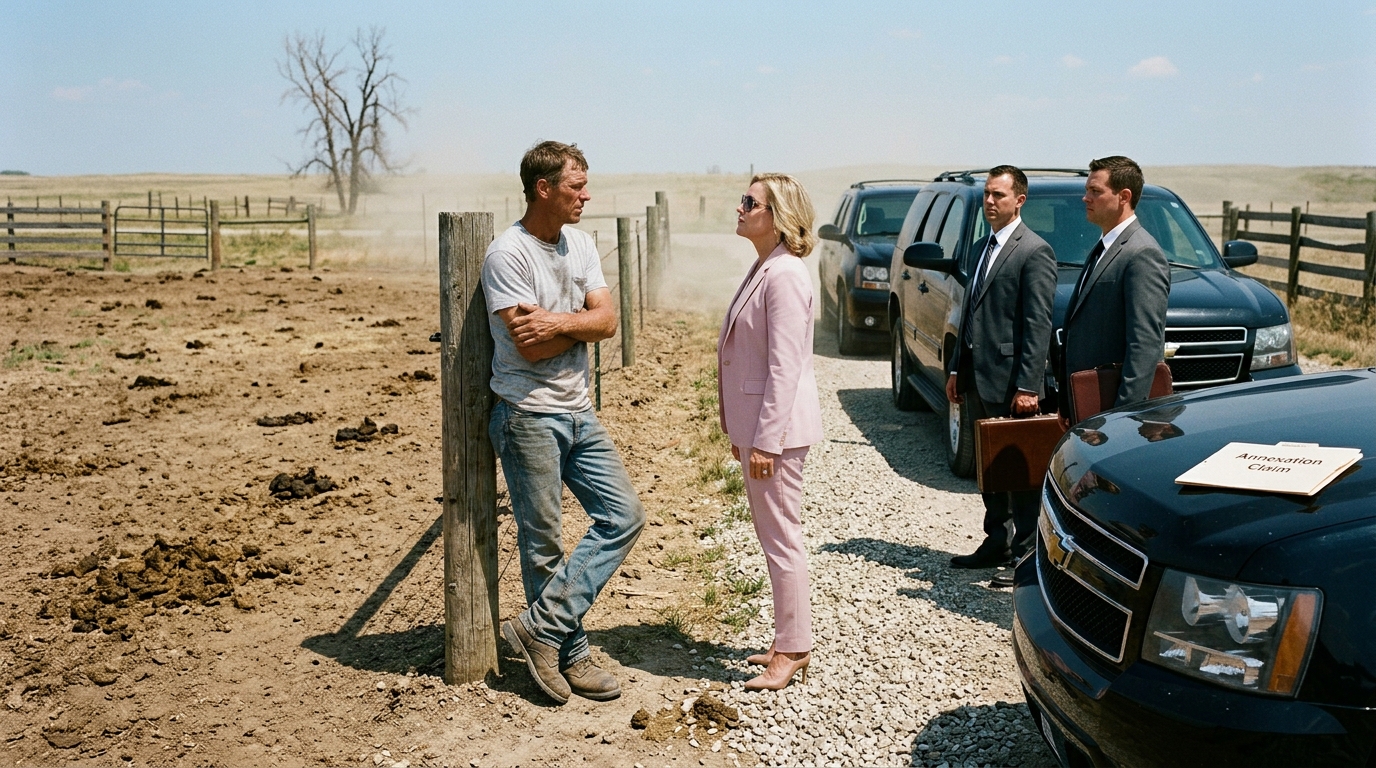
The dust didn’t settle before the three black SUVs rolled to a dead stop near the cattle gate. I kept my weight settled against the fence post, wiping a streak of gray sweat from my forehead with the back of a calloused hand.
Out stepped three men in stiff charcoal suits holding thick leather briefcases, looking like they had taken a wrong turn on their way to a Wall Street boardroom. Right behind them stepped Janette Bradford in a blinding powder-pink pantsuit and oversized sunglasses, her heels clicking sharply against the gravel.
“Marshall Zeke, we need to talk right now,” Janette’s shrill voice cut through the hum of the cicadas before she even reached the cattle guard.
I didn’t move an inch. I crossed my arms over my chest and let out a long, slow breath through my nose, staring down at the polished leather shoes standing dangerously close to my cow manure.
“I don’t live in Willow Creek,” I said, keeping my voice flat and low. “This is my farm. I’ve had these acres for 15 years. You folks built your little cookie-cutter houses up against my fence line, not the other way around.”
Janette didn’t blink. She snapped her fingers at the tallest lawyer in the middle, who wordlessly thrust a thick, heavy manila folder toward my chest.
“You are within the border of what we have recently annexed,” Janette said, her chin lifting with unearned authority. “The Willow Creek Homeowners Association has voted to include this land under our municipal jurisdiction. That gives us full rights to inspect, survey, and mandate compliance.”
I let out a dry, humorless bark of laughter that sent a pair of startled chickens scattering near the feed trough.
“You think a few signatures on a piece of toilet paper gives you my land?” I reached out, snatched the thick folder right out of the lawyer’s manicured grip, and tossed it hard back onto the hood of Janette’s shiny SUV with a wet thud. “You’re trespassing. Get off my property before I open the south gate and let the bulls introduce themselves.”
Janette’s face flushed a furious shade of crimson as she stepped right up to the boundary line. “I am giving you 24 hours to comply with inspection protocols. After that, we come back with full enforcement and court orders.”
I didn’t dignify her threat with another word. I turned my back on the pink suit, shouldered my wire-stretching pliers, and walked straight toward the darkened interior of the barn without looking back.
CHAPTER 2: THE OVERHEAD INVASION
A high-pitched, buzzing mechanical whine tore through the quiet country morning, rattling the loose shingles on the barn roof.
I stepped off the wooden porch, my boots crunching hard into the dirt, and looked up to find a black quadcopter drone hovering forty feet above my north paddock.
Its small camera lens swiveled downward, tracking the nervous movement of my Mustang, Whiskey, who was kicking at the dry dirt in furious protest.
Janette Bradford didn’t even bother waiting for her twenty-four-hour eviction notice to expire before sending her automated spies across my fence line.
I didn’t yell or wave my arms at the flying gadget; shouting at a machine only wastes breath and feeds the person holding the controller down the road.
Instead, I turned back toward the shed, reached into the shadows, and pulled down a rusted steel pipe I used for clearing irrigation blocks.
The drone dipped lower, its propellers chopping the dry air into a harsh, deafening vibration that terrorized the nesting swallows under the eaves.
I didn’t swing at it; I simply walked to the property line marker, slammed the heavy metal pipe vertically into the ground right beneath the hovering camera, and let the hollow clang ring out.
“You’re wasting battery, Janette,” I muttered into the empty air, knowing the onboard mic was picking up every syllable for her remote feed.
The machine jerked backward, its rotors whining sharply as it fought the sudden acoustic feedback before darting abruptly toward the tree line.
As it vanished behind the green canopy, something glinted sharply in the tall grass near the fence wire where the drone had hovered.
I crouched down through the brittle weeds and pulled a small, heavy aluminum stake out of the dirt, turning it over in my calloused fingers.
It was a commercial survey marker stamped with the logo of Apex Civil Engineering, a firm three towns over that had nothing to do with residential home aesthetics.
This wasn’t about property boundaries or HOA landscaping rules, and the missing legal support from Alina meant I had to trace this corporate footprint entirely on my own.
CHAPTER 3: THE COUNTY RECORDS HUNT
The wooden clerk’s desk groaned as I dropped the aluminum survey stake right onto the blotter, the sharp clatter making the middle-aged clerk jump behind his stacks of tax maps.
“I need every original township boundary plat from fifteen years back,” I said, leaning my weight against the counter edge.
The clerk adjusted his glasses, peering nervously at the piece of heavy metal resting between us. “You know you can’t just drop hardware in here, Mr. Zeke. We have protocols for parcel requests.”
“Protocols don’t cover commercial outfits driving stakes into private pasture without a county permit,” I replied, my voice dropping into a low, flat rumble that brooked no argument.
He swallowed hard, recognizing the stubborn set of my jaw, and finally spun his heavy monitor around to pull up the digital archives.
I didn’t have the luxury of a high-priced attorney to fast-track these filings, so I spent the next two hours tracking deed histories file by file, tracing the original ownership blocks of the valley.
The digital plat lines showed a neat, square layout for Willow Creek, but as I scrolled further back into the county’s historical annexations, a glaring discrepancy stared back from the screen.
The HOA’s recent expansion papers claimed jurisdiction over my entire northern acreage under a blanket municipal re-zoning clause passed last month.
But according to the official state land registry files, municipal boundaries legally cannot expand past natural topographical barriers like the old creek bed—unless explicitly signed off by individual property owners.
And my signature was nowhere on those documents, because nobody had ever asked.
“Look right here,” I muttered, tapping my finger against the glass screen to point out a hidden parcel overlay.
The clerk leaned in, squinting at the fine print detailing commercial highway zoning adjustments assigned directly to the annexed section.
“Well, that ain’t right,” the clerk whispered, his eyes widening. “This strip isn’t zoned for residential expansion at all; it’s marked for a state bypass interchange.”
The pieces clicked into place with the cold weight of a dropped anvil, exposing the true motive behind Janette’s aggressive paper push.
They weren’t trying to enforce neighborhood landscaping rules; they were trying to snatch my land so they could flip the highway-adjacent parcels to commercial developers for a massive payout.
CHAPTER 4: THE COMMERCIAL STAKES
A rusted metal gate creaked in the distance, and I saw a familiar silhouette standing near the tool shed, wringing her hands with nervous energy.
It was Carla, one of the dissenting Willow Creek board members, clutching a thick stack of printed bank statements against her chest like a shield.
“I shouldn’t be here, Zeke,” Carla’s voice shook as I stepped down from the truck bed, her fingers tracing the frayed edge of her jacket. “If Janette finds out I brought these financial ledgers off-site, she’ll make sure my property value is dragged through the dirt.”
I didn’t offer empty reassurances or sugarcoat the danger; out here, safety came from cold facts, not comforting words.
“She’s already trying to steal my land for a commercial bypass interchange, Carla,” I said, dropping the county plat map onto the wooden workbench. “Your board isn’t just playing neighborhood politics; they’re running a massive financial shell game.”
Carla swallowed hard, her eyes darting toward the empty gravel road before she slapped the stack of papers down onto the weathered wood.
“It’s worse than an interchange,” Carla whispered, her voice dropping to a harsh rasp. “They’ve been funneling neighborhood maintenance funds into fake vendor accounts, skimming thousands to pad their own pockets and fund the legal fees for these forced land grabs.”
I flipped open the top ledger sheet, my finger tracing the line items routing resident dues straight into private shell corporations tied directly to Janette’s name.
The fake zoning annexation wasn’t just a separate grievance; it was the final, desperate phase of a multi-thousand-dollar embezzlement scheme designed to liquidate independent properties before the state white-collar division caught wind of the missing accounts.
“This is all the proof white-collar investigators need,” I said, tapping the ink-stained columns with a calloused thumb.
“They’re coming back tomorrow with the final enforcement team,” Carla warned, her shoulders trembling under the sudden weight of exposure. “If we don’t drop these files on the state investigator’s desk tonight, they’re going to bury us both.”
CHAPTER 5: THE CLOSING NET
The fluorescent lights of the county annex hummed overhead, casting a harsh, pale glow over the folding table where the lead white-collar investigator sat flipping through Carla’s copied bank ledgers.
“These routing numbers don’t match standard neighborhood infrastructure budgets,” the investigator said, his pen tapping sharply against the margin of a fake vendor invoice.
“They match shell accounts tied directly to the Willow Creek board president,” I replied, standing square against the back wall with my arms crossed over my chest.
Janette Bradford didn’t wait for a formal subpoena; her black Escalade pulled up outside the municipal building twenty minutes later, tires spitting gravel against the curb.
The heavy glass door swung open, and Janette stormed into the lobby wrapped in a stiff wool coat, her oversized sunglasses flashing under the harsh indoor lights.
“This is an absolute outrage and an illegal harassment campaign,” Janette’s voice echoed off the concrete blocks as she pointed a manicured finger straight at my chest. “We demand these fabricated documents be thrown out and this farmer be cited for board interference.”
The investigator didn’t even look up from his desk; he simply slid a multi-page asset freeze order across the counter toward her path.
“You’re welcome to contest the accounts in federal court, Mrs. Bradford,” the investigator said flatly. “As of ten minutes ago, all association funds and corporate transfer channels are frozen pending white-collar fraud charges.”
Janette’s face drained of color, her mouth opening and closing in sudden silence as the weight of her collapsed scheme hit her all at once.
She didn’t surrender or apologize; instead, she spun around on her heel, hissing a furious threat about counter-suits at the top of her lungs as she stormed back out to her vehicle.
CHAPTER 6: QUIET BOUNDARIES RESTORED
The engine ticked as it cooled in the evening air, the only sound left in a valley finally free of corporate drones and slick city lawyers.
I stepped out onto the gravel and walked straight to the tool shed, my fingers wrapping around the weathered grain of a fresh wooden fence post.
The white-collar investigators had finished their sweeps by midday, shutting down the fraudulent association accounts and locking the clubhouse doors tight against the disgraced board.
Janette Bradford’s grand highway land grab had collapsed under the weight of its own greed, leaving her pink pantsuits and hollow threats buried beneath federal paperwork.
I didn’t celebrate or gloat with a crowd; out here, victory looked like a straight fence line and livestock settling down in peace for the night.
I shouldered a heavy mallet and walked out to the northern pasture where the commercial survey marker had been planted days before.
With three solid swings of the heavy iron head, I drove a thick cedar post deep into the exact same spot, burying their corporate ambition under two feet of stubborn Montana clay.
I pulled a fresh wooden sign from the truck bed, taking my time to screw it firmly into the center post right where the valley wind met the property line.
It didn’t need fancy legal jargon or threatening warnings to get the message across to anyone passing down the gravel road.
The block letters simply read: Private Land, Protected by the People Who Live Here.
I wiped a smear of dry dirt off the wood with my thumb, listening to the quiet rustle of the sycamore leaves overhead as the sun dipped low behind the ridge.
Whiskey gave a low, contented snort from the dark shadow of the barn, and for the first time in weeks, the air felt entirely clean.
I turned my back on the empty road, picked up my tools, and walked slowly toward the porch, leaving the quiet valley to the ones who actually cared for it.