The Golden Hive That Exposed A Corrupt HOA President And Restored Peace To Our Neighborhood
CHAPTER 1: THE AMBER SMUDGE
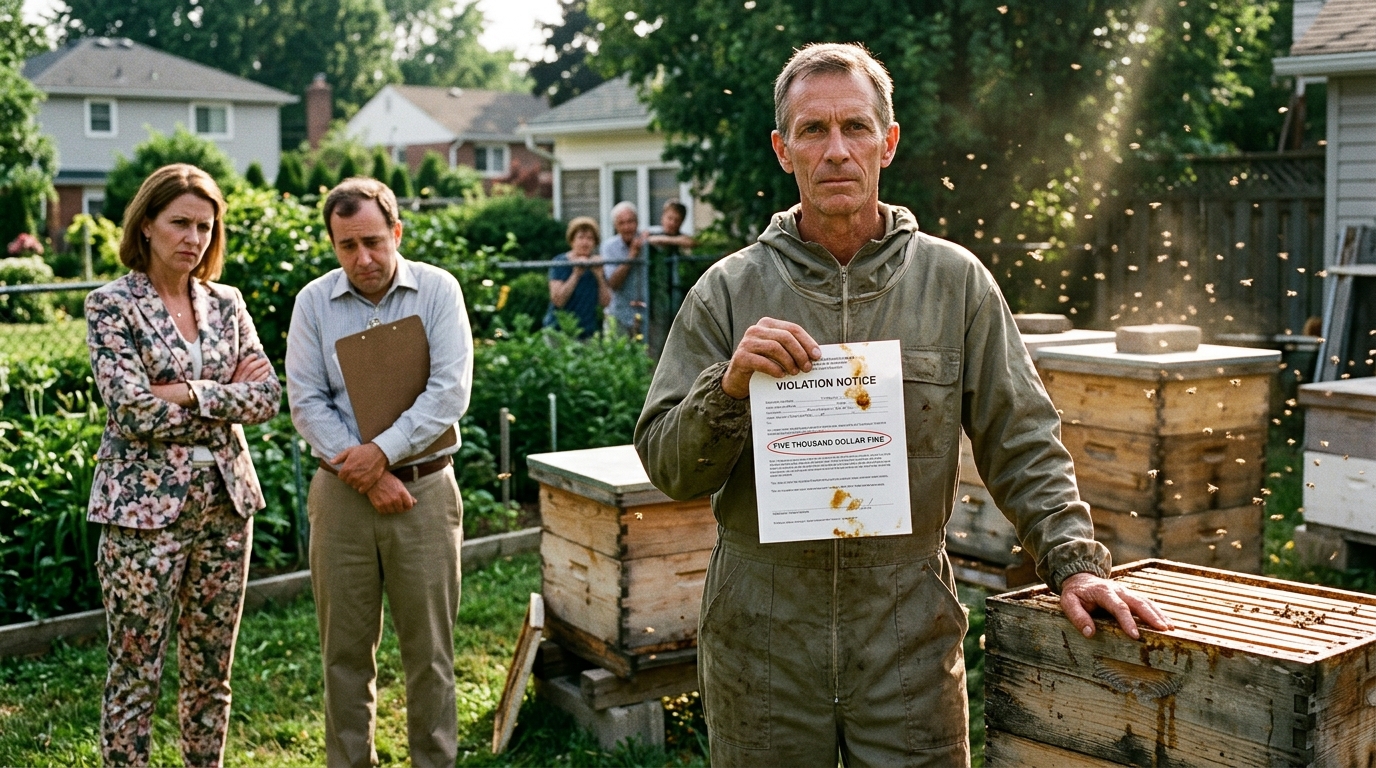
Those aren’t pets, Mr. Thompson. They’re a commercial enterprise, and this is a residential community. The fine is five thousand dollars due immediately.
The words cut through the steady, peaceful drone of my honeybees. I straightened up from the hive, my lower back throbbing with a dull, familiar ache, and turned around.
Standing on the edge of my freshly mown lawn was Karen, the president of our homeowners association. Her floral pantsuit strained against her frame, vibrating with self-satisfaction.
Beside her stood Gerald, a thin, nervous accountant clutching a clipboard like a bulletproof vest. Karen thrust a crisp envelope toward me with the grand air of a monarch issuing a death warrant.
I reached out and took the paper. My fingers were still tacky with raw propolis, leaving a faint amber smudge against the pristine white surface.
Inside the envelope was a formal violation notice demanding five thousand dollars. The stated offense was operating an unauthorized commercial business and harboring livestock.
I looked from the absurd document to the gentle hum of my apiary. Thousands of bees were weaving peacefully through the air, pollinating the very gardens Karen claimed to protect.
Livestock. The sheer weight of the absurdity almost made me laugh out loud.
Karen, I said, keeping my voice level and deliberate, the way I learned to anchor myself in tight spots, these are insects. They are for my personal use, garden pollination, and therapy. I do not sell a single drop of this honey.
I gestured toward the wooden boxes, each one built through hours of quiet, patient labor. Furthermore, I have a permit from the State Board of Agriculture. They inspected and approved this location.
I waited for a flicker of reason to cross her face, perhaps a moment of sudden hesitation. There was none. Karen’s smile simply tightened into a sharper, crueler line.
I do not care what some city bureaucrat told you, Mr. Thompson, she snapped. Your permit means nothing here. The HOA covenants are the only law that matters, and I enforce them.
She turned on her heel with practiced theatricality, leaving Gerald to scurry behind her like a pilot fish trailing a shark. I stood alone in the warm afternoon sun, the absurd paper growing heavy in my grip.
CHAPTER 2: THE PAPER SHIELD
I laid the five-thousand-dollar violation notice flat against the wood. The figure glared back at me—an arbitrary penalty manufactured out of thin air to assert dominance over a quiet yard.
My first instinct, born of years navigating high-stress combat zones, was to push back with raw force. But a man does not survive explosive ordnance disposal by running headfirst into an unmapped danger.
This was a different kind of terrain, governed entirely by clauses, bylaws, and bureaucratic procedures. I would fight her using her own weaponized paperwork.
I cleared the workbench, leaving only a legal notepad and a sharp black pen. Outside, the steady drone of the apiary continued, a rhythmic, grounding sound that kept my breathing even.
I spent the next two hours drafting a formal, meticulous response. Every sentence was chosen with surgical precision to dismantle her claims without giving an inch of emotional leverage.
To the charge of operating a commercial enterprise, I stated plainly that the apiary was a non-commercial hobby dedicated solely to ecological pollination and personal therapy.
I attached a signed affidavit affirming that not a single jar of honey was sold for profit. To the absurd accusation of harboring livestock, I cited the state agricultural code.
The state explicitly classified honeybees as beneficial insects and protected pollinators, not livestock. I printed out the relevant statute and highlighted the key passages in bright yellow.
Next, I included a pristine copy of my official state permit, signed by Dr. Grant himself, along with a photograph of the framed certificate hanging proudly on my workshop wall.
Finally, I enclosed a brief, authoritative letter from my VA therapist, Dr. Evans. It explained without unnecessary detail that beekeeping served as a vital therapeutic anchor for my ongoing recovery.
I made two identical copies of the entire packet, sealing each one with deliberate care. The following morning, I drove to the sterile, beige office of the property management firm that handled the HOA’s administrative workload.
I slid the envelope across the counter to a young receptionist who looked like she had not slept in days. I need a signed and dated receipt acknowledging you received this, I said, pushing a pre-printed form across the laminate desk.
She blinked, surprised by the formality, but pressed her stamp against the paper and scrawled her initials. That receipt was my anchor, my first piece of documented proof.
I walked back out into the morning sunlight feeling a quiet sense of tactical accomplishment. I had built an impenetrable fortress of state-approved facts around my home.
Surely, even someone as entrenched in petty authority as Karen would recognize when she had hit a legal wall of brick and mortar. The response arrived four days later by certified mail.
It was not a letter of retraction or an acknowledgment of state law. It was an immediate, brazen escalation designed to shatter my composure.
CHAPTER 3: UNRAVELING THE NEIGHBORS
I stared down at the list of signatures attached to the second violation notice. The ten-thousand-dollar fine was bad enough, but right there in the middle was the spidery, elegant signature of Eleanor Gable.
Mrs. Gable lived directly next door and had just received a jar of my spring harvest honey only a few days prior. It made no sense.
I grabbed a fresh jar of clover honey off the shelf and walked straight over to her cottage. I found her out on the front porch tending to her flowerbeds.
Jack, how lovely to see you, she said, standing up and dusting off her gardening gloves. I was just thinking about you, and that honey was absolute perfection.
My stomach tightened into a hard knot. This was not the welcome of someone who wanted my bees destroyed.
I held up the small jar. I brought another batch, but I need to ask you something serious about the neighborhood.
I pulled the folded petition from my back pocket and handed it to her. She adjusted her reading glasses, squinting down at the page.
Her expression shifted instantly from warmth to sharp confusion, then to deep indignation. Well, that is my name written right there, but I never signed this paper.
She pointed a trembling finger at the line. Karen came by last week with a clipboard talking about community garden benches, and I just signed where she pointed.
That deceitful woman, she muttered, her eyes flashing with sudden, genuine anger. I gained my first real ally on the porch that afternoon.
My next stop was three houses down to see Dave Miller, a young tech worker whose bold signature sat near the top of the list. I caught him by his driveway as he was sorting through the afternoon mail.
Dave looked up, his shoulders hunching slightly as he met my gaze. Look, man, I am sorry about the petition, he muttered, avoiding eye contact.
Karen made it sound like a chemical plant was operating back there, he continued, shifting his weight uneasily. She said my daughter was in danger of immediate anaphylactic shock.
She completely lied to you about state permits and safety guidelines, I said, handing him a printed copy of my documentation.
Dave read through the state seal and signatures, his face flushing with a mixture of embarrassment and rising fury. She told me you were an absolute outlaw operating with zero oversight.
He looked back up at me, jaw clenched tight. She lied right to my face, Jack. Who else did she trick with that clipboard?
CHAPTER 4: THE BOARDROOM AMBUSH
The assembly hall was packed far beyond its usual capacity. Homeowners lined the back walls, murmuring quietly among themselves with restless, suspicious energy.
Karen cleared her throat, tapping her gavel against the wood with a sharp, hollow crack. She launched immediately into her rehearsed script regarding community safety and unapproved livestock.
She pointed a manicured finger directly toward my seat in the front row. Mr. Thompson continues to defy the board and endanger our children with his illegal operation, she declared loudly.
A tense silence gripped the room as everyone turned to look at me. I did not raise my voice, and I did not let my posture drop.
I stood up slowly, planting both hands firmly on the back of the empty chair in front of me. Madam President, I have a few specific questions for the board record, I said, projecting my voice clearly across the hall.
Karen’s smug smile faltered instantly, her hand freezing over the microphone switch. This is not an open town hall meeting for personal grievances, she snapped back.
According to bylaw section 4.1, any member in good standing has the right to address the board during new business, I replied, quoting the exact rule from memory.
A low murmur rippled through the crowded room. Cornered by her own bylaws, Karen swallowed hard and gave a stiff, begrudging nod. Fine. One question.
My first question is simple, I continued, keeping my tone perfectly even. Did the board receive a formal letter from Dr. Allan Grant, head apiarist for the Department of Agriculture, confirming my hives are fully permitted and protected?
The color drained entirely from Karen’s face. Gerald started frantically shuffling papers on the desk beside her. That is a private board matter, she stammered, her fingers clutching the edge of the table.
So the board acknowledges receipt of the letter confirming my operation is entirely legal, I pressed forward without pausing.
My second question is for the treasurer, regarding the refusal of my legal request for financial records under article 12, section 2.
Gerald looked like he was about to be physically ill under the heavy gaze of the room. Karen slammed her gavel down twice, her face twisting with rage.
You are out of order! she screamed over the rising noise.
That was the exact moment Eleanor Gable stood up from her seat in the third row. It is not out of order at all, Karen, she said calmly, her voice carrying absolute authority.
Mrs. Gable held up a copy of the petition. Why did you tell me you were gathering signatures for park benches when you were actually fabricating a document to hurt my neighbor?
Dave Miller stood up right beside her. And why did you lie to me about safety hazards just to push your own agenda?
The room erupted into absolute chaos as other homeowners began shouting out their own grievances regarding selective fines and unfair treatment. Karen hammered her gavel repeatedly, but her control had entirely evaporated.
CHAPTER 5: FOLLOWING THE MONEY
Mr. Henderson leaned over the ledger sheets, his experienced retired accountant eyes scanning the line items with quiet intensity.
Look right here at the maintenance allocation, he said, pointing a steady finger at a highlighted row. The common area budget is capped at one hundred thousand, yet actual outflows are running fifty thousand higher.
We crossed-referenced the vendor work orders and cross-matched them against municipal business filings. The specialized project funds were not going toward community parks or public entryways at all.
Every single dollar of that overage was funneled directly into tree trimming and stone pathways exclusively inside Karen’s private cul-de-sac.
I turned the page to review the contractor agreements for Evergreen Vistas, the landscaping firm retained by the board for three consecutive years without competitive bidding.
The state business registry listed the registered agent under a familiar family name that matched Karen’s direct relatives.
She was running a closed-loop system of financial kickbacks using general association funds to upgrade her own backyard while fining everyone else.
Sarah Jenkins pulled a separate stack of enforcement records and laid them out in a grid pattern. Homeowners inside her street had numerous documented building violations with zero penalties attached.
Meanwhile, families on the opposite side of the development received heavy fines for minor infractions on the exact same day.
It was a coordinated web of selective punishment and systematic self-enrichment disguised as neighborhood governance.
CHAPTER 6: THE FINAL GAVEL FALL
Karen stood at the podium and launched into a desperate, self-pitying tirade about how hard she had worked to keep property values high.
She pointed a shaking finger at me, accusing the entire neighborhood of orchestrating a malicious smear campaign out of pure ungratefulness.
The side doors of the auditorium swung open, and an investigative television reporter walked straight down the center aisle with a camera crew rolling live.
Karen shrieked in sudden panic, demanding the cameras shut off, but the moderator calmly reminded her that special association meetings were entirely public.
I stepped up to the podium and laid out the financial audit spreadsheets, the inflated landscaping contracts, and the paper trail linking her brother-in-law directly to the missing funds.
With every slide projected onto the large screen behind us, the weight of the evidence crushed any remaining room for defense.
Pushed past her breaking point by the relentless proof, Karen lost all composure and screamed into the microphone—admitting to the nepotism and selective enforcement out of pure fury.
The community voted by a landslide ninety percent to recall the entire corrupt board on the spot, ending her reign of tyranny with absolute finality.
Months later, after state investigators filed felony fraud and embezzlement charges, the neighborhood returned to a quiet, steady rhythm.
I stood in my workshop alongside Mrs. Gable, carefully bottling a fresh batch of dark wildflower honey under the warm late-summer sunlight.
She wiped a tiny smudge of sweetness from the side of a glass jar and looked out toward the peaceful woods.
The bees hummed a steady, gentle tune in the background, entirely indifferent to bylaws or power plays, simply doing their work.
I pressed a blank label onto the glass, wrote Community Blend across the front, and set it down on the clean wooden table.