The Weight of Roots: Finding Balance in the Quiet Soil of Maple Brook Estates
CHAPTER 1: The Morning Coffee
The sun had barely breached the oak trees lining Maple Brook Estates, casting long, amber shadows across the dew-damp grass. I stood on my porch, the ceramic mug warming my palms, waiting for the familiar, comforting silence of a Saturday morning. I wanted the birds. I wanted the crickets. What I got instead was the aggressive purr of a luxury engine and the heavy, invasive scent of tire rubber pressing into my lawn.
It was her SUV—polished, black, and utterly out of place, parked deep in the heart of my yard like a jagged obsidian stone in a garden.
Cynthia Hardroof stood beside the driver’s side door. Even at this hour, she was immaculate: dark glasses shielding eyes that had spent weeks scrutinizing my mailbox paint and driveway edges. She didn’t look at me as I stepped down from the porch. She looked at her clipboard.
“Mr. Reeves,” she said, her voice cutting through the soft morning air like a whetted blade. “Your lawn is once again in violation of HOA height guidelines.”
I didn’t move. My grip tightened on my coffee. “I mowed it yesterday, Cynthia.”
“Consistency is required,” she replied, her pen hovering over the paper. She didn’t acknowledge my presence as a person; I was simply a coordinate on her map of infractions.
As she stood there, the weight of that heavy machine began to tell. The ground in this specific corner of the yard had always felt slightly hollow, a relic of an old, abandoned drainage system the former owner had warned me about. As she tapped her pen, the SUV shifted. A soft, muffled sound drifted up from the earth—the groan of soil losing its struggle against two tons of metal.
I noticed then, with a strange, clinical detachment, that the papers clipped to her board weren’t just violation notices. Beneath the top sheet, I caught a glimpse of orange-colored invoices, thick and frayed at the edges. They didn’t look like HOA stationery. They looked like personal debt.
“Cynthia,” I said, my voice dropping into a register of warning I hadn’t planned to use. “You really need to move the car. The ground here isn’t stable.”
She sighed, a sound of profound, weary irritation. She glanced at the grass, but her eyes were glassy, unfocused. She wasn’t just inspecting my lawn; she was staring into a void, her knuckles white against the dark leather of the steering wheel. She didn’t look like a president holding a constitution. She looked like a woman trying to anchor herself to the earth before she drifted away.
Then, the ground beneath the front passenger tire gave a sudden, sharp shudder. The earth didn’t just yield; it surrendered.
CHAPTER 2: The Descent
The sound wasn’t loud, not like an explosion or a car crash. It was a low, guttural moan—the earth inhaling before it collapsed. My coffee mug trembled in my hand, the ceramic clicking against my wedding ring. I watched, paralyzed, as the black SUV didn’t just stop; it folded forward. The front end dipped, the suspension groaning as if pleading for a weight it could no longer sustain.
Mud sprayed upward, dark and viscous, splattering against the immaculate black paint of the bumper. The front tire vanished into the hole, swallowed by the neighborhood’s forgotten, hollow past.
Cynthia stood motionless, her hand still frozen in the air where she had been waving me off. The silence that followed was heavy, pressurized. It felt like the air in the neighborhood had suddenly been sucked out, leaving us all gasping in a vacuum. I looked at the hole, and for a fleeting, unwanted second, I was back in my childhood bedroom, staring at the jagged hairline crack that had appeared in the foundation wall, the one my father promised would be “fixed next week” for three years. The smell of damp, pulverized dirt filled my nostrils, sharp and metallic, cutting through the pleasant scent of the morning dew.
“Cynthia,” I said, my voice sounding thin in the stillness.
She didn’t answer. She was staring at her clipboard, which now hung at an awkward, unnatural angle at her side. Her knuckles were white, bloodless, gripping the frame so tightly I thought it might snap. She wasn’t looking at the car anymore; she was looking at the ground, her shoulders pulled inward, a posture of someone suddenly realizing they were standing on a trapdoor.
Neighbors began to trickle out from behind their hedges and front doors, drawn by the sudden lack of noise. A few yards away, Mrs. Gable—who usually walked her terrier at this hour—stopped dead on the sidewalk, her phone half-raised. The morning was supposed to be about orderly lawns and consistent paint shades; it had become an exhibit of failure.
I took a step toward the SUV, the mud squelching beneath my boots. As I moved closer, I saw the clipboard more clearly. The papers hadn’t stayed neatly contained. They had been jolted by the impact, sliding upward. Beneath the formal, typed violation notice for my lawn, a slip of paper had fluttered loose. It was damp with mud, but the handwriting was frantic, looping—a grocery list mixed with a series of bank account numbers and a stark, underlined word: OVERDUE.
The air felt colder. The “perfect” HOA president was not a woman of iron; she was a woman drowning, using these notices as little more than a frantic, desperate effort to keep the walls of her own life from collapsing.
“The ground gave way,” she whispered, the words barely audible. She wasn’t talking to me. She was talking to the abyss.
“I told you,” I said, keeping my voice neutral, though my heart was hammering against my ribs. “I told you it wasn’t safe.”
“I needed to see it,” she snapped, finally looking up. Her eyes weren’t filled with the usual, clinical arrogance. They were wet, red-rimmed, and terrified. She looked at me, then back at the SUV, and I saw the realization hit her: she hadn’t just destroyed her car. She had exposed everything.
She turned to walk away, her movements brittle, but then she paused, her eyes darting back to the clipboard lying in the mud. She reached for it, but her hands were shaking so badly she couldn’t get a grip on the slick plastic. She looked at me then, a silent, desperate plea for a moment of mercy, but before I could speak, the front of the SUV groaned again. The metal chassis groaned against the edge of the hole, and a new crack shot across the lawn, spider-webbing out toward the sidewalk.
“Cynthia, don’t,” I warned.
She ignored me, stepping into the edge of the collapse to retrieve her dignity, her clipboard, and her secret. As she did, the ground rippled. I realized with a jolt of alarm that the irrigation void was larger than I thought. The entire stretch of the lawn between the house and the curb was a fragile, unstable crust.
“Move!” I shouted, the command snapping out with a force that surprised even me.
She froze, one foot hovering over the sinking earth. Behind her, the neighborhood was waking up. Phones were recording, eyes were wide, and the carefully manicured illusion of Maple Brook Estates was disintegrating into a muddy, chaotic truth.
I took another step forward, feeling the ground yield slightly under my own weight. I wasn’t here to win an argument anymore. I was here to make sure neither of us fell into the pit she had spent so long trying to bridge. I reached out a hand, not to grab her, but to offer a stopgap, a tether.
She looked at my outstretched hand, her gaze lingering on it for a long, heavy second, before her eyes flicked to the scattered, muddy invoices on the grass. The barrier between us—the one built on years of petty, rigid authority—wasn’t just cracking; it was dissolving into the mud.
CHAPTER 3: The Aftermath
The mud held its shape where the SUV had plunged, a jagged, dark wound in the pristine green of the lawn. Cynthia stood at the precipice, her shoulders slumped, her gaze locked on the scattered, ink-stained invoices that had tumbled from her clipboard. They were a mess of sodden paper—a pathetic, human wreckage.
The neighbors were closer now, a loose semi-circle of quiet, watching figures. The tension wasn’t angry anymore; it was something sharper, more inquisitive. It was the collective gaze of people who had been commanded for years and were now witnessing the commander stripped of her armor.
“Cynthia,” I said, my voice steady, aiming to bridge the gap without stepping over the line. I didn’t reach for the papers. I didn’t want her to feel like I was looting her pride. “Leave the clipboard. The tow truck will be here soon. You’re going to need to move out of the way of the debris.”
She didn’t look at me. She looked at Mrs. Gable, then at the other faces in the crowd. There was no defiance left in her, only a hollow sort of exhaustion. She bent down, her movements uncoordinated, and scooped up the wet papers. Her fingers were smeared with dark soil. She didn’t try to hide them; she just bundled them against her chest like a wounded bird.
“I didn’t mean for this to happen,” she whispered. Her voice was brittle, devoid of the sharp, regulatory edge that had defined every interaction we’d had for months.
“I know,” I said. It was the truth. Whatever she was doing, whatever debts she was balancing on the back of these neighborhood notices, it wasn’t malice. It was a terrified, frantic attempt to keep the status quo from shifting.
She turned away from the pit, her walk unsteadily navigating the soft, sinking ground. She wasn’t heading toward the safety of the pavement; she was heading toward her own home, several houses down. She was walking alone, past the neighbors who had spent years fearing the weight of her signature.
As she passed, a subtle shift occurred in the atmosphere. It wasn’t triumph. It was the uneasy recognition of shared frailty. I watched her go, then turned to the gathered group. They were waiting for me to say something, to confirm the narrative they had just witnessed.
“It’s just an old irrigation void,” I said, my voice projecting across the lawn to reach the quiet circle. “Could happen to anyone driving a heavy vehicle over ground that hasn’t been maintained.”
Victor, the retired civil engineer, stepped forward, his face etched with a knowing, weathered expression. “He’s right,” Victor said, his voice gravelly. “The soil underneath is hollow. It’s an infrastructure failure, not a crime.”
He looked at me, a brief, silent exchange of understanding. He knew, as I did, that the collapse was physical, but the exposure was something else entirely. We weren’t just fixing a sinkhole; we were recalibrating the neighborhood.
I spent the next two hours directing the recovery. When the tow truck finally arrived, its massive winch cable groaned as it pulled the SUV back onto solid ground. The sound was mechanical, rhythmic, a sharp contrast to the soft, sickening crunch that had defined the morning.
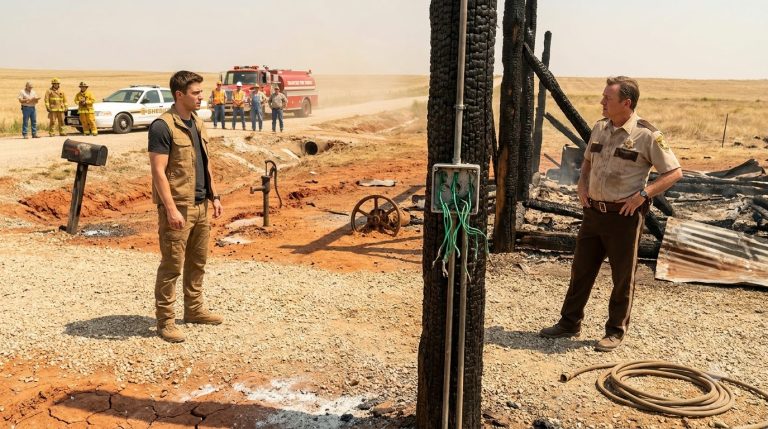
As the truck dragged the vehicle away, I stayed behind to inspect the damage. The hole was significant, revealing rusted, collapsed corrugated metal pipes that had been dormant for decades. I knelt in the mud, touching the cold, oxidized steel.
My mind wandered back to those papers. Overdue. Was I seeing what I wanted to see? Or was the neighborhood itself just another hollow space, propped up by the desperate efforts of a woman who had nowhere else to turn? I looked at the dark tracks leading toward Cynthia’s house.
I decided then that I wouldn’t let this be the end of the inquiry. Not out of malice, but out of a sudden, gnawing need to understand the architecture of this place. If the foundations were as hollow as this pipe, then the entire structure of Maple Brook Estates was a lie, and we were all just waiting for our turn to sink.
I stood up, wiping the mud from my hands onto my jeans. The neighbors were dispersing, their conversations hushed, filled with the weight of the new reality. They weren’t looking at me with the old suspicion. They were looking at me with a new, tentative curiosity.
I headed back to my porch, the morning coffee long cold in my hand. The quiet was returning, but it felt different now—not the silence of order, but the silence of an impending, unavoidable transition. I walked up the steps, and as I reached for the door, I saw a familiar envelope tucked into my mailbox.
It was the same standard HOA stationery, but the handwriting was different. It wasn’t the sharp, controlled script I had seen for months. It was hurried, shaky, and smudged at the edges.
I took it inside, closed the door, and set it on the kitchen counter. I didn’t open it. I simply watched the light from the window cast a long, narrow shadow across the paper, wondering if the message inside would be another demand, or if, for the first time, it was an invitation to the truth.
CHAPTER 4: The Ledger
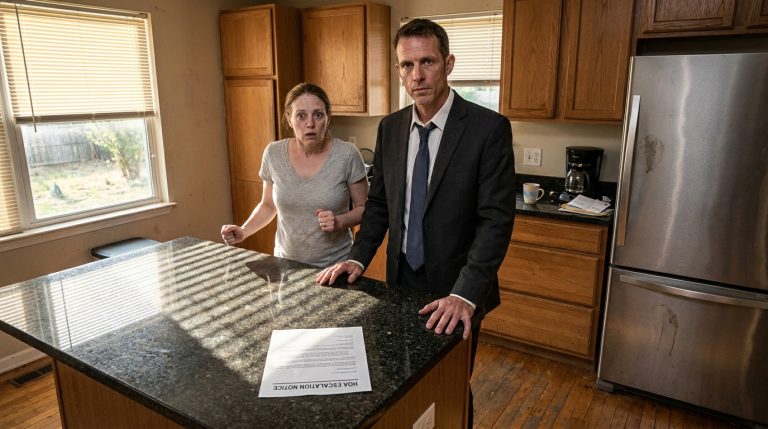
I stood in my kitchen, the silence of the house pressing in around me. The envelope sat on the granite island, a stark white rectangle against the dark, veined surface. It felt heavier than it looked. My fingers brushed the paper, sensing the faint indentation of handwriting that had been pressed down with a desperation that bordered on violence.
I sat on a barstool and peeled it open. Inside wasn’t a formal HOA warning, nor an apology. It was a chaotic assortment of loose-leaf pages, hand-written ledgers, and a single, heavy brass key that clattered onto the counter with a dull, final thud.
I ignored the key for a moment, unfolding the pages. My breath hitched. These weren’t HOA records. They were logs of cash withdrawals, utility payments, and home repair costs for at least a dozen houses in Maple Brook—houses with peeling paint, sagging fences, and cracked driveways. Names I recognized—the elderly Widower down the street, the single mother two cul-de-sacs over—were listed next to columns of numbers that didn’t add up to neighborhood profit, but to a massive, self-inflicted debt.
Cynthia hadn’t been embezzling funds for herself. She had been playing a dangerous, private game of “savior,” paying for essential repairs to keep the neighborhood looking perfect, not just for the property values, but to mask the decay of her own bank accounts. She had spent herself into a corner, and when the money ran out, she had turned to the enforcement of petty rules as a way to maintain the illusion of control.
I looked at the brass key. It was tagged with a small, handwritten label: Storage 42, Northside.
The phone on the counter chirped—a vibration that made me jump. I looked down to see a text message from an unknown number. “The hole is deeper than you think, Daniel. If the board finds these, there’s nothing left to save.”
The ambiguity of the warning sat heavy in my gut. Was she asking for help? Or was this a desperate attempt to pull me into her downward spiral? The “decoy” of the HOA power struggle had vanished, replaced by the ugly, quiet reality of someone trying to hold back the tide with a sieve.
I walked to the window. Outside, the streetlights were flickering to life in the gathering dusk. Maple Brook looked tranquil, the lawns neat, the hedges clipped. It was a veneer, a thin, polished skin over a body that was rotting from within. And I, who had wanted nothing more than quiet and birds in the trees, was now the keeper of the most damaging secret in the neighborhood.
I paced the length of the kitchen, the brass key cold and hard in my palm. My life in this house had been built on the premise of separation—that I could move here, be a neighbor, and remain an island. But the sinkhole hadn’t just taken a chunk of my lawn; it had effectively erased the distance between me and the people I lived near. I couldn’t just walk away from this ledger. To ignore it would be to watch the house of cards collapse entirely, perhaps taking vulnerable neighbors down with it.
I grabbed my jacket and the keys to my own car. I had to see what was behind Door 42. If this was indeed the center of her web, I needed to understand how far the rot went before the neighborhood meeting—the one that was currently being organized in every living room on this street.
The drive to the Northside storage facility was a blur of gray tarmac and the rhythmic sweeping of windshield wipers as a light drizzle began to fall. The facility was a sprawling, dimly lit complex, the kind of place where things went to be forgotten. My tires crunched over gravel as I navigated the rows, searching for the number stamped on the tag.
When I finally pulled up to Unit 42, the light from my headlights caught the padlock. It was already off, hanging loosely on the hasp. My pulse quickened. Someone had beaten me to it, or worse—Cynthia had been here, and she wasn’t alone.
I killed the engine and sat for a moment in the dark, my hands tight on the steering wheel. The air smelled of wet asphalt and old paper. I could hear the wind whistling through the corrugated steel gaps of the units, a lonely, mournful sound. This wasn’t about property values or HOA bylaws anymore. It was about the fragility of human dignity when the world starts to push back. I reached for the door handle, knowing that whatever I found inside would change everything.
CHAPTER 5: The Common Ground
The storage unit was a hollow shell. Empty shelves, a layer of thick, undisturbed dust, and a single, rusted chair in the corner—that was all. There was no grand conspiracy, no hidden vault of stolen riches. Just the crushing, quiet evidence of a woman who had lived on the margins of her own life to sustain an image that never actually existed.
As I backed out of the unit, the heavens opened. The light drizzle transformed into a deluge, a vertical wall of water that blurred the parking lot into a gray, featureless expanse. The temperature plummeted, the damp cold biting through my jacket as I sprinted for my car. But as I turned the key, the engine sputtered and died, a pathetic, wet whine the only response from the battery.
I was stranded. The clubhouse where the emergency meeting was supposed to be happening in less than an hour was three miles away.
I didn’t think; I just started moving. I hiked up my collar against the wind, my boots heavy with the slick, oily mud of the facility’s driveway. Every step felt like a negotiation with gravity. The rain felt personal, a cold, scouring force designed to strip away the pretense of the last few months.
By the time I reached the edge of Maple Brook Estates, I was shivering violently, my clothes plastered to my skin. The neighborhood looked surreal in the downpour—the manicured lawns were turning into shallow, dark marshes. The streetlights struggled against the gloom, casting elongated, wavering shadows across the sidewalks.
I bypassed the front entrance and slipped through the back way, my breath coming in ragged, painful gasps. The clubhouse was glowing at the end of the street, its windows bright, inviting, and utterly detached from the wreckage of the day.
I pushed open the heavy oak doors, the noise of the storm silenced instantly by the thick, insulated walls. The room was packed. People stood shoulder to shoulder, their faces etched with a mix of frustration and genuine confusion. At the front of the room, standing behind the lectern, was Cynthia.
She looked small. Gone was the immaculate hair and the sunglasses. She was wearing a beige raincoat that was still dripping onto the hardwood floor, her face pale, her hands gripped tightly to the microphone stand. She was speaking, but the room was humming with restless, unhappy energy.
“The structural repairs,” she was saying, her voice cracking, “are the priority. The drainage system—”
“We don’t care about the drains, Cynthia!” someone shouted from the back. “We want to know why our dues have been hiked three times this year, and why we’re still seeing cracks in our foundations!”
Cynthia flinched. She looked around the room, her eyes darting like a caged animal. She was waiting for an opening, a moment to explain, but the collective frustration of a neighborhood that had been silenced for years was finally finding its voice.
I moved through the crowd, my wet boots leaving dark, muddy tracks on the polished floor. The sight of me—a disheveled, shivering mess appearing out of the storm—drew eyes. The room went quiet, a ripple of movement clearing a path.
Cynthia saw me. Her eyes widened, and for a terrifying second, I saw pure, unadulterated panic. She knew what I had found. She knew the ledger was no longer hers to protect.
I stepped onto the small dais, the wood creaking beneath my weight. I didn’t look at the crowd. I looked directly at her. She reached out, a silent, desperate signal for me to stop, to wait, to offer her one last chance to preserve the lie.
I pulled the bundle of papers and the heavy brass key from my jacket. They were damp, the ink bleeding into the fibers of the paper, but the numbers were still legible. I placed them on the lectern, right in front of her.
“The money didn’t go to waste,” I said, my voice resonating in the sudden, deafening silence of the room. I turned to the neighbors, my heart hammering against my ribs like a trapped bird. “The money went to the people in this room. The people who couldn’t afford the repairs, the people who were too proud to ask for help, and the people who were being pushed out by the very rules meant to protect them.”
The murmurs began, a low, rising swell of confusion and disbelief. I looked back at Cynthia. She had stopped shivering. She was just staring at the ledger, her composure finally, completely shattered. The mask wasn’t just slipping; it was gone.
“Cynthia didn’t steal from us,” I said, the words feeling heavy, final. “She went broke trying to keep this neighborhood from falling apart, one patch at a time. And in the process, she forgot that we were supposed to be a community, not an architecture project.”
I stepped back, leaving her alone at the lectern with the truth. The room was poised on a knife-edge. This was the moment—the friction point where the neighborhood would either fracture permanently or begin the long, painful process of actually seeing one another. I felt an immense, crushing exhaustion settle over me. I had forced the issue, I had broken the seal, and now, the consequences were entirely out of my hands.
Cynthia opened her mouth to speak, her voice barely a whisper, but the room was already changing. Mrs. Gable was standing up, her expression unreadable, and toward the back, Victor was nodding to himself. The storm outside hammered against the roof, but inside, the air was still—waiting for what came next.
CHAPTER 6: The Foundation
Cynthia didn’t retreat. She stood at the lectern, her hands resting on the damp, stained ledger as if it were an anchor. When she looked up, the harshness that had characterized her for years was gone, replaced by a raw, terrifying honesty.
“I thought,” she began, her voice gaining strength, “that if I could keep the neighborhood perfect, I could stop the world from noticing that I was losing everything else.” She gestured toward the ledger. “My husband passed three years ago. The insurance wasn’t enough. The savings evaporated. I was terrified that if anyone knew, they would take away the only thing that made me feel steady—this place, this role, this sense that I was in charge of something.”
The room was heavy with the weight of her admission. Mrs. Gable reached out, placing a hand on the arm of the woman sitting next to her. The tension that had defined the room since I arrived was transforming. It was no longer the electric crackle of conflict; it was the hum of collective recognition.
“You weren’t stealing,” Victor said, his voice quiet but carrying across the hushed floor. “You were trying to build a fortress out of cardboard.”
“And it collapsed,” Cynthia said, a tear tracing a clean path through the grime on her cheek.
The next few minutes were a blur of awkward, necessary motion. People began to stand—not to leave, but to approach the dais. There were no cheers, no grand proclamations. Just the sound of chairs scraping against the floor and the shuffle of feet.
As the neighborhood began to speak, the conversation shifted. They talked about the repairs she had commissioned, the ways she had quietly stepped in to help when others were struggling, and the immense, crushing weight of the secret she had carried alone. It was a 5-pillar catharsis: the downfall of her authority was complete, but it was replaced by something far more durable—human empathy.
When the meeting finally adjourned, hours later, the rain had stopped. A thin, pale moonlight broke through the clouds, reflecting off the puddles in the parking lot. I walked out into the cool, damp air, feeling a strange lightness in my chest.
Cynthia was standing near the edge of the clubhouse porch, watching the neighbors drift toward their cars. She looked like a woman who had just stepped out of a long, feverish dream. I walked over and stood beside her.
“What happens now?” she asked. She wasn’t looking at me, but out at the neighborhood she had tried so hard to control.
“We start over,” I said. “Without the masks.”
I reached into my pocket and pulled out the brass key to the empty storage unit. I handed it to her. She looked at it for a moment, then closed her fingers around it, the metal glinting in the moonlight. She wouldn’t need to hide there anymore.
A week later, the neighborhood felt different. The lawns were a bit wilder, the hedges a little less uniform, but the streets were alive. I spent the Saturday morning outside with a shovel and a bag of topsoil, filling the remnants of the sinkhole on my property. It was slow, physical work—the kind that grounded you.
I was finishing up when Cynthia walked down the sidewalk. She stopped at the edge of my driveway. She wasn’t carrying a clipboard. She was wearing a simple sweater, her hair caught in a messy knot, and she was carrying a small, wooden plant box.
“I thought this might look better here,” she said, nodding toward the newly leveled patch of earth.
I stood up, brushing the dirt from my hands. “That’s a good idea.”
We worked together for the next hour, setting the box, packing the soil around it, and planting a small, hardy hydrangea. It wasn’t perfect. The ground was still uneven, and the soil was still damp, but it felt stable.
As we stood there, watching the plant settle into the earth, I realized that the “perfect” Maple Brook Estates had been a ghost—a fragile, hollow thing that had needed to break to become real. The truth—that we were all just people struggling to keep our foundations intact—wasn’t a failure. It was the only thing that allowed us to be neighbors in the first place.
I looked at the house, then back at the garden. The work of mending was never finished, but for the first time since I moved here, I felt like I was actually home. The quiet was there, but it wasn’t the silence of isolation. It was the silence of a foundation finally beginning to hold.