The Weight of the Bolt: A Tale of Common Sense and the Sovereignty of the Property Line
CHAPTER 1: THE FIRST SALVO
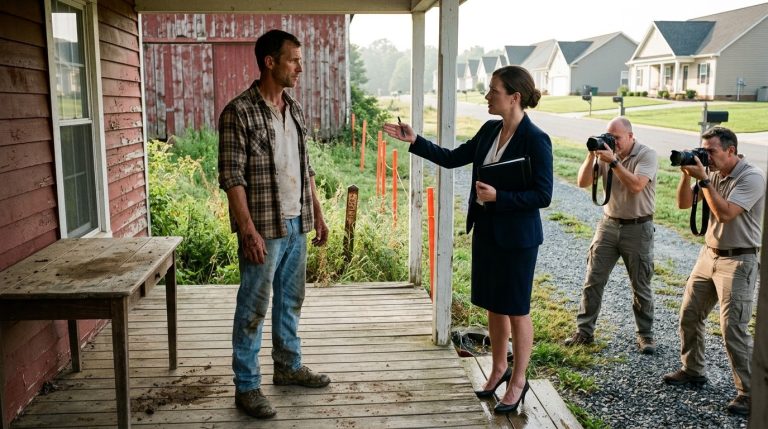
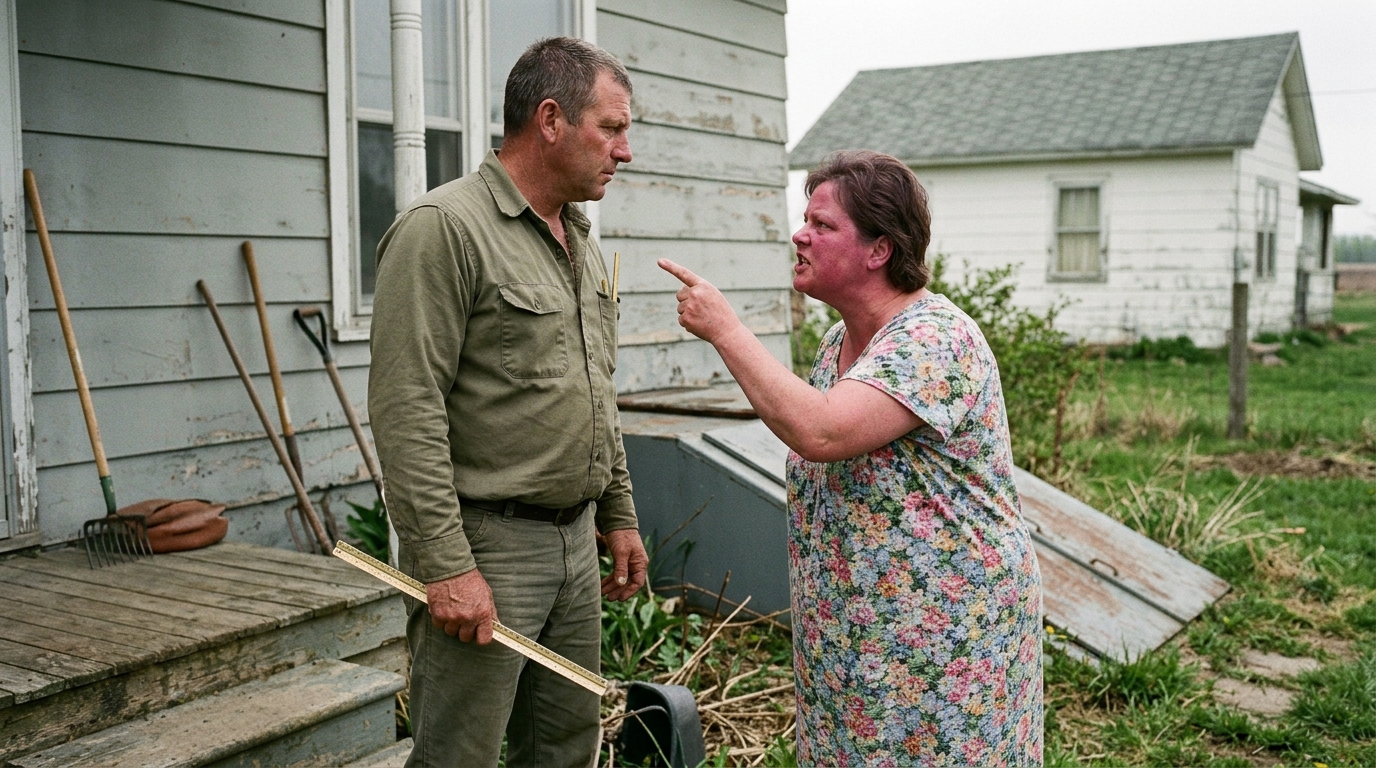
The muumuu was loud, violently floral, and smelled faintly of cheap vanilla spray, but the manicured finger sticking out of its sleeve was aimed directly at my dirt.
“Friday, Mr. Miller,” Karen said, her weight shifting on the damp rye grass of my front lawn. “That rusty piece of junk is an affront to this community. If it isn’t gone, I’ll have it ripped out myself and send you the bill for the sod.”
She was pointing at the heavy, slanted steel door of my root cellar. It sat there like an old gray turtle shell, battleship-colored and pitted by seventy years of Pennsylvania winters, anchored deep into the foundation of the original 1950s farmhouse. I didn’t say a word. I just stood there on the porch steps, my boots planted on the weathered cedar wood, sliding my thumb slowly across the deep, etched ridges of the brass engineering scale rule tucked into my shirt pocket. The metal was cold against my calloused skin, a solid, heavy weight that kept my jaw from locking.
“This is Oak Meadows, not a junkyard,” she continued, her voice rising an octave as she waited for me to explode. “All exterior structures require Architectural Review Committee approval. You know the bylaws.”
“I know the CC&Rs require certified mail for formal notifications, Karen,” I said, keeping my voice down in the low, flat register I used when colonels tried to cut corners on bridge spans in the Corps. “I’ll look for the paperwork.”
Her face turned the color of a bruised plum. She wanted the shouting match. She wanted the drama to feed back to her sycophants on the board, but I didn’t give her the satisfaction. I just turned, my left knee giving that familiar, dull ache from thirty years of heavy rucks, and walked back inside, letting the screen door click shut with a quiet, deliberate snap.
CHAPTER 2: THE CERTIFIED PAPER TRAIL
The yellow legal pad was rough under my forearm as the afternoon light faded through the window screen, leaving the kitchen in a gray, quiet shadow that matched the mood in the room.
Sarah sat across from me, her fingers laced tightly around a mug of black coffee that had gone cold an hour ago. Between us lay the crisp white envelope that had required my signature at the front door just after noon. The embossed oak tree on the letterhead looked clean, professional, and entirely detached from the woman who had stood on our grass three days ago spitting threats.
“Violation: Unapproved external structure,” I read aloud, my index finger tracing the sharp typing. “Section 7, paragraph C, aesthetic harmony. Remediation required within fourteen days or face an initial fine of two hundred and fifty dollars, compounding at fifty dollars per day.”
Sarah looked up, a sharp line cutting deep between her brows. “Can she actually do that, Frank? We were here before they even drew the blueprints for those cookie-cutter lots.”
I didn’t answer right away. I pulled the worn brass engineering scale rule from my pocket and set it on the table, its solid weight clicking against the wood. My thumb traced the triangular edges, feeling the deep, precise increments stamped into the metal. The military taught me that panic is just energy wasted before a plan is made; Karen wanted me sweating, which meant my best move was to stay perfectly still.
“She’s lazy, Sarah,” I said, tapping the paper with the corner of the brass rule. “This is a standard boilerplate template. She filled in the blanks between her morning coffee and her afternoon gossip.”
I reached behind me, pulling the heavy, three-ring binder containing the Oak Meadows Covenants, Conditions, and Restrictions off the counter. The plastic cover was dusty. I flipped the pages until the numbers aligned, my eyes scanning the dense, small-print legal jargon that most folks signed without reading when the development swallowed our borders.
Section 7, paragraph C was a full page of subjective nonsense about maintaining a harmonious appearance visible from the street. It was broad enough to ban everything from an unpainted shed to a stray garden hose, the kind of loose wording petty tyrants live for because it lets them make up the infractions as they go.
“We aren’t fighting her on taste,” I said, sliding the yellow pad closer and uncapping my old Parker pen. “A shouting match over what looks good is a mud wrestling contest with a pig. You both get dirty, but the pig likes it.”
“Then what’s the move?” Sarah asked, her voice dropping into that quiet, steady tone she used when we were moving bases every two years.
“Process,” I said, the pen scratch loud in the silent kitchen. “We build a paper trail so heavy it breaks the axle of her little committee.”
I drafted the response line by line, keeping the language flat, polite, and completely devoid of emotion. I asked for the exact date the Architectural Review Committee had voted on the cellar door standard. I requested the formal minutes of that specific meeting. I asked for clarification on whether a pre-existing structure, grandfathered by the county during the initial annexation, fell under their jurisdiction at all.
Every question was a small concrete pillar designed to hold up a bridge she hadn’t built. I knew the answers didn’t exist; the committee hadn’t held a quorum in three years, and Karen’s memory was her only archive.
The lock on the front door didn’t click, but the mailbox lid down at the end of the gravel driveway slammed shut with a metallic clang that drifted through the open window, signaling the afternoon pickup. I folded the response, slid it into a matching envelope, and stood up, my bad knee popping with a hard, dry snap in the quiet house.
“I’m driving this down to the main branch for certified delivery,” I told Sarah, grabbing the keys off the hook. “Let’s see how she likes answering questions she can’t look up in a catalog.”
CHAPTER 3: THE VAULT OF DUST
Standing inside the county clerk’s office, the smell of vinegar and old paper hitting my nose as the massive blueprint rolls crackle under my hands.
The fluorescence overhead flickered with a low, annoying buzz. I rolled out the heavy 1970s plat survey across the Formica counter, the thick paper resisting my hands, curling back up like a spring until I pinned the corners down with my brass scale rule. The clerk behind the counter didn’t look up from her screen, her fingernails clicking a rhythmic, slow cadence against the plastic keyboard.
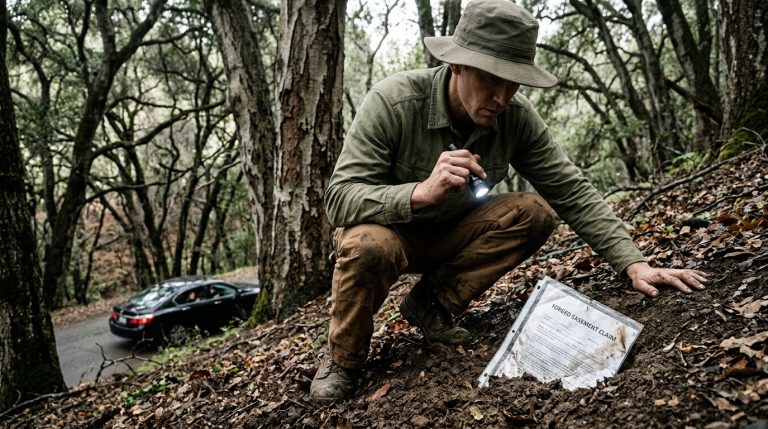
My thumb traced the grid lines of the old farmland, tracking the bold black boundary that separated my five acres from the clustered, tight rectangles of Oak Meadows. Then, my eyes caught a faint, mismatched font size on page forty-two of the master CC&R index registry tucked into the reference folder. The numbers representing individual property values looked slightly larger, stamped into the ledger over an older entry that had been aggressively scraped away until the fiber of the paper was raw.
Right across my lawn, running directly under the battleship-gray door of the root cellar, was a heavy, dashed ink line labeled multi-utility corridor easement. Next to it sat the three letters I had spent twenty-five years mapping out in the mud: EAP.
Emergency Access Point.
The document explicitly mandated a clear, four-by-four-foot opening to remain unobstructed at all times for structural access to the subterranean valves. But the real rot was right there in the ledger—the HOA board had completely omitted this easement from their public filings when they incorporated the subdivision, leaving a massive safety liability hidden just to keep the developer’s land prices artificially high.
“Find what you need?” a voice rasped from the door.
I didn’t lift my hands off the map. I just glanced sideways, my boots shifting on the grimy linoleum. A man in an oversized polo shirt stood near the water cooler, his keys jingling as his fingers nervously picked at a plastic clip on his belt.
“Just checking the property lines,” I said, my voice deadpan.
“Some lines are better left where they’re drawn, Frank,” he muttered, turning his back before I could catch his name.
I rolled the blueprint tight, the crackle loud in the quiet room, and slid the brass rule back into my front pocket. Karen wasn’t just trying to enforce a paint color; she was trying to bury a structural reality that could bring her entire house of cards down if the county ever looked close enough.
CHAPTER 4: THE OUTPOST ALLIANCE
The coffee pot was whistling on the counter as Dave shifted his weight in the old oak armchair, his face hard as he stared at the photocopied plat map on my coffee table.
“She’s fining the Millers twenty-five bucks a day because their swing set cedar stain isn’t in her imaginary color palette,” Dave muttered, his knuckles white against his knee. “And now this? She’s hiding an entire county easement just to keep the developer’s registry looking clean?”
Maria sat next to him, her thin hands trembling slightly as she set a ceramic lawn gnome down on the rag rug by her feet. “She told me the gnomes lower the property values, Frank. Said she’d have the maintenance crew impound them if I didn’t clear my porch by tomorrow morning.”
I poured the hot coffee into heavy ceramic mugs, the steam rising into the humid air, and handed them out without a word. I picked up the solid brass scale rule from the table, sliding it between my palms to catch my center. Without the utility companies willing to fight this local bureaucratic mess for us, we were standing on a very short pier.
“The county public works department won’t step in unless there’s an active rupture,” I told them, my voice flat. “Karen knows the registry gap exists. She’s counting on us getting scared by the dollar amounts before anyone looks at page forty-two.”
Young Miller leaned forward from the sofa, his eyes wide. “But if we don’t pay the daily fines, they place a lien on the house, Frank. We can’t afford a legal fight with the board’s retained counsel.”
“We don’t buy a lawyer,” I said, tapping the brass rule against the thick black line on the plat map. “We use their own ledger. If the board didn’t record this safety corridor, every single assessment they’ve levied since incorporation is structurally non-binding.”
Dave looked up, a slow, grim grin cutting through his scowl. “Malicious compliance.”
“Exactly,” I said, setting my mug down with a hard click. “We don’t scream at her. We give her exactly what she asked for—a full public review of every easement asset in Oak Meadows.”
CHAPTER 5: THE SHOW TRIAL TRAP
Standing at the back of the humid clubhouse room, the fluorescent lights humming overhead as Karen raised her small wooden gavel.
She brought it down with a sharp, unnecessary crack against the folding table. “This special executive hearing regarding the flagrant violation at Lot One is now in session,” she announced, her chest swelling beneath a bright red blazer. She didn’t look at the crowd; her eyes remained fixed on the grainy foam-board photos of my cellar door set up on a display tripod beside her. “Mr. Miller has consistently refused to maintain the aesthetic harmony of Oak Meadows, forcing this board to move for immediate contractor extraction at his expense, alongside a permanent property lien.”
I didn’t let my breath hitch. I simply walked down the central aisle, the linoleum cold beneath my boots, carrying the heavy manila folder under my arm. My fingers tightly gripped the solid brass scale rule inside my front pocket, using its hard, rectangular edges to anchor my composure as the neighbors shifted in their metal chairs.
“The bylaws require a formal vote, Karen,” I said, stopping directly at the resident lectern.
“We have the proxy votes to carry the motion, Frank,” she snapped, a tight, thin smile cutting into her plum-colored cheeks as she leaned over the podium. “Your pre-existing status doesn’t give you the right to run a junkyard on our borders. This board has the legal authority to protect our values, and we are exercising it.”
I opened the folder, pulling out the laminated county plat maps and placing them flat on the table right in front of her loyal accountant, Bob, whose eyes immediately locked onto the thick, dashed ink corridor running under my plot.
“This board hasn’t checked its own master registry index since incorporation,” I said, my voice low and flat enough to command the quiet room. “If you had, you would have noticed the deliberate font-size discrepancy on page forty-two. The developer scraped away the original county filing to hide a permanent, multi-utility safety corridor right under my lawn.”
Karen’s smile faltered, her hand freezing over her stack of proxy papers.
“Every fine you’ve levied, every aesthetic decree you’ve passed against the swing sets, the flagpoles, and the gnomes is completely non-binding,” I continued, tapping the brass rule against the raw ledger copy. “You structurally omitted a public safety easement from the community master deed to inflate individual land appraisals during the initial public offering. If the county clerk signs off on a safety audit tomorrow, this entire association goes into immediate administrative receivership.”
“That is an unverified fabrication!” Karen shrieked, her gavel hand trembling as she slammed it down again, the wood splitting along the handle with a dry, splintering crack. “We are the elected authority here! You will comply with the remediation order by Friday or I will personally ensure the sheriff clears your gate!”
Dave stood up from the second row, his jaw set hard as he looked around at the murmuring crowd. “She knew about the registry gap, Frank—look at the ledger dates.”
CHAPTER 6: THE DUSTY SETTLEMENT
Standing on the front porch step, the crisp morning air catching the scent of damp rye grass as the white moving truck backed down the pavement.
The big vehicle gave a heavy, mechanical snort as the brakes hissed, its metallic frame settling into the curb right outside Karen’s lawn. Across the street, boxes were stacked high on the porch where the immaculate, HOA-funded sod met the driveway. Dennis, her quiet husband, hauled a plastic crate toward the open back door of the truck, his shoulders hunched low and his movements stiff.
Karen followed him down the walkway, her hands gripped tightly around a small designer tote bag, her knuckles showing pale through the skin. She stopped by the rear bumper, her head turning slowly toward my lot, her eyes locked onto the front garden patch for a split second before her gaze dropped completely. The red power blazer from the clubhouse was gone, replaced by a faded denim jacket that looked two sizes too large.
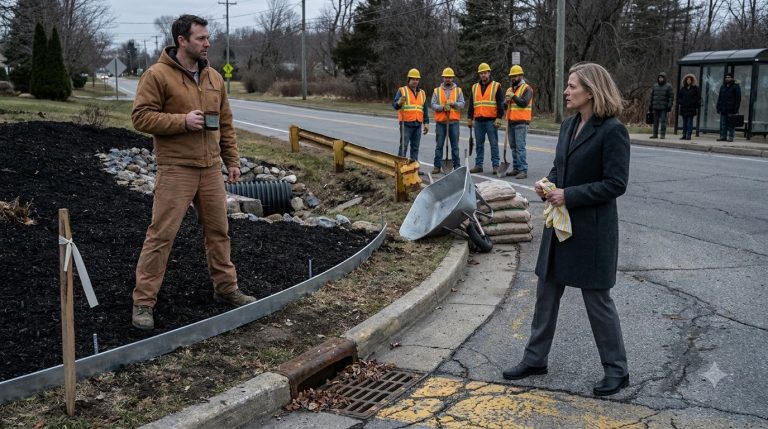
The community had taken exactly ninety days to audit the books, clear out the unwritten ARC guidelines, and put Arthur in the president’s chair. The fifteen-thousand-dollar repayment check she had delivered under the threat of a county prosecutor’s filing had already been spent on structural improvements down at the drainage basin.
I didn’t wave, and I didn’t smile. I just pulled the solid brass engineering scale rule out of my front pocket, rolling the cold, triangular edges against my thumb one last time before dropping it into the metal tool bin on the porch rail. The heavy gray steel cellar doors remained right where they belonged, bolted into the original 1950s foundation, solid, weathered, and unbothered by community palettes.
The moving truck door slammed shut with a heavy, hollow thud. The engine roared, filling the damp morning air with diesel exhaust as the big wheels rolled slowly past my property line, leaving nothing but an empty driveway and a faded green patch where the gnomes used to stand.
I walked down the steps, grabbed my spade from the dirt, and drove the metal edge deep into the soil to turn the earth for the fall cabbage. The ground was cold, hard, and quiet under my boots, completely stripped of the noise.