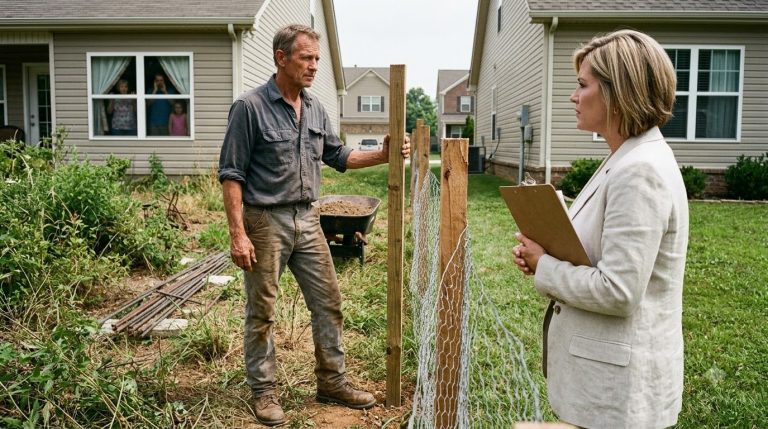
A Franklin County Corner Lot Dispute Escalates From Crushed Perennials To A Fraudulent Thirty-Year Township Drainage Easement
CHAPTER 1: THE TREAD DEPTH
The ceramic mug burned Daniel’s palm right through the glaze, but the steam had already quit rising. Down at the corner of the lot, thirty feet of fresh dark topsoil carried three sharp heel-dents punched straight through the mulch.
He didn’t run outside. He leaned his forehead against the double-paned kitchen glass until the cold seeped into his brow.
On the four-inch screen of his phone, the motion playback looped for the fourth time.
07:14:02 AM.
The gray wool hem of Clare Bennett’s overcoat swung like a pendulum across the lens. She hadn’t hesitated, hadn’t glanced at the street corner, and hadn’t picked up her pace. Her right boot simply left the municipal sidewalk slab, crushed the tender shoots of his creeping phlox into gray silt, and took the diagonal line toward the bus shelter on the county road.
Thirty feet of scraped dirt. That was the whole theft.
The corner lot had taken him two seasons of wheelbarrow work to level out after the city road crew tore through the culvert. He’d hauled forty-pound bags of river stone in the trunk of a dented Honda, dumped them by hand, and squared the perimeter with galvanized steel edging that cut his knuckles raw every spring. It wasn’t an ornamental showpiece; it was the only patch on the entire block that didn’t belong to the township.
At 5:40 PM, the gravel on Clare Bennett’s drive crunched under his work boots.
Her storm door stuck in its aluminum frame before it jerked loose with a sharp metallic rattle. Clare stood behind the mesh screen with a yellow dishtowel twisted between her knuckles, her gray coat already hanging from the brass wall peg behind her shoulder.
“Daniel,” she said, her voice dropping into that flat, polite register people use when a stranger knocks during dinner.
“Clare,” he said, keeping both hands out of his coat pockets where she could see them. “You walked across the new bed this morning. Right through the perennial border.”
Her eyebrows flicked up, smooth and untroubled. “Oh. I didn’t realize that patch was private property.”
Behind him, across the street, his corner was plainly visible under the gray streetlamp—raised beds, black shredded bark, and three-inch steel edging separating the grass from the pavement like a razor line.
“It’s the lot deed,” Daniel said evenly. “All the way out to the utility easement. Could you stick to the sidewalk around the bend?”
Clare let out a faint breath through her teeth, her gaze drifting past his left shoulder toward the intersection. “I only cut the corner, Daniel. It saves me nearly half a minute before the 7:18 bus rolls through. It isn’t like I’m hurting anything.”
“The roots won’t hold under boot leather, Clare. The sidewalk is paved.”
She smiled with the dry, tight patience of a clerk dealing with a delayed shipment, pulling the yellow towel taut across her fingers. “Fine. I’ll be more careful.”
She didn’t say she’d stay on the concrete. The aluminum door clicked shut before Daniel could take half a step backward, the latch falling into the strike plate with a hollow ring.
Down by the dark curb, twenty feet past her driveway, an old wooden surveyor’s lath stuck out of the ditch grass, its fluorescent ribbon long since bleached bone-white by the winter salt.
CHAPTER 2: THE REBAR STAKE
The shoe heel clicked against the exposed brass plug with the sharp, hollow authority of someone brandishing an inherited debt. Clare Bennett didn’t blink against the northern gust blowing off the county route; she stood in her oversized navy cardigan, waiting for Daniel to fold under the ghost of her husband’s pen.
Daniel put the truck into park, killed the ignition, and let the silence settle before opening his door.
He didn’t rush toward her. He stepped down onto his gravel drive with the certified copy from the records bureau resting flat in his left hand, folded once, crisp paper snapping against his thigh.
“You pulled Plat forty-two,” Clare said. It wasn’t a question. A thin, winter-pale smile stretched across her cheeks, tight as stretched cellophane. “I told you Arthur laid this drainage run before your deed existed. The county road commission took twenty feet for municipal flow under Ordinance ninety-four, Daniel. You don’t own that soil. You’re maintaining public thoroughfare at private expense.”
Daniel stopped three paces back, behind his galvanized edging.
“Arthur signed it as Subdivision Trustee,” Daniel said, his voice flat, devoid of the irritation she was angling for. “He recorded a temporary pedestrian and drainage detour while the township expanded the bridge over Alum Creek.”
Clare’s fingers tightened inside her cardigan pockets. “A recorded easement doesn’t vanish because you bought a bag of grass seed, Daniel.”
“A temporary dedication under Ohio Revised Code 5553 expires forty-eight months post-project completion unless reaffirmed by the board of trustees,” Daniel said. He held up the county auditor’s carbon sheet, pointing to the bottom quadrant where the purple administrative ink had faded. “Arthur never paid the vacation recording fee in 1998. He left the cloud on the margin so he wouldn’t have to reconstruct the private culvert headwall along your driveway.”
The thin smile on Clare’s lips vanished. Her chin jerked upward, her eyes darting past Daniel’s shoulder toward old man Henderson, who had moved from his push-broom to leaning against his mailbox post.
“That culvert drains four parcels,” she hissed, lowering her voice to a harsh, rattling cadence. “If you block this line, you back up the road bed into my basement floor.”
“Then you admit it isn’t a shortcut to the bus stop.”
Clare swallowed hard, her jaw muscles working beneath paper-dry skin. She had built her public alibi around a thirty-second commute to keep the township out of her ditch. Now the alibi was dead in the frost, exposed between the tire marks of South High Street and the open hole in Daniel’s mulch.
“Arthur gave this neighborhood forty years of infrastructure,” she said, her voice shaking with defensive venom. “You moved in three seasons ago with a leased truck and a shovel. You don’t get to erase thirty years of drainage flow because you don’t like footprints on your weeds.”
Daniel stepped forward, reached down, and gripped the thin wire of Clare’s green surveyor flag.
With a single smooth motion, he pulled it from the dirt, snapped the plastic pennant off the steel stem, and dropped the bare wire into his jacket pocket.
“The township road supervisor is scheduled for an on-site perimeter check at two o’clock,” Daniel said, staring straight through her wire rims into the cold grey of her pupils. “I invited him to inspect the unrecorded culvert tie-in your husband ran into this boundary iron. If that unauthorized connection is feeding your private run-off into my deeded parcel, Clare, the county doesn’t just vacate the detour.”
He pointed toward her foundation, where three decades of untreated water stain ran parallel to the blacktop.
“They assess the restoration directly to your property tax parcel.”
Clare took half a step backward, her boot heel slipping off the brass monument into the wet mulch. The righteous, neighborly entitlement that had carried her across his yard every morning fractured into sharp, frantic calculation.
She turned without another word, her slippers dragging through the grit of her own driveway, the heavy storm door slamming behind her with a violent, reverberating shudder that rattled the front gutter.
Daniel looked down at the exposed brass disc.
Beside the file marks Clare had gouged into the metal, water was already beginning to seep upward through the frozen silt—not from the street, but forcing its way backward from the clogged subterranean line running straight under Clare Bennett’s locked basement door.
CHAPTER 3: THE FORENSIC EXTRACTION
The township cruiser didn’t arrive alone at two o’clock. A yellow utility van with Franklin County Road Department stenciled along the rusted rocker panels rattled to a halt behind it, its amber roof-bar flashing a silent, rhythmic pulse across the gray slush.
Dan Vance, the road supervisor, swung out of the cab with a clipboard wedged into his armpit and steel-toed boots that looked like they hadn’t seen grease since the nineties.
Before Vance’s boot leather hit the blacktop, Clare Bennett was already crossing her driveway apron.
She wasn’t in her cardigan anymore. She had put on her gray wool town coat, buttoned straight to the collar, carrying a green hanging file folder held tight against her chest like an ecclesiastical shield.
“Dan,” she called out, her voice cutting through the damp chill with crisp, practiced familiarity. “I’m glad they sent you. We’ve got an incoming homeowner digging around the ninety-four bypass monument without a township excavation permit.”
Vance adjusted his knit cap, glancing over the open hole in Daniel’s mulch where water was now shimmering in a dark, foul pool.
“Afternoon, Clare,” Vance grunted noncommittally. He turned toward Daniel, who was leaning against his galvanized fence post with his hands out of his pockets and a sealed manila envelope tucked under his arm. “Mr. Mercer? You called in an unmapped lateral?”
“He didn’t call in an unmapped lateral,” Clare cut in, stepping directly between Vance and the ditch. She snapped the green file folder open, offering a yellowed mimeograph sheet. “This is Arthur’s signed dedication. Ordinance ninety-four, section eleven. The township has had an unrestricted drainage run right through this corner since the bridge re-decking.”
“Show him the back of that sheet, Clare,” Daniel said evenly.
She didn’t move. Her jaw set so hard the tendons along her throat corded like wire.
“Show him the expiration stamp,” Daniel repeated, stepping off the grass onto the curb line. “The one where Arthur skipped the sixty-dollar renewal fee in 1998 because renewing would have required an open-trench engineering inspection of the feeder line under your garage.”
Vance’s eyes flicked between them. The road supervisor didn’t take the yellow sheet from Clare’s hand. Instead, he walked past her, knelt by the excavated pit, and peered down at the two-inch water-casing plug Daniel had scrubbed clean.
“That’s not a county marker,” Vance said flatly.
“It has Arthur’s crew stamp,” Clare insisted, her voice climbing half an octave, losing its smooth cadence. “R-W 1994. You know his handwriting, Dan. He ran the township maintenance board for fifteen years.”
“Arthur was a trustee, Clare,” Vance said, taking a pocket screwdriver from his vest and scraping at the fresh file marks on the brass rim. “He wasn’t a licensed surveyor. And this isn’t an outflow monument. It’s an illicit cleanout cap.”
Vance reached behind him, waving his apprentice toward the yellow van. “Bring the twenty-foot camera snake. The four-inch head.”
Clare took half a step backward, the green folder fluttering against her knees. “You don’t have authorization to snake private lines without an administrative warrant.”
“We’re standing on Mr. Mercer’s deeded parcel,” Daniel said, opening his envelope and handing Vance the county auditor’s certified title transfer and Plat Map 42. “His boundary pin is six inches behind this cleanout. Which means whatever pipe is buried under this dirt is trespassing on private deeded ground without an easement.”
The electric motor of the inspection rig whined into life. The supervisor dropped the fiber-optic camera into the open steel casing. On the five-inch monitor mounted above the reel, the murky blackness turned into a gray, scoured tube of four-inch corrugated PVC.
The footage scrolled three feet. Then six feet.
The camera passed under Daniel’s steel edging, pushed straight through the municipal curb line, and angled sharply across the asphalt toward the northeast.
Directly toward the foundation wall of Clare Bennett’s house.
On the screen, a jagged mass of concrete grout and illegally tapped two-inch perimeter drainage pipes appeared, choked with black household sludge and grease that had backed up forty feet from her laundry sump.
“Well now,” Vance said softly, not looking up from the monitor. “Look at that.”
He tapped the screen with a blunt fingernail.
“Arthur didn’t give the township an easement, Clare. He diverted your house’s perimeter foundation lines into the street culvert right before the 1994 subdivision ban took effect, then forged a maintenance stamp to keep the road crew from digging it up.”
The street had gone dead silent. Across the way, Henderson had stepped all the way to the edge of the gutter, his push-broom resting forgotten against his hip.
Clare’s face had drained of every drop of color. Her eyes darted from the screen to Vance’s unreadable face, and then, finally, to Daniel. The calculated dignity she had worn for three decades didn’t just crack; it dissolved into the cold Ohio mud under her boots.
“The line is failing,” Vance said, shutting the monitor case with a heavy plastic snap. “That’s why you’ve been kicking the dirt over this plug every morning. You were checking if the back-pressure blew the cap off.”
“It’s grandfathered,” Clare choked out, her voice thin, vibrating with a panic she could no longer swallow. “Dan, you can’t touch an installation from ninety-four—”
“Grandfathering protects code compliance, Mrs. Bennett,” Daniel said, stepping forward until he was standing directly over the exposed iron casing. “It doesn’t protect intentional trespass. And it doesn’t protect thirty years of unmetered runoff dumped across my lot.”
Vance stood up, wiped his hands on a blue shop rag, and pulled a red township notice pad from his hip pocket.
“You’ve got forty-eight hours to cap this intake at your foundation wall, Clare,” Vance said without looking at her. “After that, county engineering brings the backhoe out to sever it at the property line. At your expense.”
Clare didn’t scream. She didn’t look at Henderson, or the cruiser, or the flashing amber light.
Her gaze locked onto Daniel with a venom so dense it seemed to freeze the raw air between them.
“You think you’ve won something here?” she whispered, her lips peeling back over her teeth. “You think you can force me to dig up my foundation?”
Daniel looked down at the dark, exposed pipe, then back up into her eyes with the cold, untroubled certainty of a man holding the deed.
“I won’t have to touch a shovel, Clare,” Daniel said. “The county auditor is going to do it for me.”
CHAPTER 4: THE TITLE CLEANSING
The hydraulic whine of the county backhoe at seven in the morning didn’t carry the neighborly hesitation of a lawnmower. It bit into the frozen ditch with three tons of down-pressure, severing Arthur Bennett’s unrecorded four-inch line with a clean, muffled crack.
Daniel stood behind his kitchen window, holding a fresh mug of black coffee. Down at the corner, the yellow arm of the excavator lifted a dripping segment of cracked PVC from the clay, dumping it onto the bed of a township dump truck with a hollow metallic thud.
Clare Bennett stood at the edge of her driveway in her gray overcoat, her arms pinned straight to her sides.
She wasn’t holding a travel mug, and she hadn’t looked toward the county bus shelter once.
Two county inspectors in high-visibility vests stood near her garage apron, clipboards resting against their forearms, running a dye test through her exposed foundation footing. The bright fluorescein green water bubbled up against her concrete skirt, unable to find an outlet, pooling across her driveway gravel before slowly turning back toward her basement sills.
At 7:14 AM, the crosstown bus slowed as it approached the intersection, its air brakes hissing against the slush.
The driver tapped the horn once out of routine, waiting for the familiar gray coat to round the corner.
Clare didn’t move. She remained pinned to her drive, watching the county road crew drive a four-foot steel culvert plug into the township main, sealing her private drainage off from the municipal system forever.
The bus waited five seconds, shifted gears with a heavy diesel groan, and accelerated down the county route, leaving two damp tracks in the morning mist.
By ten o’clock, the heavy machinery had cleared out.
Daniel walked down to the corner, carrying a flat spade and a forty-pound bag of crushed limestone. The ditch had been graded back to the original 1978 civil engineering specifications, backfilled with clean gravel, and compacted to municipal grade.
Nailed to the utility pole facing Clare’s driveway was a white, laminated administrative order from the Franklin County Auditor:
NOTICE OF SPECIAL ASSESSMENT: PARCEL 014-00821-00. INFRASTRUCTURE RESTORATION AND REMEDIATION LEVY PURSUANT TO O.R.C. 6117.02. AMOUNT BILLED TO PROPERTY TAX TAX ROLL: $18,450.00.
Clare stepped down off her porch, her slippers scuffing through the loose gravel, stopping precisely two inches short of the newly seeded boundary line. Her face had set into the dry, rigid lines of an old ledger, the paper-thin arrogance stripped down to bare bone.
“You knew the foundation would flood,” she said, her voice barely carrying over the distant hum of High Street traffic.
Daniel set the bag of stone down along his steel edging.
“Your husband knew it thirty years ago, Clare,” Daniel replied, keeping his voice entirely conversational. “He just made sure someone else was holding the deed when the bill came due.”
She stared at the fresh line of black mulch, the sharp galvanized border cutting through the winter earth like an unyielding surveyor’s wire. There were no footprints in the dirt. No diagonal shortcuts. No ambiguous clouds hanging over the title.
Clare turned her back and began the slow, heavy walk toward her front steps, where the dark stain of rising groundwater was already creeping up the first course of cinderblock.
Daniel knelt in the cold dirt, smoothed the topsoil flat with the back of his hand, and pressed the first fresh perennial root into the quiet earth.