[Iron Bounds and Concrete Walls: How a Retired Engineer Broke a Neighborhood Tyrant and Built a Community Legacy]
CHAPTER 1: The Unauthorized Fence
The dirt on my boots was dry enough to flake off in gray scales against the kitchen floor. I didn’t bother sweeping it. Willowbrook Estates sat just beyond my western line, a sea of manicured sod and identical shingle roofs that hummed with the quiet desperation of people who thought property lines were suggestions.
A knock rattled the aluminum screen door. It wasn’t a visitor’s knock; it was an enforcement knock, rhythmic and entitled.
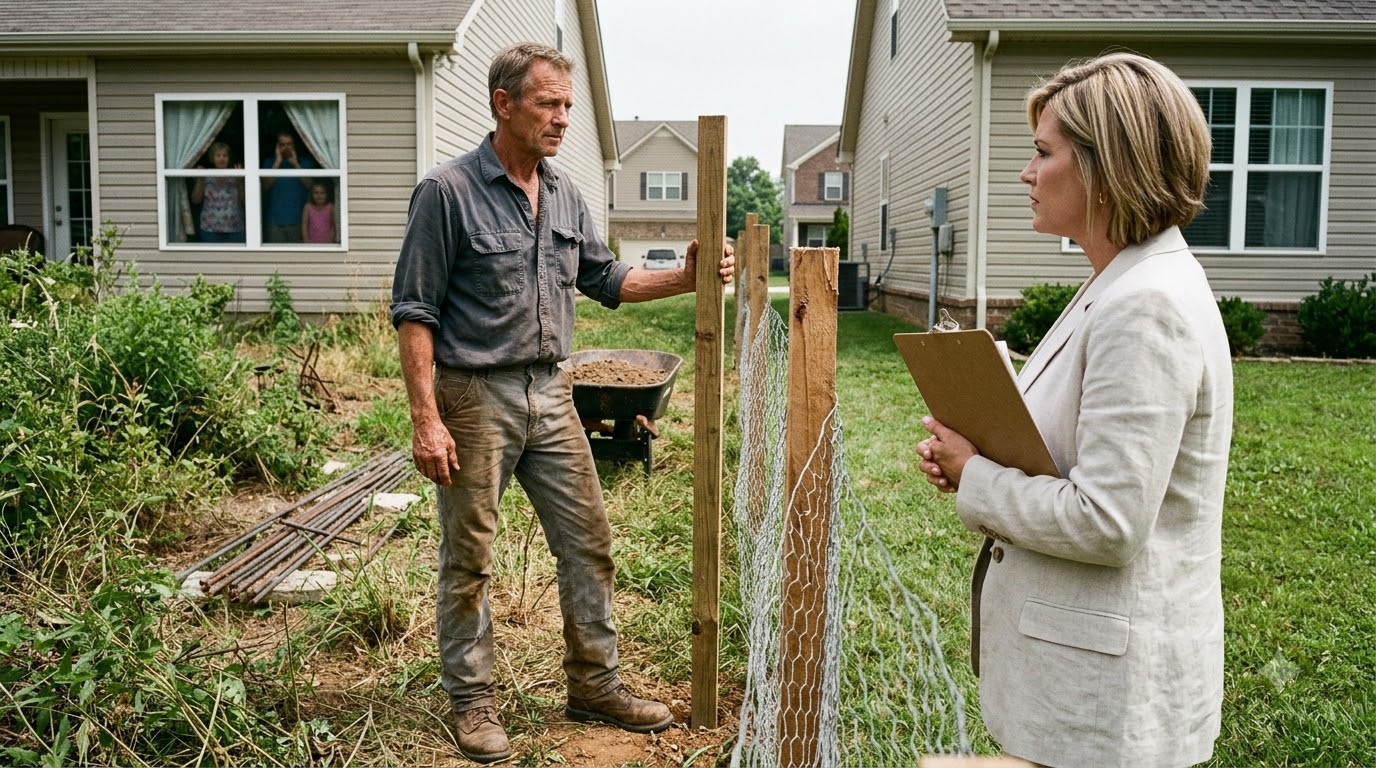
Linda Kramer stood on the porch step with a clipboard pressed against her linen blazer like a shield. Her blonde highlights caught the midday glare, perfectly immune to the Tennessee humidity.
“Marcus Thompson, right?” she asked, her voice pitched to carry across three lots. “I’m Linda Kramer. President of the Willowbrook Estates Homeowners Association.”
I kept my coffee mug balanced in one hand, the ceramic warm against my calloused palm. “Morning, Linda.”
“That chicken wire and cedar post assembly around your tomato patch violates Section Four of our community covenants,” she said, pointing a manicured nail toward the garden. “Height restrictions, color uniformity, and unauthorized structures. You have forty-eight hours to take it down or face our standard assessment fines.”
I took a slow sip of the black roast, letting the heat settle in my chest before looking past her shoulder toward the tree line. My land predated her subdivision by fifteen years.
“It’s a garden fence, Linda,” I said, my voice flat, holding back the heavy exhaustion of a man who spent forty years reading engineering blueprints instead of arguing with middle-management ghosts. “To keep the deer out of the beefsteaks.”
“The deer belong to the ecosystem, Mr. Thompson,” she replied, her smile tightening into a thin line designed to sell extended warranties. “Uniform property aesthetics belong to us. Comply, or we escalate.”
She turned on her heel, her low heels clicking sharply against the concrete slab as she walked away without waiting for an answer. I didn’t yell. I didn’t argue. I just watched the dust settle behind her silver sedan, feeling the quiet, cold friction of a war that had just begun.
CHAPTER 2: The Courthouse Archives
The county clerk didn’t look up from his screen when I set the heavy stack of index cards down on the counter. His desk lamp cast a sickly yellow glow over yellowed filing drawers that stretched back into the concrete gloom.
“Everything before nineteen-ninety is down in the damp rows,” the clerk muttered, tapping a fat finger against a plastic keyboard. “Reels and ledgers. Watch out for the silverfish.”
I walked down aisle three with a heavy flashlight, its beam cutting through floating dust motes that danced like tiny, suspended flakes of ash. My boots hit the concrete floor with a hollow, lonely echo.
The Willowbrook subdivision plats were filed under a separate commercial expansion annex from the early two-thousands. I pulled the heavy green linen binder off the shelf, the cardboard cover rough and stiff against my fingers.
The pages had been bound with heavy brass grommets that left dark, oxidized rings around the paper margins. I ran my thumb down the column of signatures until my eyes caught a sharp, handwritten annotation in red ink.
It wasn’t a permanent deed transfer or a public right-of-way dedication. It was a temporary construction easement dated March 2003, stamped with an eighteen-month expiration clause.
The development was certified complete and fully paved in December 2004. That meant the legal right for heavy equipment and shortcut traffic across my eastern boundary had expired twenty years ago.
Twenty years of smooth-riding sedans crossing my dirt line without a shred of legal standing, all because nobody bothered to read the fine print in the back of a damp county book.
I traced the red stamp with the edge of my thumbnail, feeling the raised impression of the county seal beneath the ink. Linda Kramer and her board had been operating on a ghost road for two decades, weaponizing a piece of paper that had turned to dust before her subdivision even finished its second phase.
I pulled my phone from my pocket and took three high-resolution shots of the page, the camera shutter clicking softly in the empty vault.
A shadow shifted at the far end of the stack aisle, the faint rustle of a raincoat brushing against a metal shelf. I didn’t turn around immediately, keeping my eyes fixed on the red expiration stamp while the silence stretched tight.
CHAPTER 3: The FiftyAcre Checkmate
Jennifer from the agency didn’t look like someone who sold strategic choke points. She stood by her crossover vehicle with a set of paper plats flapping in the wind, squinting across the brush toward the back fence of Willowbrook Estates.
“It’s raw dirt, Mr. Thompson,” she said, tapping a pen against her clipboard. “No well, no electric hookup, and the eastern border runs right along that private drainage swale the neighborhood uses for their golf carts.”
“I know,” I said, pulling the folded county records from my back pocket and flattening them against the hood of her car. “And it controls every natural drainage path and vehicle cut-through they’ve been relying on for a decade.”
She glanced down at the old survey lines, her eyebrows lifting as she connected the property boundaries to the subdivision’s rear access corridor. “You’re buying fifty acres just to block a local shortcut?”
“I’m buying fifty acres to enforce property law,” I replied, handing her a bank draft that had taken twenty years of engineering savings to secure. “Draw up the papers. Cash closing, no contingencies.”
Two hours later, the ink was dry, and the land belonged to a tired old man who was done playing polite games with people who treated property deeds like toilet paper. The parcel curved around the eastern edge of Willowbrook Estates like a crescent wrench tightening around a stubborn bolt.
Every deer trail, every unauthorized gravel path, and every morning shortcut Linda Kramer used to bypass the county road fell squarely inside my new fence line.
I didn’t waste time celebrating. I called an industrial fencing contractor before the sun cleared the tree line, setting up a sequence of deliveries that would turn a quiet hillside into an impenetrable corridor of steel.
A heavy yellow excavator rolled onto the property the next morning, its treads tearing into the high weeds with a deep, diesel-throated roar that echoed straight across the manicured lawns of the subdivision.
Down the hill, a few kitchen curtains twitched as homeowners paused mid-coffee to stare at the sudden machinery invading their quiet morning view. Let them look.
I stood by the boundary marker with a roll of blue flagging tape, watching the first eight-foot steel post sink into the dirt with a solid, teeth-rattling thud. The game had changed, and the rules were no longer written by a woman with a clipboard and a fake smile.
CHAPTER 4: The Gate Drops
The silver car didn’t park; it slammed into a clumsy angle across the gravel, its engine ticking in the morning heat. Linda stepped out of the driver’s side with her heels sinking half an inch into the damp dirt.
She wasn’t holding a clipboard today. She was holding a laminated copy of a neighborhood plat that looked fresh off a home printer.
“Open this gate, Marcus,” she demanded, her voice cutting through the hum of the distant excavator. “Right now. You are blocking a designated community arterial route.”
I adjusted the grip on my coffee travel mug, feeling the lukewarm plastic flex beneath my fingers. “It’s private land, Linda. You’re standing six feet inside my eastern boundary.”
“I have a surveyor coming up the lane right now who will prove this entire strip belongs to the utility easement,” she snapped, gesturing back toward a nervous man carrying a yellow tripod who was hurrying up the incline behind her.
The surveyor stopped ten paces back, looking down at his instrument setup with sudden, intense hesitation. He didn’t look like an expert mapping a victory; he looked like a man who had just realized his paycheck depended on a fairy tale.
“Go ahead,” I said, stepping closer to the industrial chain link. “Set up your tripod on my property line and show me the recorded county stamp for that arterial route.”
She thrust the laminated paper toward my chest, her fingers trembling slightly with a sharp, controlled rage. “The association board authorized this bypass two decades ago under standard community development provisions.”
“Associations don’t override county deeds, Linda,” I said, my voice dropping into a flat, steady register. “And that construction easement expired in two thousand and four.”
The color vanished from her face so fast it looked like someone had pulled a shade down behind her skin. She didn’t argue the date; she just tightened her jaw, her eyes darting toward the surveyor as if looking for an anchor that wasn’t there.
“You’re going to regret this stubborn little game,” she hissed, turning on her heel and marching back to her sedan with the rigid, furious posture of a queen bee whose hive had just been kicked over.
CHAPTER 5: The Iron Mandate
Two hired men in heavy work boots were swinging the steel bar against the anchor brackets, their breath puffing white in the damp chill. They didn’t want to be there; their shoulders were hunched against the morning wind, and they kept glancing back toward Linda’s silver sedan parked idling on the shoulder.
“Step back from the post,” I said, my voice carrying a quiet, flat weight as I walked out of the tool shed with a legal binder in one hand.
One of the men lowered the crowbar, wiping a smear of red clay off his knuckle. “We were just told the property lines were being adjusted by association management.”
“Management doesn’t own fifty feet of industrial steel,” I replied, holding up the county surveyor’s certified plat. “And damaging this fence is a felony destruction charge before breakfast.”
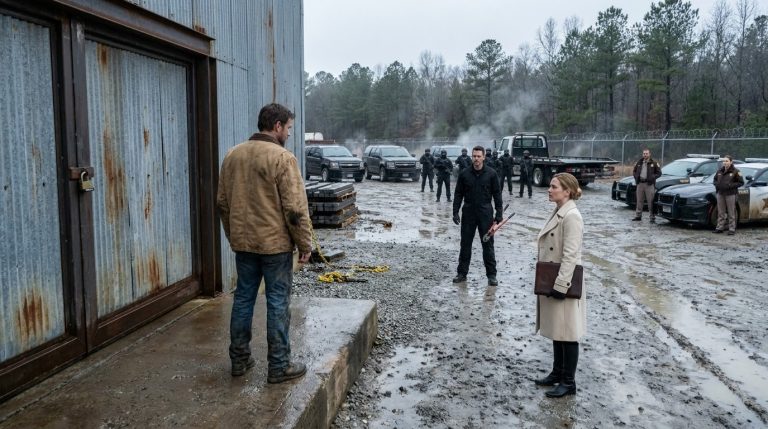
Before the men could drop their tools completely, a sharp siren cut through the trees. Sarah, my attorney, stepped out of a sleek sedan parked near the access lane, moving with a fast, determined stride that signaled she wasn’t here for polite negotiations.
“Tell your crew to drop the iron right now,” Sarah instructed the men, flashing a certified injunction copy under their noses. “Every strike on this post is being recorded by three independent motion cameras and filed directly with the magistrate.”
The men dropped the crowbar into the dirt with a heavy thud, turning away without another word. Linda burst out of her car, her face flushed with absolute fury, waving a sheaf of papers at Sarah’s chest.
“This is an outrage! We have prescriptive rights, community access agreements, and decades of established neighborhood use!” Linda shrieked, her voice cracking under the pressure.
“You have a twenty-year-old expired easement and a fraudulent financial paper trail,” Sarah replied coldly, handing her a thicker packet stamped by state investigators.
The packet detailed more than just a blocked road; it laid out the full audit of the Willowbrook HOA, exposing years of manipulated proxy votes, missing maintenance funds, and sweetheart architectural fines used to line private pockets. Linda grabbed the papers, her eyes scanning the first page before her fingers began to violently shake.
She opened her mouth to scream another defense, but the words caught in her throat as she realized the trap had finally snapped shut.
CHAPTER 6: The Crumbling Foundation
The state receiver took over the Willowbrook board by Tuesday morning, locking the administrative office doors and freezing every account associated with Linda’s regime. Homeowners received audit notices in their mailboxes detailing years of inflated assessments, forged signatures, and fraudulent vendor contracts funneled through personal friends.
Linda didn’t mount a heroic last stand or issue a gracious apology. When the state investigators served the final notice of asset seizure and criminal misdemeanor charges, she packed her silver sedan in total silence and drove away before the afternoon sun cleared the tree line.
The new board, elected under direct state supervision, didn’t want conflict or revenge. They wanted a practical fix for the traffic bottleneck that had made Linda’s shortcut look tempting in the first place.
They sat at my kitchen table with blueprints and polite handshakes, negotiating a proper, legal emergency access route across a small leased slice of my eastern land. The agreement included fair insurance coverage, proper county permits, and a permanent contract.
I agreed under one strict condition: every dollar from the lease proceeds went directly into a local scholarship fund for young people in the county studying engineering and law. Two students a year, fully funded by the community that had nearly collapsed under its own arrogance.
The rest of the fifty acres stayed fenced and monitored, turning a former battleground into a quiet wildlife sanctuary where wild turkeys and deer moved undisturbed through the brush. The industrial security cameras now watched for poachers instead of angry neighbors.
My back gate remained locked, but the heavy steel chain stayed slack because respect had finally replaced entitlement.
I set my coffee mug down on the wood, the ceramic making a soft, solid thud with zero tension left in the room. Outside the kitchen window, the afternoon light stretched long and golden across the vegetable patch, shining bright and clear on a fence that wasn’t going anywhere.