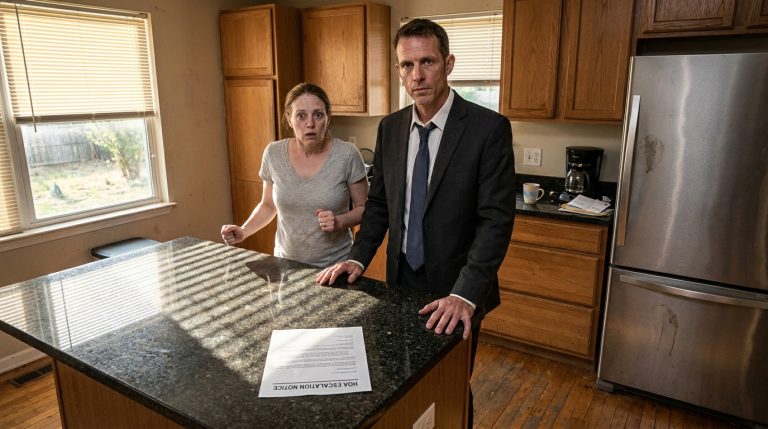
Suburban developer’s association president attempts dawn raid on independent machine shop, hits waiting deputies instead.
CHAPTER 1: THE MEASURE OF STEEL
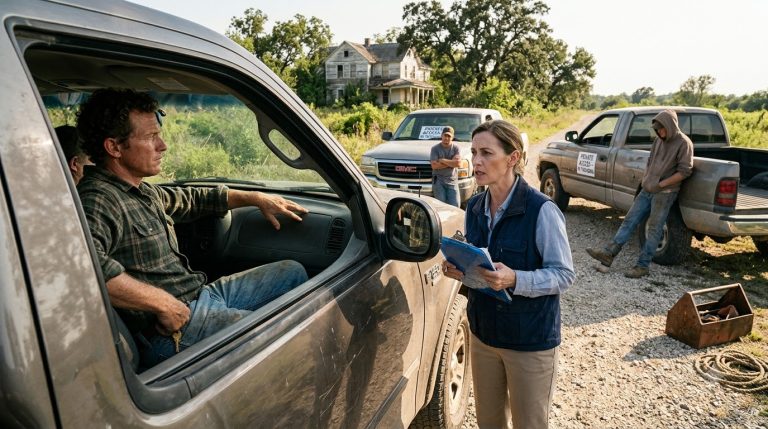
The cold corrugated steel of the roll-up door fought the track, squealing twice before bottoming out against the concrete sill. Everett Caldwell wiped cutting fluid from the meat of his thumb with an oily shop rag and checked his watch. It was 6:41 in the morning, and the low, synchronized growl of heavy truck engines was already coming up the gravel drive.
Three black SUVs and a flatbed service rig rolled through the perimeter gate without scraping. They moved in tight formation, tires grinding over crushed limestone, and stopped sixty feet out. Doors swung wide in unison. Nine men in stiff black nylon security jackets stepped into the morning damp. Two carried thirty-six-inch bolt cutters across their forearms like shotguns. Three carried heavy aluminum clipboards wrapped in thick packets of legal bond. The remaining four spread into a shoulder-to-shoulder cordon across the shop bay, cutting off the drive.
A white luxury SUV idle-crept behind them, its chrome grill ticking from road heat.
Joselyn Harrow stepped down onto the loose stone. She wore a cream wool trench coat that swept past her knees and tailored leather heels that sank a half-inch into the wet grade. Under her left arm, she pinned a zippered cowhide folio stamped with the Silverbrier Estates seal. She didn’t look at the sky or the surrounding timber. Her eyes stayed locked on the shop’s padlocked double doors.
“As of seven o’clock this morning,” Joselyn announced, her voice clipping through the crisp air, “the Silverbrier Homeowners Association assumes physical possession of this structure and its contents.”
Everett didn’t shift his boots. He tucked the rag into his rear pocket. The steel lip of the shop door was ice against his lower spine. “You’re sixteen minutes early, Joselyn. And this isn’t your dirt.”
“Emergency asset preservation and possession order,” she recited, tapping the folio. Her breath fogged white in the chill. “One hundred and eighty-six thousand, four hundred dollars in covenant penalties, environmental damage, and legal arrears. You’ve ignored three statutory cure notices. We have the statutory right to impound inventory and secure the facility until the lien is satisfied.”
She flicked her chin at the lead guard.
Grant Sloan walked forward four paces. He wore tactical boots with steel toes and a radio harness cinched tight across his chest. He stopped just outside arm’s reach of Everett.
“Mr. Caldwell,” Sloan said, keeping his voice level, professional. “We have an order to secure the perimeter. I need your keys to the main entrance and the auxiliary bay.”
“Read the signature page, Mr. Sloan,” Everett said evenly. “Take thirty seconds. Read the case number stamped on the seal.”
Joselyn stepped between them, her trench coat rustling. “There’s nothing to read. The paperwork was verified by our general counsel yesterday afternoon. We aren’t negotiating on gravel, Everett. Hand over the brass, or my men take the lock off right now.”
Sloan hesitated. His hand hovered three inches from his radio mic, his eyes darting to Everett’s face. The machinist wasn’t reaching for a phone. He wasn’t yelling for a shotgun. He was standing with his palms resting open against his thighs, perfectly balanced. That stillness made the hair on the nape of Sloan’s neck stand up.
“Ma’am,” Sloan murmured, “the sheriff’s dispatch hasn’t confirmed—”
“I didn’t pay Redstone eighteen thousand dollars to ask dispatch for permission,” Joselyn snapped. She pointed a manicured finger directly at the weathered brass Master Lock hanging from the hasp. “Cut it off. Now.”
“Just so we’re clear on the record,” Everett said, his voice flat as an iron plate. “You hired these men? You’re ordering them to breach a private shop door?”
“I am the president of this association,” Joselyn spat. “I gave the direct order. Break the lock.”
Two hundred yards behind the shop, deep in the dripping tree line, two sirens wailed once—short, sharp whoops that cut through the engine idle.
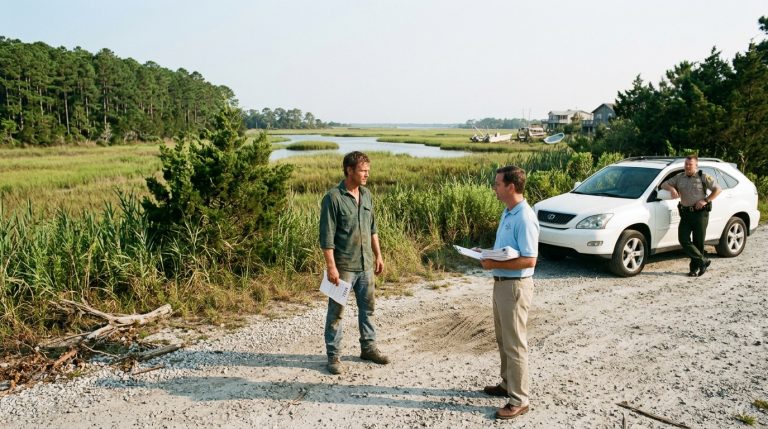
Two county cruisers tore out from the timber track, throwing rooster tails of mud as they slid across the gravel, boxing the service rig from behind. Deputy Wyatt Carver kicked his door open before his cruiser finished settling on its shocks. Deputy Elise Marlo cleared the passenger side, her hand resting over her duty holster.
Joselyn turned, relief breaking across her face like sunlight. “Carver, thank god. This individual is actively refusing a court-ordered repossession—”
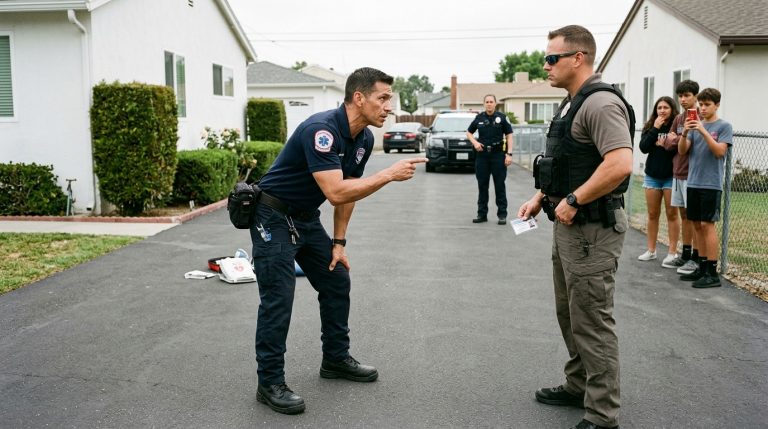
Carver walked straight past the two guards holding the bolt cutters. He didn’t glance at the shop. He stopped fourteen inches from Joselyn Harrow’s face.
“Joselyn Harrow?” Carver asked.
“Yes, obviously, now tell these men to—”
“Turn around,” Carver said. “Put your hands behind your back.”
Her mouth opened, but no sound came out. The yard went dead silent except for the low diesel tick of the idling trucks. None of the nine guards moved. Nobody reached for a key.
CHAPTER 2: THE PAPER LINE
The first ratchet of Carver’s cuffs bit into the damp air with the dry click of an empty chamber. Joselyn’s arms jerked back on instinct, her heels skidding in the limestone slurry before Deputy Marlo took her left elbow and pinned her balance against the white SUV’s quarter panel.
“This is an administrative action,” Joselyn whispered. The cold had finally reached her throat; her voice came out thin, stripped of board-room authority. “You’re interfering with an association lien.”
Carver didn’t answer. He ran his thumb across the raised notary seal on the leather folio, checking the light through the forged stamp. “Seal’s cut from an old probate ledger, Joselyn. The clerk flagged the die mark forty-eight hours ago.” He reached down, lifted the edge of her cream coat, and clicked the second cuff shut around her right wrist. “You’re under arrest for possession of a forged public instrument, criminal trespass, and attempted grand larceny.”
Across the drive, the nine Redstone guards stayed locked in place. Grant Sloan didn’t drop his aluminum clipboard, but his shoulders fell two inches. The two guards hauling thirty-six-inch bolt cutters eased the steel jaws down toward the gravel, resting the rubber grips against their thighs.
Everett didn’t move from the threshold. The roll-up door was still cold against his spine. He smelled the sulfur exhaust from Carver’s cruiser mixing with the wet iron of the shop. His right hand stayed in his jacket pocket, his knuckles curled around the flat brass key to the Master Lock.
“Sloan,” Everett called out.
The security chief turned his head slowly.
“You touch that gate latch on the way in?” Everett asked.
“Didn’t have to,” Sloan said, keeping his hands visible near his belt. “Gate was swinging open when we pulled the rigs off the county road.”
“That’s right,” Everett said. “Because Carver told me to leave it unlatched at five this morning so you wouldn’t have to cut chain to commit the felony.”
Joselyn twisted against the cruiser’s panel, her hair coming loose from its pins. “Grant, keep your mouth shut. Redstone operates under an indemnity clause signed by the Silverbrier executive committee. You speak to anyone, you void the firm’s coverage.”
Sloan looked from Joselyn’s pinned wrists to the nine men on his payroll, then down at the thick stack of bond clipped to his board. “Lady, eighteen grand doesn’t cover a conspiracy indictment. My crew was hired for an asset impound backed by what you claimed was an active civil writ.” He reached up with two fingers, clicked the release on his radio chest rig, and pulled an encrypted audio recorder from his tactical pouch. He held it out toward Carver. “I have four minutes of phone audio from six-fifteen yesterday evening. Mrs. Harrow instructing me to disable body cams prior to entering the perimeter.”
“Grant!” Joselyn screamed.
“Put it on the hood of the unit, Mr. Sloan,” Carver said without looking up from his notepad. “Don’t touch the switches.”
A battered blue station wagon rattled up the lane, its suspension groaning over the ruts before braking hard behind Carver’s patrol car. Amelia Foresight stepped out into the mud. She wore heavy work boots beneath her suit trousers and carried an accordion file held shut by an elastic band. She didn’t look at Joselyn. She walked straight to Everett, her eyes flicking across the shop doors, the padlock, then over to the security perimeter.
“Nothing breached?” Amelia asked.
“Hasn’t moved an eighth of an inch,” Everett said.
Amelia pulled a legal pad from the accordion file and uncapped a rollerball pen with her teeth. “County clerk verified the 2007 supplemental declaration forty minutes ago. The notary listed on the filing died in a nursing facility in Clark County sixteen months before the signature was recorded. It’s a complete fabrication from top to bottom.”
Everett spat onto the gravel. “What about the stakes?”
“I ran the parcel reference stamped on the survey lath you pulled from the eastern ditch,” Amelia said, lowering her voice so the wind didn’t carry it toward the guards. “The client wasn’t the Silverbrier Homeowners Association. It was registered under Hero Development Coordination.”
Everett’s jaw tightened. “The people building the shopping center.”
“Silverbrier Commons,” Amelia corrected, tapping the pad with the pen tip. “They need four lanes of dedicated commercial easement for county fire and secondary access, or their state transit permits get denied next month. The only legal passage between the state route and the proposed strip runs right across your slab, Everett. Dead center through your CNC bay.”
A heavy truck horn echoed from the direction of the county road—two long, low blasts.
Through the trees, the yellow cabs of two commercial box trucks crawled into view, slowing to an idle just outside the gate. Both rigs bore the magnetic door logos of a regional freight hauler.
Sloan glanced toward the entrance, his jaw setting hard. “Those aren’t mine,” he muttered. “Those are the haulers she told me would stage at the crossroads until we had the roll-up door opened.”
Joselyn didn’t speak. She stood pinned against the cruiser, her forehead resting against the cold glass of the rear window, watching the moving vans wait outside the wire she couldn’t cross.
CHAPTER 3: THE SINKING FUND
Forty-eight hours after Carver’s cruisers took the lane, the rain turned the gravel yard into an iron-colored swamp. Everett worked the thumb screw of a six-inch Starrett caliper, measuring the spine thickness of a county tax ledger until the digital readout clicked dead from a weak cell.
He set the tool down on the scarred laminate desk. Outside the office window, the dark profile of his vertical mill sat silent under plastic drop cloths. No chips flew. No coolant pumped. Every customer order was paused while the county attorney processed evidence logs.
The office door creaked open. Amelia stepped in first, her raincoat dripping onto the linoleum, followed by a woman clutching an expanding cardboard file held together with two snapping rubber bands.
Pauline Gresham didn’t look like an executive. She was fifty-two, wore a damp quilted vest, and had ink smudges across the knuckle of her right index finger. She had kept the books for Silverbrier Estates for seven years while working forty hours a week at the water district billing office.
“She bonded out at noon,” Pauline whispered. Her knuckles were white against the cardboard. “Her personal lawyer filed an emergency motion to impound the association’s central server. They’re claiming the files contain proprietary resident data.”
Amelia pulled a folding metal chair out and kicked it open. “Sit down, Pauline. Put the papers on the desk.”
Pauline sat, but she didn’t let go of the folder right away. “If the board finds out I pulled physical copies from the lockbox, they’ll sue me under the fiduciary indemnification clause. Joselyn told me three months ago that treasurers record numbers, they don’t interpret them.”
“Joselyn’s indemnification died the second Carver filed the felony complaint,” Amelia said, snapping her fingers once. “The papers.”
Pauline pulled the rubber bands free. They slapped against the cardboard with a dull thwack. She spread six months of commercial bank statements across the blotter, weighting them down with a heavy brass paperweight shaped like a six-point socket.
Everett leaned in, the smell of wet wool and cold paper filling the small office. “Show me where the sixteen hundred an hour went.”
“It’s not just the guards,” Pauline said, her finger shaking as she traced a yellow highlighter line across an April statement. “Here. Thirty-one thousand dollars to Blackwood Advisory Group. Registered five weeks ago to a commercial mailbox behind the interstate truck stop. The managing partner is Joselyn’s brother-in-law.”
“Consulting fees?” Everett asked.
“Lien preparation and title review,” Pauline said. “Then another twenty-two thousand, five hundred to a civil engineering firm for what the ledger calls ‘drainage easement mapping.’ But the coordinates on the voucher don’t match the subdivision retention ponds.”
Amelia pulled a state surveyor’s plat from her bag and matched the grid numbers with the ballpoint tip of her pen. “They aren’t mapping ponds, Pauline. Those coordinates run along Everett’s eastern ditch. They mapped his property line down to the millimeter.”
Everett looked at the running total at the foot of the column. “What’s the reserve balance right now?”
Pauline swallowed, her throat clicking dryly. “Sixteen hundred dollars.”
The shop went dead quiet except for the rain drumming against the steel roof.
“The road assessment,” Everett said. “The new asphalt they were supposed to lay on the north ridge last month.”
“Gone,” Pauline whispered. “The culvert repair fund, the clubhouse roof replacement, the emergency storm drainage reserve. She emptied one hundred and eighty-four thousand dollars out of the community capital accounts to finance this.”
Amelia flipped the statement over, examining the approval lines. “Your digital token authorized the wire transfers, Pauline.”
“I never touched those keys!” The woman’s voice cracked, rising toward panic. “Joselyn had access to the master terminal in the clubhouse office. She told me she was updating the cloud software over the weekend in March. She must have exported my cryptographic signature while the system was down.”
Everett didn’t raise his voice. He reached into his pocket, pulled out the mortgage inquiry letter his bank had sent three days before the raid, and laid it beside Pauline’s ledger. The signature at the bottom of the unauthorized credit check bore the same digital timestamp as the thirty-one-thousand-dollar transfer to the shell company.
“She wasn’t just trying to bully me out with noise fines,” Everett said, his hand coming down flat on the paper. The wood under the blotter groaned under the weight. “She was draining her own people’s pockets to manufacture the debt, and she was timing my mortgage renewal so the bank would pull my line of credit the week she hit the gate.”
Amelia’s eyes narrowed as she stared at the dates, aligning them side by side on the desk. “It’s worse than that, Everett. The developer didn’t offer to buy this shop from you because Joselyn told them the parcel was already in probate foreclosure.”
Everett looked out through the glass into the dark, silent shop bay, his eyes fixing on the iron frame of his lathe. “She didn’t just want the access road.”
Amelia looked up from the numbers. “No. She promised the developers a clean title before she even owned the ground. And if she couldn’t deliver it by the zoning deadline next Tuesday, the developers pull their commercial contract, and Joselyn’s shell company owes them half a million in liquidated damages.”
CHAPTER 4: THE ACCESS CORRIDOR
Seventy-two hours later, the county records basement smelled of hot copy drums and moldering binding glue. Everett laid his steel rule across the vellum map of Silverbrier Commons, pinning the curled paper down against the scratches in the laminate table.
The microfilm reader three feet away let out a dry rattle as the motorized spool jammed, spitting a frame of unreadable negative film across the glass plate. The records clerk didn’t look up from her crossword. She just tapped the sign that warned patrons not to force the rewind lever.
Amelia smoothed the corner of the master site plan with the flat of her hand. “Here’s the bottleneck,” she said, her voice dropping below the hum of the air handlers. “Look at the western perimeter.”
Everett leaned his weight on his knuckles, his calloused hands dark against the clean architectural lines. The developer’s rendering showed two hundred and forty parking stalls, a wellness facility, two bank pads, and four multi-tenant retail blocks. But the access lines told the real story. The western entrance narrowed to a single twelve-foot service lane squeezed between a steep drainage retention swale and a protected wetland buffer.
“County fire code requires thirty-two feet minimum clearance for dual-axle ladder trucks,” Everett said. “State transit requires twenty-four feet for delivery turning radius.”
“And they don’t have it,” Amelia said. She pulled an email printout from her briefcase, sliding it next to the site blueprint. “This came through the state discovery subpoena forty minutes ago. It’s the correspondence between Hero Development and Joselyn’s personal email account, dated two months before she drafted the forged declaration.”
Everett read the lines. They weren’t written in legal shorthand. They were written with the casual arrogance of a done deal.
‘Access corridor 17b secured under imminent association lien authority. Closing contingent on clear title conveyance to Harrow Asset Management LLC. Coordination fee: $240,000 upon deed recordation.’
“She was flipping it,” Everett said. His voice didn’t rise, but his hand tightened on the steel rule until the edge bit deep into his palm. “She wasn’t taking it for the HOA. She was taking it for herself.”
“The association was just the battering ram,” Amelia replied, tapping the contract date with her pen. “She used the homeowners’ reserve funds to hire the security muscle, pay her brother-in-law’s consulting firm, and manufacture the legal paper. Once she forced you out and foreclosed under the fake covenants, her LLC would step in, pay off the fabricated eighteen-thousand-dollar lien, and sell the corridor straight to the developers for a quarter-million cash.”
A heavy leather briefcase slammed down on the opposite end of the research table.
Arthur Vance, lead counsel for Hero Development Coordination, stood there in a gray three-piece wool suit, pulling a leather chair out with one polished oxblood shoe. He didn’t offer a handshake. He set down an unopened manila folder stamped with a blue expedited court summons.
“Mr. Caldwell,” Vance said, his voice measured, smooth as polished granite. “Mrs. Foresight. My clients had no operational knowledge of Mrs. Harrow’s internal accounting methods or her document preparation.”
“Your clients drafted the purchase option before the lien notices were even mailed, Vance,” Amelia countered without blinking. “You knew Parcel 17b was an independent freehold.”
“What we know,” Vance said, leaning over the table, “is that twenty-two million dollars in construction financing expires at midnight on the thirty-first. We need that arterial road, Mr. Caldwell. The county planning commission won’t approve a variance for the western swale. We’re prepared to offer you three hundred and fifty thousand dollars in cash today for the access easement. No liens, no association involvement, clean escrow.”
Everett looked at the corporate man. He saw the spotless cuffs, the gold watch, the neat paperwork that tried to reduce eighteen years of iron work, lathe maintenance, and midnight sweat to a single check.
“The easement runs right through the center of my south bay,” Everett said. “It cuts my power drop in half and demolishes my hydraulic press pad.”
“You can relocate to the light industrial park off the interstate,” Vance said, completely indifferent. “With three hundred and fifty thousand, you’ll have modern facilities.”
Everett picked up his six-inch steel rule, slid it into his coat pocket, and met the lawyer’s gaze dead-on.
“Tell your clients to redraw their parking lot,” Everett said. “The shop stays where it is.”
Vance didn’t smile. He tapped the blue summons on the table with two fingers. “Then we see you in judge’s chambers on Thursday, Mr. Caldwell. Eminent domain intervention under county utility necessity. You won’t be fighting an HOA president with a forged notary this time. You’ll be fighting the county’s commercial tax base.”
CHAPTER 5: THE SEVERED SHIELD
Six days later, the high plaster ceiling of Courtroom 3B captured every squeak of the clerk’s rubber cart like an echo chamber. Everett sat with his palms flat on the walnut counsel table, the starched collar of his clean work shirt chafing against his throat.
Across the center aisle, Joselyn Harrow sat beside a court-appointed civil defense attorney. The cream coat was gone, replaced by a dark gray wool blazer that hung loose at her shoulders. Her hands stayed folded on a single legal pad, but her thumbs worked against each other in tiny, frantic circles. Behind her, three rows back, seven residents from Silverbrier Estates sat in tight silence, their winter coats bundled in their laps like stones.
Arthur Vance sat at the far end of the bar, flanked by two junior associates with open laptops.
Judge Harold Whitmore didn’t look up when he adjusted his reading glasses. He leafed through a four-inch stack of exhibits with the slow, mechanical rhythm of a man checking grain weights. The rustle of paper was the only sound against the steady drone of the window air unit.
“We have before us,” Judge Whitmore began, his voice dry as split pine, “a consolidated petition. Hero Development Coordination moves for an expedited easement review under the municipal utility corridor statute. In counter-motion, Mr. Caldwell seeks a permanent declaratory judgment and quiet title against both the Silverbrier Homeowners Association and Harrow Asset Management LLC.”
Whitmore set his glasses on the blotter. He looked straight at Joselyn’s attorney.
“Counsel, does the association maintain that the 2007 supplemental declaration is a valid instrument?”
Joselyn’s lawyer stood up slowly, clearing his throat twice. “Your Honor, Mrs. Harrow maintains that she acted within the scope of her executive duties as board president, relying on filings provided by outside consultants. Under Article 14 of the Silverbrier bylaws, individual board members carry full indemnification against personal liability for corporate administrative actions.”
“That wasn’t my question,” Whitmore said. His gaze didn’t waver. “The county clerk’s forensic unit determined the notary stamp on Exhibit D was duplicated from an inactive 1994 Clark County probate file. Does the defense contest that finding?”
Joselyn leaned toward her lawyer, whispering through clenched teeth. Her voice carried three feet: “We relied on the record. Tell him we relied on the record.”
Her lawyer didn’t speak into the mic right away. He swallowed, his eyes dropping to the wood. “We offer no rebuttal to the clerk’s affidavit, Your Honor.”
A collective murmur broke from the back row—Pauline Gresham and the neighborhood residents leaning forward as one. Whitmore brought his small wooden gavel down once. The crack was sharp, deadening the room instantly.
Amelia stood up, smoothing the front of her jacket. “The record is clear, Your Honor. The association had no statutory authority over Parcel 17b. Furthermore, we have submitted Exhibit G: the forensic export of the laptop seized under criminal warrant from Mrs. Harrow’s residence. The document titled ‘Caldwell possession draft JH Final’ was created fourteen days before any notice was mailed to my client.”
She turned and faced the developer’s table. Arthur Vance was already shutting his laptop.
“More critically,” Amelia continued, her voice cutting through the stuffy room, “Exhibit K establishes that Harrow Asset Management LLC entered into a conditional assignment contract with Hero Development seventy-two hours before Mrs. Harrow directed nine private guards to enter Parcel 17b. This was not an administrative overreach. It was an intentional fraud executed for private financial conversion.”
Whitmore looked down at Joselyn. “Mrs. Harrow, stand up.”
Joselyn rose. Her knees knocked against the wood of the modesty screen, a dull thud that made her flinch. “Your Honor, this was an effort to protect neighborhood property values. The industrial noise, the heavy equipment—”
“Stop talking,” Whitmore said flatly. “You signed contracts committing association capital without board authorization. You depleted one hundred and eighty-four thousand dollars in resident reserves to fund private security and an unregistered consulting entity. Under the laws of this state, the corporate veil does not extend to intentional fraudulent acts.”
Joselyn’s breath caught in her chest, a short, ragged gasp that cracked her composure. “The association—”
“The association is relieved of indemnification,” Whitmore stated, picking up his pen. “The court finds that Parcel 17b is an independent freehold parcel, wholly excluded from the Silverbrier declaration of covenants, past, present, or future. The purported lien in the amount of $186,400 is voided with prejudice.”
The scratch of the judge’s nib on the order sounded loud in the silence.
“We further enter a permanent non-interference covenant running with the land,” Whitmore added, looking over his bench at Everett. “No entity, corporate or residential, may assert covenant jurisdiction or right-of-way over Parcel 17b without a recorded statutory deed signed by the title holder. Costs and documented business damages will be assessed against Harrow Asset Management and Joselyn Harrow personally.”
Arthur Vance stood up, tucked his files under his arm, and pushed through the swinging gallery gate without saying a word to Joselyn. He didn’t look back. The developer’s arterial access was dead, and the private contract was worthless paper.
Joselyn stood alone at the table, staring at the scarred grain of the walnut rail. Her attorney was already packing his legal pads, keeping his eyes down, giving her three feet of clear, cold space.
Everett didn’t smile. He felt the heavy iron weight in his chest ease by a single thread, leaving behind only the dull ache of eighteen lost days and sleepless nights. He picked up his coat from the chair, turned his back on the bench, and walked toward the double doors.
CHAPTER 6: THE WORKING LOCK
Nine months later, the early frost left a rim of white salt along the galvanized hasp of the front gate. Everett slotted the brass key into the old Master Lock, turned the cylinder until the tumbler clicked, and pushed the steel double doors open into the quiet cold of the shop.
Inside, the vertical mill sat clean, its cast-iron table coated in a thin skin of amber machine oil to keep the damp off. On the back workbench, an aluminum turbine housing from a new regional contractor waited under a strip of clean blue shop cloth. The phone on the wall stayed silent; no couriers came up the lane with white envelopes or certified receipts.
The gravel outside crunched under the tires of a lone pickup truck.
Grant Sloan walked up the concrete apron with his hands tucked into the pockets of a brown canvas work jacket. No tactical radio rig. No nylon uniform. Under his arm, he carried an aluminum clipboard with a faded yellow work order clamped to the front.
“Cold morning, Everett,” Sloan said, stopping on the threshold.
“Ground’s freezing up,” Everett said. He wiped his hands on a clean section of rag and pointed with his chin toward the coffee pot warming on the hot plate. “Cup’s in the rack.”
Sloan shook his head once. He lifted the aluminum clipboard, tapping the single line written in ballpoint across the top.
Item 1: Industrial CNC Machine.
Nothing was written below it. The rest of the sheet was blank white paper, slightly creased from months in a glove box.
“Shortest inventory I ever logged,” Sloan said. A dry, crooked smile touched the corner of his mouth. “Company closed the account in June. State licensing board pulled her corporate clearance after the audit hit the papers.”
“I heard,” Everett said. “Carver told me she took three years probation and four hundred thousand in restitution to the homeowners.”
“The new board paved the north ridge last week,” Sloan said, glancing back toward the tree line where the residential roofs sat hidden behind bare oak branches. “Paid for it out of the clawback fund Pauline recovered.”
Everett didn’t answer. He turned to his lathe, checked the lead screw with the flat of his thumb, and flicked the toggle switch on the main breaker box. The three-phase motor took power with a low, steady hum that vibrated through the concrete slab under their boots.
Sloan tossed the clipboard onto the passenger seat of his truck, lifted a hand in a brief, quiet gesture, and backed down the gravel drive without spinning a tire.
Everett walked out to the chain-link gate as the sun broke through the gray overcast. He caught the loose steel hasp with his left hand, swung the leaf shut, and clicked the scarred brass Master Lock into place. The steel shackle bore three faint file scratches on its curve—the marks left by two guards who never got the chance to cut through.
A customer had asked him two weeks back why he hadn’t bought a new lock with a hardened shroud. Everett had just told him the truth: the old one still worked fine.
He turned his back on the county road and walked back into the shop, letting the heavy roll-up door slide down behind him until the iron sill met the stone.