The Retired Firefighter Who Bought the Corrupt HOA to Teach the Tyrannical President a Hard Lesson in Justice
CHAPTER 1: The Cold Driveway Confrontation
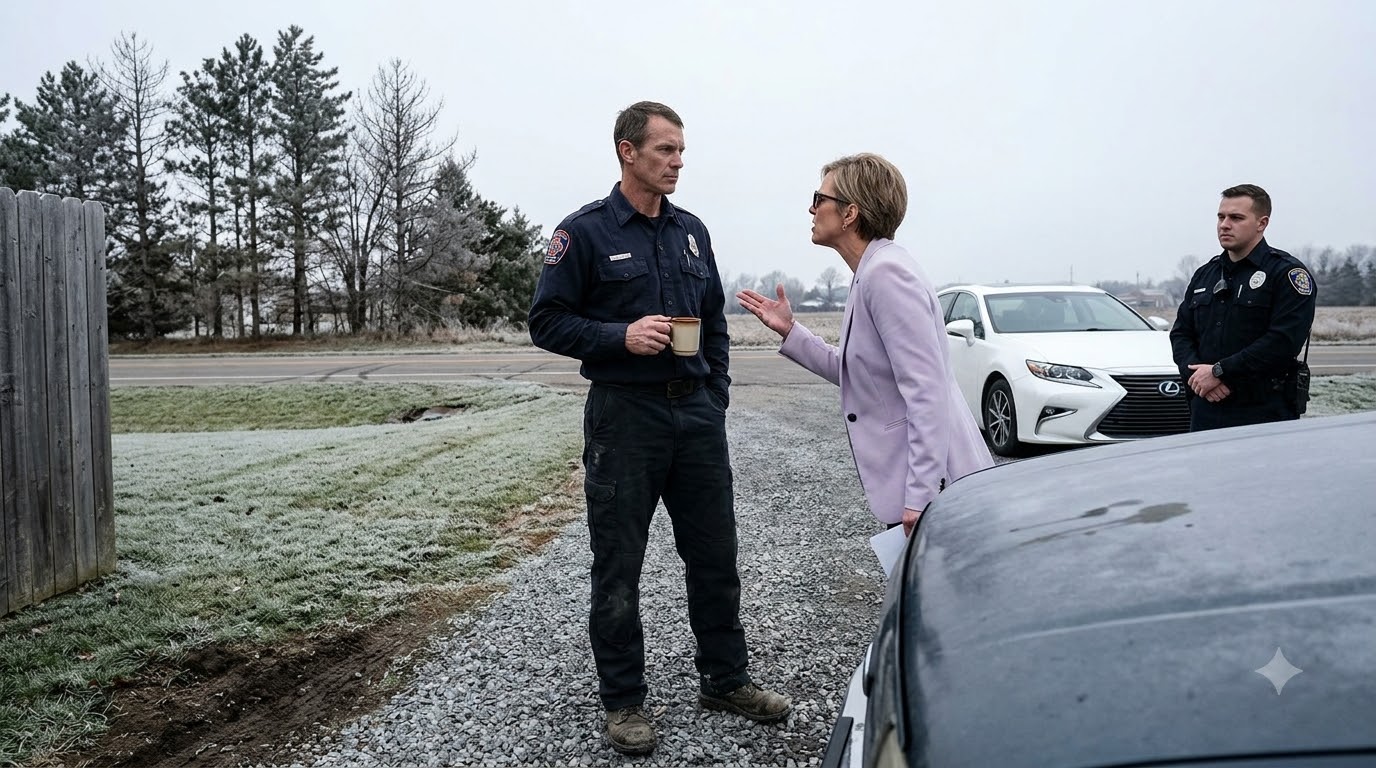
The frost on the gravel crunched beneath the young officer’s boots as he read from his notepad.
“Sir, we got a report of a squatter refusing to leave this common buffer zone,” the cop said, avoiding my eyes.
Across the road, Claudine Mercer stood with her pastel blazer buttoned tight against the morning chill, her oversized sunglasses hiding whatever triumph she was savoring. She looked ready to snip a ceremonial ribbon with a pair of golden shears.
I took a slow sip of black coffee, feeling the heat travel down my chest. My old fire and rescue sweatshirt hung heavy on my shoulders, smelling faintly of the damp earth and diesel from the barn.
“If this driveway is trespassing, officer, I’ve been breaking the law every morning for six months,” I said, keeping my voice level.
Claudine stepped off the asphalt, her heels clicking sharply against the gravel as she closed the distance. “He has no legal right to this land, Officer Miller! That structure and this drive belong to Maple Hollow Estates!”
My hand twitched toward the pocket of my sweatshirt where my fingers brushed against the smooth, cold edge of my ceramic coffee mug handle. I didn’t reach for the folder resting on the concrete steps. I didn’t pull out the county clerk’s stamped deed that would instantly end her performance.
The handicap we carry isn’t just the rules they invent; it’s the patience required to watch them dig their own graves without handing them the shovel too early.
Officer Miller looked between Claudine’s outstretched clipboard and my bare feet on the frost-bitten dirt. The air smelled of pine and distant exhaust, cold and sharp in the early dawn.
“Mr. Reeves,” the older backup officer said, stepping closer with a careful, measured stride. “You got something that clears this up, or do we need to sort this down at the station?”
I let out a slow breath, watching the steam curl away from my face into the gray morning air.
“Give me one second, officer,” I muttered, setting the heavy mug down on the hood of my truck with a dull, echoing clank.
CHAPTER 2: The Paper Trail
Officer Miller stared down at the crisp paper, his thumb running over the bottom edge where the municipal crest should have been stamped if it belonged to the subdivision.
“This isn’t a neighborhood plat, Mr. Reeves,” Miller said, his voice dropping an octave as he glanced sideways at Claudine’s tightening posture.
“That’s because my land was surveyed thirty years before a single one of these cookie-cutter houses was framed,” I replied, reaching back down to pick up my coffee mug.
Claudine stepped into my peripheral vision, her breath frosting in the thin morning air like steam off a radiator. “He altered those records, Officer! Look at the margins! That property line was rewritten to encroach on our common buffer zone!”
I didn’t blink. I didn’t raise my voice.
You don’t shout back at a grease fire; you starve it of oxygen and check the structural integrity of the walls.
The backup officer handed the paper back, shaking his head slightly. “Civil matter, Claudine. You’ll have to take this up through property court or the county assessor’s office. We can’t issue a trespassing citation on a disputed boundary.”
Her sunglasses slid down the bridge of her nose just enough to reveal eyes narrowed to hard, glittering slits. “This isn’t over, Mark. The association will levy fines until you can’t afford to breathe the air on this street.”
She turned on her heel, her designer boots crunching aggressively against the gravel as she marched back toward her white Lexus idling three houses down.
Ten minutes later, the cruisers pulled away, their red and blue lights fading into the pale Tulsa morning.
I walked back inside, the slam of the heavy wooden door cutting off the hum of the suburban traffic.
On the kitchen table, the two maps lay side by side under the glare of an overhead fluorescent bulb.
The county’s official blue-line plat ended twenty feet short of my barn, stamped clean and legitimate.
The HOA’s color-printed map painted my entire yard in a soothing shade of bureaucratic turquoise, labeling it a community retention zone.
I ran my calloused thumb along the edge of the HOA document, feeling the slight bump where a modern thermal printer had layered ink over an older photocopy.
The date stamp in the corner didn’t match the county’s registry index by three days.
A single digital mismatch hidden in plain sight, left behind by someone who thought nobody would ever check the backend data.
I picked up the landline and dialed a number I hadn’t used since I hauled her mother out of a burning attic twelve years ago.
“Sonia,” I said when the line clicked. “I need you to look at a set of blueprints and a very crooked signature.”
CHAPTER 3: The Neighborhood Wall
Sonia dropped her navy briefcase onto the wooden table with a heavy thud that rattled my coffee mug.
“The boundary map is only the top page of a much thicker file, Mark,” she said, leaning over the paperwork.
The screen door rattled as Miguel stepped into the kitchen, wiping grease from his knuckles with a dirty shop rag.
“She tried to slap a seven-thousand-dollar fine on the Torres family over a treehouse that’s been standing since my kids were toddlers,” Miguel said, throwing the rag onto the counter.
I kept my eyes fixed on the mismatch in the margin. “It’s not about aesthetics, Miguel. It’s about building a paper trail big enough to force a foreclosure review.”
Sonia flipped open a manila folder filled with handwritten notes and photocopied bank notices from across the subdivision.
“Mrs. Keen got hit with a lien for roses that predated the association by a decade,” Sonia said, tapping a pen against the table. “They aren’t just making up rules; they’re manufacturing defaults.”
A bead of condensation ran down the side of my coffee mug, soaking into the grain of the wood table.
You don’t fight a neighborhood tyrant by yelling across the fence; you gather the broken pieces everyone else left behind.
Miguel pulled out a crumpled pink violation slip from his shirt pocket and dropped it next to the map.
“She changed the meeting minutes last month, Mark,” Miguel muttered, his jaw tightening. “Crossed out a vote on lighting maintenance and wrote in a private contractor fee instead.”
Sonia looked up, her expression hardening under the fluorescent light. “That’s not just a bylaws violation. That’s altering official records.”
The kitchen grew dead silent, save for the hum of the refrigerator in the corner.
We weren’t just dealing with an overzealous neighbor anymore.
We were looking at an organized squeeze designed to bleed people out of their homes.
CHAPTER 4: The Financial Breach
Sonia pulled a fresh stack of bank statements from her briefcase, the crisp paper sliding across the worn wooden table.
“The fake fines and altered meeting minutes were just smoke, Mark,” Sonia said, tracing a column of routing numbers with a sharp fingernail. “Look where these community enhancement fees actually ended up.”
I leaned in closer, squinting at the corporate entity name listed at the bottom of the ledger.
It wasn’t a municipal account or an approved neighborhood reserve fund.
It was a private shell company registered directly under Claudine Mercer’s maiden name.
“One hundred and sixty thousand dollars in eighteen months,” Sonia muttered, her voice dropping to a harsh whisper. “Siphoned straight out of neighborhood dues and landscape maintenance budgets.”
Miguel crossed his arms, staring down at the numbers with a dark scowl. “She was shaking people down for fake code violations just to fund her own private accounts.”
There’s a specific kind of cold fury that settles into your bones when you watch someone weaponize community trust for personal greed.
It’s the exact same sickening feeling you get when you kick open a burning door and realize the structural beams were hollowed out from the inside.
Sonia turned the final page, her expression tightening into a grim line as she pointed to a fine-print clause at the very bottom.
“That’s not even the best part,” she said. “Attached to their primary operational loan is a default acceleration clause.”
I raised an eyebrow, waiting for the trap to spring.
“In the event of an unrecovered HOA financial default,” Sonia said slowly, “whoever holds the purchasing lien at the bankruptcy auction legally acquires the entire association entity and all attached governance rights.”
CHAPTER 5: The Courthouse Auction
The gray Tulsa sky weighed heavy over the concrete plaza as my brother Caleb handed me the certified cashier’s check.
“The wire cleared half an hour ago, Mark,” Caleb said, his breath pluming in the damp air. “Sonia has the injunction filed with the clerk inside. If the bank accepts the bid, the debt defaults to our holding group.”
Across the wide stone steps, two real estate investors in charcoal overcoats whispered back and forth, casting sharp glances in our direction.
They thought they were here to pick over the bones of a mismanaged suburban subdivision.
They didn’t know the bylaws carried a fatal hook at the back of the ledger.
The auctioneer stepped up to the podium, adjusting his microphone with a sharp metallic screech that bounced off the courthouse facade.
“We are opening the floor for the remaining assets and controlling debt of Maple Hollow Estates,” the auctioneer announced, his voice flat and businesslike.
The first investor threw out a number that made a few people in the crowd murmur.
I didn’t blink. I kept my weight balanced evenly on both boots, feeling the biting cold through the soles of my work shoes.
You don’t rush a fire line until the oxygen burns out and the structure stops fighting back.
“Six hundred thousand,” the second investor countered, raising a hand.
I stepped forward, sliding the folder containing Sonia’s legal filings onto the corner of the podium.
“Six hundred and ninety-one thousand,” I said, my voice cutting cleanly through the damp morning wind.
The auctioneer blinked, looking down at the cashier’s check clutched in my calloused palm. “Bidder number four. Any counter?”
Silence hung over the plaza, broken only by the distant rumble of traffic on the interstate.
The gavel came down with a sharp, final crack.
And just like that, the man they tried to fine out of existence legally acquired the entire governing body of Maple Hollow Estates.
CHAPTER 6: The Final Gavel Fall
“You cannot buy this neighborhood, Mark!” Claudine shrieked, her voice cracking as she shoved past the county bailiff with her clipboard raised like a shield.
“Ma’am, according to the recorded bank default and bankruptcy court ruling, I just did,” I replied, keeping my posture entirely locked and steady against her furious advance.
Her pastel blazer shook with a sudden, uncontrolled twitch of raw rage as she realized there were no more fake violation letters left to send.
“This is fraud! My lawyers will have this auction thrown out before sunset!” she shouted, turning to the stone pillars for an audience that wasn’t there.
A pair of county detectives in plain clothes stepped out from the glass courthouse doors, holding a crisp white document bearing a wet judicial signature.
“Claudine Mercer,” the lead detective said calmly, holding up a pair of steel cuffs. “You’re coming with us to answer for one hundred and sixty thousand dollars in missing community funds and systematic wire fraud.”
The heavy click of the handcuffs snapping shut echoed against the concrete louder than any auction gavel.
She didn’t confess, and she didn’t apologize; she simply stared down at the cold metal on her wrists as her entire fabricated empire dissolved into thin air.
By evening, the county judge formally dissolved the Maple Hollow Homeowners Association and transferred all remaining assets into an independent community trust managed by the residents.
The weight that had hung over our front porches for months finally lifted, replaced by the simple, steady hum of normal life.
Now, every evening, I sit out under the old oak tree on my four acres, my coffee mug resting warm against my palm.
The air smells like fresh sawdust and wet earth after a late-spring rain.
Down the road, Mrs. Keen walks past with a warm plate of pie, and children’s laughter echoes across a neighborhood that finally belongs to the people who live in it.