The Weight of the Gate: A Precise Dismantling of Unearned Authority in the Dusty Gray
CHAPTER 1: THE MIDNIGHT INTRUSION
The concrete dust settled like ash in the harsh glare of my porch lights. It coated the dark stone of the pillar, turning the natural gray to a sickly, synthetic white. I didn’t rush forward. Rush was a mistake. Rush was what they expected.
I stood perfectly still, my breathing calibrated to a rhythmic, steady count. My phone was already recording, the timestamp ticking away in the corner of the screen like a countdown.
Tracy Harlo hadn’t even looked up when my lights snapped on. She stood near the edge of the public road, her blazer crisp despite the hour, her hands tucked neatly into the pockets of her slacks. She was the picture of administrative calm, the kind of calm that only exists when you are absolutely certain that no one will question your authority.
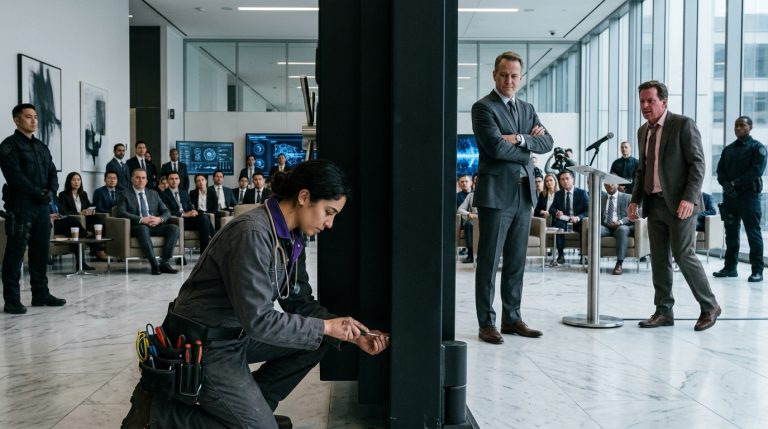
The foreman drilled again. The metal access box, a cold, gray lunch cooler of a thing, sat cocked at an awkward angle against the stone.
“Stop,” I said. My voice wasn’t a shout; it was a flat, heavy command that carried through the damp night air.
The foreman stalled, his drill bit shivering against the granite. He looked at Tracy.
Tracy turned toward me. She offered a smile that didn’t reach her eyes—a practiced, professional mask. “Emergency compliance, neighbor,” she said, her voice smooth and practiced. “You cannot interfere with official safety protocols.”
“Who hired you?” I asked, ignoring her. I walked toward the pillar, my boots crunching on the gravel. I kept my distance—a calculated buffer.
The foreman wiped sweat from his brow, his eyes flickering toward Tracy. He clearly didn’t want to be here at this hour. “We were authorized,” he muttered, sounding less like a contractor and more like a man repeating a script.
“By the association,” Tracy interjected, stepping slightly closer, though she stayed behind the safety of her workers. “We are formalizing your inclusion. It’s for the common good.”
I didn’t argue. I didn’t mention the deed sitting in my desk, nor the lack of any recorded easement. Debating philosophy with a woman who thought she owned the ground I stood on was a waste of energy.
“Leave,” I said, my gaze dropping to the box, then back to the foreman. “Now. Or I call the Sheriff.”
Tracy laughed—a small, sharp sound. “Call them. They know why we’re here.”
I pulled my phone away from the recording position and hit the 911 button, watching her face. For the first time, her mask flickered. It was subtle—a tightening at the corners of her mouth—but I saw it. She was counting on the uniform to legitimize the drill, to turn her trespass into a public service.
As the line connected, she signaled the foreman. He didn’t stop. He pressed the drill harder into my stone, and the smell of ozone and burning granite filled the air. Something was wrong. The box wasn’t just being mounted; it was being integrated. And as the foreman leaned into the pressure, I noticed something that made my skin crawl: he wasn’t using standard residential anchors. He was using a high-tensile industrial tap.
The kind used for securing heavy municipal infrastructure.
I stepped closer, the light of my porch catching the metallic glint of the bolt. “You’re not just mounting a box,” I said, my voice dropping.
Tracy’s smile turned cold. She watched the drill bit bite deep into my property, her eyes fixed on the pillar with a predatory hunger. “We’re making sure you can’t walk back out of this, neighbor.”
CHAPTER 2: THE PAPER SIEGE
The silence that followed the departure of the deputy was heavier than the noise of the drill. I stood in the dark at my gate, the smell of ozone and pulverized stone clinging to the air like the scent of a dying fire. My hands were steady, but beneath the skin, a low-frequency hum of adrenaline persisted. I didn’t head straight to the house. Instead, I walked the perimeter of my own driveway, my flashlight beam cutting through the gloom. I checked the boundary markers, the gate hinges, and the scarred pillar. The concrete scar was fresh—a raw, jagged wound in the stone that looked like a permanent reminder of Tracy Harlo’s overreach.
My house was dark, but the porch lights remained on, illuminating the driveway like a stage. I walked inside, the floorboards groaning under my weight, and went straight to my desk. This was my command center. The surface was cleared, save for a thick, leather-bound folder that held the history of my property—the original deed, the survey maps, the county records.
I sat down and opened my laptop. The blue light washed over the room, reflecting in the window where the night pressed against the glass. I needed a paper trail that was impossible to break. I began with the evidence I already had: the timestamped photos of the drilling, the video clip of Tracy directing the contractors, and the incident card the deputy had left in my hand.
The weight of the paper was grounding. I started drafting the preservation letter. It had to be precise, cold, and legally absolute. I felt the phantom itch of a past dispute—a border argument I’d handled years ago, where a neighbor had tried to move a fence by three feet under the cover of a weekend. I remembered the exhaustion, the way the bureaucracy had tried to wear me down with delays. This was different. Tracy wasn’t just grabbing land; she was fabricating infrastructure.
My mind began to sharpen, stripping away the emotional residue of the confrontation. I analyzed the work order the foreman had flashed at me. Install keyed access box. Authorized by T. Harlo. It was a laughable document, devoid of any official stamp or permit number. It was a bluff, a piece of theater masquerading as authority. But it was also a weapon. If I could prove she’d used HOA funds to facilitate unpermitted construction on private property, the board’s liability would balloon.
I reached for my phone and pulled up the PDF map Tracy had emailed earlier. I scrutinized the properties, the red line of the “emergency route,” and the way it bisected my land. It was a clean, digital lie. I saved the email, full headers included, and mirrored the file to an offsite cloud server.
I worked for hours. The house was deathly still, the air thick with the smell of old paper and dust. I cross-referenced the county’s public access records with the HOA’s stated mission. There were gaps. Significant, structural gaps. The more I looked at the map, the more it felt like I was looking at a puzzle missing its most critical pieces. Why here? Why now? The “emergency access” claim was a thin veil, but it was being draped over a specific patch of ground—the exact patch where the soil transitioned from the subdivision’s loose fill to the stubborn, ancient bedrock of my ridge.
I remembered the old geological survey I’d seen in the county archives years ago. It marked this specific ridge as a point of stability. For a developer or a board looking to bypass the subdivision’s crumbling, poorly drained foundations for new construction, this ridge was gold. The realization hit me with the force of a physical blow. The gate wasn’t just a gate; it was a key.
My phone buzzed on the desk—a notification from the security camera. I leaned in, heart drumming against my ribs. It was 4:12 a.m. Two headlights crawled slowly past my gate. A dark sedan. It didn’t stop, but it didn’t accelerate either. It moved at the speed of a predator assessing the terrain.
I didn’t turn on any more lights. I watched the screen, my hand hovering over the mouse. The car drifted onward, disappearing into the dark, but the message was clear. They were still watching, still calculating, still testing the perimeter.
I turned back to the screen and finished the letter. I added the demand for the preservation of all vendor contracts and board minutes, explicitly naming Tracy Harlo. My fingers felt like they were typing the final nail into a coffin. I sent the email to the management company, cc’ing the board.
The draft folder on my desktop stared back at me, a growing library of offenses. I was no longer just defending my driveway; I was mapping a siege. I leaned back in my chair, the leather creaking, and looked out toward the gate. The pillar stood in the shadows, waiting for the morning, and for whatever move they would make next. I had the records, the footage, and the law on my side, but I knew the nature of this game. You don’t win against someone like Tracy with a single checkmate. You win by patiently dismantling their board, one piece at a time, until they have nowhere left to move.
I stood up, my muscles tight, and walked back to the kitchen to pour a cup of water. The house was quiet, but I could hear the wind brushing against the trees, a low, rhythmic sound like a warning. I checked the lock on the front door, then the back. The boundary held, but the perimeter was shifting. I could feel it. Tomorrow, the sun would rise, and the paper would start to do its work. But tonight, I just had to be the wall they couldn’t break.
I stared into the dark, waiting for the dawn, knowing that the real fight was only just beginning.
CHAPTER 3: THE COUNTERSTRIKE
The chime of the email notification cut through the room like a physical blow. I leaned back, my chair protesting with a sharp, metallic groan, and stared at the screen. The subject line was innocuous: Clarification Regarding Complaint #882-B. I didn’t open it immediately. I sat in the darkness for a moment, letting the rhythm of my own heart settle. This was the pushback. Tracy wasn’t going to let a mere preservation letter silence her; she was going to lean into the bureaucracy, using the fire department’s own channels to tighten the noose.
I clicked. The message was from a secondary contact at the fire prevention office—a thin, bureaucratic excuse about a “clerical error” regarding the egress mapping. They were attempting to pivot the narrative, shifting the blame onto an administrative mistake while simultaneously reiterating the need for “urgent access.” It was a classic misdirection, an attempt to normalize the intrusion by recasting it as a simple, unavoidable procedural oversight.
My jaw tightened. They were trying to bait me into a defensive argument about administrative errors. If I engaged on their terms—debating the accuracy of the filing—I would be playing right into their hands, validating their premise that access was necessary.
I picked up the phone. I didn’t call the fire marshal. I didn’t call Tracy. I called the county’s public records administrator—the same one who had handled my initial request. My voice was steady, stripped of all emotion, focused entirely on the utility of the ask.
“I need the full packet for complaint 882-B,” I said, bypassing the usual pleasantries. “Specifically, the correspondence logs between the HOA management company and the office. I want the metadata on the attachments. All of it.”
The administrator hesitated. “That’s a comprehensive request, sir. It might take—”
“I have the timestamp of the original filing,” I cut in, my voice sharp enough to stop the protest. “I’m looking for the correlation between the filing and the internal notes. This is a matter of property rights, and I’m documenting the sequence for counsel.”
The shift in the administrator’s tone was instantaneous. Bureaucracy is a creature of self-preservation; it fears liability more than it fears a vocal resident. “I’ll see what I can pull up,” they murmured.
I hung up and returned to the email. I drafted a response, but not to the fire marshal. I sent a concise, formal note to the management company, blind-copying the board members. I didn’t argue the “clerical error.” I simply attached the timestamped photo of Tracy on my property at 2:13 a.m. and asked for the specific policy that allowed HOA-directed construction on private land under the guise of an unapproved clerical fix.
The strategy was simple: turn their administrative leverage into a liability. Every step they took to force the issue had to be documented, signed, and exposed.
The house felt smaller than it had an hour ago. I walked to the kitchen, the floorboards cold beneath my feet. I poured another cup of water, watching the dark trees sway outside the window. The sedan from earlier hadn’t returned, but the feeling of being watched remained. It was a tangible pressure, a weight against the back of my neck.
I checked the security monitor again. The gate stood silent, the concrete scar still fresh and jagged in the infrared light. It was a physical manifestation of their intent—a stake driven into my land, waiting for the moment I faltered. I reached out and touched the glass of the monitor, tracing the line of my property.
I wasn’t just fighting a neighbor. I was fighting a system that relied on the assumption that individuals would eventually tire of the friction. They counted on the “always successful” line, the confidence of the blazer, the exhaustion of the homeowner.
I went back to my desk. My folder was growing, the stack of papers rising like a rampart. I spent the next three hours mapping the flow of information. I tracked the PDF property data, comparing the author signatures on the fire marshal’s documents with the ones sent in the HOA blast. They matched. It wasn’t just the HOA pushing this; it was a coordinated effort to frame the county’s resources.
The logic of their attack was clear. They were creating a reality through repetition. If they filed enough forms, if they used enough official-looking maps, if they bullied enough inspectors, the truth of my deed would become irrelevant. Reality, in their view, was what was recorded in the system.
I leaned back and looked at the clock. 5:48 a.m. The first hint of gray was bleeding into the horizon. I was tired, a deep, bone-weary fatigue that comes from hours of focused, grinding labor, but my mind was clear. I had the records request in motion. I had the emails documented. I had the physical evidence of the trespass.
I stepped out onto the porch, the air crisp and biting. The morning stillness was absolute. I looked at the gate, at the mess they had made of the stone. It looked different now. It didn’t look like a threat; it looked like a mistake. A piece of physical evidence that proved their intent.
I took a deep breath, the cold air stinging my lungs. I was ready for the weekend. I had the binder, I had the law, and I had the focus. They wanted a fight? I would give them the most bureaucratic, technical, and relentlessly documented war they had ever encountered.
I watched the light grow, the world slowly shedding its mask of night. In the distance, I heard the faint, rhythmic sound of a mower—a mundane, suburban rhythm that felt alien compared to the quiet intensity of my own morning. The neighbor was starting his day, unaware that the rules of his neighborhood were being rewritten in the dark.
I walked back inside, shut the laptop, and went to the kitchen. The coffee pot hissed, a sharp, synthetic sound that mirrored the tension in my chest. I poured a mug, the heat radiating through the ceramic, and stood at the window, watching the street. I didn’t have to win today. I just had to hold the line until the paper trail caught up with them. And when it did, it would be as heavy as the stone they had broken.
CHAPTER 4: THE SATURDAY RECKONING
The gravel driveway crunched under the weight of a dozen vehicles, a rhythmic, abrasive sound that signaled the start of the standoff. I stood on my porch, the cold morning air biting at my skin, watching the parade of sedans, SUVs, and a single, idling contractor truck maneuver into position. Tracy Harlo stepped out of her vehicle in a blazer of sharp, unforgiving navy, her posture as rigid as a courtroom stenographer. Behind her, the board members moved with a practiced, orchestrated unity, while a handful of curious residents lingered near the edge of the public road, their faces tilted toward my gate like spectators at a crash site.
I didn’t descend immediately. I watched from the elevation of the porch, my hands tucked into my coat pockets, my phone already recording the scene. The fire marshal arrived five minutes later, his department truck rolling to a stop with the authority of a judge.
“Good morning,” the fire marshal said, stepping out, his eyes scanning the property with a practiced detachment that sent a warning flare through my gut. He didn’t look at me; he looked at the gate, at the scar in the stone, and then at Tracy.
“Marshal,” Tracy said, her voice projecting, a practiced performance for the small crowd of residents. “We’re just looking to resolve the safety issue. The keyed access box is the only way to ensure the community’s compliance.”
I stepped down the porch stairs, my boots striking the concrete with a slow, deliberate cadence. I didn’t need to hurry. The pace of this confrontation was mine to set. I walked past the edge of the grass and stood in the center of the driveway, the barrier between them and my gate.
“The access box,” I said, my voice cutting through the hum of idling engines, “was installed without a permit, without an easement, and in direct violation of my property rights.”
Tracy didn’t even flinch. She turned to the fire marshal, her expression one of weary, enlightened patience. “This is exactly what we’re talking about. The refusal to acknowledge the communal necessity of this route.”
The marshal looked at me. His expression was unreadable—a mask of professional neutrality that felt, in this light, suspiciously rehearsed. “I’m here to document the site, sir,” he said. “The complaint regarding obstructed egress is still active.”
I felt the shift then—the V-4 realization. The way he looked at the stone, the way he seemed to be measuring not the safety of the path, but the ease of its removal. Something wasn’t right. I moved to the pillar, placing my hand on the cold, damaged stone.
“You’re here to document,” I repeated, my voice dropping, “or are you here to validate a trespass?”
The silence that followed was sharp. The fire marshal’s eyes narrowed, just a fraction. He stepped forward, his boots stirring the dust. He looked at the installation, the metal box looking increasingly out of place against the ancient granite.
“I am here to determine if this installation fulfills the requirement for emergency access,” he said, his tone clipped.
“It doesn’t,” I said. “Because there is no legal requirement for access across private land. I’ve reviewed the title records, the subdivision covenants, and the county’s own zoning maps. There is no easement.”
Tracy laughed—a brittle, high-pitched sound that grated against the nerves. “Title records are documents, but safety is a reality. We are creating the reality the community needs.”
I pulled the binder from under my arm. It was a dense, heavy thing, filled with the printed logs, the timestamps, and the documented emails. “Reality,” I said, “is defined by the chain of command and the rule of law. You filed a complaint using a map that you modified yourself. I have the metadata, Tracy. I have the last-modified timestamps. You didn’t find an emergency; you designed one.”
The crowd of residents had gone silent. The board members exchanged a quick, nervous glance. The marshal stopped, his hand hovering over his clipboard. He looked at Tracy, then at me, the neutral mask beginning to fray at the edges.
“Is this true?” the marshal asked, his voice losing its rehearsed quality.
Tracy’s composure flickered, just for a second. She straightened her blazer, her chin lifting. “We’re working within the existing framework to ensure public safety. The homeowner’s obstruction is the issue, not the documentation.”
I stepped toward the marshal, closing the distance, forcing him to acknowledge the documents in my hand. “The documentation is the issue,” I said, my voice low and hard. “You’ve been used to provide legal cover for a private development strategy. If you sign off on this today, you’re not just approving a gate; you’re complicit in the fabrication of a zoning violation.”
The marshal pulled back, his eyes searching my face. He looked at the installation—the raw concrete, the unpermitted drill holes—and then at the group of residents standing behind the gate, their excitement replaced by a growing, uneasy tension.
He didn’t speak. He reached into his pocket, pulled out his own phone, and checked his messages. His brows furrowed. I watched his face—the way his eyes darted toward the HOA board, the way he looked at the gate as if it were a physical weight he no longer wanted to carry.
“Nobody touches this,” he said, his voice suddenly sharp, directed at the contractor standing with his hands in his pockets. “I need to review the underlying records of this complaint. Right now.”
Tracy started to protest, but he waved her off with a motion that was dismissive, almost hostile. The power dynamic in the driveway had shifted. The confidence that had fueled her entrance was dissolving, replaced by the chaotic, uncertain friction of a reality that wasn’t bending to her will. I stood my ground, my hand on the cold stone of the pillar, waiting for the truth to finish surfacing.
CHAPTER 5: THE COURTROOM SILENCE
The silence in the driveway was no longer the quiet of a standoff; it was the suffocating stillness of an collapse. The fire marshal was still looking at his phone, his thumb hovering over the screen, while Tracy’s face had lost its polished sheen. She looked, for the first time, like an administrator who had miscalculated the variables.
“I need to speak with the board,” the marshal said, his voice clipped, not bothering to look at Tracy. He turned on his heel and walked toward the small cluster of board members who had been hovering near the edge of the property.
I stayed by the pillar. My hand was still resting on the rough, damaged granite. The foreman was still holding his clipboard, looking increasingly like a man who had backed the wrong horse. I reached out, my fingers brushing against the edge of the work order he had been clutching.
“Let me see that,” I said, my tone low and conversational, as if we were discussing the weather.
He hesitated, then handed it over, his fingers trembling slightly. It was a flimsy piece of paper, but as I turned it over, the light caught a smudge of graphite on the back. It was a note, scrawled in an aggressive, sharp-angled hand: Must bypass survey line by 09/12. Zoning hearing on 09/14.
I felt a cold shiver of clarity. September 12th was the date the original boundary survey was meant to be finalized—a date that sat three decades before this subdivision had even been platted. They weren’t just annexing a driveway; they were attempting to leverage a ghost property line to force through a zoning exception that would turn this entire ridge into an industrial buffer zone.
I folded the paper and tucked it into my jacket pocket. The decoy—the “emergency access”—had served its purpose. It was a loud, aggressive lie designed to distract from the quiet, permanent theft of the land’s underlying utility.
“The work is done for today,” the marshal announced, returning to the center of the driveway. He looked at Tracy, his expression cold. “I’m issuing a stop-work order. Pending a full review of the filing history and the validity of the alleged egress requirement.”
Tracy’s mouth opened, then closed. She looked at the crowd, at the residents who were now whispering, their gazes shifting from her to the scarred stone pillar. The performative weight of her authority had vanished.
“This isn’t over,” she said, her voice strained. “The board will—”
“The board will wait for the county’s report,” the marshal interrupted. He turned to me. “I’ll need those documents you mentioned. The ones proving the lack of easement.”
“They’re already being delivered to your office,” I said.
As they dispersed—a chaotic retreat of gravel crunching under tires and muttered arguments—I remained by the gate. The foreman, before he climbed into his truck, looked at the concrete box, then back at me. “I didn’t know,” he muttered, his voice barely audible. “I was told it was municipal.”
“You were told wrong,” I said.
When the last vehicle cleared the road, the silence returned, but it was a different kind of quiet. It was the silence of a space that had been reclaimed. I pulled out my phone and dialed the number for the judge’s chambers. The temporary restraining order application was already drafted; I just needed the incident number and the marshal’s official statement to seal it.
The process was the armor. I felt the weight of it in my pockets—the folded note, the incident card, the promise of the court’s intervention. I walked back toward the house, my pace steady and rhythmic. The driveway was still scarred, the concrete still wet, but the threat had been stripped of its teeth.
I sat down at my desk, the room now filled with the golden, slanted light of a late Saturday afternoon. I began the process of filing, uploading the final exhibits, and formatting the narrative of the morning’s confrontation. Every click of the mouse was a deliberate act of reconstruction. I wasn’t just defending my land; I was meticulously cataloging the architecture of their failure.
The house felt like a fortress again. I could hear the hum of the hard drive, a steady, cooling sound that matched my own pulse. I worked through the afternoon, the world outside fading into a blur of gray shadows and rust-colored light. I had the truth now—the deeper, uglier truth that had been buried under the guise of an emergency.
I paused, leaning back to look at the gate on the monitor. It was silent, standing guard at the edge of the world. I had the leverage, I had the evidence, and I had the focus. Tomorrow would be the quietest day I had ever spent in this house. And when the court date arrived, there would be no more noise. Just the slow, methodical grinding of the law, turning the wheels of justice until they crushed the lie into dust.
CHAPTER 6: THE AFTERMATH
The report arrived by certified mail, a thick, heavy envelope that felt significantly more substantial than the trivial notices Tracy Harlo had been sending for months. I sat at my desk, the same desk where I had spent the long, grinding nights cataloging the fraud, and let the envelope rest on the wood. The house was quiet, the air settling into the familiar, reclaimed stillness of a home that was finally, truly mine again.
I slit the seal. The pages were crisp, printed on heavy stock, and they contained the administrative death knell for the HOA’s ambitions. The county inspector’s findings were explicit: not only was the gate installation a violation of private property rights, but the “emergency egress” petition was built on a series of fabricated survey maps that deliberately ignored the actual geological boundary of the ridge.
It wasn’t just incompetence. It was a calculated, multi-year attempt to annex the property, clear the way for a high-density project that would have bypassed the subdivision’s failing septic and foundation infrastructure. Tracy and her board weren’t just power-tripping; they were attempting to pave over the legal reality of the ridge to secure a massive zoning windfall. The “safety” argument was just the dirt they used to bury the truth.
I read the final page twice. The conclusion was a formal recommendation for sanctions against the HOA management company, citing “willful misrepresentation of infrastructure and property boundaries.”
I stood up, the chair scraping against the floor, and walked to the door. I needed to see the gate. I walked down the gravel drive, the crunch of stone beneath my boots no longer sounding like a warning, but like a settled, steady rhythm. The sun was setting, casting long, bruised shadows across the yard, and the air smelled of dry earth and cold iron.
When I reached the gate, I stopped. The concrete scar was gone. The contractor, under the watchful eye of the county inspector and the deputy, had finished the removal days ago. The stone pillar was patched—not perfectly, a slight discoloration in the gray granite remained—but it was whole. I reached out and ran my fingers over the patch. It was smooth, solid, and held against the pressure of my palm.
Repairs always leave a mark. I looked at the seam where the stone had been broken and mended. It was a scar, but it was mine. I had stood my ground, not with shouting or violence, but with the cold, relentless weight of the paper trail. I had treated the law as a structural component, something to be measured and applied with the same precision as a weld or a seal.
I took out my key and slid it into the lock. It clicked—a crisp, mechanical sound that echoed in the quiet air. The gate swung open, and I stepped through, walking the few yards to the public road. I stood there for a moment, looking back at the house. It sat firm on the ridge, the lights casting a warm, steady glow against the encroaching twilight.
I thought about the residents who had walked by, the ones who had slowly begun to realize that the “always successful” line was just a hollow script. They were beginning to ask questions, to demand transparency, and the HOA board was dissolving under the pressure of its own exposed secrets. The board members were resigning, one by one, their polished blazers and practiced smiles unable to withstand the scrutiny of the truth.
I walked back through the gate and pulled it shut. It latched with a final, definitive sound. The boundary was secure.
I returned to the house, but instead of heading straight for the desk, I stopped in the kitchen. I made a cup of coffee, the smell filling the small room, and carried it to the living room window. I sat in my chair, the one that faced the ridge, and watched the night settle in. The tension of the last few months was beginning to bleed out of me, leaving behind a kind of quiet, atmospheric peace.
The battle hadn’t been a crusade; it had been maintenance. A long, exhausting, and necessary piece of home maintenance. Someone had tried to claim what wasn’t theirs, and I had simply applied the pressure required to push them back.
My phone buzzed on the side table—a final notification from the county portal. The case was closed. The TRO was permanent. The costs had been settled, the repairs were finalized, and the neighborhood had started the slow, difficult process of re-establishing its own integrity.
I looked at the coffee in my mug, the surface still and dark. I had learned the rhythm of the game now. I understood that authority was often just a mask, and that the only way to tear it off was to hold the mirror up to the reality behind it. My boundaries were intact, my life was my own again, and the ridge remained, solid and unyielding beneath my feet.
I finished the coffee, set the mug down, and looked out into the dark. The house was quiet, the world was settled, and for the first time in a very long time, there was nothing left to defend. The truth hadn’t been a weapon; it had been the floor on which I stood. And now, I could finally be still.