The Resonance of Borders: How One Man’s Quiet Reclamation Restored a Fragmented Valley to Peace
CHAPTER 1: The First Incursion
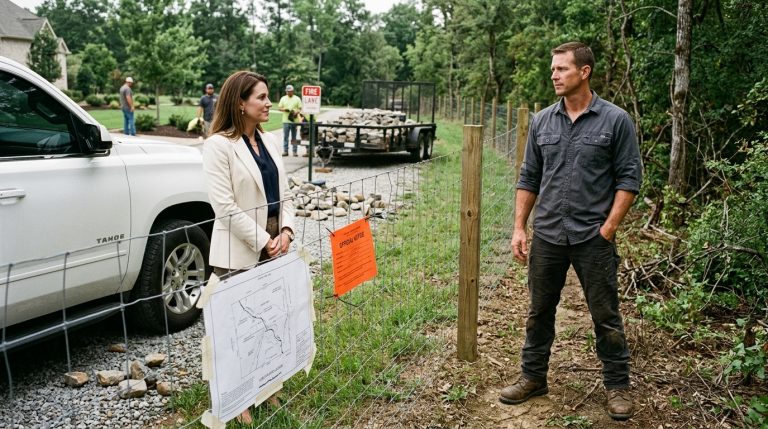
The air on the ridge never truly sits still; it holds the faint, metallic scent of iron-rich earth and the dry, rasping sound of pine needles shifting in the wind. I stood on the edge of the turnout, the gravel crunching softly under my boots, watching the white SUV roll to a stop at the base of the gate. The HOA logo on the door was a clean, plastic rectangle, jarringly bright against the weathered gray of the mountainside.
Karen stepped out. Her movements were practiced, fluid, the kind of economy of motion that suggested a life spent directing environments rather than living in them. She adjusted a pair of sunglasses, her gaze scanning the retaining wall with a proprietary interest that felt like an intrusion.
“It’s good to finally meet you,” she said, her voice carrying easily up the slope. She offered a hand, but I remained still, my weight balanced evenly, my hands buried in the pockets of my jacket. I didn’t reach for her. I didn’t move toward the edge.
“We’ve been reviewing the Ridge Emergency Flow,” she continued, her smile thin and precise, “and your gate and turnout came up. We’re looking at wildfire readiness, emergency apparatus sweeps. Your setup—it may need to be modified.”
The word hung in the air, weighted with the false gravity of public concern. She spoke with the lilt of someone who expected the world to rearrange itself around her sentences. I looked at the turnout—the wall I had braced against the spring runoff, the gate I had positioned to protect the privacy of the road above. It was a structure of utility and hard labor, not aesthetic design.
“My gate and turnout aren’t yours to review,” I said. My voice was low, devoid of the heat she was clearly expecting.
Karen gave a short, airy laugh, a sound that ruffled the silence of the valley. “This isn’t adversarial, please. We’re looking at community circulation. It’s for the greater good of the ridge.”
The greater good. It was a phrase meant to signal benevolence, but as she spoke it, her eyes flickered toward the gate, calculating, measuring, dissecting. She didn’t see a retaining wall; she saw a clearance issue. She didn’t see my property; she saw a line on a map that was currently failing to serve her intent.
I watched her, noting the way she gripped the folder in her hand, the way her posture remained locked in an authoritative tilt. She was here to negotiate, but she had already decided what the outcome would be. I felt the familiar, cold clarity of a chess player assessing an opening gambit.
“Modified by who?” I asked, my voice steady.
“By whoever needs to make the ridge safe,” she replied.
The simplicity of the lie was almost elegant. She wasn’t asking; she was announcing a process. As she began to explain the “recommendations,” I glanced down at the edge of the turnout. A faint, nearly imperceptible smudge of orange chalk marked the stone near the wall—a remnant of a survey that had happened long before she arrived today.
She hadn’t come to start a conversation. She had come to finish a process she’d already initiated. I felt the paper in my pocket, the blank notebook where I had already begun to mark the dates and the movements of the HOA, and I knew then that the silence of the mountain was about to be broken by a very different kind of sound.
“I’ll take your notes,” I said, stepping forward at last, the movement deliberate and final. “But know this: the wall stays.”
Karen blinked, her smile faltering for the briefest of seconds before she smoothed it back into place, but the reflection in her sunglasses had already shifted. She saw me looking at the paint. She didn’t know yet that I saw the timeline.
CHAPTER 2: The Archive of Shadows
The silence that followed my refusal wasn’t the natural silence of the ridge. It was a pressurized thing, thick with the weight of Karen’s unspoken expectation. She remained standing there for a moment, the sunlight washing out the colors of her vest, her shadow stretching long and sharp across the gravel. She didn’t argue. She didn’t protest. She simply tapped a rhythmic, impatient cadence against the folder with her thumbnail, the sound like a ticking clock in the middle of a desert.
“It’s a matter of community alignment,” she said, her voice softer now, almost conspiratorial. It was the tone of someone trying to manage a faulty machine, not a person. “If you make this difficult, the administrative process will only become more… formal.”
I didn’t answer. I watched her drive away, the white SUV kicking up a fine, choking cloud of dust that hung in the air long after the engine noise faded. When the silence finally returned, it felt bruised.
I turned back to the turnout. My boots felt heavier on the slope. The orange paint line on the retaining wall caught the late afternoon light, a neon scar against the earth-toned stone. I knelt down, the smell of damp, turned soil rising from the edge of the turnout where the contractors had walked. A sudden, jagged memory surfaced—the feeling of a cold winter morning years ago, the bite of the wind, and the sound of a surveyor’s stake being hammered into the ground on the opposite side of the ridge. It was the same sound, the same intent: the carving up of something that was never meant to be subdivided.
I didn’t head inside. I took my phone out and began the work.
I photographed the orange mark from three different angles, ensuring the scale of the wall was visible. I documented the tread patterns left by the contractors in the soft dirt, the exact location of the loader, and the timestamp—4:12 PM. The digital readout on the screen was a steady, emotionless anchor in the chaos.
Inside the house, the air was cool and smelled of old paper and ozone. My office was a small room facing the valley, dominated by a wall of shelves where I kept the records of the land—the original parcel maps, the dated receipts for every ton of stone, every yard of concrete, every permit I had ever filed. I pulled the master folder, the one titled Access & Boundary, and set it on the desk.
I started a new document: Timeline: Ridge Emergency Flow/Karen.
I began to map the data points. The date of the first visit. The specific, practiced phrases she used. The metadata of the glossy packet she had left behind—I opened the file properties on my computer, watching the cursor blink in the empty white space of the screen.
Creation date: four days before she first climbed this road.
I sat back, the chair groaning under the shift in weight. The realization didn’t come as a shock; it came as a confirmation of a pattern I had seen in others, though never so cleanly packaged. The plan existed before the consultation. The “emergency” was a costume, a sterile, bureaucratic mask designed to hide a very simple, very human greed. She wasn’t building for safety; she was building for control, and she was using the architecture of an HOA to legitimize it.
I opened the county website, navigating the labyrinthine menu to the fire marshal’s public portal. I needed to see what, if anything, had been filed. My fingers moved across the keyboard with a steady, rhythmic discipline. I wasn’t pacing. I wasn’t venting. I was building a barricade.
Every line of code, every PDF header, every timestamp was a brick. If she wanted to play by the rules of procedure, I would build a structure of evidence so dense, so meticulously ordered, that she wouldn’t be able to step through it.
I spent hours in the quiet, the only sound the hum of the computer fan and the distant, lonely call of a hawk circling the valley floor. I found the draft version of the Ridge Emergency Flow plan. I cross-referenced the file size and the internal revisions against the date she had first arrived at my gate. The discrepancy was there, hidden in the digital footprints—a modification made to the document after she had already begun to lobby the board.
The phone buzzed on the desk. A notification from the neighborhood group. I hesitated, then tapped the screen.
Karen had posted.
Regarding the Ridge Emergency Flow: We are currently working with non-compliant property owners to ensure our fire safety readiness is absolute. Cooperation is essential for the collective survival of the ridge.
The language was surgical. It painted me as a threat, a selfish obstacle in the path of the collective good. It was designed to provoke a reaction, to force me into the public square where the rules were emotional and chaotic. She wanted me to shout. She wanted me to lose my composure.
I turned the phone face down, the black glass catching the moonlight that had begun to bleed through the window. I didn’t reach out to anyone. I didn’t post a rebuttal. I simply saved a screenshot of her message, added it to the folder, and closed the laptop.
Outside, the ridge was bathed in silver. I walked onto the deck, the wood cool and hard beneath my palms. The mountain stood silent, indifferent to the maneuvers of the people living on its slope. But I knew the terrain better than she did. I knew that when you build on a slope, you have to account for the runoff, the erosion, and the weight of the structure. She was building on a foundation of sand, and she didn’t even realize the ground was already beginning to shift.
I picked up a piece of charcoal from the grill, feeling the rough texture between my thumb and forefinger, and drew a single, thin line across the back of the folder—a reminder that the battle wouldn’t be won by who shouted loudest, but by who remained standing when the process finally exhausted itself.
CHAPTER 3: The Widening Perimeter
The dawn didn’t bring clarity; it brought a restless, muted light that bled over the crest of the ridge, turning the valley floor into a pool of gray mist. I didn’t sleep well. The image of that orange paint—bright, synthetic, and invasive—kept reappearing in the back of my mind.
I stepped onto the porch just as the sun cleared the pines. The air was sharp, smelling of pine resin and the cold, damp earth that follows a mountain night. I held a cup of coffee, the steam curling upward into the stillness, but my attention was pulled toward the road.
I walked down to the turnout. My eyes immediately sought out the line I’d observed the day before. It was still there, a vibrant, unnatural smear against the natural slate of the retaining wall. But as I moved closer, intending to scrub the pigment away with a wire brush, I stopped.
Twenty yards down the road, near the property line of the neighbor below me, I saw another mark.
It was identical—a sharp, orange vertical slash on a boulder that marked the beginning of their drainage ditch. My pulse tightened, a slow, methodical contraction. I walked toward it, my boots making no sound on the packed dirt of the shoulder. This neighbor, a retired engineer named Miller, had kept his land as untouched as mine. He had no gates, no retaining walls, just a steep slope that he’d stabilized with native brush and root systems.
If they were marking his land, this wasn’t about my gate. It wasn’t even about the turnout.
I moved to the next marker, then the next. I followed the line of orange paint for nearly a quarter-mile. They were systematically mapping the ridge, using the language of “emergency clearance” to stake out a path that cut through every private parcel along the incline. It was a digital map brought into the physical world, a blueprint of a future where the ridge was no longer a collection of private homes, but a managed, standardized asset of the HOA.
I didn’t reach for my phone immediately. I stood in the middle of the road, the silence of the ridge feeling suddenly precarious. I felt like an architect standing in the middle of a foundation that was being undermined by a ghost.
I returned to my desk, the sense of urgency now replaced by a cold, sharpened focus. I pulled the county documents I had gathered—the ones I’d spent hours analyzing the previous night. I needed to know if this was a county-approved survey or if the HOA was performing an unsanctioned pre-visualization.
I called Miller. He picked up on the third ring, his voice sounding raspy with sleep.
“Morning, Miller,” I said, keeping my tone neutral, casual. “Did you notice anyone out by the lower turnoff yesterday?”
There was a pause, the sound of the receiver shifting. “Saw a truck. White SUV, had some sort of branding on the door. Why?”
“Did they talk to you?”
“No. Just stopped for a minute. Took a picture, marked a rock, and kept moving. Thought they were doing the road grading until I saw the paint.”
“They didn’t give you any documentation? Any notice about emergency sweeps?”
“Not a word.”
I hung up, the implications locking into place like heavy gears. They weren’t just trespassing; they were bypass-mapping. They were operating in the shadows of the “emergency” designation, gambling that no one would dare challenge a process framed in the vocabulary of safety.
I spent the next three hours at the computer, not just documenting, but comparing. I pulled property records, surveyor maps, and the original covenants of the HOA. The covenants were clear: the HOA had jurisdiction over communal roads and common areas, but they had absolutely zero authority over private, non-member parcels. Yet, the paint lines were crossing those boundaries with reckless, mechanical precision.
The phone rang. It was a restricted number. I let it go to voicemail.
“This is the HOA planning committee. We are conducting the final phase of the ridge-wide emergency survey. We’ll be at your gate tomorrow at 9:00 AM to perform the final measurement of the turnout. Please be present to facilitate the access.”
The voice was cold, professional, and entirely devoid of the pretense of “coordination.” They weren’t asking anymore. They were moving to the next stage of the timeline.
I didn’t call them back. Instead, I stood up and walked to the window. The mist had lifted, and the ridge was bathed in the harsh, revealing light of the late morning. I watched the road, waiting for the first sign of movement. I had enough evidence to prove the intent, enough to prove the trespass, and enough to prove the fraud.
But I needed a lever. A process like this, built on the shifting sands of a manufactured crisis, had to have a structural weak point. I looked at the map again, tracing the path of the orange paint. It didn’t just cut across the parcels; it looped around the community center, the only piece of land the HOA actually owned.
That was it. The entire emergency flow plan didn’t start at the ridge; it started at the center. They were justifying the takeover of our land to solve a bottleneck they had created at their own headquarters.
I picked up the pen and began to outline the request for the community center’s original construction permits. If they wanted to talk about “emergency flow,” we would start the conversation at the very beginning—at the blueprints of their own, likely non-compliant, construction.
I sat back, the house quiet around me. The battle had shifted from a defense of my gate to an interrogation of their entire operation. I wasn’t just a property owner anymore; I was a counter-architect, and I was just starting to see the flaw in their design.
CHAPTER 4: The Paper War
I didn’t answer the door at 9:00 AM.
I stood behind the heavy oak of my front entrance, my breath shallow and rhythmic, listening to the crunch of gravel as the SUV pulled to a halt at the turnout. Through the narrow slit of the sidelight, I watched Karen step out. She was dressed differently today—no hiking gear, but a sharp, charcoal-gray blazer that made her look like she was presiding over a courtroom. She was accompanied by a man in a high-visibility vest carrying a laser-mapping tripod.
They didn’t knock. They didn’t even approach the house. They went straight to the turnout, their movements efficient, practiced. The man set up the tripod near my retaining wall, the metallic click-clack of the legs finding purchase on the stone sounding like gunfire in the morning quiet.
I stayed away from the windows, moving instead to the small workbench in the corner of my living room where I kept my scanner. I spent the next hour in a state of suspended motion, pulling every file, every deed, and every scrap of communication I had collected. The paper war had begun, and it wasn’t being fought with words, but with the dry, sterile accumulation of proof.
I opened the folder on Miller. I had requested the public records of his land usage last night—a standard, boring administrative step—but as I laid the documents out on the desk, a detail caught my eye. Miller had received a “voluntary easement request” from the HOA three months ago. He had signed it.
I traced the signature with my finger. It was Miller’s. Why hadn’t he told me?
The suspicion crawled up my spine, a cold, unwanted sensation. If Miller had signed an easement, it meant he was already part of their “normalized” loop. My neighbor wasn’t a fellow defender of the perimeter; he was a potential breach in the wall.
I stood up and paced the room, the floorboards creaking under my weight. The logic of the HOA was beginning to reveal its true, jagged shape. They weren’t just taking land; they were isolating owners, creating a patchwork of consent and coercion that would make unified resistance impossible.
Outside, the beep-beep-beep of the laser-mapping device signaled the end of their measurement. I watched them pack the equipment, their movements brisk, arrogant. They had their data. They had their “emergency” clearance plan. And they had done it all on my doorstep without a single word of conflict.
As they drove away, I didn’t wait. I grabbed my bag and headed for the road. I needed to see Miller. I needed to know if he was a partner or a pawn.
The drive down the ridge was slow, the road winding through the pines like a frayed ribbon. I passed the spots where the orange paint still slashed across the landscape, the vibrant color mocking the natural decay of the forest. When I pulled into Miller’s drive, the atmosphere felt different—not the open, chaotic beauty of the wilderness, but something suppressed, ordered.
Miller was out by his barn, tinkering with a rusted tractor. He looked up as I approached, his expression guarded, his hands stained with engine oil.
“You’re making rounds,” he said, not a question, just a statement.
“They were at my gate this morning, Miller. They did a full laser map of the turnout.”
He didn’t look surprised. He wiped his hands on a rag, the movement slow, deliberate. “They’ve been through a lot of places lately. It’s a big project.”
“A big project,” I repeated, keeping my voice low, controlled. “Since when does a fire safety measure require a property easement, Miller?”
His jaw tightened. He tossed the rag onto the tractor seat and looked at me, his eyes clouded by the glare of the morning sun. “They told me it was the only way to ensure the road widening didn’t eat into my porch. They said if I didn’t sign, the county would just seize the land anyway, and I wouldn’t get a dime in remediation.”
“They lied to you,” I said, the words hitting the space between us like stones. “There is no county project. It’s an internal HOA board maneuver. The fire marshal confirmed it.”
Miller went still. The only sound was the ticking of the cooling engine and the distant, lonely drone of a bee in the tall grass. He didn’t look away, but the mask of his composure began to fray. He looked tired—not the fatigue of age, but the exhaustion of a man who realizes, far too late, that he’s been traded.
“Why didn’t you tell me?” I asked, not with anger, but with a hollow, searching curiosity.
“Because they made me feel like I was the only one who realized it was a lost cause,” he whispered, his voice cracking. “They made me feel like I was saving what I could.”
I looked at him, and for a moment, the entire strategy of the HOA collapsed into a single, ugly truth: they were weaponizing isolation. They weren’t fighting for land; they were fighting to break the ridge’s spirit, one neighbor at a time, until the only voices left were theirs.
I didn’t offer comfort. I didn’t have any to give. I turned back toward my truck, the weight of the situation pressing down on me with the density of lead. As I walked, I saw it—a new mark on his gatepost. It was painted in the same, bright, arrogant orange as the rest, but this one was different. It wasn’t a line. It was an ‘X’.
They weren’t just mapping. They were labeling. And I realized, with a shock that grounded me to the spot, that the ‘X’ wasn’t for Miller.
It was for me.
CHAPTER 5: The Paper War Unmasked
I didn’t turn around. I kept my eyes fixed on the ‘X’—the bright, synthetic orange of the paint pulsing against the weathered wood of the gatepost like a fresh wound. The realization that I was the target, and that the “emergency” was nothing more than a shroud for a systematic land grab, settled into my bones with the weight of a stone.
I drove back up the ridge in silence. The air had grown thick and heavy, the sky bruising into a deep, sickly purple as the first drops of rain began to crater the dust on the road. The storm was coming, a classic mountain deluge that would turn the narrow, winding track into a slurry of mud and run-off.
My home sat at the top of the ridge, a sanctuary of order in a landscape that was rapidly becoming a theater of deception. I pulled into the garage, the sound of the automatic door groaning as it closed, shutting out the world. I didn’t go inside. I went straight to the trunk of my truck. I kept the files there—the master collection of every email, every metadata stamp, and every timestamped photograph.
I hauled the heavy binder into the house, the weight of it comforting. I didn’t turn on the lights. The room was illuminated only by the frantic flashes of lightning that played across the valley floor, revealing the skeletal outlines of the pines in sharp, jagged bursts.
I laid the documents out on the dining table, the paper cool to the touch. I began to assemble the packet—not for the county, not for the HOA, but for the neighbors. I didn’t need a lawyer to see the pattern anymore. It was all there: the creation dates that predated the “emergencies,” the internal emails that betrayed the board’s intent to consolidate the land, and the proof of the unauthorized trespassing.
The rain started in earnest, a sudden, violent assault against the roof. It masked the sound of the world outside, turning the cabin into a sealed vessel.
I wasn’t just defending my gate anymore; I was dismantling their legitimacy. I gathered the materials, organizing them into individual envelopes for every house on the ridge. I had enough proof to shatter their narrative, but I needed a way to deliver it that wouldn’t give them a chance to label it as “agitation.”
The phone chimed—a message from the HOA board alias.
“Due to the inclement weather, tomorrow’s scheduled survey of your property is postponed. We will reschedule for the earliest clear window.”
A laugh, sharp and mirthless, escaped me. They were afraid of the mud. They were afraid of the very reality of the land they claimed to be “managing.”
I spent the rest of the night working. Every time the lightning flashed, I saw the documents on the table—the proof of their hypocrisy laid bare in black and white. By 3:00 AM, the envelopes were ready. They were clean, clinical, and devastatingly simple.
I didn’t sleep. I watched the rain, the rhythm of it becoming a steady, hypnotic pulse. The storm would wash away the orange paint, perhaps, but it wouldn’t wash away the paper trail.
I had learned one fundamental truth about this land: everything that is built on a slope eventually finds its equilibrium. Their plan was an imbalance, a structural error that relied on the silence and compliance of everyone around it. I was going to break that silence.
I looked at the ‘X’ in my mind, the one they had painted on Miller’s gatepost. They thought they were marking a victim. They didn’t realize they had painted a target on themselves.
The rain showed no signs of stopping. I stood up, the chair scraping against the floor, and looked out at the dark, roiling mass of the valley. Tomorrow, the clouds might clear, but the environment they thought they controlled would look very different. I wouldn’t be waiting for them to knock. I would be waiting on the front porch with the truth in my hands.
The strategy was set. No more defense. No more containment. The next phase was absolute, open disclosure. I would force them to justify their “emergency” in the light of day, and I would make sure every homeowner on the ridge was watching.
I walked to the kitchen and made coffee, the smell of it strong and grounding. The house was quiet, the storm still raging, but for the first time since this began, I felt the sharp, exhilarating clarity of someone who has stopped wondering what happens next and started deciding it.
CHAPTER 6: The Shattered Narrative
The community center building sat at the lowest point of the ridge, a sprawling, cedar-shingled structure that felt perpetually damp from the mist. The rain had slowed to a steady, rhythmic drip from the eaves as I walked up the path, the heavy binder of evidence tucked firmly under my arm. My boots left deep impressions in the saturated earth.
I didn’t try to hide my presence. I pushed the front door open, the heavy brass handle cold and slick with moisture under my palm. Inside, the air was warmer, smelling of stale coffee and industrial cleaning agents—the scent of an office that ran on routine and secrecy.
The main hall was empty, but the voices drifted from the committee room at the far end of the hall. I walked toward them, my footsteps echoing against the linoleum. I didn’t announce myself. I just pushed the door open.
Karen was seated at the head of a long, laminate table, flanked by two board members. A projector hummed in the corner, casting a glowing image of the ridge map against the whiteboard. It was the same map—the one with the orange lines, the one that designated my property as a “choke point.”
The silence when I entered was total. Karen didn’t gasp; she simply stopped mid-sentence, her pen hovering an inch above the agenda.
“The meeting hasn’t started,” she said, her voice clinical, devoid of its usual performative warmth.
“It’s starting now,” I said. I walked to the table and laid the binder flat. I didn’t open it yet. I let the physical weight of it sit there, a silent challenge in the middle of their carefully curated space.
The board members looked at each other, then at the door, as if searching for a way to excise me from the room. Karen, however, remained focused on the binder. She knew exactly what it was. Her eyes narrowed, the practiced smile failing entirely, leaving behind a cold, sharp-edged composure.
“You’re trespassing on private HOA property,” she said, her voice tight.
“I’m bringing you a correction,” I replied. I opened the binder, sliding the first document—the copy of their original, pre-dated concept drawing—across the table toward her. “You claimed this was an emergency survey triggered by the county. The metadata on your own internal file export says otherwise. It was created four days before you ever spoke to me.”
The board member to her left, a man I’d only ever seen at the annual meetings, leaned forward to look. Karen snatched the paper before he could get a good look, her movements sharp and jerky.
“This is an out-of-context misinterpretation,” she snapped. “This is an internal draft for a potential scenario.”
“A scenario that you pushed to the county under a false board alias,” I continued, my voice steady. I pulled the second set of documents—the county intake log and the email chains—and laid them out, one by one. “You didn’t just draft a scenario, Karen. You laundered a private land-grab through public safety channels. That’s not a draft. That’s a legal liability.”
The room felt smaller, the hum of the projector sounding like a low-frequency vibration against my teeth. The board members were looking at me, then at Karen, their faces shifting from confusion to something darker—a dawning, panicked realization.
“You’re making an assumption,” one of the board members stammered, his eyes flickering toward the door.
“I’m making a record,” I corrected. I reached into the binder and pulled out the copies of the envelopes I had prepped for the rest of the neighborhood. “I have the full evidence folder here. Every email, every timestamp, every contractor statement regarding the orange paint on the private property lines. I’m dropping these off at every mailbox on the ridge the moment I leave this room.”
Karen stood up then, the chair clattering backward against the wall. The facade was gone. The performance of concern, the language of the community leader, the veneer of civic duty—it all fell away to reveal the frantic, cornered individual underneath.
“You don’t understand the scope of this,” she hissed, leaning over the table, her hands trembling. “If the ridge isn’t compliant, we lose our insurance ratings. I am saving this neighborhood.”
“You’re not saving the neighborhood, Karen,” I said, my voice cutting through her panic with absolute, cold finality. “You’re selling it to fix the problems you created at this center. And you’re doing it by trying to erase the people who actually own the land you’re standing on.”
I looked at the board members. They were silent now, their focus entirely on the documentation I had provided. They were looking for an exit, and I knew that for them, the exit was Karen.
I didn’t wait for them to answer. I turned and walked toward the door. As I reached the handle, I stopped and looked back. Karen was staring at the map on the whiteboard, her face pale, her hands gripped so tightly on the edge of the table that her knuckles were white.
The narrative wasn’t just broken; it was shattered. The ‘X’ she had painted on Miller’s gate was no longer a marker of dominance—it was a confession. And as I stepped out into the rain, the air felt lighter, clearer, as if the storm had finally washed away the rot that had been festering on the ridge for months.
The paper war was over. The truth was now in the hands of the people, and there was no amount of official language in the world that could glue this story back together.
CHAPTER 7: The Recoil
The rain drummed a relentless, frantic beat against the cedar shingles of the community center, a sound that seemed to mirror the chaotic unraveling of the room I had just left. I stepped off the porch and into the downpour, the cold water soaking through my jacket within seconds, but I didn’t care. The adrenaline that had sustained me—the precise, cold logic of the paper war—was beginning to ebb, replaced by a profound, hollow exhaustion.
I walked to the truck, my boots sliding in the churned-up mud of the parking lot. The orange paint on the boulders nearby looked washed out in the gloom, the pigment bleeding into the gray rain. I didn’t get in immediately. I stood by the door, breathing in the smell of wet pine and iron, watching the lights flicker in the committee room windows.
They were still in there. They were likely scrambling to find a narrative, to decide who would carry the weight of the exposure, but it didn’t matter. The envelopes in the back of my truck held the physical truth, and in a matter of hours, the rest of the ridge would have the same evidence I had spent weeks compiling.
I climbed into the driver’s seat, the interior smelling of damp fabric and old coffee. I started the engine, the low thrum of the motor vibrating through the floorboards. I needed to move. Staying here, waiting for the fallout, felt like standing in the path of a collapsing wall.
I drove up the ridge, the headlights cutting narrow, luminous tunnels through the torrential rain. The road, which had been a clear, familiar path for years, was now a hazard. Small rivulets of water had begun to carve deep channels into the shoulder, and in places, the bank had slumped, depositing mud and debris across the lane. I navigated it slowly, my hands tight on the wheel, my eyes scanning the terrain for shifts in the earth.
I passed Miller’s gate. The ‘X’ was still there, but in the rain, it looked diminished, a smear of color that couldn’t compete with the raw power of the storm. I wondered if he was watching the road, if he was finally realizing that the ‘X’ hadn’t been a warning for him, but a signal for me.
The ascent to my own property was a battle against the elements. The turnout, which I had reinforced and stabilized with so much labor, held firm, though the water rushed past the retaining wall in a dark, foaming torrent. I parked, the engine ticking as it cooled, and sat in the dark for a long moment.
The house was cold. I walked through the door and straight to the kitchen, my movements stiff and automatic. I stripped off my wet jacket, the fabric heavy and abrasive against my skin. The house felt different tonight. It felt like a space that had been protected, a fortress that had withstood a siege.
I didn’t turn on the lights. I walked to the desk, the binder still sitting there where I had left it. I pulled out the last few envelopes, the ones meant for the board members themselves, and set them aside. They didn’t need to be delivered. They had seen the truth in the committee room.
I sat in the dark, watching the rain beat against the glass of the window, the world outside dissolving into a featureless gray. The recoil was hitting now. The phone began to buzz—a flurry of notifications from the community group, messages of shock, denial, and sudden, frantic inquiries about the “emergency flow” plan. I ignored them all.
I went to the living room and picked up the wire brush I had left by the door, the one I’d intended to use on the retaining wall before the realization of the wider pattern had stopped me. I stepped back out onto the deck. The rain had slowed to a drizzle, a fine, cold mist that clung to my skin.
I walked to the wall. The orange paint, though already diluted by the deluge, still clung to the stone. I pressed the wire brush against the surface and began to scrub.
The work was hard, repetitive, and deeply satisfying. I worked until my arms burned and my breath came in ragged, steaming gasps. I worked until the stone was bare again, the natural gray of the mountain emerging from beneath the synthetic rot.
I didn’t stop until every trace of the mark was gone.
I stood back, the brush heavy in my hand, my heart rate slowing to a steady, rhythmic thud. The wall was clean. The ridge was quiet. For the first time in weeks, the silence didn’t feel pressurized or fragile. It felt like the silence of a landscape that had finally been allowed to settle.
I went back inside and locked the door. The house was finally quiet, the storm outside beginning to break as the moon fought its way through the clouds, casting long, pale shadows across the floor. I knew the morning would be filled with questions, with apologies, and with the messy, exhausting work of rebuilding what had been fractured, but for now, the boundary was secure.
I was done.
CHAPTER 8: The Return of Silence
The morning sun hit the ridge with a clarity that felt earned. The storm had left behind a world scrubbed clean, the air tasting of wet stone and the sharp, pine-heavy perfume of the forest. I stepped out onto the deck, the wood grain still dark with moisture, and looked down toward the turnout.
The turnout looked different in the light of a new day. It was still the same jagged cut into the slope, the same retaining wall I had labored over for years, but the orange paint was gone. The stone was bare, honest, and undisturbed. Down the road, I could see Miller out on his own land, his movements slow and deliberate as he checked the drainage on his ditch. He didn’t look up, but there was a different set to his shoulders—the tension that had defined him for weeks was replaced by the steady, rhythmic motion of a man tending to his own territory.
The fallout had been swift. By mid-morning, the community board had issued a formal notice: the “Emergency Flow” plan was scrapped, the contracts for the ridge work were terminated, and a special election had been called to vacate the remaining seats. Karen was gone. There was no theatrical exit, no grand, sweeping apology. She simply vanished, her SUV gone from her drive, her influence evaporated into the thin mountain air. It was a clean, clinical collapse, the kind that only happens when a structure built on vanity finally encounters the weight of reality.
I walked down to the turnout, the gravel crunching under my feet. My tools were waiting—a hammer, a bucket of mortar, and the level I used for precision work. I had some maintenance to do on the retaining wall, a few loose stones that had shifted during the deluge.
The work was meditative. I felt the weight of each stone in my hands, the rough texture of the granite against my palms, the way the mortar bonded under the pressure of the trowel. There was a profound, quiet dignity in it. This was the work I had always done—maintaining the boundary, ensuring the path was stable, keeping the mountain from reclaiming the road.
As I worked, a truck pulled up to the gate. It was a member of the new interim board, a woman I had spoken to only in passing at previous meetings. She didn’t get out, but she rolled down her window, the sound of the engine dying into the stillness.
“We saw the retraction notice,” she said. Her voice wasn’t filled with the performative concern Karen had specialized in. It was tired, steady, and entirely genuine. “The ridge is looking at a long process to fix the trust, but the records you left at the center… they’re being archived. Properly.”
I wiped the excess mortar from the seam of the stone, the motion smooth and deliberate. “Truth is the only foundation that holds, even on a slope,” I replied.
She watched me for a moment, the sunlight catching the weary lines of her face, and then she nodded. She didn’t offer a platitude. She didn’t try to make it sound like a victory. She just understood the cost. As she pulled away, the dust settled back onto the road, leaving me alone with the mountain once more.
The truth was out—the desperate, shallow need of the board to erase our independence, the way they had tried to standardize us until we were nothing more than assets to be maneuvered. They had failed because they didn’t understand the land. They thought it was something to be managed, a property to be curated. They hadn’t realized that the ridge was not an asset, but a commitment.
I finished the last of the mortar work, the seam now flush and solid. I stood up, stretching the stiffness from my back, and walked over to the edge of the turnout to look out at the valley.
The sunlight was beginning to dip, casting long, amber shadows across the slopes. Everything was back to where it belonged. The noise, the manipulation, the cold, bureaucratic maneuvers—they were all gone, replaced by the enduring, indifferent beauty of the landscape.
I leaned against the wall, feeling the cool, solid strength of the stone beneath my palms. It was a small thing, this turnout, just a place for a vehicle to pull off the road, but it was mine. It was a part of the ridge that I had tended to with my own hands, defended with my own resolve, and restored to its natural state.
The silence of the mountain settled over me, a heavy, velvet blanket of peace. I could hear the wind in the pines, the distant rush of the creek in the ravine, and the soft, steady respiration of the earth itself. It was the kind of quiet you only earn, the kind that survives everything.
I looked down at my hands, the dirt ingrained in the lines of my palms, the skin calloused and dry. I wasn’t the same person who had stood here weeks ago, waiting for the first sign of an SUV. I was more anchored now, more aware of the weight of the ground I walked on.
I turned toward the house, the porch lights beginning to flicker to life as the evening deepened. Tomorrow, the work would continue—not the paper war, not the defense of the perimeter, but the simple, quiet work of living here.
And around here, that was the only ending that ever really mattered.