The Paper Trail: A Study in Boundary Defense and the Quiet Weight of Recorded Truth
CHAPTER 1: The Midnight Breach
The vibration against the stone cap of my gate pillar was rhythmic, a dull thudding that traveled through the metal frame of the gate and into the floorboards of my porch. I didn’t turn on the exterior floods immediately. Instead, I stood in the darkness of the hallway, watching the screen of my tablet. Four men in high-visibility vests. A metal box, cold and industrial, waiting to be bolted to my property.
Tracy Harlo stood apart from them, her silhouette sharp against the beam of a utility truck’s headlight. She wasn’t holding a tool. She was holding a clipboard, directing the chaos with the practiced, effortless posture of someone who had never been told “no” and survived it.
My chest tightened—not with rage, but with the cold, familiar onset of a familiar clinical focus. I tapped the record button on the security feed. The file started, a silent witness in the dark.
I stepped onto the porch. The floodlights clicked on, a blinding white surge that bleached the driveway and turned the swirling concrete dust into a localized fog. The drilling stopped instantly.
“Stop,” I called out. The word carried no heat, just the dry, factual weight of an observation. “Private property.”
The foreman, a man whose face was obscured by a heavy-duty respirator, froze with the drill still pressed against my masonry. He didn’t look at me; he looked toward Tracy. She didn’t flinch. She stepped forward, her blazer catching the glare of the lights, a polished mask of authority.
“Emergency compliance,” she said, her voice smooth, calibrated for public consumption. “You’re interfering with a designated safety route. We’re installing responder access. This is for the collective good, and you don’t have the jurisdiction to block it.”
She was bluffing. She had to be. But the way she stood, the way she had coordinated the trucks at 2:00 a.m. to minimize public witness, suggested a deeper rot. She hadn’t come here to talk; she had come to establish a physical fact on my land, betting that I wouldn’t have the stomach to dismantle it.
“Who hired you?” I asked the foreman, ignoring her.
He hesitated, shifting his weight. The smell of wet concrete and ozone hung heavy in the damp night air. Before he could speak, Tracy stepped into the line of sight, her smile tight and artificial.
“The association hired them,” she said. “We’re formalizing your inclusion. It’s done.”
She thought she had finished the narrative. She had no idea how meticulously I was documenting the opening of the story. I reached into my pocket, my fingers brushing the edges of the small, leather-bound notebook I kept for these exact scenarios. The lock on the gate hadn’t been triggered, but the lock on the conflict was now firmly shut.
Tracy took a step back, her eyes narrowing as she realized I wasn’t shouting. I was just watching. And for the first time, her confidence wavered, if only by a fraction.
“Call the police if you want,” she said, her voice dropping into a register of practiced indifference. “They’ll just tell you the same thing.”
I already had the phone out. I wasn’t calling for their help; I was calling for their record. As the 911 operator picked up, I looked at the metal box sitting in the dust, and then at the scar already forming on my stone pillar. It was a breach, yes. But a breach left a trail. And I was very good at following trails.
CHAPTER 2: The Audit of Intent
The dispatcher’s voice had been a rhythmic, dispassionate drone, but once I hung up, the silence of the night rushed back in, heavy and thick with the smell of drying cement. The deputy’s cruiser pulled into my driveway, the red-and-blue lights washing over the gate post like a strobe of artificial authority. I watched from the porch, my hands tucked into the pockets of my jacket, keeping my fingers steady.
I hadn’t moved since Tracy’s workers stopped drilling. I didn’t want to. To walk down there would be to enter their space, to concede that I was a participant in their negotiation. I remained the observer, the architect of the paper trail.
The deputy stepped out, a tall figure in a pressed uniform, his boots crunching loudly on the gravel. He didn’t rush. He moved with the measured pace of someone who had handled enough neighbor disputes to know that the first one to lose their temper usually lost the argument. He walked past Tracy—who was standing with her arms crossed, the picture of aggrieved civic duty—and came straight to the edge of my porch.
“Incident number,” he said, his voice flat. He wasn’t asking for my life story; he was asking for the data points he needed for his report.
“I have the timestamped video,” I said, pointing to the cameras mounted on the eave. “I also have the property deed and the absence of any recorded easement for this driveway. The gate post they just compromised is private property.”
I didn’t mention the knot in my stomach, the one that pulled tight every time I heard a drill. I didn’t talk about the warehouse floor ten years ago, the rust on the loading bay doors, or the way the bank officials had ignored the dates on my contracts because I hadn’t filed them in the correct sequence. That failure had been a matter of timing and oversight. This—this would be a matter of precision.
The deputy walked to the gate post. He shined his flashlight on the metal access box, which was now embedded halfway into the stone cap. It looked grotesque, an ugly, jagged intrusion into the clean lines of my property. He reached out and touched the wet cement with a gloved finger.
“Still soft,” he noted.
Tracy moved into the circle of light. She didn’t look at the deputy; she looked at me, her eyes bright and defiant. “Officer, this is a public safety hazard. The HOA has designated this a secondary emergency route. If a fire truck needs to get through, that gate is a barrier. He’s putting the whole neighborhood at risk because he’s stubborn.”
She was good. She pivoted from the illegality of the installation to the morality of the outcome. It was the same logic the bank had used when they foreclosed on my business, citing ‘market stability’ while they dismantled my livelihood.
“Do you have a permit, ma’am?” the deputy asked, his back still to her.
“We have a work order,” Tracy snapped, gesturing to the foreman.
The foreman pulled a clipboard from under his arm and handed it over. The deputy examined it, his flashlight beam scanning the document. He lingered on the signature—a sharp, aggressive ‘T. Harlo’ scrawled in black ink. There was no permit number. No county seal. Just an instruction typed on a generic form.
“This isn’t a permit,” the deputy said, handing the paper back to the foreman.
“It’s an authorization by the association board,” Tracy countered, her voice rising just enough to hit a note of manufactured desperation. “We are authorized to maintain community access.”
“You aren’t authorized to drill into private stone,” the deputy said. He turned to me. “Sir, you want to file a trespass report?”
“I want it documented,” I said. “I want the names of the contractors, the work order recorded as evidence, and a note in your log that I explicitly denied consent for this installation.”
“Done,” the deputy said.
He didn’t order them to leave. He didn’t order the work undone. He was an officer of the law, not a judge. But he was creating the record I needed. He spent the next twenty minutes documenting the scene, the lack of permits, and the presence of the HOA president. I stood on the porch, my internal clock running. Every minute that passed, every note the deputy took, was another layer of armor being added to my position.
When the deputy finally signaled for them to pack their tools, Tracy looked at me, her mouth set in a thin, dangerous line. She knew the game had changed. She hadn’t finished the installation, and more importantly, she had been forced to show her hand under the scrutiny of a police report.
As the trucks pulled away, their headlights sweeping across the trees, I walked down to the gate. The concrete box sat there, a permanent reminder of the breach. I pulled my phone out and took a photo, the flash illuminating the wet grey smear on the stone.
I didn’t sleep that night. I sat at my desk, the silence of the house pressing in on me. I opened a new file on my computer. Evidence: Rung Five. I began to transcribe the events, logging the time, the names, and the lack of authorization. I was no longer just a homeowner protecting a driveway; I was an auditor of a lie. The rust on my memories of the past started to chip away, replaced by the sharp, metallic clarity of a new, defensive strategy. I didn’t need to win a war of personalities. I just needed to win a war of documentation. And I had already begun to win.
CHAPTER 3: The Digital Fingerprint
The screen cast a pale, sickly blue light across my desk, illuminating the stacks of printed emails and the small, leather-bound notebook where I logged every interaction. I didn’t drink coffee; I drank focus. The PDF sat open in the center of my monitor, a glossy, professional-looking document that promised neighborhood safety. But files, like people, had histories, and histories always leaked.
I clicked the properties tab. My pulse hitched. The document wasn’t a template downloaded from a county website, nor was it a scanned document from an official architect. It was a native file, created at 11:47 p.m. the previous night. The author field wasn’t populated with an engineering firm’s name or a public works department ID. It simply read: Tharlo.
I leaned back, the leather of my chair creaking in the stillness. Tracy hadn’t just ‘thought’ of this route; she had manufactured the document herself, forging the appearance of official infrastructure to force a physical change on my land. It was sloppy, a move born of arrogance, and it was the first concrete crack in her facade.
I didn’t feel triumph. Triumph was for those who won the game; I was still in the middle of auditing it. I pulled up my email client and started the process of drafting a formal request to the management company. My fingers moved across the keyboard with a calculated, surgical rhythm. I didn’t include accusations—accusations were emotional, and emotions were a variable that could be used against you. Instead, I included only the metadata.
I attached the screenshot of the file properties. I added a single, razor-thin line of text: Please identify the recorded easement granting access through my driveway. If none exists, stop distributing maps depicting my property as a community route. The attached document appears to be an internal creation, not a county-approved egress.
I sent it. Then, I turned my attention to the certified letter. This was the second rung of my defense—the paper trail that couldn’t be deleted, scrubbed, or ignored. I printed my title record, the one showing the metes and bounds of my property. I laid it out, a heavy, cream-colored document that felt more real than the digital map on my screen. I clipped the title to my cover letter, ensuring the wording was precise, clinical, and iron-clad.
I wouldn’t walk this to the post office until the sun was up. I stood and walked to the window, peering out toward the gate. The access box was still there, a silhouette against the dark gravel. It looked smaller now, diminished by the fact that I knew it was a product of a midnight forgery, not a legitimate government initiative.
The house felt colder than it had an hour ago, but the chill didn’t bother me. It was the temperature of order. I went to the kitchen and poured a glass of water, watching the way the light from the hallway caught the fine layer of dust on the counter. It reminded me of the ledger books I’d left behind in the office that had gone under, the books I hadn’t balanced in time. I had told myself then that it was just a series of unfortunate events, but looking at Tracy’s forged document, I realized I had been blind to the difference between ‘unfortunate’ and ‘engineered.’
I would not make that mistake again. I wasn’t just defending a driveway; I was defending the principle of accuracy.
I checked the timestamp on my computer. 3:14 a.m. I still had three hours until the post office opened. I spent the time organizing the folders on my desktop, creating sub-directories for Evidence, Correspondence, and Legal. Every file was named with a consistent nomenclature—date, subject, action taken. It was the language of endurance.
When the sky finally turned a bruised, pre-dawn purple, I stepped outside. The air was crisp, smelling of damp earth and exhaust from the highway down the road. I walked to the mailbox at the edge of the property, the certified letter tucked firmly into my jacket. As I slid the envelope into the slot, I felt the familiar snap of the latch—a final, definitive sound. The message was sent. The clock was ticking.
Tracy believed she was playing a game of power, but she had fundamentally misunderstood the board. She was playing to win a space, but I was playing to prove a truth. And in the long run, truth was a much harder thing to delete than a file.
CHAPTER 4: The Official Inquiry
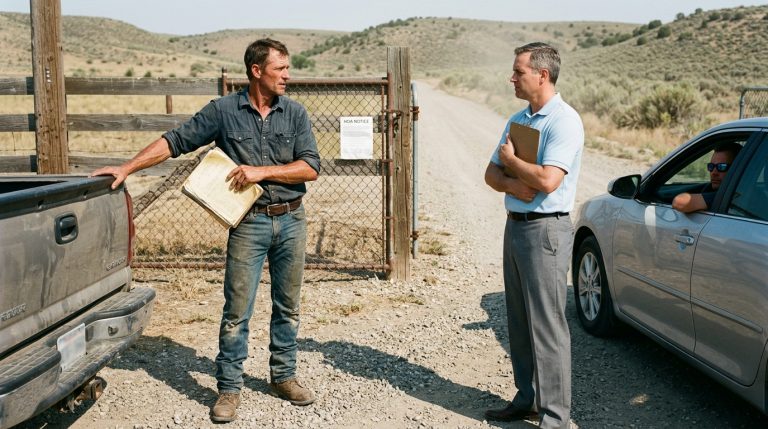
The vehicle that pulled into my driveway wasn’t a sleek HOA-leased sedan. It was a heavy, utilitarian truck with the insignia of the County Fire Prevention Office emblazoned on the door. Beside it, Tracy Harlo’s white blazer looked offensively bright, a stark contrast to the grit of the gravel road. She stepped out, her expression a careful mixture of concern and practiced authority, followed by two board members who looked less like leaders and more like nervous spectators.
I didn’t wait for them to reach the gate. I walked down the center of the drive, the weight of the binder in my hand serving as a grounding force. The air was cool, smelling of early dew and the faint, bitter metallic tang of the access box that still sat, half-embedded and ugly, in my pillar.
The Fire Marshal, a man with silver hair and skin weathered by years of field inspections, stepped out of the truck. He didn’t look at Tracy; he looked at the gate. He walked directly to the pillar, his eyes tracking the damage to the stone. He crouched, examining the concrete patch where the drill had bitten into the masonry.
“You’re the homeowner,” he said, not as a question, but as an identification.
“I am,” I replied, standing my ground. I didn’t offer a handshake. “I’m the one who filed the request for a record of this inspection.”
Tracy moved closer, her voice pitched to be heard by the board members behind her. “We called him in, actually. The safety concerns at this gate are becoming critical. We’re just trying to ensure that emergency responders have access to the community behind his property.”
I didn’t let her narrative breathe. I opened my binder to the first tab. “Marshal, before we discuss safety, let’s discuss the site’s legal status. This is private property. There is no recorded easement for the subdivision to cross this driveway. The ‘safety’ claim is being used to bypass the property deed.”
The Marshal looked at me, his eyes sharp. He stood up, wiping dust from his knees. “I’m here to look at the egress, not the title work. Let’s see the complaint.”
“The complaint was filed by the HOA,” I said, handing him the incident number card the deputy had given me two nights prior. “And the work that caused it was performed without a permit.”
Tracy’s smile flickered, a momentary lapse in her armor. “It was an emergency installation, Marshal. We had to act.”
“Emergency?” I asked, my voice remaining level, devoid of the heat she was trying to bait out of me. “Emergency implies a disaster in progress, not a planned, midnight drilling operation coordinated by a board president.”
I saw the Marshal’s gaze shift from me to the access box, then to Tracy. He wasn’t a puppet. He was a civil servant, and civil servants lived and died by the presence or absence of paperwork. He pulled a clipboard from his truck, the plastic cover snapping in the breeze.
“Who filed the complaint documentation?” he asked, looking at the board members.
One of them gestured vaguely toward Tracy. “She handled the filing. She told us it was cleared with the county.”
The silence that followed was heavy, punctuated only by the distant sound of a mower from a neighboring lot. Tracy’s face tightened. She had been counting on the Marshal to act as a blunt instrument, to validate her actions with the authority of his uniform. She hadn’t expected the audit.
“I need to see the approval packet for this installation,” the Marshal said. His tone was professional, but there was a distinct lack of warmth. “And I need the recorded instrument showing the easement rights.”
Tracy’s posture stiffened. She started to reach for her bag, her fingers dancing nervously over the strap. “We have the development plans from the builder. They show the road access—”
“Plans are not recorded easements,” I interjected, my voice quiet but cutting. I handed the Marshal my own copy of the deed, highlighting the section that defined my boundaries. “The developer’s intent is not the law. If they wanted an easement, they should have recorded it before the property was sold.”
The Marshal took the document. He studied the text, his pen hovering over his clipboard. He wasn’t looking at Tracy’s blazer anymore; he was looking at the legal reality of the land.
“Ma’am,” he said, turning to Tracy. “Did you disclose that there was no recorded access right when you filed the complaint?”
Tracy paused. She looked at me, then at the deputy who had arrived—at my request—to stand by. She had nowhere to hide. “We assumed it would be resolved,” she said, her voice strained.
The Marshal made a note on his clipboard. “Assumption isn’t an inspection standard. This whole installation stops until I see a permit and an easement.”
He turned to the contractor foreman, who had arrived late, looking guilty as he hovered by the gate. “Permit number?”
“We… we don’t have one, sir,” the foreman mumbled, glancing at Tracy. “We were told it was urgent.”
The Marshal shook his head, a gesture of deep, professional exhaustion. He turned to me, and for a second, I saw a flicker of understanding—the look of a man who dealt with the ’emergency’ of the month and saw the truth beneath it. “You have the right to demand they stop,” he said. “Do you want to file a formal protest regarding the property damage?”
“I already have,” I said, gesturing to the binder in my hand. “It’s all here.”
The atmosphere in the driveway had shifted. The initial tension had bled out, replaced by the cold, biting reality of accountability. Tracy’s face had lost its sheen; she looked small against the backdrop of the county truck and the deputy’s cruiser. The board members were already backing away, whispering to one another, their faces pale.
I looked at the gate post. The scar on the stone seemed to glow in the morning light, a permanent mark of the night’s work. I hadn’t won yet, but I had forced the players into the light. And in the light, the truth couldn’t be forged.
CHAPTER 5: The Architect of Entropy
The office was quiet, save for the rhythmic clicking of my mouse. I had the HOA’s annual financial reports spread across my two monitors, flickering in the low light of the afternoon. My mind, usually a clean, organized filing cabinet, felt frayed at the edges. The Fire Marshal’s departure hadn’t brought closure; it had brought a lingering sense of unease. Tracy hadn’t just been pushy; she had been frantic.
I scrolled through the PDF of the neighborhood’s budget, a document filled with dry, uninspired line items. Maintenance, landscaping, reserve funds. It was the standard language of a residential association. But then I looked at the ‘Special Project’ allocations for the upcoming fiscal year. There was an entry—large, vague, and heavily funded—labeled Infrastructure Egress Optimization.
It was a phantom expense. No vendor name. No contract reference.
I looked at the map again, the one I had scrutinized days ago. If they were pushing for an ’emergency egress’ through my driveway, it wasn’t just to save a few minutes for fire trucks. It was to artificially boost the neighborhood’s appraisal ratings. A ‘secondary evacuation route’ was a high-value perk for real estate developers and homeowners looking to inflate equity before a sale.
My stomach gave a slow, uncomfortable turn. It wasn’t about safety. It was about an exit strategy—not for the residents, but for the board members, Tracy included. They were liquidating the neighborhood’s stability to juice the property values before a secret audit.
I felt a sudden, sharp spike of déjà vu, the kind that tasted like copper and old warehouse dust. Ten years ago, the bank had done the same thing to my family’s business. They’d pushed for ‘efficiency updates’ that weren’t actually about growth, but about repositioning the asset for a quick, predatory sale. I had watched them bleed the company dry, one line item at a time, because I hadn’t been watching the ledger with the same level of intensity I was now.
I stood up and paced the small office, my feet heavy on the hardwood. I was seeing the pattern now. Tracy wasn’t just a bossy president; she was an architect of entropy. She was creating a crisis—the ‘blocked’ emergency exit—to justify a capital improvement project that would feed her own financial interests.
I stopped at the window. My driveway looked like a battleground. The concrete patch on the pillar, the ruts from the trucks, the lingering dust—it was all evidence of a much larger, darker machinery. My personal sovereignty was just a casualty in her wider war.
I walked back to the desk and pulled up the public records request I had filed the week before. I needed to see who had been buying into the neighborhood recently. I needed to see the names on the deeds. As I cross-referenced the property transfers with the board’s meeting minutes, the picture grew darker. There were shell companies. There were quick-turnover sales. There was a flurry of activity that defied the slow, sleepy nature of our quiet street.
My hands felt cold. This was no longer just about a driveway. If I pushed too hard, if I made enough noise about the permits and the easements, I wouldn’t just be annoying a petty HOA president. I would be threatening a multi-million dollar real estate shell game.
The phone on my desk rang, a jarring, mechanical sound that made me jump. I watched the caller ID. It was a restricted number. I didn’t pick it up. I let it ring, counting the pulses—one, two, three—until it stopped, leaving the house in a silence that felt heavier, more watchful than before.
I sat back down, my fingers hovering over the keyboard. I was no longer the hunter. I was the person who had stumbled into the center of a much larger web, and the spider was beginning to notice. I took a deep breath, forcing my heart rate to normalize, and started a new document. I didn’t write about the driveway. I wrote about the budget. I wrote about the names, the dates, and the shell companies.
I had been keeping a record for myself. Now, I realized, I was keeping a record for the authorities. The audit was no longer an attempt to protect my property; it was an attempt to dismantle a fraud. I felt the familiar weight of the past trying to pull me down, but I pushed it aside with the cold, sharp edge of current facts. I was going to follow this trail to the end, even if the end turned out to be a cliff.
CHAPTER 6: The CounterStrike
I rose from the desk, the transition from the glowing, complex maps of the HOA’s financial fraud to the dim, damp reality of my living room feeling like a physical blow. The tapping at the door was persistent—three sharp, authoritative knocks that echoed through the house. It wasn’t the tentative knock of a neighbor. It was the rhythm of someone who had a job to do and no interest in conversation.
I opened the door to find a man in a rain-slicked jacket, his face obscured by the brim of a baseball cap. He held a thick, heavy envelope in one hand, the plastic covering glistening with moisture. He didn’t look at me; he looked at the nameplate by the door, confirming the identity of his target.
“Service,” he said, his voice as flat as the paper in his hand. He held it out.
I didn’t take it immediately. I looked at the return address. It wasn’t the HOA’s management company. It was a high-end litigation firm from the city—the kind that didn’t handle petty driveway disputes.
“What is this?” I asked, though I already knew.
“Temporary Restraining Order. You’re being sued for harassment and interference with community safety protocols,” he said. He dropped the envelope into my hands, the paper feeling unnaturally heavy, like lead. “Have a good night.”
He turned and walked back into the rain before I could ask a single follow-up question. I watched him go, the taillights of his car bleeding red into the darkness of the driveway. I felt a surge of cold, sharp anger, followed immediately by a terrifying calm. This was the counter-strike. Tracy wasn’t just relying on bluster anymore; she was weaponizing the law. She wanted to tie me up in litigation, drain my resources, and intimidate me into silence using the same legal architecture I had been trying to use against her.
I walked back inside and locked the door, the sound of the deadbolt clicking home a small, insufficient victory. I sat at the kitchen table and tore open the envelope. The pages were dense, filled with legalese about ‘nuisance’ and ‘public safety,’ effectively painting me as a hostile, irrational actor who was preventing the association from fulfilling its mandate.
They had taken my actions—the video recording, the inquiries, the insistence on permits—and re-framed them as a campaign of harassment. It was a masterclass in projection.
I looked at the clock. It was nearly 9:00 p.m. I walked back to my office and pulled up the binder. I had the evidence, I had the timeline, and I had the proof of their financial fraud. But now, I had a deadline. A TRO wasn’t something you could ignore or annotate in a notebook. It required a legal response, a courtroom appearance, and a set of resources I was rapidly depleting.
My mind raced to the failed business, the way the bank had used similar ‘harassment’ claims to push me out of my own office. They had used the court system to exhaust my energy, knowing that if I couldn’t afford to fight, I would eventually fold.
I looked at my reflection in the dark monitor. I was exhausted, the kind of deep, systemic fatigue that comes from fighting a war on two fronts—one against a corrupt neighbor and one against the ghosts of my own past failures. I could feel the temptation to walk away, to just unblock the gate, to let them have their way, and to let the quiet return. But then I looked at the forged PDF still sitting on my screen. The meta-data. The trail.
I hadn’t built this evidence for my own comfort; I had built it for this specific moment.
I picked up the phone and dialed my attorney. It went straight to voicemail, but I didn’t hang up. I began to talk, laying out the timeline, the incident numbers, the marshal’s report, and finally, the financial discrepancies I’d found earlier that evening. I spoke with a clarity I hadn’t possessed in years. I wasn’t just talking about a driveway; I was talking about a systemic fraud that was using me as a cover.
When I hung up, I felt a strange, chilling clarity. They had stepped over the line from intimidation into litigation. They had brought the battle into the open, onto a field where I had the evidence to win. I spent the rest of the night assembling the documents, not for a protest, but for a trial. I would respond to this TRO with a cross-complaint that would expose the HOA’s entire financial structure.
I looked out the window one last time. The rain was coming down harder now, washing away the tracks the process server had left in the gravel. The driveway was dark, but the gate was still locked. And for the first time, I realized that the lock wasn’t just for them. It was for me. I was guarding the entrance to the only place I had left to fight, and I would not be moved.
CHAPTER 7: The Structural Removal
The rain had transitioned from a drizzle to a rhythmic, drumming downpour that battered the roof and turned the gravel of my drive into a dark, shifting slurry. I stood in the kitchen, the taste of stale coffee bitter on my tongue, my eyes locked on the Temporary Restraining Order. It wasn’t just a threat; it was a mirror. In its cold, formal language, I saw the exact same tactics that had disassembled my life a decade ago: the calculated character assassination, the weaponized litigation, the slow, agonizing depletion of resources.
I walked to the front window. The access box was still bolted to my gate pillar, a metallic wart on the landscape, half-set in grey, porous concrete. It looked like a tombstone for my own autonomy. The panic, sharp and hot, tried to rise in my throat, but I forced it down, grounding my hand against the cold, damp wood of the window frame. I wouldn’t fold. Not this time.
I went to the garage and pulled a heavy-duty masonry chisel and a four-pound hammer from the workbench. The tools were rusted, the steel pitted, but they were solid—heavier than the abstract threats contained in the legal envelope.
I walked out into the rain. The water was icy, soaking through my jacket in seconds, but I barely felt it. I stopped at the gate. The access box stared back at me, its cheap metal surface reflecting the dim, flickering light from the porch. I didn’t hesitate. I set the edge of the chisel against the seam where the concrete met the original stone of the pillar.
The first blow was a jarring, discordant sound that vibrated up my arm and into my shoulder. I struck again. And again. The concrete was brittle, not properly cured, and it began to flake away, small, grey chips flying off into the mud. Each strike was a conversation with the past, a violent rejection of the fear that had defined my previous failure. I wasn’t destroying property; I was removing an infection.
My breathing grew heavy, matching the rhythm of the hammer. The muscles in my back began to burn, a sharp, lactic acid sting that was, for once, a welcome distraction. I wasn’t thinking about the lawsuit. I wasn’t thinking about the HOA board or the secret real estate shell games. I was thinking about the angle of the tool, the composition of the mortar, and the structural integrity of the pillar I was working to restore.
A set of headlights swung into the entrance of my drive, the beams cutting through the rain. I paused, the hammer resting against my thigh. It was the deputy. He had been conducting regular patrols since the initial report, keeping the property line under the scrutiny of his cruiser. He pulled up, the window rolling down, and looked out at me, standing in the rain with a hammer, surrounded by the debris of the HOA’s failed infrastructure.
“That’s a lot of work for this hour,” the deputy said, his voice drowned out slightly by the downpour.
“Restoring my property to its original condition,” I replied. I didn’t sound angry. I sounded calm, perhaps too calm.
The deputy looked at the access box, then at the envelope sitting on the porch steps. He had seen the paperwork. He knew that by tomorrow, the legal machine would be trying to reach out and pull me into a courtroom. He looked back at me, his gaze lingering for a moment. He didn’t tell me to stop. He didn’t tell me to wait for a court order. He simply nodded.
“Keep it on your side of the boundary,” he said.
“Always,” I replied.
He turned his cruiser around and drove back out to the main road, the red taillights disappearing into the gloom. I picked up the hammer and struck the final, decisive blow. The box loosened, wobbling on the masonry. With a sharp, guttural grunt, I pried it free. It clattered against the gravel, a hollow, pathetic sound that meant absolutely nothing. I picked it up, feeling the weight of it—nothing but cheap metal and lies—and tossed it into the back of my truck.
I spent the next hour meticulously cleaning the surface of the pillar, using a wire brush to remove the remnants of the concrete. My hands were shaking—not from fear, but from the adrenaline of the physical labor. When I finished, the pillar looked ragged, scarred, but it was mine again. The intrusion was gone.
I stood there in the rain, my skin numb, looking at the smooth, clean gap in the stonework. Tomorrow, the legal storm would hit. Tomorrow, I would have to face the court and argue my case. But for this moment, the boundary held. I had dismantled their physical claim, piece by piece, and I had done it on my own terms. I walked back toward the house, the rain drumming a slow, steady rhythm on the roof, a sound of peace in a world that was trying very hard to tear me apart. I wasn’t afraid of the lawsuit anymore. The box was gone, and the path to the end was clear.
CHAPTER 8: The Restoration of Order
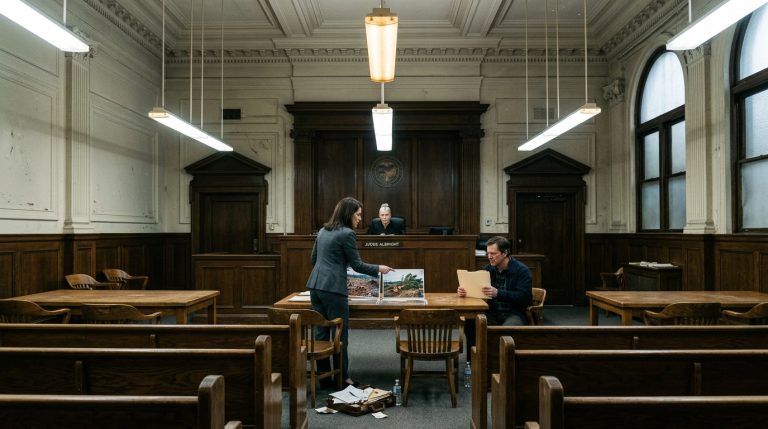
The courtroom air was thin, recycled, and carried the faint, sterile scent of floor wax and old paper. I sat at the mahogany table, my hands resting flat on a fresh stack of documents. Across the aisle, Tracy Harlo sat with her counsel, a man in a charcoal suit who smelled faintly of expensive cologne and impatience. She kept glancing at her watch, her posture tight, projecting a confidence that didn’t reach her eyes. She still thought this was about a driveway. She still thought I was the one playing for a quick exit.
My attorney nudged the file toward the judge, a woman with spectacles perched on the edge of her nose and an expression that suggested she had seen every flavor of human spite. “Your Honor,” he began, his voice calm and precise, “the defense moves to dismiss the Temporary Restraining Order on the grounds of demonstrated bad faith. We have also filed a cross-complaint regarding fraudulent activity.”
Tracy’s head snapped toward her lawyer. A frantic, hissed whisper broke out between them, but the judge raised a hand.
I didn’t watch Tracy. I watched the judge as she flipped through the folder. She started with the incident logs, moved to the Fire Marshal’s official findings, and finally settled on the digital metadata analysis I had spent my nights perfecting. The courtroom grew quiet. The hum of the ventilation system seemed to amplify in the space, a steady, mechanical drone that underscored the weight of the moment.
The judge paused on the page detailing the shell companies and the rapid-fire property transfers. She didn’t look up for a long time. When she finally did, she looked straight at Tracy. The air in the room seemed to drop ten degrees.
“Ms. Harlo,” the judge said, her voice dry as parchment. “Is there a reason these financial structures and the misrepresentation of county infrastructure documents have not been disclosed to the court?”
Tracy stood up, her composure splintering. “It… it was an effort to streamline the evacuation process. We weren’t trying to hide anything. The homeowner is simply making unfounded connections.”
“The connections are mathematical, Ms. Harlo,” the judge replied. She pushed the folder back toward the center of the table. “Fraud is not an evacuation strategy.”
The payoff wasn’t a sudden, cinematic explosion. It was the slow, systematic dismantling of Tracy’s leverage. The judge didn’t just throw out the TRO; she issued a scathing bench order, citing the HOA’s abuse of process and mandating a full, independent forensic audit of the board’s financial records.
Tracy’s lawyer was already packing his briefcase, his face neutral, the professional distance of a man who knew exactly when to abandon a sinking ship. Tracy stood there, the reality of the record settling over her like a shroud. She looked toward me—not with hate, but with a sudden, dazed recognition. She finally understood that I hadn’t been fighting her. I had been documenting her.
We left the courtroom in the quiet of the late afternoon. The sky outside had cleared, leaving the city streets glistening with the remnants of the storm. My attorney walked beside me, his briefcase heavy, but I felt lighter than I had in months. The case was over, the fraud was exposed, and the machinery of the law had been forced to work in favor of the truth.
I drove back home in the twilight, the radio off, just the sound of tires on asphalt. When I reached my driveway, I pulled to a stop and stepped out. I walked to the gate pillar. The scar where the access box had been was still there, a jagged indentation in the stone, but I reached out and touched it with a steady hand.
I took a small bag of mortar mix I’d purchased that morning, a trowel, and a bucket of water. I didn’t rush. I mixed the mortar with the same precision I had used to compile my records, watching the texture transform from powder to a smooth, uniform paste. I filled the gap, smoothing it out with the edge of the trowel, matching the texture of the old stone.
It would take time to fully cure, to blend into the history of the pillar, but it was fixed. The boundary was whole.
I went to the garage and cleaned my tools, returning them to their hooks with a finality that resonated in the quiet. I walked into the house, unlocked the front door, and stood in the living room. The silence wasn’t empty; it was the quiet of a room that had finally been balanced. I sat in my chair by the window and looked out at the gate. It was locked, secure, and entirely mine.
I thought about the warehouse, the bank, the lost business, and the years of doubt. That ghost had finally stopped pacing the floor. I had lost the battle for my livelihood ten years ago because I had allowed others to dictate the terms of my life. But here, tonight, I had enforced my own terms. I closed my eyes, the weight of the last month finally lifting, and for the first time in a decade, I didn’t think about the past. I simply listened to the quiet, and found it was enough.