The Paper Fence: A Calculated War for the Dust and the Deed
CHAPTER 1: The Weight of Paper
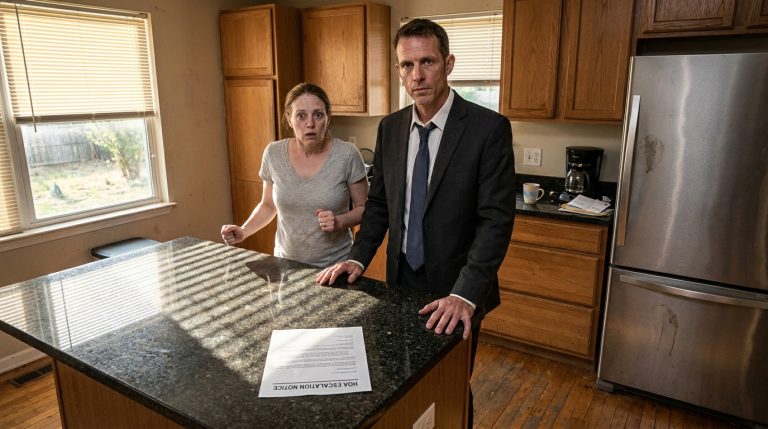
The silence of the ranch was usually my anchor, but this morning it felt like a vacuum waiting to be filled with the sound of incoming traffic. The notice on the gate wasn’t just paper; it was a manifesto of an invading force. HOA Jurisdiction. Non-compliance penalty. Access restricted.
I sat in the cab of my truck, the engine ticking as it cooled. My thumb hovered over the power window button, but I didn’t roll it down. I stared at the logo printed at the top of the page—the stylized little gate they used for their letterhead. It looked like a prison cell when you really focused on the line work.
My breath hitched. The road behind that gate was three generations of my family’s sweat. It was gravel I had personally laid when the winter rains turned the track to soup. Every stone held a memory, and this piece of paper dared to call it an easement.
I looked at the rearview mirror. My own reflection looked back, hard-lined and unmoving. I checked my watch. Eight minutes past sunrise. The inspectors would be coming back—they were like wolves that had tasted blood and now expected the herd to stay still. I didn’t reach for a gun. I reached for the glove box.
I pulled out the heavy, weathered folder I kept for emergencies. It was the only thing I owned that felt heavier than the truck itself. Inside were the original deeds, the ones with the ink that had started to fade into the yellowed fiber of the parchment. I ran a finger over the ink. It was real. It was permanent.
A flash of movement caught my eye in the distance. A dust plume. A silver sedan, moving with the arrogant, smooth precision of someone who didn’t respect the pitch of the land.
My hand moved to the ignition, but I didn’t start the truck. I sat, perfectly still, watching the car approach. My mind shifted into a cold, clinical rhythm—the Predator-Prey lens I hadn’t needed in years. I began to calculate. If they were here this early, they weren’t just inspecting. They were checking to see if I’d blinked.
I opened the folder. The deed was at the bottom, protected by a plastic sleeve. I didn’t need to read it; I knew every word, every boundary marker, every loophole they thought they could exploit. I watched the sedan pull up to the gate, the driver’s side window sliding down to reveal a face I already knew was going to be the most expensive mistake of his life.
I gripped the steering wheel, the leather cold against my palms, and prepared to play the game he had started, but which I fully intended to finish.
CHAPTER 2: The Geometry of a Lie
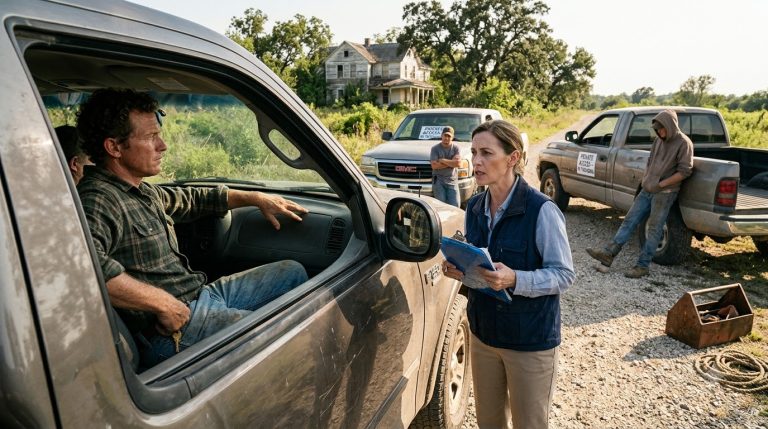
Richard Harland didn’t wait for me to invite him over. He stepped out of the silver sedan with that practiced, fluid grace that usually belonged to men who had never spent a day working their own soil. He wore a crisp, light-blue polo tucked into slacks that cost more than my work boots, and he held his clipboard like a shield. Behind him, the driver stayed in the car, a silent observer with dark glasses that reflected the morning sun, hiding whatever expression he might have had.
I finally rolled the window down. The air was cool, smelling of dry dirt and the faint, lingering scent of pine from the foothills. I didn’t greet him. I let the silence hang between us, thick and unyielding, until it became a physical pressure on his smug, rehearsed smile.
“Mr. Callaway,” he said, his voice smooth, carrying that fake tone of neighborhood concern. “I saw your truck at the gate. I assumed you’d be reviewing the documentation we sent over.”
I looked at his hand, then back up to his eyes. They were grey, flat, and completely devoid of any real empathy. My father’s voice echoed in my head, a phantom memory from a decade ago: A man who smiles when he’s stealing from you is the most dangerous kind of predator, Jake. He needs you to believe he’s just doing his job.
“I reviewed it, Richard,” I said, my voice steady, stripped of any conversational warmth. “And I noticed that the map you’re carrying doesn’t match the land I’m standing on.”
His smile didn’t falter, but it hardened at the edges. He shifted his weight, his expensive shoes scuffing against the gravel. “Mapping technology has evolved, Mr. Callaway. We use modern precision. The association isn’t interested in personal history; we’re interested in current legal standing.”
He made a gesture toward the road, a sweeping movement that included the gravel, the dust, and the very fence line my grandfather had set into the earth with nothing but muscle and iron bar. “The jurisdiction is clear. Seven years of back dues. It’s a simple matter of compliance.”
I opened the truck door and stepped out. The physical act of standing up made him flicker. He took a half-step back, his subconscious reaction to being forced to look at someone who wasn’t just a signature on a document. I walked to the back of the truck and leaned against the tailgate, crossing my arms. I didn’t want him closer, but I needed him to see that I wasn’t intimidated by his clipboard or his status.
“You’re talking about compliance,” I said, keeping my eyes locked on his. “I’m talking about property. My father graded this road. He maintained it when the county couldn’t be bothered. There isn’t a single deed in this county that grants an HOA authority over private ranch land.”
“There is now,” Richard said, his tone dipping into that condescending, ‘patient-teacher’ pitch. “These things are formalized through the proper channels. If you have a dispute, the HOA board is happy to hear it at our next meeting. But until then, the assessments stand.”
He looked past me then, scanning the ranch, his eyes lingering on the empty fields and the silent barn. It wasn’t the look of a man checking for cattle; it was the look of a man calculating the value of the dirt. For a fleeting second, I saw it—the way his gaze tracked the slope of the land toward the county line, calculating how it fit into a larger, invisible puzzle. It felt like a chill, a sudden realization that this wasn’t about the dues at all. The dues were just the bait.
“I won’t be paying you,” I said, my voice low and final.
His eyes snapped back to mine. The smile was gone now, replaced by a cold, calculating mask. “Then we’ll have to proceed with the formal legal remedies. I hope you understand, Mr. Callaway, that this is just business. The association needs to protect its assets. We have to be consistent.”
“Consistently wrong isn’t a strategy, Richard. It’s a liability.”
He looked at me for a long, silent beat. The air around us felt static, charged with the friction of two opposing worlds. He didn’t respond. He simply turned, his movements sharp and efficient, and walked back toward his sedan. He didn’t look back. He didn’t need to. He had delivered his notice, and now, he was letting the threat of the legal machine do the heavy lifting for him.
I watched him get back into the car, watched the silver sedan back out, its tires kicking up dust that hung in the air long after he was gone. I walked back to my truck, my heart hammering a rhythmic, angry beat against my ribs. I sat back down, the silence returning to the cab, but it no longer felt like a vacuum. It felt like a battlefield.
I reached for the folder again, this time pulling out the tax records. If they wanted to play with maps and dates, then I would start digging into the bedrock of their history. I had the deeds. I had the memories. And now, I had the undeniable sense that I was standing in the way of something much larger than a road. I pulled out my phone and dialed the number for Thomas Greavves. It was time to start building the wall.
CHAPTER 3: The Ghost of a Settlement
The house was a modest bungalow, painted in a shade of beige that seemed designed to blend into the background of a nondescript life. Howard Bell met me at the door before I even knocked. He was a man who looked like he had been worn down by too many years of playing by rules that were designed to break him. His skin was paper-thin, and his eyes held the dull, cautious alertness of someone who spent his days waiting for the other shoe to drop.
He didn’t invite me inside immediately. He scanned the street, checking the driveways for any sign of the HOA’s patrols—the “Neighborhood Watch” vehicles that acted more like private security than concerned citizens. Only when he was satisfied that the street was quiet did he pull the door open and gesture for me to step into the foyer.
The interior smelled of peppermint and stale dust. It was a home that hadn’t seen a significant change in decades, a sharp contrast to the aggressive, polished modernity of the HOA’s headquarters.
“You said you had questions about the road,” Howard said, his voice barely a whisper. He led me into a small kitchen where a stack of manila folders occupied the center of the table like a grave marker. He didn’t offer coffee or pleasantries. He pushed a folder toward me. “I settled. That’s what they wanted. They hit me with a claim for drainage improvements on a lot that didn’t even touch my property. I fought it for three months, but then the legal bills started mounting. My pension isn’t enough to buy a seat in a courtroom for more than a week.”
I opened the folder. It was a carbon copy of the same legal strategy Richard Harland had used on me: an amended jurisdiction map, a series of itemized, phantom charges, and the threat of a lien that would have cost Howard his home. I flipped through the pages, my eyes catching on the fine print.
“Did you ever see the notary?” I asked, pointing to a stamp on a document dated three years ago.
Howard frowned. “Carol Ames? I never met her. The HOA board handled the filing. They told me it was a standard administrative procedure required by the county.”
I pulled a notepad from my jacket and began cross-referencing the dates. My mind was moving in the cold, binary logic of a forensic accountant. I looked at the survey markers cited in Howard’s settlement. They were almost identical to the ones on my own notice, but there was a discrepancy in the filing sequence. Howard’s document had been processed in the central office, but the stamp was from a satellite branch that had closed its doors six months prior to the date on the page.
It was a small thing—a microscopic oversight in an otherwise polished scheme. A ghost in the machine.
“Howard,” I said, leaning forward. “This stamp. Was this document ever actually registered at the county clerk’s office, or was it just ‘filed’ within the association’s private records?”
Howard blinked, the realization slowly dawning on him. “They… they took it to the county for me. They said they were doing me a favor to save on processing fees.”
I felt a surge of grim clarity. They weren’t just creating fake documents; they were effectively running a private judicial system, masquerading as a legal arm of the county. They were bullying people into surrendering their rights by presenting them with paperwork that looked official enough to scare a tired man into submission.
“They didn’t just target the roads, did they?” I asked, my voice barely audible over the hum of the refrigerator.
Howard sighed, a sound that seemed to pull the very air from his chest. “There were others, Jake. The young couple in the cul-de-sac who wanted to add a deck? They were hit with a ‘variance compliance’ fine that ended in a forced sale of their lot. The old widow on Elm Street? They claimed her fence line was an encroachment and charged her for the ‘relocation’ of the property markers.”
I stood up, the chair scraping sharply against the linoleum. The sheer scale of it began to click into place. This wasn’t just a grab for my road. It was an organized, methodical liquidation of private assets, masquerading as neighborhood maintenance. They were clearing a path, turning the subdivision into a clean, unified platform for something much larger than a few homeowners.
“I’m going to need these files,” I said, my hand closing over the edge of the folder. “Not for a settlement, Howard. For the record.”
Howard looked at me, his eyes searching my face for the bravado he expected. When he saw only the cold, sharp focus of a man who had stopped caring about the cost, he slowly pushed the folder toward me.
“If you fight them,” Howard said, his voice brittle, “they won’t just come for the road. They’ll come for the ranch, the history, the dirt under your feet. They’ll bury you in the kind of paper that doesn’t burn.”
“Let them,” I said, turning toward the door. “I’ve got the receipts now. And a witness who’s ready to stop being tired.”
I stepped out into the bright, harsh glare of the afternoon, the weight of the folder under my arm feeling like a loaded weapon. The road ahead was long, and the threat of the lien felt more tangible than ever, but for the first time since this started, I knew exactly where the cracks in their armor were. I walked to my truck, my mind already calculating the next move, mapping the terrain for a fight that I was finally, unequivocally, going to win.
CHAPTER 4: The Void in the Ledger
I stood on the sidewalk, my boots clicking against the concrete, and looked up at the second-story office of Thomas Greavves. It was 7:00 PM, an hour when Thomas usually kept the blinds drawn against the setting sun and the desk lamp burning a steady, amber path through the gloom. Tonight, the glass was opaque, reflecting only the harsh, flickering neon of the streetlights below.
The air in the city felt different than the air on the ranch. It tasted of exhaust and proximity. I didn’t want to be here. I wanted to be back behind the steering wheel of my truck, out where the only jurisdiction was the horizon. But the folder in my hand—Howard’s evidence—was a ticking clock. If Richard Harland’s people realized how much Howard had actually handed over, this bungalow and this folder wouldn’t be safe for another night.
I climbed the narrow stairwell, my hand instinctively checking the heavy iron key in my pocket. The hallway smelled of floor wax and old paper. When I reached the door, I didn’t knock. I felt a subtle, gnawing wrongness in the way the handle gave way—too easily, with a soft, metallic click that suggested the lock hadn’t just been opened; it had been compromised.
I pushed the door open, my posture shifting into the defensive tension of a man expecting a fight. The office was quiet, but it was the wrong kind of quiet. The air was disturbed, smelling of sharp ozone and the faint, citrus tang of a commercial cleaner that didn’t belong in Thomas’s orderly domain.
I swept the room with my gaze, my eyes cataloging the physical reality of the intrusion. The file cabinets were still standing, but their contents were not. Papers were scattered across the floor like autumn leaves, a chaotic blizzard of white and yellow. The desk—the center of gravity for every legal battle I’d ever fought with Thomas—had been wiped clean. His lamp was smashed, the glass shards glinting like broken teeth in the dim light.
I walked to the center of the room, careful not to disturb the patterns of the debris. My heart didn’t race; it slowed down, narrowing my focus to the essential. They hadn’t been looking for money. They had been looking for the history.
I knelt by the desk, scanning the floor. My fingers brushed against a torn corner of a document near the wastebasket. I picked it up. It was a fragment of a county filing, dated only three days ago. It wasn’t one of the documents I had brought. It was a new one, a record Thomas must have pulled in secret.
The cold realization hit me with the force of a physical blow. Richard hadn’t just been tracking me; he had been anticipating Thomas. He had known exactly where the legal pressure point was and had applied it with surgical efficiency before I could even arrive.
I stood up, the silence of the office pressing in on my ears. If they had wiped Thomas’s office, they were already moving to the final stage of their plan. They weren’t just playing for the road anymore; they were clearing the entire board.
I didn’t reach for my phone. I knew, with the kind of primal certainty you only learn when you’re cornered, that the lines were no longer private. I backed out of the office, closing the door as quietly as I had opened it, and retreated to the stairwell. My mind was already discarding the “legal” route. If the official record had been purged, then the law wasn’t a sword I could wield—it was a weapon being used against me.
I reached the street and stood in the shadows of the building, my eyes scanning the passing cars. A black sedan with tinted windows drifted past, its engine note too smooth, too deliberate. It circled the block, slowing as it approached the alleyway where I had parked my truck.
They weren’t just looking for the files; they were looking for the man who held them. I waited, my muscles coiled and ready, not for a brawl, but for a calculated exit. I moved into the darkness of the alley, my boots making no sound on the wet pavement. I had to reach the ranch, not to hide, but to secure the one thing they couldn’t find in an office: the original, physical markers of the land.
I slipped into the driver’s seat of the truck, the familiar leather and the smell of dust offering a momentary anchor. I didn’t start the engine. I waited until the black sedan turned the corner, my eyes fixed on the rearview mirror. When the road was clear, I pulled out, my hands steady, my resolve turning from heat into the hard, cold steel of necessity. The game had evolved, and if I was going to be the predator in this scenario, I had to stop acting like the victim of their paperwork.
CHAPTER 5: The Glass House
The town meeting room was an architectural disaster of cheap drywall and fluorescent lights that buzzed with a low, headache-inducing frequency. It was the same room where we held election ballots and community pancake breakfasts, but tonight, it felt like an arena. The air was stagnant, smelling of floor wax and the nervous, recycled breath of two dozen people waiting for a fight.
Richard Harland was already at the podium. He stood with the effortless posture of a man who owned the room, his projector casting a soft, blue glow onto the screen behind him. It was the “master plan”—a glossy, high-resolution rendering of the district, featuring green spaces, modernized infrastructure, and, prominently, the “newly optimized” transit routes that conveniently cut straight through the heart of my ranch.
I didn’t head for the rows of folding chairs. I stayed in the back, near the entrance, my hand hovering near the edge of my jacket where I’d tucked the fragments of paper I’d recovered from Thomas’s office. I didn’t need the whole file anymore. I just needed the truth, and I needed the people in this room to look at it.
“And so,” Richard was saying, his voice a polished smooth baritone, “the association’s commitment to safety and property values remains our highest priority. The recent amendments aren’t about restriction; they are about consistency.”
I began to move. Not toward the podium, but toward the light switch near the back wall. The room was too comfortable, too controlled. I needed to shatter that comfort.
“Excuse me,” I said, my voice cutting through the soft murmur of the audience. It wasn’t loud, but it had the gravelly weight of a man who had spent three days digging for the truth.
The room went still. Richard stopped mid-sentence, his smile faltering for a fraction of a second—a hairline fracture in his carefully maintained exterior. He squinted into the back of the room, his eyes trying to pinpoint me in the shadows.
“Mr. Callaway,” he said, his tone shifting into a blend of practiced surprise and thinly veiled irritation. “This is a closed board session for community members. We have a set agenda.”
“The agenda just changed,” I said. I reached for the light switch. The hum of the fluorescents died instantly, plunging the room into the dim, moody glow of the projector.
I walked to the front, the sound of my boots on the linoleum amplified by the sudden, heavy silence. I didn’t look at Richard. I looked at the people—Patricia Monroe, who had whispered about me at the hardware store; Diane Cho, a board member who looked increasingly uneasy; and the others, the people who had been bullied into submission by the same paperwork that had tried to bury me.
“Richard is talking about consistency,” I said, standing near the edge of the projector’s beam. “But consistency is hard to maintain when your records don’t exist.”
I pulled the recovered document fragment from my jacket and held it up. I didn’t need to read it out loud. I simply turned and walked toward the screen, letting the blue light illuminate the forged notary stamp.
“I visited the county office this morning,” I lied, the fabrication smooth and necessary. “They have no record of the notary who signed your jurisdiction amendments. And they have no record of this board ever submitting the original land surveys you claim to have reviewed.”
The room seemed to tilt. I saw Diane Cho stand up, her face pale in the blue light. She looked at Richard, and for the first time, she looked like she was seeing him—not as the polished face of the board, but as a stranger.
“Is this true, Richard?” she asked, her voice cracking. “Did you verify the notary signatures yourself?”
Richard’s composure didn’t break, but it shifted. He gripped the edges of the podium, his knuckles turning white. He started to speak, his voice climbing in volume, trying to drown out the doubt spreading through the crowd. He launched into a lecture about procedure and irregularities, his words becoming a rapid-fire barrage of jargon—the kind of noise that usually worked in rooms like this.
But the room wasn’t listening. They were looking at the screen, at the map that didn’t match the history, and at the man who was suddenly, visibly sweating under the artificial glare.
I stayed silent. I didn’t need to shout. I didn’t need to be the loudest person in the room. I had forced the lie into the light, and now, the light was doing the work for me. Richard’s counter-move was coming—I could see it in the frantic way he signaled to the board secretary—but he was already off balance. He was trying to defend a structure that was built on nothing but fear, and fear, once exposed to the truth, has a habit of evaporating.
I took a step closer to the podium, my gaze locking onto his. “Tell them about the infrastructure expansion, Richard,” I said, my voice calm, almost conversational. “Tell them why you really needed the road.”
His eyes widened—a flicker of pure, unadulterated panic. He knew, then, that I had stopped looking at the road and started looking at the master plan. The room gasped, a collective intake of breath that signaled the end of the illusion. The board had lost control, and as the murmurs grew into a unified, angry hum, I knew the battle was no longer mine to fight alone. It had become a war for the town, and Richard Harland, for all his paperwork and his ties, was finally standing in a room where he was no longer the one holding the cards.
CHAPTER 6: The Unraveling of the Map
The county courtroom was a place of high ceilings and unforgiving acoustics, where every shuffle of a shoe sounded like a gavel strike. I sat at the table next to Thomas Greavves, who hadn’t said a word in twenty minutes. He didn’t need to. The stack of folders in front of him—the real ones, the ones that hadn’t been purged—spoke for both of us.
Across the aisle, Richard Harland sat alone. His attorney had vanished two days prior, citing a conflict of interest that was, in reality, a desperate attempt to avoid being associated with the fallout of the notary investigation. Richard looked smaller here than he had at the gate. The expensive watch, the pressed shirt, the practiced smile—it all looked like a costume that had become too heavy to wear.
Judge Patricia Voss stepped onto the bench, her face a mask of judicial indifference. She didn’t look at the gallery, where half the town had gathered to see if their own land titles were worth the paper they were printed on. She looked at the docket.
“We are here regarding the petition of Callaway versus the HOA,” she said, her voice dry. “I have reviewed the evidence presented in the preliminary hearings. Mr. Harland, do you wish to make a final statement?”
Richard stood. His movements were slow, burdened. He looked at me, then at the judge, and finally at the empty seat next to him. “The association believed it was acting in the best interest of the community,” he began, but his voice lacked its usual cadence. It was flat, hollow. “We saw a need for modernization. We saw a need for integration.”
“You saw a profit margin,” I said, not standing, just speaking clearly into the silence of the room.
Richard didn’t argue. He didn’t shout. He simply closed his eyes for a moment, as if trying to recall the version of the lie that had felt most convincing. “We wanted to expand the regional transit corridor,” he whispered, so quietly that the court reporter had to lean in. “The road… the road was just the first piece of the survey. We needed the ranch to connect the grid.”
The confession rippled through the room. It wasn’t a sudden explosion; it was a sigh of collective understanding. The “infrastructure expansion” wasn’t a rumor; it was the reality that had driven the entire charade.
Judge Voss looked over her spectacles. “You attempted to seize private property for an unauthorized development, falsified official county filings, and coerced residents through fraudulent legal threats. Is that the ‘modernization’ you refer to, Mr. Harland?”
He didn’t answer. He slumped back into his chair, the collapse of his entire strategy complete. He wasn’t just being defeated by the law; he was being erased by the truth.
The hearing lasted another hour, but it was just a formality. The judge invalidated the amended map, nullified every outstanding due and fee, and officially restored the Callaway Ranch boundary lines to the original deed filings. When she hit the gavel, it wasn’t a violent sound; it was the definitive closing of a door.
As the room cleared, I didn’t rush to gloat. I waited until the courtroom was mostly empty, until the shadows began to stretch across the worn wooden benches. I walked out into the late afternoon sun, the heat of the day beginning to break.
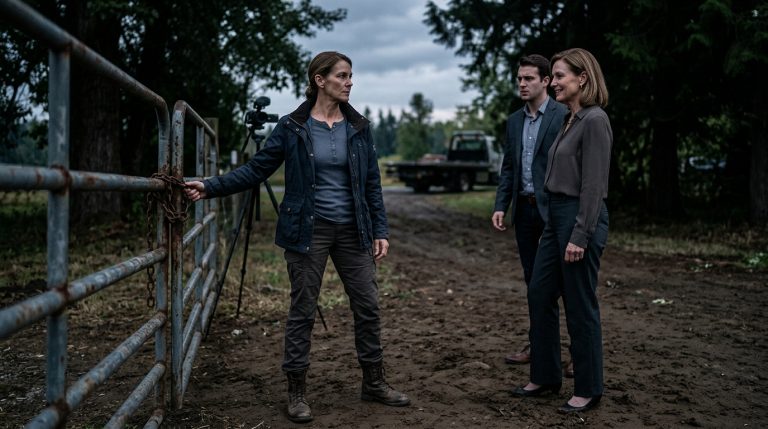
The drive back to the ranch was quiet. I took the long way, the road that had started this entire fight. I stopped at the gate—my gate—and stepped out of the truck. The orange cones were gone. The laminated signs were gone. The dust hung in the air, golden and still in the low light.
I walked to the corner post, the one my grandfather had set forty years ago. The wood was weathered, scarred by decades of wind and rain, but it was solid. I pulled a small wrench from my pocket and tightened the wire gate tensioner, the metal biting into the post with a satisfying, rhythmic click. It was a small repair, but it felt like the most important thing I had done in years.
A truck pulled up slowly behind me. It was Howard Bell. He stopped, rolled down his window, and just looked at the gate for a long moment. He didn’t smile, but the tension had left his shoulders, and for the first time, he looked like he was breathing.
“It’s quiet,” he said.
“It’s back to what it was,” I replied.
I looked out over the fence line, toward the west, where the sun was dipping below the ridge. The ranch was safe. The map was real. My daughter would come home to a place that wasn’t being traded away in a boardroom. I felt a deep, resonant peace settle into my bones, the kind of stillness that only comes after the storm has stripped away everything that wasn’t meant to hold. I wasn’t just the owner of the land anymore; I was its memory, its protector.
I climbed back into my truck, the engine turning over with a steady, reliable hum. I didn’t look back at the town. I didn’t look back at the office buildings or the fake maps or the men who thought they could out-calculate the weight of a legacy. I turned toward the house, toward the light, and for the first time in a long time, the road ahead was exactly as it should be.