The Weight of the Retaining Wall: A Siege of Property, Provenance, and the Cost of Silence
CHAPTER 1: THE MARKING
The sun was high, baking the ridge into a brittle, dust-caked heat. My turnout was a small pocket of stability carved into the slope—a deliberate, functional space I’d reinforced with sweat and six-inch timber over a decade ago. It wasn’t meant to be pretty. It was meant to hold.
Now, it was a crime scene.
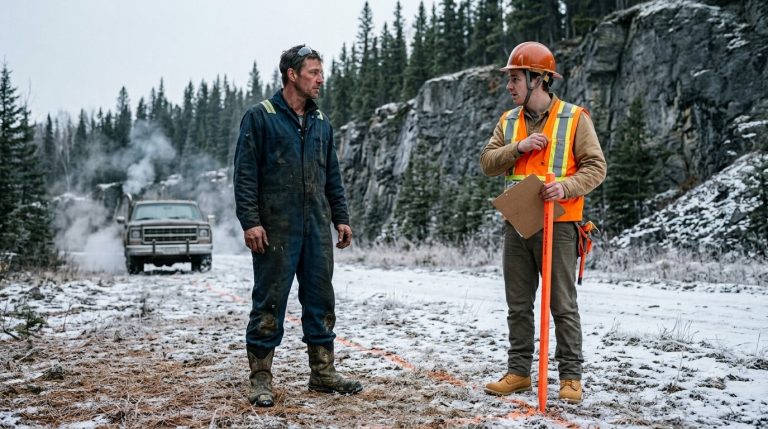
A compact loader sat angled against the turnout’s shoulder like an iron beetle, its bucket hovering inches above the dirt. Two men in neon vests moved with the sluggish, uncomfortable gait of people who knew they were trespassing but didn’t have the stomach to stop. One of them, a man with graying stubble and a measuring wheel, bent down to drag a bright orange streak across the face of my retaining wall.
“Stop,” I said.
The sound of my own voice startled the wind out of the valley, flat and hard. I kept the truck idling, the diesel engine’s low vibration humming through the soles of my boots as I stepped out onto the gravel.
Karen stood near the edge of the access road, her safety vest bright enough to hurt the eyes. She held a folder against her hip, her chin tilted up in a gesture that screamed management, not labor. She didn’t look at the dirt. She looked at the horizon, as if checking the weather for a storm she’d already scheduled.
“We’re just delineating the flow, sir,” the contractor said, not meeting my eyes. “Emergency sweep clearance. That’s the work order.”
“By whose authority?” I asked.
Karen stepped forward then, her heels clicking softly on the hard-packed earth. She smiled—a practiced, social expression that didn’t reach her eyes, which were scanning the terrain for tactical weaknesses. “We’ve been over this, surely. It’s about wildfire readiness. Your setup is an obstacle to the ridge’s circulation. We’re simply marking the requirements for the normalization project.”
“Normalization.” The word tasted like copper. I looked at the orange paint bleeding into the stone of the wall. “That isn’t documentation. It’s vandalism.”
“It’s planning,” she corrected, her voice smooth, the tone of someone explaining a simple truth to a difficult child. “The board has reviewed the intake protocols, and the fire marshal’s queue is already open. You’re holding up a community-wide safety mandate.”
The younger worker stopped his wheel, looking from Karen to me. He looked nervous, his hands fidgeting with the handle of the marking paint. “Ma’am? The layout needs to be finished before the county gets the notice.”
I pulled my phone out, the screen glowing against the harsh midday glare. I didn’t argue. I didn’t plead. I simply hit the record button and angled the frame to include the paint, the loader, and the face of the woman who had arrived with a magnet on her SUV and a lie in her teeth.
“There’s no county notice,” I said, my voice steady, stripped of everything but the facts. “And there’s no authority. You have until the count of ten to move that equipment off this parcel before I call the sheriff.”
Karen’s smile didn’t break, but it tightened. “You’re obstructing emergency planning, and you’ll answer for it when the fire marshal sees the bottleneck.”
She was waiting for me to lose my temper. She was waiting for me to shout, to swing, to give her the footage she needed to call me a liability.
I just turned, my back to her, and watched the younger worker look at the orange paint, then at the loader, and then at the vast, silent valley below. The silence deepened, heavy with the weight of what was coming next, and for the first time, I noticed something strange: a stack of folders sitting on the hood of the loader, the top one slightly curled in the heat, revealing a date stamp that didn’t align with the fire marshal’s latest public bulletin.
It was a lead, a flicker of a discrepancy, and it meant this wasn’t just about my wall.
CHAPTER 2: THE ARCHIVE
The loader’s engine sputtered and finally died, the mechanical clatter fading into the vast, hollow silence of the ridge. The contractors didn’t say a word. They packed their measuring wheels with the efficient, hurried motions of men who knew they were in the wrong place. Karen, however, did not move. She remained standing by the shoulder, her folder clutched against her side as if it were a shield. She looked at me, then at the orange streak on my wall, her expression shifting from practiced annoyance to a sharp, predatory calculation.
“You’re making a mistake,” she said, her voice dropping an octave, losing its public-facing sweetness. “The county process is not a negotiation. It is a safety mandate. You are standing in the way of a ridge-wide appraisal.”
“There is no county mandate for vandalism, Karen,” I said, my voice as flat as the horizon. “There’s only your paint, your contractors, and a very short window of time for you to leave my property before I document your presence here for the sheriff.”
She held my gaze for a moment, testing the tension. She was looking for a break—a flicker of doubt, a raised voice, a sign that I was rattled. I gave her nothing. I kept my hand on my phone, the camera still active, my posture loose but ready. She finally turned, her movements crisp, and signaled the contractors to pack the loader. As the trailer winched up, the screech of metal on metal cut through the air, sharp and discordant.
I waited until their taillights vanished around the bend of the narrow road before I walked to the turnout. I touched the orange line. It was thick, cheap latex paint, already beginning to bead in the intense heat. It felt like a violation of the stone.
Back in the quiet of my cabin, the atmosphere shifted. I didn’t pace. I didn’t pour a drink. I sat at my desk and opened the laptop. The air in the room felt heavy, the dust motes dancing in the late afternoon shafts of light, but my focus was narrow, fixed on the screen.
The Psychological Phantom: I stared at the blank cursor, and for a second, the image of my father’s old land deeds flickered in my mind—yellowed, fragile paper that had anchored our family’s grip on this ridge for three generations. He used to say that land wasn’t about the dirt, but about the paper that proved you weren’t an intruder on your own soil. Karen wasn’t just trying to take the turnout; she was trying to rewrite the history of the ground I stood on.
I opened the folder I’d started weeks ago. I dragged the video file from my phone onto the drive, labeling it with a precise timestamp. Then, I pulled up the packet Karen had handed me during our first meeting. I scrutinized the document properties—the creation date, the modification history, the author tags.
There it was. A discrepancy, faint but absolute. The document had been generated four days before her first visit to my road.
The weight of it settled in my chest—not fear, but a cold, crystalline clarity. She hadn’t come to me because of a wildfire sweep; she had come to me to sell a pre-built narrative. She had the problem, and she had the solution, and she was simply waiting for the county’s bureaucracy to rubber-stamp the whole package. She didn’t want safety. She wanted leverage.
I saved the screenshot of the metadata. Then, I cross-referenced it with the county’s official wildfire guidance. The gap between her claims and the reality of the statute was wide enough to drive a truck through. I began to build the archive: the video evidence, the digital paper trail, the contradictions in her own board memos, and now, the incriminating metadata from her “emergency” drawing.
I worked in the rhythm of the mountain—slow, steady, and relentless. Every document I saved was a stone added to the retaining wall, a reinforcement against the erosion she was trying to incite.
My phone buzzed against the wood of the desk. An email from an HOA board alias.
Subject: Joint access and safety coordination session.
It was the same, neat, inclusive tone she always used, the one that masked the razor wire beneath. She wanted me to sit down with a consultant and board members. She wanted me to look at the turnout drawings, to talk it out, to become a party to the “process.”
I didn’t answer. Not yet. I had to let her think she was still in control. I had to let her believe that the paint on the wall was the opening move, not the catalyst for her own undoing. I looked out the window at the turnout, where the orange paint still marred the stone.
It was a mark of war, and I had only just begun to gather my ammunition.
CHAPTER 3: THE FORGERY
I didn’t move for a long time. The screen’s blue light carved sharp, synthetic shadows into the room, reflecting off the stacks of physical files I’d spent the last hour cross-referencing. The metadata was a jagged, undeniable truth: the CAD file for the turnout expansion—the one she had presented as a reactive solution to wildfire risks—had been created four days before the first time she’d stepped onto my land.
I leaned back, the leather of my chair groaning under the shift in weight. The air in the cabin was cool now, the evening mountain breeze creeping through the cracks in the window frame, carrying the scent of pine needles and damp earth. But my focus was locked entirely on the digital interface. I clicked deeper into the properties of the file, my mouse clicking like the ticking of a countdown clock in the silence.
There, embedded in the subdirectory of the HOA’s local server logs—leaked by the same board member who had been growing increasingly wary of Karen’s unilateral style—was a path. It wasn’t just a drawing. It was an email draft, saved as a draft but never sent, timestamped even earlier than the drawing itself. The body of the email contained a directive to a landscape architect: “Prioritize the removal of the gate at the turnout. If the owner resists, loop in the fire marshal queue.”
The realization hit with the blunt force of a physical impact. She hadn’t been planning for a wildfire. She had been planning for a takeover, and the wildfire was just the convenient, socially acceptable costume she’d dressed her ambition in.
I stood up and walked to the window, looking out toward the ridge. In the twilight, the turnout was just a dark scar against the slope. It was easy, from this distance, to see how the HOA would view it as a piece of “unused” communal utility. They saw a resource to be managed. I saw the boundary of my own autonomy. If I let them widen that shoulder, if I let them touch the gate, I wasn’t just losing a piece of land. I was signaling that my own property was up for committee vote.
I turned back to the desk. The phone lay there, a dormant, powerful tool. I needed to know how far the rot went. I began to comb through the leaked board minutes from the last six months, looking for any mention of the turnout, any hint of a prior discussion that hadn’t been recorded in the public meetings.
The scrolling became mechanical, a rhythmic scan of bureaucratese and corporate padding. “Project Alpha,” they called it in the hidden notes. “Infrastructure realignment.”
It was cold, transactional, and entirely devoid of the “safety” language Karen used in public. I found another attachment—a list of local vendors, with a column for “compliance expected” and “resistance mitigation.” My name was at the top of the resistance list.
I didn’t feel anger anymore. Anger was for the first encounter, for the shock of the trespass. Now, I was in the rhythm of the work. This was about maintenance. Protecting a home was no different than maintaining the retaining wall; you had to identify the point of structural failure before the whole thing slid down the slope.
I picked up the physical binder—the one I kept on the corner of the desk, heavy with maps, property surveys, and legal correspondence. I started to map the HOA’s timeline against my own. Every time Karen made a move, I had a document that neutralized it. But this was different. This was proof of intent.
I spent the next three hours refining the file. I stripped out the noise, keeping only the evidence that held up under legal scrutiny: the creation dates, the draft emails, the board memo contradictions. I organized them into a chronology that would look as clean and damning as a ledger.
By the time I finished, the sky outside was pitch black, a deep, ink-wash void where the mountain used to be. My eyes burned, but my mind was precise. I had the sequence. I had the proof of the forged timeline.
I stood and stretched, the fatigue finally catching up to me. I walked to the kitchen, the floorboards creaking under my weight, and poured a glass of water. The house was silent, but in the quiet, I felt the familiar weight of the mountain pressing against the walls—a reminder that here, things lasted because you paid attention to the details.
Karen wanted a fight based on process. She wanted to drown me in committees, fire marshals, and public board sessions. She thought she could turn my own property into a public resource through the sheer force of a well-formatted packet.
She didn’t understand the first thing about the person she was trying to displace. She thought I was just an obstacle to be moved. She didn’t realize that I was the one who had built the turnout in the first place, and I knew every stone in the retaining wall, every inch of the drainage, and exactly how long it would take for her own structure to collapse once I pulled the right brick.
I looked at the phone, seeing a new notification: an automated invite to another emergency session, this one scheduled for the end of the week.
I tapped the screen, but I didn’t open it. I simply left it there, a glowing, pulsing reminder of the next phase. She was still pushing. She was still convinced that she was in the driver’s seat.
I walked back to the desk, pulled a fresh sheet of paper from the printer, and began to write out the sequence of events. Not for the HOA, not for the fire marshal, but for myself. A roadmap of the next move.
The truth was locked in the metadata, and by the end of the week, I was going to make sure the entire ridge saw it.
CHAPTER 4: THE PHYSICAL LINE
The sound wasn’t the steady, familiar drone of my own truck or the distant hum of the main valley artery. It was a rhythmic, aggressive crunching of tires on loose gravel—someone driving with purpose, and perhaps, a bit of desperation. I capped my pen, left the binder open on my desk, and moved to the door.
The sky over the ridge had turned the color of a bruised plum, the light flat and devoid of warmth. I stepped onto the porch just as a flatbed truck rounded the bend, kicking up a rooster tail of dust that hung suspended in the heavy air. Behind it, a compact loader bounced on its trailer, the same piece of equipment I’d chased off my turnout only days ago.
I didn’t reach for the phone this time. I walked down the steps and stood in the center of the road, my boots planted firmly in the hard-packed dirt. The truck braked, the air brakes hissing with a sound like a retreating tide.
The driver was the same older contractor—the one with the graying stubble who hadn’t been able to look me in the eye the last time. He shifted the truck into neutral, the engine idling with a deep, vibrating thrum that seemed to rattle the very marrow of my bones.
“Morning,” he said, his voice clipped. He didn’t come out of the cab. He just looked through the windshield, his eyes scanning the turnout behind me.
“You’re lost,” I said. “Or you’re repeating a mistake.”
He sighed, a long, weary sound that spoke of a man caught between a paycheck and a bad reputation. “Board sent a new work order. Priority status. They said the county fire marshal had already cleared the ’emergency bottleneck’ and that I was authorized to resume the marking.”
I kept my expression neutral, though my blood started to simmer. They were lying—directly to their vendors now. It was a gamble, a desperate attempt to force the work through before I could coordinate a response. “The county fire marshal hasn’t cleared anything. I have the intake log, and I have the records request in process. You’re being fed a line to protect someone else’s liability.”
He leaned out the window, his face etched with a mix of frustration and doubt. “Look, I don’t care about the politics. I care about the work order. I was told if I didn’t get this marked today, the HOA would contract it out to someone who would.”
“Then let them,” I said, moving a pace closer to the cab. The smell of diesel and dry dust was thick enough to taste. “But if you put a single drop of paint on my wall, it’s not just a trespass. It’s the second documented instance of the same vendor ignoring a formal stop notice. My lawyer will ensure that your company isn’t just liable for the cleanup—he’ll make sure you’re the face of the fraud.”
The contractor went quiet. He looked at the turnout, then back at me, calculating the weight of the risk. He was a man who understood the value of a solid structure, and he knew that my property was built to last, while the HOA’s paperwork felt like it was already fraying at the edges.
Suddenly, a second vehicle appeared in the rearview mirror—a sedan that pulled up behind the flatbed, kicking up more dust. A woman stepped out, not Karen, but a neighbor, someone who lived three houses down and had always been the quietest voice at the meetings. She looked flustered, holding a folder of her own.
“Are they here again?” she asked, her voice carrying over the idling engines. She walked up to the side of the truck, her eyes wide. “I just saw the email blast—the one about ‘immediate compliance.’ I wanted to see if it was true.”
I stepped back, allowing the neighbor to see the loader, the contractors, and the tense, standoff-ready atmosphere. “It’s true that they’re trying to force an issue, yes.”
The neighbor looked at the contractor. “I’m on the circulation committee, and I never saw a vote for this. Karen told us this was an ’emergency’ measure, but the minutes from last night said the safety review was tabled until the next quarterly meeting.”
The contractor’s gaze flickered between us. The lie wasn’t just cracking; it was splintering. He’d been told he had full board authority, and here was a board-adjacent resident telling him the project hadn’t even been sanctioned.
“This is the third time this week I’ve heard different stories from the same office,” the contractor muttered to himself, finally reaching for the gear shift. He looked at me, then at the neighbor. “I’m not doing it. Not until I get a written, signed order from the board president and a copy of the county release.”
“There won’t be a release,” I said, my voice steady. “Because there was never an order.”
He didn’t wait for a reply. He dropped the truck into gear, the tires spinning briefly before grabbing the gravel, and pulled away with a violent jolt. The neighbor stood there for a moment, looking at the empty road, then turned to me.
“She’s been telling everyone that you were the one holding up the ridge safety,” the neighbor said, her voice dropping, a hint of something deeper—anger, perhaps—taking root. “She said you were ‘obstructing’ the fire marshal. I just couldn’t believe it.”
“She needed a narrative,” I said, looking toward the horizon where the storm clouds were gathering. “Safety is just a very effective way to make a private interest feel like a public necessity.”
“Is there any way to see what you have?” she asked, glancing at my cabin. “If she’s using my dues to pay for this, I have a right to know.”
I hesitated. I had been planning to keep the evidence behind the digital curtain until the board session, but the cracks were forming faster than I’d anticipated.
“Come inside,” I said. “Let me show you how a timeline actually looks.”
As we walked toward the porch, I realized the game had changed. I wasn’t just holding a defensive line anymore. I was beginning to assemble an opposition, and in a place where community depended on shared information, that was the most dangerous move I could make.
CHAPTER 5: THE PAPER SIEGE
My neighbor, Sarah, hovered near the entryway, her eyes darting between the stacks of paper and the screen, which still glowed with the damning metadata of Karen’s pre-planned project. The cabin, usually my sanctuary of silence and order, felt suddenly claustrophobic. The air was thick with the scent of ozone and cooling coffee, and the silence seemed to thrum with the weight of the secrets I’d unspooled.
“You really have it all here,” she whispered, her finger tracing the edge of the binder. “The intake logs, the revision dates… this isn’t just a dispute. This is a design.”
“It’s a siege,” I corrected, pulling the chair out for her. “She didn’t stumble onto my turnout. She identified it as a weakness in the ridge’s flow and decided that my property was the price to pay for a better HOA aesthetic.”
I watched her face as she read. She was a woman who valued the quiet of the ridge as much as I did; she was the type to notice if a bird’s nest was disturbed or if the drainage near the culvert was blocked. Now, she was reading the internal emails where Karen discussed the “normalization” of my land as if I were a piece of hardware to be upgraded.
A sharp, metallic snap sounded from outside. I froze.
I walked to the window, keeping my shadow cast against the wall. The wind had picked up, lashing the pines against the exterior siding with a rhythmic, abrasive scrape. I peered through the blinds. Down the road, parked just out of sight of my driveway camera, sat a white SUV. Even from this distance, the shape of the magnet on the door was unmistakable: the HOA logo.
“What is it?” Sarah asked, rising from her seat.
“The periphery is shifting,” I said. “She knows you’re here.”
The paranoia I had been holding at bay—the sense that my every move was being logged, analyzed, and countered—settled into my bones like a cold draft. I had been documenting their moves, but they were effectively mapping my perimeter. I walked to the front door, the heavy iron bolt sliding home with a solid, definitive thud.
I grabbed my camera, not the phone, but the high-zoom DSLR I used for surveying the slope. I went to the back deck, moving low, my movements precise and stripped of any unnecessary flourish. I knelt and tracked the SUV. The driver was sitting motionless, watching my front door. It wasn’t Karen—it was the HOA’s “consultant,” the man who had been present at the first, failed coordination session. He was holding a camera, his lens pointed toward my porch.
He was documenting my “social assembly.”
“They’re tagging us,” I said, my voice barely audible over the wind.
“Tagging us?” Sarah joined me, her knuckles white as she gripped the railing. “We’re just talking about a drainage issue and a turnout.”
“To them, this is the start of an organized resistance,” I said, a grim smile touching my lips. “They wanted to isolate me, to make me a hazard that the rest of the neighborhood would be glad to see removed. By bringing you into the fold, the tactic has to change.”
I raised the camera and snapped a frame of him. The sound of the shutter was a dry, hollow click. He saw the lens, hesitated, and then slowly pulled the car into gear, retreating down the ridge road with exaggerated care.
The escalation was palpable. They were no longer pretending to be interested in “wildfire readiness.” The mask of procedural concern was slipping, replaced by the ugly, naked face of containment. They would come with a new packet by morning. They would frame this meeting as a “conspiracy to block safety improvements,” and they would use the board alias to push for an emergency injunction against me.
I looked at Sarah. Her eyes were hard now, the initial shock replaced by the pragmatic, quiet anger of someone who realizes their trust has been exploited.
“They’re going to try to serve me, aren’t they?” she asked.
“They’re going to try to intimidate you,” I said. “But the paperwork you just saw—the forgery, the timeline, the board memos—that’s the reality. They’re relying on the fact that you’ll be afraid of the ‘process.’ If you stand on the reality of the record, the process falls apart.”
I returned to the desk and grabbed the printer cable. I began to run off hard copies—three sets, one for the fire marshal, one for the county road office, and one for the neighbors who were currently being fed the “non-compliant owner” story.
I worked with a mechanical intensity, the heat from the printer humming in the room. The friction of the project was mounting; the “no time-skip” rule of the mountain had reached a fever pitch. We were locked into the transition, and the next move wasn’t a question of strategy—it was a question of endurance.
“Tomorrow,” I said, handing her a stack of paper. “We don’t go to them. We go to the county. We bring the receipts.”
The storm finally broke, the rain hammering against the roof with a sudden, violent force. It was the sound of the ridge resetting itself, a chaotic, necessary cleansing. My perimeter was breached, the stakes were public, and the endgame had begun.
CHAPTER 6: THE BREACH
The county records office was a cavern of beige walls and low-frequency humming, a place where time didn’t flow so much as it settled into dust-covered archives. Sarah stayed close to my shoulder, her presence a grounding, albeit nervous, tether. We were here for the intake logs—the raw, unedited version of the fire marshal’s queue that had been used to build the case against my turnout.
“Name?” the clerk asked, not looking up from a screen that looked like it belonged in a museum exhibit. Her voice was thin, tired.
“I’m filing a formal records challenge regarding the Ridge Emergency Flow intake,” I said, sliding the printed request across the laminate counter. “I’m looking for the full version history, including the metadata of the submitted imagery.”
The clerk tapped a few keys, the sound sharp and erratic in the quiet hall. “That request is marked as ‘pending review’ by the board liaison.”
I didn’t blink. I’d expected as much. “The board liaison doesn’t have the authority to suppress a public records request submitted by a resident on a matter of civil property rights. I have a copy of the ordinance here.” I pushed the highlighted statute across the counter.
She looked at the paper, then at me. There was a pause—a long, suffocating moment where the bureaucratic clock seemed to stop. She leaned back, her chair creaking, and disappeared into the labyrinthine filing area behind the desk.
“You think they’ll actually have it?” Sarah asked, her voice barely a whisper. “If Karen is as thorough as you say, wouldn’t she have purged the system by now?”
“You can purge a file,” I said, my eyes scanning the room, searching for any sign of a supervisor or someone else monitoring the queue. “But you can’t purge the system logs of the server itself, provided you know where to look. They think in terms of documents. They don’t think in terms of the infrastructure that hosts them.”
I felt the phantom of the HOA’s reach here, a vague, skin-crawling sensation that we were being watched even in this neutral territory. My mind kept jumping to the files I had left on my own secure server at the cabin. Had I encrypted the backup? Had I accounted for the possibility that the HOA’s “consultants” were sophisticated enough to attempt a remote breach of my home network? The paranoia was a cold, sharp itch at the base of my neck.
The clerk returned, but she wasn’t alone. A man in a pressed, charcoal suit followed her, his eyes fixed on my binder.
“Mr. Thorne,” he said, his tone perfectly calibrated for professional dismissal. “I’m with the county legal department. We’ve received your challenge. We’re currently ‘addressing the administrative bottlenecks’ regarding your request.”
“The bottleneck is the board liaison’s suppression of a public document,” I said, keeping my tone level. “I’m not here to discuss bottlenecks. I’m here for the file.”
“The file contains internal deliberations that are currently under legal review,” the man said, closing the distance between us. He leaned on the counter, invading the space. “I’d suggest you withdraw this request before you find yourself in violation of the very fire safety codes you’re challenging.”
It was a blatant, clumsy threat, the kind of intimidation tactic that worked on people who didn’t know the law. It was an admission of guilt. Why threaten a resident if the file was just standard, innocent paperwork?
“I’m not withdrawing anything,” I said. “And if you want to talk about violations, let’s talk about the unauthorized modification of private property based on a forged county intake packet.”
The silence that followed was electric. Sarah took a half-step back, her eyes wide as she realized the sheer scale of what I was laying out. The legal department man didn’t look offended; he looked like a man who had just realized he’d walked into a trap he wasn’t prepared to spring.
“You’re playing a very high-stakes game,” he warned, his voice lower, losing its polished edge.
“I’m playing for the title to my own land,” I said. “And the records don’t lie. Even the ones you’re currently hiding.”
I turned back to the clerk. “If you refuse to process this, I’ll be filing a complaint with the state attorney general’s office by the end of the hour, and this conversation will be the centerpiece of the record.”
She looked at the man in the suit. He hesitated, his jaw tightening, before he let out a sharp, frustrated breath and gestured to the clerk. “Give him the public-facing logs, but nothing more.”
“The logs will suffice for now,” I said.
She stamped the forms—THUD, THUD—the sound echoing off the walls like gavel strikes. As she handed them over, I felt the shift. We had the initial footprint. We had the evidence that the packet had been submitted through an unauthorized alias.
As we walked out into the harsh, white light of the parking lot, I felt a strange, hollow sensation in my chest. We had the paper, but the stakes were no longer local. By pulling this thread, I hadn’t just exposed Karen’s ambition; I had poked a hole in the entire administrative shell of the HOA.
The wind caught the papers in my hand, tugging at them like a living thing. I clutched them to my chest, my knuckles white. The breach was open, but now, there was no way to close it without a fire.
“What now?” Sarah asked, shielding her eyes from the sun.
“Now,” I said, my gaze fixed on the road that led back to the ridge, “we make sure the entire board sees what they’ve been signing off on.”
The drive back felt longer, the mountain looming larger, more indifferent to the petty warfare playing out on its slopes. I knew that by tomorrow, the board would be in a panic. And when a machine like the HOA started to panic, it usually made its most fatal mistakes.
I was ready.
CHAPTER 7: THE ACCOUNTABILITY SESSION
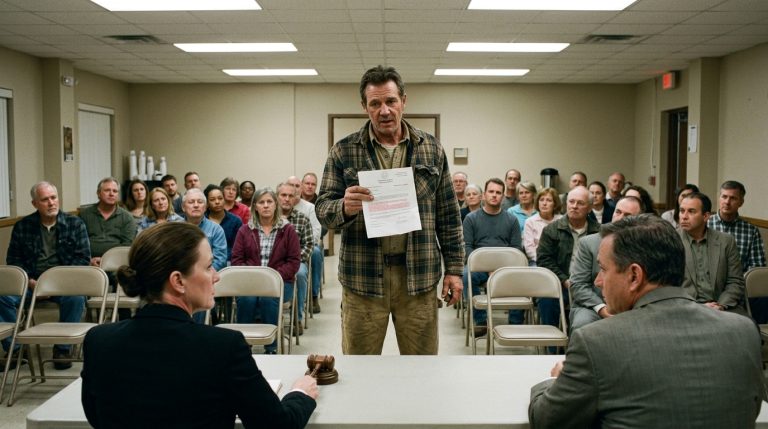
The meeting room smelled of ozone and industrial floor wax, a clinical space designed to strip the personality from any conflict. I walked to the table, my footsteps echoing against the linoleum. Karen sat at the center, her face a carefully constructed mosaic of professional concern. Three board members flanked her, their eyes darting to my folder with a mixture of apprehension and forced authority.
The fire marshal’s staffer sat to the side, looking bored, his notepad open. He was here because the HOA had requested his presence to “validate the safety findings.” He didn’t know he was about to be the primary witness to a dismantling.
“We have a lot to get through,” Karen said, her voice smooth, the practiced cadence of someone who had rehearsed this opening twenty times in the mirror. “We need to finalize the Ridge Emergency Flow plan. The owner of the turnout in question has been invited to clarify his position, though I hope we can move past individual obstruction toward communal safety.”
She looked at me, a challenge embedded in the tilt of her chin. The board members leaned in, ready to nod in unison.
“I’m here,” I said, staying seated. I didn’t reach for the folder yet. “But before we discuss the ‘plan,’ I’d like to review the foundation of the safety findings.”
“We’ve provided all necessary documentation,” Karen said, her smile thinning. “The county packet is public record.”
“Is it?” I asked. I slid a single sheet of paper across the table. It wasn’t a complex legal document; it was a simple printout of the server logs I’d extracted from the county office the day before. “Because according to the county’s own metadata, this ’emergency’ packet was finalized four days before you ever visited the ridge to discuss it.”
The room went still. The fire marshal’s staffer shifted, his pen hovering over his notepad.
Karen didn’t look at the paper. She kept her eyes on me, her expression hardening. “That’s a technical interpretation of an automated system. It has no bearing on the safety of the ridge.”
“It has everything to do with the integrity of the board,” I said. I opened the folder. I didn’t rush. I laid out the items one by one: the leaked email draft, the contractor’s statement regarding the unauthorized work order, and the original, un-redacted board memo that carried a signature block Karen hadn’t bothered to scrub.
The board members began to murmur, their faces pale. One of them, a man who had usually deferred to Karen, reached out and took the printout of the internal email. His brow furrowed as he read the directive to “loop in the fire marshal” if I resisted.
“Karen,” he said, his voice hesitant. “What is this?”
“It’s a strategic planning document, taken out of context,” she snapped, her composure fraying at the edges. She stood up, her knuckles white against the podium. “We are in the middle of a safety crisis. These are tactics to protect the community.”
“You aren’t protecting the community,” I said, my voice cutting through her panic. “You’re manipulating the process to secure private access. You used the fire marshal’s name, you used county resources, and you used your position on this board to attempt to bully a non-member into forfeiting his land rights.”
The fire marshal’s staffer stood up, his face reddening. He looked at Karen, his eyes narrowed. “I was told this was an urgent, county-requested review of the ridge. If this packet was manufactured internally, and if you’ve been misrepresenting our office to coerce property owners…” He left the sentence hanging, the threat clear.
Karen’s posture collapsed, a subtle but unmistakable shift. The confidence that had sustained her through months of tactical maneuvers evaporated, leaving her looking small, isolated, and suddenly very ordinary. She had spent months building a fortress of process and procedure, only to realize she’d built it on a foundation of sand.
“You have no right to present these,” she hissed, though the fire had gone out of her voice.
“I have every right to protect my home,” I said, standing up. “And it appears the rest of the board has a right to know exactly what they’ve been signing off on.”
I looked around the room. The board members weren’t looking at Karen anymore. They were looking at their own hands, at the documents, at the fire marshal—they were looking for the nearest exit from a sinking ship.
The “process” had turned on her. It wasn’t the heroic, dramatic confrontation she had envisioned, where I would be forced to concede under the weight of official language. It was the slow, inevitable reality of facts, laid bare in a quiet, beige-walled room.
“I’m moving to strike the emergency motion from the record,” the man who had read the email said, his voice shaking. “And I’m calling for a formal review of the board’s recent communications.”
Karen didn’t fight it. She just sat down, her hands folded in her lap, looking at the tabletop. The silence that filled the room was not the silence of tension, but the silence of an aftermath. I didn’t need to say another word. The papers were doing the work for me, and for the first time in months, the weight in my chest began to lift.
The siege was over, not because of a grand speech, but because the truth had finally been allowed to sit at the table.
CHAPTER 8: THE SETTLEMENT
The transition from the sterile, beige-walled meeting room to the open air of the ridge felt like waking from a fever. The storm had passed, leaving the mountain saturated, the air smelling of wet pine, iron-rich earth, and the faint, sharp tang of ozone. I walked toward my truck, the gravel crunching beneath my boots—a sound of simple, physical reality that had nothing to do with memos, intake logs, or forged diagrams.
Karen didn’t follow. When I looked back through the glass doors of the community center, she was still sitting at the table, a lone, diminished figure amidst a sea of empty chairs. The board members were gathered in a corner, their voices low, the frantic energy of their earlier panic having shifted into the grim, meticulous work of damage control.
The payoff was not a shout of victory, but the sudden, absolute cessation of the noise that had plagued me for months. No more “emergency” visits. No more contractors with orange paint. No more glossy packets filled with manufactured urgency.
The following weeks unfolded in a state of quiet, disciplined restoration. The HOA’s legal representative—a man far more pragmatic than the one I’d faced at the county office—contacted my lawyer with an offer that was less of a negotiation and more of a surrender. They accepted the permanent status of my turnout and gate as private, non-communal infrastructure, with a legally binding covenant attached to the parcel that barred any future HOA boards from attempting “normalization.”
I spent my Saturdays on the ridge. I returned to the retaining wall, scrubbing the remnants of the orange paint from the granite with a wire brush and a bucket of water. It was exhausting work, the friction of the steel against the stone producing a steady, rhythmic rasp. It felt right—the labor of maintenance, the direct engagement with the physical boundaries of my home. By noon, the granite was clean, the gray, weathered surface restored to its natural state.
I wasn’t alone in the effort. My neighbors, many of whom had seen the documentation I’d circulated, began to stop by, not to ask for favors, but to offer a nod of recognition. The paranoia of the “siege” had evaporated, replaced by a quiet, collective understanding that the administrative machine had been checked.
In the final weeks of the month, I watched from my deck as the HOA began their own cleanup—removing the “safety” signage that had been peppered throughout the common areas, replacing the board members who had been closest to Karen, and issuing a formal, albeit dry, apology to the community regarding “miscommunications in emergency planning.”
Karen was gone. I saw her car pull away from her driveway for the last time on a Tuesday, the roof rack loaded with boxes, the interior of the SUV cluttered with the detritus of a life built on control. She didn’t look up toward my parcel. She didn’t look back at the ridge at all.
I turned my attention back to the gate. I’d installed a new hinge, one that didn’t catch, and spent the better part of the afternoon greasing the mechanism until it swung with a smooth, whisper-quiet motion.
The core truth of the struggle—the Layer 2 reality—wasn’t about a turnout or a wall. It was about the fact that autonomy is not a right you are granted by a board; it is a weight you choose to carry. I had held my line, not because I was louder than the HOA, but because I had been more patient, more precise, and more willing to endure the labor of the truth.
As the sun began to set, casting long, golden shadows across the valley, I sat on the deck and poured a glass of water, watching the light catch the edges of the mountains. The silence of the ridge was absolute, a profound, unbothered peace that only returns when you have successfully forced a nuisance back into its proper, distant boundary.
My home was settled. The mountain was quiet. And for the first time in a long time, the ground beneath me felt entirely, unshakably my own.