The Paper Perimeter: A Calculated Defense of Sovereignty Against the encroaching Whispering Pines HOA Syndicate
CHAPTER 1: The First Incursion
The silence of the ranch house in the woods was usually my greatest luxury, a buffer against the noise of the neighboring developments. Today, that silence was shattered by the rhythmic, mechanical pulse of a pressure sprayer and the distinct, cloying odor of white traffic paint.
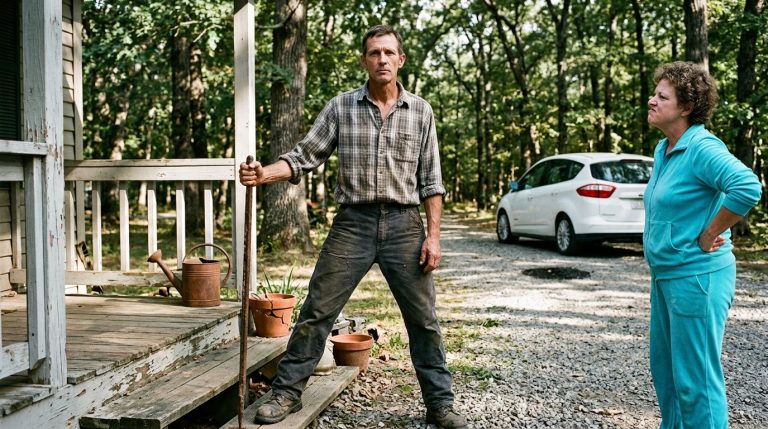
I stepped onto the porch, my hand brushing the cool, rough surface of the doorframe, and saw them. A crew of four, draped in high-visibility vests that looked too clean to be working, was currently staking their claim on the edge of my property. The stencil lay flat against the asphalt: FIRE ACCESS. Bold. Authoritative. Entirely illegal.
Karen Dubois stood off to the side, clipboard pressed to her chest like a shield. She wore a smile that didn’t reach her eyes—a practiced, public-facing curve of the lips that signaled she was ready for a performative debate.
“Morning,” she called out, her voice bright, slicing through the morning mist. “We’re just standardizing the access for the responders. It’s for everyone’s safety.”
I didn’t answer immediately. I walked down the drive, my boots crunching on the gravel, the sound amplified in the stillness. I kept my movements deliberate, measured. Every interaction was a chess move, and I had no intention of blundering in the opening sequence. I pulled my phone, the screen already recording, and angled it to capture the stencil, the crew, and the presence of the HOA president in a single, frame-tight composition.
“This is private property, Karen,” I said, my voice steady, stripped of the jagged edge of anger. I needed her to be the emotional one. I needed her to be the one who made the mistake. “You have no jurisdiction here. Where is your county permit?”
She laughed, a thin, airy sound. “It’s in process. We can’t wait on the county for safety, can we? Just let them finish.”
I ignored the instruction, focusing on the foreman. He was sweating, despite the cool morning, shifting his weight between the stencil and his clipboard. He knew. Or he suspected. Professionals didn’t paint municipal markings without a signed work order bearing a county seal.
“I need to see the permit number,” I repeated, ignoring her entirely now. I turned my attention to the foreman, holding his gaze until he looked away, down at his paint-stained boots. “If you don’t have a permit, you are currently trespassing on private land. I’ll give you thirty seconds to pack up, or I call the Sheriff.”
Karen’s smile didn’t falter, but it tightened, turning brittle. “You’re being difficult. We’re doing this for the neighborhood.”
I didn’t look at her. I waited. The silence stretched, heavy and metallic. The foreman looked to Karen for a counter-move, but she had none—not a real one, anyway. She had only theater, and theater didn’t hold up under the cold, hard weight of a sheriff’s incident report.
A movement at the edge of the woods caught my eye. My dog, Ranger, had emerged from the treeline, his harness camera glinting in the pale light. He sat at the boundary stake, staring not at the crew, but at me, waiting for the signal. He was the anchor, the silent witness to the invasion of our sovereign ground.
The foreman’s hand hovered over his gear. He was calculating. He looked at the wet paint, then at me.
“We have orders, ma’am,” he mumbled, though he didn’t reach for the sprayer.
“Orders without a permit are just vandalism,” I replied. “Thirty seconds.”
The air grew heavy with the smell of wet earth and the sharp, chemical tang of the paint. Karen shifted, her clipboard tapping against her thigh. She was waiting for me to yell, to lose my temper, to give her the ammunition she needed to paint me as the unstable adjacent owner. I gave her nothing but the steady, unblinking lens of my phone.
Then, a new sound cut through the quiet: the distant, familiar drone of a vehicle approaching on the county road. Not a delivery truck. Something heavier. The balance of the morning was about to shift, and I had to make sure it shifted in my favor.
CHAPTER 2: The Digital Archive
The heavy, rhythmic thud of an engine approaching on the county road grew louder, vibrating through the packed gravel beneath my feet. I didn’t turn my head. I kept my phone steady, the lens tracking the foreman’s indecision. He was still holding his stencil, his eyes darting toward the encroaching vehicle, then back to me, then to Karen.
She was still smiling, though the rhythm of it was fraying. She realized the audience was arriving. If she wanted to be the hero of the HOA’s safety initiative, she needed a clean scene. If the Sheriff’s deputy saw an unauthorized crew painting a private driveway without a permit, her performance would turn into a liability.
“Fine,” Karen snapped, her voice losing its polished veneer of neighborly concern. “We’ll handle this through proper channels. But you’re making a mistake, neighbor. When an emergency happens and the responders can’t find your turn, don’t come crying to us.”
“That’s a risk I’m perfectly willing to manage,” I replied. I held my ground until the foreman gave a sharp nod to his crew. They began to lift the stencil, the wet white paint smearing slightly against the asphalt—a scar of their failure. I snapped a photo of the smeared paint, the stencil being tossed into the back of a beat-up utility truck, and the logo on the side of the door.
Karen turned on her heel, her movements sharp and jerky, retreating toward her own vehicle parked at the shoulder. She didn’t look back. She didn’t need to. The battle line was drawn in drying paint on my private pavement.
I didn’t head straight to the house. I walked the full length of the driveway, my eyes scanning the ground. I was looking for anything else they might have touched, any other mark, any unauthorized hardware. The gravel was undisturbed, but the air felt different. It was no longer just the silence of the woods; it was the quiet of a perimeter being tested.
Ranger fell into step beside me, his harness camera recording the scene from a lower angle. When we reached the porch, I didn’t go inside to pace. I sat at my desk, the laptop already open. This was the moment where the fight moved from the physical to the structural. I opened a folder labeled Whispering Pines Defense.
I started the upload immediately. Footage from the phone, footage from the porch cameras, and the clips from Ranger’s harness. I wasn’t just saving these; I was creating a time-stamped, unalterable record. I labeled the files with date, time, and content: Trespass_Attempt_1_Stencil.mov, Foreman_Interaction_01.mov, Karen_Dubois_Refusal.mov.
The phantom of the day—the realization of how easily this could have spiraled—tightened my chest. If I had simply told them to leave, if I hadn’t recorded the interaction, if I hadn’t demanded the permit, it would have been my word against theirs. They would have painted my driveway, and six months later, they would have claimed a “long-standing agreement.” That was how these things worked. They didn’t take the driveway all at once. They nibbled at the edges until the edge became the middle.
I needed to be faster than them. I opened a new browser tab and navigated to the county clerk’s portal. I needed to see if they had filed anything—an easement, a notice, a petition. Nothing. The records were clean. I screenshotted the “No Results Found” page, saved it as a PDF, and attached it to a new email thread addressed to myself. BCC: My attorney’s firm.
My phone chimed. An email from the HOA’s automated system. Community Safety Compliance.
My pulse didn’t quicken. Instead, it slowed. This was the opening of the dialogue I had predicted. They were moving to the “written” phase of the conflict. I didn’t open the email immediately. I took a breath, feeling the texture of the wooden desk under my palms, grounding myself in the reality of the room, away from the theater of the driveway. I needed to respond with the same mechanical indifference they were using to erode my property rights.
I opened the email. It was formatted with a professional header, referencing “Emergency Access Standard 14-B.” It claimed that by living in the vicinity, I was subject to the HOA’s safety policies regarding “adjacent driveways.”
I leaned back, my chair creaking. It was a bluff—a corporate-sounding lie designed to intimidate the uninformed. I started typing. One sentence. No ambiguity. No anger. Just the cold, hard fact of ownership. I am not within your jurisdiction. You represent no authority over this parcel. Do not contact me again regarding property management.
I attached the county parcel map I’d downloaded the previous week, clearly highlighting the boundary lines that put me just outside the Whispering Pines master-deed. I hit send. Then, I closed the laptop. The real work wouldn’t be done in the emails, though. The real work was in the documentation I’d just started collecting.
I walked to the kitchen and poured a glass of water. Outside, the woods were quiet again, but the hum of the world felt further away. I checked the porch camera feed on my tablet. The driveway was empty, but the stencil’s ghost remained—a pale, smudged white line on the asphalt. It would fade in the rain, but the evidence was already archived.
I needed to anticipate their next move. If they couldn’t paint it, they would try to legislate it. They would go to the county. They would try to pressure the planning commission. My next move had to be preemptive. I looked at the calendar on the wall. The next county board meeting was in three days. I reached for my notepad and started a list: Recorder’s Office. Planning Commission. Permits Department. Open Records Request.
The fight wasn’t about the driveway. It was about who controlled the story of the land. And I was going to make sure the story was told in official records, not in HOA board meeting minutes. I sat back down, the light of the screen illuminating the fine grit of dust on my keyboard. I wasn’t just defending my home anymore; I was building a barricade of paper that no HOA president could burn through.
CHAPTER 3: The Proxy Gambit
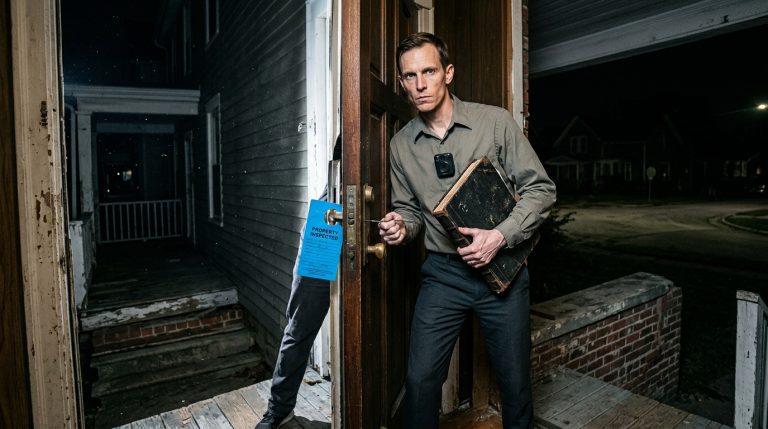
The knock was rhythmic, professional, and entirely unwelcome. I looked at the screen, then at the door, where the storm door’s mesh screen obscured the figure waiting on the porch. I didn’t rush. I took the time to set my phone to record, sliding it into my breast pocket with the lens exposed, a calculated weight against my chest.
When I pulled the main door open, the storm door remained latched, a thin barrier of glass and metal between us. A man in a pressed shirt, holding a leather-bound folder, stood there. He looked like every mid-level manager I’d ever met—someone whose salary depended on the appearance of authority.
“Mr. Sterling,” he said, offering a tight, practiced smile. “I’m David from Property Management. We’re here to finalize the emergency access paperwork. It’s just a standard compliance formality.”
I didn’t reach for the folder. I didn’t even unlatch the storm door. “I’ve already notified the association that my property is outside their jurisdiction. Did you miss that part, or are you just ignoring it?”
David’s smile didn’t waver, but his eyes flicked down to the latch of the storm door, then back to my face. He shifted the folder, the leather creaking in the humid morning air. “It’s really just a standard acknowledgement of the shared easement lane. If you sign, the board is prepared to drop the maintenance costs associated with the marking crew.”
Easement. The word hung in the air, a deliberate misrepresentation. I felt the familiar grit of frustration at the back of my throat—not the hot, explosive kind, but the cold, sharpening sort. I knew the land records. There was no easement. There was no shared lane.
“Show me the recorded easement,” I said, my voice steady, conversational. “Not the board resolution. Not the ‘standard compliance’ form. Show me the specific page and book number from the county recorder’s office where that easement is filed.”
David hesitated. A flicker of something—uncertainty, maybe, or just the realization that his script didn’t cover an owner who had actually visited the records office—crossed his expression. He smoothed the corner of the folder. “I’m just the messenger, sir. My job is to ensure the safety corridor is established for the Whispering Pines community.”
“Then deliver this message,” I said, leaning slightly closer to the glass. “Stop trying to buy consent with paperwork. Every attempt to claim authority over this parcel without a legal filing is being documented. If you step onto this property again without a court order, I will be filing a police report for criminal trespass. Am I clear?”
His smile vanished, replaced by a flat, transactional look. He wasn’t the antagonist, just a gear in a machine that had been set in motion by someone else. But gears could be stripped.
“I’m just trying to avoid a conflict, Mr. Sterling,” he said, his tone turning noticeably colder. “The board is quite determined to see this corridor completed. Refusing to sign will only result in… further complications.”
“Let them come,” I replied. “I’m not in their association. I don’t follow their rules. And I certainly don’t sign documents that contain false legal claims.”
I turned my back on him. I didn’t wait for his reply, didn’t watch as he stood there, lingering for a second too long, checking his watch. I walked to the kitchen, my boots silent on the hardwood. I grabbed my camera from the counter and stepped out the side door, circling around to the porch from the yard, capturing stills of his face, his car—a rental with a generic plate—and the logo on his folder.
When I sat back down at the desk, my hands were steady. I opened the file I’d started, the “Defense” archive, and added the latest entries. Proxy_Visit_01.mov. Subject: David, Property Management. I scanned the documents he’d been holding; I had caught a glimpse of the form in his hand. It wasn’t a standard safety form. It was a transfer of rights agreement, cleverly disguised under the header of “Community Safety.”
The realization hit me with the weight of a stone. They weren’t just trying to paint a line on my driveway. They were trying to get me to legally sign away my right to deny access. If I had signed, they would have had the leverage to bring in heavy equipment, to pave a road, to eventually force a zoning variance. It was a land-grab hidden behind the guise of a “safety corridor.”
I called my attorney, the phone pressed to my ear as I stared out the window at the tree line. My movements were automatic, a sequence of practiced motions.
“They’re escalating, aren’t they?” my attorney asked, his voice a dry rasp.
“They sent a manager,” I said. “He brought a transfer of rights agreement disguised as a safety form. They’re getting desperate, or they’ve got a deadline.”
“Don’t sign anything. Don’t speak to them again unless it’s through counsel. If they show up again, call the Sheriff’s non-emergency line. Keep the footage clean.”
“I’m already doing that,” I said. “But I think there’s more. Something about the way he pushed the easement language. They’re trying to force a claim of right, not just permission.”
“Then we document the ‘no’. We keep the record clear. If they can’t establish a pattern of consent, they have no case. How’s the shoulder of the road?”
“Still marked,” I said. “The paint is fading, but it’s still there. My next move is the county permits office.”
I hung up, the silence of the house returning, but it felt tighter now, filled with the static of the conflict. I looked at the screen again, at the metadata of the document I’d glimpsed in the photos. Author: KUBA. A name, or a set of initials. Another piece of the puzzle. I started a new document, labeling it Unknown_Entities. The HOA was just the shell. Someone else was steering the ship. I had to find out who was behind that author tag, because they were the ones who would eventually decide if this was going to end in a courtroom or something worse. The rust of the conflict was already setting in, and I could feel it in the way I was starting to look at the road—not as a passage, but as a border to be defended.
CHAPTER 4: The Escalation
The air on the shoulder of the county road was thick, smelling of hot asphalt and the sweet, dry rot of roadside grass. I stepped off my porch and onto the gravel, my boots crunching a jagged rhythm. There they were. Three orange traffic cones stood in a line along the white edge of my driveway, their plastic skins faded and peeling, topped with a makeshift, reflective sign: EMERGENCY ACCESS – NO PARKING.
No permit number. No county seal. No municipal authorization. Just plastic confidence and the audacity of a neighborhood association that had mistaken their charter for a legislative mandate.
I stopped at the boundary marker—a rusted iron stake I’d pounded into the hard-packed earth months ago. I didn’t reach for the cones immediately. I pulled my phone and the harness camera, checking the footage. My heart rate stayed low, a steady, measured pulse. This was the theater Karen preferred, and I was going to provide her with a very specific, very documented audience.
A faint, high-pitched whine emitted from the harness camera; the battery indicator on the remote flickered. A minor failure, a butterfly detoured by hardware, but one I couldn’t ignore. I knelt by the boundary marker, my hands moving with surgical precision to swap the battery, keeping my eyes fixed on the road. The silence of the woods behind me felt like a held breath.
While I worked, a neighbor’s sedan slowed to a crawl as it passed. The driver glanced at the cones, then at me, then at the camera rig. I didn’t wave. I kept my expression neutral, focused entirely on the machinery of the evidence. I was the personification of ‘difficult,’ just as Karen had promised her constituents.
I stood up, the camera lens now locked and steady. I approached the first cone, my shadow stretching long and thin across the asphalt. I didn’t kick them over; that was an act of aggression, a messy display that could be misinterpreted. Instead, I carefully lifted each cone, turning them one by one so the reflective signs faced the woods, away from the road. I wasn’t removing them—not yet—I was simply neutralizing their utility. I wanted the next driver to see a blank, meaningless plastic orange shell, devoid of the authority they were trying to project.
As I worked, I captured everything. The serial number stamped on the base of the plastic, the reflective sticker quality, and the precise GPS coordinates of the placement relative to my driveway.
Then, I heard it—the crunch of tires on gravel.
A silver SUV pulled up, halting just short of my boundary. Karen stepped out. She wasn’t alone; a man in a windbreaker with a professional-grade camera around his neck followed her.
“Mr. Sterling,” she said, her voice projecting, practiced and clear, as if she were speaking to a gallery. “We’ve had reports of residents being blocked from accessing the emergency turnaround. We’re here to ensure the corridor remains clear.”
I didn’t answer. I stepped back onto my own property, the boundary marker clearly visible between us. I remained silent, a tactic that always made her itch. I looked at the man with the camera, then back to her.
“I have the board resolution right here,” she continued, pulling a document from her bag. She didn’t offer it to me; she held it up, displaying it to the man with the camera. “This authorizes the maintenance of the corridor.”
“That document is not a county permit, Karen,” I said, my voice quiet, cutting through her theatrical projection. “You are currently trespassing on private property, and you are creating an obstruction of a public right-of-way with unauthorized equipment.”
“It’s not unauthorized if the board approved it,” she countered, her smile sharpening.
I took a step forward, just to the edge of my line. “The board’s approval means nothing to the county. I’ve already spoken with the permits office. There is no application on file for this location. If you don’t remove these cones within the hour, the Sheriff’s office will be notified of an unauthorized traffic obstruction.”
She didn’t blink. She looked at her photographer, nodded, and he began snapping photos of me, the cones, and the driveway entrance. This was the “file building” my neighbor had warned me about. They were crafting a narrative of a hostile, unreasonable owner, creating a record of “non-compliance” to justify future legal, or perhaps more aggressive, action.
“You’re making a scene for nothing,” she said, her tone dropping, the performative warmth vanishing. “The corridor is going to be established. You can cooperate, or you can watch as the board makes things very difficult for you.”
“Is that a threat, Karen?” I asked. I reached into my pocket, my fingers brushing the edge of my phone, ensuring it was still recording the audio. “Because I’d love for you to repeat that for the record.”
She froze. The man with the camera hesitated, his shutter finger stalling. The silence that followed was heavy, the heat of the sun pressing down on us, turning the smell of the road into something sharper, more volatile. She couldn’t afford to be explicit, not when her entire power base relied on the pretense of “community safety.”
She turned, her movements brittle, and climbed back into her SUV. “We’ll see how difficult you find it when the city board reviews your zoning, Mr. Sterling.”
She pulled away, the tires kicking up a spray of dust that hung in the air for long, agonizing seconds. I stood there as the dust settled, looking at the row of orange, faceless cones. They were small, insignificant, and plastic, but they represented the first real move toward forcing a zoning change. They didn’t just want the driveway; they wanted to reclassify the land. I picked up the first cone, feeling the cheap, sun-baked weight of it, and carried it toward the house. I had the footage. I had the threats. And now, I had their equipment. It was time to start the open records request for the board’s meeting minutes. The theater was ending. The real audit was about to begin.
CHAPTER 5: The Paper Trail
I didn’t let the cone sit there for long. It was a trophy, but it was also a liability—proof of my own “difficult” nature if it were ever discovered in my possession. I moved it to the garage, tucking it behind a stack of weathered timber. My focus now was the paper. Specifically, the paper that didn’t exist.
I sat at my desk, the glow of my monitor reflecting against the dark, unpolished grain of the wood. The county clerk’s website was a labyrinth of outdated portals and broken links, a digital reflection of the very bureaucracy I was navigating. I had spent the last three hours pulling every PDF, every recorded deed, and every mention of the Whispering Pines master plan.
The pattern was emerging. It was quiet, almost invisible to the casual observer, but to someone documenting every move, it was loud. The HOA hadn’t just been expanding their influence; they had been systematically acquiring abandoned property easements, pushing for “safety” declarations, and slowly creating a contiguous corridor of control that didn’t match the original survey.
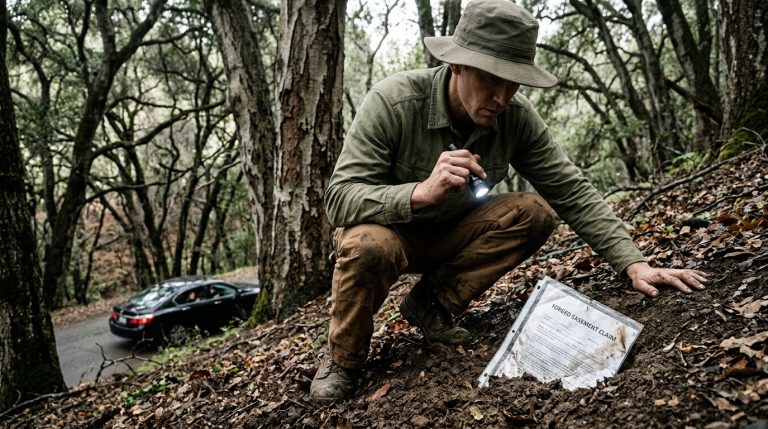
I pulled up the “Revised Plat” the foreman had sent me, the one with my boundary line thickened and the red path drawn across my shoulder. I leaned in, my eyes tracking the pixelation of the file. It looked professional, but the metadata told a different story. Author: KUBA. Modified at 11:43 p.m.
I opened the document in an advanced viewer, stripping back the layers of the PDF. Beneath the red path, I found an old, faded layer—a zoning overlay from a development firm that had gone bankrupt in the early nineties. They weren’t just creating an emergency corridor. They were trying to resurrect a dead commercial project. The “emergency access” was just the Trojan horse. It was the only way to re-zone the narrow strip of land they needed to connect the main road to the high-value commercial parcel in the back.
My breath hitched. The reality was much simpler—and much more dangerous—than an HOA president’s power trip. This wasn’t about control; it was about capital.
I started typing, my fingers flying across the keys. Open records requests. I filed three in rapid succession, aiming them at the Recorder’s Office, the Planning Department, and the County Commissioner’s internal archives. I requested everything tied to the Whispering Pines master-deed, every easement mention, and anything linking the board to the failed development firm of the nineties.
The house felt too quiet. The wind picked up outside, rattling the windowpane in its frame. I stood up and walked to the window, watching the shadows lengthen across the gravel of my drive. I felt a sudden, sharp spike of paranoia—was I being watched? I dismissed it, but the feeling lingered, an unreliability in my own perception that I couldn’t quite shake. Was the HOA truly this organized, or was their incompetence a veil? Was the “author” KUBA a ghost, or a very real developer sitting in a boardroom?
My phone buzzed against the desk. A notification from the contractor’s foreman. “We received a revised plat from HOA showing corridor connection. Can you confirm boundary?”
I stared at the screen. They were still pushing. They weren’t waiting for the county; they were trying to force a mistake in the paperwork that they could later claim as “accepted practice.”
I didn’t reply immediately. I drafted a response, carefully wording it so that it functioned as a final warning. “Any further action on this parcel will be documented as willful trespass. Incident number 2473 is already on file with the Sheriff. I have the county’s official notice of no permit on record. Proceed at your own legal and financial risk.”
I sent it. The weight of the decision settled in my gut, a hard, cold knot. By escalating, I was removing any possibility of a “quiet” resolution. If they were really working for a developer, they wouldn’t stop because of an email. They would hit back.
I checked the timestamp on my computer. 11:43 p.m. The same time as the forged plat’s metadata. Was it a coincidence, or was it a signal? I looked around the room, feeling the walls of the house press in. The silence wasn’t protective anymore; it was exposed. I had moved from the defensive to the offensive, and for the first time, I wasn’t just managing the HOA. I was hunting for the architect of the forgery.
I grabbed my coat and stepped out into the twilight. I walked to the edge of the property, where the trees gave way to the county road. I knelt at the boundary marker, my fingers tracing the rusted iron. The road stretched out into the distance, empty, cold, and indifferent. I had the facts, the logs, and the documents, but none of that mattered if I couldn’t prove who was pulling the strings. My defense had become a scavenger hunt, and I was starting to realize that the person I was hunting was just as careful, just as quiet, and just as determined to stay hidden in the gray areas of the law. The rust of the conflict wasn’t just on the tools anymore; it was in the foundation of everything I was fighting for.
CHAPTER 6: The Confrontation
The beam of a high-intensity floodlight swept across the tree line, slicing through the darkness and catching the reflective dust dancing in the air. I didn’t move. I remained crouched at the boundary, my hand still resting on the rusted iron stake. The engine sound grew, turning from a distant hum into a heavy, industrial rumble.
A truck pulled onto the shoulder of the county road, its tires kicking up a spray of gravel that rattled against the underbrush. The driver didn’t kill the lights. He blinded me, a white, sterile glare that turned the world into silhouettes. I shielded my eyes, my other hand instinctively moving to the phone in my pocket. I wasn’t just observing anymore; I was a participant in their escalation.
“Mr. Sterling!” A voice boomed, amplified by a loudspeaker. It was the county inspector. Beside his vehicle, a second car pulled up—a sheriff’s cruiser. Deputy Marorrow stepped out, his uniform sharp, his posture devoid of the casual ease he’d shown in previous weeks.
I stood up, my joints stiff, and walked toward the edge of the property, keeping well within my own lines. “I’m here,” I called back, my voice steady.
Karen Dubois emerged from the passenger side of the cruiser. She looked different in the artificial light—her hair slightly windblown, her expression less ‘community president’ and more ‘desperate stakeholder.’ She was holding a stack of papers, the edges fluttering in the cool breeze.
The inspector stepped out, his boots crunching on the shoulder. He walked toward the driveway entrance, his eyes tracking the line where the stencil had been scrubbed off but still left a ghost of white on the asphalt.
“We’re here to resolve this, Mr. Sterling,” the inspector said, his tone professional, stripped of any empathy. “The HOA has provided new documentation regarding the emergency access corridor. We need to assess the site.”
“There is no corridor,” I said, my voice low and controlled. “There is only a private driveway. If they’ve provided documentation, they’ve provided forgeries.”
“That is a serious accusation,” the Deputy added, stepping forward. He didn’t look at me; he looked at the ground, at the intersection of my drive and the county road.
Karen stepped forward, her hand trembling slightly as she shoved the papers toward the inspector. “We have a board resolution. It’s legally binding for all parcels within the Whispering Pines master-plan radius.”
I felt a surge of cold clarity. This was it—the climax of their theater. They were gambling everything on the idea that they could overwhelm the inspector’s office with enough paper to bypass the actual legal requirements. I reached into my coat, pulling out the folder I had prepared. It was thick, heavy with the weight of official county emails, the recorder’s certificate of ‘no easement,’ and the metadata analysis of the forged plat.
“I have the county’s own records here,” I said, stepping into the edge of the light. “No permit. No easement. And evidence that the document currently in Karen’s hand was modified at 11:43 p.m. by an anonymous author.”
The inspector paused. He looked at Karen, then at me. He was a man who lived by the stamp, by the signature, by the cold, hard logic of the filing system. He took the folder I offered. He didn’t look at the board resolution; he looked at the document confirming the lack of a permit.
“Is this true?” the inspector asked, his gaze shifting to the Deputy.
Marorrow’s expression didn’t change, but he stepped closer to Karen. “Karen, let me see the original filing.”
“It’s… it’s all in the process,” she stammered, her gaze darting between the inspector and the road behind us. She was looking for an exit, a way to spin this back into a civil dispute, but the presence of the Deputy had turned the tide.
I didn’t argue. I didn’t gloat. I let the silence do the work. I watched as the inspector scanned the pages, his thumb rubbing against the seal of the Recorder’s office document. The power dynamic shifted in real-time, the weight of the paper overcoming the volume of her performance.
Karen’s board members were lingering near the vehicles, their posture changing. One began to edge away, toward the shadows, as if distance could dissolve his complicity.
“Restore the shoulder,” the inspector finally said, his voice dropping to a flat, authoritative pitch. He handed the board resolution back to Karen. “And remove the remainder of the markings from the private pavement. Submit proof of restoration to the county office by Monday. If you return to this parcel without a permit and the owner’s consent, you are inviting formal enforcement.”
Karen went still. The floodlight caught the sheen of sweat on her forehead. She looked like a statue, the weight of the defeat slowly sinking into her posture.
I didn’t say a word. I turned and walked back toward the house, my boots echoing on the asphalt. I had won the battle, but as I glanced back, I saw the Deputy still talking to the inspector, and I knew the war was far from over. They would try to replace her, or they would try to re-zone, or they would try something else. But for now, the perimeter was intact. The rust of the conflict had been scrubbed clean, if only for an hour, and in that silence, I found the first real measure of what I had been fighting for: the right to exist without someone else trying to draw lines across my life.
CHAPTER 7: The Judicial Verdict
The court building was a monument to silence and dust, a stark contrast to the performative noise of Karen’s HOA meetings. I sat on a hard, wooden bench in the corridor, my folder cradled in my lap like a talisman. I had prepared for this moment, yet the atmosphere of the courthouse, with its polished floors and the distant, rhythmic clicking of a clerk’s typewriter, made the battle feel smaller, more clinical.
My attorney sat beside me, flipping through our exhibits with the methodical grace of a man who dealt in the currency of precedent. He wasn’t looking for drama; he was looking for the flaw in their filing, the microscopic crack in the foundation of their authority.
“The TTRO application is solid,” he whispered, not turning his head. “We have the documentation, the timeline, and the proof of the forgery. Karen isn’t coming to defend the HOA; she’s coming to defend her own narrative. Don’t let her speak for you.”
The heavy oak doors opened. We were called in.
The courtroom was small, the air tasting of stale floor wax and old paper. Karen was already there, flanked by two other board members who looked distinctly uncomfortable, as if they were trying to shrink into their suits. They weren’t the antagonists I’d fought on the driveway; they were merely the hollow shells left over after the reality of the legal system began to strip away their protection.
Karen caught my eye. Her gaze wasn’t the sharp, performative flick of the driveway confrontation; it was dead, hollow. She looked tired. It was the exhaustion of someone who had spent too long living inside a lie that was finally beginning to collapse under its own weight.
The judge—a woman with sharp eyes and a no-nonsense manner—cut straight to the point. She didn’t want to hear about community safety or emergency corridors. She wanted the permit.
“Counsel, show me the recorded easement,” she commanded.
Karen attempted to speak, but the judge held up a hand. “The documentation, please.”
Karen produced a document—the same resolution she had waved in the face of the inspector, but here, in the bright, unforgiving light of the courtroom, it looked like what it was: a sheet of paper with no legal standing. The judge scanned it, her expression unchanged, and then she looked at our exhibit—the recorder’s email, the county’s official “no permit” notification, and the metadata printout of the forged plat.
“This board resolution does not grant the association the right to alter private parcels,” the judge stated, her voice echoing in the small room. “Furthermore, the evidence of unauthorized plat modification is compelling. You are hereby barred from entering the parcel belonging to the petitioner. You are directed to cease all operations, remove all signage, and issue a written correction to your residents regarding the status of the parcel.”
The air in the room felt as if it had been vacuumed out. The board members shifted. One of them looked at Karen, a look of pure, unadulterated accusation.
“The court also notes that the association is liable for the costs of these proceedings,” the judge added, her pen scratching against the final order.
Karen didn’t argue. She didn’t offer a defense. She just sat there, her shoulders slumping, the veneer of the ‘president’ fully gone. The gavel struck, a sound that felt like the snapping of a lock.
We left the courtroom in silence. My attorney didn’t celebrate, and neither did I. This wasn’t a victory in the way I’d imagined; it was an audit. I walked out into the afternoon sunlight, the glare of the world feeling brighter, harsher. I pulled my phone and checked the email threads. The management company had already received the notification of the order. The correction was being drafted.
I stood on the courthouse steps, feeling the steady, rhythmic pulse of the city around me. I had the order, the signature, and the legal weight of the court behind me. But as I looked at the digital copy of the TTRO, I noticed a detail I’d missed—a mention of a “development transition” in the board’s internal correspondence, a file I’d only recently accessed via the last request. It confirmed my suspicion: Layer 2. The HOA wasn’t just incompetent; they were in deep, irreversible financial trouble, and they had been selling the idea of this corridor to a holding company to cover their own insolvency. They weren’t protecting the neighborhood; they were trying to save themselves from a fiscal catastrophe.
The mystery of the “author” KUBA began to align—not with a developer, but with the HOA’s own internal accountant, a man whose digital fingerprint was all over the forged documents. The decoy had been stripped away, and the core truth of their desperation was laid bare. I started the car, the engine turning over with a steady, reliable hum. I had the final piece of the puzzle. I had the truth. Now, all I had to do was make sure the world saw it before they could move on to their next target.
CHAPTER 8: The Quietude
The return to the ranch house felt less like a homecoming and more like a recovery. The gravel drive, once a theater of petty skirmishes and neon-painted threats, lay beneath the late-afternoon sun, stripped of its stencil, its cones, and its intruders. I walked the length of it with Ranger, his harness clinking softly in the stillness. We reached the shoulder of the county road where the white paint had been scrubbed away, leaving only a faint, scab-like discoloration on the asphalt. The striping crew had been thorough.
I paused at the spot where Karen had stood only days ago, brandishing her board resolution like a sword. Now, there was nothing. No cones. No clipboard. Just the indifferent hum of the county road.
I returned to the house, the physical weight of the last few weeks finally beginning to bleed out of my muscles. I sat on the porch, my hands resting on the cool, weathered wood of the railing. The “Paper Perimeter”—the barricade I had built from emails, metadata, and incident reports—had held.
I pulled the final piece of evidence from my pocket: the financial audit of the Whispering Pines HOA. It was a dense, technical document, but the numbers were clear. They weren’t fighting for safety; they were hemorrhaging capital. The “Emergency Access Corridor” was the final, desperate gamble of a board that had over-leveraged their community’s assets to private developers who had since long vanished into bankruptcy. They were insolvent, their accounts bled dry by years of mismanagement and the foolish hope that they could force a zoning variance to offload a dead project.
The payoff was cold, but absolute. Karen Dubois wasn’t a villain; she was a symptom. She was a woman who had tried to build an empire on a crumbling foundation and had turned to theft to keep the lights on.
I watched a car drift by, a neighbor waving—not coming in, just a small, wordless gesture of acknowledgment. They knew. In a neighborhood of secrets, the truth had a way of bleeding through the cracks. They had watched the audit, the court order, and the quiet, methodical removal of the HOA’s influence.
I went inside and into the garage, finding the hidden stack of timber where I’d stashed the final orange cone. I carried it to the outdoor fire pit, the plastic brittle and sun-damaged. I didn’t burn it—that would have been performative, a final piece of theater I no longer needed. I placed it in the recycle bin, the plastic clicking against the bottom of the container.
Symbolic closure. It was just a piece of plastic. And yet, discarding it felt like the final step of the restoration.
I returned to the porch. Ranger stretched out in the tall grass, his breathing slow and rhythmic. The world was quiet. The county road hummed, a low-frequency vibration that barely registered against the backdrop of the trees.
My attorney’s final email sat in my inbox—the confirmation that the attorney’s fees had been paid, the costs covered, and the HOA board had officially voted for Karen’s removal. She was barred from service, her voice stripped of its institutional amplification.
I leaned back, my eyes closing. The anxiety that had defined my life for the last few months—that constant, grinding vigilance—was receding. I had saved my home not with force, but with the cold, unyielding weight of truth. My life didn’t need the drama of the “Emergency Access.” It needed the reality of the boundaries I’d defined.
I sat there until the sun dipped below the tree line, casting long, deep shadows over the driveway. I realized then that I wasn’t just defending a parcel of land; I was protecting a way of life that required no permission, no oversight, and no theater. I took a deep, steady breath, the air smelling of pine needles and damp earth. The receipt had been paid, the debt settled, and the silence I’d earned was, at long last, mine to keep.