The Cold Perimeter: A Veteran’s Calculated Siege Against the Architect of Suburban Ruin
CHAPTER 1: THE WHITEOUT THEFT
The wind slammed against the siding of the house, a concussive force that made the windowpane vibrate in its frame. Outside, the temperature had cratered to eight degrees, and the air was a thick, blinding soup of white ice. I was clutching a mug of tepid coffee, my knuckles white, watching the figures. They didn’t move like locals caught in a storm. They moved like workers who had been paid a premium to operate in hell.
They were surrounding the propane tanks—eight steel sentinels lined up like soldiers at the rear of my property. They were mine. My heat. My safety. Each one represented a calculated financial blow I had absorbed to keep the house liveable, and now, they were being uncoupled.
I didn’t think. The adrenaline hit my bloodstream like a shot of adrenaline, cold and sharp. I grabbed my boots, skipping the laces, and yanked my heavy parka off the hook. The front door groaned against the pressure of the gale as I shoved it open. The cold hit me instantly, a physical weight that stole the breath from my lungs.
“Hey!” I screamed. The word was ripped away by the wind, but I kept moving, wading through the knee-deep drifts that clung to my legs like lead weights.
The men in the orange vests didn’t look at me. They worked with terrifying, sanitized efficiency, their movements devoid of the hesitation one would expect in a blizzard. They were too clean. Their vests didn’t have the jagged tears or the caked ice that mine did.
I closed the distance, my heart slamming against my ribs. As I rounded the corner of the house, the figure in front turned. It wasn’t one of the workers. It was Helen Thompson.
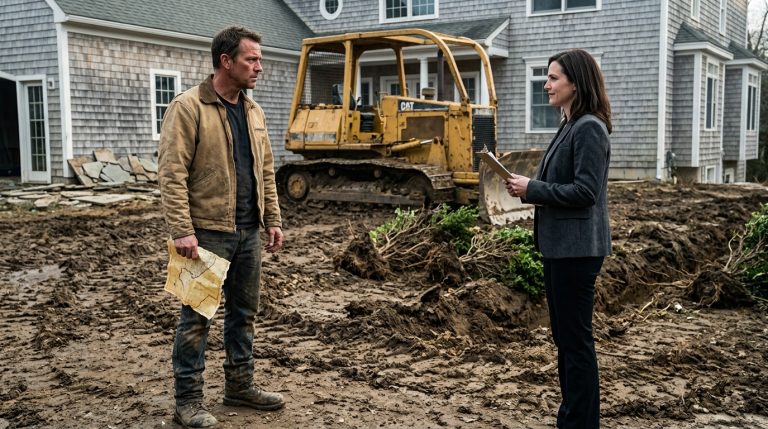
She stood there, perfectly poised, her face sheltered by the hood of a sleek, expensive parka. She held a clipboard against her chest as if it were a shield of law. The sight of her—the calm, smug arch of her eyebrow—cut through the rage.
“We’re removing these, Mr. Walker,” she said. Her voice didn’t waver. It didn’t carry the tremor of the cold. “They’re unauthorized.”
“Unauthorized?” I roared, my voice raw. “I paid for these. My wife is gone, and this is the only thing keeping this house from turning into a block of ice!”
Helen looked past me, then back at the clipboard, her thumb tracing the plastic edge of a document. “The HOA guidelines clearly state that external fuel storage is subject to board approval. You never filed the amendment.”
“It’s a blizzard, Helen!” I stepped toward her, the wind howling around us, but she didn’t blink. She looked at me with a detached, clinical curiosity, like a scientist observing an insect struggling in a jar.
“Rules are rules, Mr. Walker,” she said, and for a second, I noticed the way her gaze shifted to the side, lingering on the pristine condition of the workers’ equipment, then back to my desperate, freezing state. There was no empathy there, but there was a strange, frantic focus—a predatory need to finalize the task before the storm claimed them.
She tapped her pen against the clipboard. “Consider this a warning.”
I reached for the nearest tank, my hand freezing to the icy metal, but two of the orange-vested men stepped forward, placing themselves between me and the hardware. They didn’t strike me. They didn’t shout. They simply occupied the space, their movements precise and immovable.
Then, I saw it—a small detail that froze me worse than the wind. Stuck to the side of one of the tanks they had already moved was a small, white tag with a serial number, scrawled in black marker. It wasn’t an HOA violation notice. It was a liquidation sticker, the kind used for inventory in a clearance sale.
My stomach dropped, not from the cold, but from the realization that this wasn’t about the rules. Helen wasn’t here to manage the neighborhood. She was stripping it. And as she turned to watch the workers drag the first tank away, the way her hand trembled slightly, barely hidden behind the clipboard, hinted that this wasn’t just power—it was desperation.
CHAPTER 2: THE SIEGE BEGINS
The silence that followed Helen’s retreat was worse than the wind. It was heavy, pressurized, the kind of stillness that precedes a structural collapse. I stood in the yard, my fingers locked around the icy metal of the last remaining tank—one they hadn’t gotten to yet, or perhaps one they’d missed in their haste—and watched the taillights of their truck vanish into the whiteout.
They were gone, but the hole they’d left behind was a physical ache. The row of propane tanks was a graveyard of utility. Without that fuel, the house would be a tomb by midnight. My breath hitched in my chest, blooming in the frigid air like gray smoke. I didn’t move for a long time. My legs felt cemented to the frozen earth, the cold leaching through my boots, crawling up my shins like a parasitic vine.
I turned back toward the house. The structure loomed ahead, dark and uninviting. It wasn’t just a building; it was the epicenter of a life I’d carefully constructed, now being picked apart by a woman with a clipboard and a distorted sense of moral rectitude. Every step toward the back door felt like walking into a trap.
When I finally pushed inside, the lack of heat hit me like a physical blow. The air inside was stagnant, tasting of dust and stale, trapped moisture. The temperature had already plummeted. I walked through the kitchen, my boots clattering on the linoleum, the sound sharp and alien in the dead space.
I stopped in the hallway. A memory flared—sharp and unwanted—of Emily. She had loved the way the late afternoon sun hit the hardwood floors, turning the room into a warm, amber sanctuary. I could almost hear the low hum of the furnace, the gentle, reassuring heartbeat of a home that was actually alive. Now, the house was a hollow shell. The biting cold at the back of my neck triggered a phantom sensation of her hand in mine, and the realization that I was standing here, alone, in a freezing house, nearly brought me to my knees.
I forced the memory away. I couldn’t afford nostalgia. I couldn’t afford grief. I moved into the living room, my gaze falling on the thermostat. The digital display was dark. Dead. I tapped it, a useless, reflexive gesture.
I needed a strategy. If they were back tomorrow, they’d take the last tank. I went to the basement door, gripping the handle. It was stiff, the metal biting into my palm with a crystalline edge. I descended, the stairs groaning under my weight. Down here, the air was even thinner, smelling of dry earth and old insulation. The electric baseboards—the ones the previous owners had left as decorative relics—sat against the walls like rusted ribcages. I knelt in the dark, the concrete floor numbing my knees, and traced the line where the main feed should have been.
Nothing. Just shadows and the creeping knowledge that I was being hunted by the neighborhood association.
I sat there for a long time, the darkness pressing in. My mind raced, abandoning the raw, animal anger of the standoff for something more tactical. I began to calculate. If Helen was liquidating the neighborhood assets, she needed a paper trail—however thin—to justify the removal. She had mentioned an amendment. An approval process. If I could find the specific bylaws, if I could map the timeline of when she’d decided these tanks were “unauthorized,” I might find the flaw in her armor.
But more than the paperwork, there was the sticker. That liquidation code. I closed my eyes, picturing the font, the jagged edge of the marker, the specific way it had been applied. It wasn’t standard HOA procedure. It was logistics.
I stood up, my joints stiff, and walked back upstairs. The house felt smaller now, tighter. I went to the desk in the den, pulled out a thick, leather-bound notebook—my ledger of every repair, every bill, every interaction with the HOA over the last three years. I sat in the dark, the only light coming from the snow-reflected moon outside, and started reading.
I wasn’t just a resident anymore. I was a casualty of a war I hadn’t realized was being fought. I took a pen, the plastic cold against my skin, and began to write down the dates. Every complaint about the lawn. Every threat about the mailbox. Every time Helen had appeared on the porch with that damn clipboard.
The cold was encroaching, the air in the house becoming brittle, but I didn’t feel it anymore. The rage had transformed. It was no longer a fire that consumed; it was a mechanism. I was mapping the perimeter of my enemy. And as I turned the page, a realization settled over me: Helen wasn’t just taking things to control the neighborhood. She was preparing for something. She was clearing the slate.
I heard a sound from outside—a faint, rhythmic scraping, like a shovel hitting the frozen driveway. My heart stopped. I stood, moving to the curtain, and peered through the sliver of space. Nothing but the blizzard, the white blur, and the relentless, screaming wind.
I was alone, but the house felt occupied by her intent. I went to the kitchen and grabbed a flashlight, checking the batteries. Then I checked the locks on the back door, testing the deadbolt until it clicked with a satisfying, metallic finality. I turned toward the center of the room, listening to the house settle in the cold. I wouldn’t freeze. I wouldn’t break. I would stay here, in the dark, and I would wait for the next move.
CHAPTER 3: THE PAPER TRAIL
The morning light was a lie. It filtered through the frost on the windows, a pale, anemic gray that offered no warmth to the shivering house. My hands were stiff, the skin dry and pulled tight over my knuckles from the cold. I had spent the night in the den, huddled in an old wool blanket, listening to the house groan as it fought the low temperatures.
Now, the HOA’s letter lay on the desk in front of me. It was printed on thick, expensive-feeling bond paper, the kind of material that felt insultingly formal given the message it carried. I had read it a dozen times, but the words still felt like a punch to the gut. Violation Notice: Improper Maintenance of Yard Perimeter.
I picked it up again, my movements slow and deliberate. My eyes tracked the signature at the bottom: Helen Thompson, President. But it was the stamp in the corner that caught my attention. It was a digital seal, generic and cold, but there was a faint, ink-smudged smudge of a different set of initials beneath the embossed logo of the Homeowners Association.
I leaned in, the light from the desk lamp casting sharp, geometric shadows across the desk. I pulled a magnifying glass from my repair kit—a remnant of the work I used to do on the house before the world became a series of battles—and hovered it over the paper. The initials weren’t HOA-related. They were SLV.
It was a small, almost invisible detail, the kind of thing someone would only notice if they were looking for a crack in the veneer. SLV. It wasn’t an HOA code. It was a firm.
My pulse quickened. The cold in the room didn’t matter anymore; the house felt suddenly, sharply vibrant with the potential for discovery. I moved to the filing cabinet, my boots silent on the rug, and started rifling through the folders I’d kept since we moved in. The previous notices from the HOA were all standardized, clean, professional. But this one? This one was a template, repurposed and rushed.
If Helen was using a third-party firm to handle the “violation notices,” then the HOA wasn’t just managing the neighborhood. It was outsourcing its authority. I started cross-referencing the dates. Every time a neighbor had reported a missing piece of furniture, a towed car, or a seized appliance, the HOA had issued a notice just like this one.
I grabbed my laptop, the screen lighting up my face in the dim room, and began to search. I looked for SLV, for liquidation firms, for anything that connected the dots between my propane tank—my lifeblood—and the cold, clinical removal of my neighbors’ belongings. I wasn’t looking for a regulation. I was looking for a business model.
Two hours later, the answer was staring back at me. SLV wasn’t a property management firm. It was an asset recovery group, a company that specialized in seizing collateral from distressed accounts. The pieces clicked into place with the sickening sound of a heavy door locking. Helen hadn’t just been “enforcing rules.” She had been identifying homes with high-value, portable assets, using the HOA’s own bylaws as a legal crowbar to declare them “unauthorized,” and then funneling those assets to SLV.
It was a liquidation scheme, disguised as suburban management.
I leaned back in the chair, the wood creaking in the freezing room. My breath hung in the air, a visible indicator of the danger I was in. I wasn’t fighting a stickler for lawn height anymore. I was fighting a woman who had turned the entire neighborhood into a storefront for a secondary market.
I needed proof. I needed to see what they were doing with the seized property. I reached for my coat. The house was a trap, and it was getting colder by the minute, but the anger had shifted into something colder, more focused.
I walked to the kitchen and grabbed a thermos, filling it with the last of the lukewarm water I’d managed to heat on the small electric burner I’d pulled from storage. I checked my phone—no service. The storm was still choking the valley, cutting off the world.
I stepped out onto the back porch. The wind hit me, but I didn’t flinch. I looked toward the center of the neighborhood, toward Helen’s house—a fortress of perfect, manicured silence in the middle of the chaos.
I had to move. I had to see if I could find the warehouse, the drop-off, the place where everything we lost was being sorted, tagged, and sold. The logic was simple, a chain of causality that was finally becoming clear: Therefore, she had to take the assets, but she needed a legal excuse, so she invented the violations.
I wasn’t going to wait for the next notice. I was going to follow the paper trail to its source.
I started down the steps, the snow crunching under my feet. My goal was the main road, the place where the trucks would have to enter and exit. If SLV was moving inventory, they were moving it out before the storm completely locked the neighborhood down.
I didn’t have a plan beyond the immediate, cold necessity of the next step. I kept my head down, my eyes fixed on the horizon, tracking the faint, tire-track imprints left in the deepening drifts. They led toward the edge of the development, toward the service gate that Helen usually kept locked.
I reached the gate, my hands trembling as I felt the iron surface. It was frozen shut, coated in a thick, crystalline layer of ice. I gripped the chain, the metal biting into my skin, and pulled.
The sound of the struggle echoed in the empty street. It was a heavy, protesting groan of iron against iron. I forced it, my shoulder pressing into the cold, my lungs burning. And then, with a sharp, sickening crack, the lock gave way.
I stepped through, the world opening up into the vast, white void of the storm. I was out. I was off the perimeter. And for the first time since the tanks were taken, I was no longer on the defensive.
CHAPTER 4: THE DECOY EXPOSED
The service gate swung open with a screech of tortured metal that seemed to howl louder than the gale. I stepped through, my boots sinking into the drifts, and immediately leaned into the wind. Beyond the fence, the landscape changed. This was the commercial transition zone—a service road that connected our pristine, manicured nightmare of a neighborhood to the wider, neglected industrial outskirts of the county.
Visibility was nonexistent, just a swirling wall of white that tore at my face. I kept one hand on the fence line, using it as a guide, my fingers numb despite the heavy gloves. Every step was a fight against the suction of the snow, a slow-motion grind that made my lungs burn with the icy intake.
Then, I saw it.
The wind shifted, a sudden, violent gust that cleared a patch of the road just long enough for me to see a flash of color in the ditch. I veered toward it, struggling through the deep powder. It was a metal patio chair, tangled in a cluster of frozen, dead brush. I reached down, pulling it free.
My heart hammered against my ribs. It was one of the pieces Sharon had mentioned—distinctive, wrought-iron, with the unique scrollwork pattern that had been part of her set. It wasn’t trash. It wasn’t part of a cleanup initiative. It was tagged with a yellow plastic tie-wrap—a shipping inventory tag from SLV.
I stared at the tag, the yellow plastic vibrating in the wind. This was it. The proof. The “cleanup initiative” was nothing but a front for state-sponsored theft, a systematic stripping of the neighborhood’s equity. Helen wasn’t just power-tripping; she was running an industrial-scale fence for stolen property.
A shadow moved in the periphery of my vision.
I dropped the chair and flattened myself against the frozen embankment. A vehicle—a heavy, four-wheel-drive truck—was moving slowly down the service road, its headlights cutting amber swaths through the blizzard. It didn’t have the markings of a delivery service. It had the heavy, utilitarian frame of an recovery unit. It slowed as it approached the gate, the driver’s side window rolling down just enough to reveal a sliver of a face, eyes scanning the fence line.
I held my breath, the cold turning the air in my lungs to ice. If they saw me here, outside the perimeter, the “violation” would be the least of my concerns. They weren’t here to issue warnings; they were here to secure the shipment.
The truck idled for a long moment, the engine a low, guttural growl that felt like it was rattling my very bones. Then, the driver leaned out, his gaze sweeping the ditch. I pressed my face into the snow, the bite of the ice sharp against my skin. The truck’s headlights swung wide, the beam passing inches from where I lay. I could see the tread of their tires, heavy and deep, leaving tracks that looked like scars in the snow.
The driver muttered something, the sound lost in the wind, and then the truck accelerated, moving toward the main warehouse lot a quarter-mile down the road.
I stayed down until the sound of the engine faded into the background roar of the storm. My limbs were shaking, not just from the cold, but from the adrenaline. I had the confirmation I needed, but the scope of the operation was larger than I’d anticipated. They had trucks. They had a coordinated schedule. They were moving things now, in the middle of a disaster, because they knew nobody would be watching.
I stood up, shaking the snow from my parka. The path forward was clear, but the terrain had changed. I wasn’t just tracking a neighbor’s grudge; I was looking at an organized syndicate. I needed to see the warehouse. I needed to see if my propane tanks were still in the staging area or if they had already been moved to a holding facility.
I moved forward, keeping to the shadows of the fence line, my body reacting with a cold, machine-like precision. The “cleanup” was the decoy, the HOA’s thin veneer of legitimacy, but the truth was the cold, hard logistics of the SLV trucks.
Every step toward the warehouse was a step deeper into a reality I hadn’t been prepared for. My tactical exhaustion was setting in, the weight of the day pressing down on me, but I didn’t stop. I couldn’t. I watched the warehouse lights come into view—a low-slung, industrial building that looked like a tomb against the dark sky. The gate was open. A second truck was pulling into the bay.
I stopped behind a stack of shipping pallets, the rough, frozen wood pressing against my back. I watched as they unloaded a row of equipment, each piece meticulously tagged with the same yellow plastic I’d found in the ditch. The efficiency was haunting. It was a factory of ruin.
And then, I saw the name painted on the side of the truck in the bay: Thompson Logistics.
The realization was a freezing spike in my chest. SLV wasn’t an independent firm Helen was using; it was a sub-contractor for a shell company she controlled. She wasn’t just taking our property—she was owning the entire pipeline. The HOA was the bait, and the entire neighborhood was the catch.
I watched them for another hour, mapping the perimeter, identifying the security cameras, and timing the shift change. I was freezing, the cold starting to seep into my core, but I stayed put. I had the anchor. I had the structure of the lie. Now, I just needed the leverage to tear the whole thing down.
CHAPTER 5: THE GHOST IN THE MACHINE
The name was a shock to the system, a jarring dissonance that made the roar of the wind feel secondary. Thompson Logistics. I leaned my head back against the frozen pallet, the wood biting into my skull, and forced myself to breathe. My lungs felt like they were filled with crushed glass. This wasn’t a crime of opportunity; it was a vertical integration of theft. She hadn’t just hijacked the neighborhood; she had built a private pipeline for its contents.
I watched the truck bay. A man in a high-visibility jacket—far thicker and more expensive than the ones worn by the “cleanup crew”—stepped out of the side office, clutching a tablet. He looked left, then right, then headed toward the very truck that held the name I’d just memorized. My hands were shaking, not just from the creeping lethargy of the cold, but from a sudden, fierce clarity. I needed access to that tablet. It was the digital key to the entire operation.
I waited. The wind slammed into the side of the warehouse, a relentless battering ram, and the lights flickered, casting long, erratic shadows across the staging area. The driver disappeared into the warehouse, leaving the truck idling. The exhaust billowed in thick, gray plumes that merged with the swirling snow.
I moved. I crawled from behind the pallets, the snow crunching with a sound that felt like a gunshot in the vacuum of the storm. I kept low, my movements stiff, my muscles screaming in protest. I reached the truck’s rear, pulling myself up onto the hydraulic lift. My fingers were almost entirely numb, wooden hooks that barely held my weight. I scrambled into the back of the truck, the smell of grease and fresh-cut pine—the scent of stolen furniture—filling the tight space.
I wasn’t looking for furniture. I was looking for the manifest.
I rifled through the stacks, pulling aside draped chairs and cardboard boxes. I found the clipboard attached to the interior wall. My heart hammered against my ribs, a frantic, uneven rhythm. I flipped through the pages—names, addresses, dates. It was all there. Every item taken from Whispering Pines, logged with a value, a destination, and a commission.
Then, I saw my own address. It was marked with a red slash: PROPANE TANK: RECOVERY COMPLETE. PENDING REDISTRIBUTION.
The realization was a phantom weight. She wasn’t just stealing the tanks; she was preparing to resell the fuel at a premium to the very people she was freezing out. My vision blurred for a second, the edges of the warehouse swimming in a sea of gray. The cold was getting in. The “unreliable perception” was no longer a metaphor; I was losing the battle against the temperature.
I stuffed the manifest into my inner jacket pocket, my hands fumbling with the zipper. I had to get out.
I jumped from the truck, my boots hitting the icy concrete with a jarring thud that sent a shockwave of pain through my shins. I didn’t land cleanly. I stumbled, my balance shattered by the exhaustion, and I slammed hard into the side of the idling truck. The metallic clang echoed.
A shout came from inside the warehouse.
I didn’t turn around. I sprinted toward the service gate, my lungs burning, the world reduced to the singular, screaming need to move. I was a ghost in the machine, a malfunction in her perfect, orderly liquidation. I hit the gate, the iron cold and slick with ice, and shoved it wide.
The wind caught me, pushing me into the dark of the service road. I didn’t look back. I ran until my legs gave out, stumbling into a cluster of frozen spruce trees near the edge of our street. I collapsed there, the snow rising up to meet me like a blanket.
I sat in the dark, the manifest pressed against my chest. My mind was a fever dream, images of Emily, the warm, amber light of the house, and the cold, clinical eyes of Helen Thompson flashing in a chaotic loop. I was failing, the cold turning my movements sluggish, but I had the anchor. I had the physical proof that the HOA wasn’t a governing body—it was a parasite.
I needed to get back. I needed to find Ethan. My mind raced through the tactical possibilities, but every thought was filtered through the encroaching, terrifying haze of the cold. I had to stay awake. If I slept, I wouldn’t wake up.
I forced myself up. One foot in front of the other. The streetlights of Whispering Pines were visible in the distance, tiny, flickering stars in the whiteout. I moved toward them, a shadow among shadows, the weight of the manifest a burning ember against my skin. The siege had entered its final, most dangerous phase, and I was the only thing left standing between the neighborhood and the dark, cold machine Helen had built.
CHAPTER 6: THE GATHERING STORM
The trek back to the neighborhood was a blur of white, a disorienting slog through the drifts that seemed to stretch into infinity. Every time I closed my eyes, the cold would lull me into a state of semi-consciousness, and the phantom of Emily—her voice, her warmth—would weave itself into the howling wind. It was a dangerous hallucination, a siren song pulling me toward the snow-covered ground, but I beat it back with the friction of my own shivering. I kept moving.
When the first streetlights of Whispering Pines finally pierced the gloom, they looked like burning gaslights in a graveyard. The neighborhood was silent, buried under three feet of snow. Most houses were dark, their owners hunkered down, oblivious to the fact that their equity was being stripped from their backyards while they slept. I didn’t head for my own door. I moved toward the darkened silhouette of Ethan Blackwell’s house, two streets over.
The path was treacherous, filled with hidden ice and deep, deceptively soft drifts. My legs were heavy, my boots caked in frozen sludge, but I didn’t stop. I reached his porch and hammered on the door, the sound ringing out with finality.
Ethan opened it a second later, his face pale, his eyes sharp and alert. He didn’t say a word. He pulled me inside, the warmth of his home hitting me like a physical wall. I stumbled, the abrupt change in temperature sending a jolt of nausea through my system. He didn’t ask questions. He helped me to a chair near the fireplace, his movements efficient, practiced.
“You’re lucky to be alive,” he said, his voice a low, gravelly rasp. He wrapped me in a thick, wool blanket and handed me a mug of black coffee. The heat of it against my palms was the most beautiful thing I had ever felt.
I reached into my jacket, my fingers still clumsy, and pulled out the manifest. I laid it on the coffee table. The paper was stiff, damp from the snow, but the ink—the red slash through my address, the headers for Thompson Logistics—was clear.
Ethan leaned over, his eyes scanning the lines. As he read, the color drained from his face, replaced by a dark, simmering rage. He didn’t look at me; he kept his gaze fixed on the manifest, his jaw working as he processed the scope of the fraud.
“She’s not just stealing, Walker,” he muttered, his voice cold, devoid of its usual warmth. “She’s laundering. These aren’t just seized assets. She’s using the logistics company to move them out of state, flipping the high-value items at auctions, and then reporting them as ‘disposed of’ to cover the loss.”
“She thinks she’s untouchable,” I said, my voice barely a whisper.
“She’s counting on the storm,” Ethan replied. He stood up and began pacing the room, his shadow stretching across the floor. “But the storm is going to clear. And when it does, she won’t be able to hide this. We don’t need to fight her on the streets, Walker. We need to burn her legal house down.”
He grabbed his phone, his thumb hovering over the screen. “I have a contact in the state auditor’s office. A man who owes me a debt from the service. We give him this, and she’s not just looking at a board seat revocation. She’s looking at federal prison.”
I watched him, the weight of the manifest finally starting to settle. It felt like I had been carrying a lead weight, and now, for the first time, I was starting to see the path to the end. But even as Ethan began the call, a sinking feeling took hold of me. I looked out the window, toward the dark, silent house of Helen Thompson. She wasn’t the type to be caught by a simple paper trail. She was a woman of systems, of control, and she had built this one to protect her most vital, most hidden secret.
“Ethan,” I said, my voice cutting through his conversation. “She isn’t just doing this for the money. Have you looked at the photos of the staging area?”
He looked at me, confused. “What are you talking about?”
“She isn’t just selling the furniture. She’s keeping the personal things. Photos. Heirlooms. Things that have no resale value.” I stood up, the blanket falling away. “She’s not just clearing out assets. She’s clearing out memories. She’s building an archive of other people’s lives because she can’t deal with the emptiness of her own.”
Ethan stopped, his eyes searching mine. The tension in the room shifted. It wasn’t just about the money anymore. It was about the psychological pathology of a woman who had tried to build a perfect world by erasing everyone else’s.
“That doesn’t change the evidence,” Ethan said, but his voice was quieter.
“No,” I replied, my eyes fixed on the dark outline of the neighborhood. “But it makes her dangerous. If she knows we’re coming for her, she won’t just run. She’ll try to erase us, too.”
I turned back to the fireplace, the flames casting flickers of orange light across the room. We were at the point of no return. We had the evidence, we had the leverage, but the storm was still howling outside, a barrier against the world, and in the middle of that white silence, we were closer to the end than we had ever been.
CHAPTER 7: THE CONFRONTATION
The HOA meeting room at the community center was a sterile, fluorescent-lit box that smelled of industrial floor wax and stale coffee. Outside, the blizzard was still screaming, but inside, the air was thick with the artificial, suffocating stillness of people waiting for an axe to fall. The folding chairs were arranged in rows, but they were barely occupied. Only the “faithful”—the board members and the few homeowners still too afraid to cross Helen—were scattered throughout.
Helen sat at the head of the table, her posture rigid, her clipboard a fortress of white plastic. She looked tired, the skin around her eyes drawn and pale, but her expression remained a mask of practiced indifference. She was scanning a ledger when I walked in, followed closely by Ethan.
The sound of the door latching shut was loud, resonant, and final.
Helen looked up, her gaze meeting mine. For a split second, I saw it—not the smug arrogance I had grown to despise, but a flicker of raw, jagged panic. It disappeared as quickly as it had arrived, replaced by the icy, controlled mask she wore like armor.
“Mr. Walker,” she said, her voice steady, though it lacked its usual, ringing authority. “This is a closed meeting for board members and registered homeowners. I’m afraid you’re out of order.”
“I think we’re past the point of order, Helen,” I replied, walking down the center aisle. Every step felt measured, the floor tiles cold beneath my boots. Ethan walked a half-step behind me, a silent, immovable presence that clearly rattled the board members seated to Helen’s left.
“I have the manifest,” I continued, reaching the table. I didn’t sit. I leaned forward, my knuckles pressing into the wood. “I have the records from Thompson Logistics. And I have the confirmation from the state auditor that the ‘cleanup initiatives’ are currently being investigated as a multi-tier liquidation fraud.”
The silence in the room wasn’t just quiet—it was vacuum-sealed. A board member, a man named Henderson, dropped his pen. It clattered against the table, the sound amplified a hundred times over.
Helen’s hand tightened around the edge of her clipboard. “These are baseless accusations, Walker. You’re trying to smear the reputation of this community based on some… personal vendetta.”
“It’s not personal,” I said, my voice low, dropping the manifest onto the table. It landed with a heavy, final thud. “It’s documented. Every piece of furniture, every appliance, every propane tank you seized—it’s all on the ledger. And it’s all being tracked back to a network of shell companies you control.”
I watched her. I saw the way her gaze flickered toward the door, then back to the manifest. She wasn’t looking for a way to argue. She was looking for an exit strategy.
“You think you’re saving the neighborhood,” I said, my tone shifting, the rage replaced by a sudden, sharp clarity. “You think that by imposing your version of order, by stripping away the ‘impurities,’ you’re creating something that lasts. But you’re not building anything, Helen. You’re just erasing.”
I took a step closer, crowding her space. The board members were shifting, their allegiance fracturing in real-time. “You didn’t take my heat because of a bylaw. You took it because it was something you could reach out and destroy. You wanted to make the world as empty and cold as the one inside your head.”
She flinched. It was a small, physical reaction—a sharp intake of breath, a tightening of her jaw. For the first time, I saw the truth behind the mask. It wasn’t greed, at least not entirely. It was a frantic, pathological need to impose a static, lifeless order on a world that refused to stay still. She was drowning in the trauma of a life she couldn’t control, and she was dragging the rest of us down into the dark water with her.
“The police are on their way, Helen,” Ethan added, his voice cutting through the tension like a blade. “Not for the HOA violations. For the theft, the fraud, and the reckless endangerment of every resident in this ZIP code.”
Helen stood up slowly, her chair scraping against the tile—a harsh, screeching sound. Her mask finally shattered. Her eyes were wide, darting, looking at the door, the window, the faces of the people she had controlled for so long. She wasn’t the overlord anymore. She was a woman trapped in a box of her own design.
“You don’t understand,” she whispered, the arrogance completely gone, replaced by a cracked, hollow vulnerability. “If I didn’t do it… everything would have fallen apart. It was… it was the only way to make it stop.”
“It’s already stopped, Helen,” I said.
She turned to the board, looking for a lifeline, but they were already retreating, pushing their chairs back, distancing themselves from the table. She was alone.
Then, the sound of sirens began to bleed into the room, a rhythmic, rising wail that grew louder with every passing second, echoing through the empty, frozen streets of Whispering Pines. The storm was still raging, but for us, in this fluorescent-lit box, the temperature had finally begun to change. I looked at her, and for a moment, I didn’t feel the need for vengeance. I felt a cold, hard pity. She had spent so long trying to fix the world, she had destroyed the only part of it that actually mattered: her own humanity.
She slumped, her fingers loosening from the clipboard until it slid from the table, hitting the floor with a sound that felt like the final gavel.
CHAPTER 8: THE AFTERMATH
The police officers moved through the community center with practiced, heavy-booted efficiency, their presence stripping away the last remnants of the HOA’s thin, bureaucratic authority. I stood near the back wall, my hands shoved deep into my pockets, watching as they guided Helen toward the exit. She didn’t fight. She didn’t scream. She walked with a strange, hollow grace, her eyes fixed on a point somewhere beyond the walls of the room, as if she were already living in the aftermath of her own life.
When she passed me, she didn’t look up. For a heartbeat, I saw the empty, terrified woman behind the mask—the person who had been so desperate to freeze the world in a state of artificial perfection that she had eventually frozen herself. It wasn’t the look of a villain; it was the look of someone who had finally run out of rules to hide behind.
The room emptied rapidly. The remaining board members scattered, eager to bury their involvement under the weight of their own convenient amnesia. Ethan was talking to Detective Meyers near the podium, his voice low and firm, handing over the last of the digital files we’d secured.
I walked outside. The storm was beginning to break. The wind had died down to a low, mournful whistle, and the clouds were thinning, revealing a sliver of cold, starlight sky. The neighborhood was quiet, shrouded in a blanket of pristine, untouched snow that felt like a reset button.
I walked the path back to my house, each step firm, deliberate. I reached the backyard, where the remaining propane tanks stood—silent, cold, but finally mine. They were no longer just pieces of industrial hardware. They were a boundary. I placed my hand on the metal, the frost biting into my skin, and felt a profound, quiet surge of relief. I wasn’t just defending a property; I was reclaiming a life.
I went into the basement, where I’d spent so many hours in the dark, and began the work of re-connection. It took me three hours. My hands were raw, my back ached, and I was exhausted in a way that went down to the bone, but every turn of the wrench, every check of the seals, felt like a deliberate act of healing.
When I finally finished, I turned the valve. I walked back upstairs, the house still frigid, and listened.
A faint, metallic tick sounded from the baseboard heaters. Then another. Then the low, rhythmic hum of the system waking up—a sound that, only days ago, had seemed like a memory from another life. I moved through the living room, touching the surfaces I had once viewed with suspicion. I straightened a picture frame that had been knocked askew during the storm. I walked to the window.
The neighborhood was beginning to stir. I saw a porch light turn on down the street, then another. It wasn’t a return to the way things were; it was something else, something slower, more tentative.
I went to the kitchen and made coffee. I didn’t rush. I stood at the counter, watching the steam rise in the soft, yellow light of the kitchen lamp. The house was warming up, the cold creeping out of the corners, and for the first time, the silence didn’t feel like a threat. It felt like space.
Emily would be back soon. The roads would clear. We would have to deal with the insurance, the legal fallout, and the strange, lingering hollow of the ordeal, but we would do it in a house that was ours. I sat down at the table and opened the ledger I had used to track the destruction. I took a pen and, on the final page, wrote the date.
I wouldn’t forget, but I was done fighting. The machinery of control had been dismantled, not by a grand, heroic gesture, but by the slow, painful process of documenting the truth. I closed the book, the sound soft in the warming kitchen, and took a sip of the coffee. It was hot, bitter, and real.
I looked at the propane tank through the window, a dark silhouette against the settling snow. I wasn’t a soldier anymore, or a victim, or a strategist. I was just a man, sitting in his own home, in the quiet, absolute clarity of an aftermath that had been earned.