The Weight of Iron and the Silent Repair: A Testament to the Legacy of the Viper.
CHAPTER 1: The Gate of Ash
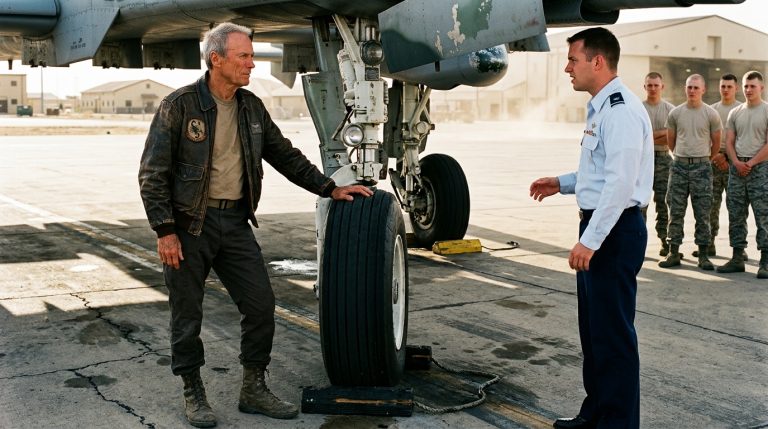
The heat coming off the flight line was thick enough to taste—a metallic, ozone-heavy flavor that clung to the back of Arthur’s throat. He stood perfectly still, a relic of an era when flying was a partnership between metal and bone rather than code and command. To the airmen scurrying across the tarmac, he was a smudge of khaki against the sterile gray expanse, a ghost that didn’t belong in the high-frequency world of the modern Air Force.
Before him, the F-16 Fighting Falcon sat in a state of suspended animation. Its canopy was retracted, exposing the cockpit like an open, jagged wound. Cables spilled from the maintenance bays, a tangle of colorful veins that served as the primary diagnostic effort of the young technicians currently sweating through their shirts.
“Are you lost, Grandpa?”
The voice was thin, vibrating with that specific, sharp arrogance that comes from having just enough rank to be dangerous. Arthur didn’t turn. He kept his focus on the landing gear strut, tracing the slight misalignment that the automated sensors had clearly missed. The question was a challenge, a claim of territory over a patch of concrete that felt far more fragile than the man standing before him realized.
“The air show isn’t for another month,” the voice continued. This was Kyle, a lead technician whose name tag was as crisp as his posture was rigid. He had crossed his arms, effectively blocking Arthur’s view of the critical junction point.
Arthur shifted his gaze slowly. His eyes, clouded by the accumulated weight of eighty years, held a depth that made Kyle’s smugness flicker. “The air show,” Arthur murmured, his voice as dry as the desert air, “is the least of your concerns, son.”
Kyle took a half-step forward, his brow furrowing. “This is a restricted area, sir. You need to leave.”
Arthur ignored the command, his attention drawn to the faint, rhythmic clicking coming from the engine bay. It was a sound of metal complaining against metal, a friction that spoke of poor maintenance protocols rather than a software crash. The ground crew was hunting for a ghost in the avionics suite, burning through hours and nerves, while the true failure was sitting right in front of them, hiding in plain sight.
The air around them seemed to vibrate with the hum of the base’s frantic energy. Somewhere in the distance, a transport plane was screaming toward the horizon, but here, in the shadow of the grounded Viper, the silence between Arthur and the technician was deafening. Arthur felt the familiar, heavy pull of his leather pouch in his pocket—the tools he had carried since the days of the Phantom. They felt cold against his hip, a sharp contrast to the scorching heat of the afternoon.
“I need you to step back,” Kyle said, his hand twitching toward his radio. “Now.”
Arthur leaned in, not toward Kyle, but toward the aircraft. He had spent his life crafting the spirit of these machines, and he could feel the Viper’s distress. It wasn’t a broken code; it was a broken promise. And he was the only one who remembered how to honor it.
CHAPTER 2: The Friction of Authority
Kyle’s fingers tightened on his radio, his knuckles white against the dark plastic. The air on the tarmac had grown heavy, the heat shimmer distorting the horizon until the base looked like a mirage flickering in a furnace. He could feel the eyes of his crew—young, anxious, and looking to him for a command that would make this awkwardness evaporate. But Arthur Vance wasn’t evaporating. He was an anchor, immovable and silent, his hand still resting on the landing gear strut of the F-16 as if he were feeling for a heartbeat.
“I said move, sir,” Kyle repeated, his voice dropping into the register he usually reserved for recalcitrant equipment. He reached out, his hand hovering near Arthur’s shoulder, intending to use the physical leverage of his position to escort the man toward the perimeter gate.
He didn’t make contact. Before his fingers could graze the old man’s windbreaker, Arthur turned his head. It wasn’t a sudden, defensive movement; it was slow, rhythmic, and terrifyingly calm. Those pale blue eyes didn’t look at Kyle’s badge or his uniform or the authority he wore like a shield. They looked straight through to the core of Kyle’s frustration.
“You’re vibrating, son,” Arthur said. His voice was soft, barely audible over the distant, rhythmic whine of a power generator idling nearby. “You’re running a diagnostic on the aircraft, but you’re ignoring the resonance. If you push that bypass when the pressure is this high, you aren’t fixing a failure—you’re creating a catastrophe.”
Kyle froze, his hand suspended in mid-air. The mention of the bypass—a specific, granular detail of the maintenance manual he had spent the last three hours frantically reviewing—sent a jolt of alarm through him. “How do you know about the bypass?”
Arthur didn’t answer. He simply withdrew his hand from the landing gear and reached into his windbreaker pocket. The motion was deliberate, a slow arc of movement that felt like it took an hour to complete. Every technician in the vicinity seemed to hold their breath, the ambient noise of the flight line fading until the only sound left was the dry rasp of Arthur’s sleeve against his own palm.
He pulled out the leather pouch. It was scarred, the surface darkened by years of grit, oil, and the slow erosion of time. He unrolled it with a steady, practiced ease, revealing a set of instruments that looked as if they had been forged in a different century. They were clean, perfectly maintained, and carried the dull, matte finish of tools that had seen more hard labor than a thousand modern hydraulic jacks.
Kyle felt a sneer forming on his lips, a reflex meant to defend his own technical inadequacy. “What is that, a museum display? You think some antique spanner is going to do what our multi-million dollar sensor suite couldn’t?”
“I think,” Arthur replied, his voice devoid of malice but sharp with the weight of experience, “that you’ve forgotten how to listen to the steel. You’re waiting for a screen to tell you what’s wrong. You’re waiting for permission to fix the problem.”
“My orders are to keep this flight line clear,” Kyle snapped, his frustration boiling over. He took a firm grip on Arthur’s arm this time, a move meant to signal the end of the conversation. “You’re a civilian. You have no business here. If you don’t step away, I’m calling security and having you removed. We have a flight schedule to maintain. We have dignitaries in the tower. We don’t have time for fairy tales from the flight line’s past.”
As Kyle started to pull, a sudden, sharp sound cut through the oppressive heat—a high-pitched, mechanical yelp that had nothing to do with the idling jets. It was the siren of a command escort, deep and urgent, approaching from the far side of the tarmac.
Kyle’s grip faltered. He looked toward the source of the noise. A black staff car, flanked by two security trucks, was tearing across the restricted expanse with an alarming lack of caution. Dust billowed in their wake, turning the air into a haze of abrasive, oxidized grit.
The convoy didn’t approach the flight line with the measured, respectful pace of a routine inspection; they moved with the raw, terrifying velocity of a tactical response. They were cutting through the established protocols, scattering ground crewmen who scrambled out of their way, their faces pale with the sudden realization that something had gone fundamentally, systemically wrong.
“What is that?” one of the younger techs whispered, his voice trembling.
Kyle ignored him, his own pulse thudding in his ears. He looked back at Arthur, but the old man hadn’t even turned to acknowledge the sirens. He was still focused on the jet, his expression one of quiet, grim assessment. He wasn’t surprised by the arrival of the command staff; he was merely waiting for them to reach the inevitable conclusion he had already arrived at.
The lead security truck screeched to a halt only twenty feet away, the tires leaving long, charred black marks on the concrete. The sound was earsplitting, a screech of friction and burnt rubber that left the scent of scorched earth hanging in the air. The passenger door of the staff car flew open, and Colonel Matthews stepped out, his posture rigid with a fury so controlled it felt like a physical pressure wave.
Kyle dropped his hand from Arthur’s arm as if he’d been burned. He stood in the center of the widening circle, his face drained of color, his authority dissolving under the intense, icy gaze of the Wing Commander. He was supposed to be the man in charge—the one who kept the line moving. Instead, he felt like an intruder in his own domain, watching as the world he understood began to fracture under the weight of an old man’s silent presence.
Arthur Vance didn’t move. He stood in the center of the storm, his eyes still fixed on the landing gear, while the roar of the arriving command staff signaled that the time for arrogance had finally, irrevocably, run out.
CHAPTER 3: The Echo of Da Nang
The arrival of Colonel Matthews didn’t break the tension; it merely compressed it into a single, agonizing point of focus. The airmen scattered like iron filings under the influence of a magnet, leaving Kyle Peterson standing alone in the center of the vast, sun-baked expanse. The Wing Commander stood motionless, a towering figure of polished authority, his gaze locked not on the multi-million-dollar fighter jet, but on the small, stooped man in the windbreaker.
Arthur felt the weight of the moment—the sheer, crushing pressure of a thousand eyes waiting for a verdict. He breathed in, and the smell of the tarmac hit him. It was a cocktail of hot asphalt, high-grade jet fuel, and the distinct, sharp tang of ozone—a smell that, in a heartbeat, stripped the years away.
The tarmac shimmered, and the bright, sterile white of the base dissolved.
He wasn’t in the shadow of an F-16 anymore. He was standing on the cracked, oil-slicked concrete of a makeshift hangar in Da Nang, decades ago. The humidity there had been a physical weight, a suffocating blanket of moisture that made his skin crawl and his uniform cling to his body like a second, feverish skin. The air had been thick with the smell of wet earth, rotting vegetation, and the sharp, metallic bite of burning kerosene from the nearby flight line.
An F-4 Phantom, a war-bird that had taken a direct hit, sat on jacks. Its wing was a jagged piece of art—ripped, scorched, and weeping hydraulic fluid that pooled into iridescent puddles on the concrete. Young Arthur—his face taut, his eyes burning with the manic focus of a man who knew that a life, or ten, depended on the next ten minutes—was wedged deep inside the maintenance bay.
He remembered the sound of the artillery in the distance. It wasn’t the rhythmic, professional thrum of a base exercise; it was the erratic, soul-shattering ‘crump’ of incoming fire that turned the horizon into a bruised purple smear. The crew chief, a man whose face had been etched by trauma into a permanent, grim sneer, had been shouting over the din. “We need this bird back, Art! They’re getting hammered out there, and they’re low on fuel. If she doesn’t lift, they don’t come home.”
Arthur’s hands, steady despite the tremors in his knees, had been working the wrench. He remembered the specific, gritty texture of the steel tool in his palm, the way the vibration of the nearby shelling traveled through the metal and hummed against his own bones. He had been so young then, yet so certain of the physical reality of the machine. The valve had been seated at a hairline angle, a design flaw the factory engineers had dismissed as an impossibility, but Arthur had seen it. He had known. One final, precise turn. A click. The hiss of stabilization.
Then, the silence of the present flooded back.
He was standing on the tarmac again, his knuckles resting on the cold, hard fuselage of the F-16. The heat of the modern flight line was a different kind of burn—sterile, unforgiving, and devoid of the raw, desperate stakes of war. Yet, the problem was the same. The machine was screaming in the same language.
“Mr. Vance?”
The voice belonged to Colonel Matthews. It was surprisingly soft, stripped of the command-grade thunder he had displayed moments earlier. The Colonel had stepped closer, his boots clicking with deliberate, precise steps against the concrete. He held his flight cap in his hand, a gesture of deference that caused the watching airmen to shift uncomfortably.
Arthur looked at him. The Colonel’s eyes were filled with a mixture of reverence and a desperate, gnawing anxiety. He was a man holding the weight of a mission, of a reputation, and of the safety of the pilots who were scheduled to take this specific bird into the sky in less than an hour.
Arthur’s hand remained on the aircraft. He felt the minute, rhythmic tick of the internal cooling pumps—a sound that, to any of the technicians standing nearby, would have sounded perfectly normal. To Arthur, it was the sound of a lung gasping for air. It was a subtle, rhythmic discordance that confirmed his suspicion.
“The actuator,” Arthur said, his voice raspy, the words feeling heavy in the dry, stagnant air. He didn’t look at the Colonel; he looked at the technician, Kyle, whose face was currently a study in mounting terror. “It’s not the avionics, Colonel. It’s the bypass. It’s sticking.”
Kyle flinched. He opened his mouth, a protest forming on his lips—a desperate, reflexive defense of his team’s hours of work, of the diagnostic software that had given them a clean bill of health. “Sir, we’ve run the tests,” Kyle started, his voice cracking. “The EPU, the relay, the power coupling… everything is within spec. The computer says the system is nominal.”
“The computer,” Arthur said, finally turning his gaze toward the young man, “is a bookkeeper. It only knows what you tell it to look for.”
Arthur’s grip on the leather pouch in his pocket tightened. He felt the cold, familiar bite of the tools inside. They were his secret, his anchor to a reality that existed beneath the layer of pixels and circuit boards. He saw the way the Colonel stiffened at the old man’s dismissiveness, but the Commander didn’t interrupt. Matthews knew the stories. He knew that the ghost of the flight line didn’t waste breath on theories.
“Show me,” Matthews commanded, though it sounded less like an order and more like a plea.
Arthur took a slow step away from the wing root. He didn’t walk toward the cockpit, where the fancy screens and the complex, flickering data ports were. He walked toward the landing gear, into the darker, grittier space beneath the belly of the beast. He moved with a precision that was unburdened by his age, his movements an echo of that younger man who had once worked in the humid, shadow-drenched hangar in Da Nang.
Kyle followed him, his boots scraping tentatively against the tarmac. The rest of the crew lingered at the periphery, held back by the unspoken authority of the Wing Commander’s presence.
Arthur knelt. The ground was baking, the heat radiating up through his khaki pants, but he didn’t feel it. He reached out and touched a small, nondescript panel—a junction point that was easily ignored, often painted over, and rarely inspected because it was tucked into a blind spot of the airframe’s design. It was a place of rust, of friction, and of wear. It was the place where the machine met the world, and in that junction, Arthur could feel the truth of the failure—a truth that the software was too blind to ever admit.
CHAPTER 4: The Command Intervention
Arthur knelt in the grit of the tarmac, his knees pressing into the coarse, oil-stained concrete. The world had narrowed down to a space no larger than the span of his own chest—a dark, cramped cavity beneath the F-16 where the sunlight couldn’t reach. The smell here was different: stale, trapped air, oxidized metal, and the faint, sweet scent of hydraulic fluid that had been weeping for far too long.
Colonel Matthews stood just beyond the landing gear, a dark, looming silhouette against the blinding white glare of the flight line. He wasn’t speaking, but his presence was a heavy, immovable object. Kyle Peterson, however, was a different story. The technician had crouched beside Arthur, his breathing shallow and ragged, his eyes darting toward the diagnostic monitors still hummed in the background. He was looking for a digital confirmation, a screen that would tell him this was all a misunderstanding.
Arthur didn’t need a screen. He leaned forward, his eyes adjusting to the gloom. He ran his calloused fingertips over the housing of the emergency power unit’s hydraulic bypass actuator. It felt wrong. Not just stiff, but wrong in a way that spoke of a structural intrusion.
“Give me the light,” Arthur said. His voice was a low murmur, the command sliding out of him with the effortless authority of a man who had spent his life surrounded by flight crews.
Kyle hesitated, then fumbled with a handheld LED work light. He aimed the beam at the housing. Arthur squinted, moving the light slowly across the metal surface.
There.
Tucked into a corner, obscured by a layer of hardened, soot-blackened grime, was a bead of weld that didn’t belong. It was thick, messy, and clearly applied by hand—an unauthorized, amateurish patch job on a component that was supposed to be factory-sealed and precision-balanced. It was a scar on the skin of the aircraft, a silent testimony to a botched repair performed in the dark, likely by someone who had been trying to bypass the safety protocols to get the bird back into the rotation.
Arthur reached into his pouch, his fingers finding the unique, angled spanner he had held in his mind since the hangar in Da Nang. He didn’t use it to pry or pull. He used it to trace the line of the weld. The metal was cold, vibrating with the ghost of the high-frequency idle running through the jet’s frame.
“You see that?” Arthur asked, his voice barely audible over the low whine of the APU.
Kyle leaned in, his face inches from the housing. When he saw the weld, his breath hitched. The blood drained from his face until he looked as gray as the tarmac. “That… that shouldn’t be there. That component is replaced as a unit. It’s never supposed to be repaired.”
“And yet, someone did,” Arthur replied. He looked at Kyle, watching the realization hit the younger man with the force of a physical blow. This wasn’t just a failure of a software suite; it was a failure of the command structure itself. Someone had prioritized speed over safety, skipping the proper maintenance cycle and gambling on a makeshift fix that was now slowly vibrating itself into a catastrophic failure.
“Is that why it’s sticking?” Kyle whispered, his voice trembling.
“The weld created a thermal bridge,” Arthur explained, his voice devoid of accusation, which made it all the more chilling. “When the unit warms up, the metal expands. It binds the valve. It doesn’t show up on your digital diagnostics because the computer is reading the sensor data, not the physical state of the metal. You were looking at the brain, son, but you ignored the fact that the throat was constricted.”
The silence that followed was suffocating. Beyond the landing gear, the base was frozen. Colonel Matthews hadn’t moved, but Arthur could feel his attention—the way the Commander’s stance had shifted from imperial fury to something much deeper, much more dangerous. The realization was spreading. If this plane had a makeshift, unauthorized weld on a critical safety component, how many others in the fleet had been ‘patched’ in the same reckless, hurried manner?
Arthur pushed himself back, his joints popping, and crawled out from beneath the aircraft. He stood up slowly, the transition from the dark, intimate space of the maintenance bay to the glaring white light of the tarmac making him blink.
Colonel Matthews was watching him, his face a mask of iron. He looked at Kyle, who was still kneeling, his hands hanging uselessly by his sides, his eyes fixed on the evidence of his team’s systemic failure.
“Peterson,” the Colonel said, his voice dropping into a register that made the air seem to vibrate. “Is that the only one?”
Kyle looked up, his lips moving soundlessly before he managed a strained, horrified whisper. “Sir… I don’t know. I’ve seen this type of weld on other units. I thought… I thought it was a factory variation. We were told to clear the backlog. We were told the mission readiness was the only metric that mattered.”
Matthews didn’t blink. He turned to the maintenance group commander standing behind him, his posture shifting, his hands clenching into fists at his sides. The reality of the situation wasn’t just a grounded jet anymore. It was a systemic breakdown that had been hidden by the frantic, crushing pressure of a command that had valued the appearance of readiness over the reality of the engineering.
Arthur turned away. He didn’t want to see the fallout. He had done his part; he had diagnosed the machine. But as he looked out across the vast, shimmering expanse of the flight line, he realized that fixing the valve on Viper07 was the easy part. The real work—the hard, heavy, rusted work of rebuilding the foundation of the wing’s integrity—was only just beginning. And it was going to leave scars that no one would be able to weld over.
CHAPTER 5: The Lesson in the Dust
The hangar bay was silent, save for the rhythmic, metallic ticking of the cooling aircraft frame. Arthur didn’t move. He stood beneath the F-16, his hands still stained with the dark, gritty residue of the actuator’s secret. He watched as Colonel Matthews’s expression shifted—not into the relief of a problem solved, but into the calculating, cold intensity of a man staring into an abyss.
“Who authorized the work, Peterson?” Matthews’s voice was low, stripped of all artifice. It cut through the hangar air like a blade.
Kyle, still kneeling in the dust, looked up. His face was a map of burgeoning, frantic realization. He reached out, his hand hovering over the diagnostic tablet that lay abandoned on the concrete, as if the answer were etched in the glass. “It… it came down through the digital tasking order, sir. It was marked as a ‘Level One Routine Maintenance’ procedure. It didn’t require a manual sign-off. It was… it was automated.”
Arthur felt a chill that had nothing to do with the air conditioning. He walked out from beneath the aircraft, his boots sounding heavy and uneven on the concrete. He didn’t look at the jet. He looked at the base, at the vast, sprawling network of hangars, control towers, and storage facilities that stretched out toward the horizon.
“The automation,” Arthur said, his voice quiet, “is a shield, Colonel.”
Matthews turned to him. The Commander’s eyes were hard, searching, as if he were trying to find a piece of a puzzle he hadn’t known was missing. “Explain.”
“You want to know who authorized the weld?” Arthur continued, gesturing toward the jet. “Don’t look for a name on a form. Look for the system that decided it was more efficient to patch a dying part than to ground the fleet. You’ve spent so long trusting the software to tell you what’s broken that you’ve forgotten to look at the machines themselves. This weld wasn’t a mistake. It was a choice. A choice made by a system that prioritizes output over integrity.”
Matthews took a step toward him, his posture tense. “If you’re suggesting that there is systemic sabotage—”
“I’m suggesting that there is systemic atrophy,” Arthur interrupted. His tone was not argumentative; it was the cold, pragmatic assessment of an engineer who had spent his life observing the decay of things left too long in the sun. “You think you’re fighting a rogue technician. You’re not. You’re fighting a culture that has grown comfortable with living on the edge of a failure it refuses to acknowledge.”
Kyle stood up, his legs shaky. He looked at the F-16, then back at the command staff. The fear that had paralyzed him was being replaced by a sharp, brittle anger. He realized now that he hadn’t been the lead of a maintenance team; he had been a cog in a machine that was designed to consume itself.
“I was told it was standard,” Kyle said, his voice stronger now, though it lacked the smugness of his earlier arrogance. “Every tasking order that came through the terminal had that same stamp. ‘Mission Readiness Optimized.’ We were all doing it. We were all patching the vents, shimming the actuators, running the diagnostics just long enough for the green lights to blink.”
Arthur looked at the young man, really looked at him, and saw the profound, hollow ache of a man who realized his own hands were dirty with someone else’s sin. He reached into his pocket and touched the leather pouch. It was a heavy, comforting weight—the only honest thing on the entire flight line.
“Colonel,” Arthur said, his gaze shifting back to Matthews. “You can punish him. You can strip him of his rank, you can ship him to the furthest reach of the logistics chain, and you can call this a closed file. But that valve is still sticking. And there are twenty-three other aircraft on this line that have the same patch, hiding in the same blind spots, waiting for the same cold soak at altitude to snap.”
Matthews went deathly still. The mention of the other aircraft—the systemic reach of the flaw—seemed to drain the air from the hangar. He looked at the maintenance group commander, who was standing a few paces back, his face a mask of shock. The silence was absolute.
“Are you certain?” Matthews asked. The question was a plea for a reality he could control.
Arthur didn’t answer with words. He walked back to the F-16 and placed his hand on the fuselage. He closed his eyes, sensing the subtle, irregular vibration of the machine. It wasn’t the healthy, rhythmic thrum of an engine in its prime; it was the disjointed, pained tremor of a system that was straining against its own flaws.
“I don’t need a diagnostic suite to tell me the truth, Colonel,” Arthur said, his voice low and vibrating with a power that seemed to transcend his age. “I can feel it. The whole fleet is holding its breath. And it’s not because of a software glitch.”
Outside, a distant siren began to wail—a persistent, lonely sound that echoed across the vast, empty tarmac. It was the sound of something ending, or perhaps something beginning.
Matthews looked at the hangar doors, then back at the jet. The authority he carried, the uniform he wore, the position he held—all of it seemed to shrink in the face of the simple, mechanical truth Arthur had presented. He took a breath, his shoulders squaring, his expression hardening into a decision.
“Ground them,” Matthews said. His voice was barely a whisper, but it carried the weight of a thunderclap.
The maintenance group commander hesitated. “Sir, the delegation… the readiness exercise… the repercussions of a fleet-wide grounding—”
“I said ground them,” Matthews repeated, his voice rising in volume, turning into a roar that echoed off the metal walls. “If this bird goes up, it comes down in a fireball. That is not a risk I am willing to take.”
Kyle stood in the center of the hangar, his hands trembling as he realized what this meant. He had gone from the arrogant lead technician to the man who had just catalyzed the biggest administrative earthquake the wing had ever seen. He looked at Arthur, his eyes wide with a mixture of terror and a strange, burgeoning hope.
Arthur didn’t offer a look of pity. He turned his attention to the tools in his pouch. The fix for this Viper had been simple, but the cure for the rot in the wing was going to be a long, painful, and deeply unforgiving process. And he was the only one who had the blueprint.
CHAPTER 6: The Aftermath of Silence
The command to ground the fleet did not ripple through the flight line; it shattered it. Within seconds of Colonel Matthews’s decree, the high-octane buzz of the tarmac—the constant, frantic energy of an active air base—dropped into a terrifying, unnatural stillness. Technicians stood motionless, their hands frozen mid-motion on panels, their faces turning toward the hangar where the Wing Commander still loomed.
Arthur felt the shift in the air pressure, a metaphorical change as significant as the silence itself. He moved away from the shadow of the F-16, his boots finding a rhythm on the concrete that sounded uncomfortably loud in the hushed space. He kept his hands in his pockets, fingers brushing the cool, reassuring steel of his custom spanner. He had delivered his diagnostic, he had forced the hand of the command, and now he was an outsider waiting to be ejected from the machine he had helped breathe life into decades ago.
Colonel Matthews was deep in conversation with his executive officers, his posture stiff, his movements clipped and aggressive. He was already coordinating the logistical nightmare of a base-wide shutdown, his focus entirely consumed by the administrative firestorm he had just ignited.
Kyle Peterson stood near the nose of the grounded Viper07. The technician’s face was an ashen mask. He wasn’t looking at the flight line anymore. He was staring at the ground, his shoulders slumped as if the entire weight of the grounded fleet were resting squarely on his frame.
Arthur walked toward him. He didn’t offer comfort; comfort wasn’t part of the language of the flight line. He stopped a few feet away, leaning slightly against a tool cart that rattled under his touch.
“You did the right thing,” Arthur said. His voice was gravelly, the product of a lifetime of breathing exhaust and high-altitude air.
Kyle looked up. His eyes were red-rimmed, the bravado of the previous hours completely stripped away, leaving only a raw, terrifying vulnerability. “I don’t know if that matters, sir. I’m the one who signed off on the tasking orders. I’m the one who didn’t question the software. I’m the one who put those pilots in the cockpit of a coffin.”
Arthur looked at the jet—at the sleek, predator lines that had been designed for grace and speed, now rendered inert and flawed. “The machine doesn’t hate you, son. It doesn’t have a morality. It only has a state of being. You were taught that the system was infallible, and that is a poison that is harder to fix than any actuator.”
“What happens now?” Kyle asked.
“Now?” Arthur looked back toward the command staff. “Now, they’ll have to open the books. They’ll have to look at every weld, every bypass, and every ‘optimization’ that was forced into the flight line over the last three years. It’s going to be a long, slow process. And you’re going to be the one holding the flashlight.”
Kyle swallowed, a hard, painful movement in his throat. “They’re going to blame me. It’s easier to burn one technician than to admit the entire command structure is rusted through.”
Arthur reached out and gripped the edge of the tool cart, his fingers tracing a patch of oxidation on the metal. “Let them try. If you stand by the truth of the problem, the politics become a secondary concern. But you have to be willing to be the one who says it out loud, regardless of who is listening.”
Arthur turned away, his gaze wandering to the library building visible in the distance, near the base perimeter. He needed to be away from the sterile, high-pressure environment of the hangar. He needed the stillness of the records section—the place where the history of these birds was kept, where the paper records, the hand-drawn schematics, and the original, uncorrupted design intents were archived.
He didn’t wait for a response from the technician. He began to walk. The flight line was a vast, sprawling landscape of concrete and potential danger, and as he traversed it, he could feel the eyes of the airmen tracking him. To them, he was a variable they couldn’t calculate, a ghost who had walked onto the tarmac and pulled the emergency brake on the entire operation.
As he reached the edge of the maintenance area, he saw Colonel Matthews turn and look in his direction. For a fleeting moment, their eyes met. The Commander’s face was drawn, showing the fatigue of a man who had suddenly realized his authority was limited by the laws of physics. Matthews didn’t move to stop him. He didn’t move to salute. He simply stood there, watching the old man walk away, an acknowledgment of the fact that the ghost was no longer something he could control, categorize, or command.
Arthur kept his pace steady. He walked toward the periphery, his mind already working through the implications of the systemic rot he had uncovered. It wasn’t just the Vipers. If the weld was standard operating procedure, then the contagion had spread to the structural housing of the engines, the avionics cooling lines, and the secondary flight control backups. He had triggered the grounding, but he had only just begun to see the scope of the architectural failure.
He reached the gate of the maintenance area, the chain-link fence humming with the vibration of the idling base. He pushed the gate open, the hinges screaming a protest that sounded, to his ears, like the metal of the Viper itself. He stepped out into the quieter, more desolate ground near the library, the grit of the tarmac still crunching beneath his boots, a constant, abrasive reminder of the work that remained.
CHAPTER 7: The Hidden Flaw
The library archives were a world apart from the harsh, sun-bleached concrete of the flight line. Here, the air was filtered, chilled, and carried the dry, papery scent of decaying history. Arthur pushed open the heavy steel door, the sound of the locking mechanism clicking shut behind him like a trap. The silence of the room was absolute—a sharp contrast to the sirens and shouting that still echoed in his mind from the hangar.
He moved through the aisles of the archive, his hand trailing over the spines of bound technical manuals and thin, brittle folders. This was the place where the ghost of the flight line usually retreated. But today, the library felt different. It felt like a crime scene.
He found the section labeled YF-16 Development & Maintenance Protocols. He pulled a thick, leather-bound volume from the shelf—the original design master. As he laid it out on the reading table, the weight of the book felt immense, the paper beneath his fingers crisp and unforgiving. He began to turn the pages, his eyes tracking the diagrams of the hydraulic bypass actuator.
It was there—a small, innocuous schematic detail tucked away in an appendix.
A memory ignited in his mind, sharp and sudden as a gunshot. It wasn’t the heat of Da Nang this time. It was the sterile, fluorescent-bright environment of a high-security lab in Fort Worth, thirty years ago. He was younger, his ego as polished as the steel on his workbench. A senior lead engineer—a man Arthur had idolized—had stood over him, pointing to this exact schematic.
“It’s a weight-saving measure, Arthur,” the man had said, his voice calm, pragmatic, and utterly devoid of hesitation. “The airframe is over-engineered as it is. If we pull the secondary safety relay from the bypass actuator, we save three pounds of payload capacity. Over a fleet of hundreds, that’s a significant efficiency gain.”
“But the cold soak at altitude,” Arthur had argued, his young, idealistic heart hammering against his ribs. “If the valve gets sticky in extreme temperatures, the relay is the only thing that resets the pressure. Without it, you’re risking a total system lockout.”
“We’ll account for it in the software logic,” the man had replied, tapping the schematic with a gold-plated pen. “We’ll build in an automated bypass. It’s cleaner, it’s faster, and it’s digital. Nobody will ever know the difference.”
Arthur stared at the diagram now, his breath hitching. The ‘hidden’ flaw wasn’t an oversight, and it wasn’t a rogue technician’s mistake. It was a compromise, baked into the very DNA of the bird, sanctioned at the highest levels of design and management, and justified by the cold, hard logic of efficiency. The weld Kyle had discovered wasn’t an unauthorized repair; it was an attempt to physically bridge a gap that the software had failed to cover.
The entire fleet wasn’t just built on a flaw; it was built on a series of calculated risks that had long since surpassed their intended shelf life. The automated diagnostics weren’t failing because they were bad code; they were failing because they were designed to ignore the physical reality that the software was meant to simulate.
He heard a soft click—the sound of the archive door opening.
Arthur didn’t jump. He didn’t close the book. He stood still, the weight of the knowledge pressing down on him. He knew the figure standing in the doorway wasn’t a librarian. The cadence of the footsteps, the heavy, measured rhythm, belonged to someone who walked with the authority of the command structure.
Colonel Matthews stepped into the aisle, his face pale in the low light of the archives. He stopped at the end of the table, his gaze falling on the open schematic.
“I heard you were here,” Matthews said. His voice was hollow, the confidence that had defined him earlier stripped away. “My team is tearing down the engines on all twenty-four birds. We’re finding the same patch-work on every single one of them. The maintenance reports were falsified by the system, automatically generated to clear the backlog before the inspection.”
Arthur looked at him, his expression unreadable. “It wasn’t just the maintenance, Colonel. It was the design.”
Matthews looked down at the schematic, his eyes tracking the lines that Arthur had studied. “This was from the origin,” the Colonel murmured, the realization hitting him with the same devastating force it had hit Arthur. “This wasn’t a failure of my wing. This was a failure of the machine itself.”
“The machine is what you made it,” Arthur replied softly. “You wanted it faster, lighter, and more automated. You stripped away the redundancies, thinking you could replace them with a string of code. But physics doesn’t care about your efficiency gains.”
Matthews stood there for a long time, the silence of the library swallowing them both. He looked at Arthur, not as a Wing Commander looking at a civilian, but as a man looking at the person who had finally, ruthlessly, revealed the truth of the world he was responsible for.
“If I go public with this,” Matthews said, his voice trembling slightly, “it destroys the program. It grounds the entire fleet indefinitely. It ruins careers. It ruins my career.”
Arthur reached out and closed the book. The sound was a dull, final thud in the quiet room. “And if you don’t,” he said, his voice cold and steady, “you’re just another part of the system that’s waiting for the cold soak at altitude to break you.”
Matthews looked at the door, then back at Arthur. The choice was hanging in the air between them—a choice between the survival of the program and the survival of the truth. It was the same choice Arthur had faced thirty years ago in that Fort Worth lab, and it was the same choice that had led him to this quiet, dusty room at the end of his life.
CHAPTER 8: The Final Turn
Colonel Matthews did not ask for permission. He reached out, his hand hovering over the schematic, his fingers tracing the very lines that had effectively compromised the entire fleet. He wasn’t looking at the technical details anymore; he was looking at the consequences.
“If we shut it down,” Matthews said, his voice quiet, “it’s a scandal that reaches the Pentagon. They’ll want a scapegoat. They’ll want the engineering teams, the command staff, and the maintenance leads on the chopping block.”
“The truth doesn’t ask for permission to be inconvenient,” Arthur said. He stood, his joints protesting the movement after the long, grueling day. He picked up his leather pouch and unrolled it for the final time. He didn’t take out the spanner wrench. Instead, he took out a small, worn graphite pencil and a notepad he had kept tucked in the felt lining—a record of every adjustment, every observation, and every realization he had made since stepping onto the tarmac that morning.
“You have a choice,” Arthur continued. “You can continue the charade, keep the patch-work in place, and wait for the inevitable day when one of these birds snaps its spine in the air, or you can begin the long, agonizing work of tearing them down and rebuilding them the right way.”
Matthews looked at him. The conflict in the Colonel’s eyes was clear—the tension between the career he had built and the conscience that was currently screaming to be heard. “And you?” Matthews asked. “What are you going to do?”
“I’m going home,” Arthur said. “I’ve spent my life looking after these machines. I’ve seen them when they were in their infancy, and I’ve seen them now, in their brittle, over-extended old age. My work here is done.”
He began to walk toward the archive door. Matthews followed him, a shadow in the dim light of the library. They stepped out into the hallway, the cool, conditioned air a relief after the stifling atmosphere of the archives. As they reached the main entrance of the building, the sun was beginning to set, painting the base in the long, desaturated shadows of a late, tired afternoon.
On the flight line, the ground was still. The Vipers sat like rows of grounded, predatory birds, their canopies closed, their systems powered down. It was a sight of strange, atmospheric peace—a fleet that was no longer straining, no longer masking its own rot, but simply resting.
Arthur paused at the top of the steps. He looked back at Matthews. “You’ll need the original specs, not the ones in the automated system. They’re here, in the basement vault. Take them, and ignore everything else. That is your truth.”
Matthews stood tall, his uniform crisp in the fading light. He reached out and, for a second, it looked as though he might offer a salute. Instead, he simply nodded—a slow, respectful acknowledgement between two men who had shared the weight of a secret.
Arthur walked toward the perimeter gate. He didn’t look back. He could feel the eyes of the airmen, the technicians, and the command staff watching him go. He felt lighter now, the burden of the design flaw finally off his shoulders. He reached the gate, the rusted latch giving way beneath his hand with a familiar, metallic groan.
He stepped out of the base, out of the world of flight, sensors, and automated errors, and onto the dusty road that led to his home. He walked past the field where he had watched the jets scream toward the sky for decades, but tonight, the silence was welcome. It was the sound of a problem that had been met, a truth that had been spoken, and a legacy that was finally, peacefully, being laid to rest.
When he reached his small, weathered house, he sat on the porch. The air was cool, smelling of damp earth and the coming night. He reached into his pocket and pulled out the spanner wrench—the tool that had started it all. He looked at it for a long, silent moment, feeling the familiar, worn texture of the metal against his thumb. He stood, walked to the small garden beside his porch, and knelt in the soft, dark soil.
He dug a small hole, placed the wrench inside, and covered it with the earth. It was a symbolic closure, a return to the ground of a piece of his own history. He sat back, his hands resting on his knees, and looked up at the stars. There were no jets screaming across the sky, no sirens, no command staff, no machines to diagnose. For the first time in his life, Arthur Vance was just a man, sitting in the quiet, watching the world settle into a deep, unshakable peace.