The Weight of the Sky: A Veteran’s Quiet Return to the Wings that Carried His Soul
CHAPTER 1: THE TARMAC STANDOFF
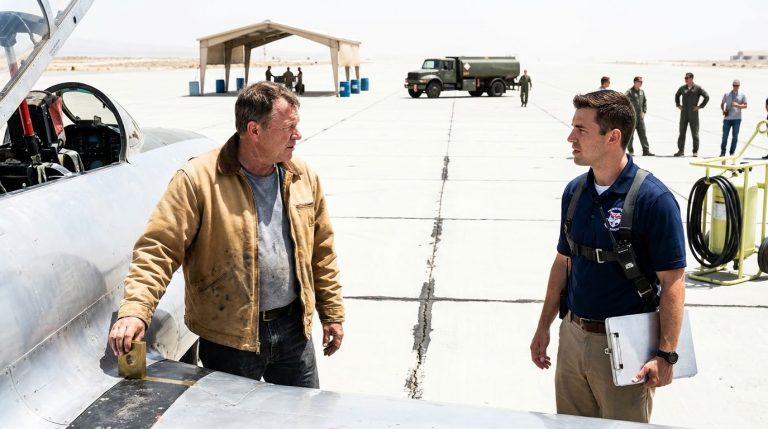
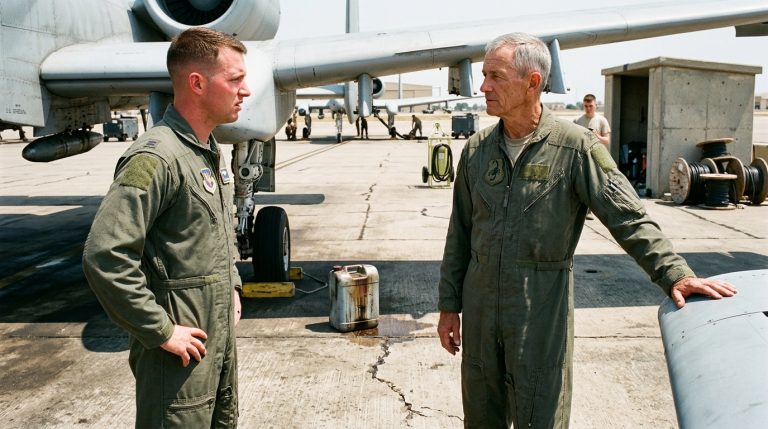
The heat of the flight line was an abrasive, physical presence, but Roger Bentley barely felt it. His hand remained pressed against the oversized tire of the A-10 Thunderbolt II, the rubber cool and textured like the skin of an old friend. To the crowd of young airmen gathered nearby, it was just a static display—a bulky, pugnacious machine sitting squat on the tarmac for the base’s family day. To Roger, the airframe breathed.
“Go on then. Start her up.”
Captain Davis’s voice sliced through the humid air with the sharp, condescending polish of a man who had never seen the underside of a smoking engine. He gestured toward the bubble canopy with a flick of his wrist, his gaze sweeping over his audience of junior airmen to ensure they were catching the performance.
Roger didn’t turn. He looked at the nose, specifically at the slightly weathered paint just below the canopy. He traced the memory of the seven-barreled GAU-8 Avenger cannon. He could feel the familiar, bone-jarring vibration of it firing—not as a sound, but as a phantom ache in his marrow.
“Come on now,” Davis pushed, stepping closer, his shadow falling across Roger’s faded leather jacket. He jabbed a manicured finger toward the instrument panel visible through the canopy. “Or is all that new-fangled glass a bit too much for you? Forget which key goes in the ignition?”
A few of the younger airmen shifted, the discomfort radiating from them like heat haze. Roger remained still. He wasn’t looking at the captain; he was looking at the small, crudely drawn scorpion stitched into a circle of sand-colored thread on his own sleeve.
“The auxiliary power unit requires a ground check before ignition,” Roger said, his voice a low, gravelly rasp. He wasn’t speaking to the captain. He was murmuring to the ghost of the machine. “Hydraulic pressure needs to be stable at 3,000 PSI. You don’t just turn a key.”
Davis laughed, a thin, brittle sound. “We’ve got a real expert, boys. Look, sir, this is a restricted area. The aircraft is a static display. I’m going to have to ask you to step away.”
Roger felt the familiar grip of the control stick beneath his palm, even though his hand was empty. He turned slowly, his sky-colored eyes meeting Davis’s. He didn’t see an officer; he saw a man who wore his rank like a costume, unaware of the gravity of the steel he stood beside.
“I’m not a civilian,” Roger said quietly.
Davis’s smile vanished, replaced by a dark, dangerous narrowing of his eyes. “Right. And I’m the Chief of Staff. Show me your visitor pass, or I’ll have security drag you off this line.”
As Roger reached into his jacket to retrieve the pass, his fingers brushed against a small, rough scrap of fabric hidden in the inner pocket—the original piece of the scorpion patch, stained with oil from a desert long ago. The present world flickered. The smell of hot asphalt vanished, replaced by the acrid, metallic tang of burnt propellant.
He wasn’t on a flight line anymore. He was back in the killbox, the radio screaming for support as the T72s crept forward. His thumb hovered over the trigger stud. He looked at Davis, and for a terrifying second, the captain’s arrogant face seemed to blur into the silhouette of a target.
CHAPTER 2: THE SAND AND THE SCRAP
The sensation of the leather against his palm didn’t belong to the sweltering heat of the Georgia flight line. As Roger’s fingers closed around the scrap of fabric inside his jacket, the world didn’t just blur; it shuddered. The air around him, thick with the scent of jet fuel and sunscreen, was suddenly displaced by the dry, metallic cold of high-altitude flight.
He didn’t pull the pass out immediately. He held his breath, waiting for the phantom roar of the engines to settle. Davis was still talking, his voice a jagged, insistent pulse, but to Roger, it was nothing more than the background chatter of a radio link that had gone dead forty years ago.
Empty your pockets slowly, the captain had commanded.
Roger felt the rough weave of the scorpion patch—the real one, not the stitching on his jacket—against his thumb. It was a fragment of the past that refused to fade. He could hear the screaming voice of Ranger 6 Actual again, a desperate, thin ribbon of sound that had pulled him into the fire. He remembered the specific, sickening lurch of the aircraft when the surface-to-air missile had clipped his starboard wing, the way the world had tilted, and the sudden, crystalline clarity that came with the realization that he was the only thing standing between the men on the ground and total erasure.
“I said empty your pockets,” Davis repeated, his voice snapping back into focus. The captain was leaning in, his face tight with a mixture of irritation and the budding excitement of a man who thinks he is about to catch a criminal.
Roger’s hand began its slow, deliberate ascent from the inner pocket of his jacket. The movement was practiced, a steady, unhurried motion that had been honed in cockpits where a single jerky movement could mean disaster. He didn’t pull out a gun, a knife, or a weapon of any kind. His hand emerged holding a weathered, laminated visitor’s pass—the one issued by the base commander this morning—and, quite unintentionally, the edge of the hidden patch trailed out behind it, catching the sunlight.
Davis didn’t see the pass. He saw the patch. He saw the faded, sand-colored scorpion, a design that looked crude and out of place against the modern, high-tech reality of the base. A flicker of confusion passed over the captain’s face, followed immediately by a sneer that didn’t quite reach his eyes. He was searching for a reason to escalate, to prove that his authority was absolute.
“What is this?” Davis gestured toward the patch. “Is this some kind of protest? Some relic you’re parading around to look like a martyr?”
The younger airmen were watching, their faces pale. The senior airman, Garcia, had already drifted toward the edge of the crowd, his eyes darting toward the command building. Roger felt a heavy, familiar fatigue settle in his shoulders. It wasn’t the exhaustion of age; it was the weariness of a man who had spent his life defending a world that had forgotten how much it cost to keep it free.
He looked past Davis, his eyes landing on the A-10’s nose art. The paint was peeling, showing the gray primer underneath—a beautiful, honest decay.
“It’s a memory,” Roger said, his voice quiet. The sound carried in the sudden, thick silence of the flight line. “It’s the only thing that keeps the weight of the sky from crushing you.”
Davis scoffed, reaching out to snatch the pass from Roger’s hand. “Enough of the riddles, old man. You’re disrupting a secured event. I’ve heard enough of your war stories. You’re done here.”
The captain’s hand brushed against Roger’s arm. The contact was brief, but it was electric. To Davis, it was a shove. To Roger, it was the trigger. The phantom whine of the General Electric turbofan engines surged, drowning out the ambient murmurs of the crowd. For a heartbeat, Roger wasn’t standing on hot concrete; he was back in the cockpit, the air thick with the smell of burnt propellant, his thumb hovering over the cannon trigger, watching the earth below erupt into fire.
He held his ground. He didn’t retreat, didn’t argue, and didn’t apologize. He simply let the moment hang, his presence suddenly massive, a singular point of iron in a world made of glass. He saw the shift in Davis—the way the captain’s bravado flickered, replaced by a sudden, irrational spike of fear. Davis had expected a frail, confused old man, but he was staring into eyes that had looked directly into the sun and refused to blink.
The silence grew, stretching thin as a wire under tension. Somewhere in the distance, a low, ominous siren began to wail.
CHAPTER 3: THE WAKE OF THE SIREN
The siren’s wail grew from a distant, thin vibration into a gut-wrenching howl that seemed to bounce off the sleek, curved hangars lining the flight line. It was not the crisp, professional chirp of a military police cruiser; it was the heavy, insistent roar of a command vehicle, tearing across the tarmac with a disregard for standard base protocol that signaled something more than a mere policy enforcement.
Captain Davis’s hand, which had been reaching for Roger with the practiced arrogance of a man accustomed to blind obedience, froze mid-air. He turned his head toward the sound, his face twisting with a flash of annoyance that was rapidly curdling into something less certain. The crowd of young airmen, previously pinned in place by the weight of the captain’s authority, began to shift. Their gaze moved from the old man in the leather jacket to the black SUV that was now closing the distance at high speed.
Roger didn’t turn. He kept his eyes locked on the A-10’s fuselage, his hand resting once more against the tire. He didn’t need to look; he knew the cadence of that vehicle’s approach. It was the rhythm of a base commander who had been alerted to a shift in the status quo.
“Stay put,” Davis snapped, his voice losing its polish, becoming thinner, more frantic. He signaled to the two airmen he had ordered to fetch security. “Ignore that! Get security here now! This is a restricted area!”
But the airmen were already distracted. A second vehicle—a maintenance truck, heavy and dusted with the grit of the flight line—screeched to a halt behind the SUV, its tires leaving thick black smears on the concrete. The sound of the engines dying was followed by a silence so sudden and absolute that it felt like a physical pressure.
Senior Airman Garcia, who had been hovering at the periphery, felt his pulse drum against his throat. He had made the call. He had bypassed the chain of command because he recognized the patch, the tail number, and the specific, immovable posture of the man standing by the landing gear. He saw the doors of the SUV swing open. Colonel Mat stepped out.
The Colonel didn’t move like a man coming to investigate a trespasser. He moved like a man arriving at a scene of profound consequence. He ignored the captain entirely, his gaze cutting through the humid, shimmering air to lock onto Roger Bentley.
Davis took a step toward the Colonel, a nervous smirk plastered onto his lips. “Colonel! Thank God you’re here, sir. I’ve got a situation with a confused civilian who refuses to vacate the flight line—”
The Colonel didn’t look at him. He didn’t even acknowledge that a sound had been made. He walked with a steady, measured pace, his boots clicking against the concrete with the sound of a countdown. Behind him, Chief Master Sergeant Wallace moved with the same disciplined urgency. The airmen nearby began to pull back, creating a wider circle, their movements almost reverent.
Roger straightened. He felt the phantom pain in his side—the old wound, the legacy of the shrapnel that had once found his cockpit—twinge in the heat. He took his hand off the tire, feeling the lingering coolness fade into the oppressive warmth of the afternoon.
“Sir,” the Colonel said, his voice dropping to a level that was both firm and uncharacteristically soft. He stopped precisely three feet in front of Roger.
The silence that followed was heavy with the weight of history. For the airmen in the crowd, the world had just tilted on its axis. The captain, standing just a few paces away, seemed to shrink, his presence dwarfed by the shift in the atmospheric pressure of the flight line. He looked back and forth between the Colonel and the old man, his confusion finally turning into the first, cold tremor of realization that he had miscalculated every variable of the afternoon.
Roger met the Colonel’s gaze, his eyes calm, clear, and utterly unreadable. “Colonel,” he replied, his voice a low, steady rumble that seemed to ground the entire scene.
“We weren’t expecting you on the line today,” Mat said, his eyes flicking for a split second to the faded scorpion patch before returning to Roger’s face.
“The machine needed a visit,” Roger replied simply.
Davis, sensing the collapse of his reality, tried once more, his voice cracking. “Sir, I don’t understand—this man was not authorized to be—”
“Quiet, Captain,” the Colonel said, without turning his head. The command wasn’t a shout, but it had the weight of an anchor. Davis’s mouth snapped shut, the blood draining from his face until he looked as gray as the concrete beneath their feet.
The maintenance NCOs began to move toward the A-10, their behavior not that of people performing a display check, but of a crew arriving to guard something sacred. They formed a loose perimeter around the aircraft, their eyes respectful, their movements quiet.
Roger took a breath of the dry, dusty air. He felt the past and the present colliding, the sharp edges of his memories beginning to bleed into the clean, polished reality of the air base. He knew that the moment was fragile—a thin, translucent veil that could be torn at any second. He watched the Colonel’s face, looking for the flicker of recognition, the silent acknowledgment of the blood debt that was stitched into his jacket.
It wasn’t just a confrontation anymore. It was an awakening. The air felt charged with the static of a storm that had been waiting decades to break.
CHAPTER 4: THE PRICE OF POLISHED BRASS
Captain Davis stood frozen, his mouth still slightly agape, the command to “quiet” hanging in the air like a physical blow. The airmen nearby hadn’t moved. They were witnessing the death of a career, played out in the harsh, unflinching light of the afternoon sun. Davis’s face, recently flushed with the triumph of his own perceived authority, was now a mask of ashen confusion. He looked at the Colonel, then at the assembled maintenance NCOs who were watching him with the detached, professional indifference one might accord a piece of broken machinery.
Colonel Mat remained turned toward Roger, his back to the captain. The Colonel’s posture was a masterclass in controlled discipline, but Roger noted the subtle, rigid tension in the man’s shoulders—the kind of stiffness that only occurred when a commander was forcing himself to suppress an intense, personal reaction. Mat wasn’t just enforcing discipline; he was acting as a bulwark, shielding Roger from the intrusion of the present.
“Mr. Bentley,” the Colonel said, his voice dropping another octave, the edge of his previous command replaced by a tone of genuine deference. “I apologize for the intrusion on your time. I’ve already ordered the flight line cleared of all non-essential personnel. If you’d prefer, we can continue this conversation in a more private setting.”
Roger looked at the Colonel, then back to the A-10. The aircraft was silent, its massive, seven-barreled maw angled slightly toward the ground, as if resting after a long, exhausting journey. Roger could still feel the phantom vibration of the engine in his feet. He saw the maintenance NCOs waiting, their hands clasped behind their backs, their faces betraying no emotion, though he knew they were undoubtedly the ones who kept the history of this bird alive.
“I’m fine where I am, Colonel,” Roger said, his voice steady. “The air is better out here.”
“As you wish.” Mat turned slowly. When he finally looked at Davis, the transformation in his demeanor was absolute. The deference he had shown to Roger evaporated, replaced by a cold, crystalline focus. It was the gaze of a man who dealt in the hard currency of responsibility.
“Captain,” Mat said, his voice so quiet that Davis had to lean forward to hear it. “You have spent the last twenty minutes demonstrating a remarkable capacity for failure. You have managed, in a single afternoon, to discard the fundamental tenets of our service—respect, humility, and the recognition of our collective heritage.”
Davis opened his mouth to protest, to offer some desperate, scripted excuse about regulations and security protocols, but the look in the Colonel’s eyes silenced him before he could form a syllable. It wasn’t hatred. It was worse. It was the utter, complete absence of regard. Davis realized, in that moment, that he had ceased to be a part of the wing’s reality; he had become an anomaly that needed to be extracted.
“I expected you to be a guardian of this facility,” Mat continued, his words slow and measured, each one landing with the impact of a mallet. “Instead, you have proven yourself a stranger to it. You have looked at a man who carried this wing on his back and seen nothing but a nuisance to be processed. That is not a failure of judgment, Captain. It is a failure of character.”
The crowd of airmen seemed to collectively inhale. Garcia, standing near the back, watched as the captain’s shoulders slumped. The polish of Davis’s uniform—the perfectly creased fabric, the gleaming silver bars—now looked like a hollow shell. He wasn’t a leader; he was a costume in search of a soul.
“You will be in my office tomorrow morning at 0600,” Mat commanded. “You will be in service dress. You will be prepared to account for every second of your conduct today. And until that time, you are relieved of all duties. You will report to your quarters and you will remain there. Is that understood?”
“Yes, Colonel,” Davis whispered. The sound was thin, fragile, and entirely devoid of the arrogance he had exuded only moments before.
“Go.”
Davis didn’t argue. He turned, his movements jerky and uncoordinated, and began to walk away. He didn’t look at the crowd, didn’t look at the A-10, and certainly didn’t look at Roger. He just walked, his boots scuffing against the sun-baked concrete, his world narrowing down to the single, humiliating path away from the flight line.
Roger watched him go, feeling no satisfaction, only a profound, hollow sense of pity. He turned back to the Colonel, who was now signaling to Chief Wallace. The Chief stepped forward, his expression grave, his eyes tracing the faded lines of the scorpion patch on Roger’s sleeve.
“Major,” Wallace said, his voice low and rich with a respect that didn’t need to be stated. “We have the original maintenance logs from the Desert Storm deployment in the archives. We’ve been preparing a dedicated section for them. Would you be willing to look them over? Your insight… it would be invaluable to the younger mechanics.”
Roger looked at the Chief, then at the gathered NCOs. For the first time, he saw past the uniforms to the people beneath them. He saw the curiosity, the quiet, persistent drive to understand the legacy they were carrying. He felt the phantom roar of the engines fade, leaving behind a silence that felt, for the first time in decades, like peace.
“I would,” Roger said. “I’d like that.”
CHAPTER 5: THE ARCHIVE OF ECHOES
The transition from the sun-drenched, open air of the flight line to the interior of the wing headquarters felt like diving beneath the surface of a dark, stagnant pool. The light here was artificial and sterile, a flat fluorescent glare that washed out the colors of the corridor and made the polished linoleum floors look like sheets of ice.
Roger walked slowly, his boots muffled by the industrial carpeting. Chief Wallace walked a step behind him, a respectful, almost protective distance. The air inside was conditioned, dry and filtered, entirely devoid of the scent of ozone and heated rubber that had defined Roger’s world for the better part of the afternoon.
“The archives are through here,” Wallace said, gesturing toward a heavy steel door reinforced with a digital keypad. He punched in a code—a rapid sequence of clicks—and the door groaned inward.
The room was smaller than Roger expected. Shelves lined the walls, crammed with binders, boxes of microfiche, and faded photographs pinned to corkboards. It smelled of old paper and the sharp, metallic tang of dust. It was a tomb of sorts, but for Roger, it felt more like a courtroom. Every box represented a mission, every binder a life-or-death calculation reduced to ink and bureaucratic observation.
Wallace moved to a desk, his movements efficient. “We keep the Desert Storm logs in these cabinets. The After-Action Reports, the pilot manifests, the maintenance records for every tail number assigned to the 355th.” He pulled out a thick, grey binder and laid it on the table. The cover was worn at the corners, the plastic yellowed by time.
Roger stood before the table, his hands hanging at his sides. He didn’t reach for the binder. He looked at the label—Tail 780618: Operational History—and felt a sudden, sharp prick of dread. He had spent decades trying to carry his own memory of the war, a version of events that was his to hold, his to forgive, and his to mourn. Now, he was being asked to reconcile that personal truth with the flat, clinical language of the official record.
“It’s all here, Major,” Wallace said softly, sensing the old man’s hesitation. “The mission reports. The Ranger Battalion request. Even the initial investigation into the missile hit on your wing.”
Roger reached out then, his fingers brushing the spine of the binder. It felt cold, inanimate. He opened it.
The first page was a copy of the flight manifest. His name was there, typed in a crisp, black font: Major R. Bentley. Next to it, the time of takeoff, the ordnance load, the mission objectives. It was all so mundane. The reality of the desert, the screaming radio, the fire that had turned the valley into a hellscape—none of it was reflected in the orderly columns and neat rows of data.
He flipped ahead, his heart hammering a rhythm that reminded him of the turbulence he had faced over the killbox. He found the page that detailed the engagement. Engagement ID: S-712. Enemy mechanized company neutralized.
“Neutralized,” Roger whispered, the word tasting like ash.
“They don’t tell the whole story, do they?” Wallace asked, his voice barely a murmur. The Chief was watching him, not with the predatory curiosity of a reporter, but with the quiet, waiting stillness of a man who understood the weight of the ink.
“They tell the story the command wanted to hear,” Roger said. He felt a sudden, irrational sense of betrayal. The official report made it sound as if he had been a surgeon performing a task, not a man fighting to keep the sky from collapsing. It didn’t mention the smell of the smoke that had seeped into his flight suit, or the way the control stick had bucked in his grip, or the silence—the absolute, ringing silence—that had followed the final explosion.
He turned the page, and there it was: a black-and-white photograph, grainy and over-exposed. It showed the side of the A-10, the paint scorched, the metal chewed up by shrapnel. A small, dark smudge was visible on the fuselage. The scorpion.
“We found that photo in a private collection,” Wallace said, stepping closer. “The Rangers kept it. When the base started the historical project, they sent us a copy. They wanted to make sure the record was… accurate.”
Roger stared at the image. The memory of the young Ranger captain pressing the patch into his hand surged up, vivid and painful. It wasn’t just a record of a mission. It was a receipt for a life. He realized then that the archives weren’t just storing facts; they were attempting to catalog the cost.
He leaned over the table, his eyes scanning the technical breakdown of the damage the plane had sustained. The report stated that the aircraft should have been lost. The engineering assessment was clear: Structural integrity compromised beyond standard safety parameters. Return to base considered a statistical anomaly.
He laughed, a dry, rasping sound. “A statistical anomaly.”
He looked up at Wallace, his gaze sharp and piercing. “Is that what they teach them now? That saving a platoon of men is just an error in the math?”
Wallace didn’t blink. “They teach them that it’s a standard to aim for. They know the math is wrong, Major. They just don’t know how else to describe a miracle.”
Roger looked back at the binder. He felt the weight of the years, the accumulation of all the times he had tried to tell the story and been told it was too long, too complex, or too dark. He had come here looking for vindication, but all he found was paper. He was surrounded by the ghosts of what he had done, frozen in amber, preserved for a generation that would never truly understand the cost.
His vision blurred. For a moment, the archives dissolved, and he was back in the desert, the sky orange with burning tanks. The friction of the desk beneath his hand turned into the vibration of the A-10, and he felt the familiar, terrifying urge to take back control, to steer the machine away from the edge of the abyss.
He closed the binder with a snap. The sound echoed in the small, sterile room like a gunshot.
“I’ve seen enough,” Roger said.
“Major?” Wallace moved to open the door, his face unreadable.
“I need to go,” Roger said, his voice hard. He turned and walked toward the door, leaving the records of his own history lying on the table, cold and indifferent. He didn’t look back. He just needed to get out. He needed the sun, the wind, and the smell of the flight line. He needed to remember what it felt like to be alive, not just a line item in a book of miracles.
CHAPTER 6: THE LONG WALK TO THE LIGHT
The heavy steel door of the archive clicked shut with a finality that made Roger’s teeth ache. He stood for a moment in the narrow, air-conditioned hallway, his breath hitching in his chest. The silence of the headquarters was absolute, a sterile void that pressed against his ears like deep water. He felt untethered. Inside that room, he had been reduced to a statistic—a data point in a grey binder—and the feeling of being cataloged, of being turned into a ghost of the Air Force’s past, left him feeling dangerously light.
He began to walk. The hallway seemed to stretch, the linoleum floor polished to such a high sheen that it reflected the harsh, overhead fluorescent tubes like rows of glowing, white teeth.
His boots sounded abnormally loud. Click. Click. Click. Each step felt like a rhythmic intrusion into the quiet sanctity of the command building. He had to get out. He needed the grit of the flight line, the smell of the hydraulic fluid, the honest heat of the sun on his shoulders. He needed to be around the machine again; it was the only thing that felt real, the only thing that didn’t have a record entry or a mission log to justify its existence.
As he reached the central junction of the hallway, a group of junior officers emerged from a side door, laughing. They were young, their uniforms crisp, their faces unlined by the things Roger had seen. They stopped when they saw him. The laughter died, replaced by a sudden, respectful hesitation. They didn’t know his name, but they saw the leather jacket, the patch, and the way the Colonel had looked at him on the flight line. They parted, giving him a wide, respectful berth.
Roger didn’t acknowledge them. He couldn’t. The phantom roar was beginning to build again, a low-frequency hum that vibrated in the base of his skull. It wasn’t the sound of the base—it was the sound of the killbox. He could see the tanks again, the T72s emerging from the dust like iron leviathans, their turrets swinging, searching for a target. The hallway walls started to waver, the sterile, white-lit paint blurring into the orange, haze-filled sky of the desert.
He forced himself to focus on his hands. They were trembling, but he gripped his jacket, his fingers digging into the worn leather. Focus on the texture, he told himself. Focus on the cold.
He reached the main lobby. It was a cavernous space of glass and polished stone, dominated by a glass display case containing a model of the very A-10 that had defined his life. He stopped in front of it. The model was perfect—too perfect. The lines were too clean, the paint too bright. It lacked the jagged, shrapnel-scarred reality of the original, the machine he had wrestled back to base with half a wing missing and his heart hammered by the violence of the encounter.
A security guard near the desk looked up, then averted his gaze, sensing that the old man standing before the display was in the middle of some private, internal upheaval.
Roger leaned closer to the glass. He could see his own reflection superimposed over the model. He looked old—tired, weathered, a relic of a time that most of the people in this building only understood as a paragraph in a training manual. He reached out, his fingertip brushing the cold surface of the glass.
“You’re not that,” he whispered, his voice cracking. “You were never that clean.”
The hum in his head spiked. The lobby vanished. He felt the sickening lurch of the aircraft as the missile impact sheared through the fuselage. He saw the flash of the explosion, felt the sudden, terrifying shift in the wind as the cabin pressure dropped, and heard the desperate, pleading voice of the Ranger captain over the comms, a voice that had been dead for thirty years.
He stumbled, his shoulder hitting the edge of the display case. The guard stood up, his face filled with sudden concern. “Sir? Are you alright? Can I get you some water?”
Roger straightened, his face pale, his breath coming in shallow, ragged bursts. He stared at the guard, but his focus was elsewhere, on the heat of the desert and the fire of the cannon. He wasn’t in the lobby of a headquarters building; he was back in the cockpit, fighting to keep the bird in the air, refusing to let the ground claim them.
“I’m fine,” Roger said, his voice coming out as a gravelly, metallic rasp. He turned and pushed past the guard, his stride uneven. He needed the light. He needed the air.
He shoved through the heavy glass doors of the headquarters and stepped out onto the sidewalk. The afternoon sun hit him like a physical impact, a sudden, blinding rush of warmth that smelled of asphalt and jet fuel. It was real. It was harsh, unfiltered, and honest.
He didn’t stop. He started toward the flight line, his pace quickening. He ignored the confusion of the staff officers passing him, ignored the curious looks from the maintenance crews working nearby. He had to get back to the A-10. He had to see if the scorch marks on the right engine were still there, if the bird still held the scars of that day. He had to be sure that the history wasn’t just in the archives—that it was here, in the metal, in the oil, in the very heart of the machine.
He felt the eyes of the base on him, but he didn’t care. He was a man possessed by the need to touch the truth, to reclaim the reality that the archives had tried to strip away. He walked toward the flight line, the ground crunching beneath his boots, his hands clenched into tight, trembling fists. He was going home.
CHAPTER 7: THE GHOST IN THE GRAY
Roger’s stride faltered, his boots skidding slightly on the grit-covered concrete. Standing directly in his path, halfway between the headquarters building and the maintenance hangars, was the man he had left behind in the office of the wing commander. Or rather, the man who had been cast out of it.
Former Captain Davis.
He didn’t look like an officer anymore. He wore a plain, nondescript civilian shirt that hung loosely on his shoulders, his posture shorn of the rigid, arrogant carriage he had worn like armor on the flight line. He looked small. He looked tired. He was holding a cardboard box, the kind used to pack up the remnants of a career that had been systematically dismantled.
Roger stopped. The silence of the tarmac seemed to rush in, filling the space between them. The phantom engine roar in Roger’s head stuttered, a mechanical cough that sent a jolt of static through his vision. He gripped his leather jacket, his fingers digging into the worn patches, and felt the rough, reassuring edge of the hidden scorpion.
“I didn’t think I’d see you out here,” Davis said. His voice was flat, hollowed out by the sheer, crushing weight of the last twenty-four hours.
Roger said nothing. He stood his ground, his eyes fixed on the man who had been the instrument of his humiliation, now reduced to an obstacle in the middle of a walkway. He saw the way Davis’s hands gripped the box, the knuckles white, the tremor in his fingers.
“They took the wings,” Davis continued, his voice barely rising above the distant, ambient hum of the base. “The Colonel. The board. They didn’t even let me fly the ferry flight to the boneyard. They just… they took the pass, they took the keys, and they told me to be off-base by dusk.”
He looked up at Roger, his eyes swimming with a frantic, desperate confusion. There was no anger there, no arrogance. Just a hollow, echoing loss.
“I was a pilot, Roger. That was all I was. I didn’t know how to be anything else.”
Roger felt the heat of the sun against his back, a searing, uncompromising reminder of the world he was currently occupying. He looked at Davis and saw not a villain, but a man who had built his entire identity on a foundation of polished brass and superficial authority, and now that the polish had been stripped away, there was nothing left underneath. It was a tragedy of ego, a slow-motion collapse that Roger found no pleasure in witnessing.
“You weren’t a pilot,” Roger said, his voice quiet, lacking the edge of judgment. “You were a uniform.”
Davis winced as if he’d been struck. He shifted the box in his arms, the cardboard creaking under the strain. “The Colonel told me to read the reports. He made me sit in that room for hours, staring at those damn files. He made me read about what you did. About the Rangers. About the way you brought that bird back.”
He took a step closer, and for a terrifying second, Roger thought he might drop the box and lunge. But Davis just stopped, his shoulders sagging.
“I tried to understand it,” Davis whispered. “I tried to find the trick. The shortcut. The rule you broke to survive. But there wasn’t one. You just… you just didn’t stop. You kept the bird flying when everyone else would have let it drop.”
“I didn’t do it for the record,” Roger said, his gaze shifting past Davis, toward the silhouette of the A-10 sitting in the distance. The sun was beginning to dip, casting long, bruised shadows across the tarmac. “I did it because there were men on the ground who had nowhere else to go. I was their only path home.”
Davis let out a shaky, broken breath. “I wanted to be a hero. I thought if I could just follow the rules well enough, if I could just be sharp enough, I’d be that person. But looking at those files… I realized I wasn’t even close.”
He looked at Roger, really looked at him, and for the first time, Roger saw a glimmer of raw, naked humanity in the man’s eyes—the jagged, uncomfortable awareness of his own insignificance.
“I ruined it, didn’t I?” Davis asked. “I ruined the only thing I ever cared about.”
Roger stood there, the weight of the moment pressing down on him. He could have walked away. He could have continued to the A-10, ignored the man, and left him to his own desolation. But he didn’t. He looked at the discarded pilot, the broken man holding his life in a cardboard box, and he felt the shift. The Kintsugi logic of his own life—the way he had been broken and put back together with the gold of his experiences—seemed to bleed out, offering a cold, hard clarity.
“You ruined the costume,” Roger said. “The man is still there. If you’re lucky, that’s where you’ll start.”
He stepped past Davis, his shoulder brushing against the edge of the cardboard box. He didn’t look back. He kept walking, his pace steady, his eyes locked on the A-10. He had reached the edge of the flight line now, the tarmac beneath his feet changing, the grit and the oil stains becoming familiar, comforting.
He was close. He could see the maintenance crew moving around the wing, their shadows long and thin. He felt a sudden, sharp ache in his chest—not of pain, but of recognition. He was almost there. The truth of the machine, the scars on the metal, the history that had been documented, analyzed, and filed away—none of it mattered as much as the simple, physical reality of being back at the side of the bird.
He took another step, then another, the hum in his head fading away until there was nothing left but the sound of his own breathing and the distant, rhythmic pinging of a cooling engine. He was walking out of the ghost of the past and into the quiet, cooling reality of the present.
CHAPTER 8: THE WELDED SILENCE
Roger reached the aircraft as the blue light of dusk began to bleed into the sky, turning the flight line into a place of long, deepening shadows. The A-10 sat silent, a hulking silhouette against the horizon. The maintenance crew had retreated to the hangars, leaving him alone in the stillness.
He moved forward, his hand outstretched, his fingers trembling not with the weakness of age, but with the kinetic anticipation of a long-awaited homecoming. He laid his palm flat against the cold, dark fuselage, just above the patch of weathered paint he had obsessed over for hours. It was here—the mark. A jagged, thin line where the shrapnel had torn through the skin of the bird decades ago, a weld mark that was so fine it was almost invisible unless you knew exactly where to look.
He felt the history pulse beneath his hand. This wasn’t the sterile record in the archive binder. This was the raw, unvarnished truth of the survival.
“You’re still holding,” he whispered to the machine.
The silence that answered him was not empty. It was the heavy, comforting silence of a comrade that had kept its promise. He closed his eyes, and for a moment, the friction of the metal against his skin felt like the end of a long, arduous journey. The blood debt, the ghost-whine of the engines, the arrogance of Davis—it all drifted away, leaving only the quiet reality of the present.
He leaned his forehead against the fuselage, the metal cold and biting against his skin. In the quiet, the full reality of the “Blood Debt” finally settled. It hadn’t been a burden to be carried, but a foundation to be built upon. Every life he had saved in that desert, every tank he had engaged, every second he had spent fighting in the sky—it all flowed into this moment, cementing the fact that he was more than just a man who had flown a plane. He was a steward of those lives. And now, he realized, he was finally ready to let the ghosts go.
He reached into his pocket and pulled out the small, hand-stitched scorpion patch, the one he had held onto since the desert. It felt soft, worn thin by the friction of years. He pressed it against the fuselage, right over the weld mark, as if he were welding the memory into the steel.
“We’re square,” he said, his voice a whisper that barely stirred the cooling air.
He stepped back. He felt lighter, as if a weight he hadn’t known he was carrying had been lifted from his marrow. He walked around the landing gear, his hand grazing the tire one last time before he turned toward the exit.
He didn’t look back at the headquarters. He didn’t look back at the hangars. He walked toward the lights of the base gate, his stride steady, his gaze fixed on the road ahead.
The next morning, the base would wake up to a different kind of quiet. Captain Davis would be gone, replaced by the reality of his own failure. The Colonel would continue his work, perhaps a little more mindful of the ghosts that resided in the hangars. And the archives would remain, a collection of papers that told a story, but would never truly capture the weight of the metal.
Roger walked out of the gate and into the cooling evening. The air felt clean. As he reached the perimeter, he saw a small, nondescript car waiting—a ride he had arranged before the sun had even risen on this chaotic, impossible day. He opened the door, the familiar smell of leather and dust greeting him.
He didn’t drive away immediately. He looked back at the base one final time. In the distance, he saw a lone technician walking toward the A-10, a flashlight in hand. The technician paused, his light playing over the fuselage, resting for a heartbeat on the spot where Roger had just been standing. He didn’t see the old man, but he stopped, touched the metal with his gloved hand, and stood there for a long, quiet moment, looking up at the sky.
The cycle continued. The history was held.
Roger turned the key in the ignition, the engine purring to life with a sound so small, so mundane, that it didn’t even ripple the silence of the night. He pulled onto the road, the hum of the tires against the asphalt a gentle, grounding rhythm. He was going home to a house that was quiet, to a life that was finally his own, and to a night where the only roar he would hear would be the wind in the trees and the steady, rhythmic beating of his own heart.
He looked into the rearview mirror. The base lights were fading, becoming nothing more than a string of distant stars, and for the first time in his life, he didn’t feel the pull to look back. He drove forward, the darkness ahead of him no longer a place of threats or targets, but a vast, open expanse of potential. He was no longer a ghost of the desert. He was just a man, driving through the night, headed toward a morning that would be the first of many he had truly, finally earned.