The Weight of Wings: A Legacy Reclaimed in the Shadow of the A-10 Thunderbolt
CHAPTER 1: The Weight of Steel
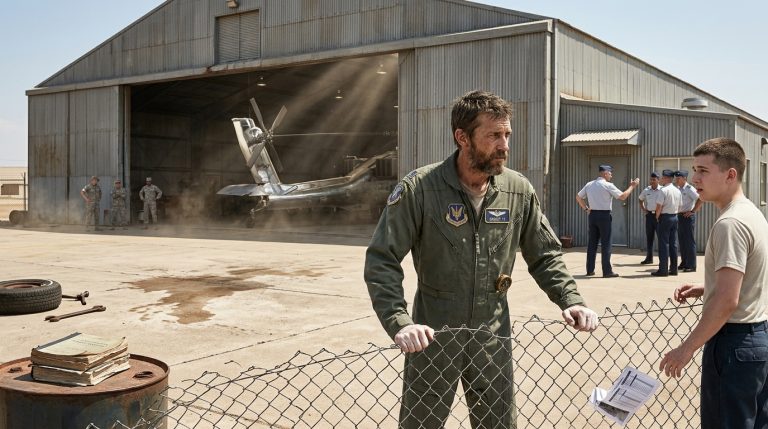
The tarmac didn’t just reflect the heat; it breathed it back into the sky, a shimmering haze that made the squat, pugnacious form of the A-10 Thunderbolt II look like it was vibrating. Roger Bentley didn’t feel the sweltering humidity. He felt the cool, synthetic rubber of the landing gear tire under his palm. It was a grounding sensation, a tactile connection to a machine that had been his shield, his weapon, and his only true confidant in a world of screaming engines and black, heavy smoke.
“Go on then. Start her up.”
The voice was thin, sharp, and entirely devoid of gravity. Captain Davis stood three feet away, his flight suit pressed to a razor’s edge, his smirk a rehearsed expression of authority. He gestured to the glass-cockpit display with a manicured hand. “Surely you remember how to flip a few switches, old-timer? Or is all that new-fangled glass a bit too much for you?”
Roger didn’t look at him. His eyes, the color of a bruised, faded sky, remained fixed on the seven-barreled maw of the GAU-8 Avenger cannon. He could feel the memory in his marrow—the bone-jarring vibration that wasn’t sound, but a force of nature. When that gun roared, time stopped. History was written in the dust and fire below.
“The auxiliary power unit requires a ground check before ignition sequence,” Roger said. His voice was a low, gravelly rasp, not a response to the captain, but a conversation with the machine itself. “Hydraulic pressure needs to be stable at 3,000 PSI. You don’t just turn a key.”
Davis laughed, a sharp, barking sound that caused a few of the younger airmen standing nearby to shift uncomfortably. They were caught in the friction between the reality of a legend and the rigid, suffocating structure of their current duty.
“Look, sir,” Davis snapped, his tone shifting into the patronizing cadence one might use for a lost child. “This is a restricted area. The aircraft is a static display. I’m going to have to ask you to step away and let my people get back to work.”
Roger straightened, his spine moving with a slow, deliberate fluidity. His hand dropped from the tire, leaving a faint streak in the dust. He had been a guest of the commander, a man invited to bridge a gap between generations, yet here he stood, dismissed as a nuisance by a man who saw a uniform as a costume rather than a contract.
“I’m not a civilian,” Roger murmured.
Davis’s eyes narrowed, his hand drifting toward his hip, where the absence of a sidearm seemed to bother him more than the presence of the old man. He stepped closer, his shadow swallowing the faded, crudely drawn scorpion patch stitched onto Roger’s jacket.
“Right. And I’m the Chief of Staff,” Davis scoffed. “Show me your visitor pass, or I’m going to have to involve security. And trust me, you don’t want to see what happens when I involve security.”
Roger looked at the captain—really looked at him—and saw the hollowness. The man didn’t see the desert; he didn’t see the tracers cutting through the twilight. He saw a nuisance. But as Roger reached slowly into his pocket, the shimmering heat of the flight line began to waver, and for a fleeting, terrifying moment, the smell of burnt propellant replaced the sterile scent of the base.
He didn’t pull out a pass. His fingers brushed against something else in his pocket—something small, hard, and cold—that made his heartbeat quicken with a sudden, sharp realization. The captain wasn’t just being rude; he was actively obstructing a memory that was already starting to burn.
CHAPTER 2: The Echo of the Scorpion
The metal of the object in Roger’s pocket—the small, hand-stitched scorpion patch, still bearing the faint, dry scent of a Saudi Arabian summer decades past—felt like an anchor pulling him down into the heat of the tarmac. He didn’t pull it out. Not yet. To reveal it now, while Captain Davis’s eyes were narrow, aggressive slits of suspicion, would be to treat a sacred memory as a trinket to be bartered for safety. And Roger Bentley did not barter.
The silence grew thick, layered with the impatient shifting of boots on sun-softened concrete. Behind Davis, the young airmen were paralyzed, caught between the instinct to retreat and the magnetic pull of a confrontation they knew was wrong.
“Well?” Davis pressed, his hand still drifting nervously toward his hip. “I’m waiting. If you have nothing to show me, then you are a liability to the safety of this flight line. I won’t have my event jeopardized by a confused drifter.”
Roger breathed, a slow, rattling inhalation that tasted of salt and old jet fuel. He looked past the captain, his gaze landing on Senior Airman Garcia. The boy was looking at the plane, then at Roger, and then back at the plane, his eyes widening with a realization that clearly defied the regulation-stiff posture he was trying to maintain. There was a flicker of something in Garcia’s expression—not mockery, but a sudden, terrifying recognition of the tail number.
“I am not lost, Captain,” Roger said, his voice quiet, lacking any tremor. “And this machine isn’t just an asset to be guarded for an afternoon. It’s a record. If you look closely at the starboard engine intake, you’ll find a series of tiny, irregular indentations. Shrapnel from a surface-to-air missile that should have brought this bird down twenty miles from the extraction point. It’s still flying because it was held together by more than rivets.”
Davis blinked, momentarily thrown off by the precision of the technical detail. For a heartbeat, the arrogance wavered, replaced by the sheer confusion of a man who suddenly realized he was arguing with a textbook of history he’d never bothered to read. But his ego was a rigid, unyielding thing. It wouldn’t allow for a moment of humility.
“I don’t care about the history of a decommissioned airframe,” Davis snapped, though the volume of his voice had dropped an octave, losing its confident edge. “I care about the rules. And the rules say you shouldn’t be here.” He turned, his gaze sweeping over the crowd of airmen. “Get security. Now. This has gone on long enough.”
As two of the younger airmen hesitated, their eyes locked on the old man’s weathered jacket, Garcia finally moved. He didn’t go for security. He turned his back on the captain, his face pale, and pulled a phone from his pocket with fingers that seemed to fumble against the screen. He stepped behind the bulky fuselage of the A-10, his body shielding his actions. He was whispering into the phone, his voice a frantic, low-frequency hum that barely carried over the steady whine of the base’s distant power generators.
Roger didn’t need to hear the words. He could feel the shift in the air. The tension wasn’t dissipating; it was evolving. He kept his hand in his pocket, his thumb tracing the coarse, fraying edges of the embroidered scorpion. The memory of that young Ranger captain—the grime on his face, the way his hands had shook as he pressed the patch into Roger’s palm—felt more real than the blistering heat of the tarmac.
He was not fighting the captain. He was holding the line against the oblivion that came when people forgot the cost of the peace they enjoyed.
“You’re making a mistake, son,” Roger said, the term ‘son’ hitting Davis like a physical blow.
“Don’t call me son,” Davis hissed, his face flushing a deeper shade of crimson. He stepped into Roger’s personal space, his posture rigid, his eyes searching for a weakness that wasn’t there. “You have no rank, no clearance, and no business here. Security will be here in sixty seconds. You can leave now, with what little dignity you have left, or you can be dragged off this flight line in front of the families you’re currently terrifying.”
Roger looked at him, and for the first time, there was a flash of pity in the old pilot’s eyes. It was a cold, detached sort of pity that made Davis shiver. Roger knew what was coming. He knew the weight of the phone call Garcia was making, and he knew the man who would be arriving to answer it.
“Dignity isn’t something you can take from me, Captain,” Roger whispered, his voice as steady as an altimeter needle in level flight. “It’s something you earn. And I think you’re about to find out just how expensive it is.”
He turned away from the captain, ignoring the frantic, reaching gesture Davis made to stop him. He began to walk—not away, but toward the cockpit ladder. He didn’t climb it. He simply stopped at the base of the wing, placing his hand on the metal skin, his eyes scanning the horizon.
The air on the base felt thin, brittle. Somewhere in the distance, a siren began to moan, a low, guttural warning that didn’t sound like security forces. It was deeper, more authoritative, cutting through the stagnant afternoon air like a blade. Davis froze, his head snapping toward the sound, his face draining of its arrogant color.
Roger didn’t turn back. He knew that sound. It was the weight of command, and it was moving fast.
CHAPTER 3: The Architecture of Authority
The sound of the approaching siren was not a thin, wailing cry; it was a rhythmic, mechanical growl that vibrated through the very soles of Roger’s boots. It was the sound of an organization’s nervous system finally registering a wound it had been trying to ignore. Captain Davis, still posturing with his chest puffed out and his jaw set in a mask of defiance, faltered. The color drained from his face so rapidly that, for a moment, he looked like a statue caught in the process of crumbling.
The maintenance crew nearby dropped their tools. The rhythmic clack-clack of wrenches hitting the tarmac was the only sound for a heartbeat, followed by the sudden, heavy silence of a base realizing the atmosphere had shifted from administrative tedium to something far more dangerous.
Roger kept his hand on the flank of the A-10. He didn’t turn to look at the gate. He didn’t need to. He could hear the specific, heavy thrum of the black SUV’s engine as it crested the perimeter access road, tires kicking up grit in a way that suggested speed, not routine. He closed his eyes for a micro-second, and the base—with its polished concrete and organized flight lines—dissolved. In its place, the arid, suffocating heat of a desert valley returned. The memory was an intrusive, jagged phantom. He was twenty-eight again. He was sweating into the oxygen mask, his hands dancing across the control stick as the GAU-8 shrieked beneath him, turning enemy armor into blooming, orange fireballs. The smell of burning rubber and ozone was so thick he could taste it on his tongue, a metallic tang that usually only preceded the final, frantic maneuver to clear the killbox.
He pulled himself back to the present with a deliberate, physical effort, forcing his fingers to release their death-grip on the Thunderbolt’s fuselage. The world snapped back into focus: the oppressive humidity, the young airmen’s pale, confused faces, and the frozen, trembling form of Captain Davis.
The black SUV skidded to a halt, the screech of rubber against concrete acting as a final period at the end of the Captain’s authority. The driver’s side door flew open, and Colonel Mat emerged. He didn’t look like a man arriving for a photo opportunity. His flight cap was pulled low, his brow furrowed with a concentration so intense it was as if he were trying to read the internal mechanics of the flight line itself. Chief Wallace was on his heels, a dark shadow of efficiency.
Davis scrambled to adjust his uniform, his hands shaking as he attempted to assume a position of attention. “Colonel, sir, I was just—”
“Quiet, Captain,” Mat said. His voice was not loud, but it possessed a weight that silenced the entire flight line. He walked past Davis without looking at him, a dismissal so absolute it was more stinging than a direct reprimand.
Colonel Mat stopped three feet in front of Roger. He stood there for a long moment, his gaze roaming over the old man. It wasn’t the look of a superior officer toward a civilian; it was the look of a man recognizing a foundational pillar upon which his entire world was built. Then, the transformation occurred. Mat’s body stiffened into the rigid, geometric perfection of a soldier, and he brought his hand up in a salute. It was sharp, crisp, and held with a deliberate, agonizing reverence. It wasn’t a standard gesture of military courtesy; it was a physical acknowledgment of a debt that existed outside of time.
Roger felt the air in his lungs go cold, then warm. He returned the salute. His hand didn’t tremble. The years of arthritis and age seemed to vanish, replaced by the muscle memory of a lifetime spent under the discipline of the wing.
“Mr. Bentley,” the Colonel said, his voice dropping into a tone of quiet, measured respect. “It is a profound honor to have you on my flight line, sir.”
Davis, standing a few paces behind, looked like he was suffocating. His mouth opened and closed, but no sound emerged. The airmen—those who had been part of the Captain’s little group—were now stepping back, distancing themselves from him as if his failure were a contagious disease.
“Colonel,” Roger replied. His voice was still that low, gravelly rasp, but it held a new, resonant clarity. “I was just admiring the maintenance on 618. It’s been a long time since I’ve seen her this well-tended.”
Mat’s eyes flickered toward the Thunderbolt, then back to Roger. “She’s the heart of this wing, sir. We haven’t forgotten what she—or you—carried for us.” He turned then, pivoting on his heel to face the gathering crowd of personnel. His face was a mask of stone, and his eyes, when they locked onto Davis, held no warmth at all. The Captain looked as though he were suddenly, desperately wishing for the earth to open up and swallow him whole.
Roger watched the scene unfold with a detached, analytical calm. He saw the shift in the airmen’s eyes—the way the doubt was being replaced by the dawning, heavy weight of history. He had planted no seed here, and yet he knew the harvest was coming. He could see it in the way the airmen were beginning to look at the A-10 now: not as a static display, but as an artifact of survival. He felt the cold, hard lump of the scorpion patch in his pocket again, a reminder of the contract he had signed long ago in blood and sand. He had come here just to stand beside the machine one last time, to feel the hum of the metal and the ghost of the mission. But as the Colonel began to speak, his voice ringing across the tarmac, Roger realized he hadn’t just come to visit a ghost. He had come to ensure the ghost didn’t fade.
CHAPTER 4: The Calculus of Respect
Colonel Mat held the salute for a heartbeat longer than protocol strictly demanded, a deliberate pause that turned the gesture into a public manifesto. When he finally dropped his hand, the movement was sharp, precise, and completely devoid of the casual fluidity common in base life. He turned to face Captain Davis, and the transition from the reverent soldier to the commanding officer was so seamless it felt like the click of a safety being disengaged.
Davis stood rooted, his breath coming in shallow, rhythmic hitches. He looked small, his uniform suddenly appearing overly starched and hollow. The silence on the tarmac was no longer heavy; it was absolute. Even the distant, ambient whine of the base’s generators seemed to fade into the background, leaving the space between the Colonel and his junior officer charged with an electric, static tension.
“Captain,” Mat said. His voice was quiet, but it carried across the concrete with the clarity of a bell. “I am going to ask you to explain your presence here. Not your operational assignment—I know you are on the schedule—but the justification for your conduct toward a guest of this command.”
Davis’s throat moved, a visible, desperate swallow. He looked at the crowd, then at the A-10, his eyes darting back to Roger, who stood motionless, his gaze fixed on the horizon as if he were waiting for a radio call that hadn’t come for thirty years. “I… I was following protocol, Colonel,” Davis stammered. The words were weak, crumbling before they even left his lips. “He was in a restricted area. There was no escort. I assumed he was—”
“You assumed,” Mat interrupted, the words clipped and cold. He took a single, measured step toward the Captain. “You assumed he was a civilian. You assumed he was a nuisance. You assumed that the uniform you wear is the only thing that confers value in this Air Force.”
The Colonel’s eyes drifted toward the nose of the A-10, specifically to the weathered patch of paint where the GAU-8 Avenger cannon protruded like a dormant god. “That aircraft is not merely hardware. It is a vessel of our history. And this man,” he gestured to Roger with an open, palm-up motion, “is the reason that history exists.”
The airmen behind Davis began to shift, a subtle, collective movement away from their commanding officer’s subordinate. The social geography of the tarmac had been redrawn in seconds. They were no longer Davis’s men; they were witnesses to a failure of leadership so profound it radiated outward, touching everyone present.
Roger stepped forward then, the leather of his jacket creaking in the silence. His movement was slow, deliberate. He stopped beside the Colonel, creating a stark visual contrast: the old, weathered veteran in his faded jacket and the modern, razor-sharp commander in his pressed flight suit.
“Colonel,” Roger said, his voice barely audible yet perfectly clear. “He’s young. He’s been trained to protect the asset, not the legacy. The confusion is… understandable, perhaps.”
The grace in Roger’s words, the refusal to demand the Captain’s immediate humiliation, only served to highlight Davis’s own lack of character. Mat turned to look at Roger, and the coldness in the Colonel’s expression softened into something resembling genuine awe. “Sir, your grace is precisely why you are the legacy we strive to honor. But we cannot afford to lose the distinction between an officer and a manager. Captain Davis has forgotten that the first duty of an officer is not to the regulation, but to the people—and the history—that make the regulation necessary.”
Mat turned his attention back to Davis. “You will be in my office tomorrow morning at 0600. Service dress. Be prepared to explain, in detail, how you intend to rectify the disgrace you have brought upon yourself and this wing today. You are relieved of your duties on the flight line. Escort yourself off the tarmac. Now.”
Davis turned, his movements stiff and jerky. He didn’t look at the crowd. He walked away from the Thunderbolt as if the aircraft itself were radioactive. As he passed Senior Airman Garcia, the young mechanic didn’t even look up; he remained at attention, eyes fixed on the horizon, his own small, silent defiance.
As the Captain’s retreating figure grew smaller against the vast, shimmering expanse of the base, the tension on the tarmac finally began to dissipate, replaced by a strange, humming energy. The airmen began to move again, but with a different cadence—slower, more purposeful. They looked at the Thunderbolt not as a display piece, but as a monument. And in the center of it all, Roger Bentley stood still, his hand resting on the cool, solid metal of the wing, the silence of the afternoon finally feeling like it belonged to him again.
CHAPTER 5: The Weight of Memory
The air on the flight line had turned stagnant, heavy with the phantom scent of spent propellant and the dry, biting iron of a desert wind that shouldn’t have been there. Colonel Mat remained in position, his eyes searching Roger’s face, not with the predatory curiosity of a commander, but with the quiet, desperate hope of a man who realized he was staring at a living piece of his own soul. The crowd of airmen, held in that strange, suspended gravity, didn’t move. They were waiting for a resolution to a story they hadn’t known they were living in.
Roger’s hand stayed on the cold, ridged surface of the A-10’s wing. The metal felt right—solid, unyielding, and honest. He looked at the Colonel, but for a split second, the image smeared, replaced by the chaotic, sun-bleached landscape of an extraction zone in ’91. He saw the Ranger captain again, the man whose platoon had been saved by the sudden, shrieking intervention of an A-10 that defied physics just to get them home. The patch in Roger’s pocket felt hot, almost burning through the fabric of the leather jacket.
“You speak of honoring the heritage, Colonel,” Roger said, his voice barely rising above the low, mechanical drone of the base’s cooling systems. “But heritage isn’t kept on a plaque. It isn’t kept in the archives of a history department. It’s kept in the living. It’s kept in the realization that the man standing next to you—the one you might look past because of his age or his civilian clothes—might be the only reason you have a ‘today’ to talk about.”
Mat nodded, a slow, solemn movement. “I know, sir. And we have failed you in that regard today. The Captain will be held to account. Not because of a violation of regulation, but because of a failure of spirit.”
Roger looked down at his own hands. They were spotted with age, the veins prominent and the skin thin, but as he moved them, he could still feel the phantom resistance of the control stick. He remembered the specific, tactile joy of leveling a beast like this, of knowing exactly where the edge of the envelope was and deciding to push past it for the sake of the men on the ground.
“The Captain is just a symptom,” Roger said quietly. He didn’t want to humiliate the man further, but he couldn’t lie about the nature of the rot he had witnessed. “The culture of the uniform… it’s easy to treat it like a costume. It’s harder to treat it like a promise.”
As the afternoon sun began to dip, casting long, sharp shadows across the tarmac, Roger felt a sudden, sharp exhaustion. The adrenaline of the confrontation was fading, leaving behind the stark reality of his eighty-two years. He looked at the airmen. They were watching him with an intensity that bordered on reverence. They weren’t looking at an old man; they were looking at a mirror, and they were finally seeing the reflection of what they were meant to be.
He reached into his pocket and pulled out the patch—the sand-colored, hand-stitched scorpion. He didn’t offer it to the Colonel. He held it in his palm, looking at the crude, messy embroidery. It was a ugly thing by modern standards, a piece of fabric frayed by time and necessity, but it held the weight of a dozen lives.
“I was going to leave this behind,” Roger murmured, almost to himself. “I thought maybe it was time to let it be just a piece of cloth. But standing here, seeing this, I realize it’s not mine to give away.”
He looked at the Colonel, then at the young mechanic, Garcia, who was still standing at the edge of the group, his face illuminated by a mix of fear and deep, unshakable respect. Roger walked over to the young airman. The crowd parted like water, leaving a path that felt as wide and lonely as a desert highway.
Roger took Garcia’s hand and pressed the small, worn patch into his palm. “Don’t let them turn this into a story for a history book,” Roger said, his voice barely a rasp. “Keep it real. Keep it hard. Remember what it costs to keep the sky open.”
The airman looked down at the patch, his breath catching in his throat. When he looked up, his eyes were wet. He didn’t say a word; he simply stood there, guarding the small, frayed piece of history as if it were the most valuable thing on the base. The transition was complete. The weight of the moment shifted from the old pilot to the new generation, and for the first time that day, the tarmac felt quiet—not the silence of a confrontation, but the silence of a torch being passed in the cold, thin air of a desert night.
CHAPTER 6: The Quiet Aftermath
The bell over the coffee shop door chimed—a light, cheerful sound that felt entirely discordant with the weight Roger Bentley carried in his chest. Outside, the world was moving with the frantic, thoughtless energy of a Tuesday afternoon, but inside, the air was still, smelling of dark roasts and old, damp wood. Roger sat at his usual corner table, the morning paper spread out before him like a map of a world that didn’t know he existed.
The door jingled again. A man stepped inside, his shoulders hunched, his eyes fixed on the scuffed linoleum floor. It was Davis. He was dressed in civilian clothes—a simple, nondescript jacket that made him look smaller, stripped of the sharp, pressed geometry of the uniform that had once been his armor. He looked tired. Not the tired of a man who had pulled an all-nighter, but the tired of a man who had finally, painfully, realized that the foundation of his world was built on sand.
Davis stopped near the counter, hesitated, then spotted Roger in the corner. He stayed there for a long moment, the air around him fluctuating with the uncertainty of a man standing on the edge of a cliff. Finally, he walked over. Every step looked deliberate, as if he were measuring his proximity to the old man with extreme caution.
Roger didn’t look up immediately. He finished his sentence, turned the page of the paper, and then looked over his glasses. His gaze was neutral—not cold, but devoid of the judgment Davis clearly expected. He gestured to the empty chair across from him. Davis sat down, placing his hands on the table. They were clean, manicured hands, but they were trembling, just slightly.
“Sir,” Davis began. The voice was quiet, stripped of the condescending amusement that had defined their encounter on the flight line. “I… I know an apology is a cheap thing to offer after what happened.”
Roger waited. He didn’t offer a platitude. He didn’t tell the man it was alright. He simply watched, his silence acting as a mirror for Davis to see the hollowness of his own past conduct.
“They made me read it,” Davis continued, his gaze finally lifting to meet Roger’s. There was no arrogance in his eyes now, only a raw, stinging vulnerability. “Every mission report. Every citation from ’91. Every after-action brief on Tail 618. I spent three days reading about what you did. What the pilots of that era had to do.” He swallowed hard, his throat working visibly. “I had no idea. I thought… I thought I was protecting the base. I thought I was doing my job.”
“You were,” Roger said, his voice a low, steady rumble. “But you were doing it from a place of fear, not of understanding. You saw a threat because you couldn’t see the history. You saw a stranger, but you couldn’t see the debt.”
Davis looked down at the table, his fingers tracing the grain of the wood. “I’ve been reassigned. Logistics command. It’s… it’s a desk in the middle of nowhere. It feels like the right place for me right now.”
Roger nodded once. He reached into his own jacket, not for a patch or a weapon, but for a small, simple fountain pen he’d carried for years. He turned his paper over to a blank margin and wrote something down. He slid the paper across the table. It wasn’t an address or a phone number. It was a list of three books—memoirs of men who had flown in the same desert skies, men who hadn’t come home to write their own stories.
“Read these,” Roger said. “Don’t read them to be a better officer. Read them to be a better man. The rank is temporary. The understanding… that stays.”
Davis stared at the paper as if it were a map to a place he had never visited. He reached out and tucked it into his pocket with a reverence that, a week ago, would have been impossible for him. He stood up, his posture different—still tired, but no longer hunched under the weight of an unearned arrogance.
“Thank you, sir,” he said. He started to turn, then paused. “I hope… I hope you find some peace with the machine. I know it’s just a plane, but…”
“It was never just a plane,” Roger corrected, though there was no heat in his words. “It was the bridge between us and the people we fought for. You’ll understand that one day. Or you won’t. That’s up to you.”
Davis left the shop, the bell chiming again as he walked out into the sunlight. Roger watched him go, then returned to his paper. He took a sip of his coffee. It was lukewarm, but it felt good, a simple, grounded pleasure.
He thought of Garcia, the young airman who now carried the scorpion patch. He thought of the Thunderbolt, sitting quiet and sturdy on the flight line, no longer just a display, but a living monument. He had paid his debt. He had stood his ground. The world would continue to turn, the uniforms would continue to be pressed, and the history would continue to be written—and for the first time in thirty-five years, he didn’t feel the need to stand guard over it. He closed the paper, folded it neatly, and stood up. He walked out of the shop and into the bright, open air, his steps slow but entirely, perfectly steady. The sky above was clear, infinite, and finally, mercifully, quiet.