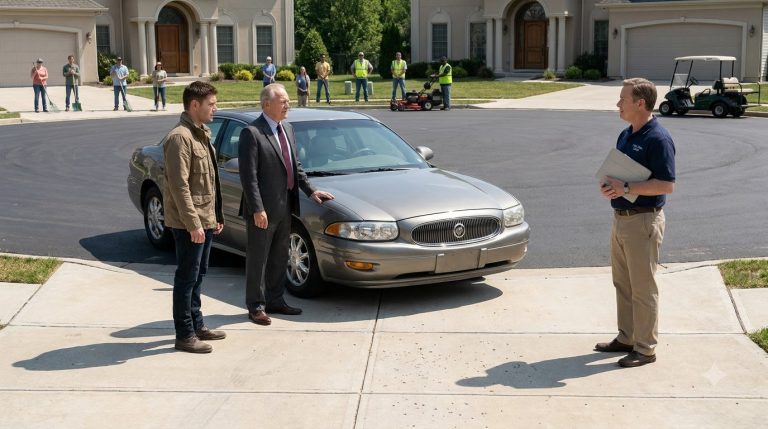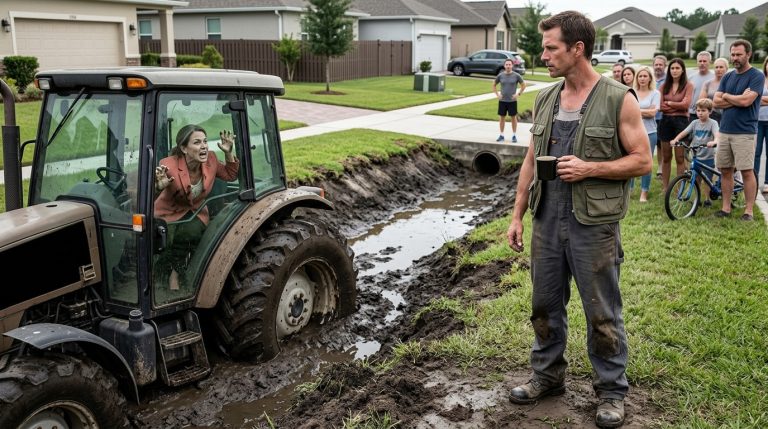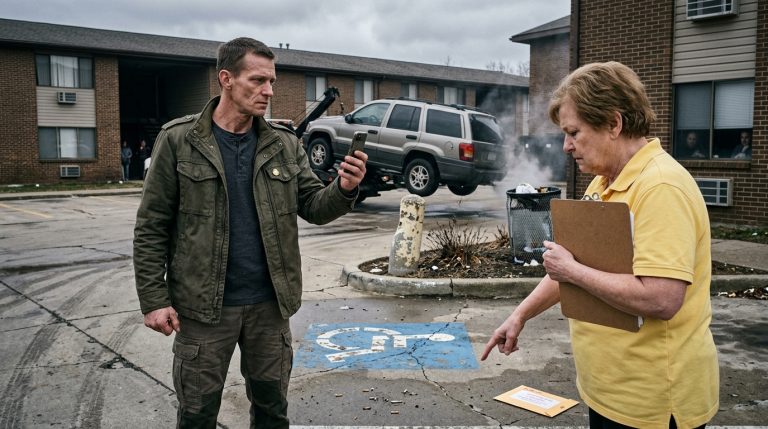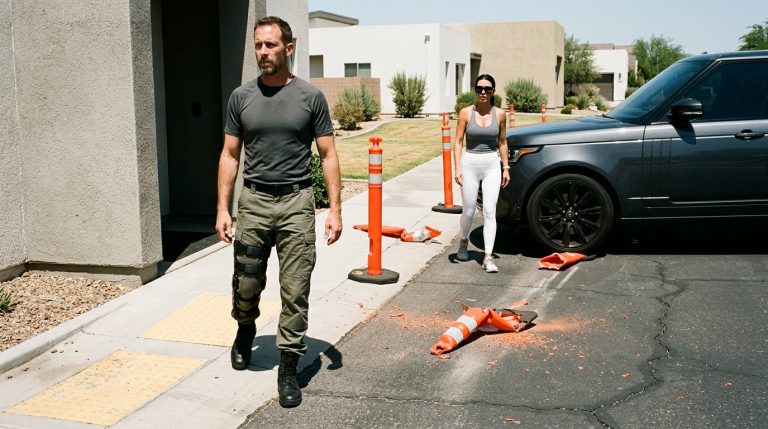
The Subterranean War Of Oak Ridge: How One Retired Army Engineer Took Down The Neighborhood Bully
CHAPTER 1: THE LINE IN THE GRASS
“That illegal sinkhole you call a root cellar will be filled with concrete by Friday at your expense, Mr. Henderson.”
Karen Miller cleared her throat, the sound dry and grating in the humid afternoon air.
“This is a covenanted community, not a doomsday prepper compound.”
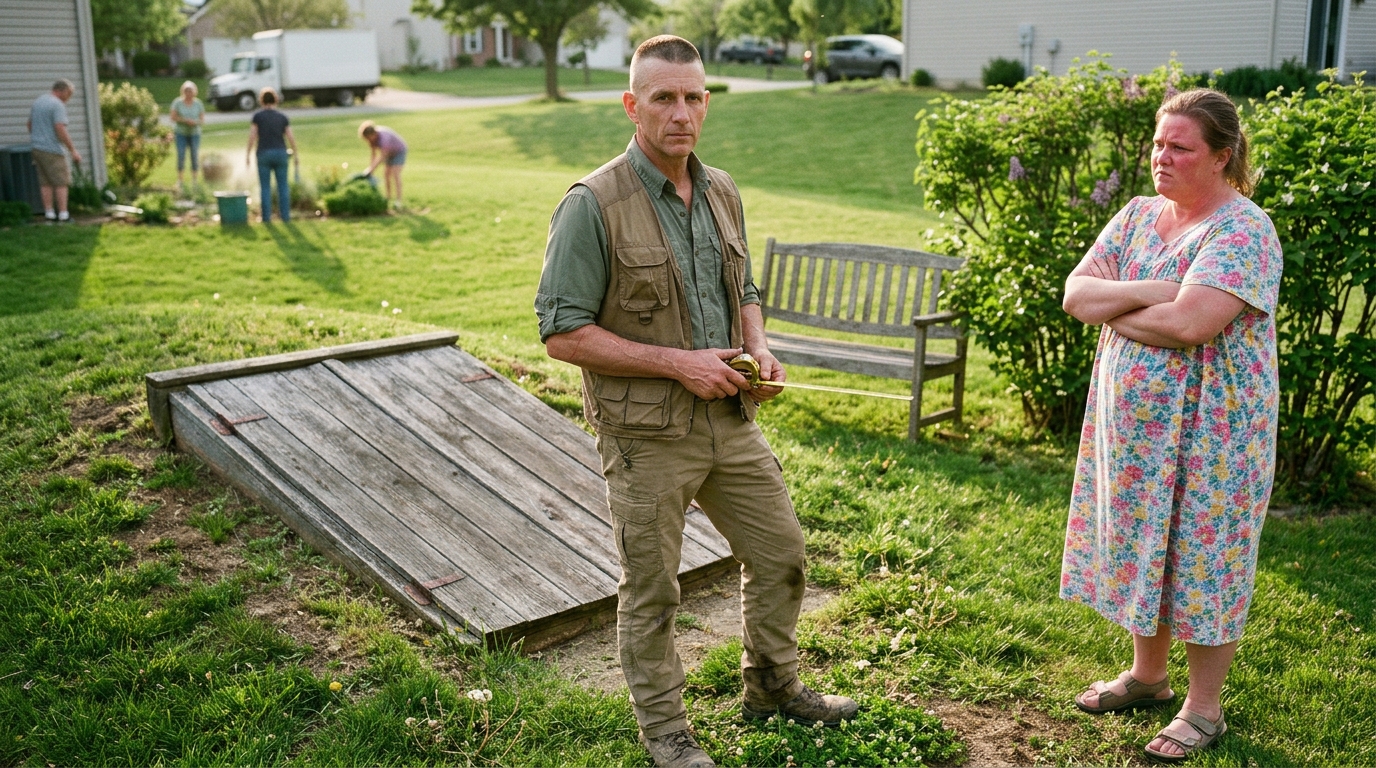
She stood on the manicured edge of my turf, her floral print muumuu hanging like a brightly colored tent over her wide frame. Her arms were crossed tight over her chest, eyes squeezed into dark slits as she glared past my shoulder toward the backyard.
Down the gentle slope of the grass rested the heavy cedar door of the cellar I had spent three months building with my own hands.
I didn’t shout. I didn’t raise a hand. I reached into my right pocket, my thumb finding the notched wheel of my worn brass measuring tape, sliding the lock back and forth with a quiet, metallic click.
Click. Clack.
“It’s six feet subterranean, Karen,” I said, keeping my voice low and level, the same tone I used when evaluating bridge abutments in foreign mud. “Reinforced block, precast slab overhead, set four feet clear of any utility easements.”
“I don’t care if it’s lined with solid gold,” she snapped, taking a half-step forward. The toe of her orthopedic sandal crushed a handful of clover at the boundary line. “You didn’t submit architectural plans to the board. That makes it an unauthorized structure. By Friday, the truck backs up your driveway, or the daily fines start at one hundred dollars.”
I looked at her face—flushed red, damp with sweat, radiating the pure, unadulterated high of petty authority. She was waiting for me to panic. She was waiting for me to beg for an extension or offer a check.
What she didn’t know was that twenty years in the Army Corps of Engineers teaches you one fundamental rule about conflict: never interrupt an enemy when they are walking into a perimeter you already mapped.
I didn’t have a county permit sitting in my desk drawer to wave in her face. The local zoning office had flagged subterranean storage as a purely private civil matter six months ago, leaving the entire battleground strictly within the four corners of the Oak Ridge Homeowners Association Bylaws.
She thought that gave her absolute power. She thought the lack of a government paper trail left me defenseless.
“I’ll be waiting for your written notice,” I said smoothly, sliding the brass tape back into my pocket with a final snap.
Karen gave a tight, satisfied smirk, convinced she had delivered a knock-out blow, before turning on her heel to waddle down my driveway.
I turned toward the backyard, stepping down to the heavy cedar door. I ran a hand over the rough timber frame, feeling the cool draft rising from the earth below, and made a quiet vow to the dirt beneath my boots.
She was going to pour concrete, all right—but it wasn’t going to be in my yard.
CHAPTER 2: THE PAPER FORTRESS
The letter arrived forty-eight hours later, delivered via certified mail like a federal indictment.
Inside was a single sheet of heavy, linen-finish stock bearing the glossy Oak Ridge HOA emblem. It cited Bylaw 14.7—”Unapproved Structures and Alterations”—demanding the immediate demolition of the “subterranean bunker” on my property. It imposed a initial fine of one hundred dollars, escalating by twenty-five dollars for every twenty-four hours the violation remained unaddressed.
I sat at the kitchen table, the paper laying flat between my coffee mug and my brass measuring tape.
I didn’t call a lawyer. I didn’t rush out to knock on her front door. I pulled the three-ring binder containing the complete Oak Ridge covenants out from the bottom drawer of my desk, flipping directly to section fourteen.
My thumb ran down the black ink of 14.7. Any shed, gazebo, deck, fence, or other above-ground structure required prior written approval from the Architectural Review Committee.
Above-ground.
The text was plain, unambiguous, and entirely fatal to her argument.
I pulled a fresh sheet of paper from the printer, setting my pen beside it. My thumb slid the brass tape measure’s lock button back and forth—click, clack—as I drafted the response.
I quoted section 14.7 word for word. I bolded the phrase above-ground. I systematically detailed the subterranean depth, the soil displacement metrics, and the lack of any municipal zoning authority conflict. I didn’t offer an emotion, an apology, or a plea for leniency. I gave her raw, cold logic wrapped in a polite, professional envelope.
I drove to the main post office downtown, paid the three dollars and eighty cents for certified mail with a green return-receipt card, and watched the clerk stamp it.
Four days later, the green card came back with her jagged, furious signature crammed onto the line.
Two days after that, a second envelope hit my mailbox. The fine had jumped to two hundred and fifty dollars. The letter no longer just cited the bylaw; it accused me of “creating a severe soil stability hazard” that threatened neighboring lot lines.
I picked up the notice, stepping over to the front window. Across the cul-de-sac, Karen stood on her front porch holding a pair of garden shears, pretending to deadhead her hydrangeas while keeping her eyes locked onto my driveway.
She thought she was backing me into a corner. She thought throwing around words like hazard would make a retired engineer tremble.
I turned back to my desk, opened the binder, and started typing a second letter.
“Regarding your unsubstantiated assertion of a soil stability hazard,” I wrote, my fingers moving with steady, rhythmic precision, “the retaining walls were designed to exceed local load capacities for soil pressure. If the board possesses a signed report from a licensed geotechnical engineer stating otherwise, please forward a copy immediately. Otherwise, cease making libelous claims regarding structural integrity.”
I attached a detailed diagram of the wall footings, printed three copies, and prepped another certified mail envelope.
As I sealed the adhesive strip, I noticed a tiny discrepancy at the bottom of her second notice—a digitized signature block for the ARC committee chairman, Dennis Vance, that looked strangely pixelated compared to the crisp HOA letterhead.
Dennis was a soft-spoken retired school teacher who lived two doors down, a man who spent his afternoons quietly painting watercolors on his back patio.
I picked up my leather folder, slipped the second letter inside, and walked out the front door into the warm afternoon air.
CHAPTER 3: THE GATHERING STORM
The screen door creaked open, revealing Dennis in a paint-splattered apron, a wet camel-hair brush held delicately between two thin fingers.
“Mark,” he said, blinking behind round wire-rim glasses. “If this is about Karen’s latest email blast, I didn’t sign off on any of it.”
I opened my leather folder, pulling out the notice of violation with its pixelated ARC signature line. “She’s using your name on fine escalations, Dennis.”
Dennis took the paper, his jaw tightening as his thumb brushed over the fuzzy print. “I haven’t called an ARC meeting since November. She told the board you were digging a deep drainage vault that threatened the storm mains.”
“Come over for burgers Saturday at six,” I said, keeping my tone steady and conversational. “Bring your wife. Brenda and Tom are coming too. I want to show you the vault.”
Saturday evening was quiet, the muggy summer air carrying the smell of charcoal smoke and seared beef across the back lawn.
Tom, a local real estate agent who lived three doors down, stood on the edge of the slope with a cold bottle of amber ale in his hand, looking at the cedar door nestled between the lilac bushes.
“Karen told my wife this was going to collapse the water table,” Tom muttered, shaking his head. “She had three people on Maple Lane convinced their foundations were cracking because of your excavating.”
“Take a look for yourself,” I said, pulling open the cedar door and stepping down the three concrete steps to flick the light switch.
The clean, cool air of the cellar washed over them as Tom and Dennis stepped inside. Smooth, white-painted block walls framed rows of cedar shelving, already lined with Laura’s jarred tomatoes and pickled cucumbers.
“This isn’t a hazard,” Dennis murmured, running a hand over the tight mortar joint near the ceiling. “This is better built than my master bathroom extension.”
“It’s a selling point,” Tom added, turning around to inspect the overhead slab. “If I put this on a listing, it adds five grand to the property value easily. She’s out of her mind.”
I leaned against the door jamb, pulling the brass measuring tape from my pocket and letting the metal rule slide out three inches with a soft scrape.
“She’s using the fear of fines to keep everyone quiet,” I said, looking between them. “She claims the board authorized every dollar of the penalty matrix, but Dennis didn’t sign the ARC notice.”
Dennis pulled a crumpled sheet of paper from his back pocket, his knuckles turning pale as he smoothed it against his knee.
“It’s not just you, Mark,” Dennis said, his voice dropping an octave. “Three years ago, she tried to force George Gable to tear out his rose garden borders. Claimed it was an illegal fence. He fought her until she threatened to put an HOA lien on his house.”
“Where is George now?” I asked.
“Sitting on his porch three streets over,” Dennis said grimly. “And he’s still got every letter she ever sent him.”
By nine o’clock, the burgers were gone, but Tom and Dennis were still sitting at my patio table under the amber string lights, comparing notes on four years of Karen’s arbitrary fines.
“We need a full record,” Tom said, setting his empty bottle down with a sharp clink against the glass tabletop. “If she’s pushing fine notices without board quorums, every single assessment she issued this year is legally void.”
“I’ll talk to George tomorrow morning,” I replied, sliding the brass tape back into my pocket until the lock clicked home. “And then I’m going down to the county clerk’s office to pull the public filings on her pet project by the pond.”
Dennis looked up, his eyebrows raising behind his specs. “The community gazebo?”
“She spent forty thousand dollars of our reserve fund on it last spring,” I said quietly. “Let’s see how carefully she followed the rules when it was her name on the contract.”
CHAPTER 4: THE COUNTERINVESTIGATION
Dave, the county clerk, wiped his hands on a shop rag. “Oak Ridge Gazebo project. Pulled it right from the spring 2024 archive stack.”
“Appreciate it, Dave,” I said, pulling the heavy cardboard flaps open.
Inside lay the complete public record of Karen’s flagship community project—the forty-thousand-dollar gazebo she had built by the pond to cement her legacy as HOA president.
I pulled out the approved blueprints first, laying them flat on the laminate surface. I drew my thumb across the notched wheel of my brass tape measure, using the hard steel edge as a straight-edge to track the line items.
Click. Clack.
The foundation plan specified four concrete piers sunk four feet deep to clear the frost line.
I flipped to the material delivery receipts behind the contractor’s bid. The invoice from the local ready-mix plant showed a delivery of just under three cubic yards of concrete—barely enough to pour piers two and a half feet deep.
She had cut the foundation depth in half to save eighteen hundred dollars on labor and materials.
I turned to the electrical layout. The engineering diagram explicitly called for rigid Schedule 80 PVC conduit buried eighteen inches deep to carry the main power feed from the pool pump house to the gazebo’s overhead lighting.
I scanned the supply invoices attached to the final payout voucher. There was no line item for PVC conduit. There was no bill for underground-rated UF-B cable.
Receipt #4082 listed two hundred feet of standard, twelve-gauge orange Romex interior wiring.
My pulse went still. Romex is designed for dry drywall cavities, not moist earth. Direct-buried interior wire breaks down under soil moisture within months, turning the surrounding ground into an active electrical hazard the moment a circuit grounds out.
I flipped frantically to the back of the file, looking for the yellow card.
The initial framing inspection was signed. The footers were signed. But the line marked Final Electrical Inspection was completely blank—no stamp, no signature, no date.
She had rushed the project to completion for the summer block party, bypassed the final county sign-off, and buried live, unshielded interior wire straight through the grass where neighborhood kids played barefoot every weekend.
Ten minutes later, I stood near the community pool pump house behind the gazebo.
I knelt beside the manicured mulch bed, pulling a flat wooden stick from the edge of the flower garden to scrape away three inches of damp cedar chips.
Just beneath the topsoil, embedded in wet earth, rested a bright orange plastic jacket.
I pulled my brass tape measure from my pocket, locking the ruler out at three inches. The live high-voltage line wasn’t even buried to the depth of a lawnmower blade.
I took out my phone, lined up the brass tape directly beside the exposed orange sheath, and snapped four clear, high-resolution photographs.
Karen had built her reputation on enforcing the rules, but in her rush to build a monument to her own power, she had left a loaded gun buried in the neighborhood grass.
I stood up, wiping the dirt from my knees, and dialed Dennis Vance’s number.
“Dennis,” I said, looking across the water at the wooden gazebo glowing in the afternoon light. “Call Tom and George. Karen just called a special neighborhood meeting for Thursday night to humiliate me—and we’re going to give her the audience she deserves.”
CHAPTER 5: THE SHOWDOWN AT THE CLUBHOUSE
Over fifty residents packed the folding chairs, their voices humming with a nervous, electric energy under the buzzing fluorescent lights.
Karen stood behind the wooden lectern in a bright purple caftan, clutching a wireless microphone in her right hand like a gavel. Beside her sat Inspector Evans, a gray-bearded county official in a dark polo shirt, twirling a steel pen between his fingers with an exhausted sigh.
“—an unpermitted, structural hazard sitting right in our backyards!” Karen shrilled, her voice cracking against the microphone speaker. “We brought Inspector Evans tonight to confirm what the board already knows. We will vote on the forced remediation of 112 Oak Drive before this meeting adjourns!”
I walked down the center aisle, my boots heavy against the linoleum flooring, and stopped directly in front of the front row.
“Before we take any field trips, Karen,” I said, my voice cutting through the hum without needing a microphone, “let’s let the inspector look at the actual engineering record.”
I pulled the structural calculations, soil displacement charts, and mortar specification sheets from my leather portfolio, setting them on the long folding table right in front of Inspector Evans.
Karen’s face flushed a deep, blotchy maroon as she leaned over the podium. “This is an official board hearing, Mark! You don’t dictate the procedure—”
“Go ahead and check the load capacity, Inspector,” I said, ignoring her completely as my thumb tapped the edge of the table. “Reinforced block, footers set four feet clear of utility lines, subterranean profile.”
Inspector Evans picked up the sheets, his steel pen dropping to the table with a sharp click. He scanned the load calculations, his eyebrows pulling together as his thumb flipped through the structural drawings.
“Mr. Henderson,” Evans said, looking up with a deadpan stare. “These specs exceed commercial retaining wall codes. On paper, this vault is built better than the foundation of this clubhouse.”
A loud, collective whisper rippled through the rows behind me. Dennis Vance leaned over to Tom, nodding sharply.
“That’s just paper!” Karen shouted, her fingers digging into the plastic edge of the lectern until her knuckles turned white. “He could have cut corners in the ground! It needs a physical inspection!”
“I welcome it,” I said smoothly, stepping back toward the double doors. “In fact, Inspector, while you have your flashlight out, there’s another structure built this spring that needs an immediate code check.”
Karen froze, her mouth staying half-open as her eyes darted toward the side window facing the pond. “We are not discussing other community property! This meeting is about your violation!”
“The public gazebo,” I continued, looking directly at Evans. “Page twelve of my portfolio contains the county material invoices for that structure. The foundation piers were poured two feet shallow, and the power feed was run using direct-buried interior Romex wire without conduit.”
Evans snapped his notebook shut, his eyes narrowing as he turned his head slowly toward Karen. “Interior wire in direct earth?”
“He’s lying!” Karen screeched, her voice pitching up an octave as she slammed her palm onto the lectern. “He’s making up baseless accusations to protect his illegal hole!”
Inspector Evans stood up, unclipping a heavy yellow flashlight from his belt loop. “Let’s take a walk to the pond first, Mrs. Miller.”
The entire room stood up in unison, folding chairs scraping against the floor like a wave of thunder as fifty neighbors followed us out into the cool evening air.
Karen marched at the front, her arms flailing as she tried to block Evans’ path, but the inspector brushed past her, kneeling directly beside the mulch bed behind the gazebo.
He scraped the top layer of cedar chips away with his boot heel, revealing the bright orange plastic sheath resting in the damp mud three inches down.
Evans reached down, pulled his pocket knife out, and carefully stripped back two inches of outer insulation to reveal standard interior paper wrapping around untreated copper strands.
“Dear God,” Evans muttered, his face turning hard as iron.
He stood up, pulled a bright red, heavy-stock tag from his kit bag, and slapped it straight across the gazebo’s main support pillar.
“This structure is officially condemned as an active electrocution hazard,” Evans announced, his voice echoing across the quiet pond. “Power must be disconnected immediately.”
Karen stood frozen under the yellow light of the patio posts, her jaw working silently as the crowd turned to stare at her, their faces twisting from confusion into cold, absolute fury.
“This is a mistake!” she shrieked, backing away toward her car as Tom and Dennis stepped forward to block her path. “The contractor handled the wiring! I didn’t know!”
“You signed the completion payout, Karen,” I said, pulling my brass tape measure from my pocket and letting the lock snap shut. “And now you’re going to answer to the whole neighborhood.”
CHAPTER 6: THE FALL OF THE KINGDOM
The diesel engine rumbled as the hydraulic arm came down, its steel teeth tearing through the roof timbers of the condemned gazebo with a loud, splintering crunch.
Karen stood behind the yellow caution tape on the street, her arms wrapped tightly around herself. There were no cronies standing beside her today. Gary had resigned as treasurer forty-eight hours after the county issued the demolition mandate, terrified of being named in a personal liability lawsuit.
George Gable walked down my slope, holding a clip-board with a stack of signed petitions sitting under the spring clamp.
“Eighty-four percent of the neighborhood signed the recall petition, Mark,” George said, setting his foot on the bottom concrete step beside me. “The special assessment notice went out yesterday. Tearing that structure down and restoring the grade is costing twelve thousand dollars.”
“Who’s handling the board until elections?” I asked, unscrewing the ring band on the jar.
“Dennis took interim president. Tom is handling treasurer,” George replied, a faint, rare smile touching his eyes behind his glasses. “First official vote was a formal retraction of every fine issued against your address—along with a written apology for harassment.”
I looked across the lawn as the excavator’s claw lifted the broken framing into the back of a dump truck.
Karen didn’t wait for the recall vote to go through the county court. The real estate sign went up on her front yard three days later.
In a neighborhood where quiet, common-sense folks had finally found their voice, there was no room left for a bully who relied on bluffing and forged signatures to rule by fear.
Laura stepped out through the back door, carrying two small spoons and sitting down on the top step beside me. She reached down, taking a slice of peach from the jar, the cool draft from the dark cellar below sweeping over our ankles.
“No more certified letters?” she asked softly.
“No more letters,” I said, pulling my brass tape measure from my pocket one last time, setting it gently on the wooden shelf inside the cedar door, and closing it tight against the earth.