Boundaries Written in Granite: A Retired Combat Engineer’s Stand Against Suburban Encroachment
CHAPTER 1: LINE IN THE PINE DIRT
The engine of the timber harvester rumbled to a low, heavy idle, shaking the crisp morning air.
I rested my palm against the warm steel of the cab, feeling the vibration hum straight through my work gloves.
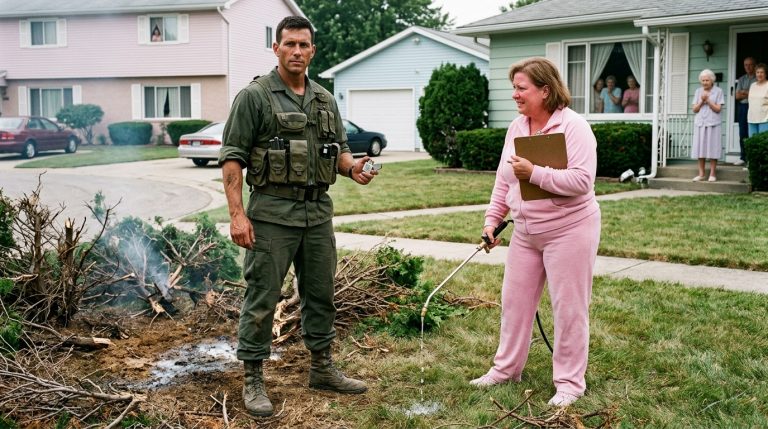
Five yards away, past the freshly cut stump of a seventy-foot Douglas fir, a pink tracksuit stood planted in the pine needles.
“That forest belongs to the visual harmony of this community!” her voice cut through the woods, sharp enough to scrape paint. “I’ll see you in jail before I let you touch one more tree!”
I didn’t rush to answer.
Twenty-two years in the Army Corps of Engineers teaches you two things fast: never jump at loud noises, and always check the ground beneath your boots before you take a step.
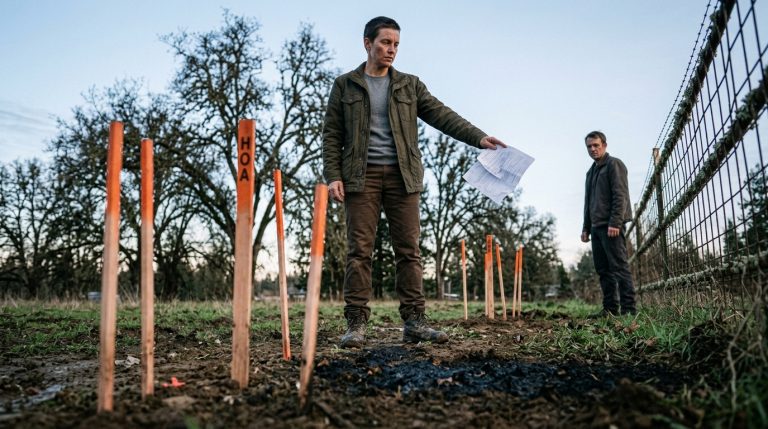
I reached down to my belt, my thumb finding the cold, notched steel of a surveyor’s boundary pin tucked into my side pocket.
I rolled the heavy metal cylinder against my knuckles twice before looking up.
“Ma’am,” I said, keeping my chest steady and my voice level as a spirit level. “You’re thirty feet past your mark.”
Karen—the name my propane delivery guy had warned me about three weeks back—crossed her arms over her track jacket, her posture locked tighter than a rusted gate.
Behind her, parked crooked on the gravel shoulder with the driver’s door slung wide, sat a pristine luxury SUV, its exhaust curling white into the freezing mountain air.
My three-man crew stood frozen near the skidder, chainsaws hanging dead in their hands, watching the scene like a bad accident on a clear highway.
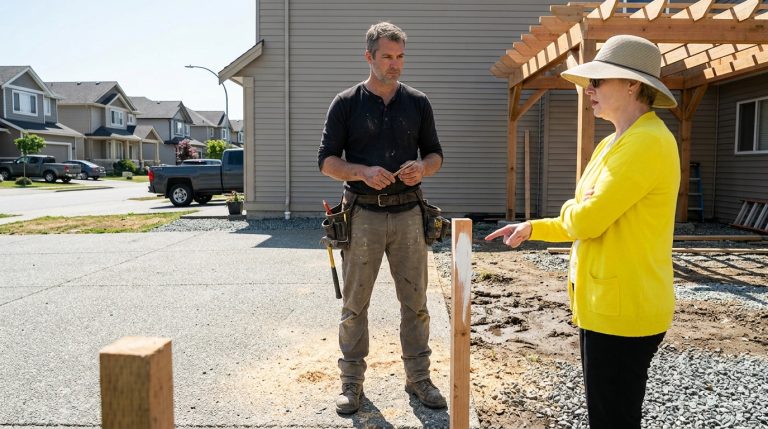
“Your rights end where our property values begin,” she snapped, taking two sharp steps forward until her sneakers hovered right over the fresh red paint I’d sprayed on the property stake last Tuesday. “We have covenants. This… this butchery is a direct violation of Aspen Ridge Estates!”
“This parcel isn’t in Aspen Ridge,” I said flatly.
“It overlooks us!” she yelled, her face flushing the color of a bruised plum. “I’ve already dispatched the county sheriff. You are under citizen’s arrest for destruction of community assets!”
I didn’t laugh, though my crew chief, Gus, spat a stream of black tobacco juice into the dirt behind the tracks.
Instead, I looked past her shoulder at the line of million-dollar McMansions sitting on the ridge above us like oversized birdhouses.
Five years ago, the developer carved up that scrub-brush hill into fifty tiny lots, leaving my hundred-acre timber tract alone because I wouldn’t sell out my retirement for his kickbacks.
I bought this ground fifteen years ago with combat pay and saved pension checks.
Every tree on this slope was an annuity meant to keep my wife Sarah and me clear of bank loans for the rest of our days.
“The sheriff knows where the county line is, ma’am,” I said, turning my body just enough to shield the equipment from her blind approach. “And he knows where my deed sits.”
“We’ll see about that when our legal team files the cease-and-desist!” She reached into her leather purse, pulled out a gold-trimmed smartphone, and held it up like a weapon. “Every minute that machinery sits on this ridge is costing you ten thousand dollars in visual damages!”
She tapped the screen with a manicured nail, stepping deeper onto my dirt, her eyes tracking the single felled fir like it was a murdered relative.
I stayed motionless, my fingers pressing hard into the cold steel surveyor pin in my pocket until the metal bit back.
CHAPTER 2: COUNTY BINDERS AND DUSTY MAPS
“I’m calling the sheriff back!” Karen’s voice rose an octave, vibrating with the pure, unadulterated shock of someone who’d never been told ‘no’ by a man in a work coat. “You can’t just stand there and insult the board!”
“I’m not insulting anybody, ma’am,” I said, letting my thumb slip off the steel pin as I took a half-step back toward the skidder. “I’m telling you where the earth stops being yours.”
She whipped her phone up, her index finger stabbing at the glass with enough force to crack it.
I didn’t stick around for the second act of the tantrum.
I turned my back on her—a deliberate, slow pivot that I knew would cook her temper faster than a butane torch—and motioned to my crew chief.
“Gus,” I called out, my voice easily carrying over her shrill demands to a 911 dispatcher. “Kill the ignition on the rig. Secure the chains for the night.”
Gus spat another dark stream into the pine needles, his jaw working as he glanced from me to the woman currently screaming about visual terrorism into her phone. “We backing down, Jack?”
“We’re taking a intermission,” I told him, stepping up to the driver’s side of my F-250. “I’ve got some reading to do down at the county seat.”
Twenty minutes later, the diesel engine was idling in the gravel lot of the county courthouse downtown.
The air inside the basement archive room smelled of damp paper, old ammonia, and fifty years of forgotten property fights.
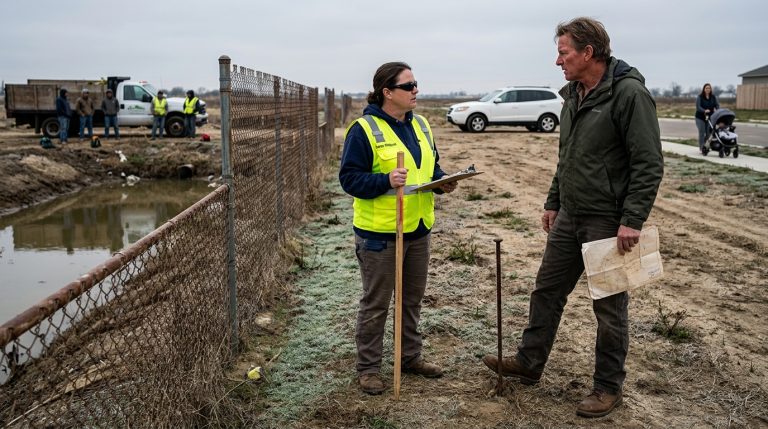
Without a lawyer to bill me two hundred bucks an hour to navigate the filing cabinets, I had to rely on the same skills I used when mapping supply routes in Anbar Province: follow the elevation lines, check the legal boundaries, and look for what the enemy didn’t want marked on the map.
I hauled a pair of heavy, leather-bound plat binders onto the long oak table, the wood groaning under the weight.
I flipped past the shiny, color-printed marketing maps the developer had handed out to retirees—the ones showing pristine greenbelts and babbling brooks—and went straight for the actual filed deeds for Aspen Ridge Estates, Parcel 73-4A.
My fingers, stained with chain oil and dirt, traced the property lines drawn in faded black India ink twenty years ago.
Then I saw it.
Right at the top corner of the Aspen Ridge plot, where their main paved avenue dead-ended near my north tree line, there was a dotted red line overlaying an old skid trail.
An easement.
I leaned closer, the harsh fluorescent overhead light reflecting off my wire-rimmed reading glasses as I studied the small, cramped handwriting of the county surveyor from 1998.
Emergency & Utility Access Only. Private Maintenance Agreement Required.
I pulled the current HOA bylaws out of the adjacent binder and flipped to the infrastructure schedule.
My eyes scanned the line items, skipping past the lawn care mandates and the paint color restrictions, until I hit the municipal road adoption section.
There was a big red stamp from the County Road Commission dated four years back: DENIED – SUB-STANDARD TURNAROUND & EXCESSIVE GRADE.
A quiet, cold smile tugged at the corner of my mouth.
The developer hadn’t built a proper cul-de-sac at the top of the hill because cutting into the granite ridge would have cost him another hundred grand.
He’d slapped together a narrow dead-end, used my old logging road as a temporary variance to satisfy the fire marshal, sold the houses to folks like Karen, and handed them an unadopted road that the county plow trucks wouldn’t touch with a ten-foot blade.
And right there, blazed across the corner of the easement map in fresh red ink that matched the paint on my boundary pins, was a recent handwritten annotation that hadn’t been signed by the county clerk.
Someone had tried to alter the easement boundary line by hand, stretching it fifteen feet wider into my timber tract without a formal survey.
I didn’t need a legal degree to figure out who held the paint can.
The metal chair legs scraped loudly against the linoleum as I stood up, closing the heavy binder with a solid, dusty thud that echoed through the empty basement archives.
Karen wasn’t just trying to protect her view.
She was hiding the fact that her entire high-end subdivision was hanging by a single, illegal thread over my land.
CHAPTER 3: THE COLD HEARING
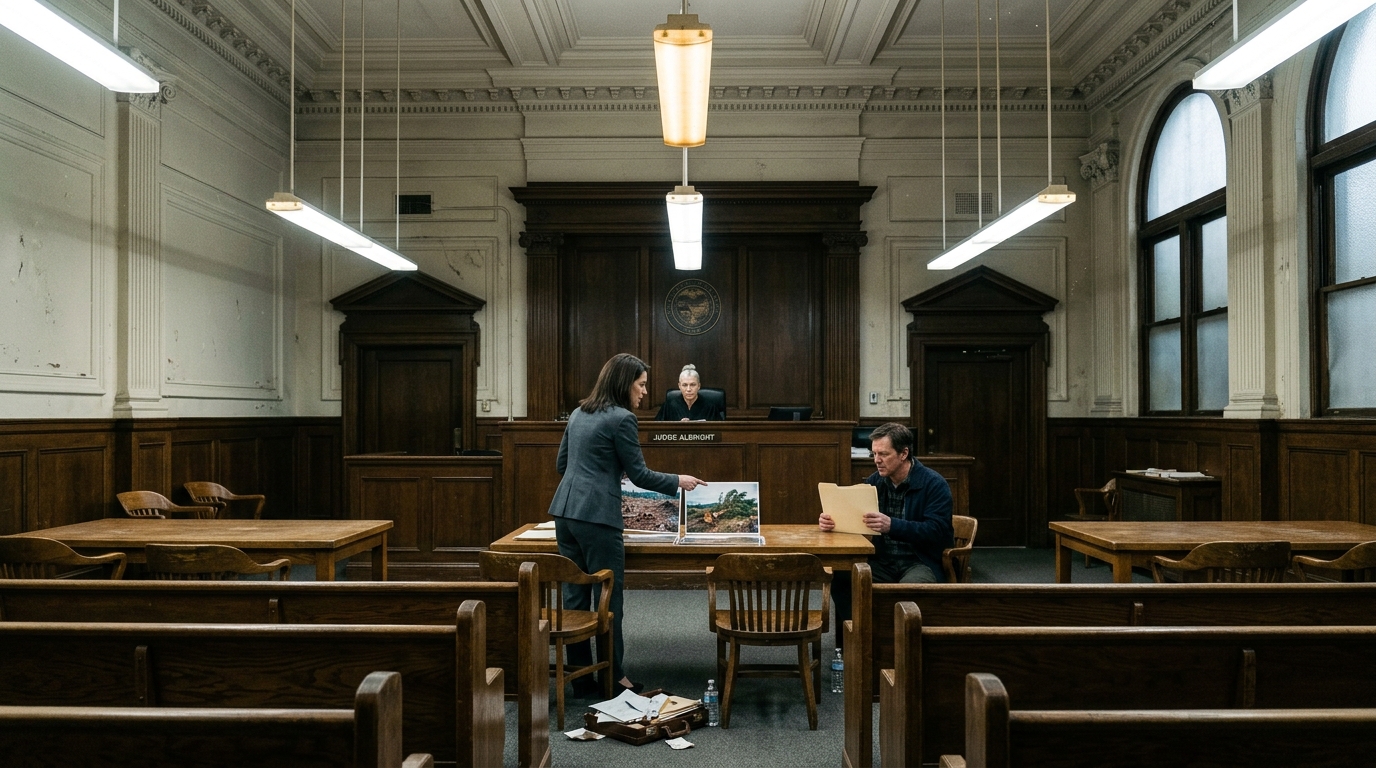
The wooden bench in Courtroom 2B creaked under my weight, the oak backrest hard against my shoulder blades.
Across the aisle, Karen sat beside a high-dollar corporate attorney whose tailored grey suit probably cost more than my first logging truck.
He was shuffling a stack of glossy color photographs—twenty angles of my single felled Douglas fir, printed on heavy cardstock to make one tree look like a carpet-bombed wasteland.
“Your Honor,” the suit began, stepping up to the podium with a practiced, fluid glide. “What we have here is a clear-cut case of willful nuisance. Mr. Coleman’s industrial activities present an immediate threat to the aesthetic integrity and property values of Aspen Ridge Estates. The HOA covenants, Section 7, explicitly prohibit visual and auditory disruptions within the viewshed.”
Judge Albright, sitting beneath the state seal with her silver hair pulled into a tight bun, didn’t reach for her gavel.
She just looked down over the rim of her half-moon glasses, her quill pen hovering over a yellow legal pad.
“Mr. Coleman,” she said, her voice dry as dried cedar. “You are representing yourself today?”
“I am, Your Honor,” I said, standing up without breaking my back curve, holding my single thick manila folder in my right hand.
Karen leaned over to whisper in her lawyer’s ear, a sharp, smirk-tinted nod passing between them as if my lack of a briefcase was an automatic white flag.
“Do you have a response to the plaintiff’s claim regarding covenant enforcement?” the judge asked.
I walked three steps to the defense podium, lay the folder flat on the oak surface, and flipped it open.
“The plaintiff’s entire petition relies on the assumption that my land is subject to their jurisdiction,” I said plainly, keeping my tone as neutral as a grease gun. “I offer Exhibit A: the certified county plat map for Parcel 73-4A, stamped by the land recorder in 1998.”
I stepped forward and handed the sealed document to the bailiff, who passed it up to the bench.
“If Your Honor looks at Section 3, line twelve, you’ll see my parcel was carved out five years before the Aspen Ridge development was even drawn on paper,” I continued, pointing a calloused finger toward the judge’s desk. “My deed contains zero HOA restrictions, zero covenant ties, and zero aesthetic encumbrances.”
The suit cleared his throat, adjusting his silk tie with a flick of his wrist. “Your Honor, even if the parcel is non-member land, the doctrine of common-law private nuisance applies when an operation inflicts severe emotional and financial harm on neighboring homeowners—”
“The land has been designated a working timber tract for ninety years, counselor,” I interrupted, staring straight at the attorney until he shifted his heels on the carpet. “My state forestry permit is in order. My environmental impact report is cleared. I’m not running a copper smelter. I’m cutting wood on my own dirt.”
Judge Albright flipped through the certified plat map, her thumb rubbing the raised seal from the recorder’s office.
She looked at Karen, whose hands were clasped so tight in her lap her knuckles showed stark white against her pink tracksuit sleeves.
“Counselor,” Judge Albright said, her gaze landing hard on the suit. “Is it your client’s position that buyers in a rural timber zone hold an implicit right to dictate the forestry practices of adjacent, non-member private land in perpetuity?”
“Well… Your Honor,” the lawyer sputtered, his slick composure fracturing just enough for his left eyebrow to twitch. “The reasonable expectation of the homeowners—”
“The court deals in recorded deeds, not expectations,” she cut him off with a crisp slap of her hand against the bench. “The plaintiff lacks legal standing to enforce private covenants on a non-member parcel. Request for a temporary restraining order is denied.”
Her gavel hit the sound block with a sharp crack that echoed off the mahogany paneling.
Karen slammed both palms against the counsel table, her chair sliding back two inches with a harsh screech against the floor. “Your Honor, this is an outrage! He is destroying our—”
“Sit down, ma’am, or you will be removed,” the judge warned without lifting her eyes from her paperwork.
I didn’t smile. I didn’t cheer.
I simply folded my certified map back into my manila folder, tucked it under my arm, and walked out the double doors into the quiet hallway.
Karen blew past me three seconds later, her heels clicking like hammer strikes against the marble floor as her suit tried to keep pace behind her.
“Enjoy your little victory, Coleman,” she spat, her breath smelling of bitter mint as she whirled around at the elevator doors. “My legal fees are covered by the community budget. I can drag this out until every dollar of your logging profit is eaten up by court filings.”
I stopped four feet away, resting my hand against the cold brass elevator frame.
“You can spend their money all winter, Karen,” I said quietly, letting my eyes drop to the fresh red paint smudges still staining the tips of her manicured fingernails. “Just make sure you save enough for the snowplow.”
CHAPTER 4: THE GRANITE TRAP
Dust and grey powder billowed up from the impact, settling over my work boots.
Chet, the dozer operator, throttled down the diesel engine, killed the ignition, and stepped out onto the metal track with a groaning sigh.
He pulled off his canvas work gloves and gestured with a thumb toward the three five-ton granite rocks sitting smack in the center of the gravel clearing where my road met the Aspen Ridge easement line.
“You’re sure about the placement here, Jack?” Chet asked, wiping sweat from his forehead with his sleeve despite the forty-degree air. “This completely kills the turnaround radius for anything bigger than a lawnmower.”
“That’s the point, Chet,” I said, reaching into my canvas jacket pocket to feel the smooth, heavy notch of the steel surveyor pin. “We’re doing road maintenance. Erosion control along the culvert. It’s fully legal on private ground.”
“Erosion control,” Chet repeated, a slow, gravelly chuckle rumbling in his chest as he looked toward the dead-end asphalt thirty feet away that marked the edge of Karen’s subdivision. “Right. Well, those rocks aren’t moving unless somebody brings a ninety-horsepower excavator up this hill.”
I looked up at the sky.
The grey cloud cover was thickening, turning from pale ash to a heavy, bruised charcoal near the northern peaks.
The barometric pressure was dropping fast enough to make my old knee ache—the first true Pacific cold front of November was rolling in twelve hours early.
A door slammed over at the nearest Aspen Ridge house.
Karen marched out onto her back deck, wearing a white fleece jacket, her hands gripped tightly around the cedar railing as she glared down at the dozer.
She pulled out her phone, aimed the camera directly at me, and started taking rapid-fire photos.
I didn’t wave, and I didn’t hide.
I walked over to the freshly narrowed throat of my logging road, where Chet had widened the drainage ditches on both sides.
The usable driving track was now exactly ten feet wide—plenty of room for my four-wheel-drive F-250, but tight enough that any wide-bodied vehicle would have to crawl at two miles an hour or risk dropping its axles straight into a knee-deep mud trench.
I picked up a brand-new aluminum sign I’d picked up from the hardware store downtown and drove the steel post into the frozen dirt with a hand sledge.
PRIVATE ROAD – UNDER CONSTRUCTION – NO UNAUTHORIZED COMMERCIAL VEHICLES – TRAVEL AT OWN RISK.
“That ought to do it,” I muttered, driving the last blow home until the metal rang out like a bell through the quiet woods.
Chet climbed back into his transport truck, cranking the engine. “Forecast says two feet of wet snow by morning, Jack. If their contractor tries to run his big blade up from the highway, he’s going to hit those boulders blind if the drift covers ’em.”
“He won’t hit ’em,” I said, locking the tailgate on my pickup. “Commercial drivers have eyes. They see a construction sign and a dead-end ditch, they turn around before they wreck a hundred-thousand-dollar rig.”
I drove down my road, parked the truck near the cabin, and hauled a fresh armload of seasoned oak logs onto the porch.
By six in the evening, the wind was howling through the tops of the Douglas firs, carrying the first thick, wet snowflakes that hit the cabin glass like thrown sand.
By nine, the power lines along the county highway were humming under an inch of ice, and the dark slope leading up to Aspen Ridge Estates was completely buried under a whiteout.
I sat by the woodstove with a mug of black coffee, watching the thermometer on the porch drop straight past twenty degrees.
My phone on the kitchen table buzzed once, then started vibrating continuously against the wood.
I let it ring five times before picking it up.
I didn’t say hello; I just pressed the speaker button and listened to the roaring blizzard outside my window mixed with the sound of pure, unadulterated panic on the other end of the line.
“Coleman!” Karen’s voice came through the speaker, distorted by wind noise and static. “The plow truck just stopped at the top of the hill! He refused to clear the upper loop! He says your road is blocked!”
I took a slow, quiet sip of coffee, letting the heat settle in my throat before I answered. “Good evening, Karen. Stay warm out there.”
CHAPTER 5: THE SIEGE OF ASPEN RIDGE
The phone speaker rattled on the table as Karen’s breathing came through in ragged, furious bursts.
“Did you hear me, Coleman?” she shrieked. “The plow driver turned around! He said he’s not driving onto an unmaintained construction site! People can’t get out for work!”
“I heard you fine, Karen,” I said, setting my mug down on the wood with a quiet click. “My road is undergoing drainage maintenance. Construction signs are up. I’m not going to have a thirty-ton rig tearing up my gravel or sliding into my culverts.”
“That is a designated emergency route!”
“Emergency route,” I agreed, taking out the steel surveyor pin from my pocket and setting it upright on the table. “Which means if a fire truck needs to crawl through at five miles an hour, the gap is open. But commercial snowplows doing routine maintenance for a private subdivision? That’s a different story. Check your easement document.”
“I’ll have you arrested for this!”
“You tried that,” I said, my voice deadpan. “Then you tried suing me. You spent forty grand of your homeowners’ money on a case Judge Albright threw out in forty-five minutes.”
Silence fell over the line—a heavy, suffocating pause where her breathing hitched.
“How… how do you know about the legal fees?” she stammered, her voice dropping out of its high screech for the first time.
“I can read county records,” I said. “And I know how to check plat maps. Your developer never got that top road adopted by the county, Karen. You’ve been using my land as your private plow turnaround for three years without a contract, an agreement, or my permission.”
I disconnected the line before she could answer.
By two in the afternoon, the sun hit the snowdrifts, turning the white slopes into a blinding sheet of glare.
My home phone rang again, but the caller ID didn’t show Karen’s name.
“Mr. Coleman?” A man’s voice came through, tired, steady, and carrying the quiet discipline of a guy who used to fly commercial jets. “My name is Tom Gable. I live up at Forty-Two Aspen Ridge Way.”
“I know the house,” I said. “You’re on the architectural committee.”
“Unfortunately,” Tom sighed, the sound carrying a deep, exhausted weight. “Look, Jack—if I can call you Jack—I’m not calling to yell. We’ve got eighteen houses up on this upper loop. Nobody can get out. Two folks have prescription pickups downtown, and my neighbor’s wife has a shift at the clinic at five.”
“Tom, I’m not holding anybody hostage,” I said, leaning back in my chair. “My land is private property. Your HOA president dragged me to court, cost me two weeks of logging revenue, and tried to slap an injunction on my livelihood.”
“She told us it was a minor boundary clarification,” Tom said, his tone tightening. “She said the board was handling a routine nuisance issue.”
“She spent forty thousand dollars of your reserve fund on a private law firm and lost in under an hour,” I said flatly. “And she did it while hiding the fact that your plow contractor relies illegally on my property to clear your own street.”
A long, heavy pause hung on the line.
“Forty thousand?” Tom asked, the words coming out as a harsh exhale. “She spent forty grand without a board vote?”
“The court records are public at the clerk’s office,” I replied. “I have certified copies sitting right here on my table.”
“What is it going to take to fix this, Jack?” Tom asked, his voice dead earnest. “Realistically. We can’t stay buried up here.”
“Two things,” I said, tapping the steel surveyor pin against the wood twice. “First, complete financial restitution for the forty thousand dollars in legal costs and idle machinery fees your president caused me. Second, a formal, legally binding road-use agreement signed by the board that includes a annual lease fee and full liability coverage for my land.”
“That’s a steep hill,” Tom said quietly.
“Your president dug the trench, Tom,” I told him. “I’m just offering you the ladder to climb out. You want your plow through here by morning? Get your neighbors together and call an emergency meeting.”
CHAPTER 6: THE TURNAROUND CHECKMATE
The heat inside the small clubhouse hit my face, smelling of damp wool coats, stale coffee, and twenty panicking homeowners.
Karen stood behind a folding plastic table at the front of the room, her track jacket zipped all the way to her chin, slamming a metal stapler against the table like a makeshift gavel.
“This meeting is unsanctioned!” she shouted, her voice thin and cracking against the drywall. “You cannot hold a board vote without forty-eight hours written notice! Section 4, Subsection C!”
“We have thirty-two inches of snow outside, Karen!” a man in the third row yelled back, waving a gloved hand. “My ambulance access is blocked!”
Tom Gable stood up from the front row, his tall frame cutting right through the noise. He turned around, spotted me standing by the double doors, and motioned me forward.
“Jack brought the paperwork,” Tom announced, his voice carrying the firm cadence of a cockpit captain. “Let’s see what we’re actually paying for.”
Karen’s eyes locked onto me, her jaw working as she lunged across the plastic table to point a trembling finger. “He is a trespasser! He blockaded our emergency exit! He’s trying to extort this neighborhood!”
I didn’t raise my voice.
I walked straight to the front table, set my manila folder down right next to her stapler, and pulled out three stapled packets.
“I didn’t block an exit,” I said, looking across the room at thirty exhausted faces. “I maintained my private logging road. Here is the certified county survey showing where your developer stopped paving. And here is the court dismissal signed by Judge Albright two weeks ago.”
Tom took the top packet and handed it to a woman sitting beside him—a retired attorney who immediately pulled out her reading glasses.
“She spent forty-one thousand three hundred dollars of your HOA contingency fund suing me to stop my forestry permit,” I told the room, laying down the itemized law firm invoice I’d pulled from the public court filing. “She lost because my land isn’t in your HOA. And while she was suing me, she was relying on my private road for your winter plow turnaround without a single piece of paper authorizing it.”
The room went dead silent.
The woman with the reading glasses looked up from the judge’s signature, her mouth forming a tight, disbelieving line. “This is a formal court dismissal with prejudice. The board filed an unapproved suit and absorbed a judgment for frivolous filing.”
Karen grabbed the edge of the table, her fingernails digging into the plastic. “It was a strategic defense of our viewshed! The developer promised—”
“The developer lied to you, Karen,” Tom interrupted, turning on her with cold, measured finality. “And you covered his track because you were too arrogant to ask Mr. Coleman for an easement.”
Tom reached into his coat, pulled out a sheet of notebook paper signed by twelve homeowners, and laid it flat over Karen’s stapler.
“Under Article 7 of our bylaws, a simple majority of members present at an emergency assembly can vote to recall the president for unauthorized expenditure of community funds,” Tom said, looking around the room. “All in favor of immediate removal?”
Every single hand in the room went up.
Karen looked at the sea of raised hands, her face draining of color until she looked ten years older under the buzzing fluorescent lights.
She didn’t sign a confession. She didn’t offer a tearful apology.
She grabbed her leather purse off the chair, shoved her way past Tom’s shoulder, and marched out the side door into the snow without looking back at a single neighbor.
Two minutes later, Tom signed the new road-use agreement I’d drafted—a simple, fair contract granting non-exclusive turnaround access in exchange for a yearly maintenance fee and full liability coverage paid out of the HOA reserve.
By five the next morning, Chet’s dozer had shifted the granite boulders six feet to the left, and the heavy diesel plow truck rolled up my road, clearing a sixteen-foot swath through the snowdrifts all the way to the top loop.
Three months later, the April mud had dried into solid brown earth.
The sound of my timber harvester hummed rhythmically through the woods as Gus and the crew loaded three long-bed trucks with prime Douglas fir logs.
I stood on my back porch in the cool spring air, holding a warm mug of black coffee, watching the trucks roll smoothly down my newly graded road toward the county highway.
Past the tree line, on the ridge above, Tom Gable gave me a brief, friendly wave from his driveway before turning to check his mailbox.
I reached into my pocket, pulled out the old steel surveyor pin, and set it permanently on the porch railing beside my coffee mug—a heavy, silent piece of iron marking where my land began, and where my peace remained.