The Price of Dismissal How a Quiet Teacher and Her Misunderstood Husband Shattered an Elitist Empire
CHAPTER 1: The Back Table Reality
The metal leg of the chair scraped against the polished parquet floor with a grating screech.
I pulled my seat closer to the edge, trying to tuck my knees out of the path of a passing waiter balancing a towering tray of champagne flutes.
The air near the kitchen doors smelled of scorched garlic and heavy dish soap, a sharp contrast to the expensive imported perfume drifting from the front rows.
Marcus didn’t flinch. He adjusted his cuffs, his dark suit jacket fitting with a clean, unassuming precision that completely vanished against the sea of tailored designer wear around us.
“Table fourteen,” he said quietly, his voice devoid of anger, carrying only a flat, heavy calm. “They really outdid themselves this time.”
My fingers tightened around the stem of my water glass until the chilled condensation bit into my skin.
Across the narrow aisle, Jennifer Walsh turned her head sharply, her diamond-encrusted earrings catching the glare of the overhead crystal chandelier.
She narrowed her eyes, staring straight at Marcus with a look of intense, clinical calculation.
Her thumb swiped rapidly across her phone screen as if searching for a name she couldn’t quite place.
I wanted to shrink into the white tablecloth, to vanish behind the floral centerpiece, but the numbness in my chest had finally hardened into something dense and cold.
“Have we met?” Jennifer asked, leaning back over her chair, her voice cutting cleanly through the ambient jazz music.
Marcus didn’t blink. He simply met her gaze with steady, impenetrable eyes.
“I don’t think so,” he said smoothly.
Jennifer hesitated, her finger hovering over her display, but before she could speak again, the overhead lights dipped into a heavy purple hue.
My father tapped the microphone on the central stage, and the room instantly snapped to attention.
CHAPTER 2: Whispers Across Linens
Jennifer Walsh did not look back up at the stage where my father was speaking about forty years of excellence.
Her gaze remained locked onto the bright glass of her device, her eyebrows drawing together in a sharp, concentrated line.
She turned her body slightly away from the table, shielding the screen with her palm, but I caught the blur of a logo and a familiar headshot flashing under the gallery lights.
“Recognize someone?” I asked, my voice flat and low.
Jennifer snapped her phone downward, the cover case hitting the mahogany tabletop with a muffled clatter.
“Just checking a press release,” she murmured, her tone suddenly stiff and defensive.
Across the aisle, my sister Madison swept past table fourteen in a rustle of silk, her eyes fixed entirely on the VIP front row where our mother was basking in the applause.
Madison didn’t even turn her head toward us, treating our corner of the room as if it were quarantined space.
“She thinks we’re invisible,” Marcus said quietly.
His fingers stayed relaxed against the linen tablecloth, completely unbothered by the cold draft blowing off the kitchen service doors.
Up on the dais, my father raised his glass to toast the future of Parker real estate, his voice booming effortlessly through the house speakers.
“We built this company on absolute clarity,” my father announced into the microphone, his chest puffed out under his tailored tuxedo.
Jennifer leaned toward me, her voice dropping to a hurried whisper while the crowd laughed at a prepared joke about corporate grit.
“Your husband,” she began, her eyes darting nervously toward Marcus. “He works in education, correct?”
“That’s what they say,” I replied, my fingers tightening around my glass.
Jennifer opened her mouth to press further, but the applause swelled around us, drowning out her words as the lights shifted toward the front row.
CHAPTER 3: The Public Execution
The amber spotlights swept across the ballroom, catching the heavy crystal pendants of the chandeliers and scattering blinding points of light across the white tablecloths.
My father gripped the edges of the mahogany podium, his knuckles whitening as he shifted from corporate achievements to personal reflections.
“Forty years of building something from nothing,” my father announced, his voice ringing with practiced authority.
He gestured toward the front row with an open palm, singling out my mother, who pressed a manicured hand over her collarbone on cue.
“My wife Helen, my rock, and my daughter Madison,” my father continued, his tone swelling with immense public pride. “Senior vice president at twenty-eight, the absolute future of Parker real estate.”
Madison rose halfway from her chair, accepting the rippling applause like an actress stepping up to claim an award.
The gallery cameras flashed in rapid succession, painting the front tables in stark, electric white frames.
I sat motionless in the dim shadow near the kitchen doors, the hum of the dishwashers vibrating quietly beneath the floorboards.
“And Diana,” my father added, his voice dropping into an awkward, dismissive cadence.
A sharp pause stretched across the room, heavy and uncomfortable, before he delivered the punchline.
“She’s still trying to figure out what to do with her life.”
Scattered, polite laughter rippled through the middle tables, a quiet sound of awkward agreement with a joke at my expense.
My chest went entirely hollow, the blood rushing in my ears as one hundred fifty pairs of eyes flicked toward table fourteen.
Marcus didn’t flinch or look away; his hand remained flat and steady on the linen, a silent anchor against the tide.
“We love her anyway,” my father concluded, his smile stretching thin and mechanical before he pivoted back to business.
CHAPTER 4: Stepping Into Light
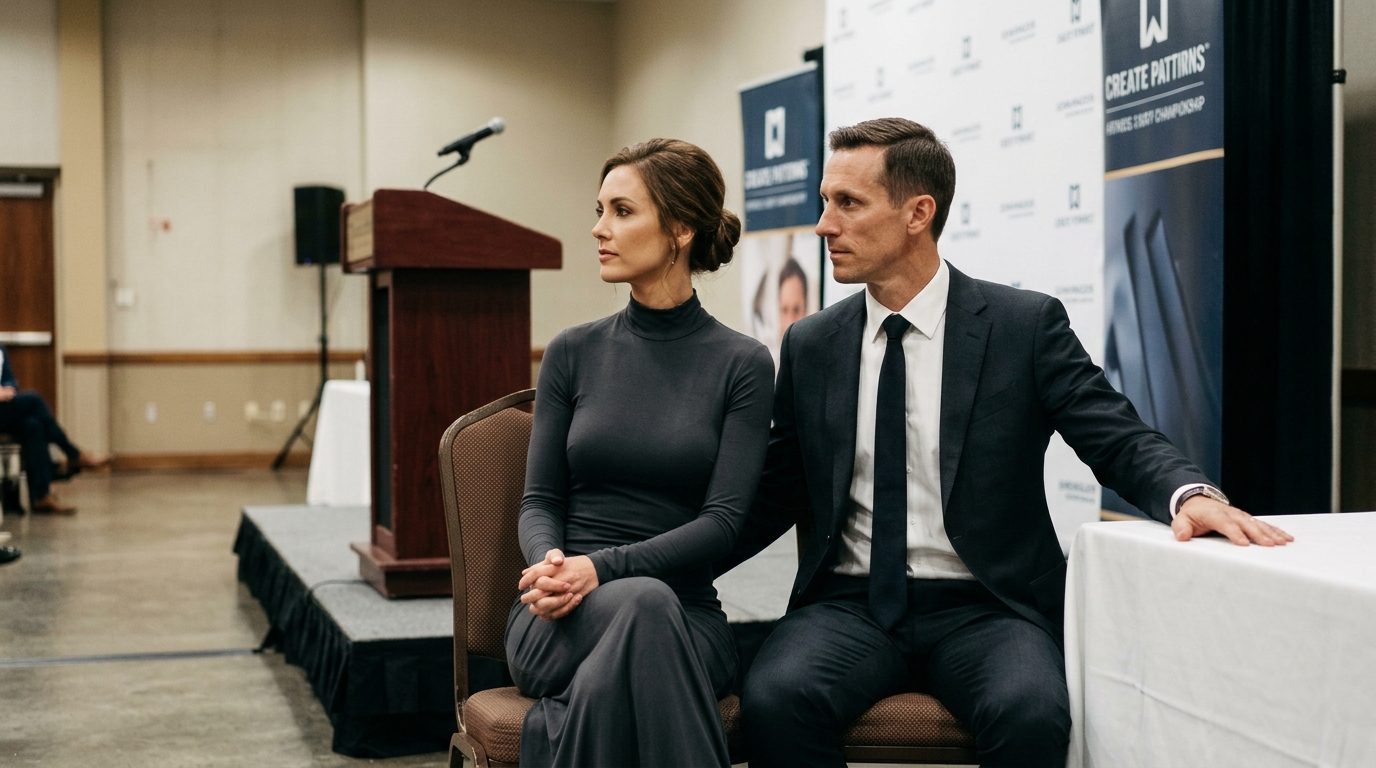
The metal feet of the chair lifted off the floorboards without a sound as Marcus stood up from table fourteen.
He didn’t rush. Each step forward was measured, calm, cutting straight through the narrow aisle between the kitchen doors and the middle seating rows.
Heads began to turn, whispers rippling outward like dropping a heavy stone into stagnant water.
My father paused mid-sentence, his professional smile freezing into an awkward grimace as Marcus crossed the edge of the wooden stage.
“Can I help you?” my father asked, his microphone capturing the sudden tightness in his throat.
Marcus stepped onto the platform, planting his shoes firmly against the carpeted floorboards under the blinding glare of the spotlights.
“I think you can,” Marcus said, his voice level and entirely unobstructed.
My mother abandoned her seat in the front row, rushing toward the steps with her hands raised in protest.
“This isn’t private property, and this certainly isn’t the time,” she snapped, her voice pitching upward in panic.
“It’s exactly the time,” Marcus replied, turning to face the sea of one hundred fifty stunned faces.
CHAPTER 5: The Corporate Collapse
The heavy silence in the ballroom stretched until the distant hum of the kitchen exhaust fans sounded deafening.
Marcus didn’t raise his voice, but the acoustic design of the hall carried every syllable straight to the back rows.
“I build educational platforms,” Marcus said evenly, his fingers resting light and unburdened on the microphone stem. “Software that scales across school districts nationwide.”
Jennifer Walsh pushed past two startled guests near the center aisle, her eyes wide as she stared up at the stage.
“EduSpark,” she blurted out, her voice cutting sharply through the quiet. “He owns EduSpark. They were valued at two hundred million last quarter.”
The name dropped into the crowd like a heavy anchor.
Heads whipped around, phones emerged from pockets, and frantic typing fingers tapped against glass screens under the gallery lights.
My father gripped the edge of the mahogany podium, his fingers turning bloodless and white as the realization hit him.
“That’s impossible,” Madison stammered, stepping out from the middle aisle with her face draining of color.
“I assure you, it’s very real,” Marcus replied, his gaze fixing entirely on the front row where my mother had frozen mid-gesture.
CHAPTER 6: Aftershocks and Fallout
The mahogany of the podium creaked under the sudden strain of my father’s grip.
He didn’t look at the audience; his eyes were fixed on the middle aisle where guests were already pulling up financial news sites on their displays.
My phone buzzed against the fabric of my small handbag tucked beneath table fourteen, a sharp, continuous vibration that didn’t stop.
I pulled it out to a relentless stream of notifications: missed calls from unlisted numbers, frantic text messages from my mother, and a lengthy rant from Madison.
“They’re pulling out,” Jennifer Walsh murmured aloud, her voice carrying across the quiet space as she held her phone to her ear. “Cancel the Parker contract. All of it.”
Across the room, my father’s business partners began gathering their coats and briefcases, slipping out toward the exit doors without a single goodbye.
The glittering retirement celebration had dissolved into an empty room of echoing acoustics and flickering lights.
Marcus kept his hand resting quietly over mine, his expression calm as the final pieces of manufactured prestige collapsed around us.
“Let’s go home,” he whispered.
CHAPTER 7: Neutral Ground Confrontation
The wooden leg of the cafe chair met the tiled floor with a firm, steady thud.
My parents sat across from me at the corner table, their usual tailored suits replaced by faded cotton and worn wool.
My mother’s wrists were entirely bare of emeralds, and my father’s hands rested flat on the laminate surface, trembling slightly against the cold air.
“Thank you for meeting us,” my father said, his voice stripped of its usual boardroom thunder.
“You’re welcome,” I replied, keeping my spine straight against the rigid wooden backrest. “Keep it brief. My time belongs to my classroom.”
My mother flinched as if struck, her fingers digging into the fabric of her coat pocket.
“We want to fix this, Diana,” she whispered, her eyes shining with sudden moisture. “Family is everything. We can start fresh.”
“Starting fresh requires telling the truth about the past,” I said, leaning forward until the laminate table separated us like a courtroom rail. “You didn’t just disagree with my choices. You humiliated my husband in front of one hundred fifty people because you assumed his worth by a job title.”
My father opened his mouth, a familiar defensive flicker crossing his eyes, but he stopped himself against the heavy silence of the cafe.
“We were wrong about how we measured success,” he admitted, the words sounding foreign and painful in his mouth.
“You were wrong about respect,” I corrected flatly. “And respect isn’t something I negotiate twice.”
CHAPTER 8: The Weight of Peace
The aluminum latch dropped into place with a dull, heavy click, sealing out the hum of evening traffic from the street below.
Marcus set two ceramic mugs of hot coffee on the wrought-iron railing, the steam curling upward into the crisp night air before dissolving into the dark.
I leaned my forearms against the cold metal, looking out over the endless grid of city lights stretching toward the horizon.
My phone lay silent on the glass-topped table inside the living room, its screen entirely dark, stripped of the constant pressure of demands and expectations.
“Any regrets?” Marcus asked, wrapping his arms around my waist and pulling me back against his steady warmth.
“Only that I waited so long to trust my own voice,” I whispered, resting my hands over his.
The years of performing for approval, of shrinking into background tables, and of measuring my worth by someone else’s scale felt completely distant now.
There were no grand speeches left to make, no boardrooms to conquer, and no apologies to extract from people who refused to understand.
There was only the quiet, hard-earned rhythm of a life built on mutual respect and genuine love.
I took a slow sip of the coffee, feeling the warmth spread through my chest without a single trace of hesitation or doubt.
“We’re going to be fine,” I said.
Marcus rested his chin on my shoulder, smiling into the quiet dark.
“I knew that on day one.”