The Iron Ledger of the Fortieth Floor: A Hard-Earned Haven Born from the Dust of the Streets
CHAPTER 1: THE COLD CURB
The night air tasted like exhaust and damp concrete.
Simone Carter pressed the edge of her clipboard against her green silk blouse, her thumb whitening over the aluminum clip as the valet hauled another idling sedan away from the grand hotel entrance.
Inside the glass doors, the charity gala had netted over two million dollars in pledges. Outside, the pavement was slick with oily residue and discarded program flyers.
Her shoulders ached from fourteen hours of standing on marble floors, but the dull knot in her stomach had nothing to do with fatigue.
It was the child near the planter box.
Small, dark-skinned, with cornrows fraying at the edges, the girl couldn’t have been more than seven. Her jeans were stiff with old mud, and her faded purple t-shirt hung loose over narrow ribs.
Three times tonight, hotel security had nudged her back toward the service alley with murmured threats. Three times, she had slipped back through the hedges, her gaze locked past Simone entirely.
Her eyes were fixed on the tall man in the navy suit standing by the gold-trimmed doors.
Jonathan Blake.
He didn’t look like a philanthropist who had just written a seven-figure check with a flick of his wrist. He looked like an equation that refused to balance—stiff, efficient, and entirely closed off from the noise around him.
He hadn’t spoken a single word to Simone all evening, communicating his exacting standards exclusively through a nervous young assistant named Clare.
Now, his black town car pulled silently to the curb, tires hissing against the wet curbstone.
The driver hopped out, swinging the heavy rear door wide.
Jonathan moved toward it, his thumb flicking across the glass of his phone screen, eyes fixed on an incoming financial report.
The little girl didn’t run; she exploded from the shadows of the boxwood hedge.
“Don’t get in,” she cried out, her voice cutting through the idling engine noise with the raw snap of broken glass. “Don’t get in that car.”
She lunged forward, both small hands clamping onto the sleeve of Jonathan’s custom navy suit, yanking downward with surprising leverage.
Jonathan’s phone slipped from his fingers, clattering sharply against the concrete before skittering into the gutter.
“What in God’s name—” Jonathan jerked backward, his shoulder slamming against the open door frame.
His head of security broke away from the pillar, heavy boots thudding against the stone.
“I heard them,” the girl gasped, words tumbling over each other as she fought to anchor herself to his sleeve. “The two men by the kitchen loading dock. They were speaking Chinese. My friend Wu taught me. They said the car. They said tonight. They said it would look like an accident.”
“Sir, step away from the child,” the security guard ordered, his heavy hand reaching out to collar the girl’s thin shoulder.
“Wait,” Jonathan commanded.
His voice didn’t rise; it dropped into a flat, dangerous register that stopped the guard dead in his tracks.
Jonathan stared down at the child, then slowly turned his gaze to the polished flank of his town car.
The driver stood frozen by the open door, his face flushing a mottled red. “Mr. Blake, I’ve driven for you for three years. This is insane—”
“Then you won’t mind if we look elsewhere,” Jonathan said coldly, his eyes narrowing as he crouched down to meet the girl’s wide, terrified stare. “What exactly did they say?”
“They said the American would be gone before midnight,” the girl whispered, her fingers digging into the fabric of his arm. “They said the device was ready under the floorboards.”
Simone stepped closer, the clipboard slipping under her arm as the cold truth of the child’s raw terror sank into her bones.
There was no theatricality in the girl’s stance; she was braced for a blow, trembling with the absolute certainty of what she had heard.
Jonathan straightened slowly, his jaw tight as iron.
He didn’t look for police. He didn’t look for his security team.
He reached into his pocket, pulled out a secondary burner phone, and dialed a single, direct number without breaking eye contact with the asphalt.
“Tom,” Jonathan said into the receiver, his voice flat and devoid of panic. “Get the perimeter locked down. Nobody touches the vehicles. Nobody.”
CHAPTER 2: THE RUSTED THRESHOLD
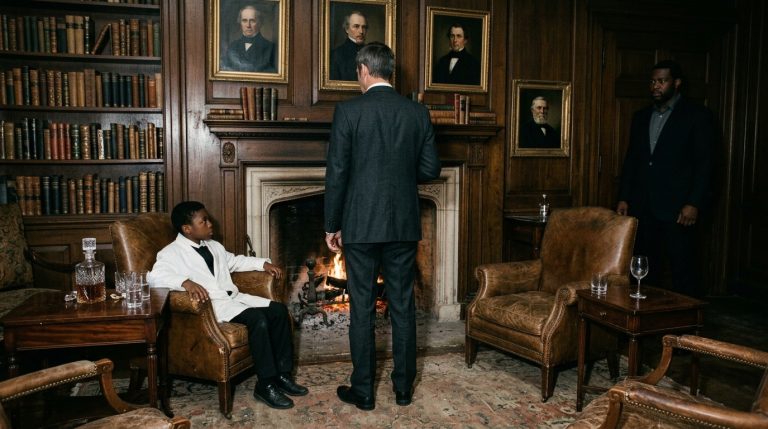
The heavy oak doors of the penthouse did not click shut; they sealed with a hydraulic hiss that cut off the distant wail of downtown traffic entirely.
Simone dropped her clipboard onto the nearest console table, the aluminum clip clattering against the polished wood like a dropped bone.
“Tom,” Jonathan called out, his voice sharp enough to crack glass as he dropped the scarred metal paperweight onto the blotter. “Status on the perimeter.”
“Locked,” a voice answered from the intercom panel near the floor-to-ceiling glass. “Service elevators are isolated. No unauthorized access from the sub-basement.”
Amara didn’t sit on the plush blue couches overlooking the glittering skyline; she stood near the edge of the Persian rug, her small fingers clutching the frayed hem of her oversized shirt as she stared at the bulletproof glass.
“They’re not coming through the front,” the girl said, her voice small, flat, and carrying the terrible weight of someone who knew how dark alleyways operated. “They use the pipes. The ones behind the kitchen.”
Jonathan didn’t dismiss her; he crouched down, his gray eyes locking onto the child with a hard, unblinking intensity.
“Show me,” Jonathan ordered.
Simone watched them move toward the expansive kitchen area, her chest tightening with every step across the imported marble floor.
There was no police cruiser waiting downstairs, no flashing lights to anchor them to a safe, orderly reality.
They were locked forty floors above the city with a billionaire whose wealth had suddenly become a target painted on his back, and a child who had learned too early how men spoke when they planned violence in Chinese dialects.
Jonathan’s phone vibrated against the counter, a silent text pulsing on the dark glass.
He didn’t pick it up.
Instead, he pulled a small, silver-bound ledger from the bottom drawer of the desk—a physical record of the gala’s donor registry that Clare had left behind in the panic of departure.
“Look at this,” Jonathan muttered, sliding the book across the stone island toward Simone.
Simone leaned over the page, her finger tracing the column of corporate sponsors until it hit a discrepancy that made her breath catch.
A donation listed under an anonymous shell company matched the exact alphanumeric signature printed on the scrap of paper she had pulled from Jonathan’s trash earlier that evening.
It wasn’t Richard Chin’s signature.
It belonged to a subsidiary that had been liquidated three years ago, right around the time Jonathan’s company was first going public.
“This isn’t just about a rival stealing a tech contract,” Simone said, her voice dropping as she looked up to meet Jonathan’s hardened gaze. “Someone inside your own board is feeding information to the outside.”
Jonathan’s thumb stopped its restless turning against the edge of the counter.
The silence in the penthouse grew heavy, broken only by the faint, rhythmic hum of the wind against the reinforced glass panes.
“Tom,” Jonathan spoke into the comms unit again, his tone dropping into a dangerous, glacial calm. “Double-check the east stairwell access logs from three years ago.”
“Sir?” Tom’s voice crackled with static. “That’s ancient history. Why now?”
“Because the car wasn’t targeted by a competitor,” Jonathan said, his eyes fixed on the dark reflection of the city outside. “It was targeted by someone who wanted to make sure I never reached the archive floor.”
Amara looked up from the floor, her small brow furrowed as she pointed a dirty finger toward the heavy service door at the end of the hall.
“Somebody is in the utility shaft,” the girl whispered. “I hear the metal clicking.”
CHAPTER 3: THE HEAVY PAPERWEIGHT
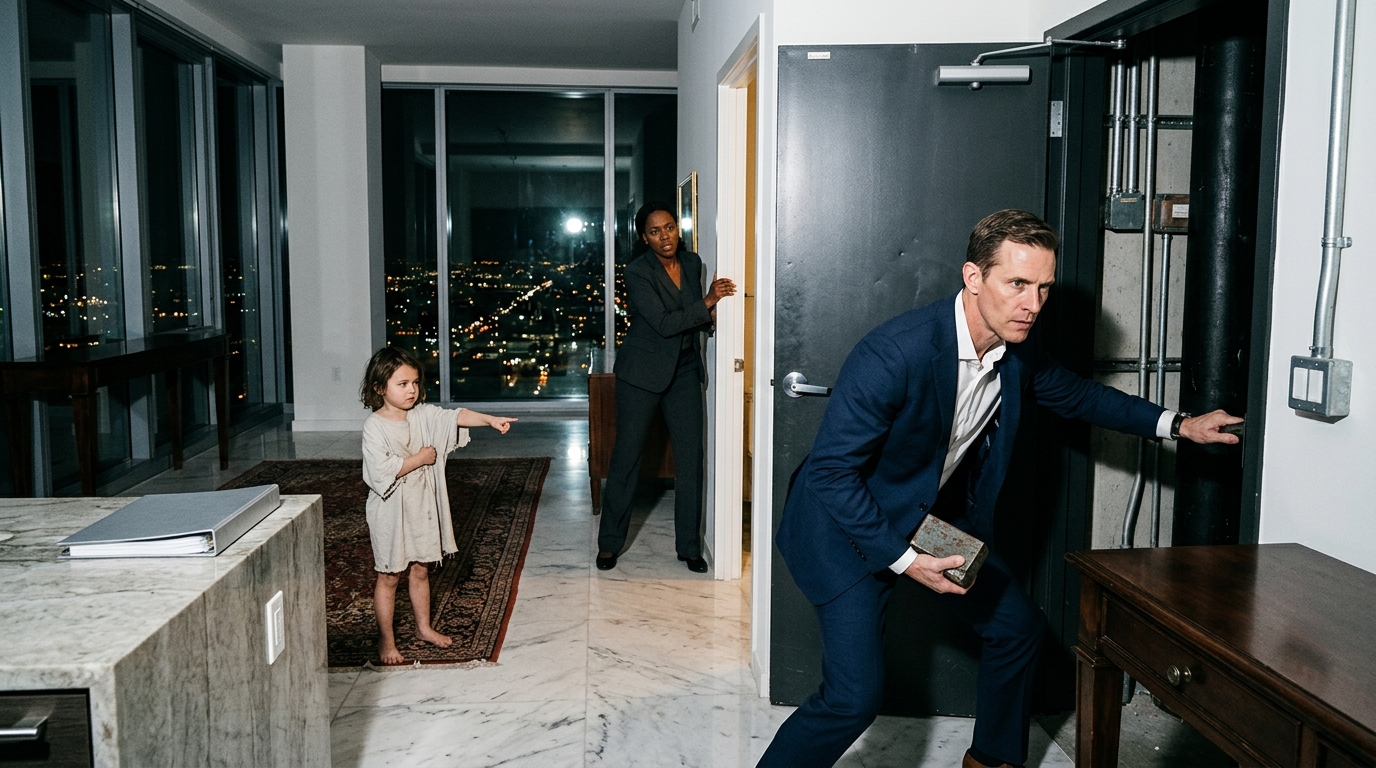
“Stay back,” Jonathan murmured, his weight shifting forward over the balls of his feet as he dragged the service door outward.
The hinges didn’t squeak; they groaned under decades of grease and cold metal, parting to reveal a narrow vertical shaft stretching upward into shadow and downward into the freezing gloom of the service core.
There was no sound now except for the heavy, rhythmic thrum of the air handlers pumping filtered oxygen through the luxury suite.
Simone stepped up beside him, her fingers curling over the edge of the door frame until her knuckles went chalk-white.
“Nobody uses that shaft,” Simone whispered, her eyes straining against the blackness where the service ladder vanished into the ceiling. “Tom said the security overrides were sealed from the main terminal.”
“Overrides can be bypassed if you have the master keys,” Jonathan replied, his voice dropping into a harsh, grating register.
He didn’t wait for confirmation.
He reached down to the mahogany desk, his fingers bypassing the financial ledgers to wrap tightly around the scarred metal paperweight.
The heavy block of iron felt cold and abrasive against his palm, a crude, functional tool in a room built entirely for aesthetic excess.
Amara crept forward from the edge of the Persian rug, her small face pinched with a hard, defensive focus that belonged to someone twice her age.
“They’re coming from the third basement,” the girl said, her voice dropping to a flat monotone. “The freight elevator doesn’t stop here unless you cross-wire the relay box.”
Jonathan paused, his gaze dropping to the child with a sudden, sharp realization.
“How do you know where the relay box is?” Jonathan asked.
“Because my friend Wu showed me the blueprints,” Amara answered simply, staring straight at the dark metal of the shaft. “Rich men leave their blueprints in the recycling bins behind the municipal office. If you look at the plumbing, you know where the rats hide.”
Jonathan didn’t answer.
Instead, he swung his arm backward and hurled the heavy iron paperweight straight down into the open throat of the utility shaft.
The crash was instantaneous—a deafening, metallic shriek as the heavy block struck a ladder rung, followed by a hollow, tumbling clatter that echoed downward like falling masonry.
A sharp curse floated up from the darkness below, followed immediately by the frantic scuffle of boots scrambling backward against galvanized steel.
“They’re not maintenance,” Jonathan said, his teeth bared in a grim, exhausted smile that held no humor. “They’re clearing a path.”
Simone watched him move back toward the living area, his movements no longer those of an isolated billionaire, but of a man stripped down to bare survival mechanics.
“We can’t stay on this floor,” Simone said, her voice cutting through the ringing silence of the shaft. “If they have the maintenance codes, the smart glass on these windows is just a timer.”
Jonathan stopped beside the glass wall, looking out at the endless expanse of city lights glittering indifferently forty stories below.
“We don’t run,” Jonathan said, his thumb brushing against the raw scar on the metal paperweight he had just retrieved from the threshold. “We let them come up.”
CHAPTER 4: THE FRACTURED LEDGER
The ink on the third page of the donor registry didn’t match the rest of the bound volume.
Simone leaned closer to the recessed lighting of the penthouse counter, her eyes burning from hours of uninterrupted scrutiny.
“Look at the routing numbers,” Simone said, her voice dropping into a dry, gravelly monotone as she angled the page toward Jonathan. “These aren’t charitable contributions. They’re quarterly disbursements routed through three different dummy accounts in the Cayman Islands.”
Jonathan didn’t look up from his position by the reinforced glass.
“That’s standard venture capital layering,” Jonathan replied, his shoulders rigid beneath the custom wool of his jacket. “We set up shell entities to acquire land for the new server farms.”
“Not this land,” Simone tapped the paper with a fingernail, the sharp tap echoing in the quiet room. “Look at the project code. Project Asher. That wasn’t a server farm, Jonathan. That was a clinical testing facility built in upstate New York three years before your company went public.”
The silence that followed was absolute, heavier even than the hum of the air handlers.
Amara sat cross-legged on the rug near the hallway entrance, quietly assembling a small barricade out of spare cushions and heavy art books, her eyes darting between the adults with watchful caution.
Jonathan slowly turned away from the window, his footsteps making no sound on the thick wool carpet until he stopped directly across the island from Simone.
“Project Asher was sealed by federal mandate,” Jonathan said, his voice dropping an octave. “How did you find that record?”
“Because Clare left the physical archive keys in the bottom drawer of the staging desk,” Simone said, holding his gaze without blinking. “And because the medical manifest stapled to this transfer order lists eighty-four pediatric patients under the heading of experimental palliative care.”
Jonathan’s jaw tightened, a muscle twitching sharply beneath his right cheek—his sole biometric tell under extreme pressure.
“My sister Lily was one of those patients,” Jonathan said, the words dragging out of him like iron pulled through gravel. “They told me the leukemia took her in the clean room. They told me the trials failed because the disease moved too fast.”
“They didn’t fail,” Simone whispered, her chest tightening as the pieces clicked into a horrifying, seamless alignment. “They succeeded well enough to build a billion-dollar tech empire on top of the data.”
A low, metallic ping rang out from the smart panel by the service entrance—a single automated alert indicating that the perimeter sensor on the forty-first floor stairwell had just been manually tripped from the inside.
“They’re not coming from the basement anymore,” Simone said, her hand dropping instinctively toward the heavy iron paperweight. “Someone inside the board just used an executive passkey.”
Jonathan reached out, his fingers closing around the iron block with crushing force.
“Let them try,” Jonathan muttered, his eyes fixed on the dark corridor.
CHAPTER 5: THE GLASS PERIMETER
The amber light flickered twice, then clicked to a solid, dull green.
The freight car had arrived at the fortieth floor.
Jonathan didn’t flinch; his thumb pressed harder against the scarred metal of the paperweight until his knuckles turned the color of old paper.
“They’re cutting the main power grid,” Simone said, her voice dropping as the recessed track lighting above them sputtered and died, plunging the vast living room into the cold, blue glare of emergency LEDs.
Amara didn’t scream; she ducked behind her barricade of art books, her fingers locking onto a heavy dictionary like a shield.
“They want us to move to the open space,” the girl hissed from the shadows. “That’s where the smart glass has no support beams.”
The heavy service doors at the end of the hall didn’t rattle—they swung open with a slow, deliberate groan.
A figure stepped through the frame, wearing an executive security uniform with the corporate insignia scraped clean off the collar.
It wasn’t Richard Chin.
It was Marcus Vance, the head of Jonathan’s own internal compliance board—the man who had signed off on every financial transfer in the Project Asher files.
“You shouldn’t have opened the bottom drawer, Jonathan,” Marcus said, his voice echoing smoothly against the glass walls as he stepped onto the Persian rug. “We built this entire empire on clean numbers. You were supposed to stay in the boardroom and let the machine run.”
Jonathan didn’t lower his hand.
“You traded children’s lives for a server farm,” Jonathan said, every word grating like broken stones. “Lily wasn’t a statistic, Marcus. She was a ledger entry to you.”
Marcus smiled, a tight, humorless stretch of the lips that didn’t reach his eyes.
“Lily was an outlier,” Marcus replied, taking another measured step forward while his hand slid inside his coat. “And you are becoming an unacceptable liability to shareholders who expect dividends, not ghost stories.”
Simone stepped into the gap between them, her clipboard held out like a barrier.
“The physical ledgers are already uploaded to three independent servers off-site,” Simone lied, her voice steady and absolute against the hum of the dying HVAC unit. “Step forward, Marcus, and the audit goes public before you reach the elevators.”
Marcus stopped dead, his fingers freezing inside his coat as his gaze flicked from Simone to the heavy iron block in Jonathan’s fist.
CHAPTER 6: THE DUSTY GRAY DAWN
Marcus didn’t pull his hand out.
Instead, his fingers twitched against the dark wool lining of his jacket, his eyes darting toward the frosted perimeter glass where the city lights flickered through the ice crystals.
“You think an audit stops a board of directors?” Marcus sneered, his breath pluming in the artificial chill of the room. “The shareholders don’t care about a ledger from three years ago, Jonathan. They care about the stock price holding steady when the markets open.”
Jonathan didn’t blink.
He took one slow, heavy step forward, the iron paperweight in his grip catching the pale blue LED light.
“The shareholders won’t have a choice,” Jonathan said, his voice dropping into a flat, implacable register. “Because Project Asher wasn’t just a clinical trial. It was a breach of federal charter that voids every corporate patent this firm holds.”
Marcus stiffened, the arrogant smirk finally cracking across his face like dry clay.
“You wouldn’t burn down your own company,” Marcus spat, his voice rising in sudden, frantic disbelief as he yanked his hand free from his coat—empty. “That’s suicide.”
“It’s not suicide,” Simone said quietly, stepping up beside Jonathan to lock the heavy ledger closed with a sharp thud. “It’s just balancing the books.”
Amara crawled out from behind her barricade of books, her small fingers clutching the edge of the glass island as she looked straight at the trapped executive.
“My friend Wu taught me that bad numbers always catch up to you,” the child said, her voice clear and steady in the quiet room. “You can’t hide in the basement forever.”
Marcus stared down at the child, then across at Jonathan’s immovable stance, his chest heaving with ragged, desperate breaths as the realization of total, unyielding defeat settled over him.
He didn’t confess. He didn’t apologize.
With a low, choked curse, he spun on his heel and lunged toward the service elevator, slamming his fist against the call button until his knuckles bruised.
The car didn’t come.
The emergency overrides Jonathan had locked into the building’s core system three hours ago held fast, leaving the executive trapped against the sealed doors in the gray, freezing dawn.
Simone watched him slump against the polished metal, his shoulders shaking with impotent fury as the first rays of morning sunlight broke over the eastern horizon, cutting through the frost on the glass.
Jonathan turned away from the corridor, his fingers finally loosening their grip on the scarred iron block and setting it down on the clean wood of the counter.
The air in the penthouse smelled like cold iron and damp concrete, but the heavy knot in Simone’s stomach was gone.
She walked over to the kitchen counter, picked up the small electric kettle, and flicked the switch without a word.
The metal coil inside began to hum, soft and steady, bringing the first quiet warmth to the room as the city below woke up to a new, unclouded day.