Beneath the Chandelier Glass: How a Quiet Teacher and an Unseen Husband Dismantled an Empire of Arrogance
CHAPTER 1: The Kitchen Table Exile
The silver band on my left finger turned cold against my skin as the orchestra struck a dissonant chord. Around us, hundred-dollar crystal glasses chimed with manufactured merriment, but table fourteen offered a different soundtrack entirely. Every time a waiter swung the double doors open to haul out trays of prime rib, a draft of stale dishwater and grease swept across our tablecloth.
“They could have given us a napkin holder that wasn’t stained,” I murmured, staring down at the frayed hem of my black dress.
Marcus didn’t look up from his water glass. His thumb traced the rim in a slow, rhythmic circle, steady and unbothered by the heavy bass vibrating through the floorboards. His navy suit was clean, bought off the rack three years ago, entirely devoid of the designer labels that peppered the room.
“It’s about visibility,” Marcus said, his voice low enough to be swallowed by the brass section. “Or the lack of it.”
Up front, my mother stood like an empress receiving tribute, her emerald necklace catching every watt of the crystal chandeliers. She nodded sharply at a passing investor, her smile fixed and surgical. Next to her, Madison laughed behind a manicured hand, her red gown spilling across the dais like an oil slick.
My phone buzzed against my thigh. A text from Madison: Try not to eat too much bread, sis. Photos are going live in ten minutes.
I didn’t answer. I just watched the silver ring catch the dim amber light of the corner sconce. Four years of quiet holidays, four years of biting my tongue while my father praised Madison’s ruthless quarterly margins and referred to my third-grade classroom as a pleasant hobby.
A shadow fell across our table.
Jennifer Walsh, her tailored gray pantsuit sharp enough to draw blood, stopped mid-stride between the main floor and the bar. Her eyes swept over Marcus, lingering on the plain fabric of his lapel before snapping up to meet his gaze.
“Have we met?” Jennifer asked, her brow furrowing as she tilted her head. “I never forget a face in restructuring.”
Marcus offered a faint, polite curve of his lips, entirely devoid of deference. “I don’t think so, Mrs. Walsh.”
Jennifer opened her mouth to press further, but my father’s voice suddenly boomed through the overhead speakers, cutting her off mid-thought. The spotlight swung away from the entrance, blindingly bright, locking onto the raised stage.
Marcus let go of his water glass. His hand slid inside his jacket, brushing against the heavy bulk of the manila envelope tucked into his inner pocket.
“Keep your eyes on the stage,” Marcus whispered, his fingers tightening slightly against the thick paper. “It’s almost time for the opening remarks.”
CHAPTER 2: The Public Execution
Robert Parker adjusted his cuffs, his smile returning with the practiced ease of a man who owned the room.
“Forty years,” my father began, his voice swelling to fill the vaulted ceiling. “Forty years of building something from absolute nothing. Deals, negotiations, and yes, a few sleepless nights.”
Polite laughter rolled through the rows of tailored suits.
Up front, my mother pressed a hand to her chest, her eyes glistening on cue as she tilted her head toward the dais.
“I didn’t do it alone,” my father continued, gesturing grandly toward the front row. “My wife Helen, my rock, and my daughter Madison, the future of Parker real estate.”
Madison rose slightly from her seat, accepting the warm applause like an actress stepping forward to take a curtain call. Photographers near the service bar raised their lenses, capturing the flash of her diamond earrings against her crimson dress.
At table fourteen, the draft from the kitchen doors hit my spine like a cold knife.
“Look at them,” Marcus murmured beside me. His fingers did not touch the water glass anymore; they rested flat against the tablecloth, completely still. “They are performing for a ghost.”
“A ghost?” I whispered, keeping my eyes fixed on the stage.
“They think their empire is made of concrete and steel,” Marcus said quietly. “They forgot who holds the municipal notes.”
Up on the stage, my father’s gaze finally drifted past the bright lights, sweeping across the dark perimeter of the ballroom until it landed on our corner. His smile flickered, turning into the thin, tight line he reserved for difficult zoning boards.
“And Diana,” my father said, pausing just long enough for the room’s attention to pivot toward the kitchen doors. “My eldest.”
A heavy, suffocating silence settled over the tables.
“She’s still trying to figure out what to do with her life,” my father said, letting out an indulgent, dismissive chuckle. “Teaching third grade. We offered her an MBA, we offered her a desk here, but she chose… well, whatever it is she chose. But we love her anyway.”
Scattered, awkward snickers rippled through the crowd.
My mother joined in with a light, brittle laugh, leaning into the microphone to cap off the performance. “At least Diana found a husband, even if we don’t know what he does for a living.”
The laughter swelled, washing over the back tables like warm grease.
Beside me, Marcus slowly pushed back his chair. The wooden legs scraped against the parquet floor with a sharp, distinct sound that cut straight through the applause.
He didn’t rush. He didn’t look at the crowd. He simply reached inside his navy jacket, his fingers brushing against the heavy, unsealed manila envelope tucked into his inner pocket.
CHAPTER 3: The Cold Rise
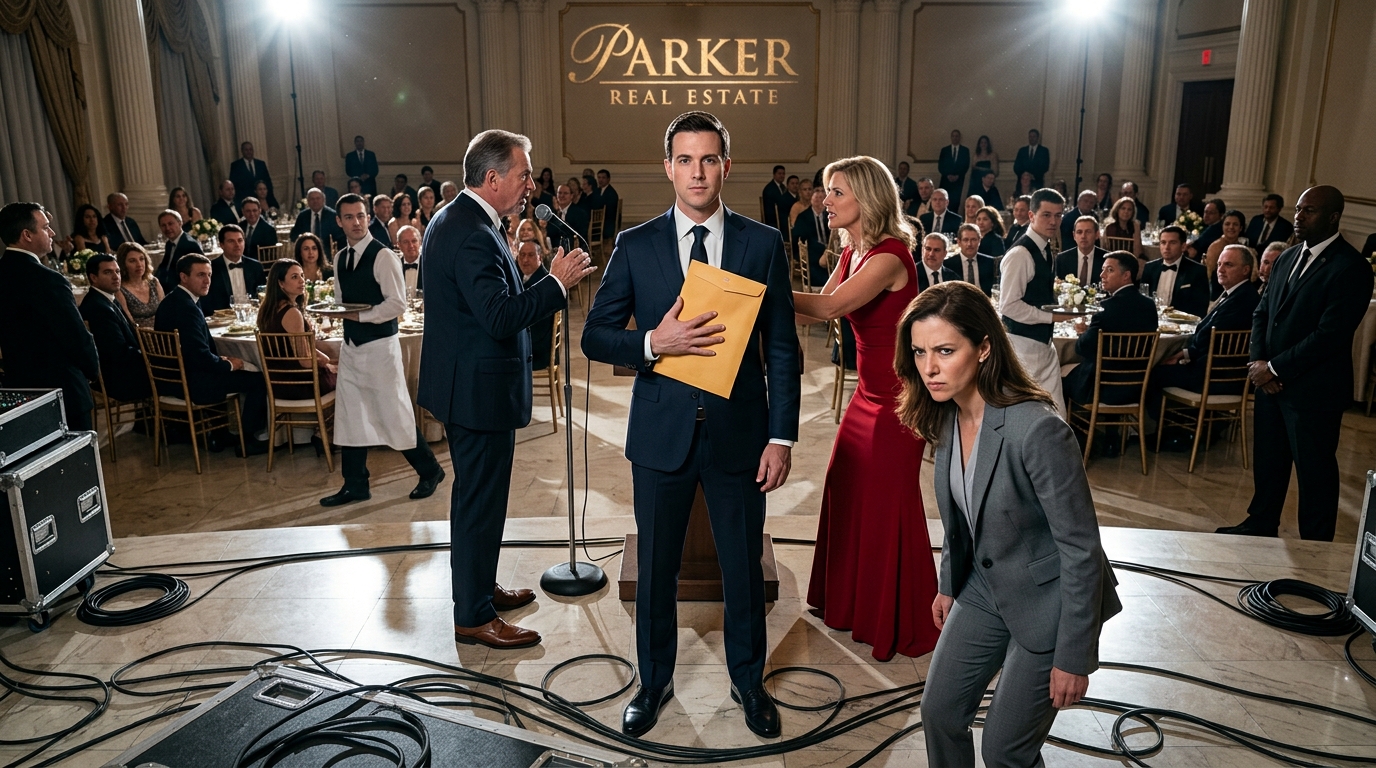
The murmur of one hundred and fifty elite guests flattened into an uneasy hush as Marcus’s shoes met the first carpeted step of the dais.
My father’s hand froze half-an-inch from the microphone grille, his fingers twitching with sudden annoyance.
“I must ask you to step back down,” Robert Parker said, his voice dropping into the low, practiced register he used to intimidate municipal inspectors. “This is a private celebration.”
“It’s public enough,” Marcus replied.
His voice didn’t boom or echo; it carried with a flat, heavy certainty that required no amplification. He reached the platform level, standing three feet away from my father’s expensive Italian leather shoes.
Up front, my mother stood up half-way from her chair, her emerald necklace clinking against her collarbone. “Security,” she hissed toward the side aisle. “Get this man off the stage before he makes a complete fool of himself.”
No one moved in the aisles. The security guards near the ballroom entrance remained frozen, caught between the flashing cameras and the sudden shift in social gravity.
Madison pushed her way past the front-row tables, her crimson skirt rustling sharply against the chairs. “Are you out of your mind?” she snapped, stepping between Marcus and our father. “You work in a classroom. You grade spelling tests. You don’t belong anywhere near this microphone.”
Marcus looked down at her, his expression entirely devoid of anger or frustration. It was the look a grown man gives a child throwing a tantrum in a grocery aisle.
“I do grade papers,” Marcus said quietly. “And you sell real estate you don’t actually own.”
A nervous ripple ran through table three, where Jennifer Walsh leaned forward, her eyes narrowing as she studied the manila envelope still clutched in Marcus’s left hand.
“What did you just say?” my father demanded, stepping forward to block the view of the photographers.
“I said your portfolio is leveraged to the breaking point,” Marcus answered, his fingers tightening around the heavy paper. “And your zoning permits for the North Ridge development expired forty-eight hours ago.”
CHAPTER 4: The Leverage Collapse
Robert Parker didn’t reach for the envelope. His fingers twitched against his thigh, the color draining rapidly from beneath his tanned skin until he looked like dry parchment.
“What is this nonsense?” my father muttered, his voice losing its resonant theatrical boom.
“It’s the assignment audit for your municipal grading permits,” Marcus said. His tone remained flat, entirely devoid of malice, carrying the weight of an accountant reading a ledger. “The city council filed a stop-work order at noon today. You missed the environmental filing window by three days.”
Madison shoved past our mother, her diamond earrings catching the overhead light as she slammed both palms onto the edge of the podium. “You’re lying,” she snapped, her chest heaving beneath the red silk. “Dad, have security throw him out right now. He’s making up garbage to ruin your party.”
Jennifer Walsh stood up from table three. Her chair scraped sharply against the parquet floor.
“Robert,” Jennifer said, her voice cutting across the room with razor-sharp clarity. “Is the North Ridge project tied to those municipal filings?”
My father turned his head slowly, his jaw tight. “Jen, this is a family misunderstanding—”
“Answer the question,” Jennifer demanded, taking two crisp steps toward the dais. “If those permits are invalid, our investment group has exposure on the primary grading bonds. Are they valid or not?”
The silence in the ballroom became absolute. One hundred and fifty people held their breath, waiting for a denial that didn’t come.
My father’s mouth opened, but no sound emerged. His eyes darted from Jennifer’s rigid posture back to the manila envelope resting inches from his knuckles.
CHAPTER 5: The Shattered Legacy
“The exposure is total,” Jennifer said, her voice cutting through the hollow acoustics of the ballroom like a chisel against stone. She did not look at my father; her eyes remained fixed on the manila papers still resting on the podium. “If the primary grading bonds are tied to invalid municipal filings, our legal team pulls out tonight. Every single dime of our backing is contingent on regulatory compliance.”
My mother stumbled backward against the edge of the head table, her fingers clawing frantically at the emerald necklace around her throat as if the air had suddenly turned to lead.
“Robert, tell her she’s wrong,” my mother gasped, her voice cracking into a high, brittle panic. “Tell her it’s just a clerical delay. It’s a misunderstanding.”
My father stood frozen behind the microphone, his hands gripping the wooden sides of the podium so hard his knuckles shone white beneath the skin. He looked out over a sea of one hundred and fifty faces—investors, business partners, longtime associates—and every single one of them had turned their chairs slightly away from the dais.
Madison rushed toward him, her face flushed red beneath her makeup. “Dad, fix this! Tell them he’s lying! We can’t let a nobody—”
“Quiet,” my father whispered.
The single word fell flat and heavy, devoid of any authority.
Jennifer turned on her heel, her tailored suit jacket snapping around her waist as she motioned to her associates at the adjoining tables. “We’re leaving, Robert. My office will serve the formal notice of withdrawal by Monday morning.”
As Jennifer walked toward the grand exit, three other major development partners stood up in unison, their napkins left crumpled beside untouched plates of prime rib.
Marcus didn’t move from his spot beside the stage. He simply adjusted his cuffs, his expression neutral, waiting for the weight of reality to fully settle over the people who had spent decades measuring human worth in dollar signs.
CHAPTER 6: The Quiet Threshold
The cool night air hit my face, sharp and clean, carrying the scent of damp pavement and distant exhaust.
Marcus stayed close beside me, his hand settling gently on the small of my back as we stepped off the hotel steps and onto the quiet sidewalk. Behind the heavy glass doors, the glittering ballroom had turned into a tomb of fractured expectations, my parents trapped among the ruins of their own unearned arrogance.
“Are you alright?” Marcus asked, his voice steady against the hum of late-night city traffic.
I looked down at my left hand, where the plain silver band caught the amber glow of a streetlamp. The weight I had carried for thirty-two years—the constant, exhausting need to perform, to justify my existence, to shrink myself so others could shine—was entirely gone.
“I’m not empty,” I said, a slow, quiet breath escaping my chest. “I’m just light.”
We walked two blocks to where our sedan was parked under a flickering municipal light.
The phone in my pocket buzzed once, twice, a relentless series of frantic text messages and missed calls from my mother and Madison, but I didn’t pull it out. I simply reached down, turned the device completely off, and dropped it into the glove compartment without a second glance.
Back at our apartment, the city lights sparkled across the dark skyline through the living room window.
Marcus filled two ceramic mugs with warm coffee, handing one to me before leaning against the kitchen counter. We didn’t talk about the financial liens, or the collapsed development projects, or the investors who had walked away into the night.
Those were their burdens to carry, not mine.
I took a slow sip of the coffee, feeling the warmth spread through my hands, and watched the distant headlights trace lines against the dark pavement below.
For the first time in my life, there was no performance waiting for me tomorrow, no invisible standard to meet, and no apologies left to give.
I was Diana Parker. I taught third grade, I built my life with my own hands, and I finally knew my worth without asking anyone’s permission.