The Frozen Horizon: How Exhausted Pilots Faced the Relentless Silver Tide Over a Shattered Reich
CHAPTER 1: COLD DAWN AT TWENTYEIGHT THOUSAND FEET
The oil pressure gauge flickered, a dull yellow tremor against the instrument panel.
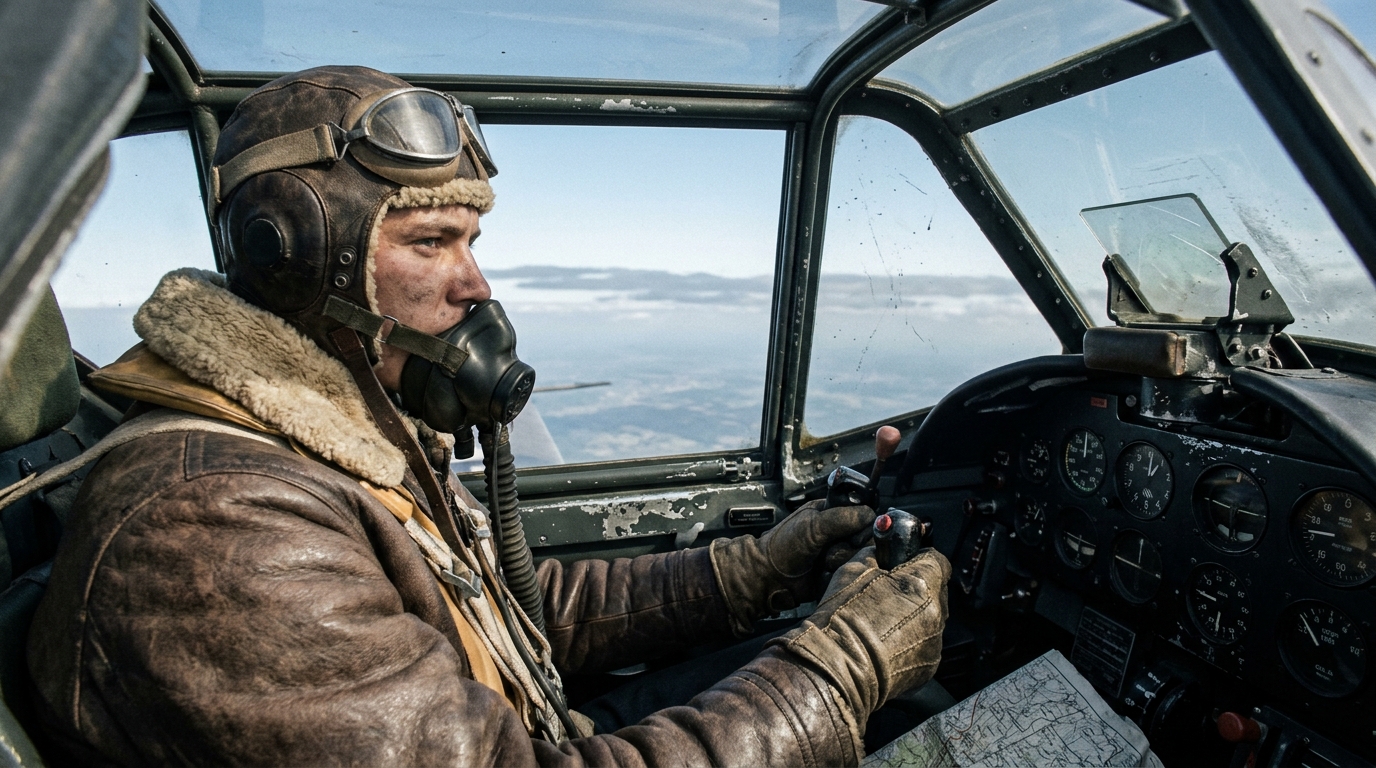
Inside the cramped cockpit of the Messerschmitt, the air smelled of stale sweat, cold engine grease, and the metallic tang of oxygen leaking from a worn regulator.
The leather of the flight helmet creaked as he turned his head, scanning the pale, empty slate of the morning sky toward the west.
Below, the Rhineland lay blanketed in a thin, gray haze, completely indifferent to the engines screaming behind the cowling.
This climb had been mapped out a hundred times before in briefing rooms smelling of damp wool and chalk.
The routine was etched into the muscle memory of every pilot in the wing: wait for the heavy bomber stream, let the short-range escorts peel away at the border, and strike the unprotected flanks in the quiet minutes that followed.
His gloved fingers tapped against the throttle quadrant, adjusting for the thin air as the altimeter needle locked onto twenty-eight thousand feet.
There was no room for grand heroics up here, only the steady management of fuel flow and cylinder temperatures while the frost crept inward from the frame joints.
A distant glint caught the corner of his visor, sharp and unnatural against the blue.
It wasn’t the stubby, familiar silhouette of a Republic thunderbolt turning back toward the coast.
The shape was long, clean, and impossibly deep inside the Reich’s airspace.
CHAPTER 2: THE SILVER ANOMALY
The altimeter didn’t lie, but the sheer distance of those silver shapes defied every doctrine drilled into the wing since the first months over the Channel.
His thumb tightened against the safety toggle, pressing until the knuckle turned white inside the stiff leather lining.
Down below, the cloud layers broke open into cold, flat patches of gray, offering no shelter and no tactical advantage against an enemy that simply refused to turn back at the invisible border.
A faint scratching sound came through the radio frequency—not static, but the distant, rhythmic hum of high-output engines running lean and cold at altitude.
He banked the Messerschmitt slightly to the left, letting the wing drop to clear his blind spot while the oxygen regulator hissed a steady, rhythmic breath into his mask.
The silver silhouette hadn’t altered course; it held a steady, arrogant line toward the heart of the Reich, completely ignoring the traditional turning points where escorts always bled away.
His eyes burned from the dry, rushing air leaking past the canopy seal, but he kept his gaze locked on that unyielding shape in the distance.
There was no chatter on the tactical channel, only a heavy, suffocating silence shared by wingmen who suddenly realized their kingdom had shrunk to the width of a runway.
CHAPTER 3: THE BROKEN PERIMETER
The cylinder head temperature needle crept into the red zone, humming with a dry, metallic vibration that carried straight through the stick and into his forearm.
He shoved the mixture lever forward by a fraction of an inch, wincing as the engine coughed once before settling back into a harsh, high-altitude roar.
Ahead, the cluster of heavy bombers tried to lock their defensive boxes, but the silver shapes were already diving from the sun with sickening speed.
There was no orderly assembly, no predictable staging where ground control could vector them into position.
The entire defensive perimeter was dissolving into a chaotic scramble of engine smoke and frantic evasive rolls.
He wrenched the control column hard to port, letting the Messerschmitt drop into a steep, desperate dive to intercept a pair of silver fighters peeling off toward a wounded bomber.
My aircraft, my airspace, he muttered behind his oxygen mask, wiping a smear of condensation from the instrument glass.
The opposing fighters didn’t bite or hesitate; they swept through the gap with terrifying discipline, their multi-gun turrets flashing in the pale light as they cut off every avenue of escape.
CHAPTER 4: THE WEIGHT OF ATTRITION
The fuel feed needle jittered erratically against the dial, marking the steady drain of every precious gallon left in the reserve tanks.
Down on the rough concrete strips of the dispersal bases, mechanics worked in frantic, shivering silence under grease-stained canvas covers, trying to patch bullet-torn cowlings with dwindling supplies of sheet metal.
There was no talk of grand offensives or decisive victories here; the maintenance sheds were choked with the bitter smell of unburned synthetic fuel and exhausted men staring blankly at empty parts bins.
He wrenched the fuel selector valve tighter, feeling the raw metal bite into his palm through the worn fabric of his glove.
Every mission demanded more than the machines could give, and every replacement pilot sent up from the training units had fewer hours in the air than a civilian weekend flyer.
—We are burning through everything just to keep the birds in the air— muttered the ground crew chief, his face dark with soot as he slammed an access panel shut.
The institutional machinery was grinding down to bare iron, starved of resources while the relentless silver tide above continued to expand its reach without a single pause.
CHAPTER 5: THE DESPERATE ASCENT
The tachometer needle bounced wildly against the stop, screaming in protest as the overworked power plant strained to drag the heavy nose upward into the freezing gray mist.
Every muscle in his shoulders locked tight, fighting the violent torque of an engine starved of proper octane and running on harsh chemical substitutes that smelled like burning rubber.
Below them, the cloud cover was choked with black anti-aircraft bursts and the relentless, downward-sweeping glint of silver escorts cutting off every upward path.
There was no tactical advantage left to play, no clever vertical maneuver to outclimb an adversary that blanketed every thousand-foot band of the sky.
—We cannot hold this altitude— shouted his wingman over the crackling radio, his voice strained and thin against the roar of wind tearing at the canopy seams.
He jammed the mixture control forward again, refusing to yield an inch of vertical space even as the oil pressure gauge dropped toward the danger zone.
The entire defensive line was bowing under the strain, forced into a messy, exhausting upward climb against an enemy that held all the cards and all the fuel.
CHAPTER 6: THE DUSTY SILENCE
The red emergency warning lights flickered once and died, leaving the instrument panel in a flat, cold shade of slate gray.
He pulled the canopy release lever sharply, letting the freezing slipstream rush in to clear the smell of burnt synthetic oil and cooling metal.
Down on the patchwork of scarred runways below, the remaining ground crews moved like ghosts among silent frames, their fuel barrels empty and their parts bins stripped to the bare wood.
There was no grand surrender speech, no dramatic confession from high command, and no sudden stroke of luck to save the day.
The opposition had simply mastered the math of endurance, flooding every mile of the sky with unyielding industrial reach until resistance became an impossible arithmetic.
—We were not beaten by better tactics— he whispered into the roaring wind, his fingers resting heavily on the cold frame of the cockpit edge.
The gray tide had settled over the horizon, locking every boundary in place with absolute, undeniable finality.
He cut the ignition switch completely, letting the massive propeller spin down into a dull, groaning halt that left nothing behind but the empty whistling of the wind.