Iron and Frost: The Heavy Burden of Survival in the Frozen Forests of the Ardennes
CHAPTER 1: Frost on the Breech
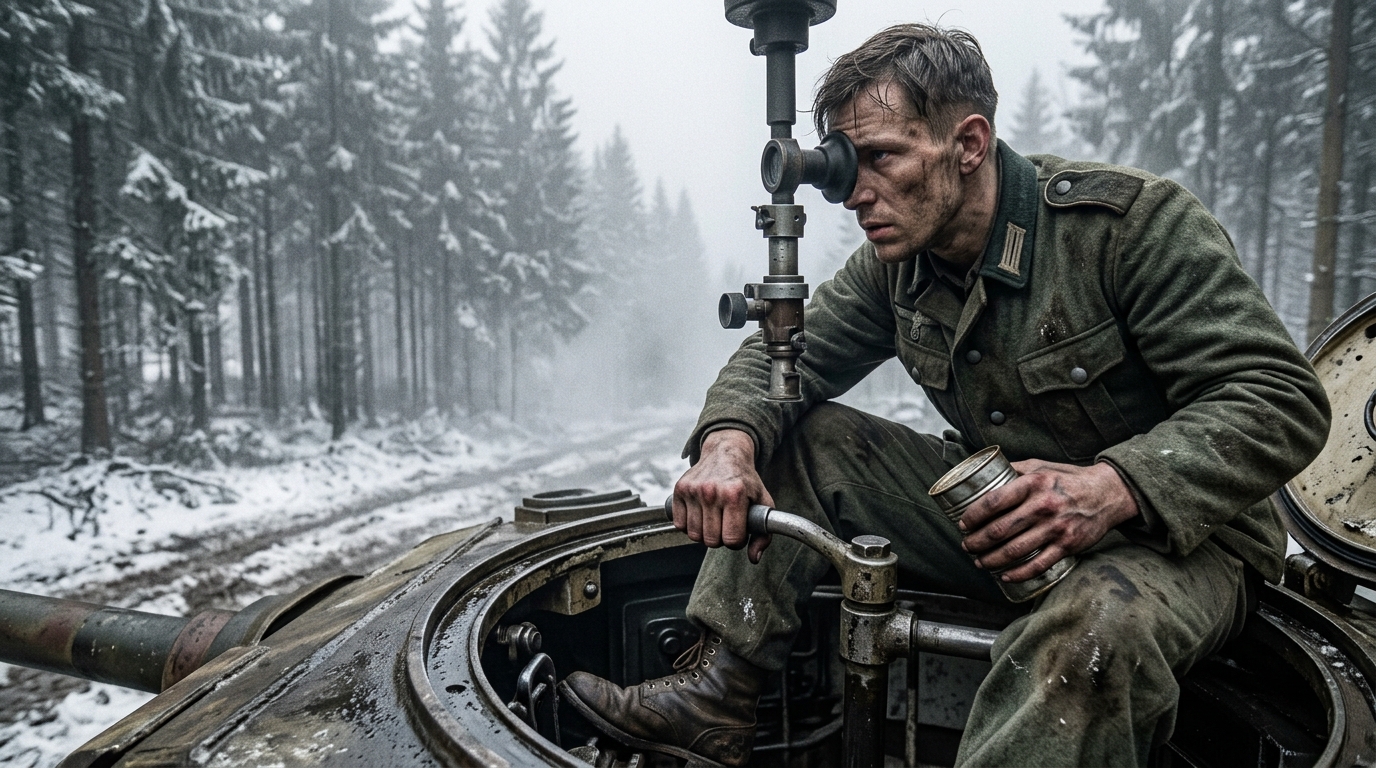
The frost on the steel sights didn’t clear away no matter how hard Hans breathed against the cold glass.
His wool gloves were stiff with old grease and frozen mud, making the elevation crank feel like solid lead under his bare knuckles.
Outside the cramped turret of the Panther, the Ardennes forest was nothing more than a jagged wall of grey pines dripping slush into the snow.
“Keep your eyes on the northern ridge,” the commander muttered, his boots scraping against the hull floor as he shifted his weight to fight the creeping numbness in his toes.
Hans didn’t answer.
He just rolled a dented, grease-stained ration tin between his soot-blackened fingers, feeling the familiar cold bite of the metal against his palm to anchor himself in the present moment.
The briefing from the night before was still ringing in his ears, heavy with the specific warnings about long barrels and British steel.
According to the maps they weren’t allowed to trust and the scouts who never came back, every shadow in the woods was supposed to hide a Firefly.
Hans tapped the edge of the tin against the breech block, the dull metallic clink swallowed instantly by the low, suffocating rumble of the Maybach engine idling beneath them.
A single drop of condensation fell from the turret ring, running slowly down his collar to freeze against the back of his neck.
He blinked hard against the sting of diesel fumes trapped inside the iron box, wiping the grease from his forehead with the back of a stiff sleeve.
The snow outside was starting to churn into grey slush as the column behind them ground its gears, the entire machine vibrating with the exhausted strain of a winter campaign that had long since lost its purpose.
He didn’t need a tactical manual to tell him what kind of day it was going to be.
He just needed the motor to keep turning and the breech to stay clean enough to load the next shell before the woods decided to speak.
CHAPTER 2: The Long Barrel
The map case had barely stopped rolling when the platoon commander’s voice crackled through the intercom, thin and tight over the static.
“Keep your tubes elevated toward the northern ridgeline,” the speaker spat. “Intel says the British have moved those long-barrel seventeen-pounders into the tree line. If you see a snout sticking out past a standard Sherman hull, you put high-explosive right through it before it breathes.”
Hans wiped his palm across his greasy trousers, staring at the topographic lines smeared in ink beneath the harsh interior lamp.
The doctrine was drilled into every man in the battalion: the Firefly was the apex predator, the gun with the velocity to slice clean through a Panther’s sloped frontal plate at a thousand yards.
He reached down to adjust his headset, his knuckles scraping against the cold turret wall as the tank gave a violent shudder over a patch of frozen ruts.
“Always the long barrel,” Hans muttered under his breath, leaning his forehead against the rubber pad of the gun sight.
Outside, the gray mist hung heavy between the pines, distorting distances and turning every charred stump into the silhouette of an Allied tank.
He tapped the elevation wheel twice, feeling the smooth resistance of the gears turning in their housing, but his eyes kept drifting away from the expected avenues of approach toward the lower, silent depressions in the valley.
There was a strange, oily smell drifting through the turret ventilation—not just the familiar cordite of their own ready racks, but something sharper, like scorched insulation mixed with damp earth.
It didn’t match the tactical bulletins pinned to the briefing room wall in Cologne.
The commander kicked the side of the ammunition bin with the heel of a heavy winter boot, demanding a status check on the ready rounds.
Hans didn’t look up from his optics, his fingers tightening around the rubberized grip of the traverse handle as the wind outside picked up a notch, whistling shrilly through the mantlet seal.
“Loading solid shot,” the loader grunted from the rear, his voice muffled by wool and exhaustion.
The heavy shell slid into the breech with a dull, echoing click that signaled readiness, but the metallic snap didn’t bring any comfort.
Hans kept scanning the fog, knowing the manual told him where the danger ought to be, while his gut told him the real threat wasn’t going to announce itself with a cathedral spire on its turret.
CHAPTER 3: The Unseen Whisper
The metal groaned beneath their feet as the tank settled awkwardly into the frozen ruts of the tree line.
Hans slammed his hand against the elevation housing to steady his aim, his muscles instantly tightening against the sudden mechanical failure.
“Track pin’s sheared on the left sprocket,” the driver yelled from the lower compartment, his voice cracking with sudden strain over the grinding idle of the engine.
The commander dropped down from the hatch, his heavy wool coat dusting snow across the breech as he cursed under his breath.
“We don’t have time to fix a track in the open,” the commander spat, wiping frost from his goggles with a soot-stained thumb. “Keep the gun locked on the northern clearing. If they come out of that fog now, we’re sitting targets.”
Hans didn’t reply, his mind flashing back to the burned-out hulks they had passed three days ago—not split open by clean shell holes, but blown completely apart from the inside out like hollow eggshells.
He gripped the traverse handle until his knuckles turned white, feeling the cold iron bite deep into his skin as he scanned the grey blur outside.
There was no sound of a long British barrel shifting into position, no massive muzzle flash to mark the textbook threat they had spent weeks preparing to counter.
Instead, the air in the forest suddenly grew preternaturally still, the wind dying down into an absolute, suffocating vacuum.
“Something’s moving by the lower ditch,” the loader whispered, his hand freezing halfway to the ready rack.
Hans peered through the gun sight, his breath fogging the rubber eyepiece before he wiped it clean with the back of a stiff sleeve.
A low, flat-hulled silhouette crept out from behind the veil of mist just four hundred yards away—lacking the towering turret of a standard Sherman, showing a snub-nosed, high-velocity gun tube that moved with absolute, silent purpose.
The machine didn’t pause to announce itself, and it didn’t give them a second chance to calculate doctrine.
CHAPTER 4: The Closed Compartment
The gears jammed hard against a frozen tooth of steel inside the grease-packed housing.
“Manual lock is slipping,” Hans grunted, his shoulder blades pressing hard into the cold curved wall of the armor plate as he forced the hand crank around.
The commander didn’t look back from his observation slit, his boots locked rigidly to the ribbed floorboards.
“Keep turning it,” the commander spat, wiping condensation from his brow with a greasy sleeve. “If that low-profile silhouette clears the hedge line, we won’t get a second revolution.”
Outside, the muffled thud of a ninety-millimeter tube cycling shook the frozen pine needles loose from their branches.
Hans didn’t need a textbook to calculate what happened next if that muzzle swung their way.
The standard bulletins talked about penetration values and plate thickness, but inside a four-man steel box, numbers didn’t stop shrapnel or save eardrums.
A single drop of ice-cold condensation fell from the turret ring, striking the back of his bare hand like a drop of molten lead.
“Range is closing,” the loader muttered behind him, his breathing coming in ragged, shallow gasps as he wrestled another solid shell out of the rack.
Hans jammed his hip against the traverse wheel, ignoring the searing pain in his bruised muscle as the crosshairs dragged across the gray fog.
There was no room for error, no friendly spotter in the sky to bail them out, and no clean exit if the metal gave way.
The front armor was thick enough on paper, but the real terror wasn’t the hole the enemy made—it was what happened a fraction of a second after the steel parted.
“Load high explosive,” Hans yelled over the ringing in his ears, his finger hovering white-knuckled over the electric firing trigger.
The loader slammed the brass casing home with a frantic shove, his jaw clenched tight against the rising panic in the compartment.
The breech snapped shut with an absolute, final echo that left nowhere else to hide.
CHAPTER 5: The Frozen Clearing
The floor plates bucked upward against Hans’s boots as the heavy vehicle absorbed its own massive discharge.
“Target hit,” the loader shouted over the shrill whine of internal ventilation fans struggling to clear the thick, yellow smoke.
Hans didn’t waste a second celebrating the flash across the ridge, his eyes locked back onto the optics to see if the opposing machine had stopped its advance.
The ninety-millimeter destroyer sat motionless in the snow four hundred yards out, its snub-nosed barrel still pointed dead ahead like an unblinking iron eye.
“It’s not brewing up,” the commander yelled, hammering his fist against the radio housing with a sudden, frantic outburst. “Fire again—load solid shot, right now!”
Hans felt a cold knot tighten in his stomach as he watched the enemy turret refuse to yield, defying every clean textbook rule they had been handed in training.
The opposing crew wasn’t surrendering or bailing out; they were shifting their weight, fighting dirty through the frozen brush to line up their own counter-strike.
“We don’t have time for a second reload,” Hans snapped back, his voice dropping an octave as he fought to keep his hands from shaking on the traverse handles.
The environment around them offered no shelter—just open, white slopes of snow and the bitter wind howling through the skeletal trees.
Every second they lingered in the open clearing brought them closer to the exact fate they feared most: the flashless, instantaneous detonation that left no room for survival.
The commander grabbed Hans by the shoulder, his grip tightening like a vise against greasy wool.
“Move the hull left, or we’re dead before the breech closes,” the commander snarled, refusing to give an inch as the tension reached its absolute boiling point.
CHAPTER 6: Silence in the Sieve
The concussion wave hit the steel hull like a physical wall, throwing Hans sideways against the ready rack.
He didn’t scream, though his ribs throbbed with every shallow breath he tried to pull into his lungs.
Across the compartment, the commander was already hauling himself back toward the periscope, his face caked in fine gray dust and old grease.
“They missed the mantlet,” the commander rasped, spitting a wad of phlegm onto the ribbed floorboards. “Just a near miss—keep the transmission engaged!”
Hans wiped the grit from his eyes, his hands shaking slightly as he gripped the traverse crank to bring their gun back around.
The forest outside was burning now, black smoke mingling with the low-hanging fog to blot out what little winter sunlight remained.
There was no glorious victory parade waiting at the end of the road, and no friendly map to tell them which shadows were safe.
They had survived the day not because of grand tactical brilliance, but because they kept moving when the metal around them threatened to become their tomb.
He reached down into his pocket, his freezing fingers brushing against the dented ration tin he had carried since dawn.
He pulled it out, tossed it onto the empty shell tray, and slammed the breech lever home for one final, quiet load.
The engine beneath them wheezed and settled into a steady, rhythmic idle as the column slowly began to roll backward into the gathering dusk.