Iron in the Gale: The Final, Desperate Run of a Warship Trapped in the Arctic Night
CHAPTER 1: THE STAR SHELLS
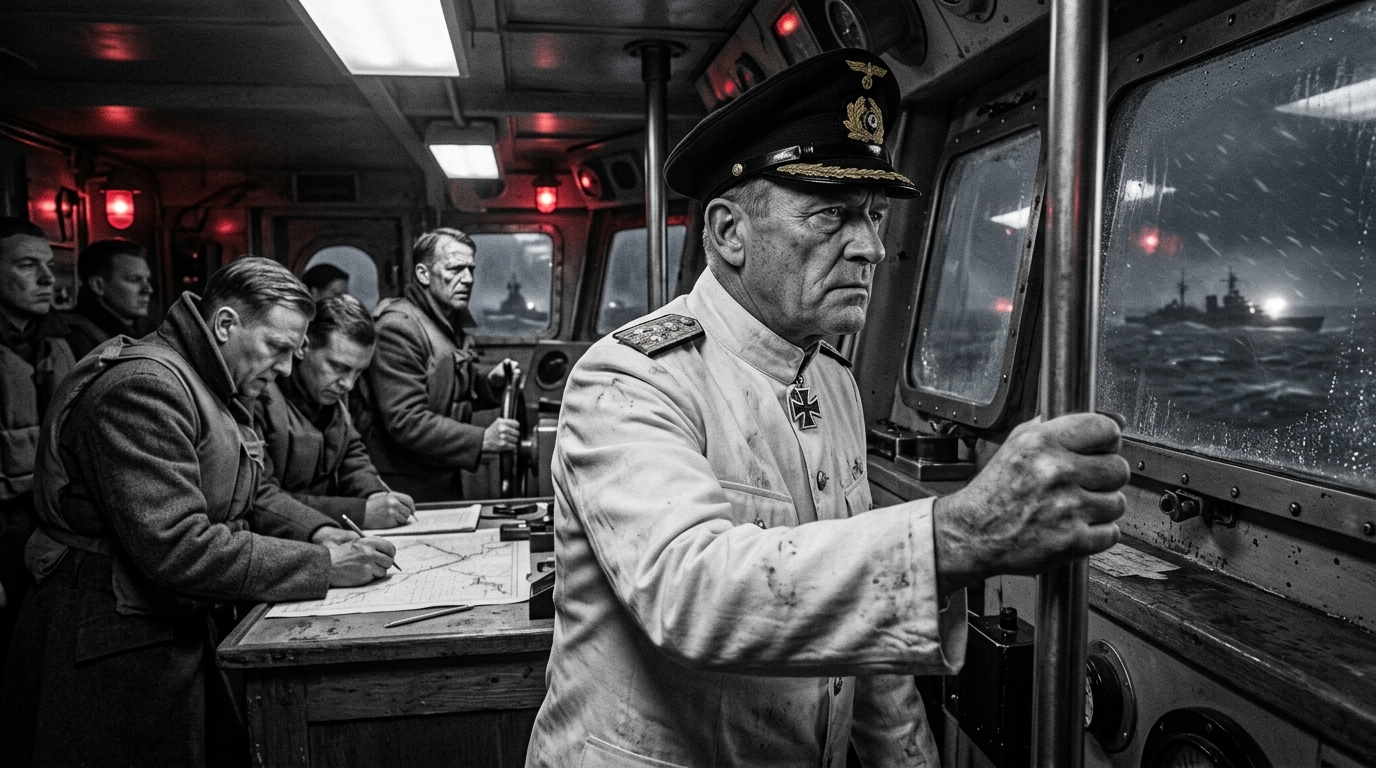
The bridge of the Scharnhorst smelled of damp wool, stale coffee, and the sharp tang of ozone from the gyrocompass.
Konteradmiral Erich Bey gripped the freezing brass railing as the massive hull shuddered against a heavy Arctic swell.
Outside the armored glass, the night of Christmas 1943 was a solid wall of black and blowing snow.
There was no room for hesitation when the sky above them suddenly ripped open in a blinding, unnatural glare.
Star shells blossomed in the upper atmosphere, washing the rolling white waves in a harsh, ghostly illumination.
“Muzzle flashes, bearing two-four-zero!” shouted the watch officer, his voice cracking against the hum of the engine telegraphs.
Bey did not flinch; his eyes locked onto the jagged horizon where dark silhouettes cut through the swirling squall.
The soft target of merchant ships they had hunted moments ago had vanished, replaced by the unmistakable profile of Royal Navy cruisers.
Bey twisted away from the glass, his boots sliding slightly on the condensation-slicked steel deck.
“Hard to port, one hundred fifty degrees,” Bey commanded, his voice flat and steady against the rising roar of the wind. “Bring the aft turret to bear. Make smoke and give me full power to the turbines.”
The battleship groaned as tons of pressurized steam slammed into the drives, heeling the massive vessel hard over into the freezing trough.
Aft, the colossal steel housing of turret Caesar screamed on its roller bearings, turning its heavy barrels toward the pursuing shadows.
Before the German guns could clear their leather tampions, the British broadsides answered from the dark.
An incoming shell struck the forward mast with a deafening, metallic shriek that vibrated straight through the soles of Bey’s boots.
“Radar room report!” Bey barked, grabbing a stanchion as another wave hit the listing deck.
“Hit confirmed on the antenna!” came the static-laced reply over the internal comms. “We’ve lost the primary screen!”
Bey stared into the blinding snow ahead, knowing the dark was no longer empty.
CHAPTER 2: BLIND FLIGHT
The bridge was a suffocating cage of red emergency lighting and heavy, recycled air that tasted faintly of copper and sweat.
Konteradmiral Erich Bey did not wipe the condensation from his brow, his attention locked entirely on the empty space where the radar screen used to glow with tactical certainty.
“Dead reckoning only,” Bey muttered, his voice scraping against the metal walls like dry gravel. “Assume the cruisers are closing the arc from the south.”
Without instruments, the massive battleship was navigating the pitch-black Arctic night like a blindfolded giant stepping through a briar patch.
The navigator bent double over the chart table, his pencil frantically tracing an estimated vector through the blinding squall.
“If we alter course fifty degrees east, we might slip between their picket line before they recalibrate,” the officer said, his hand trembling slightly as a stray shell detonation rattled the hull.
Bey stared into the compass binnacle, calculating the brutal mathematical odds of surviving an unseen pincer movement with a crippled mast.
A sudden, sharp metallic ping echoed from the overhead ventilation shafts, an unnatural sound that did not belong to the rhythmic pounding of the turbine rooms.
Bey stiffened, his fingers curling tightly around the edge of the chart table as he scanned the compartment for the source of the anomaly.
“Did you hear that?” the watch officer whispered, pausing mid-stride with his dividers frozen over the map.
“Keep your eyes on the bearing,” Bey ordered, pushing down the unsettling unease with cold, hard practicality.
There was no time to hunt ghosts in the dark when the entire British home fleet was presumably converging on their exact coordinates.
The ship shuddered heavily as the engine rooms strained to maintain twenty-eight knots through freezing, trash-clogged water.
Bey reached out and grabbed the internal speaking tube, his knuckles white against the brass.
“Bridge to damage control—status of the forward compartments?”
“Holding dry for now, Admiral,” came the scratchy, exhausted voice from the bowels of the steel hull. “But the rivet seams are weeping ice from the vibration.”
Bey slammed the valve shut, knowing that every knot they forced out of the turbines brought them closer to structural failure or a waiting broadside.
The snow outside thickened into a swirling whiteout, blurring the distinction between the frozen sea and the hostile sky above.
Bey stepped back to the armored observation window, his eyes narrowing as he stared into the impenetrable wall of white.
“They are waiting,” Bey said quietly, his breath fogging the cold glass. “They are holding the door shut.”
CHAPTER 3: THE MAIN FORCE AWAKENS
The entire ocean seemed to rise up and strike the hull with an iron fist, sending a massive wall of white spray washing over the forward gun shields.
Fourteen-inch shells dropped out of the heavy black sky like falling meteors, exploding with a blinding shockwave that knocked the wind straight out of the bridge crew.
“Direct hit on the forward deck!” a voice roared through the intercom, thick with rising panic. “Anton turret is compromised!”
Konteradmiral Erich Bey planted his boots firmly into the non-skid matting, his eyes darting across the smoke-filled horizon as the shapes of heavy battleships materialized from the squall.
The decoy cruisers were gone, replaced by the towering silhouette of the main Royal Navy force blocking every inch of the southern escape route.
“Flood Bruno turret immediately,” Bey commanded, his voice remaining flat and unyielding despite the deafening roar of incoming broadsides. “Prevent secondary detonations before the fire spreads to the shell rooms.”
The navigation officer stared across the chart table in disbelief, his hands gripping the edges as another violent shockwave lifted the ship.
“We are walking right into their trap,” the officer shouted over the shrieking turbines. “They anticipated our entire evasion route.”
Bey didn’t blink, his common-sense pragmatism stripping away any illusion of easy escape as he calculated the crushing weight of the enemy’s metal advantage.
“They expected us to run, not fight through,” Bey muttered, his knuckles turning white as he braced against the console. “Shift all remaining power to the port engines and bring Caesar turret around.”
Another massive concussion hammered the superstructure, filling the bridge with the sharp, choking smell of cordite and burning insulation.
The ship listed heavily to port, fighting against the freezing Arctic gale as the crew scrambled to keep the crippled giant moving through the freezing dark.
Bey stared into the blinding snow where the flashes of enemy guns flickered like angry ghosts, knowing the margin for error had just shrunk to zero.
CHAPTER 4: CLIMBING THE MAST
Lt. Harold Bates stared up into the swirling vortex of white snow and jagged steel above the bridge, his fingers locking onto the ice-caked rungs of the ladder.
The wind shrieked like a trapped animal, tearing frantically at his heavy woolen coat and driving frozen needles straight into his face.
Every time the massive 14-inch guns fired from below, the entire mast whipped violently back and forth, threatening to snap like dry timber and fling him into the black sea.
“Hold on,” Bates muttered through blue, stiff lips, forcing his boots upward one agonizing step at a time.
He didn’t wait for orders, and he didn’t check if anyone was watching; common sense dictated that a ship sailing blind in a crossfire was already a floating coffin.
The weight of the unearned disaster pressed down on him, carried by the stubborn refusal to let the automated failure win without a fight.
He reached the trembling instrument housing at the summit, his fingers numb and bleeding slightly against the abrasive frost.
The antenna arm hung limply downward, knocked completely out of alignment by the concussive force of the opening broadsides.
Bates threw his entire body weight against the heavy iron framework, using his shoulder as a crude lever against the gale.
“Move,” he hissed, his muscles cramping violently from the bitter cold and the sheer strain of the metal resistance.
With a sharp, cracking sound of breaking ice, the antenna jerked back into position just as another deafening salvo lit up the dark horizon below.
A muffled cheer crackled through his headset from the control deck as the primary screens flickered back to life with glowing green targets.
Bates clung to the swaying rungs, staring down into the freezing chaos as the tactical grid reformed around them.
CHAPTER 5: THE CLOSING CIRCLE
The ocean around them turned into a churning maze of white wakes and iron hulls as four separate attackers closed the gap from opposite bearings.
Konteradmiral Erich Bey watched the perimeter contract from the bridge windows, his fingers clamped so hard around his brass spyglass that his knuckles turned completely white.
“They are boxing us in for a torpedo spread,” the executive officer warned, his voice tight with the frantic realization that every escape vector had vanished into the gray gloom.
Bey did not blink, his common-sense endurance refusing to yield to the overwhelming mathematics of the pincer movement.
“Shift all secondary batteries to face the northern approach,” Bey ordered, cutting through the rising panic with cold, mechanical authority. “Do not let them dictate the launch distance.”
The ship shuddered violently as the mid-deck guns swung around and opened fire, sending orange streaks flashing across the dark water toward the lead attacker.
Instead of turning away, the approaching hulls surged forward through the spray, doubling down on their aggressive run with reckless, unearned confidence.
A sharp explosion rocked the port quarter as a steel cylinder found its mark, sending a massive wall of freezing seawater cascading over the lower decks.
“Speed dropping to ten knots!” the engine room intercom blared, the metallic squeal of damaged turbines echoing through the bulkhead.
Bey stared at the crippled gauges, knowing the trap had finally clamped shut with absolute, inescapable finality.
“They think we’re done,” Bey muttered, his jaw tightening into a hard line as he prepared for the final, brutal confrontation.
CHAPTER 6: THE FINAL SALVO
Konteradmiral Erich Bey stood unyielding against the listing bulkhead, his coat soaked with freezing spray and the bitter sweat of a lost battle.
Around him, the instrument panels flickered and died one by one as icy water rushed into the lower decks, cutting off power to the remaining turbines.
“Caesar turret reports out of ammunition,” the voice over the speaking tube came thin and broken through the rising roar of flooding compartments.
Bey did not look down; he stared across the dark, churning waves where the silent silhouettes of the British fleet closed the final perimeter.
There was no surrender in the iron logic of the sea, and there were no unearned second chances left to claim.
“Abandon ship,” Bey ordered, his voice steady and hollow as the deck tilted beneath his boots. “All hands to the upper rail.”
The survivors moved with the grim, mechanical efficiency of working men who had done everything common sense demanded against impossible odds.
Bey took one last look at the compass binnacle before stepping out onto the open wing, feeling the freezing gale bite deep into his skin.
The great iron hull rolled heavily to starboard, its bow dipping beneath the black surface as the propellers spun slowly into the open air.
Silence settled over the freezing water, broken only by the hiss of cooling steam and the gentle wash of the Arctic swell against empty life rafts.