A 79-Year-Old Veteran With a Ruined Leg Challenges Modern Ballistics at Redstone Ridge
CHAPTER 1: THE CRACKED APRON
The brass latch on the walnut transit case refused the thumb catch on the first pass, choked with dried river grease and three decades of attic lime. Walter Mercer did not force it; he set the steel ferrule of his hickory stick into a seismic crack running through lane three’s concrete apron and shifted his bad hip until the metal popped free under his body weight. The dry wind over the rim of the basalt cut took the sound and tore it flat.
Thirty paces south, the morning line went cold.
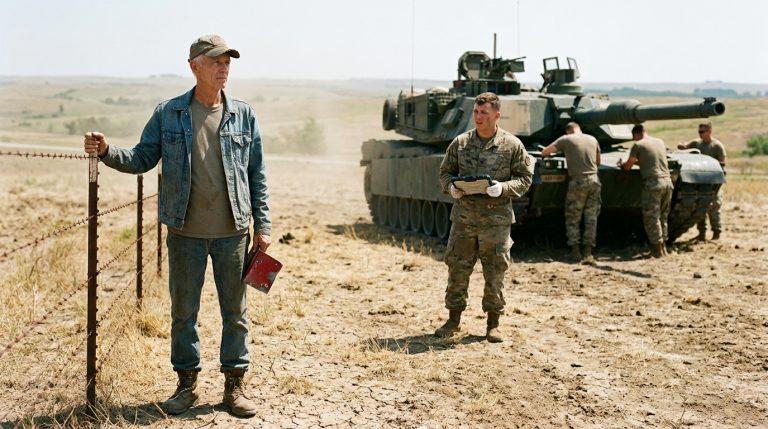
“That leg changes the safety calculation on my deck,” Gunnery Sergeant Travis Cole said.
The voice had iron in it, pitched to carry through doubled ear protection and the idle thump of the generator trailer. Cole stood with his heels planted over the yellow boundary stripe, clipboard held flat across his chest, thumbs hooked over the edges of a clipboard that hadn’t seen grease since sunrise.
Walter kept his weight back on his heel. His left leg sat locked at the knee, dead-straight, the denim of his field trousers bleached near-white over the tendon scars.
“A delayed mount or a slipped support drops muzzle discipline,” Cole said. “You know the manual of arms for an open lane. Pick up the box, sir.”
“I read the board before I cut my engine,” Walter said.
His thumb ran the softened grain of the top crease in Samuel’s letter, keeping the paper flat against the walnut lid. The fold was split clean through on the left border from forty-eight hours of finger oil.
“Three rounds out,” Walter said. “Three zeroes on the back plate.”
Cole took one step forward. The gravel along the apron edge crunched under his service treads, sharp and dry.
“The wind down the cut is boiling at twelve hundred,” Cole said. “Modern chassis can’t dial it out with a Kestrel on the tripod. Your case doesn’t have an armory clearance tag, and you’re not on the manifest.”
“Samuel put me on it.”
“Samuel Keen died in Prescott three weeks ago.” Cole reached out, not rough, but with the flat authority of an NCO who owned the dirt beneath his boots, and tapped two fingers against the folded paper Walter held. “His signature was good for thirty years. It expired when they folded the flag.”
Walter didn’t pull the paper back. He held it still, letting the edge flutter against Cole’s forearm as the gust lifted red dirt from the gravel ditch.
“He signed this four days before the pump gave out,” Walter said. “He knew what was running in lane four.”
Behind them, Lance Corporal Ethan Brooks straightened from his spotter’s hood, a pair of digital binoculars resting loose against his tactical harness. The kid’s knuckles were red from the plateau air, his display screen flickering with barometric updates that showed forty-two inches of drop at the long silhouette.
“Gunny,” Brooks said quietly.
“Stay off the net, Brooks,” Cole snapped without turning his head. He looked straight into Walter’s eyes, dropping his chin a fraction of an inch to cut the glare off his safety glasses. “This isn’t an open club match. This is the trials. You’ve got an uninspected action and a bad hinge for an ankle.”
Walter didn’t shift his boots. He let his left shoulder drop half an inch, easing the iron spike of pain that ran from his lower spine down into his calf, then tapped the case once with his middle knuckle.
“The hinge works well enough to carry the walnut,” Walter said. “And the rifle’s already registered to the ridge.”
Cole’s mouth tightened into a hard, white line. “Every serial on this hill is on my pad. What did you bring out of the weeds, Mercer?”
Walter turned the second latch. The brass gave way with a dry, mechanical screech that echoed across the dead silence of the firing points.
Inside the green wool lining, resting in fitted mahogany channels that smelled of raw sulfur and forty-year-old linseed, the bolt-action M40 lay with its chamber open, its dark receiver scarred near the breech by a half-inch gouge cut straight into the grain.
On lane two, Brooks stepped completely clear of his optics, his eyes dropping to the hand-stitched olive cloth tucked beneath the spare magazines.
“Look at the heel plate,” Brooks said, his voice dropping below the wind. “Gunny… look at the rack stamp.”
Cole didn’t touch the rifle. His eyes tracked from the brass buttplate up to the rough, hand-filed letters cut into the flat of the receiver beneath the scope ring: Keen-01.
“Where did you steal that mark?” Cole said.
Walter closed his fingers around the hickory handle of his cane and let the weight of the rifle answer for itself.
“Samuel didn’t mark the steel until we hit the gravel in eighty-four,” Walter said. “And he didn’t do it with a government stamp.”
The horn on the tower blared once, cutting the line cold as an olive-drab maintenance truck bounced up the access track, its tires throwing shale against the safety fence.
CHAPTER 2: COLD GEOMETRY
The dual rear tires of the armory truck kicked shale into the chain-link fence with a dry rattle like loose brass hitting a bucket.
The truck didn’t cut its lights. It idled ten feet short of the yellow apron, exhaust blowing thin blue haze through the red dust until the cab door swung open with a screech of dry hinge metal.
Cole didn’t turn his back on Walter. He kept his boots square to the concrete line, his clipboard pinned against his ribs.
“Step away from the bench, Mercer,” Cole said.
Walter didn’t take his hand off the walnut case. The cold iron of the latch bit into his palm, grounding the ache throbbing behind his hip socket.
“The rifle stays on the wood,” Walter said.
“The rifle isn’t cleared for this deck.” Cole took two paces toward lane two, his shadow stretching across the concrete as the morning sun cleared the eastern berm. “Brooks, shut that monitor down and get the armorer out of that cab.”
Brooks didn’t touch the power toggle. The corporal stayed hunched over his hood, his left thumb scrolling through the digital weather feed where the mirage read fifty-eight percent vertical boil over the ravine.
“Gunnery Sergeant,” Brooks said, his throat catching once before he leveled his tone. “Look at the wind layer on lane four.”
“I told you to shut it down.”
“He’s not guessing the air,” Brooks said.
Cole reached over the corporal’s shoulder and pulled the sunshade off the spotting monitor.
On the high-resolution feed, the red crosshair hovered over the 1,910-yard steel plate. The computer had painted the standard correction: fourteen clicks left to fight the near crosswind rolling across the firing mats.
Below the digital solution, typed into the scratchpad in Brooks’s hurried inputs, sat Walter’s manual correction: three clicks right, two down.
“You took wind calls from an unregistered civilian?” Cole’s voice dropped an octave, the flat fury of an NCO handling an insubordinate junior.
“Look at the grass beyond the cut,” Brooks whispered.
Cole leaned down. His knuckles whitened against the aluminum frame of the tripod.
At nine hundred yards, the dust pulled east toward the canyon floor. But two miles out, clinging to the talus below the steel silhouette, the brittle cheatgrass didn’t lean east; it flattened west, caught in an updraft spilling over the blind crest.
The digital station at the line couldn’t read what the basalt ridge was doing to the floor of the gap.
“It doesn’t matter what the air is doing down-range,” Cole said, straightening up and facing Walter. “Range rules govern the line, not the wind. You don’t have an armory voucher. You don’t have a cleared chamber flag.”
The armory truck door slammed shut.
Master Gunnery Sergeant Raymond Pike walked onto the apron. He didn’t carry a clipboard; he carried a brass bore gauge and a flat steel case marked with yellow ordnance tape.
“He doesn’t need a voucher, Travis,” Pike said.
Pike’s service boots hit the concrete with a slow, measured cadence that belonged to forty years on military ranges. He stopped three feet from Walter’s bench, eyes locked on the scarred walnut stock.
Cole didn’t step back. “Master Guns, this is an active qualification lane. Range safety remains with me.”
“It does,” Pike said. He laid his steel inspection kit on the corner of the wood, the latches popping open with clean, oiled clicks. “And historical verification remains with base ordnance.”
Pike looked at Walter. Neither man moved to shake hands; their eyes met, heavy and worn, the silent tally of two men who remembered the same funeral three weeks prior.
“Samuel left something in the safe,” Pike said quietly.
“I know,” Walter said.
Cole stepped between them, his chest inches from the bench. “What safe? What is this weapon?”
Pike didn’t answer the junior sergeant directly. He picked up a nylon inspection light, clicked the tail-cap, and slid the narrow white beam into the open chamber of the M40.
The light illuminated the feed ramp, polished to a mirror shine forty years ago, and caught the sharp interior edge of the rifling lands.
“The serial number on this action isn’t in the base inventory,” Pike told Cole, keeping his eyes on the steel. “It was struck from the Marine Corps registry in November of 1984 by order of the Division Commander.”
Brooks leaned forward from his stool. “Why strike a match rifle?”
Pike pulled the bore light free, the brass tip clicking softly against the receiver bridge.
“Because officially,” Pike said, “this rifle was reported lost at sea during a training exercise off the coast of Subic Bay.”
Cole stared down at the dark gouge near the bolt handle, the wood bruised black by stone that had never seen an ocean.
“Then who owned it?” Cole asked.
Walter shifted his left boot, driving the heel hard into the crack in the concrete to steady his trembling knee.
“Nobody owned it,” Walter said, his voice grating like dry gravel. “That’s why Samuel had to sign for the bullet.”
CHAPTER 3: THE SEALED DIRECTIVE
Pike’s hand stayed flat on the open steel of his gauge kit, his thumb hooked into the yellow ordnance tape.
“Samuel didn’t sign for a weapon, Mercer,” Cole said. “He signed for range safety on this ridge for thirty years, and I’m the one holding the line today.”
Cole turned on his heel, his clipboard cracking against the aluminum rim of the spotting bench.
“Lane four remains red,” Cole barked down the apron. “Brooks, pull the bolt from that action and tag it for the armory locker.”
Brooks stepped past his tripod, his right hand hesitating an inch above the walnut stock.
Walter didn’t reach for the steel. He twisted his torso, driving the hickory cane two inches into the expansion joint between the concrete slabs, and leaned his full weight against the bench edge.
The wood groaned under his ribs, blocking the lane with his body.
“The bolt stays in the raceway,” Walter said.
Brooks froze, looking over Walter’s shoulder toward Cole. “Gunny, if Master Guns says it’s restricted property—”
“I don’t take range disposition from a lance corporal,” Cole said, closing the distance until his service belt brushed the brass latch on the case. “And I don’t let an uncarded pensioner dictate a cold deck. You want that rifle on the line, Mercer, you show me a live command authorization.”
A second set of tires ground through the shale outside the gate.
A dark utility sedan with base command plates pulled up behind Pike’s maintenance rig, its front suspension bouncing hard as it crossed the culvert.
The driver’s door opened before the engine died, and Colonel Nathan Whitaker stepped out into the dry glare, a thick manila folder tucked beneath his left arm.
“Stand down the lane argument, Travis,” Whitaker said, his voice level and dry as the red dirt blowing across his trousers.
Cole snapped to attention, his chin locked straight ahead. “Sir, civilian on lane four with uninspected hardware and a non-standard physical condition.”
Whitaker didn’t look at Cole. He walked straight to the wooden bench, looked down at the dark gouge in the walnut stock, and set the folder on the lid.
The paper made a dry, hollow slap against the wood.
“The rifle was inspected forty minutes ago in the division records room,” Whitaker said. He broke the red wax seal on the top flap with a thumbnail. “Along with Master Gunnery Sergeant Keen’s final personnel directive.”
Walter kept his hands locked on the cane handle. The ache in his hip had turned into a dull, grinding burn that traveled all the way down to his ankle.
“Samuel left instructions for the trials,” Walter said.
“He left conditions,” Whitaker corrected, pulling a single typed sheet from the cardboard sleeve. “One round. Cold bore. Target plate eighteen-forty at nineteen-ten yards.”
Cole’s jaw tightened. “Sir, with respect, range regulations dictate a standard prone position for all non-bench trial entries. His left leg cannot support the cant.”
Whitaker handed the sheet directly to Cole.
“The order grants a supported bench cradle under supervised demonstration protocol,” Whitaker said. “Signed by the commanding general forty-eight hours before Keen’s service.”
Cole scanned the text, his eyes tracking down to the bottom line where the red command seal overlapped the ink.
“There’s a rider, Colonel,” Cole said, his voice dropping as he tapped the bottom margin.
Walter looked from the paper to the far cut where the heat mirage was boiling into a solid, shimmering wall. “What rider?”
Cole looked at Walter, the procedural resistance hardening into something colder, more clinical.
“If the round doesn’t impact within the scoring ring,” Cole said, “the rifle is remanded to base custody as abandoned ordnance under the 1984 strike order.”
The wind over the berm dropped to nothing, leaving the dry whine of the generator filling the silence between the benches.
“Samuel didn’t put that in the letter,” Walter said.
Cole handed the sheet back to the colonel, his mouth set in a thin, unyielding line.
“Samuel didn’t write the rider, Mr. Mercer,” Cole said. “The range committee did. You want to touch his record with an off-book weapon, you put the rifle on the table.”
CHAPTER 4: THE 240SECOND WINDOW
Pike dragged two canvas sandbags across the timber bench, their coarse seams leaving white trails of pulverized quarry lime in the weathered grain.
“Rear cradle is locked,” Pike said, not looking up. “Leg channel is clear to the deck.”
Walter didn’t reach for the rifle yet. He laid his hickory stick flat along the bench edge, took his weight onto his good right heel, and lowered himself toward the firing mat.
His left knee caught on the edge of the timber.
A sharp, sick heat shot from the scarred patella straight into his lower spine. His torso pitched sideways, his right elbow slamming down on the concrete apron to arrest the fall.
Brooks moved first, boot striking the yellow boundary line. “I’ve got him—”
“Stay off the mat, Brooks,” Cole said. His thumb rested on the split-second toggle of his digital stopwatch. “Assisting a shooter during the mount violates lane autonomy. He establishes the position, or the lane goes red.”
Walter pushed against the concrete with his palm, the rough aggregate biting through his skin.
“I have the deck,” Walter said, his voice flat, dragged out between his teeth.
He dragged the dead weight of his left boot forward, sliding it through the clearance notch Pike had cleared between the bags. The limb lay extended, locked straight and stiff as an iron bar against the low cradle, the denim already darkening with sweat behind the knee.
He pulled the walnut stock into his right shoulder.
The wood settled into the hollow of his collarbone with the cold familiarity of a tool handled ten thousand times. His cheek pressed the comb, feeling the deep gouge where stone had gouged the grain thirty-one years before.
Cole stepped to the edge of the mat, his watch display glowing in the desert glare.
“Line is hot,” Cole said. “Four minutes on the master clock. One round loaded on command. Single shot to verify.”
Pike dropped a single brass cartridge into the open port.
Walter turned the bolt handle down. The extractor claw snapped over the rim with a heavy, oiled clack that vibrated through his cheekbone.
“Range confirmed,” Brooks called from behind the glass of lane two. “Nineteen hundred and ten yards. Heat index ninety-four. Near wind six miles an hour, quartering off the eastern berm.”
Walter looked through the glass.
The optical reticle—fine crosshairs on old ground glass, devoid of digital stadia lines or battery-lit holdovers—floated over the shimmering heat. Two thousand yards out, the thirty-six-inch plate was a dark, wavering sliver clinging to the talus beneath the rimrock.
“Do not average the near wind,” Walter whispered, his breath fogging the brass bell of the ocular lens before evaporating.
Brooks hesitated, the rubber eyecup pressed hard against his brow. “Near wind is picking up, Gunny. Eight miles an hour now.”
“Read the mirage above the wash,” Walter said.
His left quadricep seized.
It was not a gradual cramp; it was an abrupt, violent knotting of deadened muscle that jerked his heel an inch against the plywood support. The crosshair jumped two feet above the silhouette, swimming through the boiling air.
Cole didn’t blink. “Movement on the support. Two minutes, forty seconds.”
Walter took his trigger finger completely out of the guard, resting the pad flat against the receiver’s cold exterior wall. He closed his eyes against the sun, drawing air in through his nose until his ribs pressed hard against the bench frame.
“Heel slipped,” Pike murmured, his boots shifting as he checked the rear bag without touching the shooter. “You’re torquing the receiver, Walter.”
“I know where the torque is,” Walter said.
He didn’t fight the spasm. He wedged his right hip harder against the oak bench, taking the tremor out of his skeleton by driving his ribcage straight into the corner of the firing table.
Pain flared behind his sternum, dull and mechanical, grounding the tremor until the reticle steadied again.
“Ninety seconds,” Cole called.
The wind down the cut didn’t steady. It ripped across the line, snapping the canvas flags above the berm into rigid, popping rectangles.
Down in the ravine, the gray cheatgrass had ceased moving entirely, caught in the vacuum between the two opposing thermals.
“He’s running out of air,” Brooks muttered, his knuckles whitening on the tripod traverse. “Gunny, the thermal is collapsing the mid-field. The solution is gone.”
“Clock runs,” Cole said, his eyes tracking the digital numbers dropping on his screen. “Sixty seconds. Fire or safe the weapon, Mercer.”
Walter didn’t touch the trigger. He watched the dead air inside the cut.
“Forty seconds,” Cole said.
A crow dropped off the telephone wire near the mid-range target pits, wings flared against a sudden, violent updraft lifting out of the wash.
The near flag went slack. The far cheatgrass bent flat toward the western rock face.
The three winds had collided, canceling their cross-drift for the space of a single heartbeat.
“He’s out of time,” Cole said, his mouth opening to call the line cold. “Thirty—”
Walter let the half-breath slide out of his lungs, his finger finding the cold steel shoe of the trigger.
CHAPTER 5: COLDBORE STRIKE
The crosshair cut through the dead space of the wash.
Walter did not pull the trigger. He squeezed the pad of his index finger against the shoe until the three-pound sear broke with a dry, mechanical snap.
The rifle bucked straight back into the meat of his collarbone.
The muzzle blast flattened the red dust across lane four, kicking a cloud of dry grit against Cole’s trousers and rattling the empty brass latches on the open transit case. The recoil drove Walter’s right elbow hard into the oak bench, but his left side stayed anchored, rigid as dead iron against the sandbags.
The crack of the shot rolled down the basalt draw, hollowed out by the heat.
“Shot out,” Brooks whispered, his forehead jammed against the rubber hood of the spotting glass.
Walter did not cycle the bolt. He kept his cheek welded to the walnut, his right eye locked into the tube, watching the gray blur of the 1,910-yard rimrock.
One second.
Two seconds.
The air inside the cut remained flat, the mirage boiling straight up in thin, greasy ribbons.
Three seconds.
Four seconds.
A sharp, metallic clink drifted back up the canyon—thin, dry, and late, arriving seconds behind the bullet.
On the mast above the 1,910-yard pit, the yellow electronic indicator flipped instantly to solid green.
“Target impact,” Brooks yelled, his voice cracking as he stood clear of the optics, hands flat against his thighs. “Center-right quadrant. Hit confirmed.”
The line stayed dead silent.
No one cheered. Three junior marksmen down on lane one leaned around their sunshades, staring across the concrete at the smoke lifting off Walter’s muzzle.
Cole didn’t look down at his stopwatch. The digital screen read zero, frozen on the final split second.
“Target score verified by line camera,” Pike called out from the truck rail, his hand coming down flat on the manila folder. “First-round cold bore. Nineteen hundred and ten yards.”
Walter drew air back into his lungs. The sharp scent of burnt powder and hot barrel oil bit into his throat, familiar and grounding.
He pushed his upper body away from the bench, his right arm taking the strain as his left knee ground against the timber edge. The joint cracked, a dry pop of bone and cartilage, but he didn’t reach down to rub it.
“Chamber clear,” Walter said.
He lifted the bolt handle. The steel action slid back with an oiled glide, and the extractor tossed the hot brass casing into the dirt beside his hand.
Brooks stepped forward, bent down, and picked up the hot brass by the rim. He wiped the red clay from the neck with his sleeve and laid it gently on the walnut case.
Cole walked across the boundary stripe, his service boots stopping two inches from the edge of Walter’s mat. The clipboard hung loose at his side.
“You waited for the dead thermal,” Cole said.
Walter reached out, his fingers closing around the hickory handle of his cane. He used the bench corner to lever his hips upward until his boots were flat on the concrete, his left leg locked into its familiar, rigid wedge.
“The wind doesn’t argue with an order, Gunnery Sergeant,” Walter said, his voice level. “It just moves.”
Cole looked down at the scarred walnut stock, then back up into Walter’s eyes. The rigid posture remained, but the defensive edge had collapsed into the quiet reality of the hit on the board.
“The rider is void,” Cole said. “The rifle stays with you.”
Colonel Whitaker stepped onto the concrete, holding the sealed envelope from Samuel Keen’s records locker in both hands.
“The rifle stays with the record, Travis,” Whitaker said. “Both of them.”
He broke the inner paper seal of the document, the stiff parchment tearing with a clean, deliberate rip that drew every eye on the apron.
“Master Gunnery Sergeant Keen didn’t leave a request for a demonstration,” Whitaker said, looking directly at Walter. “He left an official correction of the 1984 board of inquiry.”
Walter’s fingers tightened on the cane. “Samuel knew that file was buried.”
Whitaker unfolded the single typewritten sheet, the base watermark visible through the reverse side under the harsh noon sun.
“It was buried because the operation was classified,” Whitaker said. “It’s declassified as of six o’clock this morning. And it doesn’t say what you think it says, Walter.”
CHAPTER 6: THE UNSEALED LEDGER
The dry desert heat swallowed the last trace of burned propellant, leaving only the smell of hot steel and sun-baked pine.
Whitaker held the single sheet against the flat lid of the transit case so the wind could not catch the corners.
“The 1984 board did not record Samuel Keen as the sole shooter,” Whitaker said, his voice carrying clear across the silent lanes. “The original action report listed a two-man reconnaissance element operating under classified division directives. One rifle. One glass. Two names submitted for the record.”
Walter stood braced against his cane, his knuckles grey against the hickory handle.
“Samuel took the name off the board,” Walter said.
“Command took the name off,” Whitaker answered. “Your personnel file was sealed following the extract in eighty-four because of the medical board. Samuel spent thirty-one years trying to declassify the mission so the registry could show what actually happened on that slope.”
Whitaker laid the document inside the green wool lining of the case, directly beside the embroidered olive cloth.
“Samuel didn’t invite you here to prove you could still shoot, Walter,” Whitaker said quietly. “He invited you because the declassification order cleared this morning. He knew you wouldn’t let the record change unless you paid for the ground yourself.”
Cole stepped forward. He reached up to the timber board above lane four, unfastened the tarnished brass screws with a pocket driver, and lifted the original plate free.
A pale rectangle of unweathered wood showed on the timber, bright against thirty years of desert sun.
Pike opened a shallow wooden box from his truck. Inside lay the replacement plate, cast in heavy, darkened brass: 1984 Historical Record – 1,842 Yards. Shooter: Walter Mercer. Spotter: Samuel Keen.
Below it, Pike slotted the second fresh strip into the wood: Demonstration Record – 1,910 Yards. Walter Mercer. Cold Bore.
Cole set the screws into the grain, tightening each one until the heads sat flush and true.
“The line is logged, sir,” Cole said, stepping back and bringing his heels together.
Walter looked at the two names sitting level on the timber, neither above the other, both anchored into the same cedar plank.
He did not answer with words. He reached out, picked up the warm brass casing from the morning shot, and set it inside the case beside the old casing marked WS.
The two pieces of metal clicked together softly in the wool channel.
Walter closed the lid. The heavy brass latches engaged with two clean, mechanical snaps that signaled the end of the line.
“I have an armory transport if you need the lift down the grade,” Whitaker said.
Walter picked up the leather handle of the case in his right hand and settled his weight onto the hickory cane.
“The truck’s parked outside the gate,” Walter said, his voice dry and slow. “It runs well enough.”
He turned and walked away from the apron.
His left boot dragged slightly against the loose gravel, kicking up small plumes of red dust that drifted off into the scrub brush.
Behind him, the warning flags snapped once in the midday thermal, but nobody called the line hot.