The Dusty Stakes Of Maplewood Estates Where Every Board Carries The Heavy Weight Of Truth
CHAPTER 1: The Rusting Screen Door
The dust motes hung thick in the stale air of the farmhouse kitchen. I set the cardboard box down on the scarred wooden table and wiped my palms on my jeans.
Outside, the cicadas droned a relentless rhythm against the humid afternoon heat. Beyond the sagging porch, neat rows of identical mailboxes and manicured lawns replaced the overgrown pastures I remembered from childhood.
The screen door shrieked its familiar, iron-on-iron note as I turned back toward the boxes. My grandfather had built this frame with his own calloused hands fifty years ago.
A sharp crunch of tires on gravel cut through the cicadas. I paused, my hand resting on the cardboard flap.
A pristine white BMW idled near the edge of the packed dirt drive. The driver’s door opened, and a woman stepped out into the blinding sunlight, her navy blazer crisp and her high heels sinking slightly into the loose gravel.
She held a black clipboard against her chest like a shield. Her expression was set in a rigid, practiced mold of severe disapproval.
“Excuse me,” she called out, her voice cutting cleanly through the heavy summer air. “This property is in direct violation of multiple community standards.”
CHAPTER 2: Unwelcome Paperwork
“Seventy-two hours,” the woman said, her voice clipped and entirely devoid of warmth. “That is the statutory grace period before non-compliance triggers daily fines, liens, and eventual foreclosure proceedings.”
I looked down at the heavy packet she thrust toward me. The paper was crisp, expensive, and completely detached from the reality of the soil beneath my boots.
According to the map folded neatly inside the front flap, her association claimed eighty percent of the land my grandfather had worked for six decades. The boundaries cut right through the old apple orchard and sliced across the eastern pasture.
“My grandfather bought this land when developers were still sketching maps on napkins,” I said, keeping my voice level despite the tightness in my chest.
She offered a small, surgical smile that didn’t reach her eyes. “Times change, Mr. Smith. Oversight protects property values. Without uniform standards, this entire valley would regress into an unmanaged eyesore.”
She turned sharply on her high heels, the gravel crunching beneath her stride as she marched back toward the white BMW. She did not wait for an answer, treating my family’s legacy like an administrative oversight waiting to be corrected.
I stood in the doorway as the luxury sedan reversed down the long drive, kicking up a gray cloud of dust that settled slowly over the overgrown weeds. On the kitchen table, the packet lay open, detailing two hundred dollars a day for unpainted siding, one hundred for unapproved landscaping, and fifty for visible agricultural equipment.
The numbers were designed to bleed a property dry before the owner even realized the hemorrhage had begun. I reached out and touched the edge of the paper, feeling the sharp corner bite into my thumb.
The front porch boards groaned under my boots as I stepped outside to trace the modern plastic boundary stakes she had planted along the perimeter. They were driven straight through ancient stone markers my grandfather had set in concrete back in nineteen-fifty.
A shadow fell across the garden bed near the root cellar. Half-buried beneath a tangle of wild blackberry vines, the rusted head of a 1924 surveyor’s stake protruded from the dirt, completely ignored by the new management’s neat plastic flags.
CHAPTER 3: The Morning Inspection
The heavy dew soaked through the knees of my jeans as I pried the encrusted iron free from the damp earth.
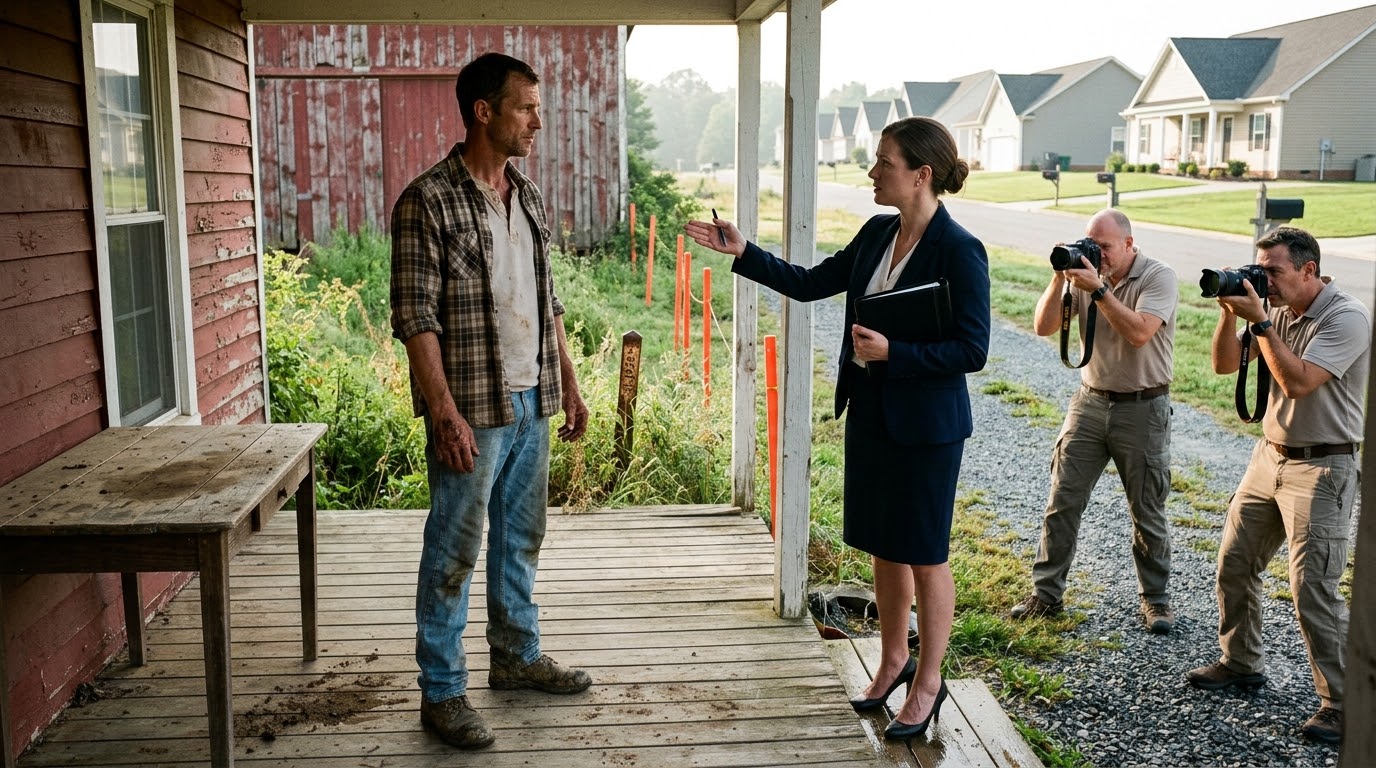
Before I could wipe the soil from the stamped metal numbers, a pair of sharp heels tapped briskly against the gravel drive. Two men carrying professional DSLR cameras stepped past the boundary line without breaking stride.
“Mr. Smith,” Karen announced, her voice pitched to carry across the yard while she flipped open her leather-bound checklist. “We are documenting seventeen individual dandelions in your primary view corridor.”
I stood up slowly, wiping my palms on my thighs and holding the rusted surveyor’s iron behind my hip.
“These boundaries were drawn a century before your subdivision ever scraped this topsoil,” I said, my voice roughening against the morning chill.
She did not look at the iron. She clicked her pen with a sharp, repetitive snap that cut through the silence of the pasture.
“The county registry recognizes our modern plat maps, not buried scrap metal,” she retorted, gesturing for the photographers to circle the barn. “That agricultural equipment near the foundation is another three hundred and fifty dollars a day starting at noon.”
She turned on her heel before I could answer, her notebook rustling as she checked off a fresh violation.
The camera shutters clicked in rapid succession, capturing every weathered board and peeling edge of the old homestead. They were building a case file brick by brick, fine by fine, designed to drown me in paperwork before I even understood the scope of the land grab.
I set the ancient iron stake down on the porch step with a dull, heavy thud.
The morning sun crept over the ridge, casting long shadows across fields that had belonged to my family long before corporate planners mapped out identical cul-de-sacs.
CHAPTER 4: Secrets in the Basement
The damp chill of the cellar floor seeped through the soles of my shoes as I knelt beside the open crate.
Decades of property tax receipts, county correspondence, and handwritten survey notes lay scattered across the stone blocks. My grandfather had not just maintained this farm; he had documented every single bureaucratic shift that encroached upon the valley over the last twenty years.
I pulled out a yellowed envelope tied with faded twine. Inside was a legal opinion from a regional land office dated back when Maplewood Estates was nothing more than empty pastureland.
The ink was stark and clear. Original landowners retained uncontested reversionary rights over structures placed without explicit, uncoerced consent.
A sudden groan from the floorboards overhead made me snap the flashlight off, plunging the basement into absolute darkness. Footsteps crossed the kitchen floor above, moving with an uninvited familiarity.
“Anybody down there?” Susan’s raspy voice filtered down through the open cellar stairwell, carrying a note of urgent warning.
I clicked the light back on and stood up, brushing spiderwebs from my flannel sleeves as I climbed the wooden stairs.
Susan stood near the kitchen table, her fingers nervously pleating the hem of her cardigan while she glanced out the window toward the paved street.
“She knows about the tax ledgers,” Susan whispered, her breath coming short. “Karen is filing an emergency motion with the county assessor by morning to declare this entire footprint abandoned.”
CHAPTER 5: The Lawyers Warning
The receiver clicked on the second ring, bringing a calm, measured voice through the static.
“Your grandfather was far more strategic than anyone realized,” Margaret said, her tone steady and devoid of panic. “He anticipated every single maneuver the association is currently pulling.”
I tapped the edge of the tax receipt against the wood, feeling the grain bite into my thumb.
“She is filing an emergency motion in the morning to declare this entire footprint abandoned,” I said, keeping my gaze fixed on the dust motes dancing in the kitchen window.
“Let her file,” Margaret replied evenly. “Without formal judicial injunctions, she relies entirely on intimidation and unverified administrative overreach. You have the tax records proving continuous ownership, but you cannot fight her in a courtroom alone.”
“Then how do we stop her?”
“You don’t fight her with gavels,” Margaret said, the line crackling slightly with distance. “You dismantle the leverage she holds over the neighborhood. Go talk to the people who have lived under her thumb for twenty years.”
The line went dead with a soft click, leaving me in the quiet kitchen with the weight of the old ledgers pressing down from the table.
Susan turned away from the window, her expression tight with caution.
“If you challenge her directly without backing from the neighbors,” Susan warned, her fingers worrying the edge of her sweater, “she will target everyone who ever spoke to you.”
CHAPTER 6: Surveying the Lines
The wooden steps groaned under my weight as I crossed Robert’s porch.
The old man sat in a rocking chair with a faded plaid blanket folded across his knees, watching me approach with eyes that had tracked forty years of subdivision expansion.
“You’re walking the old boundary, aren’t you?” Robert asked, his voice creaking like dry timber.
I leaned against the porch railing, looking out toward the manicured lawns that now choked the valley. “Karen is pushing for an emergency county ruling by morning to seize the homestead footprint.”
Robert let out a dry, rattling cough that ended in a humorless chuckle. He reached into his shirt pocket and pulled out a brass key on a greasy string.
“Your grandfather didn’t fight them when they built this place,” Robert said, tossing the key onto the small table between us. “He let them build. He wanted to see who had the stomach to live here when the ledger finally opened.”
I picked up the cool brass key, feeling its weight against my palm.
“That unlocks the floor safe in his back bedroom,” Robert continued, pointing a gnarled finger toward the horizon. “Everything you need to break her leverage is sitting in the dark, waiting for someone with enough grit to turn the lock.”
CHAPTER 7: The Asymmetric Counter
The heavy iron door swung open with a dry, metallic pop that broke decades of silence.
Inside lay stacks of original deeds, historical tax receipts, and signed legal briefs outlining every improper fine levied against the valley. My grandfather had left behind an airtight paper trail, proving that the association’s boundary claims were built entirely on administrative fabrication.
I pulled out the drafted lease proposals Margaret and I had prepared the night before. Instead of fighting a protracted legal war through traditional court channels, we had structured a direct alternative for the homeowners.
Ground leases at fifty dollars a month, bypassing the inflated association fees entirely.
A sharp rapping at the front screen door echoed down the hallway before I could lock the safe. Karen stood on the porch, her face pale with frustration, clutching her leather binder like a weapon.
“You are holding an unauthorized gathering,” Karen snapped, her voice rising sharply as I walked down the hall. “The county assessor is already reviewing our emergency petition for abandonment.”
I opened the front door just enough to slide a single notice across the weathered wood toward her manicured fingers.
“You’re welcome to review the county records yourself,” I said, my voice level and hard. “Every home built past this threshold sits on land that has property taxes paid in full under my grandfather’s name.”
Karen stared down at the paper, her breath catching in her throat as she read the bold legal heading.
“This is invalid,” she hissed, her fingers trembling against the leather binder. “You can’t do this—we control the standards here!”
“You control nothing on this acreage,” I replied, stepping back and letting the heavy screen door latch shut between us.
CHAPTER 8: Gathering the Storm
Karen stood at the front podium, her navy blazer tight across her shoulders, desperately tapping a metal pen against the microphone to restore order.
“These documents are fabrications,” Karen announced, her voice cracking slightly as she tried to shout over the mounting questions from the back rows. “The association holds absolute jurisdiction over every square foot of this development!”
I stepped out from the shadows near the projector stand, holding the original tax ledgers under my arm.
“Jurisdiction requires lawful ownership,” I said, my voice cutting cleanly across the room without needing an amplifier. “Every citation, every penalty, and every threatened foreclosure was built on a boundary line drawn twenty years after my grandfather’s deeds were recorded.”
The silence that followed was heavy and absolute, broken only by the hum of the projector fan against the wall.
Karen slammed her clipboard down onto the wooden podium, her face flushing a dark, mottled red as her administrative defenses completely collapsed.
“You are destroying everything I built here!” she shouted, her composure shattering completely as she grabbed the edges of the stand. “They won’t survive without strict standards!”
“They will survive just fine as neighbors,” I replied, stepping forward to place the alternative lease agreements on the table.
She turned and fled through the side exit before the applause could begin, leaving behind an empty podium and a community finally breathing its own air.
Months later, the gravel driveway no longer carried the sound of morning citations, and Susan hung her laundry across the yard under a clear afternoon sun.
I sat on the front porch steps, rolling a heavy, rusted iron surveyor’s stake between my palms while the sound of children laughing drifted up from the pasture.