Subdivision President Illegally Scraps Private Ranch Bridge, Trapping Forty-Two Families Behind Her Own Gate
CHAPTER 1: THE SEVERED SPINDLE
The steel pins on the cattle trailer usually rattled in a three-beat rhythm over the deck timbers of Willow Creek, a dull iron thud Grant Holloway could pick up half a mile out. When his front tires dropped off the asphalt onto the washboard gravel lane, there was no iron thud—only the dry, uninterrupted rattle of grease-caked chain against the hitch.
Grant eased off the throttle of the three-quarter-ton diesel. Through the dust kicked up along the fenceline, an orange boom cut the grey afternoon sky. A Caterpillar excavator sat with its steel tracks gouged three inches into his riverbank turf, black exhaust coughing from its stack with every pull of the hydraulic levers. A yellow nylon strap, thick as a bull’s neck and strained to a hard white shine, stretched from the bucket teeth down into the silt. The northern beam of the crossing—ninety feet of eight-inch structural channel he’d hand-treated with zinc primer three summers back—groaned as forty tons of machine leverage tore it loose from its bearing plate. The anchor bolts sheared with the flat, deafening crack of a deer rifle.
Grant didn’t hit the horn. He parked the truck twenty yards back, let the engine idle to cool the turbo, and stepped out onto the crushed stone. His knees cracked, stiff from three hours behind the wheel coming back from the farm auction in Mercer County. The wind smelled of raw river mud and fresh diesel soot.
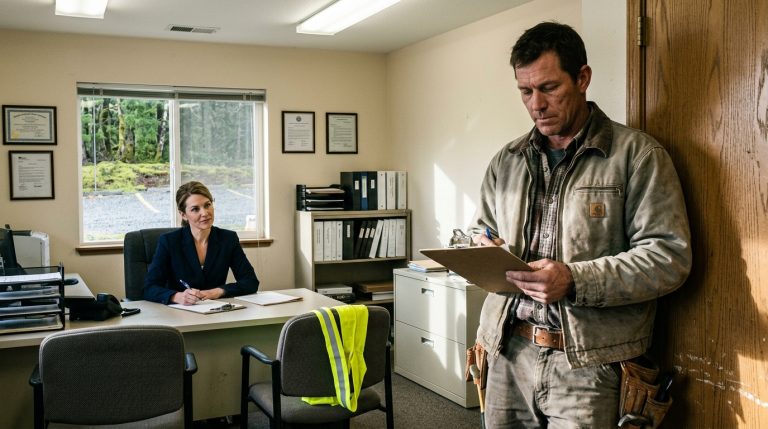
Standing twenty feet from the excavator’s tracks was Marissa Whitlock, a neon lime safety vest pulled tight over a tailored charcoal wool coat. Her arms stayed locked across her chest. Beside her, Travis Monroe stood with a hardhat tucked under his elbow, staring at a folded piece of bond paper like he was trying to find a misprinted price.
Grant walked past the front quarter-panel of Monroe’s flatbed without breaking stride. His work boots hit the bank gravel, loud and steady.
“Shut it off, Travis,” Grant said. His voice was level, carrying beneath the machine whine.
Travis flinched, glancing toward the cab. “Grant, look, we got an emergency order—”
“Shut the machine down before you roll that pier into the current,” Grant said. He didn’t look at Travis; his eyes stayed locked on the hydraulic piston extending another six inches. “You’re hooked onto private iron.”
“It’s a condemned hazard, Grant,” Marissa said, stepping into his path. The wind caught her hair, but her chin stayed up, sharp and rigid. She tapped the edge of the clipboard in her left hand against her hip. “The association voted on emergency structural intervention. Caleb Wright’s inspection was flagged for non-compliance with regional transport thresholds. This bridge violates community ingress safety codes.”
“Caleb works for the state board, Marissa. You run a garden committee,” Grant said. He stepped right around her shoulder, giving her two feet of clearance without stopping, and looked up at the excavator cab. The operator, a kid barely old enough to shave with oil streaks across his forehead, cut the throttle to an idle and cracked the glass door.
“Don’t you stop that rig,” Marissa shouted over the engine thrum, her heels sinking an inch into the soft loam of the bank. “Travis, your contract has a liquidated damages clause for work stoppages. He doesn’t have an injunction.”
Grant reached into his jacket, pulled out his phone, and dialed three digits. He didn’t yell. The cold river air bit his knuckles where grease had set into the skin.
“Mercer,” Grant said into the receiver. “They’re on the south bank. Travis has the tracked 320 hooked to the span. Bring bolt cutters for the utility gate down the lane, because forty-two of her people just lost their only way home.”
He clicked the screen dark. Across the split channel, the first silver minivan from the subdivision slowed on the far gravel approach, its headlights flicking on against the falling dusk, its bumper inches from a twenty-foot drop into nothing.
CHAPTER 2: THE DRY CROSSING
Twenty-five minutes after the sheared anchor bolts cracked over Willow Creek, the revolving amber flash of a county cruiser washed across the mud-caked tracks of the excavator.
Deputy Wade Mercer let his patrol car roll to a stop behind Grant’s stock trailer, the tires grinding on the creek gravel. He didn’t shut down his headlights. The twin beams sliced through the rising mist, catching the raw scar where ninety feet of structural channel had rested an hour ago. The north pier stood naked, two sheared studs sticking out of the cracked cap like broken teeth. Down in the pool, six feet of water piled against the submerged deck timbers, churning up yellow silt and dead leaves.
Mercer climbed out, his radio squawking once before he thumbed the volume down. He hitched his duty belt, the leather creaking against his winter jacket, and took in the steel submerged in the current.
“You took your time, Wade,” Grant said. His hands were stuffed deep into the canvas pockets of his coat. He stayed planted four feet back from the bank’s crumbling edge, his boot heels dug into the firm clay.
“Had a cattle truck jackknifed on Highway 9,” Mercer said. He walked past the idling Caterpillar, his boots sinking into the wet churn. He stopped beside Travis Monroe, who was working a grease-caked spud wrench around an auxiliary hydraulic fitting that wouldn’t budge. “Cut the engine, Travis. Let’s have the keys on the dash.”
“We’re on private contract, Deputy,” Marissa said, stepping into the headlights. The wool of her coat had picked up wet splatter around the hem. She held out the manila folder with both hands, rigid against her ribs. “This is an emergency abatement. The structural integrity of the culvert approach was compromised under county safety provisions. We’re well within association purview.”
Mercer didn’t take the folder. He pulled a heavy plastic flashlight from his belt, flicked the beam onto the excavator’s teeth, and followed the tensioned yellow strap down into the dark water.
“Grant’s deed sits in the clerk’s safe in town, Mrs. Whitlock,” Mercer said, his voice flat as ditchwater. “Ain’t no association purview fifty feet past that survey pin. Where’s the county seal on your demo permit?”
“It’s an emergency structural removal authorization,” she said, her voice rising half an octave, sharp enough to cut through the idle of the diesel engines. “Signed by the department director. The board reviewed Caleb Wright’s findings and deemed the crossing an active hazard to life and property.”
“Let me see it,” Mercer said.
She passed him a single sheet of heavy bond. Mercer clicked his flashlight down to a dull circle of white, holding the paper against his forearm. Grant didn’t move to look. He knew the paper was trash; he’d seen the way Travis looked at the ground when the rig was pulling iron.
“This says Infrastructure and Transit Oversight,” Mercer said, pointing a calloused thumb at the header. “County ain’t had a transit office since seventy-eight. We run road work through County Highway out of the annex.” He folded the paper once, neat and deliberate, and slid it into his notebook pocket. “Travis, get your boy down out of that cab. Turn the key off, or I’ll have the county wrecker drag this machine up to the impound lot by its counterweight.”
The excavator’s diesel cut out. The sudden drop in sound left only the low rush of Willow Creek fighting the drowned steel beam and the click of cooling manifolds.
Across the creek, the silence didn’t last.
Three sets of headlights were lined up on the far gravel approach now. A car door slammed with a tinny rattle, followed by another. Evelyn Prescott walked to the far water’s edge, her quilted housecoat pulled tight against the evening chill, flashlights from two other residents bobbing behind her like fireflies.
“Grant!” Evelyn called out over the water. Her voice shook with cold and thirty years of bad knees. “The north gate is chained! We tried the utility road behind the substation—power company put a padlock on it big as an anvil!”
Grant stepped toward the bank. The wind was coming hard off the lower pasture now, bringing the smell of cold river stones.
“Stay back from that edge, Evelyn,” Grant called across. “The gravel gave way when they pulled the beam.”
Marissa walked past Mercer, her leather-soled shoes slipping slightly on the slick bank grass before she caught her balance. “The power company will provide emergency right-of-way,” she shouted toward the far bank. “I’ve already contacted regional dispatch. It’s a temporary reroute while we replace the hazard.”
“They ain’t opening that gate, Marissa,” Grant said. He didn’t raise his voice, but in the dead air after the machinery shut down, every word carried across the thirty yards of open water. “That road’s an unpaved service track over a high-pressure gas main. They don’t run forty sedans a day over six-inch pipe for an association president who forgot where her fence ends.”
Evelyn didn’t answer Marissa. She kept her light pinned on the twisted steel under the water, where three thousand pounds of fabricated iron lay dead in the silt. “My husband’s insulin is on this side of the creek, Marissa,” Evelyn said, her voice dropping down low, steady with a neighbor’s quiet hatred. “You tell me how he gets it.”
Marissa didn’t look at the water. She turned her back on the creek, her heels clicking hard against the dry gravel near the flatbed trailer, and pulled her phone from her pocket. The light from the screen lit her cheekbones, white and sharp, as she started dialing with her thumb.
Grant walked over to the north pier. He reached down, gripped the cold zinc of the sheared anchor stud, and tested it with his palm. It didn’t have any give left in it. The concrete beneath the bearing plate was fractured three inches deep into the aggregate, spiderwebbed clean through to the rebar.
“Seventy tons of hydraulic pull,” Grant said to Mercer, who was writing Travis’s commercial driver’s license number into his log. “Ruined the pour. She didn’t just scrap the deck, Wade. She cracked the footing.”
Mercer looked up from his pad, his pencil pausing on the yellow line. Across the creek, another pair of headlights turned onto the dead-end lane, their high beams washing white across the empty air where the road used to be.
CHAPTER 3: ORANGE STAKES ON FALLOW GROUND
Thirty-six hours after the structural steel hit the mud of Willow Creek, three wooden stakes wrapped in fluorescent orange surveyor’s ribbon stood driven into the clover of Grant’s winter pasture.
Grant spotted the bright plastic flutter from the seat of his tractor while hauling two round bales out to the dry lot. He didn’t drop the bale spear. He set the tractor in neutral, pulled the mechanical parking brake until the pawl snapped into its third notch, and climbed down. The grass was crisp with morning frost, crunching under his soles like broken glass.
A hundred yards down the slope, a tripod with a yellow transit level stood planted squarely on his side of the boundary ditch. Two men in high-visibility vests were sighting back toward the subdivision’s perimeter fence, driving a steel rebar pin into the frozen dirt with a small sledge.
Grant walked across the frost, his sixteen-ounce claw bar swinging loose against his right thigh.
The older surveyor, a man with a grey mustache and a clipboard tucked into his vest pocket, glanced up as Grant’s boots cleared the ditch line. The sledge stopped mid-swing.
“Morning,” the older man said, touching the rim of his cap. “Holloway farm?”
“You’re thirty paces past the ditch,” Grant said. He didn’t raise his voice, but he stopped six feet out, his weight balanced square over his work boots. “Who told you to drive iron into my hayfield?”
“Silver Pines Homeowners Association,” the surveyor said, thumbing a work order on his clipboard. “Emergency corridor survey. We’re laying out the centerline for a bypass access road. Connecting the eastern cul-de-sac through to county blacktop.”
Grant stepped forward. He hooked the claw bar under the surveyor’s orange stake, leaned his weight on the tool, and levered the lathe out of the clover with a clean snap of splintering pine. He tossed the broken wood into the ditch.
“Hey, hold on,” the kid holding the sledge said, stepping around the tripod. “That’s three hundred dollars in benchmark time—”
“Pack your brass and get your rig on the other side of my ditch,” Grant said. He looked at the older man, ignoring the kid entirely. “The association doesn’t own this dirt. You drive one more pin, and Sheriff Barrett impounds your transit as evidence of criminal trespass.”
The older surveyor stared at the broken lathe in the weeds, then looked past Grant’s shoulder at the game camera mounted to the corner cedar post fifty feet away. Its red lens blinked once in the pale light. The surveyor let out a long breath that steamed white against the morning sky.
“Work order said the right-of-way was uncontested,” the man muttered, reaching for the tripod legs.
“It’s contested,” Grant said.
Before the crew could fold the second leg, the dry crunch of gravel signaled a black Mercedes SUV pulling onto the shoulder of the county road behind the ditch. The doors didn’t slam; they clicked shut with heavy German tolerances.
Marissa Whitlock walked down the ditch bank, flanked by two private security guards wearing nylon tactical vests and embroidered Silver Pines crests on their shoulders. She wore dark leather boots today, stepping deliberately across the frozen thistle. Her eyes were rimmed with gray exhaustion, but the set of her jaw was hard as pig iron.
“Leave the markers where they are, gentlemen,” she said, her voice cutting sharp through the cold air. She didn’t look at the surveyors; her gaze was locked on Grant’s face. “The association is exercising its statutory easement rights under the county emergency infrastructure code. We have forty-two homes without emergency vehicle access, Grant. Every hour you obstruct this route increases your liability.”
“You don’t have statutory easement rights on private farm ground, Marissa,” Grant said. He stood motionless over the hole where the pin had been. “You broke one road because you couldn’t put a toll gate on it. Now you’re trying to cut another one through my pasture.”
“The county allows private takings for public necessity,” she snapped, stepping closer until one of the guards moved up to her shoulder. “Our legal counsel filed the notice of intent this morning. We will condemn the acreage if we must. The community will not be held hostage by a spiteful neighbor.”
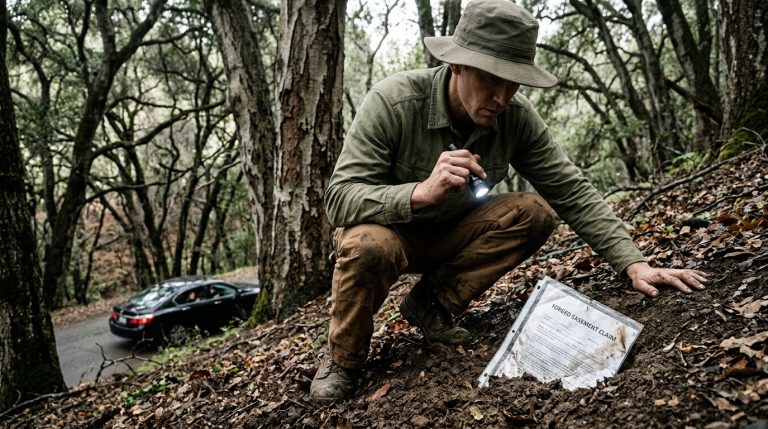
Grant looked down at the guard’s radio harness, then back to her. “A homeowners association doesn’t have eminent domain power. Not in this state, not in this county, and not with a forged transit seal in your desk drawer.”
Marissa’s mouth drew into a thin, bloodless seam. For half a second, her eyes flicked toward the cedar post where the trail camera sat silent in the frost.
“Those families are isolated because of you,” she said, her voice dropping into a tight, deliberate venom. “When an ambulance gets stuck at the creek bank, the entire county will know whose stubbornness killed them.”
“They’re stuck because you paid Travis Monroe seventy-four thousand dollars to drag ninety feet of bridge into the silt,” Grant said. He took one step forward, planting the claw bar into the dirt between them. “Get your men off my grass before I call Mercer to tow that Mercedes.”
The surveyors were already loading their tripod into the back of their pickup. Marissa stood her ground for three long heartbeats, her breath hitching once in the biting wind, before she spun on her heel and climbed back up the gravel embankment.
Grant waited until the black SUV cleared the tree line. His hand tightened on the cold steel of the bar, feeling the small vibration of the wind humming against the boundary wire.
CHAPTER 4: THE PAPER TRAIL IN THE SILT
Nine days after the orange stakes were pulled from the pasture dirt, Douglas Fenwick set an ink-smeared cardboard box on the laminate counter of the county annex.
Douglas didn’t look like a man who managed three million dollars in suburban reserves. His tie was shoved into his jacket pocket, the collar button torn clean off, and his hands had the slight, uncontrollable tremor of an accountant who’d spent forty-eight hours staring into a federal penitentiary.
Sheriff Nolan Barrett closed the blinds on the small conference room, shutting out the dull grey light of the county parking lot. He didn’t offer Douglas coffee. He sat his heavy frame into a metal swivel chair that groaned under his holster, pulled a yellow legal pad toward him, and uncapped a ballpoint pen.
Grant stood near the back wall, his shoulder blades resting against the painted cinder block. His boots were dusted with dry lime from spreading the heifer pen that morning. He stayed silent, his thumb slowly tracing the brass eyelet of his pocketknife.
“I didn’t authorize it, Nolan,” Douglas said, his voice cracked dry around the edges. He shoved a stack of bank drafts across the table. “She ran it through as an emergency line item under ‘Capital Drainage Stabilization.’ The board never saw the check. She signed the voucher under single-officer emergency purview on a Thursday afternoon while I was in Omaha for my sister’s hip replacement.”
Barrett used the tip of his pen to turn the top sheet. “Seventy-four thousand dollars flat. Wire transfer to Monroe Demolition Services.”
“That was just the deposit,” Douglas said. He pulled a second ledger sheet, his fingernails chewed down to the pink. “Here’s twenty-one thousand four hundred to an outfit called Apex Land Solutions. Another eight thousand six hundred for commercial traffic feasibility. And twelve thousand for civil blueprinting on a main gate we don’t even have an ordinance for.”
Grant pushed off the cinder block. He walked to the edge of the table, his eyes tracking down the date stamps on the Apex invoices. “Who owns Apex, Douglas?”
“A shell LLC registered out of Wilmington,” Douglas said, looking up at Grant with eyes bloodshot from fluorescent glare. “I called the state corporation bureau yesterday morning. The registered agent is the corporate attorney for Kincaid Commercial Properties.”
Barrett’s pen stopped scratching the pad. The sheriff raised his chin, his gray eyebrows knotting tight. “Kincaid’s the outfit sniffing around the seventeen timber lots on the east boundary.”
“They’re not sniffing anymore,” Douglas whispered. He opened a manila folder with trembling thumbs, pulling out a printout of an email chain stamped with an internal Silver Pines board header. “They signed a conditional letter of intent four months ago. Kincaid agreed to pay four point two million for the eastern tract, but only on one condition: Silver Pines had to operate as a closed single-point community. One guarded security gate on the east end. Zero public cut-throughs. Zero uncontrolled easements.”
Grant looked down at the paper. The black print was sharp and cold under the ceiling tubes.
The West Bridge problem will be eliminated before closing, Marissa had typed to the developer’s land broker twelve weeks back.
“She didn’t tear it down because it was falling,” Grant said. The words came out quiet, flat as an iron plate hitting dirt. “She tore it down because four million dollars doesn’t clear escrow if my cows and Evelyn’s sedan have a free road to the county blacktop.”
Barrett leaned forward, the leather of his vest creaking. “What about the emergency order she handed Travis?”
Deputy Mercer walked through the inner door, holding a printout fresh off the workstation down the hall. The paper was still warm, smelling of ozone and cheap toner.
“Forensic scan on the PDF came back from the state lab in capital,” Mercer said, dropping the sheet next to Douglas’s ledger. “The seal was lifted off a public drainage easement application the county posted back in twenty-one. Metadata shows the file was assembled on the desktop computer in the Silver Pines clubhouse office forty-eight hours before Monroe moved the excavator. User profile was logged in as Whitlock, M.”
Douglas put his face in his hands, his breath coming in ragged hitches through his fingers. “The special assessment notices go in the mail tomorrow. Nine thousand eight hundred dollars per household to cover the temporary steel crossing and the attorney fees. The neighborhood’s going to burn her house down.”
“No,” Sheriff Barrett said, capping the pen with a dull, final click. He stood up, towering over the conference table, his hand resting easy on the grip of his sidearm. “They won’t have to.”
Grant reached down, picked up the printout showing the developer’s closing terms, and folded it twice until it fit square into the front pocket of his work coat. His face didn’t hold triumph, only the heavy, cold weight of a man who’d known all along what happens to fences when money wants the grass on the other side.
“Wade,” Barrett said, picking his Stetson up off the desk. “Pull the car around front. Let’s go see the president.”
CHAPTER 5: THE COLLAPSE OF THE GATE
Four hours after Sheriff Barrett capped his pen at the annex, the double oak doors of the Silver Pines clubhouse slammed back against the drywall stops.
The air inside the room was hot, stale with the breath of ninety people packed shoulder-to-shoulder on grey folding chairs. A projector hummed on a card table in the center aisle, throwing a slide full of legal fees and drainage line-items onto a pull-down screen. Marissa Whitlock stood behind the oak lectern at the front, both palms pressed flat against the polished veneer, her knuckles white.
“The bylaws are explicit on point of order,” she was saying, her voice amplified through two black plastic speakers that buzzed with electrical feedback. “This floor is closed to non-member commentary. The special assessment is an operational necessity to defend this development against catastrophic municipal liability.”
Evelyn Prescott stood in the third row, her winter coat draped over her arm, pointing a trembling finger at the projection. “You signed a seventy-four-thousand-dollar contract out of our reserve fund without a board quorum, Marissa! You stranded forty-two houses so you could sell an access road to an outfit in Wilmington!”
“That is slander, Evelyn, and counsel will document it,” Marissa snapped. “Sit down or I’ll have security clear the aisle.”
The brass latch on the side exit groaned, then clicked hard.
Grant walked in first, his boots scuffing the industrial blue carpet. He didn’t say a word. He stepped two paces into the room and stopped beside the water cooler, his shoulder resting against the door jamb. Behind him came Nolan Barrett and Deputy Mercer, their hats held low in their left hands, the yellow fluorescents reflecting off the cold brass of their county shields.
The room died down row by row, the muttering folding into a thick, dead quiet until only the cooling fan of the projector was left whining in the aisle.
Marissa didn’t back away from the lectern. She pulled her shoulders back, her chin lifting until her neck cords went tight beneath her collar. “Sheriff, this is an executive session of a private association. If Mr. Holloway is here to file a trespass complaint regarding the eastern boundary, he can deliver it to our corporate counsel in the morning.”
Barrett walked down the center aisle. He didn’t hurry. His boot heels made no sound on the carpet, but the heavy leather of his gun belt creaked with every stride. He stopped five feet from the podium steps and laid a folded blue legal backing onto the corner of the wood.
“State versus Marissa Whitlock,” Barrett said. The room was so quiet that a man three rows back clearing his throat sounded like a shovel hitting stone. “Grand jury returned five counts twenty minutes ago out of the circuit court. Criminal mischief over ten thousand dollars. Tampering with a public record. Uttering a forged instrument. And two counts of grand theft by deception.”
Marissa didn’t reach for the paper. Her eyes stayed locked on Barrett’s face, her lips parting slightly, but no breath came out. For three seconds, the room watched her try to assemble the words, her mouth working like a dry hinge.
“This is an administrative dispute,” she said, though her voice lacked its mechanical snap, coming out thin and hoarse. “My attorney—”
“Your attorney’s standing out in the hallway talking to the county prosecutor on his cell phone,” Mercer said, stepping up the riser with a pair of nickel-plated steel cuffs hanging open from his finger. “Turn around, Mrs. Whitlock. Hands behind your belt.”
The crowd didn’t cheer. Nobody yelled. The silence in the room had the heavy, suffocating pressure of a storm cellar before the roof comes off.
Douglas Fenwick stood near the side wall, his arms folded tight against his ribs, staring down at the carpet between his shoes. When Marissa turned her head toward him, searching for a face that had nodded at her motions for three straight years, Douglas didn’t look up.
Mercer took her left wrist. The steel ratchet clicked once, twice, a sharp, surgical sound that cut through the room.
Marissa’s shoulder hitched as the second cuff caught her right wrist behind her coat. She stiffened, her gaze cutting past the rows of her neighbors, past the projector still glowing with her unvoted budget, until it hit the back wall where Grant stood with his hands in his pockets.
“You think this fixes your road, Grant?” she whispered. The venom was there, but it was cracked down the center, brittle and hollow. “You’re still sitting on an easement you have to maintain out of your own pocket. You’re still paying to let forty-two strangers drive across your dirt.”
Grant looked at her, his face as weathered and still as the limestone piers down in the creek.
“That’s right,” Grant said, his voice carrying easy through the dead air. “My dirt.”
Mercer guided her down the riser steps. Her heels clicked once on the linoleum by the water cooler, unsteady, before the heavy exterior door caught the latch behind them and shut the night air back out.
CHAPTER 6: WEATHERING STEEL
Five months after Deputy Mercer’s handcuffs clicked shut in the community clubhouse, the fresh zinc coating on the new ninety-foot steel span caught the first white light of a May sunrise.
The new piers didn’t look like the old ones. Caleb Wright had drawn them three feet wider at the base, poured out of four-thousand-pound aggregate with deep chamfered skirts designed to split high spring water before it ever touched the bearing plates. The main girders were heavy weathering steel, a deep industrial red-brown that had already begun taking on its dark, protective skin of oxide against the creek damp.
Grant Holloway knelt on the timber deck beside the north approach, an adjustable spud wrench locked around a three-quarter-inch galvanized carriage bolt. He hauled back on the steel handle until the lock washer flattened against the oak runner with a dry, iron grunt.
The morning air smelled of green clover, raw hydraulic fluid, and the clean, chalky lime of curing concrete.
Down by the water’s edge, the old twisted channel iron from Monroe’s excavator was gone, hauled off for scrap four weeks back under the court receiver’s order. The bank had been graded back, seeded with winter rye, and packed down with heavy limestone riprap to hold the dirt when the June rains came down off the ridge.
The soft crunch of tires over crushed stone came down the lane from Silver Pines.
It wasn’t a county cruiser, and it wasn’t an excavator. A faded blue Subaru wagon slowed as its front tires climbed the concrete transition plate, the steel undercarriage giving off a single, hollow thud as the suspension settled.
The wagon stopped square on the center of the span. The driver’s window rolled down with a dry squeak of weatherstripping, and Evelyn Prescott rested her elbow on the door frame. Her hair was pulled back in a silver clip, and on the passenger seat beside her sat a brown cardboard flat carrying six potted tomato starts.
“Caleb said you signed the final inspection voucher at seven this morning,” Evelyn said.
Grant stood up, wiping the black grease off his palm onto the thigh of his work jeans. He slid the spud wrench into the side pocket of his canvas vest. “County road supervisor stamped it forty minutes ago. It’s open.”
Evelyn looked out over the railing, watching the yellow water of Willow Creek slip smooth and quiet between the new concrete piers. There were no cameras on the approaches. No keypads. No orange markers in the pasture grass. Just eighty feet of heavy iron and three-inch white oak planks, bolted down into private stone.
“You going to put a board up?” she asked, gesturing toward the timber header by the fence. “Give it a name? The board discussed buying a brass plaque at the last session. Just something small to note the rebuild.”
Grant looked down the length of the steel channel toward his heifer barn, where a dozen black Angus were nudging through the bottom rails of the feed bunk.
“No,” Grant said.
Evelyn watched him for a second, her hands resting loose on the steering wheel. “Why not?”
“It already has a deed,” Grant said. He picked up his grease gun off the deck timbers by its wire handle. “Don’t need a plaque to tell people whose dirt they’re crossing. Just need them to remember to shut the gate if the latch drops.”
Evelyn let out a short, quiet laugh that didn’t have any argument left in it. She put the car in drive, the tires rolling smooth and slow across the deck timbers until the wagon crossed the south apron and disappeared up the gravel lane toward the county blacktop.
Grant didn’t watch her tail lights clear the rise. He walked to the edge of the bank, checked the drain hole on the lower shoe to make sure the silt hadn’t backed up, and kicked a loose chunk of limestone back into the current. The stone hit the water with a dull, heavy plop, broke the surface once, and settled into the mud at the bottom.
He picked up his tools, threw them in the metal bed of his truck, and drove back toward the barn to feed the cows.