The Cold Calculation of the Shoreline: A Legal Siege to Reclaim What Was Never Lost
CHAPTER 1: THE WEIGHT OF THE WAKE
The fog over Silverthorn Cove wasn’t a blanket; it was a shroud, cold and smelling of wet reeds and decaying peat. At seven in the morning, the light was gray, filtered through a canopy of pines that had stood guard over this water long before the HOA had been birthed in some sterile boardroom.
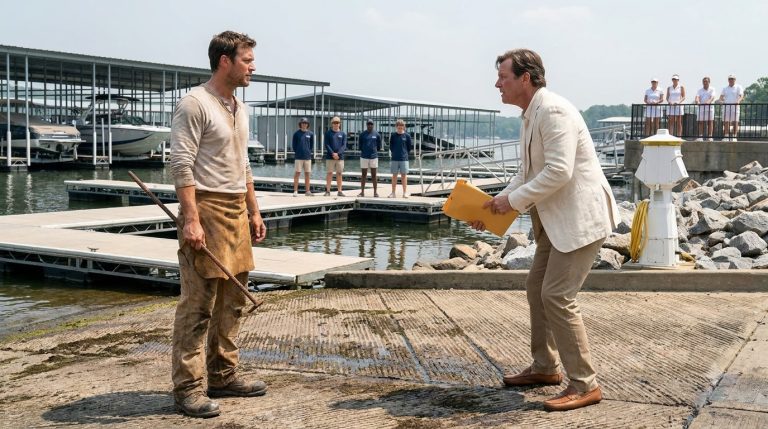
Eli stood on the edge of his dock, the wood slick with dew beneath his slippers. He didn’t shiver, though the air had a bite to it that settled deep into the joints. He watched the tow truck, a rusted behemoth that seemed to groan under its own weight as it backed slowly toward the launch ramp.
The movement was mechanical, deliberate. Two bright orange kayaks—his only real connection to the daily pulse of the lake—were already hoisted into the air. They swayed, the plastic hulls glinting with moisture, catching the dim morning light. They looked like evidence being hauled away from a crime scene.
Karen Bloom stood ten feet away, a ghost in a neon sash. The fabric screamed against the natural, muted tones of the lake, a garish yellow smear that felt like an insult to the horizon. She held a clipboard like a shield, her expression set in that permanent, practiced mask of administrative efficiency.
“Article 19, Eli,” she said, her voice cutting through the thick silence of the fog. It was thin, crisp, and utterly devoid of anything resembling warmth. “No private vessels on HOA-managed lakefronts without registered certification. We’ve discussed this in the bulletins.”
Eli didn’t turn his head. His focus was entirely on the hook as it pulled the kayaks higher, the nylon straps biting into the gunwales. His grip tightened on his coffee mug until the ceramic bit into his palm. He felt the familiar, dangerous cooling of his pulse. It was the same sensation he got when his grandfather taught him how to set a valve—a complete decoupling from the immediate, frantic urge to shout, and a sudden, sharp engagement with the math of the situation.
He didn’t see a neighbor. He didn’t even see a nuisance. He saw a variable in an equation that needed to be zeroed out.
“The water isn’t yours, Karen,” Eli said, his voice flat, barely reaching her.
“The access is,” she replied, a smirk ghosting across her lips as the truck driver killed the engine. The silence that followed was heavy, punctuated only by the drip of lake water falling from the kayak hulls onto the pavement.
Eli watched the truck shift into gear. He watched the way Karen’s sash caught the breeze, a flickering, unnatural yellow. He didn’t move to stop the truck. He didn’t yell at the driver. He simply watched the kayaks vanish behind the screen of trees, noticing for the first time the slight, tell-tale dent in the rear bumper of the truck—a piece of information that would prove essential when he decided exactly how to break the system that supported her.
He was left with nothing but his coffee, the cold morning, and a silence that felt different than it had ten minutes ago. It wasn’t peaceful anymore. It was waiting.
CHAPTER 2: THE PAPERWORK WAR
The drive to the HOA office was a exercise in controlled stillness. I didn’t turn on the radio. I didn’t reach for the heater, even though the morning chill had soaked through my shirt. Instead, I drove with my hands at ten and two, watching the familiar turns of the Silverthorn access road. Every curve in the pavement, every overgrown patch of scrub oak, was a memory of my grandfather’s labor. He had laid this foundation, literally and figuratively, ensuring that the cove remained a basin rather than a flooded disaster zone.
Karen’s “office” was a prefabricated box plopped at the end of the main clubhouse parking lot. It sat there like a malignant growth, gleaming white and aggressively sterile against the soft, mossy green of the surrounding forest.
I parked the truck and stepped out. The gravel crunched with a brittle, synthetic sound. As I walked toward the door, my mind drifted to the old valve house near the reeds. I could almost hear the low, rhythmic hum of the regulators my grandfather had installed decades ago. He had warned me once, over a game of checkers, that the lake was a sleeping beast—the moment people stopped respecting the sediment flow was the moment the water would decide it no longer wanted to stay within its banks. I hadn’t understood the gravity of his tone then, but as I stood before the glass-paned door of the HOA headquarters, the sharp edges of his warning came into focus. Karen didn’t see a flood risk; she saw a spreadsheet.
I pushed the door open. A small bell chimed, thin and annoying.
Karen sat behind a desk that looked like it had been staged for a lifestyle magazine. Her sash was draped over the back of her chair, a neon warning sign. She looked up, her expression shifting from focused to politely dismissive in a fraction of a second.
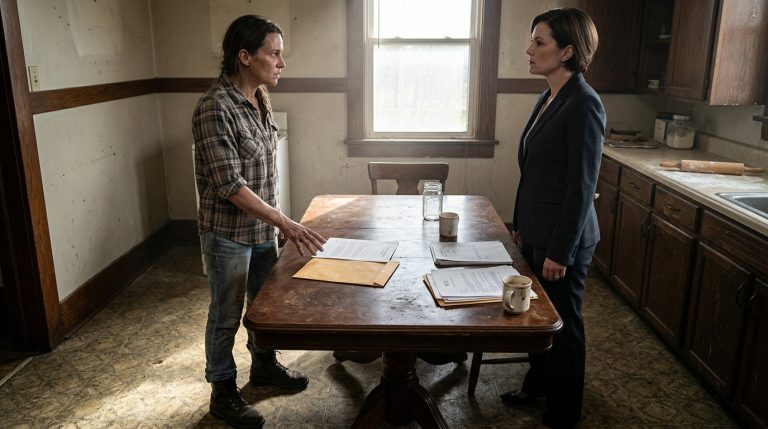
“Eli,” she said, tapping a pen against her clipboard. “I assume you’re here to discuss the removal of your private assets. As per the memo distributed last week, all private docks and shoreline-adjacent equipment must be cleared to facilitate the new aesthetic standards of the Cove.”
I didn’t sit. I leaned against the doorframe, letting the cold air from outside linger in the room. I looked at her hands—the way she held the pen, the way she clutched the clipboard. There was no tremor of uncertainty. She felt entirely in control, shielded by the thickness of her laminated rules.
“Those kayaks were on my private property, Karen,” I said. My voice was steady, stripped of the jagged edges of anger. It felt like holding a cold, smooth stone in my palm. “They weren’t on your shoreline. They weren’t obstructing your brunch patio. They were sitting on a pier that has been in my family since before this development was a blueprint.”
She offered a smile that didn’t reach her eyes—a calculated, transactional gesture. She slid a document across the desk. It was thick, bound in a plastic sleeve that reflected the overhead fluorescent lights.
“Article 19, section four, paragraph seven,” she recited, her voice a monotonous hum. “Jurisdiction over all recreational watercraft within the Silverthorn Cove perimeter is vested in the HOA board. It’s for the uniformity of the community, Eli. We’re moving toward a cohesive look. Bright colors like… neon orange… disrupt the visual harmony we’re trying to build.”
I looked at the document. I didn’t need to read it. I knew exactly how it was written: broad, ambiguous, and designed to intimidate. It was a tool of containment.
“I never signed those guidelines,” I said, my gaze shifting to the window, where the sun was beginning to burn through the fog, casting long, sharp shadows across the parking lot.
She laughed—a dry, clipped sound. “Your signature is a formality, not a requirement. The HOA holds the deed to the access rights. We own the water’s edge. If you want to challenge it, feel free to file a grievance with the committee. It takes about six months to process.”
The arrogance of it was almost surgical. She had calculated the cost of my resistance and decided I couldn’t afford the time. She looked at me, waiting for me to react, to shout, to slam my hand on her desk. She was waiting for the emotional outburst that would prove her point: that I was an unstable element, a relic of a disorganized past.
I didn’t give her the reaction.
“I see,” I said, backing away from the desk. “I appreciate the clarification, Karen. Truly.”
She blinked, confused by the lack of friction. The silence that followed was heavy, filled only by the hum of the air conditioner.
“You’re just going to leave?” she asked, a flicker of genuine curiosity breaking through her mask.
“I have a lot of work to do,” I said, turning to the door. “The lake requires a great deal of maintenance this time of year. I wouldn’t want to neglect the details.”
I stepped out into the bright, harsh morning, the screen door clicking shut behind me with a final, metallic snap. I walked back to my truck, my mind already working through the structural implications of her “cohesive look.” She thought she was building a resort. She didn’t realize she was dismantling the very infrastructure that kept her pristine patio from sliding into the mud. I climbed into the truck and started the engine. The engine’s growl felt like a promise. The war wasn’t about the kayaks anymore; it was about the math, and I was the only one in the cove who knew the equations.
CHAPTER 3: THE ANCESTRAL ARCHIVE
The silence of the cabin was different from the silence of the HOA office. Here, the air smelled of dry paper, floor wax, and the faint, sweet scent of cedar planks. I stepped inside and didn’t bother turning on the lights; the late morning sun sliced through the gaps in the window blinds, laying long, white strips of light across the floorboards.
I walked straight to the back study. My grandfather had been a man of meticulous order, a trait I’d always viewed as a harmless eccentricity until today. The study was essentially a fortress of filing cabinets. He hadn’t trusted digital clouds or modern record-keeping, believing that if you couldn’t touch the paper, it didn’t really exist.
I pulled the heavy brass key from the chain around my neck and slid it into the lock of the largest cabinet—the one labeled Cove Infrastructure: 1974-1998. The lock clicked with a crisp, authoritative sound. I pulled the drawer open. It was packed with manila folders, each neatly tabbed and cross-referenced in his tight, sloping handwriting.
I didn’t start with the folders. I started with the sediment.
I moved to the corner, where he kept a small, portable drafting table. There, under a weighted glass press, lay the original blueprints of the Silverthorn valve system. My fingers brushed over the ink lines—the precise, calculated diagrams of the spillway, the floodgates, and the hidden regulator hut. Looking at them now, the complexity of his design felt less like an engineering feat and more like a warning. He hadn’t just built a way to drain water; he had built a pressure-relief valve for an entire ecological system that the developers had chosen to ignore.
I began to sift through the folders. My hands felt clumsy, impatient. I was looking for one thing: the conservation agreement signed between my grandfather and the state environmental board.
V-4 (Unreliable Perception): A sudden, biting doubt crept into the back of my mind. What if I was misremembering? What if the agreement had expired, or worse, been legally superseded by the development expansion? I stopped, my hand hovering over a folder marked County Permits. For a second, I could almost hear his voice—a low, gravelly rasp—reminding me that people like Karen Bloom operated on the assumption that nothing exists unless it’s displayed on a permit board. If I was wrong, if the authority wasn’t absolute, the moment I pulled that lever at the valve shed, I wouldn’t be a protector. I’d be a criminal.
I breathed in, the smell of dust filling my lungs. I reached into the center of the drawer, bypassing the general correspondence, and pulled out a thick, legal-sized folder bound with a piece of faded red ribbon.
Conservation Agreement, Silverthorn Basin, Article V.
The paper was stiff, yellowed at the edges. I spread it across the drafting table, the sunlight catching the ink. I traced the paragraphs, my eyes scanning for the specific terminology Lupe had mentioned.
…the grantor retains perpetual authority over sediment control, floodgate regulation, and ecological discharge… such authority is non-transferable and supersedes any subsequent municipal or homeowner association zoning designations…
The language was archaic, sharp, and immovable. It was a lock that couldn’t be picked.
I leaned back, the wooden chair groaning beneath me. The weight in my chest, which had been there since the tow truck pulled away, suddenly loosened. It wasn’t just a right; it was a mandate. I wasn’t fighting an HOA board; I was upholding a legal obligation that they were currently in violation of by their very existence.
I checked my watch. Noon.
I stood up, closing the cabinet drawer with a soft, final thud. I knew where the gaps were. I knew where the HOA had overreached, and more importantly, I knew exactly how their “cohesive look” depended on the very water levels they were trying to regulate. If they wanted a resort, they were going to get one—but it would be one that followed the laws of the lake, not the laws of a neon sash.
I went to the kitchen and grabbed a thermos of black coffee. As I walked out the door, I took a detour through the shed, picking up the heavy iron handle used for the primary spillway lock. It was cold, heavy, and felt like a promise. The research was done. Now, the execution began. I didn’t need to be loud. I didn’t need to shout. I just needed to start the clock.
CHAPTER 4: THE VALVE SHED
The walk down to the valve shed was a trek through terrain that felt increasingly foreign. The brush had been cleared in places where it should have been thick—a sign of the HOA’s “beautification” efforts—but in doing so, they had exposed the soil to erosion. I moved silently, my boots finding purchase on the slick, rain-softened earth. I didn’t need a flashlight. The moonlight, filtered through the sparse canopy, was enough to illuminate the path I had walked a thousand times since childhood.
The valve shed was a concrete block, nondescript and aging, half-hidden by a tangle of overgrown reeds that Karen’s cleanup crews had evidently deemed “unsightly.” As I reached the structure, I paused. I laid a hand against the concrete. It was cold, damp, and felt like skin.
I slid the iron handle into the recessed slot of the main access hatch. It didn’t groan. It hadn’t been touched in years, but my grandfather had greased the gears and sealed the gaskets with a dedication that bordered on the obsessive. It turned with a smooth, metallic precision that was startling. The door swung open, revealing the subterranean steps leading down into the regulator chamber.
The air inside was stale, smelling of wet iron and deep, undisturbed earth. I descended, my heartbeat steady, echoing against the damp concrete. At the bottom, the central valve—the heart of the Silverthorn drainage system—loomed in the center of the chamber like an industrial idol. It was a massive brass wheel, oxidized to a deep, dark green.
I didn’t move to turn it yet. I stood there, letting my eyes adjust to the gloom, and noticed something that hadn’t been there the last time I checked the system. A smear of fresh, dark mud on the floor near the secondary outlet pipe. And beside it, a scattering of coarse gravel—the kind used for landscaping projects.
V-1 (Physical Discrepancy): I crouched down, the cold floor biting into my knees. The gravel didn’t belong here. This was a sealed maintenance chamber. I reached out and sifted the stones through my fingers. It wasn’t natural sediment. It was crushed granite—the exact type of decorative fill the HOA had been hauling in for their new marina.
My pulse spiked, but I forced it to settle. This wasn’t just neglect; this was deliberate. They were dumping debris into the runoff channels, potentially clogging the secondary drainage routes to keep the water levels artificially high for their “brunch patio” aesthetics. They were playing with the pressure of the entire basin, and they were doing it blindly.
I stood up and approached the main wheel. I didn’t need to force it. I had the permit, I had the legal grounds, and I had the precise knowledge of what this machine could do. I turned the wheel. One full rotation. Two.
The sound was instantaneous—a deep, resonant vibration that traveled through the floor and up into my very marrow. Somewhere far above, hidden under the surface of the lake, the heavy iron gates began to shift. The water, which had been held back by neglect and ignorance, began to surge, channeled into the regulated spillway.
I felt the shift in the pressure. It was a subtle, almost imperceptible change in the vibration of the shed, but to me, it was a thunderclap. The lake was breathing again.
I climbed back out, locking the hatch behind me with the same surgical precision. As I stepped back into the night, I looked toward the southern shore. The marina—the pride and joy of Karen’s legacy—would be the first to feel the change. As the water level dropped, the shallow foundations of their construction would be exposed, and with them, the evidence of their unlicensed, destructive dredging.
The plan was simple. I wasn’t going to fight them with memos or meetings. I was going to let the lake reclaim its own boundaries. I walked back toward the cabin, the iron handle heavy in my grip. Behind me, the sound of the water began to intensify—a rushing, hungry noise that sounded like the truth. Karen wanted a resort. She was about to find out exactly how much the lake cost to maintain.