A Cold Claim: The Measured Descent of a Small Town Into the Heat of Legal War
CHAPTER 1: The Threshold of Silence
The air in the kitchen felt heavy, pregnant with the kind of stillness that precedes a thunderstorm. I was staring at the ink of my uncle’s will, a document that had become my compass since the funeral, when the door slammed open with a violence that made the floorboards groan.
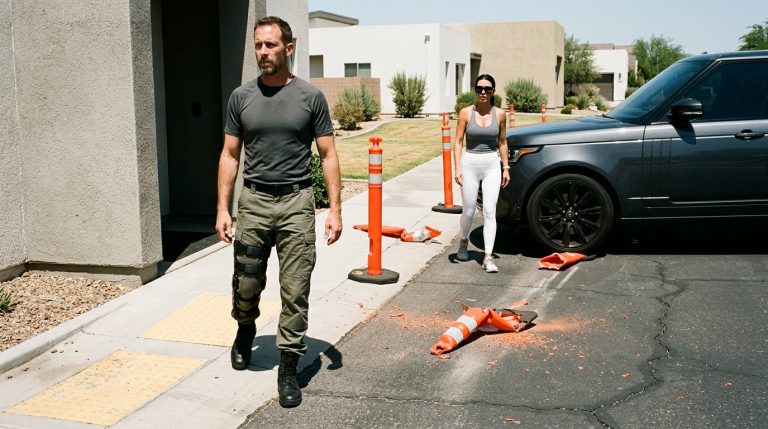
I didn’t see her approach. One moment, I was anchored in the solitude of my own home; the next, Lena Caldwell was a fixture in my kitchen, cutting through the space with an effortless, practiced arrogance. She wore the presidency of the Rigidus Valley HOA like an expensive coat—sharp, tailored, and entirely hostile to the landscape around her.
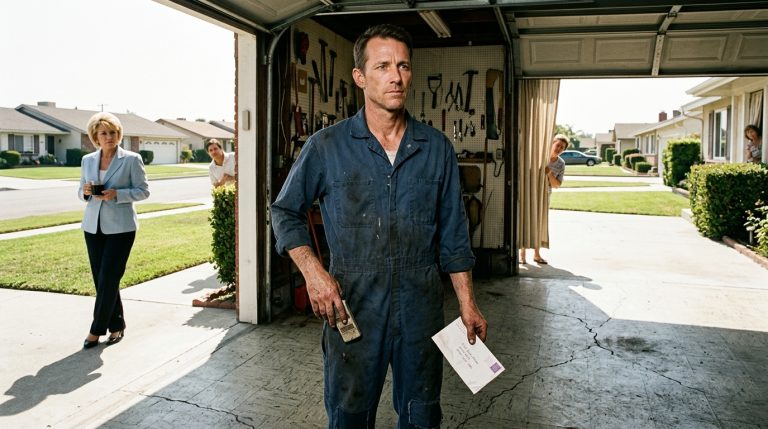
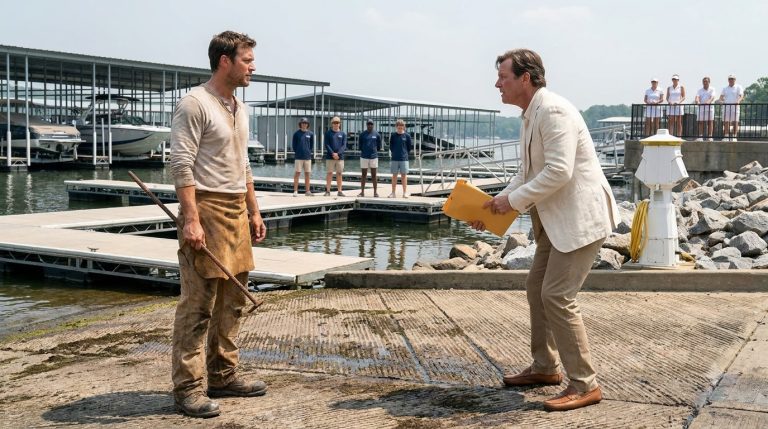
She didn’t offer a greeting. She dropped a thick manila envelope onto the table. It sat there, a tan blister on the mahogany. “This land isn’t yours,” she said, her voice a low, steady cadence that didn’t match the jagged rhythm of my pulse.
I looked at the document she pointed toward. It claimed the mineral rights had been transferred to the HOA back in 2019. I traced the signature at the bottom—my uncle’s. A cold realization settled in my chest, heavy as lead. My uncle, Roy, had been cold in the ground for six months by the time that ink had dried on the page.
I didn’t speak. I couldn’t. I watched her eyes, looking for a tremor, a shift, something that would reveal her as a human capable of remorse. There was nothing. Just the sharp, polished veneer of someone who viewed the law as a tool rather than a moral boundary.
“Sign the mineral rights over,” she continued, her gaze fixed on a crack in the wall behind me, “or we take the land in its entirety.”
The audacity hung in the air, a physical pressure. I reached out, my fingers brushing the edge of the envelope. There was a faint scent of ozone lingering in the kitchen—the sharp, acrid smell of high-voltage electronics—that felt entirely out of place in this drafty, century-old house. It was the only thing that didn’t fit. As she turned to leave, the silence that followed was louder than the door slam had been. I didn’t look at her back. I looked at the signature again, knowing with a sudden, sinking clarity that the war had already begun, and I was holding the first piece of their lie in my shaking hand.
CHAPTER 2: The Paper Wall
The silence in the kitchen wasn’t empty; it felt heavy, pressurized, like the air in a cabin just before the oxygen drops. My eyes were locked on the signature—Roy Wilson, penned in a fluid, confident scrawl that I had known my entire life. But the date on the transfer agreement, February 2019, was a knife-edge. My uncle had been buried for six months by then. The signature was a ghost, a physical impossibility that shouldn’t exist in the real world.
I stood up, the chair scraping sharply against the linoleum—a jarring sound that felt like a violation of the quiet. The smell of ozone was fading, replaced by the faint, stale scent of dust and floor wax. I walked to the window. The late afternoon sun was hitting the dry grass of the ranch, turning the landscape into a flat, washed-out expanse.
My memory flickered to the way Roy used to hold a pen—the way the callouses on his thumb would catch on the paper, the slight tremor he had in his index finger during the last winter of his life. This signature was too smooth. It was a practiced imitation, an edge carved with clinical precision. He wouldn’t have been able to make this stroke even if he had been alive.
I reached for my phone, my movements stiff. I didn’t call the police. The realization hit me with the force of a physical blow: in this valley, the law was an instrument controlled by the same hands that had forged this document. Calling the local authorities would be like walking into the wolf’s den to ask for a ceasefire.
Instead, I dialed a number I hadn’t touched in years—Sandra Vance. She was a forensic accountant, the kind of person who looked at the world in spreadsheets and tax codes, finding the truth hidden in the margins where everyone else saw only boredom.
“It’s me,” I said when she picked up. My voice sounded foreign in my own ears—hollow and steady. “I have something that needs a magnifying glass. Not a lawyer. A ledger expert.”
“I’m retired, and you’re miles away,” she replied, her tone clipped. But she didn’t hang up.
“It’s Roy’s land. And a signature from six months after his funeral.”
The silence on the other end lasted for three heartbeats, then she let out a sharp, exhaling breath. “Get it to me. Physically. Don’t scan it, don’t email it. If they’re bold enough to forge a dead man’s hand, they’re bold enough to track a digital footprint.”
I looked at the envelope on the table. The “fines” had started appearing in my mailbox like clockwork over the last month, small, nuisance-level demands—a few hundred dollars for “aesthetic violations,” another for “overgrowth.” At the time, I had assumed it was just local pettiness. Now, staring at the forged contract, I saw the pattern. The fines weren’t about the grass or the roof; they were a systemic pressure, a method of testing my threshold, a way to see how long I would hold out before I either caved or made a mistake.
I grabbed my keys. The house felt like it was closing in, the walls holding the weight of a secret that was slowly suffocating me. I checked the back door, double-locking the deadbolt. The wood was old, the frame weathered, but it was the only barrier between me and the people who felt entitled to this land.
As I stepped out onto the porch, the evening heat hit me—a dry, oppressive blanket. I caught a glimpse of the western fence line, a thin, jagged scar across the horizon. Something about the way it was constructed—the hurried, military-grade efficiency of it—felt disconnected from the slow, natural decay of the rest of the ranch. It didn’t belong. It was an intrusion of cold geometry into a wild space.
I climbed into my truck, the engine turning over with a tired, mechanical protest. I didn’t know yet that the HOA was in the middle of a massive, hollowed-out failure, a financial collapse they were desperate to paper over with oil revenue that didn’t exist. I only knew that I was holding a lie in my passenger seat, and the only way to break the machine was to take the gear apart, one piece at a time. I put the truck in gear and pulled away, the tires kicking up gravel that sounded like gunfire in the absolute, unnatural quiet of the valley.
CHAPTER 3: The Western Boundary
The road to the western boundary wasn’t so much a thoroughfare as a suggestion of travel, rutted deep by years of neglect. As I drove, the engine’s idle was the only sound, until the road curved sharply around the old oak grove, and the rhythm of the drive was abruptly shattered. A freight train was idling at the crossing, a wall of rusted, graffiti-streaked steel that stretched into the haze of the afternoon.
I cut the engine. The silence that rushed back in was absolute. I leaned my head against the steering wheel, the cool metal a sharp contrast to the humid, stagnant heat radiating through the windshield. The delay was a physical weight. I checked my watch—two minutes, four, then ten. The train didn’t move. It was as if the valley itself had seized up, refusing to let me reach the edge of my own land.
When the tracks finally cleared, the screech of steel on steel sounded like a dying animal. I drove through the crossing, my hands white-knuckled on the wheel. Five minutes later, the ranch’s western edge came into view, and the blood drained from my face.
It wasn’t just a fence. It was a barricade.
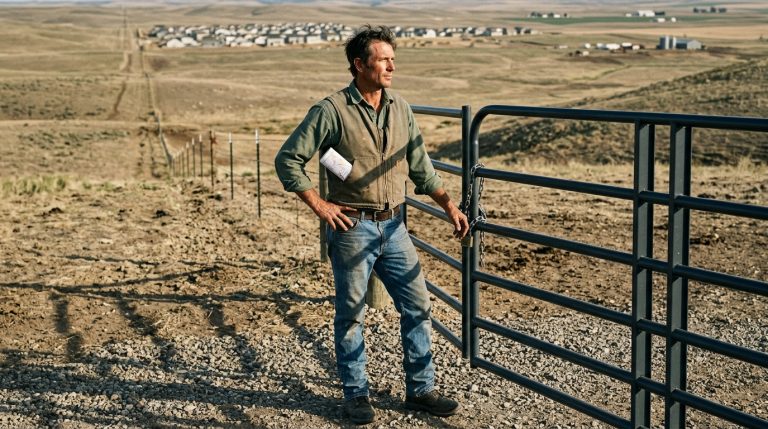
A chain-link structure, topped with a lethal curl of razor wire, sliced through the landscape where the pasture used to be. It looked alien, a jagged, silver scar standing in defiance of the soft, rolling hills. The signs were fixed at perfect, intimidating intervals: Rigidus Valley HOA Authorized Zone – No Trespassing – Restricted Access.
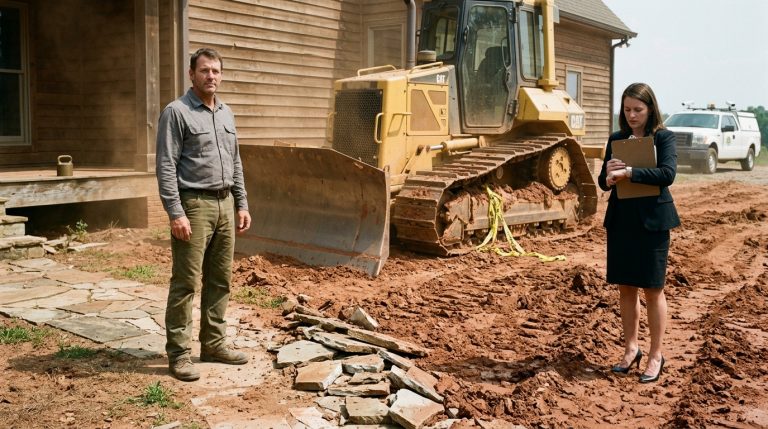
The fence was taut, the steel posts driven deep into the earth. It had the look of something erected overnight, a surgical strike on my property line. Beyond the fence, the landscape had been violated. A series of heavy, yellow drilling rigs dominated the skyline, their hydraulic limbs poised over the soil like predatory insects. The air carried the metallic, oily stench of industrial lubricant, thick and unnatural against the dry, sage-scented wind.
I stepped out of the truck, the crunch of gravel beneath my boots sounding unnaturally loud. I needed to know, to see the scale of it. I walked toward the perimeter. My phone felt heavy in my pocket, a fragile tool of resistance. I pulled it out, the screen cool against my palm, and began to document.
I photographed the equipment—the heavy-duty transport trucks, the workers in their bright, high-visibility vests moving with the mechanical indifference of cogs in a machine. They weren’t just drilling; they were colonizing.
“Hey! You’re on private property!”
The voice was amplified, a mechanical bark that made me flinch. A man in a hard hat was standing fifty feet away on the other side of the fence, staring at me through the wire. He didn’t look like a construction worker; he looked like a guard. His posture was static, vigilant.
“This is my land,” I shouted back, my voice cracking slightly.
He didn’t blink. He just raised a radio to his mouth, speaking into it with a calm, practiced detachment. “We have an unauthorized individual at the western perimeter. Sector Four. Advise.”
The coldness of it was what hit me hardest. There was no argument, no attempt to explain, no human confusion. Just a report, a coordinate, and a status update. The man turned his back on me and walked toward the nearest rig, leaving me standing in the dust of my own property, staring at a wall of steel that had turned my home into a contested zone. I retreated to the truck, my pulse hammering a frantic, uneven rhythm in my throat. This wasn’t just a land grab; it was an occupation. And as I turned the key, I realized the fence wasn’t there to keep me out—it was there to keep me from seeing what they were actually doing to the foundation of the valley.
CHAPTER 4: The Recluses Warning
The gravel driveway of Gene Hollister’s property was overgrown, the weeds reaching up to scrape the undercarriage of my truck like skeletal fingers. I killed the engine, but the silence didn’t feel peaceful this time; it felt expectant, like the quiet of a room after someone has stopped shouting. The house was a low-slung, weather-beaten structure that seemed to be actively sinking into the arid earth. Every plank of wood was grayed by sun and neglect, and the windows were dark, reflecting nothing but the relentless glare of the afternoon sky.
I sat for a moment, the steering wheel slick under my palms. My heart was a erratic, dull thrumming against my ribs. I thought about the man at the fence, the cold, radio-controlled efficiency of his demeanor. That wasn’t just a guard; that was a symptom of a larger, systemic malaise that had metastasized through the valley.
I got out. The heat was a tangible weight, pressing down on my shoulders. I approached the front door, the wood warped and splintered. Before I could even raise my hand to knock, the door opened a crack. It didn’t swing wide. It was held by a heavy-duty chain, leaving a narrow, dark sliver of space. Through it, I saw the glint of steel—a shotgun barrel—and the hard, narrow squint of an eye that had seen far too much.
“Roy Wilson’s nephew,” the voice grated out, more of a vibration than a sound. It wasn’t a question.
“I need to talk,” I said, keeping my hands visible, my voice measured. I didn’t want to be an intruder; I wanted to be a mirror. “The fence at the western boundary. The rigs. They aren’t just drilling, Gene.”
He looked at me, really looked at me, for the first time. The eye didn’t soften, but the gun barrel lowered an inch. “You’re late,” he muttered, but he didn’t unlatch the chain. “Thought you’d have been here before the steel went up. You’ve got more of your uncle’s stubbornness than I gave you credit for.”
“They’re calling it an authorized zone. They’re using my land to fuel something that doesn’t belong here.”
“That land’s been spoken for since the day the first HOA board was sworn in,” Gene said. He shifted, his shadow looming large in the hallway behind him. “Folks around here, we don’t ask about the holes they’re digging because we’re too busy trying to keep our own rooftops from caving in. You start poking at the dirt in this valley, and you’ll find out real quick that the soil’s poisoned.”
I leaned in, my voice dropping. “My uncle didn’t sign those rights away. They forged the dates. I have proof of the impossibility. They’re running a game, Gene. I just need to know why they picked this spot.”
Gene let out a dry, hacking laugh that sounded like dry leaves skittering over pavement. “Why? Because it’s the only place left where the records are still buried in paper, son. Electronic systems have logs. Paper? Paper burns, or it gets moved to a storage unit that nobody audits. Talk to the clerk. But watch yourself. You aren’t just fighting a neighbor anymore. You’re fighting a shadow that’s grown thick enough to choke the life out of this entire county.”
He slammed the door shut, the bolt sliding home with a final, echoing click. I was left standing on his porch, the smell of dust and stagnant air filling my lungs. I reached into my pocket and touched the folded documents I’d gathered earlier—the tax records I’d managed to copy at the clerk’s office before they caught on to my interest. There was a payment address listed on the most recent assessment—a P.O. Box in a district that didn’t exist, linked to a company name that was nothing more than a string of vowels.
The realization settled in, chilling me despite the heat. This wasn’t just about the oil. It was about the paper trail. They were moving money—massive, irregular chunks of it—under the cover of property improvements and “shared maintenance.” Every fine they issued me was just another drop of grease in the gears of a much larger, darker machine. I turned away from the door, the weight of the mystery pressing into my back like a physical load, and headed back to my truck, the path forward suddenly, terrifyingly clear.
CHAPTER 5: The Paper Trail
I didn’t head straight home. The isolation of the ranch, with its long, vulnerable driveways and lack of neighbors, suddenly felt like a tactical mistake. Instead, I drove until the paved roads of the county seat gave way to the dense, fluorescent-lit rows of the commercial district. I found a corner booth in a diner that smelled of burnt coffee and industrial cleaner—a place where no one looked twice at a man sitting alone with a thick, ominous folder of paperwork.
I laid the documents out. My hands were steady, but the rest of me felt frayed, like a rope pulled past its breaking point. I started with the tax assessments. They were masterclasses in bureaucratic obfuscation. The shell company—Veridian Core Holdings—was listed as the primary contractor for “shared infrastructure maintenance” for the entire valley. Every time the HOA issued a fine for “aesthetic violations” or “fencing upgrades,” the money flowed directly into Veridian’s accounts.
I looked at the dates. The payments were perfectly timed to coincide with the HOA’s aggressive expansion of their “authorized zones.” They weren’t just taking land; they were cycling public funds into private coffers, using the HOA’s legal leverage as a vacuum to pull equity out of every property owner in the valley.
For a moment, the columns of numbers started to swim. I leaned back, rubbing my eyes until stars danced in my vision. Was I hallucinating the pattern? Was the exhaustion of the last seventy-two hours playing tricks on my mind, turning innocent accounting errors into a grand conspiracy? No. I looked again, and the logic was iron-clad. The math was too clean. The irregular, recurring payments to Veridian stopped exactly on the days the HOA board held their closed-door “emergency sessions.”
I had been so focused on the oil, on the idea that they were drilling for wealth, that I had missed the simpler, more brutal reality. The drilling rigs weren’t there to find oil. They were there to create the pretext for development. They were creating a reason to seize land, to justify massive, un-audited infrastructure spending, and to move the county’s capital into their own hidden accounts before the state could realize that the Rigidus Valley HOA was essentially insolvent.
A shadow fell over my table. I instinctively covered the documents with my arms, my heart hitting a jagged beat.
“Refill?”
The waitress was standing there, a tired woman with a name tag that read Carol. Her gaze drifted toward the folder for a fraction of a second too long. She didn’t look malicious, just weary, the kind of person who had learned long ago that the best way to survive in this town was to look at the floor and never ask about the people who sat in the back booths.
“No, thank you,” I said, my voice tighter than I intended.
She turned away, but the moment had broken my focus. I started packing the documents, each one feeling heavier than the last. I needed to move. Every minute I sat here was a minute they could be tracking my car, or watching the clerk’s office to see who had requested the files.
As I walked out to the parking lot, the night air felt different—thinner, colder. I checked the street behind me. The empty expanse of the parking lot was illuminated by flickering streetlights that cast long, distorted shadows across the asphalt. I kept my head down, my pace brisk. I was halfway to my truck when a black SUV, headlights off, glided into the lot from the far entrance.
It didn’t stop in a parking space. It slowed, the engine a low, rhythmic growl, and began to circle the perimeter, its path surgical, purposeful. My pulse was a physical presence in my ears, a thundering warning. They weren’t just watching; they were hunting. I reached my truck and slid inside, my movements fluid and practiced. I didn’t turn on the headlights until I was already on the main road, disappearing into the dark, jagged silhouette of the valley, a ghost in a machine that was finally beginning to understand how to tear itself apart.
CHAPTER 6: The Shredders Light
The canyon road was a ribbon of cracked asphalt draped over the spine of the valley, and the SUV was a shadow tethered to my rear bumper. My hands were locked onto the wheel, my joints aching with the strain. Every time I hit a curve, the headlights of the pursuit vehicle sliced through my rearview mirror, blindingly bright, turning the cabin into a cage of harsh, strobe-like light.
I didn’t dare push the speed. The road was a treacherous, narrow thing, littered with the debris of neglect. I knew every hairpin turn and every soft shoulder. The SUV, however, was testing me, surging forward on the straightaways, its engine high-pitched and strained, then falling back with chilling precision. They weren’t trying to crash me; they were herding me.
My destination wasn’t home. Home was a trap now. I swerved right, tires screaming against the loose gravel as I cut onto a service road that led toward the old community center. The transition was violent, the truck bucking as it hit the unpaved surface. Dust clouds erupted in my wake, momentarily cloaking my movements. I killed my lights, relying on the moonlight that silvered the dry scrub brush, and kept the pedal floored.
The community center building sat like a tomb in the middle of the dark, its windows boarded up and its parking lot empty save for a single white van parked near the back, tucked into the deepest shadow of the loading dock. I didn’t slow down. I cut the ignition a hundred yards out and let the truck’s momentum carry me into the dense treeline, the crunch of dry foliage echoing like gunfire before I came to a dead stop.
I sat in the dark, my breath ragged, listening. The SUV had overshot the turn, its tires skidding on the asphalt before it braked, reversed, and crept back toward the center’s entrance.
I grabbed my camera—the only weapon I had. I crept through the brush, the thorns tearing at my jacket. Every snap of a twig felt like a scream. I reached the edge of the parking lot and crouched behind a rusted dumpster, my skin prickling. Three men had emerged from the white van. They weren’t wearing masks, which told me everything I needed to know about their confidence in the valley’s lawlessness. One of them was Ray Bledsoe, the county councilman. His face, caught in the dim light of a handheld lantern, was tight with a frantic, sweating desperation.
They were hauling heavy plastic boxes out of the storage unit—the kind that held thousands of pages of records. Bledsoe was gesturing wildly, his voice muffled by the distance, but the frustration was palpable. He kept pointing at his watch.
I framed the shot. The shutter click sounded like a thunderclap in the stillness. I froze, my heart stopping, but the men didn’t react. They were too focused on the task, too convinced of their own untouchability. I snapped three more photos, capturing the faces, the boxes, the clear HOA logos on the side of the unit. This was the raw, jagged truth—the paper trail they were trying to incinerate before it could lead to the insolvency audit.
Bledsoe reached into a box, pulled out a thick stack of ledger pages, and shoved them into a portable, industrial shredder that was set up on a folding table. The whine of the machine was high and ugly, a thin, mechanical screech that shredded the history of the valley into confetti.
As I watched, a sudden, cold realization settled in: these weren’t just financial records. They were land titles. I saw a flash of my own name on a document being fed into the teeth of the machine—a property tax assessment that had been altered.
I needed to move, but as I adjusted my weight, my boot slipped on a patch of slick, loose shale. I stumbled, my hand catching the edge of the dumpster. The metal groaned—a loud, screeching protest.
The three men froze. The shredder continued its monotonous, hungry whine for a second, then clicked off. Silence rushed back in, heavy and suffocating. Bledsoe spun, his flashlight beam cutting through the darkness, sweeping across the lot like a lighthouse searchlight. The beam hammered against the trash bins, the fence, and finally, it started to crawl toward my hiding spot. I felt the heat of the light as it swept over my shoulder. I was pinned. I wasn’t just observing the crime anymore; I was part of the scene, and for the first time, I realized that catching them in the act had put a target squarely on my back.
CHAPTER 7: The Crucible
I didn’t wait for the beam to find my eyes. I shoved off the metal side of the dumpster with every ounce of strength in my legs, the sound of my boots slamming into the asphalt acting as the starting pistol for a chase that I knew I couldn’t win on foot.
“There! By the bins!” Bledsoe’s voice was a jagged tear in the night.
I hit the darkness of the service alley, my lungs burning, the taste of metallic grit filling my throat. I didn’t look back. I heard the scuffle of heavy boots on gravel, the frantic slamming of vehicle doors, and the roar of the SUV’s engine as it surged forward, tires spinning wildly on the loose dirt. I dove toward the only cover available—a dense patch of overgrown briars bordering the property. The thorns raked across my jacket, tearing through the fabric, but I barely felt it. Adrenaline had turned my nervous system into a wire stretched to the snapping point.
I scrambled through the brush and vaulted the low back wall of the community center, landing in a heap of discarded crates in the rear storage yard. My head hit the concrete hard. For a heartbeat, the world went white. I lay there, gasping, my hand clawing at my pocket to ensure the camera was still there. It was. The evidence of their destruction, of their conspiracy, was pressed against my hip.
The SUV rounded the corner of the building, its headlights sweeping over the alleyway in a blinding, rhythmic arc. I pressed myself flat against the ground, tucked into the deepest shadow cast by the foundation. I heard the doors open.
“Split up,” a voice—Caldwell’s, cold and authoritative—commanded. “He’s got the drive. If he gets to the main road, we’re finished. Don’t worry about the noise—just get it back.”
I watched them move past my hiding spot, their flashlights dancing like restless, starving ghosts. They were so close I could hear the rasp of their breathing, the rhythmic click of their safety catches being disengaged. I was trapped. To head for my truck was suicide; to stay here was an invitation to be found.
Then, I looked up. The community center’s ventilation shaft was partially pried open, the metal cowling rusted through and hanging by a single hinge. It was an impossible climb, but the alternative was the end of the line. I stood, my legs wobbling, and lunged for the brickwork. I found a grip on the rain gutter, the cold metal digging into my fingers, and hauled myself upward. My boots scraped the brick, the sound of grinding stone amplified in the silence.
They turned. The light beam hit the wall, inches below my dangling feet.
“He’s on the wall!”
I didn’t think; I pushed. My muscles screamed as I shoved my body through the narrow gap into the pitch-black interior of the building. I tumbled down a metal chute, hitting the concrete floor of the main hallway with a bone-jarring impact. I scrambled to my feet, my flashlight flickering on to reveal the hollow, echoing cavern of the community hall.
I didn’t stop. I ran for the front doors, my footsteps thundering across the hardwood. I burst outside, not into the parking lot, but into the center of the town square, right under the streetlamp where the local police patrol usually made their midnight rounds. I stood there, gasping, my clothes torn, my body shaking with the sheer kinetic energy of the escape.
The town square was empty. But then, a pair of headlights flickered to life at the far end of the street—not the HOA’s black SUV, but the blue-and-white cruiser of the county sheriff. I raised my hands, the camera held high like a beacon, and shouted into the silence. I wasn’t running anymore. I was delivering the end of their world.
CHAPTER 8: The Quiet After
The cruiser’s doors opened with a crisp, metallic snap. Sheriff Miller stepped out, his expression unreadable, framed by the rhythmic pulse of the overhead light bar. I didn’t drop the camera. I held it out—a small, plastic square that suddenly felt heavier than a mountain.
“Mr. Wilson,” Miller said, his voice flat. He didn’t look at me, but at the storage unit behind me, where the last wisps of smoke from the industrial shredder still curled into the night air.
I handed him the camera. “Everything’s on here. The forged signatures, the shell company payments, the destruction of evidence. Bledsoe and the others are still inside the lot.”
Miller took the device with a gloved hand. He didn’t offer a platitude. He just nodded to his deputy, who moved toward the alley with a practiced, heavy-footed caution. The standoff lasted minutes, though it felt like a lifetime. Within half an hour, the square was teeming with activity—not the chaotic, fearful scramble of the HOA’s enforcers, but the methodical, cold precision of state investigators.
Watching Bledsoe being led away in handcuffs, his expensive suit rumpled and his face pale with the dawning realization of his own ruin, felt less like a victory and more like a necessary clearing of debris. Warren Caldwell arrived an hour later, his confidence evaporating the moment he saw the federal seals being taped to the community center’s doors. He didn’t shout. He didn’t plead. He simply stood there, a man whose manufactured authority had been stripped away, leaving only the hollow, frightened frame of a criminal.
The final realization didn’t come in the courtroom or during the interrogation. It came a week later, when the state audit of the Rigidus Valley HOA was finally made public. It wasn’t about oil. It was never about oil. The “drilling rights” had been a fiction designed to funnel millions from state infrastructure grants into Veridian Core Holdings, a shell entity used to pay off the personal debts of the HOA board. The HOA was effectively bankrupt, its books a labyrinth of fraud that would take years to fully unwind.
As the weeks passed, the valley began to change. The fence at the western boundary was dismantled, the steel posts pulled from the earth like rotting teeth. The drilling rigs were hauled away, leaving behind scarred, empty circles in the dirt that began to fill with the slow, green creep of native wildflowers.
I returned to the ranch one quiet afternoon, the sun low and casting long, golden fingers across the porch. The house felt different now—no longer a bunker, but a home. I took the old survey compass I had found in my uncle’s desk—the one that had felt so heavy when the chaos was at its peak—and placed it on the kitchen table. The glass was cracked, but the needle still swung north, true and steady. I spent the afternoon repairing the hinge on the back door, the rhythmic clink of the hammer against the metal the only sound in the vast, open silence of the land.
The fear that had held the town in a vice-like grip had dissipated, replaced by a tentative, fragile relief. People started coming by again, offering quiet nods or short, halting words of acknowledgment. They were still careful, but they were no longer looking over their shoulders.
I stood on the porch, my hands clean, the hammer resting beside me. The struggle had cost me, but it had yielded a clarity I hadn’t known I was missing. I hadn’t saved the land for the sake of its value; I had saved it for the sake of its stillness. The corruption, the forged papers, and the tactical paranoia were gone. In their place was the wind, the smell of dry sage, and the certain, quiet knowledge that the truth, when held steady, is the only thing that can truly anchor a man to his home.