The Architect of Silence: A Journey Toward Reconciliation Within the Cold Steel of Command
CHAPTER 1: THE GATE
The Virginia sun was an unforgiving light, bleaching the color out of the navy blue dress uniforms surrounding the Grand Naval Parade Grounds. I stood outside the perimeter, a shadow in a coat that felt too heavy, watching the sea of families—mothers with flowers, fathers with chests puffed out like they were breathing in their own legacies.
I adjusted the strap of my bag. It wasn’t full of documents or medals; it was full of the quiet, precise data that had kept the Gulf task force from going dark last year. The petty officer at the security gate tapped at his tablet, his movements sharp, practiced. He was trying to find “Cartwright” on a list where I didn’t belong.
“Sorry, ma’am,” he said, his voice dropping into that rehearsed tone of automated dismissiveness. “You’re not on the guest list for Commander Marcus Cartwright.”
I didn’t feel the sting. I felt the friction—a memory of sitting on the back steps at eight years old, watching Marcus learn how to shine his boots until they caught the sun. My father had stood over him, hands clasped behind his back, a silent sculptor carving a son out of polish and discipline. I had held the tin. I had waited for the nod that never came.
“I understand,” I said, my voice steady.
Behind the gate, the world was a blur of cream blazers and polished smiles. There was Marcus, the family jewel, walking with the kind of practiced ease that only comes from being told you are the center of the orbit your entire life. He passed the gate without glancing at me, his stride unbroken, his gaze fixed on the stage.
Then, I heard it. “Leah forgot to RSVP. Some people never learned the chain of command.”
It was a soft murmur, meant for his wife, but it carried in the still air. I almost laughed. I had spent a decade operating in the gaps of that chain, rewriting the protocols that kept him safe while he played the lead in the parade. I reached into my pocket, my fingers brushing the cool, rounded edge of the metal polish tin I still carried as a penance. The metal felt cold, grounding.
A black government SUV pulled to the curb, the engine purring with a silence that demanded attention. The window slid down, and for the first time that day, the air around the gate felt thin. Admiral Rayburn looked out, his eyes like flint, before turning his gaze to the young officer.
“Stand down, Enson,” he said, his voice a low, heavy vibration. “She’s not on your list because her clearance outranks yours.”
The Enson’s hand twitched, his clipboard clattering to the pavement. I let the coat slip, the deep navy of my own formal dress finally catching the morning light, revealing the twin stars that sat heavy and earned on my shoulders.
I looked at the gate, then at the sprawling, artificial perfection of the parade. The secret wasn’t that I was here; the secret was that the script they had written for me had already been discarded. And as I stepped forward, I realized the most unsettling truth of all: I was no longer waiting for their invitation. I was here to rewrite the entire day.
CHAPTER 2: THE PARADE
The final chord of the national anthem hung in the humid Virginia air, a metallic resonance that seemed to vibrate against the very stone of the parade grounds. I didn’t move. My hands remained folded in my lap, the fabric of my dress blues smooth and unyielding against my skin. Around me, the ritual of the ceremony began to reassert itself, a frantic, unspoken recalibration.
I could feel the heat radiating from the crowd, a collective, stifled breath. A junior lieutenant, positioned three rows back, had been staring at my shoulders for the better part of three minutes, his eyes darting between my twin stars and the clipboard still resting near his feet on the grass. He was waiting for a cue, a command, or perhaps an excuse to look away. I didn’t provide one. I kept my gaze fixed on the podium, where my brother, Marcus, stood—a portrait of practiced, textbook poise.
But it was fraying.
I watched the way his jaw muscles worked, a rhythmic, subtle pulsing that I recognized from childhood. It was the “script-break” twitch. Whenever the reality of a situation diverged from the narrative he had carefully constructed, his body betrayed him. He looked out over the crowd, his smile fixed with the structural integrity of thin glass, but his eyes were searching. He was looking for the parents, for the retired admirals, for anyone who could tell him how to process the fact that I was sitting in the front row, not as an invited guest, but as an authority who outranked him.
“Admiral,” a voice whispered.
It was Admiral Rayburn, leaning in from the seat to my right. His presence was a quiet anchor. He didn’t look at me; he looked straight ahead, his posture as rigid as a bulkhead. “The Vice Admiral is expecting a preliminary briefing before the reception begins. Are you prepared to move?”
I didn’t answer immediately. I took a slow, measured breath, grounding myself in the texture of the moment—the faint, lingering smell of hot pavement and expensive, floral perfume from the women in the rows ahead. This was the stage they had built, the one where Marcus was the hero and I was the ghost. But the ghost had arrived in uniform, and the stage was beginning to tilt.
“I am,” I said, my voice low. “But not yet.”
I turned my head slightly, catching the profile of Marcus’s wife, Lauren. She was sitting two chairs over from Marcus’s designated spot. She caught my eye, and for a fraction of a second, her composure faltered. Her gaze dropped to the polish tin still heavy in my pocket. I hadn’t realized I was thumbing it, the metal cool and reassuring under my thumb. She looked away quickly, turning her attention back to the ceremony, but the damage was done. The performance had a flaw.
The master of ceremonies stepped to the microphone, his voice booming across the lawn. “And now, to conclude our commemoration of the Atlantic Strike Division’s leadership, we recognize the commitment of the families who anchor our resolve.”
It was a generic transition, designed to celebrate the stoic, supportive families. It was the moment where my mother usually straightened her blazer and my father stood with that proud, narrow-eyed squint. I shifted in my seat, the movement subtle, almost reptilian. I wasn’t going to stand. I wasn’t going to be part of the “anchor.” I was here to be the current.
I watched my father stand. He was wearing his old captain’s uniform, the medals slightly tarnished, the wool feeling the weight of the years. He scanned the crowd, his eyes landing on me. There was no warmth in his look, just a raw, unvarnished shock that he couldn’t quite mask. He looked at me, then at the stars on my shoulders, then back to the stage. He blinked, a sharp, sudden movement, as if he were trying to adjust his own vision to accommodate a light that was too bright.
Marcus looked down from the podium, his gaze tracking our father’s focus. He saw me. His smile, that recruitment-poster perfection, faltered. It didn’t break entirely, but the edges began to curl, to look tired, artificial. He took a half-step back, his hand gripping the edge of the wooden lectern until his knuckles turned white.
The silence that followed was not the respectful silence of a ceremony. It was the silence of a structure undergoing stress. I sat perfectly still, my presence a physical weight in the front row. I wasn’t challenging them—not yet. I was simply occupying the space they had denied me for a decade.
I looked at my brother, not with resentment, but with the clinical distance of a strategist. He was a man who had built his life on the expectation of being the best, the brightest, the most decorated. He had never had to survive the silence. He had never had to forge a name in the dark, away from the applause and the cameras. And now, he was realizing that he didn’t know how to operate in a world where I was no longer the background noise.
“The ceremony is concluding, Admiral,” Rayburn murmured again.
I nodded, my resolve hardening. I would give them their moment. I would let the applause wash over Marcus, let the photographs be taken, and let the masks remain firmly in place for a few minutes longer. But when the dust settled on this parade ground, the narrative they had spent twenty years writing would be rewritten. I wasn’t going to ask for their validation. I was going to force them to look at the reality of who I had become, and for the first time in their lives, they would have to find a way to exist in my shadow.
I stood up, the movement fluid and precise. The chair behind me scraped against the pavement, a harsh, grating sound that drew a dozen eyes. I didn’t glance at them. I straightened my jacket, felt the weight of the twin stars, and walked toward the aisle. My parents were ten feet away. Marcus was still on the stage, the master of ceremonies gesturing for him to come down.
I stopped near the edge of the walkway. The path was clear, but it was crowded with the people who had erased me. I took one last look at the pristine, white-chair arrangement of the parade grounds—a stage built for an old, dying truth. Then, I stepped into the aisle, and the crowd, seemingly against their own will, began to part.
CHAPTER 3: THE AFTERMATH
The parting of the crowd wasn’t a gesture of respect—it was an admission of confusion. I walked with a measured, consistent gait, my heels clicking against the stone path, each sound amplified in the strange, expectant silence that trailed behind me. I didn’t look at the faces of the officers I passed. I knew what they were doing: assessing the stars on my shoulder, cross-referencing my presence with their internal registers of who “belonged” in the front row, and failing to find a match.
I reached the edge of the reception lawn, where the noise returned in a sudden, jarring wave. The clink of crystal, the murmurs of polite congratulation, and the distant, rhythmic thrum of the military band all converged. It was the “champagne foam” environment, as I had once thought of it—bright, noisy, and intentionally superficial.
“Admiral Cartwright.”
I stopped. The voice was smooth, familiar, and belonged to someone who had spent the last five years in my peripheral vision. I turned to see Commander Elias Vance. He had been a classmate at Annapolis, a man who had excelled in the traditional command tracks while I was busy learning how to dismantle them. He held a glass of water, his eyes flicking to my uniform with a mixture of professional curiosity and genuine disorientation.
“Commander,” I replied, my tone neutral.
“I have to admit,” Vance said, his smile failing to reach his eyes, “this wasn’t on the schedule. Word in the wardroom was that you were… otherwise occupied with private sector consulting.”
“The wardroom hasn’t had accurate data on my deployments for a long time, Elias,” I said. It wasn’t a boast. It was a statement of fact.
He took a slow sip, his gaze lingering on the insignias. “Marcus didn’t mention you were coming. He’s been… well, he’s been a bit overwhelmed today. It’s a big step for him.”
“It’s a promotion,” I corrected, my voice steady. “It’s a change in responsibility, not a change in character.”
Vance’s smile thinned. He was looking for the version of me he remembered—the quiet student who avoided the spotlight—but he couldn’t find the seams to fit me into that narrative anymore. “You’ve changed, Leah.”
“I’ve grown,” I said. “There’s a difference.”
Before he could respond, I saw them. My parents were standing near the periphery of the refreshment table, my mother carefully adjusting her pearls, my father staring at the horizon with that rigid, jaw-clenched posture I knew all too well. Marcus was with them. He was leaning in to say something to his wife, his movements jagged, uncharacteristically restless. He wasn’t the center of the orbit anymore; he was a man struggling to keep his footing on a shifting floor.
I nodded once to Vance—a dismissal that wasn’t a slight, but a closing of a file—and began to move toward them. As I approached, the distance between us seemed to stretch, a long, exposed stretch of lawn that felt like walking through the aftermath of an explosion.
I heard my mother’s voice first, low and sharp. “—didn’t tell us, Marcus. You said she’d moved on.”
“I thought she had,” Marcus whispered back, his voice brittle. “I haven’t spoken to her in three years, Mother. How was I supposed to know she was in the Pentagon’s pocket?”
I reached them just as Marcus looked up. The look on his face was a volatile mixture of resentment and genuine fear. He wasn’t just worried about his status; he was worried about the collapse of the world he had mastered. He saw me, and his hand moved to his tie, a nervous, habitual gesture that signaled a complete loss of composure.
“Leah,” my father said. It wasn’t a greeting. It was an acknowledgment of an anomaly. He stood straight, his old captain’s uniform seemingly straining against his sudden rigidity. He looked at me, then at the crowded lawn, his face reddening. “You’ve caused quite a scene.”
“I was invited by the Admiral,” I said, my voice cutting through the ambient noise of the party. “If my presence is a disturbance, it’s only because you weren’t prepared for the reality of my service.”
Marcus took a step forward, his jaw tight. “Service? Is that what you call it? Showing up unannounced to a ceremony you weren’t part of? That’s not service, Leah. That’s theater.”
I looked at him—really looked at him. I saw the tremor in his hands, the way he shifted his weight to hide his uncertainty, and the way he looked to our father for an cue that wasn’t coming. He was a man who had been fed a diet of praise and certainty his entire life, and now, he was starving because he couldn’t grasp the truth: that I hadn’t come to compete with him. I had come to show him that the game he was playing was obsolete.
“I’m not here for your theater, Marcus,” I said, my voice barely above a whisper, yet loud enough to silence the immediate area. “I’m here because the orders I’m currently processing require a level of integration that your division hasn’t even considered. We aren’t competing for the same space anymore.”
My father moved to intervene, but I didn’t let him. I turned to my mother. She was watching me, her expression a fragile mask of confusion. She didn’t know how to relate to a daughter who wasn’t “undecorated.” She didn’t know how to speak to a woman who had spent a decade building a career in the absolute silence of high-level intelligence.
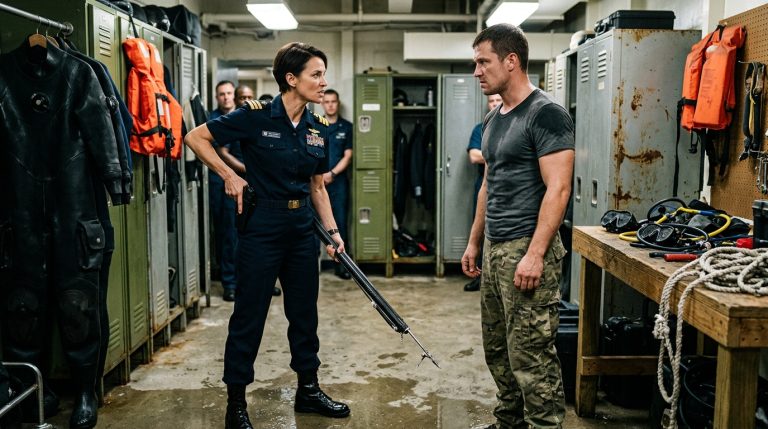
“I’m leaving,” I said. “But not because I was asked to. I’m leaving because I have work to do—real work. Marcus, when you’re ready to discuss the reality of the Pacific Hybrid Operations unit, let me know. I’ll be at the Pentagon.”
I didn’t wait for his answer. I didn’t wait for my father to regain his command presence. I turned, feeling the weight of their combined, confused gazes, and walked away from the lawn. I could feel the tension radiating off them, a pressure building in the air, but I didn’t look back. I had set the foundation, and now, the structure would have to hold under the weight of the truth.
CHAPTER 4: THE PENTAGON
The transition from the open, sun-bleached expanse of the parade grounds to the climate-controlled sterility of the Pentagon was like stepping into an entirely different dimension of reality. Here, the air tasted of ozone and filtered circulation, and the walls—brushed concrete and industrial glass—offered no quarter for human warmth. As I walked down the long, linoleum-lined corridors, the sound of my own footsteps was the only rhythm I cared to maintain. Each strike of my heel was deliberate, measuring out the space I had carved for myself in a building that had spent years trying to pretend I didn’t exist.
Every gaze I encountered was a calculation. I saw senior officers pause mid-conversation, their eyes drifting toward my rank insignias, the familiar flicker of realization—the “who is she?” moment—passing over their faces. I kept my head leveled, my posture consistent with the internal gravity of my own goals. I wasn’t here to be observed. I was here to be the observation.
I reached the secure entrance to the Pacific Hybrid Operations wing, tapping my clearance card against the reader. The light turned green with a soft, clinical hum, and the heavy door hissed open. Inside, the office was as I had left it: quiet, efficient, and devoid of the performative clutter that defined so many other command centers in the building. There were no flags leaning against the corners, no framed photos of dignitaries, no trophies of past appointments. There were only the screens—rows of them, mapping data streams, satellite overlays, and the fragile, invisible threads of communication that connected our naval interests in the Pacific.
I walked to my desk, the surface clear save for a single manila folder placed dead-center by my chief analyst. It was the briefing package for the upcoming Joint Forces integration. I sat down, the chair offering no resistance, and opened the file. The data was dry, technical, and necessary. It was the kind of work I had spent the last decade perfecting, the kind of work Marcus would likely never fully comprehend because he was too busy looking at the “big picture” of his own image.
As I began to read, a subtle disruption caught my attention. It wasn’t a sound, but a slight change in the airflow—a door opening down the hall. I didn’t turn around. I simply shifted my eyes, catching the movement in the reflection of my monitor.
It was Admiral Rayburn. He stood in the doorway, his silhouette imposing against the harsh overhead lighting of the hallway. He didn’t enter. He simply stood there, a silent sentinel who had been the only one to see the transition of power I had initiated.
“The Chairman is asking questions, Leah,” he said, his voice flat, devoid of the cadence of a typical officer’s inquiry.
“Let him ask,” I said, my fingers continuing to scan the lines of code and strategy on the screen. “The model I’ve built doesn’t need his permission to be effective. It needs his silence.”
Rayburn walked into the room, his movements slow and methodical. He stopped beside my desk, looking down at the monitor. He didn’t try to look at the data—he knew better than to attempt to decipher the encryption I maintained—but he was looking at me, searching for the crack in the facade. He wanted to know if the “sister” had finally been eclipsed by the “Admiral.”
“Your brother is under a lot of pressure,” he offered, the words hanging in the air like a question. “The Atlantic Strike Division is a high-visibility command. He’s going to make mistakes. The question isn’t whether he’ll fail; it’s whether you’ll be there to catch him when the narrative slips.”
I looked up at him then. The sterile light caught his eyes, making them look like two polished stones. “I’m not his keeper, Admiral. And I’m certainly not the safety net for a system that was built on the premise that I was invisible. If he fails, it won’t be because I didn’t intervene. It will be because the system he’s clinging to is structurally incapable of handling the reality I’m currently presenting.”
Rayburn didn’t blink. “You’re talking about a paradigm shift, not just a career change.”
“I’m talking about honesty,” I said. “For the first time, people are having to look at what actually works, rather than what simply looks good on a recruiting poster. If that’s a shift, then it’s one that was overdue.”
He remained silent for a long moment, the hum of the servers the only sound in the office. He was a man of the old guard, a man who respected the chain of command above all else, yet he was the one who had brought me back to the center of the grid. He knew, better than anyone, that my success was the only thing preventing the total collapse of the current strategic model.
“Keep working, then,” he said, finally turning to leave. “But remember: the higher you go, the less room there is for the truth to hide. Your parents… they’re starting to reach out. They’re confused by the fact that you haven’t burned the bridge entirely.”
“I haven’t burned it,” I said, returning my gaze to the screen. “I’ve simply stopped using it to get where I’m going.”
As he walked away, I felt the familiar weight of the polish tin in my pocket. I reached down, my fingers tracing the cold, indented metal. I had built this office, this strategy, and this new, quiet authority in the absence of their approval. And as I stared at the data streams before me, I realized that the hardest part of the journey wasn’t getting here—it was learning to exist in the daylight without needing to be, as my father had once demanded, “decorated” for my efforts. I was the architect now. And I was finally done with the shine.
CHAPTER 5: THE TRUCE
The Arlington cafe was small, a quiet pocket of space tucked between rows of brick townhouses. It smelled of burnt coffee and damp morning air. I stood in the doorway, letting the door chime settle into the silence of the room. It was early, the streets still gray with the pre-dawn mist, and the few patrons inside were hidden behind newspapers or the blue glow of screens.
Marcus was sitting at a corner table. He wasn’t in uniform. He wore a heavy, charcoal-gray coat that made him look smaller, less anchored than he had on the parade ground. He wasn’t looking at his phone. He was looking at his hands, which were clasped tightly around a white porcelain mug. He looked tired—a deep, marrow-level exhaustion that went beyond the reach of a good night’s sleep.
I walked over. The floorboards creaked under my boots—a sound that made him jump slightly. He looked up, his eyes searching mine with a desperation that was harder to witness than his former arrogance.
“You came,” he said.
“I said I would,” I replied, sliding into the chair opposite him. I didn’t reach for a menu. I didn’t reach for a drink. I placed my hands on the table, palms down, and felt the rough texture of the wood beneath them.
“I didn’t think you’d actually talk to me,” he continued, his voice dropping to a near-whisper. “Not after everything. Not after I spent years pretending you were just… gone.”
“I was gone to you, Marcus. That was your choice, not mine.”
He let out a ragged breath, a sharp sound that drew a glance from the barista at the counter. He quickly looked away, retreating into his own personal space. “It wasn’t a choice, not at first. It was just… the way things were. Dad, the Division, the expectations—I didn’t know how to see anything outside of that narrow line. I thought if I just did what they wanted, I’d be safe. I’d be whole.”
I watched him. The psychological phantom of the polish tin appeared in my mind’s eye—the eight-year-old version of me, sitting on the stairs, waiting for the crumbs of validation that never fell. I remembered the feeling of being invisible, of being the one who stood in the background while the spotlight shone on a brother who didn’t even know how to use it.
“You were a tool, Marcus,” I said, my voice clinical but not cruel. “You were a vessel for their unachieved ambitions. That’s not a crime, but it is a prison. And you’ve spent a long time being the warden of your own cell.”
He winced, but he didn’t look away. “I’m not the commander they wanted anymore. After the parade… the feedback from the board was… different. They’re questioning the efficiency of the Atlantic Strike Division’s current model. They’re looking at your Pacific hybrid data, Leah. They’re starting to see the holes in my foundation.”
“They aren’t holes,” I said. “They’re gaps in the logic you were forced to adopt. You can’t command a modern theater with antiquated doctrine.”
He looked at me then, really looked at me, and I saw a flicker of the brother I had once known before the Navy, before the stars, before the silence. “I don’t know how to do what you do. I don’t know how to look at the world and see the mechanics instead of the medals. Can you teach me?”
The request was so fragile, so entirely lacking in the performative confidence he had worn like armor for fifteen years, that I found myself momentarily frozen. This was the mid-point of our divergence. If I said yes, I would be tethering myself to his failure, potentially compromising the integrity of the unit I was building. If I said no, I would be leaving him to the mercy of a system that had no use for a commander who had finally started to doubt his own legend.
“You’re asking me to share the burden of the truth,” I said.
“I’m asking to stop pretending,” he countered.
I leaned back, the wooden chair pressing into my spine. Outside, the mist was beginning to lift, revealing the stark, unforgiving lines of the city. I thought about the files on my desk at the Pentagon, the complex web of hybrid threats that demanded a level of cold, hard pragmatism that Marcus was only just beginning to grasp.
“I can’t teach you how to be me,” I said finally. “And I won’t carry the weight of your past. But if you want to understand the mechanics, if you want to be where the real decisions are being made… you have to accept that you might never be the hero of this story again.”
He sat with that, his knuckles whitening as he gripped the mug. It was a brutal admission to make for a man whose identity was tied to the spotlight. But then, slowly, he exhaled, the tension in his shoulders dropping by a fraction of an inch.
“I don’t want to be the hero,” he said, his voice quiet and clear. “I just want to stop being a ghost.”
It was an irony that didn’t escape me—the hero and the ghost, finally sitting at the same table, both of us realizing that the roles we had been assigned had nearly destroyed us both. I felt the polish tin in my pocket, the metal cool and unchanging. I didn’t take it out. I didn’t need to. I stood up, the decision already etched into the architecture of my plan.
“Show up at the office tomorrow at 0600,” I said. “And leave the uniform at home. If you want to learn how to operate in the gray, you need to learn how to walk without being seen.”
He nodded, a sharp, decisive movement, and for the first time, he didn’t look like he was waiting for someone else’s permission to exist. I turned and walked toward the door, leaving him there with his coffee and the sudden, terrifying reality of a blank page. The truce was struck, but the conflict had only just evolved into something far more dangerous: a shared responsibility for a future neither of us had been prepared to inhabit.
CHAPTER 6: THE DINNER
I pulled into the driveway at exactly 6:00 PM, just as the sun was beginning to bleed into the horizon, staining the suburban sky a bruised, exhausted purple. The house looked exactly as it had for two decades: white brick, perfectly trimmed hedges, the flagpole standing at a rigid, military-grade attention. But as I killed the engine, the familiar architecture of the place felt foreign, stripped of the comforting weight of certainty. It was just a house now, a physical manifestation of a script I had spent years learning to unread.
The front door opened before I could reach for the bell. Marcus stood in the threshold, no longer wearing the charcoal coat from the morning. He wore a simple sweater, his sleeves rolled up, his hair slightly disheveled. He looked less like a commander and more like a man who had been frantically trying to tidy a room that was fundamentally falling apart.
“You’re here,” he said. It wasn’t an invitation; it was a surrender.
“I am,” I replied, stepping past him into the foyer.
The interior air was thick with the scent of roasted rosemary and something sharp—lemon, maybe, or cleaning solvent—that tried, and failed, to mask the underlying odor of stagnation. It was the smell of a house that had held its breath for too long. My mother was in the dining room, her movements precise as she arranged the silverware. She didn’t look up when we entered, her posture a masterpiece of practiced denial.
“Leah,” she murmured, her voice thin. “You’re on time. Thomas will be down in a moment.”
I walked into the dining room. The table was set for four, the china gleaming under the low, warm glow of the chandelier. It was a scene from a brochure, a curated display of the “Cartwright Legacy.” I looked at the arrangement—the way the forks were perfectly aligned, the way the napkins were folded into sharp, aggressive triangles—and I felt a sudden, visceral wave of fatigue. This wasn’t a family dinner; it was a board meeting with higher stakes and lower transparency.
My father descended the stairs. His footsteps were heavy, rhythmic, the sound of a man who had once marched across the decks of carriers and now found himself wandering the halls of a quiet house. When he saw me, he paused. He didn’t offer a smile. He simply stood at the head of the table, his eyes tracing the line of my posture, the way I held myself—not with the rigid, defensive tension of his early career, but with a fluid, adaptive grace.
“Welcome home, Admiral,” he said. The word “Admiral” hung in the air, weighted with a strange, dissonant reverence that didn’t belong to him.
“Thank you, Father,” I replied.
We sat. The meal was a sequence of small, tactical exchanges. My mother asked about the weather, about the commute, about the efficiency of my new office in the Pentagon. It was the kind of conversation that was meant to keep the peace, to keep the edges of the room soft and the reality of our fractured history at bay. I played along, my responses polite and sparse, watching the way Marcus moved. He was the most agitated of us all, his eyes darting to the kitchen door, his jaw flexing in that familiar, involuntary rhythm.
I realized then that Layer 1—the decoy—was beginning to crumble. Marcus wasn’t just struggling with his rank; he was struggling with the fact that he no longer believed in the authority he was trying to protect. He was looking at me, not with the competition I had once feared, but with a desperate, underlying need to understand how I had survived the erasure.
Over dessert—a peach cobbler that looked too perfect to eat—my father finally set down his fork. The sound echoed in the room, sharp as a gunshot.
“The board contacted me today,” he said, his voice low, gravelly. “They’re asking questions about the Pacific integration. They’re asking why the Atlantic Strike Division is being sidelined in the new modeling.”
Marcus stiffened. The peach cobbler on his plate remained untouched, the crust cooling into a rigid, impenetrable layer. “They’re not being sidelined, Dad. They’re being re-tasked. There’s a difference.”
“A difference that seems to favor your sister’s career,” my father noted, his gaze shifting to me. “Leah, you were always the quiet one. The one who understood the systems better than you understood the people. But you’re playing a game that could collapse more than just your brother’s command.”
“I’m playing the only game that matters,” I said, my voice steady, my gaze locking onto his. “Efficiency. Reality. Truth. The system didn’t fail because I entered it. It failed because it was built on the assumption that I would never speak.”
“And now that you’ve spoken?” my mother whispered. She wasn’t looking at the plate anymore. She was looking at me, her eyes wet, searching for the child I had been—the one who had sat on the stairs, waiting for a nod.
I didn’t answer. I looked at the table—the china, the silverware, the staged, comfortable arrangement of our shared history. It was a beautiful, brittle facade, and it was shattered. I realized then that the “truth” I was looking for wasn’t hidden in the Pentagon’s data streams or the military’s doctrines. It was here, in the silence of a room where no one knew how to be anything other than a rank, a role, or a legacy.
Marcus stood up abruptly, his chair scraping against the hardwood. He didn’t look at my father. He looked at me, a flicker of raw, unvarnished fear in his eyes. “I think… I think we’re done here,” he said, his voice trembling.
He was right. The dinner was over, but the reckoning had just begun. As I walked out into the cool, dark night, I felt the familiar weight of the polish tin in my pocket. It wasn’t a weight I needed anymore. I wasn’t waiting for a nod. I was the one who had finally given myself permission to walk away.
CHAPTER 7: THE BRIEFING
The security checkpoint was a gauntlet of biometric scanners and silent, observant Secret Service agents. Each step toward the West Wing felt like traversing a canyon of glass; everything was transparent, yet shielded by layers of invisible, tactical armor. My uniform felt heavy today, the twin stars on my shoulders pressing into the fabric with a weight that was no longer just ceremonial. It was the weight of the doctrine I had spent months refining—a strategy that prioritized resilience over reputation.
I was escorted into the briefing room by an aide who didn’t look at me, only gestured toward the door. The room itself was smaller than I expected, dominated by a long, polished table that looked like it had been carved from a single piece of dark, unforgiving wood. The President sat at the head, a woman whose face was etched with the weariness of a dozen global crises. The Secretary of Defense and the Chairman of the Joint Chiefs sat to her right. They were waiting.
I didn’t rush. I walked to the head of the table, set my leather portfolio down, and opened it. I didn’t need slides. I didn’t need a teleprompter or a PR team to fluff the edges of the reality.
“Admiral,” the President said, her voice devoid of pleasantries. “You were requested because your recent model—the Pacific Hybrid Operations doctrine—has been flagged by the Joint Chiefs as ‘radically unconventional.’ Walk us through the escalation points in the Gulf.”
I looked at the Chairman, then at the Secretary. I saw the skepticism in their posture—the way they leaned back, arms crossed, expecting a textbook explanation of standard naval maneuvers. They wanted a justification for why the Atlantic Strike Division, led by my brother, was being effectively sidelined in the new intelligence streams.
“The escalation points in the Gulf aren’t a military problem, Madam President,” I began, my voice steady, carrying through the room without needing to be raised. “They are a communication problem. We have been operating on a system that rewards the loudest voice, the most visible commander, and the most public success. We have been fighting a war of appearances.”
I pushed a single sheet of paper across the table. It was a map of the signal degradation patterns from the last quarter—a data set that Marcus’s division had ignored because it didn’t align with their “heroic” narrative.
“The breaches aren’t coming from external aggressors alone,” I continued, pacing slowly along the length of the table. “They’re coming because our internal protocols are so brittle, so obsessed with maintaining the look of control, that we’ve blinded ourselves to the actual movement of the threat. The Atlantic Strike Division, under Commander Cartwright, has spent six months defending a perimeter that ceased to exist in February.”
The room went cold. The Secretary of Defense shifted, his eyes narrowing. “That’s a bold indictment of your own brother’s command, Admiral.”
“It’s not an indictment, Mr. Secretary. It’s an assessment. If we want to secure the Pacific theater, we have to stop building command structures based on the, quote, ‘heroic tradition’ of the service, and start building them based on the reality of the threat. My model works because it doesn’t care who gets the medal. It cares where the data is leaking.”
I could feel the tension spiking. The Chairman reached for the paper, his eyes scanning the numbers. He was looking for the flaw, the place where I had overreached, the moment where the “sister” had let the family grudge overtake the strategist. But there was no grudge. There was only the math.
“And if we adopt this?” the President asked, her eyes fixed on mine. “What happens to the existing chain of command?”
“It changes,” I said. “We stop prioritizing the visible. We start decentralizing. We empower the officers who are doing the work, not the ones who are good at the press releases.”
“You’re talking about dismantling the very foundation of the Navy’s public prestige,” the Secretary argued, leaning forward.
“I’m talking about winning,” I countered. “Prestige is a commodity. Security is a necessity. If we can’t tell the difference, we’ve already lost the theater.”
As I spoke, I realized the full scope of what I was doing. I wasn’t just fixing a protocol; I was tearing down the pedestal my father had built and my brother had been forced to stand upon. It was a violent act, conducted in the sterile, quiet language of bureaucracy. I saw the realization hit the Chairman’s eyes. He wasn’t looking at a rogue officer anymore; he was looking at an architect of a new reality.
The President studied me for a long time. The silence in the room was absolute—a vacuum where the old ways of doing things were being sucked out and replaced by a cold, hard, and undeniably efficient logic. Finally, she nodded once.
“The shift is authorized,” she said. “But be clear, Admiral: you are now the face of this model. If it fails, there is no one left to blame. No legacy to hide behind.”
“I don’t need a legacy,” I replied, closing my folder. “I need the theater secured.”
As I left the briefing room, I didn’t feel the rush of victory. I felt a strange, hollow sense of clarity. The path I had chosen was absolute, and as I walked out into the cool, evening air of Washington, I knew that the bridge to my old life was well and truly burned. I had the power I had once thought was reserved for the heroes, but it didn’t feel like a crown. It felt like a responsibility—a silent, heavy, and entirely necessary burden that I would now have to carry alone.
CHAPTER 8: THE SIGNAL
The Navy Yard was a graveyard of steel and salt at this hour. I walked along the water’s edge, the lights of the carriers shimmering across the river like sunken stars. My phone buzzed in my pocket—a simple, encrypted chime. I pulled it out. Marcus. A photo appeared: my image projected on a new recruitment banner outside our old high school. It was sharp, the font bold, the caption reading Earned, Not Inherited.
Below it, his message: They’re quoting you now, Leah. Everywhere. You aren’t just a story anymore. You’re a signal.
I stood there for a long time, the cold river air biting at my cheeks. The internal noise—the years of competing for shadows, the desperate need for a nod from a father who didn’t know how to look at me—had finally gone quiet. I looked at the ship lights, those silent sentinels, and realized that for the first time in my life, I wasn’t waiting for a signal. I was the one transmitting it.
I walked back to my apartment, the city of Washington sleeping around me in layers of gray and stone. Inside, the space was empty, but it no longer felt desolate. It felt like a blank canvas. I set my portfolio on the table and reached into my pocket, pulling out the small, dented metal tin I had carried since I was eight years old.
It was an artifact of exclusion. I had held it while I watched Marcus shine his boots, hoping to be asked to participate in the ritual. I had kept it as a reminder of the silence I was expected to inhabit. I set it on the table and, with a steady hand, opened it. The polish inside was dry, cracked, and useless. I took a soft cloth and, for the first time, used the empty tin not as a symbol of what I couldn’t have, but as a container for the small, physical mementos of the last few weeks: a coin from the President’s briefing room, a decrypted data drive, a simple note from Marcus.
I closed the lid. The sound was a quiet, metallic snap that resonated in the room, finalizing the transition.
The next morning, the sun rose over the river with a pale, steady warmth. There was no fanfare. There was no need for it. I walked to the window, the city beginning to wake in the distance. The phone chimed again. This time, it was my father. No preamble, no posturing. Just a text: I saw the news. I see the work. It’s enough.
I didn’t reply. I didn’t need to. I watched the water, the light catching the ripples until the entire surface looked like beaten silver. I thought about the house with the perfectly trimmed hedges, the flagpole that stood too straight, and the dinner where we had finally stopped performing. They were human, and they were flawed, and they were, finally, beginning to see.
I turned away from the window and walked to my desk. The plaque on the door read Vice Admiral Leah Cartwright, Director of Pacific Hybrid Operations. It was just a name, just a title, but it was anchored in a reality I had built from the ground up, grain by grain, without asking for permission to exist.
I sat down and picked up a pen. There was more work to do—new protocols to write, new doctrines to stress-test, and a command to lead that finally valued the truth over the image. My brother was waiting in the lobby. He would be coming up soon, not as a commander who needed to be led, but as an officer ready to learn how to operate in the gray.
I wasn’t the sister who had been left behind. I wasn’t the ghost of the family legacy. I was the architect of a new standard. I looked at the door, listened for the sound of his footsteps, and for the first time, I felt the peace of a finished, earned silence. The signal was clear. And it was leading to a place where we could finally, truly, begin.