A Grazing Trail, 27 Parked Imports, and the 1884 Deed That Broke Red Mesa
CHAPTER 1: THE SURVEY PIN ON SECTION LINE 12
The grease gun coughed twice, sputtering a ball of burnt lithium into the dust before the fitting finally took. Silas wiped the nozzle with his thumb, left the pump on the tailgate, and squinted through the heat haze at the row of tinted windshields choking his cut-bank.
Twenty-seven of them sat nose-to-tail across forty-two feet of crushed creek rock.
The lowest vehicle on the line was a silver German coupe whose low-profile tires were already cutting ruts into the soft ditch edge. Behind it stretched two dozen oversized SUVs, their clear-coat finishes throwing blinding sheets of western sunlight straight back up the rise toward the northern pasture gate.
Silas didn’t reach for his phone to call the front desk.
He pulled a three-ring binder from behind the bench seat of his Dodge, snapped the brass clasps open, and thumbed past forty years of pasture leases to the original plat copy from 1884. The paper had gone yellow along the folds, smelling like cold basement storage and dry cedar pulp.
“She’s having them park clear to the juniper break,” Boone said, resting both forearms on the rusted pipe wire of the line fence. His spurs clicked once against the bottom runner as he shifted his weight off a bad knee. “Valet kid told me they ran out of gravel by the clubhouse terrace before four.”
“They didn’t run out of gravel,” Silas said. “They ran out of room they own.”
Silas walked down the cut-bank with a pocket notebook and a stub pencil, his work boots sinking half an inch into the dust Meredith’s landscapers had pushed off their newly seeded berm. He wrote down the first plate: five numbers on an embossed blue background from three counties south. Then the second. Then the third.
Bass notes from a four-piece band drifted across the sod from the clubhouse patio, muffled and thick through the warm air.
A girl in a white catering vest hurried out from between two imported wagons, carrying an empty plastic ice tote. She froze when she saw Silas standing by the driver-side door of a black Cadillac, his hand flat against the quarter-panel to gauge how far the fender hung over the survey line.
“The party’s private,” she said, her voice thin against the thumping drums down the lawn. “Security said nobody’s supposed to walk this service lane until midnight.”
Silas didn’t take his hand off the warm steel.
“Tell Meredith she’s got nineteen minutes,” he said, not looking up from his ledger. “The water trough down in the south basin shuts off on a float valve at sundown, and three hundred head of cows aren’t sleeping on dry rock.”
The girl looked at his boots, then at the dust-covered pickup idling on the ridge behind him, before she turned and ran back toward the white linen canopies.
Silas reached into his pocket, gripped the heavy brass padlock key for the north pasture gate, and started walking back up the grade to where Boone was already checking the cinch on his saddle. Across the valley, the first dry breeze of the evening rattled through the dry leaves of the scrub oak, carrying the distant, sour scent of three hundred animals packed tight behind a single pine gate.
CHAPTER 2: THE SOUND OF THREE HUNDRED THROATS
The padlock chain didn’t rattle. Silas had kept the links soaked in waste motor oil since spring, and they slid through the tubular steel gate without a scrape.
Down the draw, the white linen tents fluttered like clean laundry against the dusty scrub.
Boone sat high in his stirrups, his gelding side-stepping into the cedar brush to keep clear of the lead cows. Three hundred head of Longhorns were packed into the cut, their breath rising in a sour, warm draft that smelled of dry fescue and stomach acid.
They weren’t moving yet, but the ground was already buzzing under Silas’s boot soles.
“Security brought two golf carts to the bottom gap,” Boone said, spitting into the weeds. “Yellow shirts. Kid with a radio told me they got orders to hold the line until the dessert course.”
Silas didn’t look at the golf carts. He looked at his pocket watch: twelve minutes past five.
A white county truck was crawling down the access road from the north, its amber warning bar throwing dull orange flashes against the limestone cliffs. Travis Bellamy didn’t speed. The county livestock officer drove the way he did everything—thirty miles an hour, tires grinding methodically through the caliche.
Silas stepped out to the center of the road as the truck rolled to a stop.
“She’s got twenty-seven rigs across the survey line,” Silas said through the open driver-side window. “I wrote the tags.”
Travis took the yellow slip of legal paper, resting his forearms on the steering wheel while he read. His uniform shirt was soaked through at the armpits, the dark sweat rings grayed with road powder.
“She told the dispatcher you were running an unlicensed demonstration,” Travis said, not looking up from the plates.
“The easement’s recorded on page forty of the county ledger,” Silas said. “It doesn’t require a permit to walk cows to water.”
“I know the ledger, Silas.” Travis folded the paper once and slid it under a clipboard on his dash. “The problem isn’t the ledger. The problem is three dozen lawyers drinking gin on the grass, and three hundred horned brutes that don’t know the difference between an import fender and a fence post.”
A dry bellow started near the back of the bunch, low and vibrating, before catching three more along the ridge.
The sound carried straight down the funnel of the draw, hitting the white tents like a physical drop in barometric pressure. The string quartet on the terrace skipped a beat, drifted into a discordant hum, and stopped altogether.
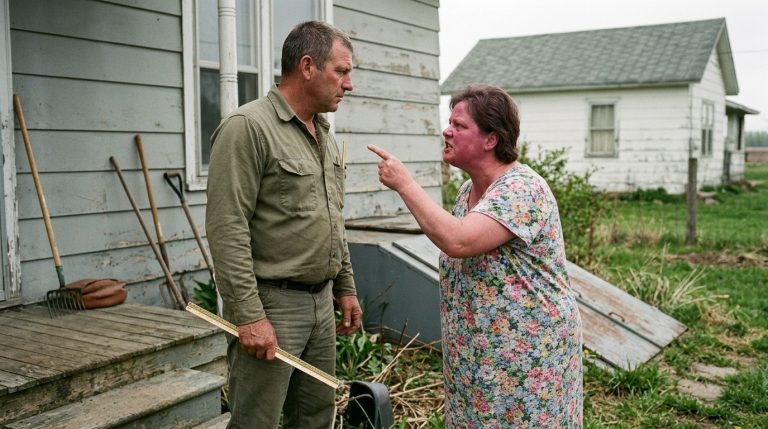
Down on the grass, Meredith Kincaid stepped away from a cluster of men in linen blazers. Even from two hundred yards off, her cream-colored pantsuit stood out like a fresh chalk mark on a blackboard.
She pointed a thin arm up the slope, her voice faint but sharp over the open air.
“Travis,” Silas said, stepping back toward the iron latch. “The county float valve down in the south ditch cuts the pressure at six. My stock drinks today, or your office writes the mortality report on forty head of yearlings.”
Travis looked from the gate to the clubhouse lawn, where two rent-a-cops were frantically waving yellow plastic flashlights at nothing.
“Don’t push ’em hard,” Travis said, clicking his truck into drive. “I’ll go tell her what an unencumbered right-of-way actually costs per minute.”
Silas dropped the oiled chain into the dirt.
He didn’t yell, and he didn’t slap his leather chaps. He simply swung the tubular steel pipe wide until the hinge hit the cedar post with a dull, iron thud.
The lead cow, a raw-boned brindle with five feet of horn from tip to tip, dropped her nose to the crushed stone, found the scent of the lower spring, and took the first step down the grade.
Behind her, the dust didn’t rise in a cloud—it rose as a solid, rolling wall that blotted out the sunset, moving dead-straight toward the silver roofs parked below.
CHAPTER 3: THE SLOW IRON TIDE
The lead brindle didn’t run. She walked with the heavy, side-to-side roll of an old cow that had covered that same gravel ten seasons in a row.
Behind her, three hundred head dropped into the cut like poured ballast.
The first vehicle in their path was the silver German coupe parked with its front quarter-panel hanging four inches across the ditch stake. The lead cow brushed past the side mirror with her flank, leaving a streak of pale dried mud across the metallic clear-coat before her left horn cleared the roof glass by half a finger.
Down on the turf, the catering staff scattered like flushed quail.
A waiter carrying a hammered zinc tray of flute glasses caught his shoe in the irrigation trim, dumping twenty glasses into the newly laid sod. The glass didn’t shatter loud—it just popped softly against the wet rye grass while the bass amplifier on the bandstand let out an electric howl and died.
Silas stayed on foot at the edge of the ditch, keeping his shoulder square to the line of parked hoods.
“Keep ’em centered, Boone,” Silas called out, his voice flat under the grinding roar of hooves on river stone. “Don’t let ’em drift into the fairway.”
Boone rode the outer ditch-bank, his horse’s hooves chopping through Meredith’s ornamental hostas with wet, rhythmic thuds. He didn’t use a whip. He tapped his leather chaps with an open coiled rope, clicking his tongue to hold the flank tight against the fence line.
Meredith charged down the stone stairs from the terrace, her high heels puncturing the damp lawn with every stride.
“Stop them!” she screamed, her hand clamped tight over the strap of a designer clutch. “You are trespassing on private association grounds! Get these animals off my property!”
Travis Bellamy stepped out from behind the tailgate of his county truck, unhooking a heavy leather-bound clipboard from his belt.
“The ground under them hooves is Section Line 12, Meredith,” Travis said, not raising his voice above the rumble. “Your association bought land wrapped around an open road. If you don’t want cows near your party, don’t build your tent on the driveway.”
Drew Whitcomb stood fifty yards back under the white canvas marquee, flanked by two men in dark summer wool. He wasn’t yelling. He was watching the silver coupe rock on its springs as a four-year-old steer squeezed between its bumper and the ditch culvert, leaving a clean scratch down the front quarter-panel where a horn tip found the seam.
Whitcomb looked down at the brochure in his hands, then turned his back on the lawn entirely and walked toward the clubhouse exit.
“Move the cars!” Meredith shouted at three valets huddled behind a decorative cedar lattice. “Don’t just stand there! Move the damn cars!”
“Keys are missing for seven of ’em, Mrs. Kincaid,” one kid shouted back, his voice cracking. “Two of the owners took their fobs inside, and the steering locks are on!”
The herd didn’t care about steering locks.
The mass of horns and red hides moved at a steady three miles an hour, grinding through the forty-two-foot strip with mechanical indifference. Three hundred animals shoved forward by the weight of their own thirst, their breath hot and rank against the polished paint of twenty-seven luxury vehicles trapped in the cut.
Silas walked past Meredith without stopping, his eyes fixed on the survey stake driven into the caliche twenty paces ahead.
She reached out, her manicured fingers catching the sleeve of his denim jacket.
“You’re paying for every scratch on every single car,” she hissed, her teeth bared in the amber glare of the setting sun. “I will have a lien on your gate before Monday morning.”
Silas pulled his arm back, not violently, but with the steady torque of a man pulling a tractor lever.
“You won’t have a lien, Meredith,” Silas said, stepping over a crushed string of party lights. “You’ll have an invoice from the county for obstructing a state-chartered trail.”
He kept walking down the gravel until the lead cow crossed into the southern basin, leaving twenty-seven mud-streaked cars idling in a cloud of settling dust behind them.
CHAPTER 4: THE PAPERWORK TRAP
Thirty-six hours later, the white envelope taped to the gatepost had collected enough caliche dust to turn the paper the color of dirty bone.
Silas didn’t use a pocketknife. He pulled the tape free with a thumbnail, tearing a strip of cedar bark with it, and unfolded the three-page summons against the flat of the top hinge.
One hundred and eighty thousand dollars.
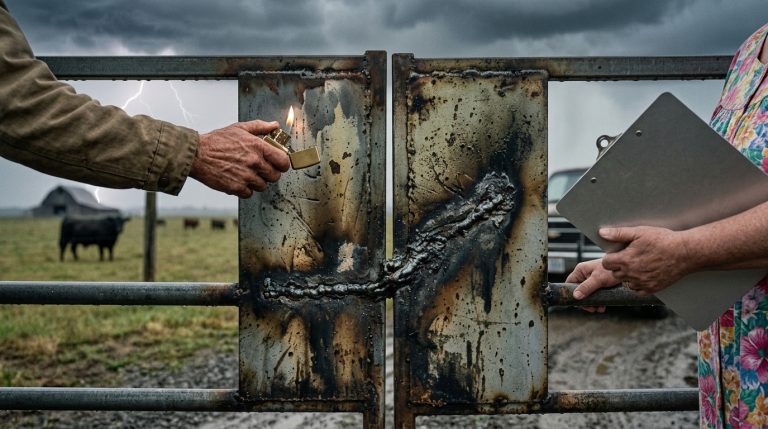
The word Tortious Interference sat in bold type right above the signature line, flanked by two case citations from the district court in Abilene. Below that was an emergency application for an immediate injunction to weld the northern cattle gate shut pending judicial review.
Boone dropped the tailgate of the Dodge with a metallic bang that echoed off the dry limestone cut.
“Sheriff’s deputy brought it out at daylight,” Boone said, his eyes bloodshot from running the lower ditch pump through the dark. “Didn’t even get out of the patrol car. Just stuck it to the post with packing tape and drove off toward the highway.”
Silas folded the paper along its original crease and shoved it into his shirt pocket next to his pencil.
“She didn’t file for vehicle damage,” Silas said.
“What’s that mean?”
“If she filed for sheet metal, the insurance adjusters would have to come out and measure where the tires were sitting,” Silas said. “She filed for economic disruption of a commercial enterprise. She wants a judge to freeze the gate before Monday morning so the title company clears the plat.”
Travis Bellamy’s county truck rolled past the cattle guard, its front suspension squeaking with dry, rhythmic friction as it stopped by the culvert.
The livestock officer didn’t bring his clipboard this time. He held a brass surveyor’s plumb bob and an iron pin stamped with a county road commission seal from 1952.
“Avery Sloane called my supervisor at eight,” Travis said, stepping out into the weed-choked ditch. “The HOA’s lawyer says the 1884 easement was an unrecorded agricultural license that expired when the original township charter dissolved in sixty-eight.”
Silas unclipped the brass sixty-six-foot chain from the back of the Dodge.
“The county commissioners re-indexed the deed in seventy-four,” Silas said, dropping the heavy brass links into the dirt between them. “My old man paid twelve dollars at the courthouse to have the survey pins driven into the bedrock.”
“Meredith’s filing says the pins don’t exist,” Travis said, wiping his brow with the back of his forearm. “Says the gravel road was built on association common ground as an access lane for the groundskeepers.”
Silas didn’t answer with words. He walked twenty yards down the ditch toward the corner where Meredith’s newly laid sprinkler line ran under the fence, knelt in the rank cheatgrass, and started digging with a flathead screwdriver.
The metal struck something hard three inches under the caliche crust—not limestone, but cold, poured iron.
He scraped the gray dirt back until the round top of the surveyor’s monument showed through, its center punch-mark filled with hardened silt. Beside it, clipped neat and buried under two inches of loose peat moss, ran a fresh, unshielded low-voltage conduit feeding the decorative uplighting around Meredith’s floral arch.
“She didn’t miss the pin,” Silas said, tapping the iron post with the handle of the screwdriver. “She buried it.”
Travis looked down at the uncovered iron, then pulled a small wire brush from his pocket and cleaned the top face until the stamped numbers caught the late-morning glare: SEC 12 – T4N – R2W.
“That’ll hold the gate open,” Travis said slowly. “But it won’t kill that hundred-and-eighty-thousand-dollar lien. She’s got the board voting at six tonight to assess the legal fees directly against your deed as an adjoining nuisance.”
Silas stood up, his knees cracking in the dry heat.
From the front pocket of his work coat, he didn’t pull a deed. He pulled a glossy, heavy-cardstock pamphlet that Lowell Briggs had dropped on his kitchen table twelve hours before—a confidential investment brochure printed on linen stock, showing a four-lane paved boulevard named Founders’ Walk cutting straight through the iron pin beneath his boots.
Silas pointed his calloused thumb at the developer’s map.
“She doesn’t care about the cattle, Travis,” Silas said, his voice flat and dead. “And she doesn’t care about the cars. Look at the date on the back page.”
Travis squinted at the fine print along the lower margin, and his mouth went hard.
“She printed this three months ago,” Travis said.
Silas turned toward the cab of his truck. “She sold Drew Whitcomb the road before she even bought the paint for the parking lines.”
CHAPTER 5: THE LEDGER IN THE BOARDROOM
Six hours later, dried crust from the culvert ditch flaked off Silas’s work boots, leaving pale gray smudges on the emerald-green carpet runner leading to the head table.
Nobody offered him a chair.
Meredith sat behind a brass desk lamp, flanked by four board members and Avery Sloane. Her cream jacket was gone, replaced by a dark wool blazer pinned with the gold crest of the development.
On the projector screen behind her, a still frame from Saturday showed a long-horned brindle steer stopped three feet from a white tablecloth, its muzzle dripping creek foam onto the sod.
“The bylaws are explicit regarding agricultural nuisance,” Meredith said, tapping the gavel lightly against its leather pad. “Section Four grants this board emergency assessment authority when an adjoining landholder deliberately damages community infrastructure and endangers member safety.”
She slid a typed resolution across to Lowell Briggs.
“We are voting to approve the special litigation assessment,” she continued, her gaze fixed on the center of the table. “One hundred and eighty thousand dollars in statutory mitigation, to be recorded as a priority lien against the adjoining parcel at sunrise.”
Drew Whitcomb sat in the second row of spectator chairs, his arms crossed over a dark cashmere vest. He hadn’t touched the glass of ice water set before him.
Silas didn’t walk to the podium. He walked directly to the edge of the board table, his heavy manila folder landing on the polished walnut with a dull, dead smack.
“Avery,” Silas said.
The lawyer glanced up, his pen hovering above his legal pad. “Mr. Mercer, this is an executive session. You’ll be given three minutes during open comment.”
Silas popped the brass clasps on the folder.
He didn’t hand out legal briefs. He laid three items side-by-side across the veneer: the 1952 iron pin rubbing, Travis Bellamy’s stamped survey report, and the heavy linen brochure titled Founders’ Walk: Phase Three Master Plan.
“Page seven,” Silas said, tapping the cardstock with a dirt-caked thumbnail.
Lowell Briggs pulled the brochure toward himself before Meredith could reach it. The page fell open to the architectural rendering of a four-lane limestone boulevard cutting directly across Section Line 12.
“The board never authorized an acquisition plan for that western strip,” Lowell said, looking straight at Avery Sloane. “We voted on a perimeter hedge. That was all.”
“It’s conceptual marketing,” Meredith snapped, her voice tightening as she stood up. “Preliminary designs prepared for our financing partners to show future community potential. It has nothing to do with the nuisance violation committed on Saturday.”
Silas leaned his knuckles against the table, his shoulders dropping into the unyielding stance he used when wedging a fence post into hardpan.
“The county surveyor found the monument three inches under your sod this morning,” Silas said, looking directly at Whitcomb. “Your uplighting wire is wrapped around the benchmark. That means every foot of that proposed avenue sits dead-center on an active, federally patented stock route.”
Avery Sloane picked up Travis Bellamy’s report, his eyes scanning down to the seal at the bottom.
The room went completely flat. The faint hum of the overhead air handler sounded like a dry axle turning in sand.
“Meredith,” Sloane said, not looking up from the numbers. “Did you represent this corridor to the Whitcomb Group as unencumbered HOA property during the March prospectus filing?”
Meredith didn’t answer right away. Her jaw worked silently, a muscle jumping beneath the foundation on her cheek.
“It was an abandoned agricultural license,” she said, her fingers curling around the edge of the podium. “No reasonable court would uphold an 1884 cow path over a seventy-million-dollar residential development. The title company was prepared to clear it through standard quiet-title proceedings.”
“We didn’t file quiet-title,” Sloane said, tossing his pen onto the pad with a sharp click. “You parked twenty-seven cars on an active easement after receiving two written statutory notices, and you just handed this man a paper trail for criminal tort.”
Whitcomb stood up smoothly, buttoning his jacket.
He didn’t say a word to Meredith. He didn’t look at the board. He signaled his two associates, turned on his heel, and walked out the double mahogany doors, his leather soles whispering across the carpet.
Lowell Briggs pushed his chair back and laid his pen flat on the table.
“I make a motion to withdraw the damage claim against Mercer Spear Farm,” Lowell said quietly, “and to suspend the president’s administrative authority pending an independent audit.”
Meredith stood frozen beneath the light of the projector, the slide of the cattle herd throwing an elongated shadow of horns across her chest.
Silas didn’t wait for the second. He scooped his plat map off the table, closed the manila folder, and walked out into the cool evening air, where Boone was already waiting with the truck running.
CHAPTER 6: THE RETURN ACROSS THE CALICHE
Three weeks later, the fresh zinc coating on the new signpost still smelled sharp under the midday sun.
Silas tightened the lower carriage bolt with a crescent wrench until the lock washer flattened against the steel channel, then gave the metal plate a hard tug with his gloved hand. It didn’t budge.
The black lettering on white enamel faced straight toward the clubhouse drive: Mercer Cattle Trail. Active Easement. No Parking at Any Time.
A second sign sat fifty yards east, bolted into the limestone shoulder where the valets had once parked the German coupe.
Down on the fairway, two maintenance men in green utility shirts were replacing a strip of ruined sod near the ditch line, shoveling black loam from the bed of a small utility cart. They didn’t look up, and Silas didn’t wave.
The white tents were gone. The linen marquees, the decorative uplighting, and the wooden stage had been cleared out within forty-eight hours of the emergency meeting, leaving only yellowed rectangles of dead grass that the sprinklers hadn’t managed to revive.
Boone brought the pickup down the pasture road, the tires crunching slowly over the graded river rock.
Behind the Dodge, the herd moved at its own pace. With the south basin dry for routine canal cleaning, the three hundred head were heading back to the northern pasture, their red hides and long, sweeping horns cutting through the clean desert air without haste.
There were no horns blaring, no frantic calls for keys, and no security guards standing in the wash.
“Saw Lowell Briggs by the mailboxes,” Boone said, resting his elbow out the open window as he idled beside the post. “Said Meredith packed her office on Tuesday. Board accepted her formal resignation yesterday morning.”
Silas slid the wrench into his back pocket. “She didn’t resign from the board. She resigned from the county.”
“Whitcomb pulled out completely,” Boone added, squinting across the fairway toward the terrace. “Heard they’re running the title search back to the original Spanish land grants before they touch another acre out here.”
Silas didn’t answer.
He leaned against the corner post, listening to the dry, familiar rhythm of three hundred pairs of cloven hooves grinding the gravel down into the caliche bed. A young steer stopped near the edge of the manicured rough, dropped its muzzle to sniff at a fresh sprinkler head, found nothing worth eating, and stepped back into the line of dirt.
The heat shimmer rose off the fairway, blurring the distant stone archways of the clubhouse into soft, pale shapes.
Silas waited until the last yearling crossed the culvert, then walked over to the swinging pipe gate, drew the chain through the latch, and dropped the brass padlock into the link.
He didn’t click it shut. He left the key turned, the shackle open, and the road clear.