Cold Steel and Montana Pine: How One Isolated Rifleman Broke an Entire Winter Siege
CHAPTER 1: THE FROSTBITE LINE
The barrel of the 1903 Springfield was ice against my glove.
Around us, forty men shared three boxes of ammunition and a silence heavy enough to crack.
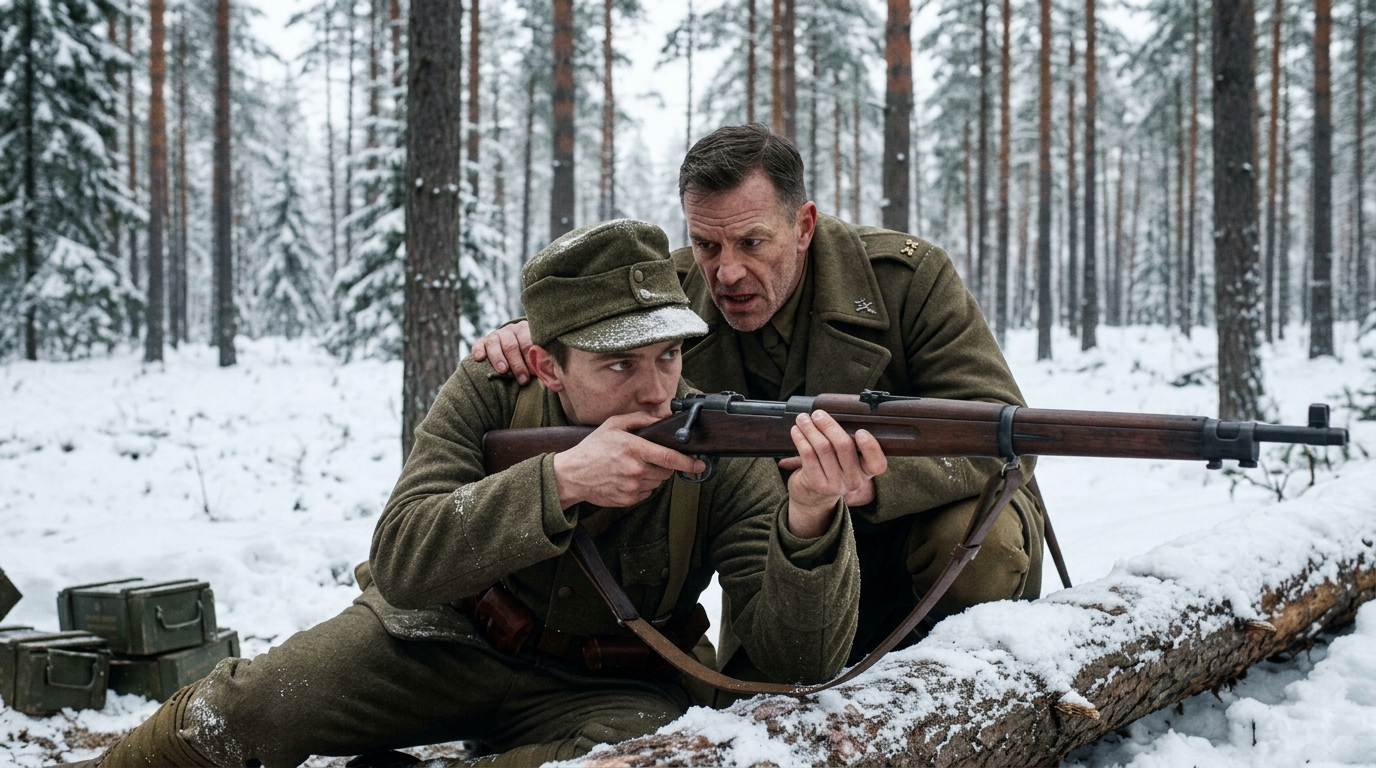
Captain Walsh knelt by the fallen pine, his breath pluming white in the freezing air.
“They are probing the tree line,” Walsh muttered, his fingers clenched hard around his carbine sling. “Hold your fire until they reach two hundred yards.”
I didn’t answer.
I just tracked the dark shapes moving between the gray trunks far down the slope.
Without a scope, the distance looked like a blurry watercolor painting.
I rested the rough wooden stock against the rough bark and worked my hand along the cold steel bolt.
The wind was cutting hard from the left, biting straight through wool and canvas.
Down the hill, a gray-coated figure stopped by a jagged boulder, pointing an arm toward our center.
I didn’t think about medals or grand strategies.
I thought about elk hunting in the Absaroka range when the temperature dropped below zero and the wind screamed down the canyon.
You don’t rush a shot in weather like that.
You wait for the breath to steady, calculate the drop, and let the metal do the work.
CHAPTER 2: IRON SIGHTS ALONE
The missing magnification of a Unertl scope meant the world at four hundred yards looked like a smudge of charcoal on white paper.
I didn’t have crosshairs to lean on.
I had a front sight post that looked as thick as a fence nail against the snow.
Captain Walsh stayed low beside the log, his breath catching in his throat as a mortar shell detonated fifty yards behind our position.
“They are pushing the center,” Walsh snapped, his hand gripping my shoulder with enough force to bruise. “You are wasting time with single shots.”
“They are staying out of M1 range,” I murmured, keeping my cheek welded to the cold wood of the stock. “If I don’t slow them down here, they won’t stop at all.”
Down the slope, a German officer waved an arm, urging his men forward through the deep drift.
Without glass, I had to read the movement entirely through the twitch of shadow and the stark contrast of gray wool against the Belgian snow.
I settled the thick front blade six inches high to compensate for the distance and the bitter crosswind.
The trigger broke clean, though the recoil felt harsher against my shoulder without the heavy scope absorbing the punch.
The officer stumbled, caught himself on a birch sapling, and dropped.
The remaining figures scattered instantly, diving headfirst into the drifts behind them.
Walsh let out a ragged breath, his fingers slowly loosening their grip on my canvas jacket.
“Keep shooting,” Walsh whispered.
CHAPTER 3: THE BROKEN PUSH
The enemy officers were moving differently now, abandoning the tidy textbook formations that made easy targets an hour ago.
They crawled through the snow banks in short, jagged rushes, keeping low beneath the ridge line.
Captain Walsh slammed a fresh clip into his Garand with a metallic ping that sounded entirely too loud in the silent clearing.
“They’re refusing to stand up,” Walsh growled, his knuckles white against the dark walnut stock. “We are burning through our last boxes for nothing.”
“They aren’t standing because they are guessing where the shots are coming from,” I replied, sliding another round into the bolt-action well.
Without magnification, every hundred yards looked like an endless stretch of white.
I ignored the frantic shouting echoing across the frozen gully and focused entirely on the erratic movement of a junior officer hugging a snow-covered boulder.
The wind shifted abruptly, carrying a freezing gust that bit straight through my wool collar and threatened to throw off the aim.
I adjusted my hold slightly to the left, taking up the slack on the trigger until the metal felt like glass against my finger.
The rifle kicked hard against my shoulder, the sharp report cracking through the frozen pines.
The officer dropped behind the stone, abandoning his frantic hand signals to drag himself out of sight.
Across the perimeter, the coordinated advance shattered into isolated, defensive scrambling.
CHAPTER 4: SHIFTING THE LINE
A low whistle cut through the gray air overhead, followed instantly by the dull thud of mortar impacts shaking the frozen earth.
Chunks of snow and black dirt rained down over our shelter as Captain Walsh dragged himself across the frozen ground.
“They’re walking shells right down the ridge,” Walsh shouted over the roar, his face caked with white frost and soot. “We have to shift fifty yards west before they pin us in this pocket.”
“Moving now means exposing the flank,” I muttered, keeping my eyes locked on the white slope through the naked iron sights.
The memory of guiding elk through blinding mountain squalls flashed behind my eyes—knowing when to stay put against the weather and when a single step meant losing the trail entirely.
Except here, the wind wasn’t just cold; it carried the sharp, choking reek of burning pine and sulfur.
We couldn’t stay, and we couldn’t run out into the open without drawing immediate fire.
I grabbed the heavy wooden stock of the Springfield, heaved my body through the drift, and scrambled toward the lower shelter of a shattered oak stump.
Walsh followed hard behind, his breathing coming in ragged, whistling gasps as the next wave of shells chewed up the ground we had just abandoned.
We settled into the new cover, cold mud soaking through our wool trousers, while the enemy adjusted their sights across the valley.
CHAPTER 5: THE DESPERATE FLANK
The enemy squads came fast this time, surging out of the gully in a chaotic, synchronized rush designed to overwhelm our thinning line through sheer numbers.
Captain Walsh emptied his M1 with frantic, deafening bursts that filled the freezing air with acrid smoke.
“They’re bypassing the center!” Walsh yelled over the rattling din, his weapon clicking empty on an open clip. “They’re flooding straight into the eastern gully!”
I didn’t look up from the iron sights.
Without optical magnification, I had to trust the raw muscle memory built from decades of tracking fast game through thick timber.
A gray-coated leader sprinted across a patch of exposed snow, trying to herd the surging mass forward into our perimeter.
I held my breath, factored the howling crosswind, and squeezed the cold trigger.
The heavy recoil slammed into my shoulder as the target dropped instantly in the drift.
The rest of the flanking party scattered in sheer panic, tripping over their own equipment as they realized the approach was a dead trap.
Walsh slammed a fresh clip into his rifle, his chest heaving as he stared down the slope at the broken charge.
“They aren’t stopping,” Walsh breathed, his fingers tightening around the wooden stock. “They’re going to try one last desperate wave.”
CHAPTER 6: SILENCE IN THE SNOW
Far down the valley, the heavy rumble of approaching American armor shook the pine branches and rattled the stones in the creek bed.
The gray-coated lines scattered in a sudden panic, breaking cover and scrambling backward through the deep drifts before the relief column could crest the ridge.
Captain Walsh lowered his binoculars with a shaking hand, his breath pluming thick and white against the frozen air.
“They’re pulling back,” Walsh muttered, leaning his weight heavily against the notched trunk of the pine. “We actually held the line.”
I didn’t answer right away.
I worked the cold steel bolt forward, cleared the empty chamber, and slid the safety back into place with a dull click.
My shoulder throbbed from the unpadded recoil, and my fingers were stiff with a deep, numbing ache that no wool glove could block.
Around the clearing, the surviving men slumped against the snowbanks, too exhausted to cheer or shout over the arrival of our armor.
They weren’t heroes out of a textbook.
They were just ordinary men who had refused to give an inch when the ground beneath them gave way.
I set the Springfield down across my knees, pulled a rag from my pocket, and wiped the gray soot from the iron sights.
The forest fell completely silent, save for the crunch of heavy treads breaking through the valley snow.