The Frozen Wire: How One Captured American Radio Shattered an Empire’s Strict War Machine
CHAPTER 1: THE COLD TRUTH
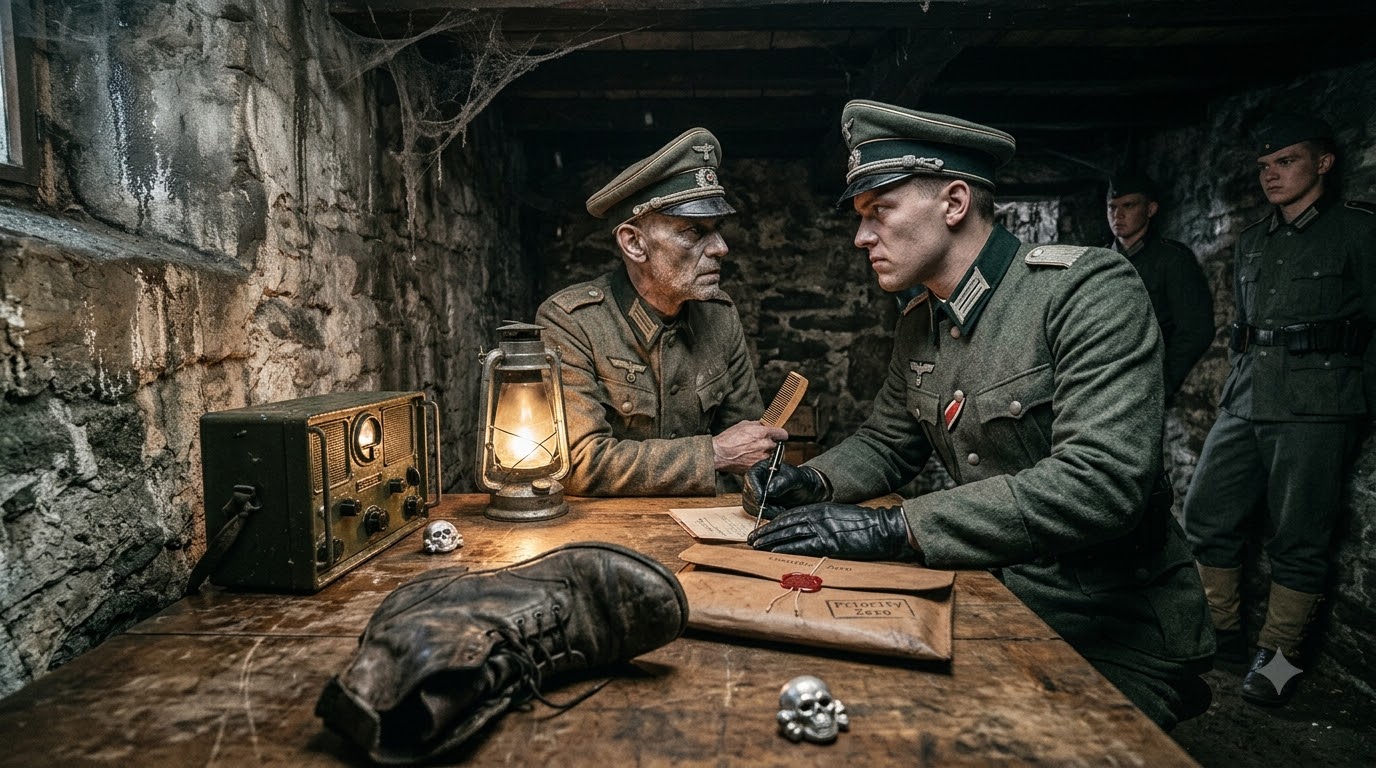
The wooden pocket comb in Hauptmann Friedrich Dressler’s right hand was missing five teeth right in the middle.
His thumb ran back and forth over the jagged gap, scraping the worn horn material until the friction generated a tiny spot of heat against his calloused skin. Across the scarred oak table, the olive-drab casing of the American SCR-300 sat dripping meltwater onto a requisition ledger from 1941.
“They don’t ask permission,” Dressler said. His voice was a flat, dry rasps—the voice of a man who had spent three years swallowing coal dust and bad news. He didn’t look up at the doorway. “A corporal sees a tree line he doesn’t like. He picks up this handset. He speaks into the wire. Three minutes later, four hundred pounds of high explosive erases the trees.”
Private Heinz Becker stood rigid near the cellar’s stone archway, his boots caked in frozen Belgian mud that flaked off onto the dirt floor like dark scab shavings. He kept his right hand clamped around the frost-bitten receiver of his Kar98k, his shoulder aching from the twelve-kilogram weight he had carried three miles through the dark.
“The paperwork,” Becker muttered, his teeth clicking together once before he caught himself. “Who signs for the shells?”
“Nobody,” Dressler said. He clicked the metal latch on the radio’s battery compartment with a dull, heavy thunk. “That is the horror of it, Becker. The system trusts the private to know he is being shot at.”
The heavy oak door at the top of the cellar steps slammed open, rattling the iron hinges and sending a shower of dried mortar dust down onto the lantern chimney.
Heavy leather jackboots—not the canvas-and-leather ankle boots of the line infantry, but polished, high-grade calfskin—stamped down the narrow stone stairs. Major Ernst Krol descended with his silver-braided shoulder boards gleaming even in the dim oil light, his black wool greatcoat spotless despite the snowstorm howling outside the farmhouse.
“You have been staring at that iron box for forty minutes, Hauptmann,” Krol said. He didn’t adjust to the gloom; he dominated it, stepping directly into Dressler’s space until the edge of his tailored coat brushed the corner of the table. “Regimental headquarters demands a tactical summary of Hill 493. Why is your reporting officer not at his desk?”
Dressler’s thumb didn’t stop its steady, rhythmic rasp across the broken teeth of the comb. He slowly raised his eyes, fixing them on the silver skull pin pinned to Krol’s cap.
“Because my reporting officer is dead, Major,” Dressler said softly. “He died four hours ago waiting for Battalion to approve a twelve-round mortar barrage.”
Krol’s jaw tightened, a tiny muscle twitching beneath his pristine, closely shaved cheek. He reached out with a gloved hand and tapped the laminated instruction card attached to the American set, his fingers sliding over the simple black-and-white diagrams.
“Then you pick up his pen and execute the orders you were given,” Krol snapped, his voice dropping into that clipped, sharp register meant to end arguments before they began. “This is an administrative delay. The Führer’s offensive does not stall because a company commander lacks clerical efficiency.”
Becker shifted his weight by the archway, his eyes dropping to the corner of the cellar floor. Sitting beneath a stack of empty sauerkraut crates was a pristine, sealed leather courier pouch, double-stamped in red wax with the classification code Priority Zero.
It hadn’t been there yesterday. And it hadn’t been opened.
Dressler noticed Becker’s subtle glance, but his own face remained a mask of gray, weathered granite. He set the broken comb down beside the captured radio with a quiet clack.
“The Americans aren’t using pens, Major,” Dressler said, his hand resting flat on the cold olive metal of the transceiver. “They’re using this. And if we don’t change how we answer them before the sun comes up, there won’t be anyone left alive in this cellar to read your summary.”
CHAPTER 2: STATIC ON THE LINE
The transceiver’s top housing was pitted with small, sharp salt-flecks of dried slush. Dressler kept his thumb planted right against the negative wire terminal, the copper lead biting into the soft pad of his flesh until he felt his own pulse thumping against the metal.
Major Krol didn’t back up. He stood three inches from the edge of the oak table, his breath coming out in thin, clean gray wisps that smelled faintly of peppermint throat lozenges.
“You think you are clever, Hauptmann,” Krol said, his voice flat, dropped low enough that the two junior guards at the top of the stairs couldn’t hear. “You think a dead reporting officer absolves you of a schedule.”
“The dead don’t fill out late slips, Major,” Dressler said. He didn’t lift his hand from the radio. He looked down at the dials, the heavy black bakelite knobs stamped with raised white numbers that made no sense under the Wehrmacht grid system. “Becker. The wire spool by the coal bin.”
Becker didn’t ask what wire. He reached into the dark behind his boot, dragged out a coil of thin, black German field-telephone line, and tossed it. The wire hit the tabletop with a dry, metallic slither.
“Touch that American trash again and I will have you relieved before the sun clears the ridge,” Krol said. He didn’t reach for his holster. Officers like Krol didn’t need to pull a weapon; they used the weight of a thousand invisible clerk desks behind them. “We do not salvage enemy equipment without an intelligence clearance stamp from Division.”
“The stamp is in my pocket, Major,” Dressler said softly. He pulled out his worn wooden comb with his left hand, setting it down directly over the red wax seal of the Priority Zero leather pouch tucked under the sauerkraut crates. “Or it would be, if Division had sent the morning courier.”
He picked up the bare copper end of the lead wire, scraping it twice across the terminal post.
A sharp, static hiss spat out of the SCR-300’s small, circular speaker grill—a high-pitched, wet crackle that sounded like dry grease hitting an open flame. It cut straight through the low rumble of the artillery forty miles south.
Krol flinched, a subtle jerk of his chin that he tried to hide by straightening his high, stiff collar. “Turn that off.”
Dressler didn’t touch the dial. He leaned closer, his ear three inches from the metal grill.
Through the white noise came a voice. It wasn’t the slow, heavy German of the radio operators back at Regimental HQ, nor was it the bark of an officer giving grid coordinates. It was a flat, Midwestern drawl, spoken through a mouthful of chewing tobacco, sounding completely relaxed.
“—Baker-Three to Easy-Red, we got two stalled half-tracks near the bridge deck. Tell the boys to bypass the church line and roll straight down the timber track. Over.”
Becker took one step forward from the archway, his eyes wide. “They aren’t stopping at the hill.”
“They aren’t even looking at the hill,” Dressler corrected quietly. He turned the main frequency knob one notch to the left. The static shifted, pitch dropping half an octave. “That’s an armored column. A full battalion, moving without infantry flankers.”
“Impossible,” Krol snapped, his boot coming down hard against the dirt floor. “Their armor is pinned at Bastogne. General von Lüttwitz’s morning bulletin explicitly stated—”
“The General’s morning bulletin was printed at three o’clock yesterday afternoon in a dry office in Luxembourg,” Dressler said, his voice dropping into a dangerous, icy calm. “The men in those tanks are three miles from this cellar right now. And they aren’t waiting for anyone’s bulletin.”
The speaker crackled again. A second voice cut in, louder, punctuated by the distinct, heavy clatter of steel treads chewing up frozen asphalt.
“—Easy-Red, copy. We’re pushing six Sherman units through the gully now. Zero opposition. I repeat, zero opposition.”
Dressler’s thumb pressed harder into the broken teeth of his comb. He looked straight at Krol’s pristine, unspotted coat.
“They’re coming straight down our supply line, Major,” Dressler whispered. “And we don’t have a single anti-tank gun left with a full crew.”
CHAPTER 3: THE BROKEN SPINDLE
“Nonsense,” Major Krol said, stepping forward until his polished boot toe pressed straight against the wooden leg of the table. “You expect me to report a breakthrough based on a radio play captured by a private who doesn’t even speak English?”
“The armor is real, Major,” Becker said quietly, his voice raspy from the frost. He didn’t raise his rifle, but his knuckle stayed white against the trigger guard. “You can hear the track tensioners. German tanks don’t squeal like that.”
Krol turned on Becker with sharp, blinding efficiency, his hand snapping out to gesture at the soldier’s caked boots. “Silence, Private. You speak when your company commander gives you permission, not before.”
Dressler didn’t look up from the broken comb in his hand. He slowly ran his index finger down the jagged gap where the plastic teeth had snapped off months ago in Russia.
“He’s right about the sound, Major,” Dressler said, his voice dropping into that low, flat register that signaled he was done measuring words for politeness. “Pak 40 anti-tank guns. That’s what we need on the timber track. Two batteries. We have the crews sitting in the gully with empty caissons.”
“Then requisition the shells,” Krol snapped, drawing a thin, silver-capped fountain pen from his breast pocket with a flourish that belonged in a Berlin courthouse, not a dirt cellar. “Fill out Form 109-B. Three copies. I will personally initial the emergency priority dispatch to Battalion.”
Dressler let out a short, dry sound that wasn’t a laugh. “Form 109-B requires the countersignature of the Sector Ordnance Officer.”
“Then find him.”
“He was blown out of his command trench at four o’clock this morning,” Becker chimed in, stepping around Krol’s side to drop a crumpled, oil-stained carbon copy onto the oak table. “There is no Ordnance Officer.”
Krol stared at the carbon slip. His nostrils flared, a tiny drop of sweat breaking through the powder on his upper lip despite the sub-zero chill creeping down the stone steps.
“Then the chain remains unbroken,” Krol declared, his voice rising in pitch as he leaned over the table, placing both gloved hands flat on the edges. “Without proper requisition documentation, no quartermaster in this sector is authorized to unseal reserve munitions. That is Wehrmacht regulation, Hauptmann. If we break protocol, we invite anarchy.”
“The Americans are three miles away and they don’t have a single piece of paper in their pockets,” Dressler said softly. He picked up the iron handset of the captured radio and set it heavily on top of Krol’s silver pen. “They have a wire and a frequency. We have three forms and a dead officer.”
Krol pulled his hands back as if the radio handset were hot iron. “You will obey protocol, Hauptmann, or I will cite this unit for willful insubordination before the morning staff meeting!”
Dressler slowly stood up, his spine popping in the cold air. He didn’t reach for a weapon, and he didn’t raise his voice. He simply reached past Krol’s shoulder, his fingers deliberately brushing against the leather strap of the sauerkraut crates near the wall, bringing his boot down right next to the sealed leather pouch.
“I am obeying protocol, Major,” Dressler whispered, his eyes locked on Krol’s pale face. “I am searching for the Ordnance Officer’s backup authorization right now.”
CHAPTER 4: THE PAPER FORTRESS
The bottom crate slid out with a dry, splintering groan against the cellar floor.
Dressler reached into the dark gap beneath the oak slats, his fingers dragging out the heavy leather courier pouch. The double-stamped red wax seal cracked down the middle under the weight of his thumb, flaking off in dry, dark red chips onto his trousers.
Krol took a sharp, rigid step forward, his leather boot heel clicking hard against the stone. “That pouch is classified under Sector Staff jurisdiction. You do not have clearance to break that seal, Hauptmann.”
“The Sector Staff is six miles behind us, Major,” Dressler said, his voice dropping into a flat, steady rasp as he unbuckled the iron brass clasp. “And if their paperwork doesn’t match the artillery state on the hill, then nobody in this cellar is getting back to see them anyway.”
Becker leaned his shoulder against the damp stone wall near the archway, his eyes glued to the thick stack of folded, gray-ink mimeographs Dressler pulled into the lantern light.
The top sheet wasn’t an order. It was a divisional allocation ledger dated three days ago, stamped across the header with a thick, purple ink block: Priority Zero — Immediate Redistribution.
Dressler ran his index finger down the typed column of quartermaster numbers. His hand stopped at the entry for 7.92mm infantry rifle rounds and 75mm anti-tank shells.
The allocation number wasn’t a requisition figure. It was a single, typed zero.
“Look at the margin, Becker,” Dressler murmured.
Below the ledger line, written in thin, sharp pencil by a staff clerk back at Corps HQ, was a single notation: Sector 493 designated static delay position. Zero resupply authorized for fourteen days. Personnel to maintain fixed positions to cover Division withdrawal.
A heavy, suffocating silence settled over the dirt room, deeper than the freezing air coming down the stone stairs.
Becker slowly took off his thick winter cap, his face pale under the layer of soot and sweat. “They aren’t sending the truck.”
“There is no truck,” Dressler said. He held the paper closer to the lantern chimney, the glass reflecting the black ink numbers directly into his gray eyes. “There never was a truck. The orders Major Krol brought down those stairs were written to keep us sitting in these foxholes until the Americans run over us.”
Krol’s jaw twitched violently, his left hand clenching around his silver-capped pen until the plastic casing creaked. He didn’t look at the paper; he stared straight at the stone wall behind Dressler’s head.
“It is a strategic necessity,” Krol said, his voice suddenly sharp, defensive, and loud enough to echo up the staircase. “The Division requires seventy-two hours to reorganize behind the river. Someone has to hold the line.”
“Hold it with what?” Becker interjected, his voice cracking as he stepped forward, pointing a trembling finger at the captured radio sitting silent on the oak table. “With empty crates? You let us stand out in the timber line for three days knowing we didn’t have five rounds per man!”
“You will address a superior officer with respect, Private!” Krol barked, stepping directly into Becker’s chest, his chest heaving under his spotless wool coat. “The High Command calculates these trade-offs! It is not your place to analyze the arithmetic of the Reich!”
Dressler slowly folded the paper along its original crease, tucked it inside his breast pocket over his heart, and picked up his broken wooden comb from the table.
“The arithmetic is very simple, Major,” Dressler said softly, running his thumb over the missing teeth. “You brought us a death warrant, and you expected us to thank you for the administrative efficiency.”
CHAPTER 5: MALICIOUS COMPLIANCE
“Section 12 of the Standing Field Regulations,” Dressler said, his voice dropping into a dry, steady whisper that carried straight through the hiss of the radio speaker. “In the absence of clear operational directives from Battalion, the senior line officer present is bound to execute defensive maneuver according to immediate tactical reality.”
Krol’s face flushed a mottled, violent purple under the lantern light. He reached for his leather holster strap, his fingers twitching against the iron clasp. “You are defying a direct command from a Liaison Officer of the High Command!”
“I am obeying the written order in my breast pocket, Major,” Dressler replied without raising his arm. He stepped sideways, placing his body directly between Krol and the oak table. “The paper signed by Corps HQ states this position is a static holding point. It requires one officer of record to maintain the station.”
Becker took two quick steps backward toward the stone staircase, his Kar98k slung tight over his shoulder, his eyes darting between the two men. “Hauptmann?”
“Take the radio, Becker,” Dressler ordered, keeping his eyes on Krol’s right hand. “Load the spare batteries into the truck. Every man in the line falls back along the timber track toward the river. Right now.”
“You will not move a single boot!” Krol roared, finally tugging his pistol half-inch from the holster leather. “I will have this entire company court-martialed for desertion before the sun reaches the trees!”
Dressler didn’t draw a weapon. He simply pulled his broken wooden comb from his palm, set it squarely on top of the blank requisition forms on the table, and pushed Krol’s silver fountain pen right next to it.
“You want someone to hold this station, Major,” Dressler said, his voice utterly devoid of anger. “The order requires an officer’s signature on the log every thirty minutes. You have the pen. You have the authority. The command post is yours.”
Krol froze, his hand clamped around his holster, his breath coming in jagged, shallow gasps as the physical reality of the situation crashed through his bureaucratic armor.
“You… you cannot leave an officer of my rank without an armed detachment,” Krol stammered, his posture cracking as the confidence bled out of his voice.
“According to your own regulations, Major, the line infantry reports to the company commander,” Dressler said. He gestured toward the open stairs, where the distant, rhythmic rumble of American tank engines was already shaking loose fine grains of stone dust from the ceiling arches. “And as company commander, I am ordering a tactical repositioning to preserve unit assets. You are free to file a written complaint in my ledger.”
Becker grabbed the canvas handle of the SCR-300 crate, slinging the twelve-kilogram weight under his arm with a heavy, metallic clatter. “Truck’s warmed up, Hauptmann.”
Dressler turned his back on Krol, stepping onto the first stone stair. “He’s all yours, Major. Don’t forget to sign the log.”
CHAPTER 6: THE DUSTY HORIZON
The Kübelwagen’s engine coughed once, sending a plume of blue exhaust into the frozen air, before setting into a steady, chugging rattle.
Becker had the SCR-300 wedged tight between his knees on the front passenger side, his gloved fingers resting on the olive-drab metal casing as he pulled the canvas tarp over the back seat.
Major Krol came running up the cellar stairs, his high calfskin boots slipping on the icy threshold. He didn’t have his silver pen out anymore. He had his Service pistol clutched in a white-knuckled grip, his spotless coat trailing open in the wind, exposing his sweat-drenched tunic.
“Dressler!” Krol screamed, his voice breaking into a high, hysterical screech as he stumbled toward the tailgate. “You are abandoning an official post! I order you to turn this vehicle around! You will face a firing squad for this!”
Dressler didn’t draw a pistol. He didn’t even look back at Krol’s raised weapon. He simply climbed into the driver’s seat, pulled his heavy wool collar up around his ears, and engaged the gear clutch with a dull, iron clunk.
“The post is signed for, Major,” Dressler called out over the engine noise, his voice entirely calm. “You have the paperwork on the table. You have the command.”
“I am a Liaison Officer!” Krol yelled, grabbing the vehicle’s side rail as the tires began to turn against the frozen mud. “You can’t leave me here! The Americans—”
“The Americans don’t care about your rank, Major,” Becker said, looking back over his shoulder as the truck pulled forward. “And they don’t read German forms.”
Krol’s hand slipped off the frost-covered rail. He stumbled back two steps into the rutted snow, his pistol sagging in his grip as the heavy rumble of steel tank treads rounded the timber line a quarter-mile up the road.
He didn’t fire a shot. He just stood there, tiny and dark against the immense white forest, surrounded by empty foxholes and a stack of unsigned requisition papers.
The Kübelwagen rolled smoothly onto the river track, leaving the farmhouse and the screaming officer far behind in the gray mist.
An hour later, parked beneath a thick canopy of pine boughs three miles west of the river, Dressler pulled the truck onto the shoulder.
The forest around them was dead quiet. No orders down the wire. No staff officers shouting about schedules.
Becker leaned back against the canvas seat, pulling his worn cap down over his eyes. Beside him on the floorboards, the captured radio sat cold and silent, its dials locked onto a frequency nobody was listening to anymore.
Dressler reached into his tunic, pulled out his broken wooden comb, and ran his thumb gently across the smooth horn handle.
He didn’t think about High Command. He didn’t think about the divisional map or the late reports.
He just sat in the quiet morning light, breathing in the cold air, and watched the snow fall softly over the hood of the truck.