The Midnight Tide: When Cold Arithmetic Demands Breaking the Rules to Save Lives
CHAPTER 1: THE GEOMETRY OF SALT AND IRON
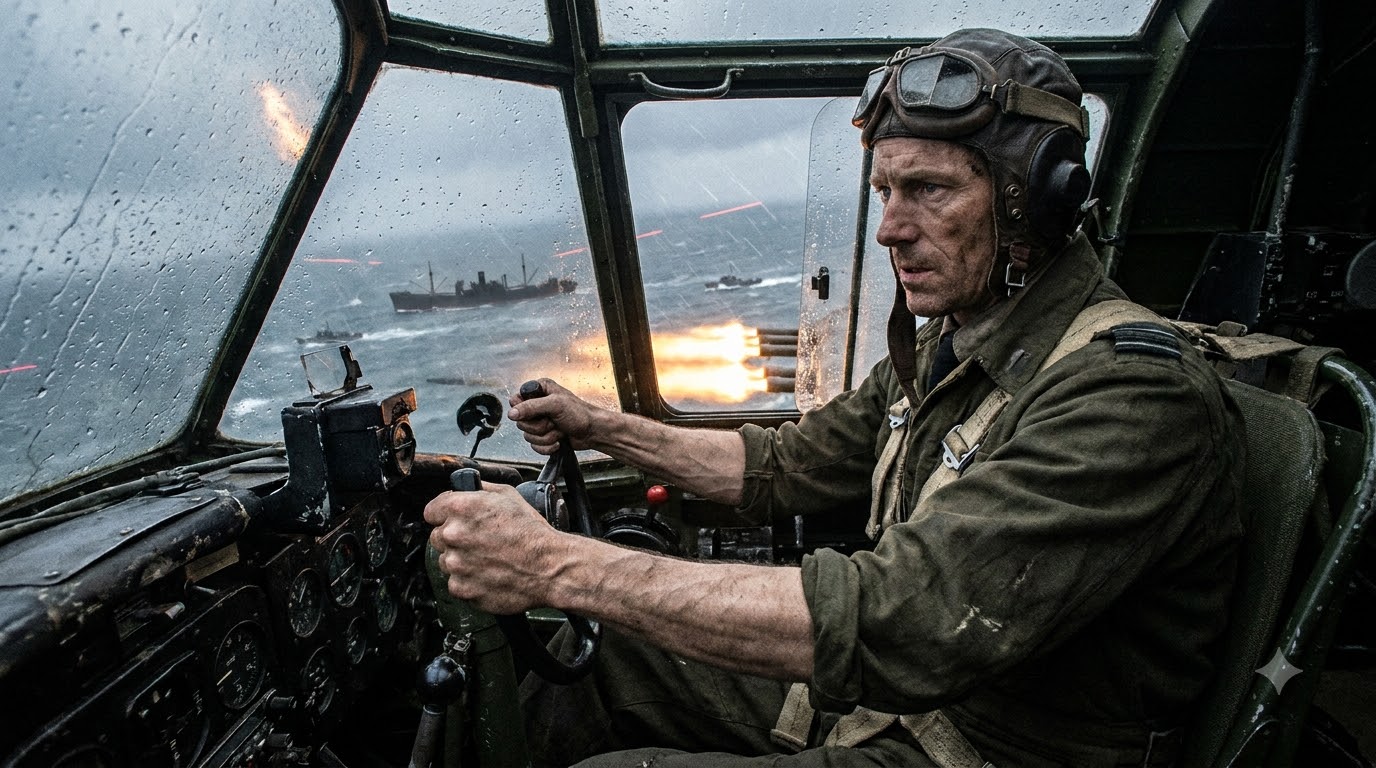
The twin radial engines of the Bristol Beaufighter rattled the instrument panel inside its iron housing. At two thousand feet over the North Atlantic, the air tasted of scorched lubricant and spray.
Kenneth Moore adjusted his grip on the control yoke. His thumb rested two inches above the red rocket arming switch. Below them, gray water churned in heavy swells under skies the color of cold lead.
“Three contacts, zero-four-zero,” Sergeant Thomas Reed said through the static of the intercom. His voice was flat, calibrated by nine months of shared cabin noise. “Medium freighters. Two armed escorts hugging the coastal Shelf.”
Moore nudged the yoke left. The Beaufighter banked, its port wing dipping toward the dark ocean. He turned the worn brass calipers between his left thumb and forefinger, feeling the small notch on the metal joint.
Four hundred yards between ships. Speed: eight knots. Distance to the mouth of the Sognefjord: eleven miles.
“They aren’t running evasive patterns,” Moore said. His throat felt dry, coated in the thin film of unburned aviation fuel that always leaked into the cockpit. “They think the air belongs to them this close to the cliffs.”
“Message is encoded, Flight Lieutenant,” Reed replied, the click of the transmitter key cutting through the engine drone. “Position, heading, speed. Standard recon report filed.”
Moore didn’t answer. He held the Beaufighter in a wide, lazy circle, keeping the pale afternoon sun directly behind their tail. Through the plexiglass nose, he watched the lead freighter plow through a white cap. Its decks were dark with lashed cargo crates.
In London, the report would hit the teleprinter in twenty minutes. A Duty Officer would cross-reference the coordinates with the strike package schedule. The bombers at Wick were still refueling from the morning sweep. By the time a strike force cleared the runway, four hours would pass. By then, those hulls would be tied to the concrete quays of Bergen, their holds emptied into mountain bunkers.
“They won’t send a strike,” Moore said aloud to the vibrating windshield.
“Order of the day stands, Kenneth,” Reed’s voice came back, firmer this time. “Observe and return. We don’t have authorization for offensive engagement against capital escorts.”
Moore flipped the brass calipers in his fingers, the cold metal biting into his palm. He looked down at the fuel gauges. Two hundred gallons in the main tanks. Eight rocket projectiles slung under the wings. Four 20-millimeter cannons loaded in the belly.
He pushed the throttle levers forward. The twin Bristol Hercules engines roared, the sudden vibration rattling his teeth as the nose dropped toward the black sea.
CHAPTER 2: CALCULATING THE BREAK POINT
The Beaufighter’s nose dipped lower, plunging through the gray mist until the salt spray coated the windshield. Below, the ocean lost its rolling geometry and became a floor of churned foam.
Kenneth Moore did not flip the switch. Instead, he pulled back slightly on the stick, leveling the twin-engine fighter at fifty feet above the swells.
“They’re not reacting because they think we’re a Ju-88 out of Trondheim,” Moore said, his voice flat inside the heavy leather helmet. He turned the chipped brass calipers between his fingers, testing the tension of the center screw. “A single aircraft at this altitude doesn’t match an RAF strike vector.”
“And if the lead escort has a sharp lookout?” Reed’s voice came back through the static, tight and unhurried. Behind Moore, the navigator was already braced against his desk, securing the logbooks with a canvas strap. “We’re inside the envelope of their 20-millimeter deck guns. If we pull up now, we still have the fuel to make Wick.”
“We make Wick, and the paper sits on the Duty Officer’s desk until six p.m.,” Moore said.
He didn’t yell. The cockpit noise—a violent, rhythmic drumming of two 1,400-horsepower Hercules engines—swallowed everything except the cold facts.
Moore looked down at the rearmost cargo ship. Through the salt-pitted perspex, he could see the rust-colored deck beams, the dark tarp covering the main hatch, and something else. Bolted to the outer housing of the aft superstructure sat a cylindrical zinc container, gleaming unnaturally clean against the flaking lead paint of the hull.
It wasn’t a standard Kriegsmarine storage drum. It was sealed with heavy brass rivets, positioned where a captain could throw it overboard in deep water.
“Look at the riding line on that trailing freighter, Thomas,” Moore said, nudging the rudder pedal to compensate for a crosswind off the cliffs. “She’s sits three feet lower than the escort, but her draft isn’t even. She’s heavy in the stern.”
“Grain or iron ore,” Reed replied.
“Iron doesn’t sit stern-heavy unless the forward hold is empty,” Moore muttered. He squeezed the brass calipers until the tips bit into the leather of his palm. “Or unless whatever they’re hauling isn’t cargo.”
“Standing order 44-B,” Reed said quietly. “We track. We log. We do not engage capital shipping or coastal trade without a three-plane element.”
“Standing orders were written by men in Middlesex who think the ocean stays still while the ink dries,” Moore said.
He shoved the brass calipers into his breast pocket and clicked the red arming toggle up. A low amber light flickered on the instrument panel. Underneath the wings, the electric solenoids on the rocket rails hummed to life.
Reed didn’t shout. He didn’t reach for the emergency override. He simply pulled his harness straps tighter and clicked his stopwatch.
“Target alignment in twelve seconds, Kenneth,” Reed said, his thumb hovering over the lap sheet. “Wind is twelve knots from the northwest. If you’re going to break the rule book, don’t miss.”
CHAPTER 3: TWELVE MINUTES OF FIRE
The airframe bucked violently. Four sixty-pound solid-fuel rockets ignited under the starboard wing, their exhaust screaming past the cockpit canopy in a blinding sheet of orange flame.
The Beaufighter lurched sideways as the sudden loss of wing weight threw the trim out of balance. Moore fought the yoke, his knuckles white inside his gloves as he used his forearm muscle to keep the heavy nose pointed straight at the trailing merchant ship.
A hundred yards ahead, four plumes of white water erupted from the ocean, followed immediately by two sharp, ringing thuds that vibrated through the floorboards.
The rockets punched straight into the stern waterline of the trailing freighter. A bloom of dark crimson oil and ruptured timber geysered into the sky.
“Hit on the stern!” Reed shouted, his hands braced against the navigator’s bulkhead as the force of the acceleration slammed him into his harness. “She’s losing way—smoke from the engine casing!”
Moore didn’t celebrate. He yanked the stick back, banking hard left into the shadow of the fjord cliffs to break line-of-sight. The 20-millimeter anti-aircraft guns on the two escort patrol boats finally woke up, pumping steady strings of glowing red tracer rounds into the gray air where the Beaufighter had been a fraction of a second before.
“Four rockets remaining,” Moore said, his chest heaving against the leather harness. “We take the center transport now before the escorts cross-field their fire.”
“Kenneth, fuel margin is down to sixty-two minutes,” Reed called out over the intercom, his tone clipped and steady despite the tracer rounds popping outside the glass. “If we execute a second pass, we have zero allowance for weather delays on the approach to Wick.”
Moore didn’t answer with words. He kicked the right rudder pedal, bringing the twin Hercules engines into a tight, shuddering turn over the open water. Through the cockpit side panel, he watched the center merchant ship begin a frantic, sluggish turn toward the shallow coastal rocks. Black smoke poured from its stack as its crew pushed the boilers to maximum pressure.
He lined up the crosshairs on the midship superstructure. The escort boats were turning inward now, their deck guns tracking his approach, but their angle was tight and rushed.
“Hold tight, Thomas,” Moore muttered, his index finger resting cold against the rocket release.
He squeezed the firing lever again. The final four rockets surged off their rails with a deafening roar, punching four parallel white trails through the salt spray directly toward the turning cargo ship.
CHAPTER 4: THE STATIC IN THE COCKPIT
The needle on the port fuel collector flickered against the red reserve hash mark. Below, the second freighter listed heavily to port, a column of greasy black smoke trailing forty miles across the dark ocean.
Moore leveled the wings and pulled the throttle back to long-range cruise setting. The sudden drop in engine pitch sounded like a gasp inside the cockpit.
He didn’t look back at the third ship drifting toward the fjord entrance. He reached into his breast pocket, pulled out the brass calipers, and laid them flat on the aluminum instrument ledge.
“Course two-seven-zero,” Reed said, his pencil scraping against the paper chart in the rear cabin. “Heading for Wick. Wind is holding, but we’re thirty gallons light on the margin.”
“We’ll lean the mixture once we clear the coastal radar band,” Moore said.
Silence settled over the airframe, thick and cold. The adrenaline that had sharpened Moore’s vision twelve minutes ago evaporated, leaving a dull ache behind his eyes and the bitter taste of cold tea in his throat.
A memory flashed unbidden into his mind—a structural load lecture at Cambridge in the autumn of 1939. His professor had drawn a single cantilever beam on the slate board, marking the exact spot where internal stress exceeded material strength. Failure doesn’t happen at the point of impact, the old man had said, tapping the chalk against the slate. It happens where the structure is least allowed to bend.
Moore stared at the empty rocket selector switches on the main panel. Eight physical rails were now bare steel.
In two hours, they would touch down on the wet asphalt at RAF Wick. There would be no scramble crew waiting with congratulations. There would be two Military Police motorcycles parked beside the operations hut and a Squadron Commander holding a copy of Standing Orders 44-B.
“Thomas,” Moore said, his eyes fixed on the empty horizon ahead.
“Still here, Kenneth.”
“That sealed zinc drum on the stern of the lead ship.”
Reed paused, his pencil suspended over the log sheet. “What about it?”
“It wasn’t Kriegsmarine issue,” Moore said softly, rolling the brass calipers under his palm until the metal grew warm against his skin. “And a crew doesn’t mount emergency destruction canisters on a vessel carrying routine iron ore.”
CHAPTER 5: THE LEDGER OF DISOBEDIENCE
Wing Commander Vance did not offer a seat. He stood behind a desk cluttered with teletype printouts, his thumb hooked under his web belt, his brass buttons reflecting the harsh glow of an overhead lamp.
“Standing Order 44-B,” Vance said. He tapped a single sheet of typed paper lying beside a damp glass. “You were briefed at 0800 hours. Observe. Report. Do not engage capital shipping or coastal escorts without explicit authorization from Strike Command.”
Moore stood straight, his hands clamped behind his lower back. Between his thumb and forefinger, he turned the brass calipers, feeling the cold steel notch dig into his skin.
“The targets were undefended, sir,” Moore said. “The window was twelve minutes. A formal request to Strike Command would have delayed execution by four hours minimum.”
“That is not your calculation to make, Flight Lieutenant,” Vance snapped, leaning his palms flat on the wood. “The system exists so individual pilots don’t decide policy over the ocean. If every Beaufighter crew takes independent runs at coastal shipping, we lose aircraft to uncoordinated flak traps!”
“The convoy was carrying heavy munitions and fuel for the Bergen garrison,” Reed added from two steps behind Moore, his voice flat and unyielding. “We confirmed two secondary explosions on the primary hull.”
“Silence, Sergeant!” Vance turned his glare to Reed. “You are an air-navigator, not an intelligence analyst. You don’t know what those ships were carrying.”
“I know what I saw,” Moore said softly, stepping forward until the wooden edge of the table pressed against his belt buckle. “I saw a stern-heavy freighter riding low on a calm sea, with a sealed zinc destruction canister riveted to the aft housing. That wasn’t a standard Kriegsmarine cargo run, Wing Commander.”
Vance’s face hardened. His hand twitched slightly over a red-stamped folder sitting on the corner of his desk—the Layer 1 cover-up.
The door banged open. A young intelligence officer stepped inside, carrying a wet photographic print fresh from the darkroom. He handed it to Vance without a word, his eyes darting briefly to Moore before he backed out of the room.
Vance stared at the wet photograph. The high-altitude Spitfire recon shot showed two hulls resting on the seabed off the fjord entrance, surrounded by miles of shimmering oil slicks and drifting timber.
The Wing Commander closed the folder slowly, locking his eyes on Moore. “The Admiralty has confirmed the sinkings. They are revising engagement protocols effective tomorrow morning. You won’t face a court-martial, Moore.”
Vance leaned in closer, his voice dropping to a harsh whisper. “But don’t mistake results for vindication. You broke the chain of command, and the chain of command remembers.”
CHAPTER 6: THE QUIET STEEL
The autumn air smelled of damp earth and late rose blooms. At sixty-six, Kenneth Moore’s hands were rougher than they had been in the cockpit of a Beaufighter, worn by forty years of calculating bridge spans, soil resistance, and steel tension loads across central England.
Beside him on the bench lay a pair of heavy garden shears and the same chipped brass calipers he had carried in his flight jacket over the North Atlantic. The center screw was still notched, worn smooth by decades of quiet turning.
He opened the leather-bound book to the page dated April 18, 1945.
The entry was written in faded black ink, six lines total in his own neat, draftsman’s hand: Patrol completed. Engagement conducted. Three vessels struck. Return to base.
There was no mention of Wing Commander Vance’s red folder, nor the 37 conscripted Norwegian laborers locked beneath the hatches of the lead freighter—a detail buried thirty feet down in a classified Admiralty ledger that no public history book would ever print.
A letter had arrived three days ago from an Air Ministry archivist asking for an interview, offering to record his story for a museum exhibit on wartime heroism. Moore had written back a single sentence declining the offer before dropping the envelope into the kitchen stove.
He picked up the brass calipers and turned the thumb adjustment screw until the tips met with a faint, perfect click.
The war hadn’t been won by glorious speeches or reckless heroics. It had been won by working men who looked at a broken system, calculated the exact strain point, and made the hard call when standing orders were too slow to save lives.
He closed the logbook, rested his hands over the worn cloth cover, and looked out over his green lawn. The engines were silent. The heavy ledger was closed. The peace was real, earned by twelve minutes of iron resolve, and it belonged to him.