The Iron Forest Signal: A WWII Tale of Survival, Grit, and Tactical Truth
CHAPTER 1: SHADOWS IN THE NEEDLES
Cold mud clung to Brener’s boots, but it was the quiet in the pines that made his jaw ache.
He didn’t need a command map to know the Americans were close. He felt it in the back of his neck—a tight, prickly heat that no amount of field experience ever washed away.
Two fingers went up. Behind him, the four men of his patrol froze in the damp gray fog.
Private Diet Holtz stopped mid-step, his knuckles white around the wooden stock of his rifle.
A branch snapped somewhere to the west, muffled by the thick carpet of rotting pine needles.
Brener didn’t move a muscle. He kept his head low, listening as the wind rattled through the canopy of the Hurtgen Forest.
Holtz tapped Brener’s shoulder and pointed into a shallow wash where an ancient oak’s roots clawed out of the earth.
Wedged deep in the black mud sat an olive-drab canvas bag, its brass buckle unlatched and caked in grit.
Brener crouched low, sliding through the slush until his knee hit a exposed root.
He reached out with two fingers, checking the canvas seams for tension wires or rigged pins.
Nothing tripped. The bag was heavy, dead weight sitting in the frozen dirt.
He peeled the wet flap back, expecting rations or wool socks, but met the cold edge of an olive-painted sheet-metal box.
White block letters stood out stark against the dark metal: STR300.
A heavy, coiled cord sagged out of its side, cut clean through near the missing handset.
Strauss stepped up, his boots squelching in the mire, his old face lined with grey stubble.
He reached down and lifted the metal case by its corner, turning it over with cautious hands.
“This thing weighs less than my left boot,” Strauss muttered, his voice barely a rasp above the wind.
Brener took the casing back, feeling the cold transfer straight through his leather gloves.
The battery compartment latch hung loose. When he clicked it open, a faint smell of burnt copper and dead acid drifted into the damp air.
Inside, the internal coils were black, twisted, and utterly melted into a solid lump of ruined lead.
There would be no turning this on. No listening to voices in the fog.
Brener snapped the compartment shut and pulled out his brass pocket watch, clicking the cover open with a dull snap.
The glass face was cracked straight down the middle, the second hand ticking with a tiny, dry metallic beat.
“Twelve minutes since they ran,” Brener said quietly, eyeing the fresh, broad bootprints heading west into the brush. “They left the iron, but they took the legs.”
Holtz wiped his nose on his sleeve. “Can we use it?”
“We carry it,” Brener said, wrapping the heavy canvas around the dead radio. “The Major will want to look at the metal.”
He signaled the retreat, keeping his eyes on the dense treeline as the wind picked up.
Somewhere deeper in the woods, a single distant thud rattled the heavy air, followed three seconds later by the long, tearing whistle of incoming steel.
CHAPTER 2: DEAD IRON ON THE MAP TABLE
The air inside the ruined command post tasted of stale tobacco, wet wool, and old coal dust.
Brener didn’t bother to wipe the gray mud from his trousers before laying the heavy canvas bundle down on the scarred pine table.
Major Westerhouse didn’t look up from his map immediately. His thick, ink-stained thumb remained pinned against a red topographic contour line near Grid 447.
“Report, Oberfeld,” Westerhouse said, his voice flat, dry as dried oak leaves.
“American patrol, Herr Major,” Brener said, unbuckling the canvas flap. “Retreated west toward the ridge. They dropped this in the root structure of an old oak.”
Hauptmann Vogle stepped out from behind the hanging canvas tarp, his round wire-rimmed glasses catching the yellow light of a single flickering kerosene lamp.
Vogle’s eyes widened slightly as the olive-drab metal casing slid onto the grease-spotted map.
“SCR-300,” Vogle murmured, stepping forward without being asked. He didn’t touch it immediately; he leaned in, his nose inches from the painted block lettering.
“Is it operational?” Westerhouse asked, finally lifting his gaze from the troop positions. His eyes were heavy, framed by deep, dark hollows that three years of bad news had carved into his skull.
Vogle reached out, his long fingers working the side latches of the battery housing with the practiced speed of an Essen bench mechanic.
The heavy metal door clicked open, swinging back on a stiff steel hinge.
A sour, burnt stench rose immediately, cutting through the room’s thick dampness.
Inside, the power pack was nothing more than a charred, melted core of slag and blackened copper wires, fused solid against the chassis.
“It’s dead, Herr Major,” Vogle said, his shoulder slumping just enough to show the weight of his coat. “Scorched clean through. The battery is ruined, and the primary transformer coil is melted.”
Westerhouse reached down and picked up the dead iron frame by its top handle, testing its weight.
He didn’t look angry; he looked exhausted, like a man handed a broken shovel and told to dig a trench in frozen granite.
“So we can’t listen,” Westerhouse said. It wasn’t a question.
“No,” Vogle replied, adjusting his wire frames with two fingers. “We can’t intercept their voice bands, and we can’t jam their signal. Without a live power pack, it’s just five kilograms of cold steel.”
Brener stood near the shattered doorway, keeping his hands tucked behind his belt, watching the two officers.
Outside, the tarpaulin flapped against the exposed lath with a steady, rhythmic crack.
“They didn’t break it when they ran,” Brener said, his voice quiet. “The flap was unbuckled, but the casing wasn’t smashed. The internal heat happened before it hit the mud.”
Westerhouse turned the heavy radio over in his palms, setting it down hard enough to rattle the oil lamp.
“They have thousands of these,” Vogle added, his thumb running along the cold seam of the metal face. “The intelligence reports from Normandy weren’t wrong. They aren’t running wire through the mud, Major. They’re talking.”
Westerhouse leaned both palms on the edge of the table, staring down at the dead American box as if waiting for it to speak anyway.
“Five minutes,” Westerhouse whispered, looking at the red lines on his grid map. “Every time my men dig in, five minutes later the sky falls.”
Brener reached into his pocket, his fingers finding the smooth, cool edge of his brass watch, feeling the tiny, rhythmic vibration of the ticking gears against his palm.
“Not five minutes, Herr Major,” Brener said softly. “Three.”
CHAPTER 3: THE THREEMINUTE CLOCK
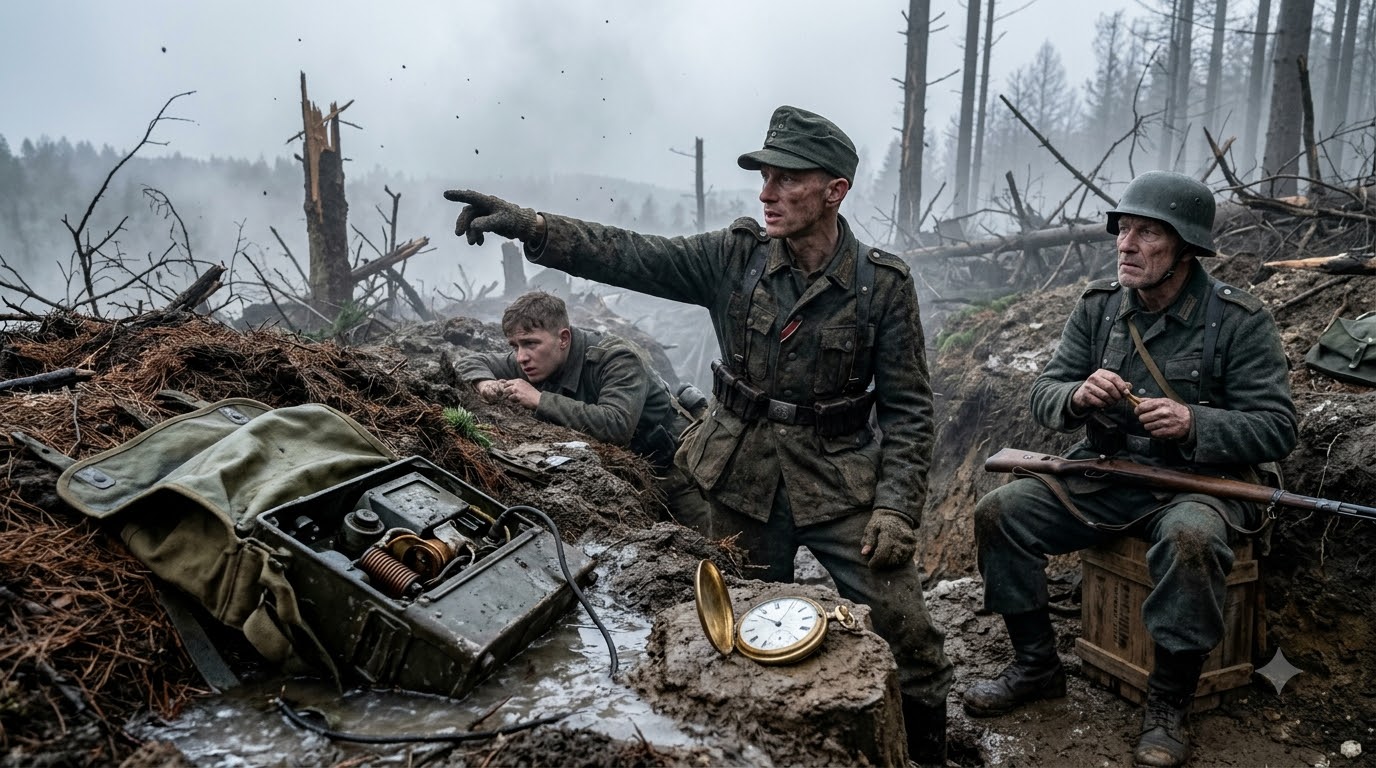
The blast wave shoved a sheet of freezing pine needles down the back of Brener’s collar.
He didn’t flinch. He clicked the cracked cover of his brass watch open, watching the thin second hand tick past the twelve.
One minute.
Beside him, Holtz pressed his face into the wet clay of the parapet, his shoulders twitching every time a treetop split overhead.
“They aren’t aiming at us,” Holtz choked out, spitting black silt onto his boots. “They’re just chewing the wood!”
“They don’t throw steel without a mark, Diet,” Strauss said from three paces down the trench line. The older soldier was sitting on an inverted wooden crate, calmly scraping mud out of the bolt assembly of his Mauser with a notched pine splinter.
“Two minutes,” Brener said, his voice level, eyes fixed on the gray curtain of mist hanging over the western ravine.
The distant battery thundered again—a sharp, triple crack that rattled the teeth in Brener’s skull.
Three minutes. Exactly three minutes since the first sighting smoke drifted above the ridge.
The high-explosive round sheared through a three-hundred-year-old pine fifty yards out, slamming into the earth with a wet, bone-jarring crunch that showered the trench in dirt.
It wasn’t luck. It wasn’t guesswork. It was a factory machine running on a schedule.
“They aren’t using observers on the ridge anymore,” Brener said, snapping his watch shut with a sharp metallic click.
Holtz raised his head, wiping clay from his eyes. “What do you mean? Someone has to see us to call the guns!”
“No,” Brener replied, stepping over a puddle of icy water to reach the parapet’s edge. “An observer takes time to adjust. He checks the fall of shot. He calls back corrections. He waits.”
He pointed a mud-caked glove toward the ridge line where the artillery had just walked its tight, deadly line.
“That wasn’t adjusted fire,” Brener continued, his jaw tightening. “That was a pre-set grid. The moment they know we are in this wash, they don’t look—they just tell the battery to pull the cord.”
Strauss stopped scraping his rifle bolt. He looked up, his grey eyes narrow under his steel helmet.
“The box,” Strauss said quietly.
“The box,” Brener agreed. “They didn’t drop it because they panicked. They dropped it because they were done with it.”
Holtz looked back and forth between them, his hands shaking slightly against his rifle barrel. “So what do we do? We can’t move backward without stepping into the open.”
Brener reached down, grabbing Holtz by the shoulder harness and tugging him upright.
“We don’t go backward,” Brener said, turning toward the dark, tangled gradient of the ridge. “We go find where they marked the grid.”
CHAPTER 4: THE CRACKLING RIDGE
Sparks flew into the damp fog as lead tore through pine resin overhead.
Brener shoved Holtz hard into the hollow of an uprooted trunk. Strauss fell in right beside them, his shoulder slamming against the wet granite ledge with a dull thud.
“That’s an American weapon on the crest!” Holtz gasped, his chest heaving as he fumbled to clear wet sand from his rifle receiver. “They’re still holding the high ground!”
“They aren’t holding anything,” Brener said, wiping a streak of black grease off his forehead with the back of his hand. “They’re covering a retreat.”
A burst of tracer rounds whipped through the low brush, snapping thin branches like dry twigs.
Brener didn’t look at the ridge line. He looked at the terrain—the sharp, forty-degree slope slick with wet pine needles and rotting moss.
Directly above them lay a shallow depression where two massive fallen logs formed a natural V-shape.
“Strauss,” Brener called out over the tearing sound of another automatic burst. “Keep their eyes focused on this drainage ditch. Five rounds, spaced slow.”
Strauss didn’t argue. He braced his elbow against the stone ledge, racking his bolt with methodical, rhythmic precision.
Brener motioned to Holtz. “On me. We use the dead ground under the bank.”
They scrambled upward on knees and elbows, hauling themselves through the frozen slush by clawing into thick pine roots.
The steep incline burned Brener’s lungs, but every foot they gained under the lip of the ridge kept them beneath the gunner’s line of sight.
A sudden shift in the wind carried the sharp, bitter smell of spent cordite right into their faces.
Brener reached the lip of the log structure first. He reached back, grabbing Holtz by the web belt and dragging him over the slippery timber frame into the shallow pit.
The position was empty.
Two brass shell casings bounced against Brener’s boot, still smoking faintly in the damp mud.
On the dirt floor lay a wooden tripod leg, snapped clean at the adjustment knuckle, and three empty ration tins stamped with American lettering.
“They pulled back,” Holtz panted, collapse-sitting against the earthen wall. “They left as soon as we started moving up the hill.”
“They didn’t pull back because of us,” Brener said, crouching near the edge of the pit where the timber met the stone.
He reached down and picked up a strip of olive-drab cloth tape stuck to a pine log.
On it, written in grease pencil, was a single number sequence: GRID 447 – MARK ALPHA.
Brener stared at the wooden timber. Directly below the tape, a deep, clean notch had been carved into the dead wood with a combat knife—pointing straight down the ravine toward their trench line.
“They weren’t trying to hit us with that rifle,” Brener said softly, his fingers tracing the fresh cut in the bark. “They were just holding us down long enough to verify the line.”
Holtz looked up, his jaw slack. “Verify what line?”
“The trap,” Brener said, his eyes darkening as he looked back down into the misty valley.
CHAPTER 5: THE NOTCH IN THE FRAME
The candle stub sputtered in its saucer, dropping a thick tear of wax onto the corner of Westerhouse’s topographic map.
Brener didn’t look up as the Major’s heavy boots scraped across the floorboards.
He scraped the dull point of his pocket knife along the top edge of the sheet-metal radio frame, right beside the olive-drab carrying handle.
“You’ve been scraping that dead metal for twenty minutes, Oberfeld,” Westerhouse said, his voice grating like two stones grinding together. “Has it grown a wire I didn’t see?”
“Look at the rim, Herr Major,” Brener said quietly, tilting the metal box so the flame hit the side at an angle.
Vogle leaned over the table, his wire-rimmed glasses slipping down his nose as he peered at the steel lip.
A tiny, precise V-shaped notch had been filed straight into the metal frame, right through the green paint into bright, unrusted steel.
“A tool mark?” Vogle asked, reaching out to touch the groove with a pale index finger. “Perhaps from assembly?”
“Assembly marks are stamped before painting,” Brener said, dragging the flat of his knife blade through the notch. “This was filed by hand. Freshly filed. And it aligns with nothing on the internal chassis.”
Westerhouse slammed his hand down on the map table, making the kerosene lamp jump. “We are losing two men every hour to indirect fire, Brener! I do not care about a mechanic’s file mark!”
“You should, Herr Major,” Brener said, his voice rising just enough to cut through the officer’s anger. “Because when I stood in the pit on the ridge, I found the exact same V-cut notched into a pine timber.”
The room went dead quiet, save for the wet slapping of the tarpaulin against the broken wall outside.
Vogle straightened up slowly, his thumb fumbling with his collar hook. “A visual sight line?”
“Not a sight line for a observer,” Brener said, pulling his cracked pocket watch from his pocket and laying it next to the radio. “A physical reference mark. They don’t need a live signal from this box to hit us.”
He tapped the steel casing with the butt of his pocket knife.
“They drop these empty casings along the grid lines,” Brener continued, every word deliberate and heavy. “They sight their battery angles off the notches before they ever pull back. The box isn’t a transmitter anymore. It’s a land marker.”
Westerhouse stared at the notch, his dark-rimmed eyes narrowing as the reality settled into his chest.
“They aren’t listening to us,” Westerhouse whispered, the color draining from his face. “They already know where we are because we are sitting on their mark.”
Brener snapped his pocket watch open. Three minutes until the next scheduled registration strike.
“They didn’t lose this radio, Major,” Brener said cold. “They gave it to us.”
CHAPTER 6: THE STEEL CANOPY
Plaster dust rained down in thick, blinding sheets as the ceiling joists groaned under the airburst.
Brener didn’t hesitate. He lunged across the table, sweeping the paper maps into his coat before grabbing Westerhouse by the heavy wool strap of his tunic.
“Out!” Brener shouted, his voice cutting through the deafening roar of splintering timber. “The grid is set on this room!”
Vogle scrambled through the dust, clutching his canvas satchel against his chest as another detonation flattened the eastern wall of the farmhouse.
Westerhouse stumbled through the shattered doorway into the icy mud, his jaw slack as he watched the roof beams collapse into the burning center of the room.
They hit the treeline fifty yards out, sliding on their bellies into a shallow drainage ditch behind a row of ancient hemlocks.
Behind them, the farmhouse vanished under a concentrated barrage—four high-explosive rounds crashing into the exact same three-meter square within six seconds.
Methodical. Precise. Absolute.
Vogle lay on his side in the slush, his breathing ragged, his wire-rimmed glasses hanging off one ear. “They didn’t even send a scout to check if we were inside.”
“They didn’t need to,” Brener said, wiping wet ash from his eyes. “They knew the mark was on the table.”
Westerhouse leaned back against the frozen bank, his hands caked in black dirt, staring at the rising plume of gray smoke where his command desk had sat three minutes prior.
The systemic leverage was broken—not by radio jamming or heroic defense, but by plain, brutal recognition of the game being played.
Brener pulled his cracked pocket watch from his coat pocket, clicking the cover back to reveal the steady, quiet movement of the brass gears inside.
The second hand ticked forward without stopping, indifferent to the falling timber and the distant rumble of American guns resetting their elevation far to the west.
He didn’t look back at the burning ruins. He pulled his wool gloves back over his damp knuckles, picked up his rifle from the mud, and turned deeper into the gray silence of the pines.