The Silent Gunner of the Mekong Mud Carved a Legacy Out of Rusted Iron and Unforgiving Steel
CHAPTER 1: THE OPEN WATER TRAP
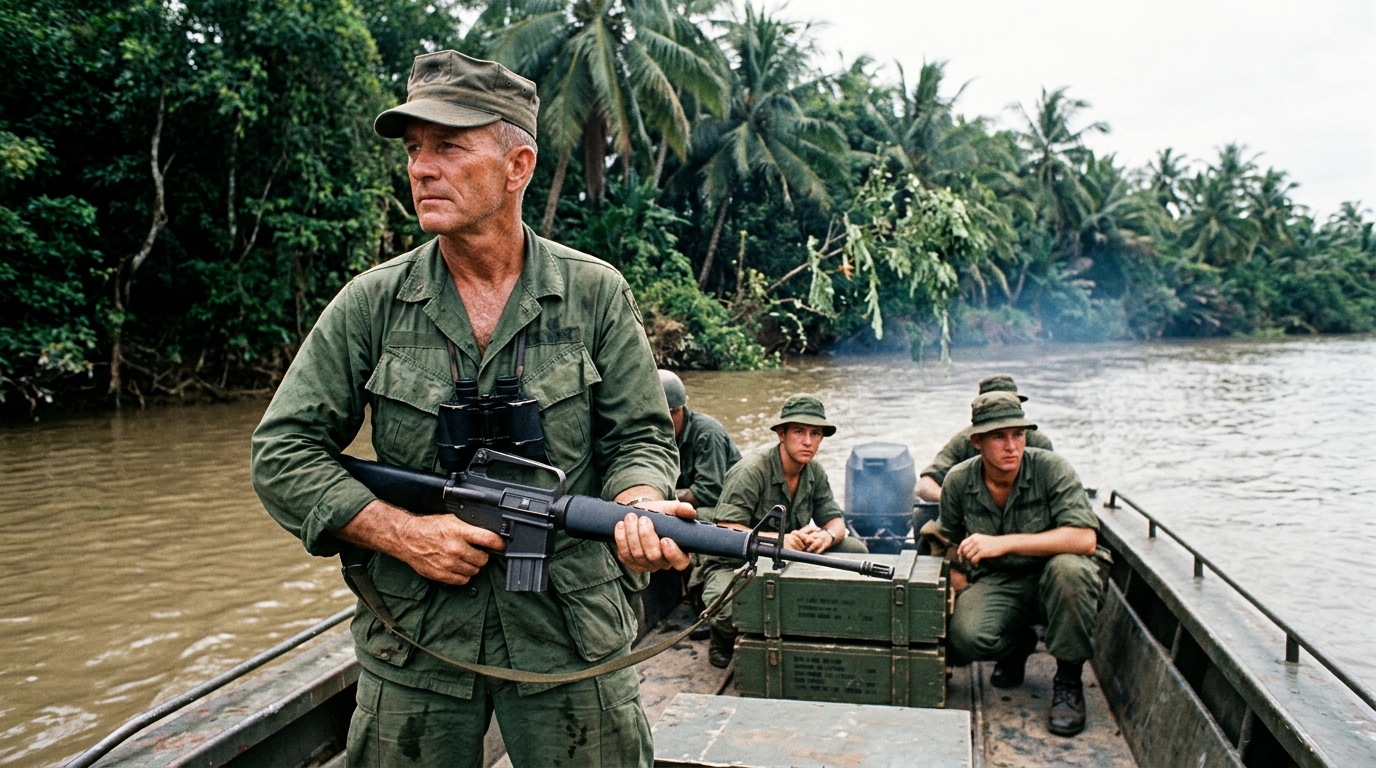
The heat coming off the brown water was heavy enough to taste.
I kept my thumb pressed flat against the receiver of the standard-issue rifle, feeling the faint, gritty film of oil and river silt coating the steel.
Around me, the deck plates vibrated with the steady, dull thrum of the diesel engine pushing the Tango boat upstream against the Mekong current.
Nobody spoke. On these patrols, talking was just a way to spend air you might need later.
A sudden crack split the humid air from the north bank.
It wasn’t the sharp snap of close-range carbine fire; it was the heavy, flat report of a rifle fired from a distance that muffled the sound until the impact arrived first.
Twenty feet off the port bow, a geyser of brown water erupted, soaking the gunwale.
The second round struck closer, punching cleanly through a stack of wooden rations piled three feet to my left.
Every man on the deck dropped instantly, pressing flat against the steel plates.
The heavy .50 caliber machine gun on the bow swung around, its crew scrambling into position to hammer the tree line with suppressive fire.
Bullets churned the distant foliage into shredded green confetti, but the tree line stretched solid and silent for nearly a thousand yards.
At that range, individual coconut palms blurred together into an unbroken wall of green shadow.
The man shooting at us was hidden somewhere out there, invisible behind leaves and distance, holding all the cards while we cooked in the open sun.
CHAPTER 2: THE IRON SIGHT TEST
The Tango boat rocked beneath me, the hull grinding slightly against a submerged sandbar as the diesel engine idled down to a low, rattling purr.
Billy Bingham crouched three feet away, his binoculars pressed tight against his face, scanning the endless green wall of the north bank where the second round had kicked up a spray of yellow mud.
“Still out there,” Bingham muttered, his voice flat and low over the hum of the exhaust.
“900 meters,” I said, squinting down the metal barrel of the standard-issue rifle.
Without the adjustable scope or the hand-fitted match-grade action, the distance wasn’t just a measurement; it was an obstacle built out of raw geometry and stubborn humidity.
The front post sight trembled slightly against the distant horizon, dancing up and down with the roll of the river.
A faint, metallic glint flashed briefly through the upper fronds of a coconut palm near a gap in the tree line, disappearing almost as fast as it came.
It was a tiny speck of brass reflection, barely noticeable against the glaring afternoon sun.
I adjusted my grip, sliding my palm back along the wooden stock to steady the drift.
The other men in the squad kept low behind the supply crates, muttering curses and waiting for orders that weren’t coming from a lieutenant who had ducked behind the cabin bulkhead.
They expected someone else to fix the line, someone with official clearance and high-end gear.
Instead, they had an older sailor who had spent half his life watching rivers flow past without asking questions.
I settled my cheek against the cold wood, let out half a breath, and squeezed the trigger on pure instinct.
CHAPTER 3: THE COUNTERSNIPER PROWL
Billy Bingham did not wait for the smoke to clear before he shifted his weight, his boots squelching slightly against the oil-stained deck plates.
“They’re adjusting azimuth,” Bingham muttered, his knuckles white as he clamped down on his binoculars.
“Let them,” I said, jacking the bolt back with a sharp, metallic clack that ejected the spent brass casing into the brown water below.
Without high-magnification glass to map the tree line for us, staying put on an open vessel was a slow way to wait for a box.
I grabbed the standard-issue rifle by the wooden handguard, swung my leg over the low gunwale, and dropped straight down into the knee-deep mud of the riverbank.
The suction of the delta muck grabbed my boots instantly, trying to pull the footwear right off my feet with every inch I moved forward.
Beside me, the dense mangrove roots twisted like gnarled wire, offering zero clean pathways and plenty of snags for a rifle sling.
We had to cross fifty yards of tangled bank before we reached the shelter of the secondary palm line where the shooter’s vantage point should have been.
There were no radios crackling orders from a command tent, and there was no spotter calling wind speeds through a dedicated mic.
There was just the wet slap of foliage against canvas and the slow, heavy pounding of my own pulse in my ears.
“Move low,” Bingham hissed, dropping into a crouch behind a rotting log that smelled sharply of stagnant tannin and decay.
I didn’t answer him; I just kept my eyes locked on the shifting shadows ahead where the brass glint had flickered moments before.
CHAPTER 4: THE MUD AND THE MIRE
The humidity rose off the stagnant water like steam off a laundry kettle, soaking through my fatigue shirt within seconds.
Bingham stayed three paces behind, his breathing coming in shallow, controlled hitches as he checked the breech of his own sidearm.
“Channel’s branching ahead,” Bingham whispered, pointing a scarred finger toward a murky fork in the overhanging brush.
“We stay left,” I said, wiping a mixture of sweat and silt from my forehead with the back of a calloused hand.
The air smelled intensely of rotting vegetation and diesel oil drifting from the distant patrol boats on the main current.
Every step required a deliberate calculation, lifting one boot at a time against the suction of the delta floor while keeping the standard rifle cradled tight across my chest.
There was no room for error, and there was certainly no machinery to bail us out of a tactical blind spot.
A sudden gust of wind rattled the high palm fronds overhead, shaking loose a shower of heavy droplets that splattered against the muddy water.
The shift in air current carried a faint, unnatural sound from deeper up the bank—the metallic click of a bolt sliding home into a breech.
Someone else was moving through the foliage, and they weren’t trying to hide their tracks anymore.
I paused, pressing my back flat against the trunk of a broad-rooted mangrove, and eased the safety off without a sound.
CHAPTER 5: THE CHECKMATE CANOPY
The wind died down instantly, leaving the air thick and stagnant across the upper river bend.
Billy Bingham stayed low in the roots behind me, his hand tightening around his canteen as he watched the high fronds ninety meters out.
“He’s locked into the middle fork,” Bingham muttered, his voice barely cutting through the hum of distant insects.
“Let him stay there,” I said, squinting through the iron sights at the exact crown of the leaning palm where the brass glint had flashed earlier.
Without an adjustable scope or a spotter calculating wind drop for me, the distance was entirely a matter of raw arithmetic and cold patience.
The opposing shooter thought he held all the cards from his high perch, assuming any target down below was blind to his setup.
He shifted his weight in the branches, rustling the green fronds just enough to give away his exact elevation against the skyline.
I adjusted my grip on the wooden stock, feeling the coarse grain bite into my palm as I controlled my breathing.
There was no room for hesitation, and no second chances waiting in reserve.
I settled the front sight precisely where the shadow met the sunlight, let out a slow, measured breath, and squeezed the trigger.
CHAPTER 6: THE QUIET DEPARTURE
Billy Bingham stood up slowly from the roots, wiping a streak of dark mud from his sleeve without saying a word.
“That’s the last of them for this stretch,” Bingham murmured, his eyes lingering on the quiet tree line across the water.
“Pack the kit,” I said, sliding the bolt forward on the standard rifle and checking the safety catch.
There were no medals waiting on the deck, and there was no crowd of cheering men to mark the end of the patrol.
Just the steady, heavy thrum of the Tango boat idling against the current and the endless flow of brown water heading toward the sea.
I picked up my duffel bag, slung the rifle over my shoulder, and stepped back onto the steel deck plates.
The heat of the delta still pressed down on the river, thick and unyielding, but the tension in the air had finally broken.
Some men needed a story to make sense of what they carried, and some men needed a book to prove they were there.
I didn’t need either.
I walked to the rear of the boat, sat down on a wooden crate, and let the silence take me back where I belonged.