The Survey Stakes: A War of Inches and the Fragile Peace of Sage Brook Ridge
CHAPTER 1: The First Shard
The hum of the patrol cruiser’s engine sounded like a death knell against the quiet of the neighborhood. I stood on the porch, my hands shoved deep into the pockets of my jacket, feeling the rough texture of the fabric against my palms. It was a cold, metallic kind of night, the kind that smelled of damp mulch and the faint, biting scent of ozone from the flashing light bar.
Celeste Harrow was pacing at the edge of my lawn, her movements frantic and rehearsed. She held her phone like a talisman, her thumb hovering over the screen. She wasn’t looking at her son, who was slumped against the fence a few feet away, laughing at something only he could see. She was looking at the officers, her eyes scanning for a weakness, a way to fold this reality into something that suited her.
“This is HOA land,” she said, her voice cutting through the pulsing blue light. She kept her posture upright, a rigid, unnatural alignment that suggested she was performing for an audience only she could see. “He is harboring individuals who are a threat to our community safety.”
I didn’t argue. Arguing with Celeste was like trying to hold back a rising tide with a piece of paper. Instead, I looked past her, toward the strip of land that bordered the trees. The fence line was scarred with rust, a relic of a time before the homeowners’ association had turned the street into a museum of perfectly manicured facades. My back lot was outside their boundary—it had always been—but looking at the way she stood, I realized that truth didn’t matter here. Not if she could talk loud enough.
A deputy stepped away from the cruiser, the paper in his hand crinkling in the wind. He frowned, his eyes moving from the map to the grass under my feet. “Ma’am,” he said, his voice flat, scrubbed of any emotion. “According to the county plot, this land isn’t HOA property.”
For a split second, the performance faltered. A hairline fracture appeared in Celeste’s composure. Then, she smiled—a tight, efficient expression that didn’t reach her eyes.
“It’s adjacent,” she corrected, the word sliding off her tongue like polished stone. “And the association has authority over all adjacent corridors.”
The deputy didn’t answer. He just looked at me, a silent inquiry that tasted like stale coffee. I glanced toward the fence again. The shouting had stopped, replaced by a sudden, heavy silence that felt more dangerous than the noise. Someone was moving in the dark, a shadow detached from the tree line, blending into the rust-colored chaos of the back lot. My stomach twisted. It wasn’t just a party. It was a transaction.
The silence grew, pressing in on the edges of the yard. Celeste took a step forward, her shadow stretching long and distorted across the concrete. I realized then that she wasn’t just protecting a drunken son. She was guarding a space, and the rusted fence was the only thing standing between the reality of her world and the truth I held in my deed. And beneath the sound of the wind, I heard the sharp, unmistakable scrape of metal against metal, as if something back there was being locked away.
CHAPTER 2: The Paper Trail
The cruiser’s red and blue pulses eventually faded into the distance, leaving my backyard in a silence so thick it felt weighted. I didn’t move for a long time. My hand remained on the latch of my back door, the cold iron biting into my palm, grounding me while my mind refused to settle. Celeste had played the police like a fiddle, her tone and her posture radiating the kind of practiced, suburban authority that made a deputy hesitate to question a map, even one that looked suspicious on the surface.
I walked back into the kitchen, the linoleum cold beneath my socks. The house felt different tonight—smaller, more fragile. Every shadow in the corner of the room seemed to stretch, mimicking the way Celeste had distorted the boundaries of my own property. I sat down at the small wooden table, the surface scarred from years of use, and pulled my laptop toward me. The screen lit up, casting a harsh, artificial glow that made the kitchen feel even colder.
I didn’t need to guess where to start. I needed the truth written in something more permanent than the spoken word. I pulled up the county clerk’s portal, my fingers trembling slightly. My brain kept replaying the metallic scrape I’d heard from the treeline, a sound that felt entirely out of place in a residential area. It wasn’t the sound of teenagers; it was the sound of a professional transaction, something practiced and efficient. Why would a simple “easement” area require such secrecy?
The boundary overlay I pulled from the county database was clean, a sharp, crisp line that clearly separated my plot from the Sage Brook Ridge common grounds. But then I navigated to the HOA’s own digital portal, the one Celeste insisted everyone use for “clarification.” I pulled up their map and overlaid it with the county’s. My pulse quickened. The lines didn’t match. The HOA’s map showed a jagged, aggressive intrusion, a strip of land that had been “nudged” deep into my backyard to accommodate the treeline.
I stared at the screen, the friction of the realization catching in my throat. It wasn’t a mistake. Someone had gone into the digital files and manually redrawn the boundary. I started tracing the file history, looking for a stamp, a surveyor’s ID, or even a basic authorization code. There was nothing. Just a blank signature field where the legal approval should have been. It was a digital fabrication, a hollow shell designed to look authoritative enough to fool a patrol officer who didn’t want to deal with a yelling HOA president on a Friday night.
I felt a ghost of a memory surface—the day I’d first walked this yard, the way the realtor had pointed out the distinct, rusted post that marked the edge of the property, a point now sitting well inside the HOA’s “easement” zone. I had built my life around that line, and now, someone had erased it with a few clicks of a mouse.
The silence of the house was interrupted by the sudden, sharp vibration of my phone on the table. A notification. A new post in the neighborhood group chat. I didn’t want to open it, but the compulsion to know what she was broadcasting—what lie she was weaving into the community fabric—was too strong to ignore.
“Safety Warning: Hostile homeowner on Juniper Bend,” the post read. “Reports of aggressive behavior and intimidation of residents using the common area behind lot 17. Please report any suspicious activity immediately.”
The comment section was already filling up. Unstable. Keep your kids away. Maybe he’s armed. The ease with which she turned the neighborhood against me was like watching a master artisan at work. She wasn’t just claiming the land; she was isolating me from the very people who lived on the other side of my fence.
I closed the laptop and walked back to the window, peering out into the dark. My backyard was empty now, the intruders gone, but the atmosphere remained heavy with the smell of iron and dry earth. I realized then that I was playing a game of chess against someone who had already moved all the pieces, and the only way to break her hold wasn’t to shout back at her—it was to start documenting every lie, every digital ghost, and every physical encroachment.
I stood there for a long time, watching the way the moon hit the rusted fence. I was no longer just a homeowner protecting his property. I was a man trying to piece together a reality that had been deliberately shattered. Tomorrow, I wouldn’t call the police. I would call the one person who could look at a boundary line and tell me exactly what it was worth. I needed a surveyor.
The realization brought a strange, cold clarity. The battle had shifted from a noise complaint to a war of property, and for the first time, I felt the sharp, steady resolve to win, no matter how many pages of documentation it took.
CHAPTER 3: The Surveyors Arrival
The morning air tasted of metallic dust and impending friction. I stood on my back porch, the screen door vibrating slightly in the wind, watching the surveyor’s truck rumble down the quiet street of Juniper Bend. He was a man of few words, his movements deliberate and devoid of the performative urgency that defined everyone else in Sage Brook Ridge. His orange vest was a vibrant, aggressive gash of color against the desaturated browns and grays of the neighborhood.
I walked out to meet him, my boots crunching on the dry earth. He didn’t look up immediately, his eyes fixed on the rusted fence that delineated my perceived boundary. I handed him the deed, the edges crinkling in my grip. He took it without a word, his gloved fingers tracing the legal descriptions as if reading braille.
“The markers should be near the old iron post,” he said, his voice gravelly and calm. He pulled a tripod from his truck, the metal clicking into place with a sound that seemed loud enough to echo off the nearby houses.
I looked toward Celeste’s house. The blinds were drawn, but I could feel the weight of eyes watching from behind the fabric. The silence of the street was unnatural, a heavy, stifling quiet that usually preceded a storm. I kept one eye on the surveyor and the other on the street, half-expecting a patrol car to come rolling through, looking for a reason to escalate the situation.
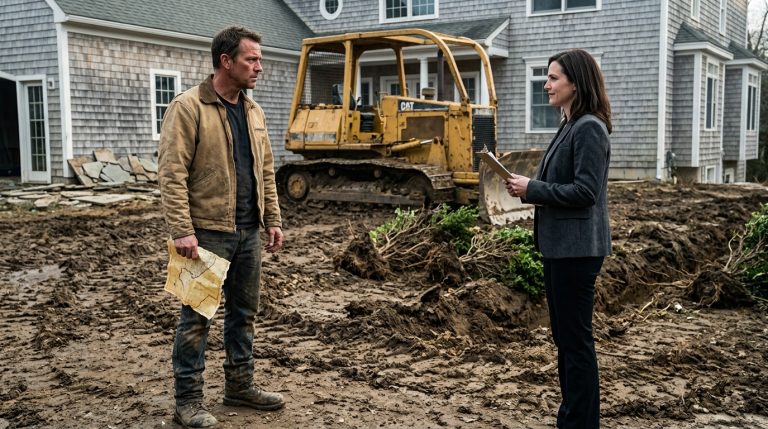
The surveyor began his work, pacing the line with a precision that bordered on surgical. Every few minutes, he’d pause, consult his handheld unit, and adjust his course. Then, the rhythmic thud-thud-thud of the mallet began, driving the wooden stakes into the hard-packed soil. Each strike sent a shiver through my chest.
Suddenly, a heavy utility truck with local municipal markings swung around the corner, its brakes screeching like a wounded animal. It idled right in front of my driveway, blocking the line of sight to the street. A worker climbed out, looking confused, clutching a clipboard. “Checking a reported water main issue,” he announced, his voice carrying just a little too far.
My skin prickled. A water main issue, now? Of all the times, on the exact morning I’d brought in an expert to verify my property line. I leaned against the rusted fence, watching the surveyor stop his work, his brow furrowing as he looked at the utility worker, then back at me. It was a classic “Butterfly Detour”—a minor, external disruption that felt too orchestrated to be coincidental. Celeste was feeling the pressure, and she was reaching into her bag of tricks to stall, to confuse, to create just enough friction to make this simple verification feel like a chaotic transgression.
“Don’t stop,” I said, my voice low and steady, aiming for a pragmatism I didn’t entirely feel.
The surveyor gave me a sharp, knowing look. He didn’t need to be told. He stepped over the utility hose the worker had begun to unroll, placing his next stake with even greater focus. I stood my ground, my arms crossed, watching the utility worker move slowly, filming his progress with a phone tucked into his pocket. It was amateurish, almost laughable, but it kept my nerves on edge.
As the surveyor neared the treeline, the air grew tighter. I watched him hammer the final stake into the ground—the physical manifestation of my rights, a wooden sliver defying the digital erasure Celeste had attempted. He stood up, wiped his brow, and walked back toward me.
“Your deed is solid,” he said, handing me the report. “There’s no easement here, and no ambiguity. If anyone tries to tell you otherwise, they’re ignoring the physical geography.”
I took the report, the weight of the paper feeling more substantial than any of the HOA notices I’d received. It was a tool, a weapon of sorts, but more than that, it was a confirmation that I hadn’t lost my mind. The utility worker climbed back into his truck, his “water main check” abandoned as quickly as it had begun. He didn’t look at us as he pulled away, his eyes studiously fixed on the dashboard.
I turned back to the treeline. The stakes stood in a neat, defiant row. I had the verification, but I also had a new, gnawing realization. Celeste wouldn’t just accept this. She wasn’t fighting for land; she was fighting to keep the treeline a black box, a place where people disappeared and transactions happened in the dark. By proving the land was mine, I hadn’t just settled a boundary dispute—I had exposed the very cover she was using to protect her son.
The rust on the fence caught the morning light, burning a deep, angry orange. I walked to the edge of the property, my hand grazing the top of the stake. It was solid, rooted deep in the dry, unyielding earth. I hadn’t won the war, but I’d finally drawn a line. And now that I knew what was hiding behind that line, the real danger was only just beginning.
CHAPTER 4: The Security Dragnet
The sun didn’t bring warmth to Juniper Bend; it only sharpened the edges of the neighborhood, turning every perfectly pruned hedge and pristine sidewalk into a silhouette. I sat on my front porch, the wood beneath me cool and unyielding. The stakes in the backyard were still there—a quiet, stubborn victory—but as I looked toward the street, my stomach tightened.
Parked diagonally across the road was the same security van that had been hovering for days. It was a nondescript, industrial beast, its tires stained with road grit, the paint faded to a dull, institutional gray. It hadn’t moved since dawn. No one got out, no one got in, but I could feel the weight of it, a physical pressure pressing against the front of my house. The contractor—a man whose name I still didn’t know—was inside, his presence a silent declaration of the HOA’s ongoing interest in my “compliance.”
I reached for my phone, but my hands were unsteady. The surveyor’s report sat on the small table beside me, its pages filled with the irrefutable geometry of my land. It felt like a heavy stone, a burden of truth that Celeste was clearly determined to bury under a mountain of bureaucratic noise. I pulled my own phone out and began recording, framing the van’s license plate in the viewfinder.
The movement triggered an immediate reaction. The van’s engine coughed to life, a low, guttural rumble that vibrated through the porch floorboards. It didn’t pull away; it simply shifted, the driver’s side mirror angling slightly to catch my reflection. It was an exercise in pure intimidation, a way of signaling that while they couldn’t enter the property, they could own the space around it.
I didn’t break eye contact. I watched as the driver’s side window slid down, just an inch—enough to catch the glint of a smartphone lens aimed directly at my front door. He was filming me.
“You’re trespassing on public property,” I called out, my voice raspy from disuse. It was a hollow statement; he was on the street, and in Sage Brook Ridge, the rules were whatever Celeste said they were.
The driver didn’t respond. He simply reached out and tapped a sequence into a mounted tablet on his dashboard. Seconds later, my own phone buzzed—a new notification from the HOA portal. I opened it. It was an automated “Formal Warning of Non-Compliant Activity,” the text bolded and dripping with legalistic jargon: Unauthorized interaction with community security personnel, obstruction of monitoring, potential for further enforcement action.
The precision of the timing was a gut punch. It wasn’t just surveillance; it was a feedback loop designed to catch me in any moment of frustration and record it as proof of my “instability.” I realized then that my porch wasn’t a vantage point—it was a cage. I stood up, the chair scraping sharply against the wood, and went inside, pulling the blinds shut with a finality that felt like slamming a door on the world.
Inside, the house felt claustrophobic. I walked to the kitchen, the scent of the dry, iron-rich soil from the backyard clinging to my clothes. I needed to move, to stop being the target of the observation. I headed to the home office, a small room at the back of the house that had become my base of operations. The walls were covered in printed-out maps, property deeds, and email headers.
I looked at the latest thread I’d unearthed. It was a quiet, digital trail, a series of messages between the board members and the security contractor regarding “contingency expenditures.” The amounts were small, broken down into innocuous categories like “asset management” and “perimeter maintenance,” but when I added them up—the equipment, the surveillance hours, the legal padding—they totaled a sum far higher than any reasonable HOA budget.
This wasn’t just about the back lot. It was about the money. Celeste and her board weren’t just protecting her son; they were looting the association to fund the very infrastructure of my harassment. The security contractor wasn’t just a guard; he was an accomplice.
My mouth went dry. If I could prove the contingency line item was being used for something other than community maintenance—if I could prove it was being used to falsify boundary maps and pay for personal security to target a homeowner—then the HOA’s entire narrative would collapse.
I sat down at the desk, the hum of the computer’s cooling fan the only sound in the room. I began cross-referencing the invoices I’d managed to find in the public portal with the dates of the “easement” enforcement attempts. The correlation was exact. Every time I’d been slapped with a fine, a corresponding payment was routed to the security firm.
I reached for my coffee, but my hand brushed the surveyor’s report, knocking it to the floor. As I leaned down to pick it up, I noticed something I’d missed—a faint, handwritten notation in the corner of one of the parcel maps, something that looked like a coordinate. It wasn’t a standard survey mark. I pulled the magnifying glass from the drawer and leaned in. It was a precise, technical reference to a sewage access point, one located deep in the forbidden zone behind my fence.
Why would a property survey contain a specific reference to a utility access point located outside the boundary, buried in the middle of the “easement” area? I stared at the coordinate, the ink dark and deliberate. My heart began to hammer against my ribs. This wasn’t just a boundary dispute. There was something hidden in that strip of land—something the HOA was willing to spend every cent of their contingency fund to keep buried. And suddenly, the security contractor’s presence outside didn’t seem like just a nuisance anymore. It felt like a guard standing watch over a secret that was, by all rights, currently sitting in my own backyard.
CHAPTER 5: The Hidden Thread
The air in the office was stale, recirculated and thick with the smell of old paper and the sharp, ozone-tinged exhaust of the computer. I hadn’t moved from the desk in hours. The coordinate I’d found on the survey kept drawing my gaze, a tiny, innocuous mark that now felt like a beacon. I pushed the magnifying glass aside and started pulling up every digital file I had archived from the neighborhood association’s portal.
If there was a sewage access point there, the city records had to have a schematic. I navigated to the municipal engineering database, my fingers moving across the keyboard with a frantic, rhythmic intensity. The login was a hurdle, but the credentials I’d scraped from the public access logs proved just enough to grant me “read-only” status. It was a small, fragile victory, but it was enough to reveal the truth.
I pulled up the regional infrastructure map. I zoomed in on Juniper Bend, the grid lines of the neighborhood appearing on the screen like a spiderweb. I tracked the sewer line, a thick, blue vein that snaked through the subterranean depths of the residential lots. When the line hit the back of my property—the area Celeste was so desperate to claim—it didn’t just pass through. It branched.
There was a sub-junction, a decommissioned valve cluster that hadn’t been touched in over a decade. The coordinate on the survey matched the junction point perfectly. I felt a cold shiver trace my spine. It was a dead-end, a perfect, subterranean hollow that existed off the official grid. It wouldn’t show up on a residential survey unless someone had specifically mapped it for a reason. And that reason became clear as I traced the associated maintenance logs.
The last entry for that specific junction wasn’t a city repair. It was a “special assessment” authorized by the Sage Brook Ridge HOA, signed by none other than Celeste Harrow.
The pieces clicked together with the heavy, satisfying snap of a lock. The “easement” was a lie. The security contractor wasn’t just a guard; he was a gatekeeper for the access point. Everything that had happened—the fabricated maps, the fines, the relentless surveillance—wasn’t about keeping the neighborhood safe. It was about controlling the only point of entry to a blind spot in the city’s infrastructure. A place where things could be moved, stored, and exchanged without ever appearing on a security feed or a street-level record.
My head pounded, the fatigue of the long hours finally catching up to me. I leaned back in the chair, the wood creaking in protest. My vision blurred for a second, the glowing monitor turning into a smear of light and shadow. I blinked, trying to focus on the screen, but the lines seemed to shift, moving like static. Was I seeing the connection clearly, or was I just finding the pattern I wanted to see? The doubt was a jagged, annoying splinter in my mind, but I pushed it down.
I looked at the invoices again, the ones marked “perimeter maintenance.” Perimeter. Not of the neighborhood, but of the junction.
I stood up and walked to the window. The van was still there, a dark, hulking presence against the streetlamp’s glow. The driver was sitting on the hood now, smoking a cigarette, the ember a dull, warning orange in the dark. He wasn’t watching the house anymore; he was watching the treeline, his posture guarded, alert.
I had the thread. Now I just needed to pull it. I reached for the phone. I didn’t call the police; they were too slow, too prone to being steered by the loudest voice in the room. I dialed my lawyer, the one person who knew that this wasn’t about a noise complaint, but about a systematic abuse of authority that had reached into the city’s own pipes.
“I have the trail,” I said, my voice sounding foreign and steady in the quiet room. “The money, the maps, and the site. It’s not a boundary dispute anymore.”
He listened in silence, his breath a faint whisper on the other end of the line. “If you’re right,” he said slowly, “this doesn’t end with a settlement. This goes straight to the county prosecutor.”
“I am right,” I replied, staring out at the van. “And I have the proof.”
I hung up, the silence of the house rushing back in. The battle was escalating, the stakes shifting from my backyard to the foundations of the neighborhood itself. I looked at the surveyor’s report one last time, the stakes in the yard below finally making sense. I wasn’t just holding a line; I was holding the key to the entire cage.
CHAPTER 6: The CounterMove
The rap at the door was sharp, persistent, and possessed that specific, hollow authority of someone who believed they were carrying bad news. I stood in the middle of my office, the legal packet—thick with the surveyor’s report, the infrastructure schematics, and the incriminating email thread—staring up at me from the desk. My lawyer’s words echoed in my head: This doesn’t end with a settlement.
I walked to the front door, my boots hitting the floorboards with a heavy, steady sound. I didn’t rush. I needed the extra seconds to clear my face, to settle the frantic vibration of my nerves into a mask of calm, pragmatic exhaustion. I opened the door.
Standing on my porch was a man in a crisp, county-issued windbreaker. He wasn’t the police; he was a municipal inspector, holding a clipboard that looked like a weapon in his grip. Behind him, parked right on the curb, was the security van. The driver was out now, leaning against the door frame, watching with the smug, detached patience of a man who knew he was backing a winning horse.
“Name’s Miller,” the inspector said, skipping the pleasantries. “We’ve had reports of unapproved structural modifications and potential property boundary violations at this address. I’m here to conduct a formal assessment.”
He didn’t wait for an invite. He pushed past me, his eyes scanning the interior of the house with a dismissive flick of his gaze. I closed the door, the sound of the latch clicking into place feeling like a barricade. “There are no unapproved modifications,” I said, my voice steady, stripped of the defensive edge I’d been nursing for weeks. “And the boundaries were surveyed this morning. The report is on my desk.”
He ignored me, walking straight into the living room and toward the back door. He wanted to see the stakes. He wanted to be the one to find the “error” that would justify the HOA’s claim.
“I wouldn’t touch those if I were you,” I said, following him, my stride matching his. “The surveyor’s report is signed, stamped, and already on its way to the county clerk’s office. If you move them, you’re tampering with evidence.”
The inspector froze, his hand hovering over the back door handle. He turned, his face tightening. “Evidence of what?”
“Of the fabrication of city infrastructure maps,” I replied, my voice dropping to a low, serrated tone. I pulled the legal packet from the side pocket of my jacket and held it up. “The junction behind my fence is a decommissioned city asset. I have the schematics and the maintenance logs that show the HOA is using it for unauthorized access. And I have the email thread where Celeste Harrow authorizes contingency funds to keep anyone from looking too closely.”
The silence that followed was visceral. The inspector looked at the packet, then back at me. The smugness of the security contractor outside, which I could see through the kitchen window, began to fray. He was watching us, his phone out, probably recording the entire exchange.
“You’re making a mistake,” the inspector said, but his voice lacked the earlier punch.
“The mistake was thinking you could bury a city junction and use an easement claim to hide it,” I said. “I’m not the hostile homeowner here. I’m the one who just saved the county from an illegal infrastructure breach.”
I walked over to the desk and opened the packet, fanning out the pages. I didn’t give him the originals; I gave him copies. I needed him to see enough to know that the threat was real, but not enough to let him walk out with the entire story.
“You can do one of two things,” I continued, feeling the adrenaline sharpen my senses. “You can walk out that door, tell your HOA friends that there’s no violation here, and let the prosecutor handle the investigation. Or, you can finish your inspection, sign off on a report that’s fundamentally false, and become the next person on the witness list when the county starts asking why municipal schematics were being tampered with.”
The inspector looked at the documents, then at the van outside, then back at me. He was caught in the friction, the space between the lie he was told to uphold and the reality he was now holding in his hands.
“That’s a lot of paper,” he muttered, but his grip on the clipboard had relaxed.
“It’s a lot of truth,” I corrected.
The contractor outside finally moved, walking toward the porch, his hand on his phone. He was getting anxious. He knew that if the inspector walked out without a violation report, the whole narrative—the “hostile homeowner,” the “easement security,” the entire front—would evaporate.
I didn’t wait. I turned to the inspector. “I’m going to step outside and invite the county investigator to verify this survey, as he’s currently in the neighborhood. Do you want to be part of that conversation, or would you prefer to step aside?”
The inspector looked at the van, then at me. He stepped back, the authority in his posture collapsing. He didn’t say a word, just turned and walked toward the door. I followed him, my heart hammering a rhythm of pure, tactical relief. The confrontation was coming, but for the first time, I was the one holding the line.
CHAPTER 7: The Clubhouse Confrontation
The inspector hadn’t even reached the sidewalk before Celeste was on my lawn. She moved with a jagged, unnatural velocity, her heels sinking into the soft dirt where the surveyor’s stakes were still standing. She ignored the inspector entirely. Her eyes were fixed on me, bright and feverish with the frantic energy of a woman who had just realized the floor was falling out from under her house of cards.
“You don’t get to do this,” she said, her voice a low, strangled rasp that carried the weight of a dozen broken pretenses. She didn’t look at the packet in my hand; she looked through it, as if she could burn the paper with the sheer force of her denial.
I didn’t answer. I stepped off the porch, the wood groaning behind me, and walked past her toward the clubhouse. The air was cool and smelled of the coming rain, a heavy, iron-scented draft that seemed to herald the finality of the day. Celeste shadowed me, her breath hitching in her throat.
“If you walk into that building,” she warned, her voice rising now, drawing the attention of the neighbors who were beginning to gather on their own porches, “you aren’t just hurting me. You’re destroying this community. Think about the property values. Think about what you’re doing to everyone who trusted us to protect this place.”
She was still doing it. Even now, with her son’s secret rotting just a few hundred yards away, she was framing her survival as a civic duty. It was a masterpiece of cognitive dissonance, a weaponized empathy that had worked on everyone in Sage Brook Ridge—everyone except me.
I reached the clubhouse door and pushed it open. The smell of cheap carpet cleaner and stale coffee hit me, a sensory memory of the long, exhausting hours I’d spent tracking the digital ghost of the boundary. The room was empty, save for the chairs still set up in a horseshoe from the last aborted meeting.
“I’m not destroying the community, Celeste,” I said, turning to face her as she crossed the threshold, her face a mask of desperate, performative rage. “I’m just clearing the rot out of the foundation.”
I walked to the front table and laid the packet down, spreading the pages out like a winning hand. The infrastructure schematics, the highlighted maintenance invoices, and the internal email thread concerning the contingency fund. It was all there, a narrative of corruption written in the coldest, most undeniable ink possible.
Celeste stepped up to the table, her hands trembling as she reached for the documents. I didn’t pull them away. I let her see them. I watched as her eyes darted across the schematics, the realization dawning that I hadn’t just found a map—I had found the blueprint of her son’s operation, the very thing she’d been using the association’s authority to hide.
“You’re making a mistake,” she whispered, her voice failing her now. “This… this is an internal matter. It’s an administrative clarification, nothing more.”
“A clarification doesn’t require a contingency fund,” I said, my voice steady, echoing off the high, hollow ceiling of the room. “And it doesn’t require lying to the county inspector. I’ve already sent copies to the prosecutor’s office, Celeste. By tomorrow, they aren’t going to care about the HOA’s bylaws. They’re going to care about where those payments were routed.”
She stood there, frozen, the paper crinkling under her fingers. The color had drained from her face, leaving her looking hollow, reduced. For a moment, the performative armor she’d worn for months cracked completely, and I saw the woman underneath—not an HOA president, not an architect of suburban order, but a terrified parent who had gone to impossible lengths to shield a reality that was never going to hold.
The front door of the clubhouse pushed open. It wasn’t the police, not yet, but the county investigator stepped in, his face serious, his hand resting on the notebook at his hip. He looked at the documents on the table, then at Celeste, who had finally let go of the papers, her shoulders slumped in a gesture of absolute, defeat-filled exhaustion.
“Mrs. Harrow,” he said, his voice quiet, lacking any of the theatricality Celeste had used to command the neighborhood. “We need to have a conversation about that access point.”
The silence that followed was total. It wasn’t the silence of a secret being kept, but the silence of a house of cards finally, mercifully, falling down. Celeste didn’t run. She didn’t shout. She just turned, her gaze sweeping the room as if trying to find the world she’d built, only to find nothing but empty folding chairs and the harsh, indifferent light of the afternoon.
I turned away, my chest finally feeling the weight of the air leaving my lungs. The battle was over. The boundary was marked, the truth was out, and for the first time in months, the future of the house on Juniper Bend wasn’t something I had to fight for—it was just something I had to live in.
CHAPTER 8: The Quiet Aftermath
The departure of the county investigator and the subsequent arrival of the patrol units to escort Celeste away felt like a strange, muted performance. There were no lights flashing, no sirens wailing—just the methodical, clinical removal of a woman who had tried to build an empire out of thin air and neighborhood fear. As the heavy doors of the clubhouse clicked shut, leaving me standing in the center of the room, the sound resonated like the final chime of a clock.
I didn’t rush out. I stood there, watching the dust motes drift in the late afternoon light. The air was cool now, filtering through the vents with a sharp, clean scent of the coming evening. For the first time in months, I didn’t feel the need to look over my shoulder. The constant, gnawing anxiety that had turned my home into a defensive perimeter had evaporated, replaced by a profound, hollow exhaustion.
I walked out of the clubhouse and into the twilight. The neighborhood of Sage Brook Ridge looked exactly the same as it had when I moved in—manicured lawns, hushed streets, the same houses standing in silent, watchful rows. But the feeling of the place had changed. The tension, that invisible thread that Celeste had pulled to control the entire block, was gone.
As I walked down Juniper Bend, I saw my neighbors peeking from behind their curtains, their expressions a mixture of relief and, in some cases, deep, lingering shame. An older man, Mr. Henderson from the corner, was out on his porch, fiddling with a garden hose. He saw me, hesitated, and then slowly raised a hand in a hesitant, awkward wave. I nodded back. It wasn’t forgiveness, not yet, but it was an acknowledgement of a shared, complicated reality. We were all starting over, stripped of the manufactured drama that had defined us.
When I reached my house, the first thing I saw was the row of surveyor’s stakes. They looked different in the fading light—no longer weapons of war, but simple, sturdy markers of fact. I walked into the backyard, the earth firm and cool under my boots. I reached down, my fingers brushing the rusted metal of the fence line. It was solid, rooted, and mine.
I spent the next hour simply walking the boundary. I pulled up the temporary stakes, one by one, feeling the resistance of the soil, the satisfying pop as they came free. I didn’t need them anymore; the truth was now a matter of record, hard-coded into the county database. I brought them to the back porch and stacked them neatly, a pile of wood and string that had served their purpose.
Inside, the house was dark and quiet. I didn’t turn on the lights. I walked to the kitchen and sat at the table, the same spot where I’d spent those long, frantic nights deciphering the digital fabrications. It felt like a lifetime ago. I reached into my pocket and pulled out the small, jagged piece of metal I’d picked up from the fence line back when the chaos started. I placed it on the table, a tiny, rusted totem of the struggle.
I made a cup of coffee, the steam curling into the still air of the room. The silence was no longer heavy or suffocating—it was simply peaceful. I listened to the house settle, the slow, rhythmic expansion and contraction of the walls as the temperature dropped.
There was a quiet knock at the back door. I stood, my pulse steady, and opened it. It was my neighbor, the one who had apologized earlier, standing there with a plate of fresh cookies, her eyes downcast.
“I… I know it’s not much,” she said, her voice soft, “but I wanted to apologize. For not saying anything. For letting her make us believe the lie.”
I looked at the plate, then at her. The anger that had fueled me for weeks had completely dissipated, leaving behind a clear, unburdened clarity. “Thank you,” I said, taking the plate. “It’s a start.”
She nodded, turned, and walked away into the night. I leaned against the doorframe, watching the lights in the neighborhood flicker on, one by one. The HOA board would be meeting soon, the treasurer would have to answer to the board members, and the new president would be working to untangle the mess of the contingency fund. It would be a long, tedious process of administrative repair, but it was a path forward, not a spiral of manipulation.
I went back to the table, sat down, and took a sip of the coffee. It was warm, real, and tasted of nothing but itself. I looked out the window at the tree line, the darkness beyond the fence now just a space, no longer a hiding place or a front for someone else’s secrets. I was home. The battle had been long, the cost of the victory felt in every muscle of my body, but as I sat there in the quiet, I knew I had done more than just win a dispute. I had reclaimed my life, inch by inch, by the cold, clear light of the truth.