The Weight of Aluminum And Cold Truth Over the Burnished Skies of Wartime Germany
CHAPTER 1: COLD IRON AND UNFAMILIAR GAUGES
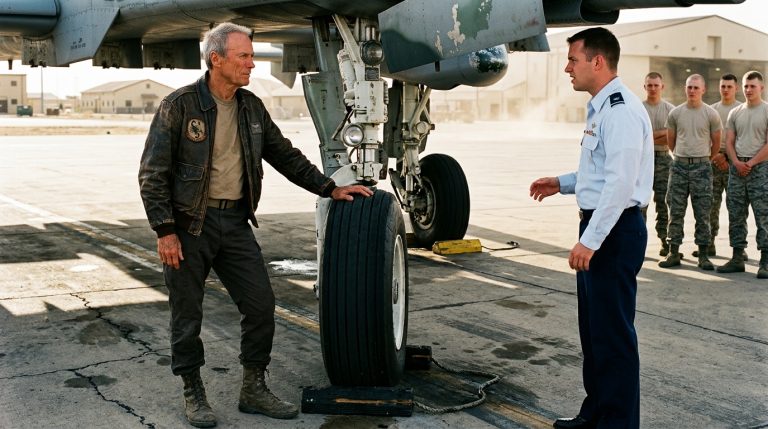
The metal beneath Hans’s boots is heavy, scarred by transport and the dull gray paint of foreign skies. May 19th smells of frozen grease and stale oil. He grips the edge of the central nacelle, feeling the cold bite through his sleeves.
This machine has no business sitting on a German runway. The twin booms stretch out behind him like jagged prongs of iron, awkward and defiant.
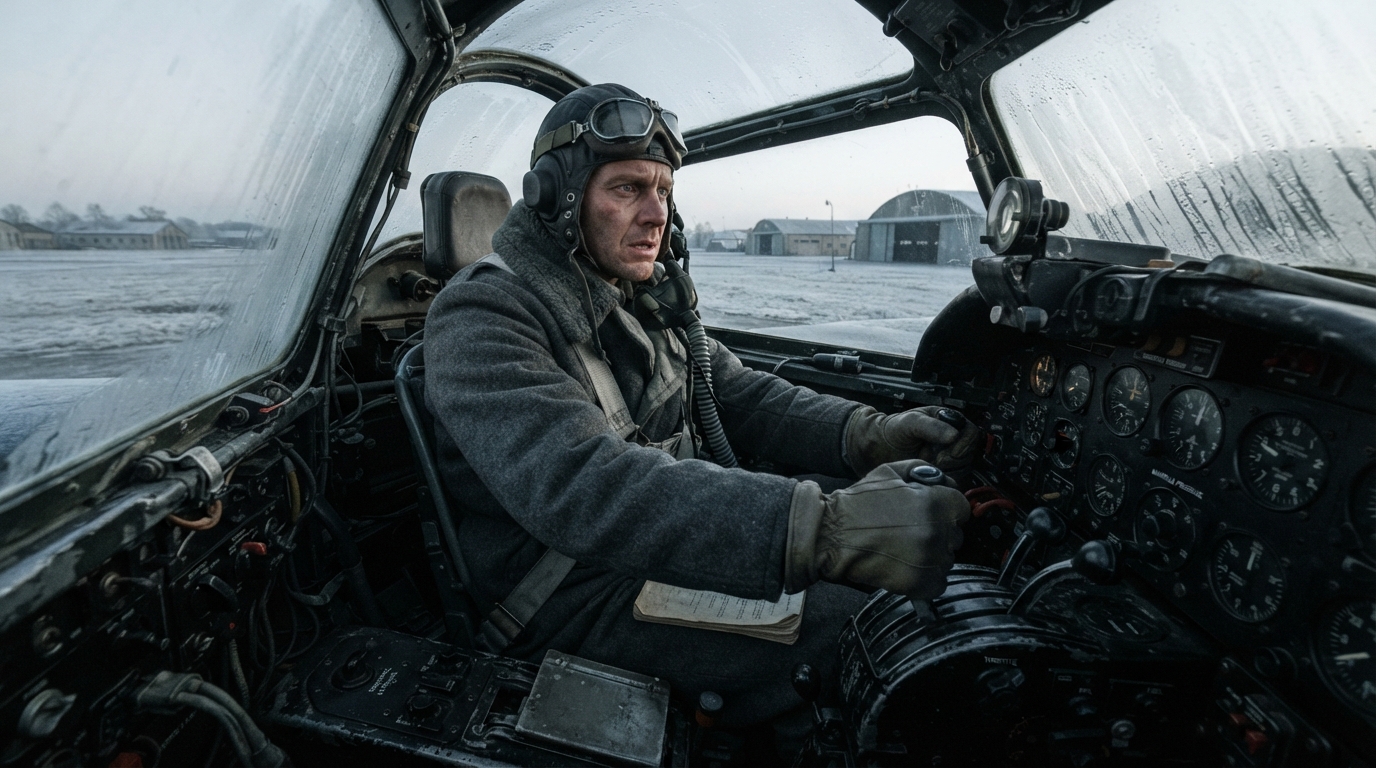
Inside, the seat feels too wide. The pedals demand broader boots than a Messerschmitt ever required. Two throttle levers wait under his right hand instead of one.
He adjusts his oxygen mask, tasting the rubber and old dust. Every instrument label is printed in sharp English letters. There are no smooth German curves on these dials, only hard angles and printed procedures.
The preflight manual sits folded in his knee pocket, untouched. He didn’t bother translating the final pages. The weight of the aircraft rests heavily on its tricycle gear, steady and unblinking.
A mechanic taps twice on the left boom, signaling clearance. Hans wraps his fingers around the cold metal of the starters.
The right Allison engine coughs once, spitting blue exhaust across the concrete. Then the second engine catches, smoothing into a deep, rhythmic roar.
The counter-rotating blades blur into silver disks against the morning frost. There is no torque pulling his boots to the left. The thrust vectors balance with terrifying precision.
He pushes the throttles forward an inch, feeling the chassis shudder against the brakes. The runway stretches out ahead, cold and silent under the Brandenburg dawn.
CHAPTER 2: THE ASCENT INTO THIN AIR
The Rechlin runway vanishes beneath the twin booms in less than a thousand feet. The tricycle gear lifts cleanly, refusing to swing left or demand correction from his boots.
Hans pulls back gently on the control column, expecting the usual heavy groan of a twin-engine transport fighting gravity. Instead, the altimeter spins upward like a broken clock.
One thousand feet. Three thousand feet. Five thousand feet. The dual Allison engines hum with an easy, terrifying authority.
He watches the manifold pressure needles hold dead steady while the world below flattens into a cold gray map. In a Messerschmitt, he would already be sweating over manual supercharger levers, nursing the oil temperatures.
Up here, the automatic regulators do the thinking while the air thins against the canopy glass. The frosted breath inside his oxygen mask freezes and thaws with every measured breath.
At fifteen thousand feet, the climb rate refuses to decay. It holds at three thousand eight hundred feet per minute, mocking every structural rule written in Berlin.
Hans banks the heavy airframe slightly to the right, feeling the immense inertia of the wing panels. The roll is broad, measured, and distinctly unhurried.
A single-engine fighter could snap around inside this wider radius without breaking a sweat. But that thought feels increasingly useless as the altimeter climbs past twenty thousand feet in under six minutes.
The sky up here belongs to an architecture Germany never thought possible. He trims the rudders, keeping his eyes locked on the trembling pressure gauge.
CHAPTER 3: THE TURNING POINT OF DOCTRINE
The air up here is thin enough to taste the copper dust of the oxygen line. Hans rolls the heavy airframe into a steep, four-hundred-mile-per-hour dive, feeling the invisible wall of compressibility press against the control column.
The elevators grow stubborn, resisting his pull with the raw weight of physics. He reaches down, his fingers finding the toggle for the dive flaps tucked beneath the throttle quadrant.
The small panels snap open into the slipstream. The violent acceleration checks instantly, and the control column lightens in his palms.
He cuts the right Allison engine completely, letting the propeller feather into a dead spin. The aircraft yaws sharply to the right, threatening to break his rhythm.
Hans stomps the left rudder and pushes the surviving engine to maximum continuous power. The machine refuses to fall out of the sky.
It begins to climb at fifteen hundred feet per minute on a single power plant. Das ist unmöglich. He mutters the words into his mask, staring at the altimeter as it unwinds upward.
A Messerschmitt with a dead engine becomes a gliding coffin. This American machine simply shrugs off the loss and keeps reaching for the stratosphere.
He brings the right engine back to life, watching the manifold pressures lock into symmetry. The turning numbers from his previous logbook flash through his mind like a bad memory.
In a flat horizontal circle, the lighter German fighters can easily out-turn this twin-engine giant. But the horizontal fight is a trap, a relic of an old war that nobody is fighting anymore.
He banks away from the test sector, pointing the nose toward the gray horizon where the tactical reality of the Reich is quietly unraveling.
CHAPTER 4: THE DEBRIEFING ROOM SILENCE
The smoke inside the command tent is thick enough to sting the eyes, smelling of stale tobacco and cheap chicory coffee. Three senior officers sit behind a heavy oak table, their fingers drumming impatient rhythms against stacks of optimistic intelligence summaries.
They expect a confirmation of weakness, a tidy technical report proving that American engineering is heavy, clumsy, and doomed to fail.
Hans lays his flight notes flat on the scarred wood without a word. He doesn’t sit down.
The lead officer shifts his weight, leaning forward over a pair of wire-rimmed spectacles. — Well? Does it snap under its own weight in a dive as predicted? —
— No. It climbs at four thousand feet per minute, and our interceptors cannot follow it above twenty thousand feet, — Hans says, his voice flat and devoid of professional courtesy.
An indignant murmur ripples across the table. One officer slams his palm against the tabletop, rattling the porcelain cups.
— That contradicts every tactical doctrine we have established since the Polish campaign! Twin engines mean inertia, and inertia means a sluggish target! —
— The mathematics do not care about our doctrine, — Hans replies, tapping the edge of his flight log with a grease-stained thumb. — You can order our pilots to climb until their engines choke, but the American machine will still be pulling away above them. —
The room falls dead silent, save for the crackle of a distant coal stove in the corner. The officers exchange dark, panicked glances, realizing too late that their comfortable assumptions have just burned up in the Brandenburg sky.
CHAPTER 5: ASHES OF AN OLD TRUTH
Spring turns to the heavy ash of 1945. The Rechlin perimeter shudders beneath the low rumble of advancing armor from the east, and the airfields are stripped for final demolition.
Rows of captured aircraft are dragged into the open fields, soaked in high-octane fuel, and put to the torch to keep them out of Allied hands.
Serial number forty-two dash twelve six five two lies in the center of the tarmac, surrounded by blackened aluminum ribs and twisted landing gear.
Hans stands a hundred yards away, his boots crunching on frozen gravel as the flames devour the wings and engines. The metal groans, warps, and collapses into a quiet heap of glowing gray soot.
The high command’s rigid doctrines didn’t survive the fire, and neither did the factories that built them. Every defensive calculation made over the past two years crumbles into smoke under the spring wind.
No amount of paperwork or bureaucratic denial could alter the math of an engine that climbed higher and faster than anything else in the sky.
The ashes settle into the mud, cold and heavy. Intelligence is only worth what a military can build, fuel, and fly.
Hans turns his back on the glowing wreckage, sliding his bare hands into his pockets as the distant roar of artillery marks the final, undeniable end of an era.