The Wire and the Weight: A Sapper’s Silent War in the Mud of the Rapido River
CHAPTER 1: The First Snap
The mud of the Rapido River Valley did not just cling; it possessed. It swallowed boots, cached the heat of a man’s exhaustion, and held the smell of iron and decay with a permanence that defied the rain. James Dalton kept his head low, his gaze fixed on the narrow, rutted stretch of dirt that served as the lifeline for the German scouts.
He held the entrenching tool with a grip that had long since numbed, the metal handle slick with the dampness of the March air. Around him, the valley was a theater of ghosts. The artillery to the north was a dull, rhythmic thudding that vibrated in the marrow of his teeth, but here, in this pocket of stagnant air, the world felt smaller, tighter.
He had measured the distance three times. The oak trees were the only landmarks in a landscape of blurred grays. He tapped the handle of the second shovel into the mud, the sound dull and swallowed instantly by the fog. His pulse hammered against his throat, a frantic, uneven tempo that mocked his attempt at precision.
The wire was a ragged, rusted loop he had scavenged from a supply dump—a pile of refuse the quartermaster considered scrap, but which Dalton saw as a surgical instrument. He pulled the line taut. It bit into his palms, the serrated barbs tasting his blood, mixing the copper tang with the scent of wet soil.
He calculated the tension with the instinct of a switchman. If it was too loose, the axle would slide harmlessly over the steel, a useless ripple in the path of the scout car. If it was too tight, the metal would snap with a sound like a gunshot, signaling his position to the ridge line. He looped it, twisted, and checked the height again. Fourteen inches. Not a millimeter more. Not a millimeter less.
It was an invisible scar on the road. From twenty yards away, it was nothing more than a trick of light and shadow, a frayed remnant of some long-forgotten fence. But to an armored scout car, it was an immovable law of physics.
He retreated to the ditch, his movements practiced and devoid of grace. He was not a hero, and he certainly wasn’t a soldier in the way the manual described. He was a man who had seen the bodies of Kowalski and Brennan and realized that the “approved methods” were nothing more than a death warrant signed by men who never left their desks.
He checked his watch. 1:15 a.m. The world held its breath.
Dalton pressed his back into the freezing mud, pulling the heavy, wet wool of his coat over his shoulders. He reached into his pack, his fingers brushing the second entrenching tool. He realized then that he had left a single, distinct impression of his boot heel in the soft clay near the road—a mistake he should have smoothed over, a tiny, glaring error in his own system.
He started to move, to crawl back to the road and fix it, but a metallic clatter echoed from the north. The engine of a 222 armored car, distinct and hungry, growled to life in the distance. The window for perfection had closed. He froze, pressed against the earth, and watched the darkness for the first hint of gray light.
CHAPTER 2: The RailYard Logic
The sound was not an explosion, but a grinding, hungry dissonance—the gears of a German 222 armored scout car chewing through the damp gravel of the Liri Valley road. Dalton lay motionless in the mud, his breathing shallow and controlled, a habit carved into his bones from years spent around the heavy machinery of the Gary rail yards. In the yards, silence was a warning. Here, the engine’s approach was a promise of violence.
He watched the fog. It was thick, swirling in tattered ribbons that obscured the road ahead, but the steady, mechanical whine was growing sharper. His palms, caked in a mixture of red clay and dried blood, throbbed with a cold, rhythmic ache. He focused on the wire, that thin, invisible thread of rusted steel he had pulled taut between the two oak trees. It sat exactly fourteen inches off the ground, a calculated variable in an environment defined by chaos.
A memory surfaced, unbidden and sharp: a winter morning in Indiana, the smell of molten iron and coal smoke heavy in the air. He remembered watching a coupler pin shear off under load, the way the entire line of freight cars shuddered and buckled, energy moving through the steel like a physical wave. The car in front of him now was not a freight train, but the principle remained the same. Weight and momentum, when channeled correctly, became a weapon against itself.
The scout car emerged from the shroud of white at perhaps two hundred yards. Its paint was a dull, desaturated gray, a ghost drifting through the mud. He could see the open commander’s hatch now, a small, dark aperture against the vehicle’s slab-sided armor. His finger hovered near the trigger guard of his M1, but he forced his hand to remain steady, pressed into the saturated earth. This was not a fight for a rifle; it was a test of the iron.
The driver was steering with the casual confidence of an occupier, the vehicle’s wheels biting into the soft verge of the road. Dalton felt the urge to stand, to shout, to do something other than wait, but he suppressed it. That was the officer’s way—reactive, frantic, useless. He lived by the logic of the switchman: set the path, anticipate the failure, and let the machinery do the work.
At one hundred yards, the vehicle accelerated. The engine note rose, a mechanical shriek that pierced the morning damp. The gunner was traversing the 20mm autocannon, the barrel swinging in lazy, searching arcs. They were looking for the American positions they knew were here, scanning for the tell-tale glint of a rifle or the movement of a man. They were looking for a war of bullets, never suspecting that the threat lay beneath their own tires.
Dalton’s heart hammered against his ribs, a frantic, syncopated beat. He squeezed his eyes shut for a micro-second, grounding himself in the freezing mud. He remembered Private Kowalski’s face, pale and wide-eyed in the dawn light of February, and Sergeant Brennan’s voice, steady and calm as he taught him to read the lie of the land. The anger was there—a cold, dense coal in his gut—but he didn’t let it flare. He used it as a lens, sharpening his focus on the front right wheel of the scout car.
Fifty yards. The vehicle was moving at fifteen miles per hour, a speed that was both fast enough to maintain security and slow enough to be a death sentence if the road gave way. The front axle was clearly visible now, a thick, greasy bar of steel that seemed to mock his pathetic, rusted wire.
Forty yards. The commander leaned out, binoculars raised, his uniform impeccable and dry—a stark contrast to the shivering, mud-stained infantry he hunted.
Dalton didn’t blink. He waited for the front wheel to pass the line of the trees. The car was heavy, its center of gravity high—a classic, fatal design flaw he had studied for weeks. He held his breath, the air in his lungs turning to ice. The wire was a hair’s breadth from the path. If it snapped, he was exposed, a lone soldier in a ditch with no answer for the autocannon. If it held, the road itself would become the judge.
The wire bit into the rim.
The sound was not a snap, but a sudden, violent cessation of movement. The front right wheel snagged, the tire twisting against the immovable resistance of the rusted steel. For a fraction of a second, the entire vehicle seemed to hang in mid-air, a suspended mechanical tragedy. Then, momentum took over. The chassis, still traveling at fifteen miles per hour, swung forward as the front axle acted as an anchor. The rear of the car lifted, a slow, inevitable tilt toward the heavens.
Dalton pressed his face into the mud as the machine flipped, the sound of tearing metal and shattering glass drowning out the artillery’s distant roar. It rolled once, twice, a cacophony of internal structural failure, before crashing upside down into the roadbed. The engine groaned, sputtered, and died, replaced by the hiss of steam and the faint, sweet smell of leaking gasoline.
Silence reclaimed the valley, heavy and absolute. Dalton didn’t move. He kept his head pressed to the earth, eyes locked on the wreckage, waiting for the crew to emerge, waiting for the reality of his own insubordination to settle in with the settling dust. He had done it. He had inverted the doctrine. Now, he had to survive the consequences.
CHAPTER 3: The RailYard Logic
The wreck hissed, a dying sound of escaping steam and cooling metal. Dalton remained pressed into the mud, his lungs burning with the effort of holding his breath. He watched the overturned scout car. It was a jagged, ugly silhouette against the dim gray light of dawn. The silence that had followed the crash was being eaten away by the rapid, staccato rhythm of running footsteps.
American soldiers. They had heard the impact from the main defensive line.
Dalton knew he couldn’t stay where he was. If he were found near the wreck, he would be questioned. If he were caught with the shovel handles and the wire, the threat of a court-martial—which had been a distant, bureaucratic menace—would become a concrete, life-ending reality. Yet, he couldn’t leave the site either. The wire was still attached to the front axle, a physical link between this carnage and the crime he had committed against Army doctrine.
He moved, but not in a rush. He crawled, his body low to the ground, utilizing the natural depressions of the ditch. His movements were fluid, the product of a lifetime spent navigating the hazards of the industrial rail yards, where one wrong step meant getting crushed between tons of unforgiving iron. Here, the hazard was different, but the principle remained: keep your profile low, know your exit, and never let them see you coming.
He reached the edge of the road, hidden by the gnarled roots of the oak trees. Private Morrison—not the Captain, but the young man he’d grown up with—was in the lead, rifle raised, his face a mask of shock and confusion. Behind him, three other soldiers followed, their eyes wide as they took in the overturned, smoking ruin of the German 222.
Dalton watched from the shadows. The air was thick with the scent of ozone, burnt oil, and the sharp, metallic tang of cold earth. He saw Private Morrison circle the wreck, his boots crunching on the gravel. Morrison stopped, staring at the front axle. Dalton held his breath, his hand tightening around the handle of his own entrenching tool, which he had retrieved from the dirt.
Morrison didn’t see the wire. It was thin, pulled tight, and largely obscured by the mud and the way the front wheel had twisted in the crash. But Morrison’s eyes were searching, looking for something to explain the impossible. Scout cars didn’t just flip. They didn’t decide to somersault on a flat, straight road without provocation. The young private stood there, his rifle lowered slightly, his brow furrowed as he scanned the terrain.
Dalton felt a spike of adrenaline. He had to remove the wire. Now.
He waited for the group to move toward the far side of the wreck, toward the driver who was beginning to stir and groan within the twisted cabin. As soon as Morrison’s back was turned, Dalton shifted. He didn’t stand; he poured himself forward, a shadow merging with the mud, and reached the edge of the road.
He was within ten feet of the axle. He could see the tension in the wire. It was vibrating, still holding the weight of the wreckage. He reached out, his fingers slick with cold, biting mud. He gripped the shovel handle he had driven into the earth on this side, the wood slick and cold. With a sharp, practiced jerk, he broke the vacuum the mud had created and pulled.
The wire went slack.
He didn’t waste a second. He began to coil it, his movements rhythmic and efficient. The rusted barbs tore at his skin, but he didn’t flinch. He heard a voice shout from the other side of the car—a command to check the driver. It was Morrison.
Dalton finished the coil, shoved the wire into his pack, and looked at the shovel. He couldn’t leave it. It was a marker, a signature of the crime. He yanked the tool free, the suction of the mud popping loudly.
“Who’s there?” Morrison shouted, turning around.
Dalton didn’t turn back. He dropped into the drainage ditch, his heart hammering against his ribs like a trapped bird. He moved fast, his boots splashing into the water, and didn’t stop until he was deep within the cover of the brush two hundred yards south. He collapsed against the trunk of a tree, his chest heaving.
He was safe. For now. But he knew the questions were already forming in Morrison’s mind. He had left the scene, but he hadn’t left behind the consequences. He had saved the company from the scout car, but he had opened a void in the logic of the sector—a void that would pull the curious and the suspicious toward him, sooner or later.
The artillery was beginning again, a low, tectonic rumble from the north. He looked at the coiled wire in his pack, the rust staining his palms. This was the work. This was the price. He was a switchman, and the train was moving toward the cliff. All he could do was keep his hands steady and pray the tracks held.
CHAPTER 4: The Midnight Installation
The brush scratched at Dalton’s face, sharp, icy fingers that reminded him he was far from the safety of the lines. He leaned back against the rough bark of a pine, his chest heaving. The woods around him were not quiet; they were alive with the nervous, shifting sounds of a sector under pressure. Every snapped twig sounded like a scout car; every rustle of wind felt like a patrol circling in.
He opened his pack. The wire was there, coiled and smelling of rust and old, damp earth. He looked at it, his fingers tracing the cold metal. He had done it. The car was a carcass on the road, a testament to what a man could do when he stopped waiting for permission. But as he sat there, the weight of the moment began to shift. It wasn’t just about the car anymore. It was about the fact that he was now a secret, a singular point of failure in a system that demanded predictability.
He thought of the rail yards again, the way a loose coupler pin would cause a chain reaction that took hours to untangle. He was that pin.
He stood up, his boots sinking into the saturated ground. He couldn’t just sit here. The “midnight installation,” as he’d begun to call it in his mind, had to become a rhythm. He needed another spot. Somewhere not as obvious, somewhere the scouts would push into once they realized the main road was becoming a graveyard for their vehicles. He walked with a heavy, deliberate gait, avoiding the clearings and sticking to the thick, unforgiving undergrowth that lined the riverbank.
He emerged near the old logging road, a narrow, treacherous track that snaked up toward the ridgeline. It was perfect—too narrow for a heavy tank, but an ideal highway for the faster, lighter vehicles the Germans relied on for their constant, probing reconnaissance. It was dark, the moon hidden behind a wall of dense, low-hanging clouds that threatened more rain.
He knelt, his fingers finding the soft, yielding mud of the track. He needed to be invisible. He drove his entrenching tool into the earth, the blade cutting deep, efficient arcs into the soil. He wasn’t thinking about the war now; he was thinking about the physics of the road.
As he worked, a nagging sensation at the back of his neck made him pause. He checked his pack again. He counted the shovels.
One. Two.
He froze. He only had one handle. The other was still back at the road—the scene of the crash, lying somewhere in the churned-up earth where Morrison had been standing. A cold, hollow ache blossomed in his stomach. A shovel handle wasn’t just a tool; it was an identifier. It was proof. If Morrison or any of the others found it, they wouldn’t just see a piece of scrap metal. They would see the intentionality of it. They would see the wire attached to it.
He cursed under his breath, a sharp, ragged sound. He had been precise, but precision in the mud was a lie. There was always a remnant, always a trace left behind. He looked toward the direction of the crash, the dark forest swallowing the distance. He couldn’t go back. Not now. The risk was too high; the area would be crawling with patrols and commanders trying to make sense of the carnage.
He had to move forward. He finished burying the wire, his movements faster, more frantic now. He pulled the earth over the line, camouflaging it with leaves and broken twigs. It looked natural, like a shallow ditch cut by the rain. But he knew it was a trap. It was always a trap.
He stood, his back aching from the long hours of hunched, subterranean labor. He was tired, a bone-deep exhaustion that made his vision blur at the edges, but he couldn’t stop. The rhythm was the only thing that kept the fear at bay. He walked back toward the company lines, his boots heavy, his hands trembling.
As he crested the final ridge, he saw the flickering, distant light of the command tent. Captain Morrison was there, likely staring at maps and counting the losses. Dalton stood in the shadows, watching the silhouette of the tent against the night sky. He was a shadow among shadows, an unauthorized engineer of his own survival. He wasn’t sure if he was doing this for the men who had died, or if he was simply trying to balance a ledger that had been broken long before he arrived in this valley.
He crawled into his foxhole, the damp, cold earth rising up to meet him like a shroud. He closed his eyes, but the image of the scout car, of the broken metal and the silent, dead eyes of the commander, followed him into the dark. He wasn’t a hero. He was a man with a piece of wire and a set of tools, and he was the only thing standing between the men in this valley and the next, inevitable dawn.
He lay awake, listening to the artillery, waiting for the sound of the next engine.
CHAPTER 5: The Fog at 06:47
The gray light of 06:47 a.m. filtered through the mud-caked mesh of Dalton’s foxhole, cold and clinical. It didn’t bring comfort; it brought the expectation of movement. He felt the familiar, low-frequency hum of the valley—a vibration that wasn’t just the distant, ceaseless rumble of artillery, but something sharper, more predatory. He sat up, his joints popping, the dampness of the earth having settled deep into his skin during the few hours of restless sleep he’d managed.
He reached for his rifle, the cold steel of the M1 familiar and grounding. He didn’t check the action—he had done that before he closed his eyes—but he checked his pack. The wire was coiled, a dead weight against his spine. He hadn’t yet reconciled the loss of that shovel handle, and every time he closed his eyes, he pictured Private Morrison standing in the mud, staring at the front axle of the wrecked 222, looking for something that wasn’t there.
Then, he heard it.
It started as a faint tremor in the air, a high-pitched whine that rose above the muffled, constant thudding of the northern front. A German straight-six engine. He didn’t move, didn’t even shift his weight. He knew the pitch, the cadence, the way it hesitated when the driver shifted gears for the incline of the Liri Valley. It was a 222, just like the one he had flipped three days ago.
He crawled to the edge of the foxhole, his movements slow, deliberate, and silent. The fog was thick this morning, a wet, suffocating blanket that pressed against the trees. He could see maybe fifty yards into the gloom. He waited, his ears straining, filtering out the environmental noise—the drip of condensation, the groan of shifting timber, the wind—until only the engine remained.
It was coming from the north. The same route. The same predictability.
He felt a sudden, sharp intrusive thought: the sound of a steam whistle in the Gary rail yards, a high, piercing note that meant a shunting error was about to become a catastrophe. He shook his head, clearing the memory, but the phantom sensation of grit and coal dust lingered in his mouth. He wasn’t in Gary. He was in Italy. And he was a part of the mechanism now.
The car emerged from the mist at exactly 06:43 a.m., just as the records of the last patrol had suggested it would. It was traveling at fifteen miles per hour, its gray paint muted by the fog. The commander’s hatch was open, and the man inside was peering through binoculars, the lenses catching a fleeting, dull reflection. They were cautious. He could see it in the way the vehicle hugged the inside of the turn, in the way the gunner’s 20mm cannon was traversed constantly, scanning the shadows. They had been burned by this road, and they were trying to account for it, but they couldn’t see the one thing that mattered.
Dalton watched, his hand steadying the stock of his rifle. He wasn’t going to fire. He wasn’t even going to call out. He wanted to see if the wire had held, or if the soil had shifted. He wanted to see if his improvisation could survive the scrutiny of a crew that was now, for the first time, looking down at the road instead of just ahead.
The scout car moved toward the spot he had rigged the previous night. The logging road narrowed, the trees closing in to create a natural choke point. The car accelerated, a slight increase in engine pitch, the driver clearly eager to clear the section they now recognized as a kill zone.
Dalton held his breath.
The vehicle’s front wheels hit the depression he had so carefully disguised. It dipped—once, twice—the suspension absorbing the uneven ground. Dalton saw the commander lean out further, his head turning as if he heard something, perhaps the faint, metallic song of a taut wire vibrating in the breeze.
He didn’t hit the wire.
The scout car rolled over the spot, its tires gripping the mud where Dalton had buried the steel. It didn’t flip. It didn’t seize. It just continued, the driver accelerating as he cleared the danger zone.
Dalton sank back into his foxhole, the adrenaline draining from his system, leaving him cold and hollow. He had failed. He hadn’t miscalculated the physics—the wire was still there, beneath the mud, waiting—but he had miscalculated the human variable. The Germans were driving differently. They were treating the road with a newfound, agonizing respect.
He looked at his hands, raw and stained. He had expected a collision, a victory, another moment of quiet vindication. Instead, he had only learned that the war was a conversation, and they were finally answering back. He realized then that he couldn’t just keep setting the same traps in the same way. He was going to have to do something else. Something harder.
He closed his eyes for a moment, listening to the scout car’s engine fade into the distance, carrying with it the artillery coordinates that would begin to rain down on their position in an hour. He had saved the company from a direct assault, but he had failed to stop the reconnaissance. He was a switchman who had lost control of the line.
He sat up, his movements stiff. He checked his pack again. He still had the remaining coils of wire. He looked at the terrain, not as a soldier looking for cover, but as a worker looking for a structural weakness in the valley itself. The logging road was compromised, but there were other paths. And he knew, with a sudden, cold certainty, that he was the only one who could bridge the gap.
CHAPTER 6: The Unseen Witness
Dalton didn’t head back to the company lines immediately. Instead, he moved deeper into the Liri Valley, his boots finding purchase on the slick, shale-covered slopes that the German patrols usually avoided. The failure of his trap at 06:43 a.m. sat in his mind like a stone. It wasn’t just that the car had passed; it was the way it had passed—with a deliberate, knowing caution.
They were learning.
As he climbed, the forest grew thinner, the trees replaced by tangled scrub and jagged limestone outcrops. Every shadow seemed to stretch, reaching for him. The feeling of being watched was a prickle on the back of his neck, a phantom tension that wouldn’t dissipate. He kept his head low, his eyes scanning the ridgeline for any sign of movement. He told himself it was the fatigue. He told himself that a man who spent his nights stringing wire in the dark eventually started seeing ghosts in the brush.
But the rail-yard logic in his head—the need to identify the fault before the crash—demanded he trust the feeling.
He found a vantage point overlooking a secondary track, a goat path that snaked through a narrow ravine. It was the only alternative route for a light vehicle attempting to bypass the blocked main road. He crouched behind a boulder, the stone cold against his palms, and pulled his canteen. The water was lukewarm and tasted of metal, but it helped clear the grit from his throat.
He had expected the Germans to stay on the main artery. They were creatures of doctrine, bound to the maps provided by their intelligence officers. But if they had realized the main road was a graveyard, they would adapt. He checked his watch. It was 09:00 a.m.
Below him, the path was quiet. Too quiet. Even the artillery fire from the north seemed muffled, held back by the walls of the ravine. He scanned the ground, looking for the tell-tale signs of recent movement—disturbed mud, broken twigs, the faint sheen of oil on stone. Nothing.
Then, he saw it.
A shadow, not cast by the rising sun, but moving independently near the base of the ravine. It was a man, dressed in the mottled gray-green of the Wehrmacht, moving with a fluid, predatory grace. He wasn’t on patrol. He was hunting.
Dalton’s heart skipped a beat. This wasn’t a standard scout crew; this was an engineer, or perhaps an intelligence officer, tasked with investigating the “anomalies” on the road. The man stopped, kneeling in the dirt, his hands moving in precise, measured motions. He was inspecting the terrain.
Dalton pressed himself flat against the rock, his breathing so shallow it was almost non-existent. The distance was nearly three hundred yards, but the clarity of the man’s movements was unnerving. He was methodical. He was doing exactly what Dalton would have done: he was looking for the cause.
The German stood up, his head turning, scanning the slopes above him. Dalton felt a jolt of cold realization. The man wasn’t just looking for clues; he was looking for the source of the sabotage. He was looking for the person who had rigged the traps.
Dalton clutched his rifle, his knuckles white. He could take the shot. The man was exposed, standing in the open, his back to the slope. But a shot would reveal his position. It would turn a silent, tactical struggle into a firefight that would bring down the entire local garrison. He held his ground, his finger hovering off the trigger.
The German spent ten minutes in the ravine, his motions repetitive—kneel, scrape, observe, stand. Finally, the man turned and began to climb the far side of the ravine, heading not toward the American lines, but back toward the German forward positions.
Dalton remained frozen until the man disappeared into the dense treeline. He slumped back against the rock, his pulse beginning to slow, though the chill in his blood remained. The Germans hadn’t just discovered the wire; they had discovered the method.
He looked at his pack, then at the ravine below. He had thought he was the hunter, setting traps for machines that couldn’t fight back. But the war had evolved. He wasn’t just competing with machines anymore; he was competing with an intellect that was beginning to mirror his own.
He realized then that the “midnight installation” couldn’t just be about wire and shovels. It had to be about misdirection. If they were looking for the engineer, he had to give them a ghost. He had to stop fighting the machines and start fighting the mind that was directing them.
He waited until the sun was high and the heat began to burn the last of the morning fog away. He didn’t head back to the company lines. He headed north, toward the ridge, toward the place where the shadows were deepest and the enemy’s gaze was fixed. If they wanted to find the person behind the wire, he would lead them exactly where he wanted them to go.
He walked with the quiet, steady pace of a man who had finally accepted that the tracks were broken, and that he was the only one left to switch them.
CHAPTER 7: The Whispered Network
The rain began as a soft, rhythmic tapping against the canopy before escalating into a violent, driving deluge that turned the Liri Valley into a landscape of sliding mud and white-water runoff. Dalton crouched beneath the overhang of a limestone ledge, his breath hitching in his chest. He was soaked to the bone, his woolen coat heavy and freezing, but his focus remained on the path ahead. The storm had washed out the goat trail he had been tracking, turning the ravine into a churning gutter of brown water and debris.
This was a complication, not a defeat. He shifted the coil of wire in his pack, the weight dragging at his tired shoulders. He needed to reach the secondary ridgeline before dusk, but the rain had turned the slope into a death trap of loose scree and slick clay.
He moved, but the rhythm was broken. Every step was an exercise in pure mechanical endurance. He dug his boots into the mud, finding purchase where there should have been none, his mind running through the calculations of a switchman—traction, weight distribution, the angle of the incline. He didn’t think about the German specialist who had been hunting him in the ravine; he focused only on the immediate, physical reality of the climb.
As he reached a plateau, the trees broke, and he caught a glimpse of the valley floor below. He saw the flicker of movement near the supply road—a group of soldiers, their figures blurred by the downpour. They were moving in a tight, disciplined line. They weren’t just patrolling; they were sweeping the area. They were looking for the engineer.
Dalton pressed himself against the trunk of a dying pine. He was close enough to see the way they moved—efficient, probing, the way they checked the terrain. They were using his own tactics against him. He realized with a sudden, cold clarity that they weren’t searching for an American soldier. They were searching for a pattern. They were looking for the hand of the man who had turned the roads into obstacles.
He shifted his weight, his boot sliding on a slick patch of moss. A small avalanche of pebbles tumbled down the slope, rattling against the rocks below.
The patrol stopped instantly. The lead man raised a hand, his posture rigid as he scanned the slope. Dalton held his breath, his heart hammering against his ribs, his hand hovering over the M1. If they spotted him, the game was over. He wasn’t a soldier in a battle; he was a liability to his own command.
The lead soldier pointed toward a thicket to the left—away from Dalton’s position. They weren’t looking for him here. They were looking for the “engineer” in the logical places. They were looking for where the next trap would be.
Dalton waited until they moved on, their silhouettes fading into the curtain of rain. He waited for another five minutes, his muscles cramping with the cold, before he moved again. He didn’t head for the ridgeline. He turned back.
If they were hunting for the engineer, he would give them a masterpiece of misdirection.
He spent the next three hours in the dark, moving through the rain-slicked terrain with the quiet, desperate intensity of a man building a bomb. He didn’t need to string another wire across a road. He needed to set a trap for the hunter. He moved along the perimeter of the German sector, finding the places where their patrols intersected, where the path was worn deep by their boots.
He used the last of the wire, not as an obstacle, but as a snare. He rigged it near a creek crossing, hidden beneath a layer of saturated, decaying leaves. He didn’t need it to flip a tank. He only needed it to snag a boot, to make a noise, to force a soldier to break their formation.
When he finished, his hands were numb, his skin gray and puckered from the water. He didn’t go back to the company lines. He stayed in the brush, finding a hollow beneath a fallen oak that stayed relatively dry. He lay there, his pulse finally slowing, watching the rain wash away the tracks he had left behind.
He had whispered his work through the company, a silent, underground network that passed from one man to the next. He knew that even if he were caught, the method would remain. He had already seen Morrison and Williams setting up their own traps. The wire was a contagion, a simple, elegant piece of engineering that the army couldn’t stop, no matter how many manuals they wrote or how many corporals they court-martialed.
The sound of a distant, sharp pop echoed through the valley—a branch breaking, or perhaps a trap being triggered. Dalton closed his eyes. He didn’t need to know what it was. He only needed to know that the valley was no longer a place where machines could roam with impunity.
He was a switchman who had finally managed to change the tracks, and as the rain beat a steady, relentless tattoo against the earth, he allowed himself a single, fleeting moment of rest. The work was done. Tomorrow, the hunt would begin again, but tonight, he was the ghost in the machine.
CHAPTER 8: The Intelligence Inquiry
The pop of the snare—a clean, high-tension snap of wire against timber—echoed through the sodden forest like a command. Dalton didn’t wait to see if it had caught a man. He moved. The woods were no longer a labyrinth; they were a closing cage. Every rustle of the wind now sounded like a boot stepping onto gravel; every raindrop on a leaf was the click of a safety being disengaged.
He didn’t head back to the hollow. He dropped into a narrow, vertical fissure in the limestone, a natural chimney that smelled of wet slate and cold decay. He pulled his body into the dark, his breath ragged, the adrenaline finally beginning to curdle into something colder and sharper. He had baited the hunter, but he had underestimated the hunter’s reach.
He crouched in the dark, listening.
Voices. Not the casual chatter of soldiers on patrol, but the low, clipped, rhythmic commands of a professional unit. They were moving toward the snare. He could hear the crunch of boots on the soaked forest floor, the metallic clink of equipment being shifted. They were moving with a tactical precision that made his own efforts feel like the work of a child.
He pulled his M1 close, his hands shaking. He had no more wire. He had no more shovels. He was a man with a rifle and a secret, and he was being squeezed by the very apparatus he had tried to dismantle.
“Da ist es,” a voice murmured, close. The tone was devoid of anger; it was the flat, clinical observation of a mechanic examining a failed part.
Dalton looked through a crack in the limestone. A light—a narrow, intense beam from a combat torch—cut through the rain-lashed darkness. It danced over the forest floor, illuminating the wire he had strung, the leaves he had disturbed, the very earth he had broken. The light held on the wire, studying the tension, the knotting, the placement.
The man holding the torch was the same one he had seen in the ravine. He wasn’t just a soldier; he was a specialist, an intelligence officer of the 29th Panzer Grenadier Division. He wasn’t looking for a casualty; he was looking for a pattern. He was cataloging the “wire menace.”
Dalton watched as the officer knelt, his fingers tracing the rusted coil. The specialist was talking into a field radio, his voice muffled by the rain, but the urgency in his tone was unmistakable. He was reporting the find. He was telling his command that this wasn’t just a random act of infantry desperation—it was a coordinated, localized, and technically sound obstruction.
The specialist stood, and for a terrifying second, the beam of his light swept across the very fissure where Dalton was hiding. The light caught the wet, reflective surface of the limestone, casting long, erratic shadows that seemed to claw at the air. Dalton pressed his back into the rock, his eyes locked on the darkness, waiting for the shout of discovery.
It never came. The specialist turned and signaled to the two men behind him, their shadows looming large and threatening in the torchlight. They moved on, their voices fading into the persistent drumbeat of the storm.
Dalton remained motionless for a long time. The realization hit him with the weight of a freight train. He wasn’t just fighting the scout cars. By demonstrating that his method worked, he had forced the enemy to treat it as a significant, divisional-level tactical threat. He had inadvertently provided the justification for a massive, organized, and dangerous sweep of the entire sector.
He had wanted to save his men. Instead, he had made them targets.
The thought was a physical blow, a sudden, blinding clarity that made his hands tremble uncontrollably. He had tried to be a switchman, to fix the track to save the train. But the train was still moving, and the rail line was disappearing beneath them.
He looked at his hands, raw, bleeding, and trembling in the dark. He had to get to the company lines. He had to tell Morrison, or anyone who would listen, that the reconnaissance wasn’t just a patrol anymore; it was an intelligence operation. They were coming for the wire. And if they found the man who made it, they wouldn’t just court-martial him. They would erase him.
He pushed himself out of the fissure, the cold rain hitting his face like buckshot. He didn’t run. Running was for prey. He moved with a cold, desperate pragmatism, his eyes fixed on the distant, flickering lights of the American positions. The war had changed, and he was the only one who had the blueprint for the coming collapse.
CHAPTER 9: The Doctrine Wall
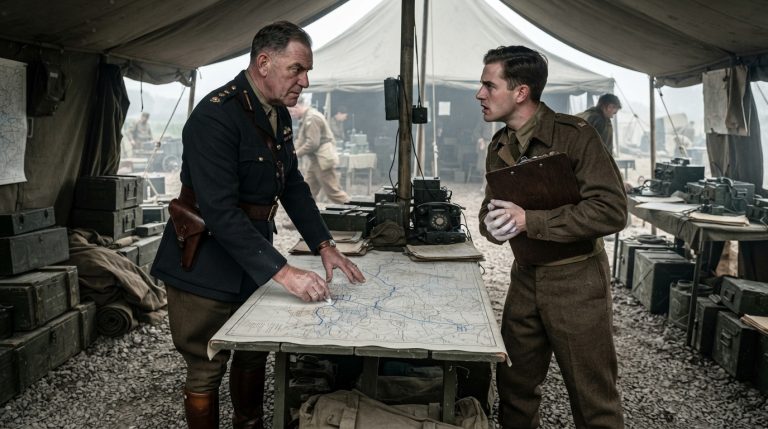
The company lines did not look like safety; they looked like a cage. Dalton moved through the perimeter, his body a map of fatigue and grit. He stayed low, ducking behind ammunition crates and piles of wet, discarded wool. The camp was a symphony of misery—the coughing of men, the low, monotone murmur of exhausted voices, and the constant, rhythmic clatter of mess kits. He bypassed the main thoroughfare, creeping toward the small, dimly lit structure that served as the temporary command post.
Captain Morrison’s tent was guarded, but the guard was a boy no older than nineteen, his rifle slung lazily over his shoulder, his eyes glazed with the vacant, staring intensity of someone who had seen too much. Dalton waited in the shadow of a supply truck, watching. He needed to find Morrison, not to report a victory, but to warn him of the failure. The German intelligence officers weren’t just guessing anymore—they were mapping the wire. They were mapping the company’s desperation.
He saw the flap of the command tent shift, and Captain Morrison stepped out, his uniform cleaner than the rest of the company, but his face etched with a fatigue that mirrored Dalton’s own. Morrison looked around, his gaze sweeping the camp with the detached, analytical focus of a man counting losses. He stopped, his eyes drifting toward the shadows where Dalton crouched.
Dalton didn’t retreat. He stepped into the sliver of light cast by the lantern near the entrance.
Morrison didn’t shout. He didn’t reach for his sidearm. He simply stopped, his expression tightening. He recognized the corporal—the man who had suggested the unauthorized, impossible fix. He looked at Dalton’s mud-caked, bloody hands, at the ragged, shivering frame of the man before him.
“Corporal,” Morrison said, his voice low and devoid of the usual command-post arrogance. “I thought I told you to stay out of the wire business.”
Dalton stood his ground, the cold rain still dripping from his hair. “The Germans know, sir.”
Morrison’s brow furrowed. “What are you talking about?”
“They aren’t just sending patrols anymore,” Dalton said, his voice rough, urgent. “They’re sending engineers. Intelligence officers. They’re mapping the roads. They’re treating it like a tactical anomaly. They aren’t just driving into the traps—they’re dismantling them.”
Morrison stepped closer, his shadow falling over Dalton. The rain seemed to heighten the tension, the steady drumming on the canvas tent turning into a roar. “If you’re telling me that your little project has alerted the entire German reconnaissance wing to our defensive vulnerabilities, I should have you in a cell.”
“And if I’m telling you that they’re preparing a major sweep, and that they’re going to find every single piece of wire, every single shovel, and every single man involved?” Dalton countered. He didn’t back down. The fear was there, a cold knot in his stomach, but beneath it was a strange, jagged clarity. “They’re coming to dismantle the system, Captain. If they find it, they’ll know exactly what we’ve been doing. They’ll know we’ve been operating outside the manual.”
Morrison stared at him, his face flickering in the dim light. The captain’s eyes seemed to drift, not to Dalton, but to the reality of the war itself. He was a man who believed in the book, in the chain of command, in the structures that had held the Army together since the dawn of time. But he was also a man who had seen forty-seven of his men die in six weeks.
“The official response from battalion was to discontinue,” Morrison whispered, more to himself than to Dalton. “That was the order.”
“The order didn’t stop the artillery, sir,” Dalton said. “And it won’t stop the intelligence sweep.”
Morrison looked at him, and for a moment, the distance between the officer and the corporal seemed to vanish. He wasn’t looking at a subordinate; he was looking at the man who had done what the doctrine said was impossible. “Get out of here, Dalton. Go to your squad. Get some sleep.”
“Sir—”
“I said, get out of here.” Morrison turned, his back stiff, and retreated into the tent.
Dalton stood there in the rain for a moment, the weight of the rejection pressing down on him. He had tried. He had brought the truth to the man who held the keys to the company’s survival, and he had been dismissed back into the mud. He walked away, his boots dragging in the sludge, feeling the crushing weight of his own insignificance.
He didn’t return to his squad. He found a hollow near the edge of the camp, a place where the trees offered a modicum of cover, and collapsed. The rain continued to fall, washing away the traces of his efforts, the mud coating his skin in a layer of grime that felt like a permanent shroud.
He had tried to be a switchman, but the track was shifting. He was no longer a corporal in the 34th Infantry Division; he was a man waiting for the inevitable moment when the machinery of the war would realize he was in the way, and move to crush him. He closed his eyes, the sound of the artillery in the distance now sounding like the heavy, grinding rhythm of the rail yards, pulling him into a dark, suffocating sleep.
CHAPTER 10: The Silent Compromise
The darkness in the hollow was absolute, a suffocating, wet weight that matched the crushing realization of his own isolation. Dalton lay in the mud, staring up at the canopy of branches that offered no protection from the wind. The silence of the forest was no longer a tactical advantage; it was a testament to his own precarious position. He had been dismissed by the one man who could have sanctioned the work, and in doing so, he had become an anomaly—a rogue variable in a system that demanded total adherence to doctrine.
He didn’t move for hours. He listened to the artillery—the familiar, rhythmic thudding of the northern front, which felt less like the sound of war and more like the beating heart of a giant, indifferent machine. He thought of his father in the blast furnaces, working fifteen-hour shifts for a pittance, fixing couplers with nothing but scrap wire and sheer, stubborn willpower. He remembered his father’s words: “You fix the line, Jimmy. You don’t ask the company for permission. You just fix the damn line before the whole train goes into the ditch.”
Dalton sat up, his hands pressing into the muck. The rain had subsided into a fine, freezing mist that coated everything in a layer of silver. He looked at his hands—calloused, stained with deep, permanent grease and the red clay of the Rapido Valley. He was a switchman. The track was broken, the train was screaming toward the abyss, and there was no one left to pull the lever but him.
If Morrison wouldn’t sanction the work, he would do it without the sanction. If the German intelligence was hunting the engineer, he would give them a ghost they could never catch.
He stood, his body stiff, and began to gather his remaining gear. He had only a few feet of wire left—the last of his salvaged stock. It wasn’t enough for another road-flipping trap. He looked at the terrain, at the way the mud and the limestone interacted, at the natural choke points that governed movement through the valley. He didn’t need to stop a tank. He needed to create an atmosphere of paranoia, a sense that the valley itself had turned against the occupants.
He moved toward the logging road, but not to set a wire. He moved toward the German supply dump near the base of the ridge—a place he had watched from afar for weeks. It was a well-guarded, organized, and hostile environment, but it had a structural vulnerability he had noted long ago: the reliance on local, unmarked supply paths that branched off the main route.
He navigated the slope with a cold, calculated efficiency. The physical pain in his joints had dulled to a background hum, an echo of the deeper, structural tension in his own life. He wasn’t thinking about the consequences anymore. Consequences were for men who still believed in the system. He was a man who had already been discarded by it.
He reached the perimeter of the supply camp at 03:00 a.m. The guards were few, their attention focused toward the perimeter of the Allied lines, not the dense, treacherous brush behind them. Dalton moved through the darkness like smoke, his boots making no sound on the wet, decomposed foliage. He reached the edge of the supply trail, a narrow dirt road that saw heavy, late-night traffic from the supply trucks coming in from the north.
He didn’t string the wire. He used the scrap metal he had collected—old, rusted tent stakes, jagged bits of piping, and the remaining length of the barbed wire—to create a series of subtle, psychological barriers. He placed them in the deep ruts of the road, hidden by the mud and the low light. They weren’t designed to flip a vehicle. They were designed to puncture tires, to snap fuel lines, to create small, manageable malfunctions that would force the German patrols to stop, dismount, and investigate.
He was going to turn their efficiency into a nightmare. He was going to force them to be cautious, to be hesitant, to lose the very thing they relied on: speed.
As he worked, a flare went up in the distance, a brilliant, magnesium-white light that turned the entire valley into a stark, overexposed photograph. Dalton pressed himself into the mud, his heart hammering against his ribs. The light died, leaving the darkness deeper, more oppressive than before.
He didn’t finish. He left the work incomplete, a series of subtle, shifting hazards that would only reveal themselves when the pressure of a vehicle’s weight pressed them into the earth. It was a chaotic, organic, and entirely unpredictable obstruction. It was the work of a man who no longer believed in the manual.
He retreated into the woods, his movements fluid, his mind calm. The system had failed, the doctrine had been shattered, and the captain had looked the other way. He was no longer a corporal in the 34th Infantry. He was a ghost in the machine, and as the first, pale light of dawn began to bleed into the sky, he knew that the war would never be the same again.
The train was moving, but the track had been changed. And for the first time since he arrived in Italy, the fear that had been his constant companion was gone, replaced by the quiet, icy determination of a man who had finally found his true work.
CHAPTER 11: The Training Tent
Dalton did not head to the camp; he headed to the ridgeline, the high ground that overlooked the German supply route. He carried nothing but the last length of heavy-gauge wire and the entrenching tool he had sharpened against the limestone until the edge was keen enough to draw blood. The air was thin, biting, and smelled of coming snow. Below him, the supply camp was a hive of activity. They were dismantling the “anomalies.” They were bringing in heavy gear to clear the roads, to sanitize the valley of his engineering.
He saw the German specialist—the man in the ravine—supervising a recovery vehicle. The officer was precise, orderly, a man who believed in the primacy of the machine and the sanctity of the order. Dalton watched him from the rocks, his own breathing rhythmic and slow. This was the final adjustment. He didn’t need to destroy the truck. He needed to destroy the officer’s belief that this was merely an engineering problem.
He descended the slope, moving with the silent, predatory grace of an animal. He didn’t use the path. He moved through the thickets, through the razor-sharp brambles, until he reached the edge of the supply route just fifty yards from where the specialist stood. The officer was currently inspecting a section of road, his back turned, his attention focused on a set of blueprints spread across the hood of a light armored car.
Dalton stepped out. He didn’t run. He didn’t hide. He walked out onto the dirt road, his rifle slung, his hands clearly visible, empty.
The specialist turned, his hand flashing toward his sidearm, but he stopped when he saw Dalton—a single, mud-caked, shivering American corporal, walking with the heavy, unhurried gait of a man who had nothing left to lose. The officer barked an order in German, and two nearby guards leveled their rifles, but Dalton kept coming, his gaze locked on the officer’s eyes.
“You’re looking for the wire,” Dalton said, his voice quiet but carrying in the thin, cold air.
The specialist hesitated. He knew English; most of them did. The tension in his shoulders shifted, a flicker of confusion breaking his clinical, detached facade. He looked at the soldiers, then back at Dalton. “You are the one.”
“I am the reason your scout cars don’t go home,” Dalton said. He stopped ten feet away. He could see the officer’s face—the high cheekbones, the tired, haunted eyes of a man who had seen too much of this war. He looked like any other man who had been tasked with the impossible. “You want to clear the road. You want to make it safe for your patrols to call in their fire. But you’re missing the point.”
“The point is that you are a saboteur,” the specialist replied, his hand loosening slightly on his holster. “You act outside the laws of conflict. You are a criminal, not a soldier.”
“I am a man who watched his friends die because their manuals didn’t give them a way to fight back,” Dalton countered. He didn’t speak with rage; he spoke with the absolute, bone-deep certainty of a man who had already faced his own destruction. “You clear this road, another will take its place. You stop the wire here, it will appear there. You cannot fix a problem that is fueled by desperation with a manual written in a quiet room miles away.”
The officer stepped forward, the blue light of dawn washing over his face. He looked at the mud on Dalton’s boots, at the ragged state of his uniform, and then at the utter lack of fear in his eyes. The “cornered beast” was not a beast at all. It was an equal.
“You think you have won,” the officer said, his voice dropping to a whisper. “You think this makes you a hero.”
“I don’t care about being a hero,” Dalton said. “I care about the fact that your reconnaissance doesn’t work anymore. You’re slowing down. You’re afraid. Every time one of your cars leaves the perimeter, you’re not scanning for artillery targets. You’re scanning for a piece of wire.”
The specialist looked toward the wreckage of the truck, his expression a sudden, violent mix of fury and understanding. He saw the truth then—the decoy secret of the wrecked vehicles was nothing compared to the reality of the psychological erosion Dalton had inflicted upon his entire platoon.
“My men are terrified of a piece of steel,” the officer muttered.
“Your men are terrified of the fact that they don’t know what they’re fighting,” Dalton said.
He didn’t wait for the order to fire. He reached into his coat and tossed the final coil of wire at the officer’s feet. It hit the dirt with a heavy, metallic thud. “You want to dismantle the system? Start with that.”
The officer looked down at the wire, the coil of rusted steel that had turned his professional, mechanized army into a group of men who were afraid of the dark. He looked up, his hand shaking slightly as he reached for the radio on his chest. He could have ordered the guards to shoot, but he didn’t. He stared at Dalton, his face a complex mosaic of defeat and begrudging respect.
Dalton turned around. He didn’t wait for them to change their minds. He walked back into the brush, his heart steady, his mind clear. He had revealed the truth, not through a monologue, but through the physical, undeniable evidence of his own existence. He was the wire. And as he disappeared into the mist, he knew that even if they killed him, they would never, ever be able to clear the road.
CHAPTER 12: The Quiet Return
Dalton did not turn to look back as he retreated into the dense, rain-slicked pines. He moved with a heavy, deliberate pace, his boots sinking into the saturated earth. The silence of the ridgeline felt different now—less like a predator’s hunting ground and more like a space that had finally, exhaustively, settled. He could hear the sounds of the German supply camp below beginning to fracture; the low-level, continuous hum of trucks and heavy machinery was disrupted by a series of sharp, discordant mechanical failures—the very tires and fuel lines he had sabotaged finally claiming their due.
He found a secluded hollow near a dry creek bed and sat down. For the first time in weeks, the constant, clawing urge to move, to check the perimeter, to calculate the next trap, vanished. He pulled his pack from his back and set it on the ground. It was empty. The wire was gone. The shovels were buried or broken. He reached into his coat and felt the cold, jagged edge of the entrenching tool handle, his last link to the work. He pulled it out, turning the wood over in his hands. It was smoothed by months of sweat, mud, and hard labor. It was a handle for a grave-digger’s tool, a soldier’s weapon, and a rail-yard worker’s lever.
He didn’t throw it away. He laid it gently against the root of a nearby cedar. It was his signature, left for the mountains to swallow.
The morning light began to bleed over the Liri Valley, painting the scars of the war in shades of bruised purple and charcoal. From his vantage point, he watched a line of German vehicles retreating toward the north—not a patrol, not a tactical maneuver, but a full, disorganized withdrawal. They weren’t probing; they were abandoning the sector. The fear he had planted—the realization that the valley was no longer a place of predictable geography—had acted upon them like a poison. They had been forced to stop, to look at the ground, and in that hesitation, they had lost the war of momentum.
He stood up, his bones aching with a deep, structural fatigue. He began the long walk back to the company lines. He didn’t avoid the paths this time. He walked with the heavy, unhurried gait of a man who had already survived the end of his world.
When he reached the perimeter, the camp was different. The mood was less defined by the frantic, desperate energy of the previous days. There was a quiet, almost eerie stillness. Men were cleaning their rifles, repairing their gear, their faces marked by the same deep, etched lines as his own. He saw Private Morrison near the supply tent, his back turned as he hauled a crate of rations. He saw Williams sitting in the entrance of his foxhole, staring at a piece of wire in his hands with the distant, contemplative expression of a man who had seen the mechanics of the world and understood them.
Dalton didn’t call out to them. He didn’t seek recognition. He walked to his own foxhole and lowered himself into the earth. It felt different, too—less like a grave, and more like a foundation.
He closed his eyes. The artillery had stopped. The valley, for the first time in months, was silent. He heard the faint, distant whistle of a wind blowing through the pines—a sound that, for a single, fleeting second, reminded him of the trains rolling out of the Gary yard, their steel wheels singing against the rails, carrying their cargo toward a future he could finally imagine.
He would return home. He would work for the steel company. He would marry, raise his kids, and die in a house that didn’t shake from mortar fire. And on the anniversary of the 12th of March, he would hear the voices of the men who hadn’t made it back—Chen, Brennan, Vargas, Kowalski. He would carry the weight of that silence not as a burden, but as a testament.
He touched the rough edge of his uniform, the fabric worn thin and stained with the iron-rich mud of Italy. He was a switchman, and he had fixed the line. The train was on its way. He took a deep, steady breath, the clean, cold air filling his lungs, and for the first time since he had been a boy at the rail yards, he allowed himself to drift into a sleep that was not merely an absence of war, but the beginning of peace.