A Shadow in the Rain: The Final Reckoning of a Mafia Boss Protecting the Innocent
CHAPTER 1: The Sterile Silence
The hospital room felt smaller than it had hours ago, the walls encroaching with every shallow breath Emma took. Outside, the city wept, a persistent, cold drizzle that blurred the world beyond the glass into a smear of gray and neon. Rocco stood by the window, his reflection a silhouette against the dark, stormy cityscape. His fingers traced the jagged edge of his ring, a habit formed long before he ever built this empire.
Every second that ticked by on the wall clock felt like an indictment. He had promised safety. He had promised the kind of protection that even the law couldn’t provide. Yet, here he was, watching a child struggle for air because he had failed to account for the depth of his own shadow.
A floorboard creaked in the hall, followed by the soft, rubberized squeak of a nurse’s shoes. Rocco didn’t turn. He heard the metallic clink of an IV stand being adjusted nearby. His senses were dialed to a razor’s edge, detecting the shift in air pressure as someone entered the room.
“Boss,” Tony’s voice was barely a rasp.
Rocco turned slowly. Tony stood near the door, his face pale, holding a small evidence bag. Inside was the card, blackened and curled by heat, yet the gold foil emblem still shined defiantly against the ruin.
Rocco took the bag, the plastic crinkling under his touch. The logo wasn’t of any gang or syndicate he recognized. It was a simple, stylized mark—a broken bird trapped in a circle. His breath hitched, a cold sensation blooming in the center of his chest. He hadn’t seen that mark since the winter of ’96, in the basement of a warehouse that no longer existed.
“Where exactly did you find this?” Rocco asked, his voice low, vibrating with suppressed fury.
“Tucked into the floorboards near the front door, inside a shielded compartment. It wasn’t meant to be found in the fire, boss. It was meant to be found after.”
Rocco’s gaze darted back to Emma. She shifted in her sleep, her brow furrowed in a phantom dream of flame. He looked back at the card. The “broken bird” wasn’t just a symbol; it was a promise. He had built his reputation on the idea that he controlled every outcome, that every move was calculated. But this was a variable he had long ago dismissed as an error.
The door swung open again, and a doctor walked in, face drawn, carrying a tablet. “Mr. Moretti, we need to talk about the child’s lung capacity. There’s something in the X-rays—debris that shouldn’t be there.”
Rocco stepped forward, the weight of the card in his pocket pressing against his thigh like lead. He wasn’t just here as a patron anymore. He was here as a target. And as the doctor leaned over the bed, Rocco noticed the subtle, rhythmic tapping of the man’s fingers on the bedrail—a code, perhaps, or a nervous tic.
His eyes locked onto the doctor’s collar. Peeking out from beneath the white fabric was a faint, jagged scar, identical to the one Vincent Caruso had once displayed—but this one went deeper, disappearing beneath the skin of the neck. The room felt suddenly, impossibly cold.
“What kind of debris?” Rocco asked, his voice steadying into a blade.
The doctor looked up, his expression unreadable, and for the first time in his life, Rocco felt the sharp, terrifying edge of uncertainty.
CHAPTER 2: The Echo of the Broken Bird
Rocco did not move. His body, trained to anticipate violence before a muscle twitched, held a stillness that was more dangerous than a lunge. He stared at the doctor—a man of science and healing—whose hands were currently engaged in a pattern of movement that felt like a secret handshake with the dead.
“Debris,” the doctor repeated, his voice smooth, professional, yet utterly devoid of the warmth one expected in a pediatric ward. “Small particles. Industrial, most likely. It’s lodged in the upper bronchial passage. We’ll need to perform a bronchoscopy to ensure it doesn’t cause a systemic reaction.”
Rocco’s gaze dropped to the doctor’s neck. The scar was a thin, white line, nearly invisible under the harsh fluorescent lights unless one knew exactly how the shadows fell. It wasn’t the ragged work of a knife fight; it was a surgical removal of a mark, a brand, or perhaps a tracking chip.
“Do it,” Rocco said. His voice was a flat, heavy stone dropped into a deep well. “But I stay in the room.”
The doctor stiffened. “That’s not policy, Mr. Moretti.”
Rocco stepped forward, closing the distance until he was within the doctor’s personal space. He leaned in, and the smell of the room changed. The sterile lemon-scent of hospital cleaner faded, replaced in Rocco’s mind by the heavy, suffocating odor of ozone and burning fuel—the smell of the 1996 warehouse the night the ‘broken bird’ first claimed its territory. His mind pulled him backward, the present world blurring at the edges. He saw the crate falling, the sparks dancing on the wet concrete, the girl in the yellow raincoat who had vanished into the smoke.
“Policy is a suggestion for people who aren’t currently being observed by someone who knows how to spot a liar,” Rocco murmured. He didn’t blink. “You aren’t checking for debris. You’re looking for evidence of something else. And if you touch that child, if you breathe on her, I will take that scar on your neck and make it look like an amateur’s first attempt at a portrait.”
The doctor stopped tapping. The silence in the room became a physical weight, pressing against Rocco’s eardrums. Outside, a siren wailed, a high, lonely sound that cut through the city’s constant roar, but inside the room, time had frozen into a single, jagged shard.
The doctor’s eyes shifted, not toward Rocco, but toward the business card still clutched in Rocco’s hand. A flicker of recognition passed over the man’s face—not fear, but a strange, clinical satisfaction.
“You remember,” the doctor said, his voice lowering to a whisper that sounded like dry leaves skittering over pavement. “Thirty years, and you still carry the weight of that night in your shoulders. It’s impressive, really. Most men would have drowned the memory in whiskey or blood.”
Rocco felt his grip tighten on the plastic evidence bag. “Who sent you?”
“Nobody sends the consequence of an action, Mr. Moretti. The consequence simply arrives.”
Without warning, the doctor turned and moved with a sudden, fluid precision, not toward the door, but toward the bedside monitor. His hand hovered over the power switch. Rocco didn’t hesitate. He surged forward, his hand clamping down on the doctor’s wrist, the force of his movement rattling the metal frame of Emma’s bed.
Emma stirred, a soft, frightened whimper escaping her throat. Rocco froze, his heart clenching in a way he had never thought possible. He couldn’t fight here. Not with her.
The doctor looked at Rocco’s hand, then up at his face, a thin, crooked smile spreading across his lips. “You’re changing, Rocco. You’re letting the prey dictate the terms of the hunt. That’s how empires crumble. Not with a bang, but with a thousand small, suffocating acts of mercy.”
He yanked his wrist free. Rocco allowed it, his priority shifting instantly to the child. He checked Emma’s vitals—steady, though elevated. He looked up, ready to end the encounter, but the doctor was already moving toward the doorway with a speed that suggested he had planned the exit as carefully as the arrival.
“Wait,” Rocco commanded.
The doctor stopped in the threshold, the harsh corridor light framing him in a halo of clinical white. “The fire wasn’t just about the house, Rocco. It was about the records. Check the basement of the warehouse you haven’t visited in decades. If you’re fast, you might find what’s left of your legacy before it’s reduced to ash.”
He vanished into the hallway. Rocco didn’t pursue. He couldn’t. He looked at Emma, her small face pale and vulnerable, then at the card in his hand. He stepped into the hallway, the linoleum cold beneath his expensive shoes, and pulled out his phone.
“Tony,” Rocco said, his voice vibrating with a dangerous, quiet intensity. “Cancel the security detail at the front entrance. I need you to meet me at the old shipping district. The warehouse on 4th. And bring the sledgehammers. We’re going to open up the floor.”
He stood for a moment, listening to the hum of the hospital, the sounds of life continuing indifferent to the storm he was carrying. He had been a protector for six months, and in that time, he had forgotten how much he thrived in the center of the flame. The ‘broken bird’ was back, and this time, he wasn’t going to let it fly away.
CHAPTER 3: The Weight of Buried Foundations
Rocco exited the vehicle into the relentless downpour. The shipping district at midnight was a graveyard of rusted shipping containers and skeletonized cranes. The warehouse on 4th Street stood as a jagged tooth against the skyline, its windows long since shattered, its doors sagging on hinges that hadn’t seen grease in a generation.
Tony was already waiting, his silhouette framed by the flickering, dying light of a street lamp. He didn’t speak as Rocco approached; he simply handed over a heavy-duty flashlight and a crowbar.
“Found the perimeter secure, boss,” Tony said, his voice barely audible over the wind. “But the secondary gate is jammed. The rain caused the tracks to swell. We’ll have to bypass it from the alley.”
Rocco didn’t reply. He moved toward the alley, his boots splashing through oily puddles that caught the dull sheen of the night. He reached the gate, a slab of corrugated iron that rattled in the wind. He wedged the crowbar into the gap and applied pressure. His muscles coiled, the strain pulling at his shoulders, but the gate didn’t budge. It was anchored by time and neglect, a physical manifestation of the secrets he had tried to seal away.
“Let me help, boss,” Tony started, but Rocco signaled him off.
This was his burden. The warehouse, the year 1996, the broken bird—they were all his, a private museum of failures. He exhaled, narrowed his focus, and threw his entire weight against the iron. With a scream of tortured metal, the gate groaned, tilted, and then shunted inward with a violent thud that echoed through the empty docks like a gunshot.
They slipped inside. The air was stagnant, tasting of wet cardboard and decades of dust. Rocco swung his light around. The beam cut through the darkness, revealing stacks of empty pallets and the crumbling remains of partitions that had once served as the headquarters for his earliest, most brutal operations.
“You really think there’s something under here?” Tony asked, his voice uneasy as he scanned the shadows.
“The doctor didn’t choose this location at random,” Rocco said, moving toward the center of the floor. “He wanted me to see the foundation.”
They reached the middle of the warehouse where the concrete floor was marred by a series of deep, circular cracks. Rocco knelt, shining his light into the fissures. There were no wires, no obvious traps—just the age-old instability of a building settling into the soft marshland of the district. He wedged the crowbar into one of the larger cracks and pried.
The concrete slab shifted, revealing a hollow space beneath. It wasn’t a secret passage in the cinematic sense; it was a rough, improvised crawlspace used to stash goods when the heat was too high. He pushed the slab aside, letting it crash to the floor.
He dropped down into the dark, his flashlight beam revealing a collection of wooden crates, half-rotted, marked with the same ‘broken bird’ insignia that had been on the card at the hospital. He knelt among the debris and pried open the lid of the nearest crate.
It wasn’t money. It wasn’t weapons.
It was files. Hundreds of them, preserved in thick, industrial-grade plastic.
Rocco pulled one out, his heart hammering against his ribs. He shone his light on the label: ‘The Moretti Ledger – 1996 – Discrepancies and Residual Assets.’
He ripped the plastic open. The pages were yellowed but legible. As he scanned the names, the reality of the situation hit him with the force of a physical blow. These weren’t just business records. They were lists—names of families, addresses, and children—marked with the same code he had seen Vincent Caruso use in the Riverside neighborhood.
“Boss?” Tony called down from the opening.
Rocco stood, his breath catching in his throat. He looked at the ledgers and then at his own hands. For thirty years, he had operated under the assumption that he had purged his organization of the worst elements. He had believed that his “code of conduct” was the reality of his business. But these ledgers told a different story. They were a record of a shadow organization that had been running alongside his own for decades, using his name, his infrastructure, and his reputation to operate a system of extortion that he had been blind to.
And worse, the names on the lists were dated. They didn’t stop in 1996. They continued up until last week.
He looked at Tony, whose face was obscured by the shadows above. “Tony, how long have you been handling the logistics for the Riverside project?”
The silence that followed was absolute. When Tony finally spoke, his tone had shifted, losing the subservience that had defined their relationship for fifteen years.
“Long enough to know that the empire only stays standing when the foundation is kept lean, Rocco. You wanted to be a guardian. But guards are just targets. I was just making sure the organization didn’t run out of fuel.”
Rocco felt the air in the cramped space grow thin. He looked down at the crate of ledgers, then back up at the opening. Tony was no longer standing there. He heard the metallic clack of a bolt-action rifle being chambered, somewhere in the rafters above.
The warehouse had become a cage, and the architect of his downfall was the only man he had ever truly trusted.
CHAPTER 4: The Architect of Shadows
Rocco didn’t look up. To glance toward the rafters was to confirm he was hunting, and in this moment, he was the prey. Instead, he dropped into a crouch behind a stack of rotted pallets, his movements fluid and silent, the kind of muscle memory that transcended decades. He wasn’t just hiding; he was assessing the geometry of the kill zone.
“You were always too sentimental, Rocco,” Tony’s voice drifted down from the darkness, calm and conversational, as if they were discussing the weather rather than a pending execution. “You built this house on the idea that fear could be balanced by favor. But favor is just a debt that people like Vincent—and people like me—don’t have any intention of paying.”
Rocco gripped the crowbar, feeling the rough iron bite into his palm. He checked the periphery. To his left, a rusted support beam offered limited cover. To his right, the open expanse of the warehouse floor stretched out toward the dock doors—a death trap if he tried to sprint.
“You spent fifteen years by my side, Tony,” Rocco said, his voice projecting outward, localized to ensure Tony wouldn’t be able to pin his exact position. “You saw what happened to Vincent. You saw what happened when the line was crossed. Did you really think you were the exception to the rule?”
“I’m not the exception,” Tony replied. A slight scraping sound followed—the shift of weight on the corrugated metal roof. “I’m the evolution. You protected the innocent because you wanted to sleep better at night. I extorted them because I wanted to wake up in a world where I held the strings. The fire? That wasn’t a punishment for you, Rocco. It was a litmus test. I needed to see how far you’d bend before you broke.”
Rocco shifted, his boot catching on a loose nail. He froze, his pulse a steady, controlled rhythm in his ears. He needed a distraction. He scanned the floor. A few feet away, a discarded industrial-grade fire extinguisher sat rusted against a pillar. If he could trigger the release, the resulting cloud of dust and chemical suppressant would turn the warehouse into a fog bank, effectively neutralizing the rifleman’s line of sight.
“And now that you’ve seen me break?” Rocco pressed, sliding his hand inch by inch toward the canister.
“Now I see that you’re obsolete.”
Rocco lunged. He didn’t go for the extinguisher; he threw his body toward the pillar, and in the same motion, kicked the extinguisher into the center of the open floor.
Crack.
The rifle barked, the bullet punching through the wood of the pallet he had been hiding behind just a heartbeat before, sending splinters showering down like rain. The sound was deafening, amplified by the cavernous space. Rocco slammed his shoulder into the extinguisher’s handle as he slid past. A plume of white chemical dust exploded, billowing outward, filling the air with a choking, opaque fog.
He didn’t wait to see if the shot landed. He moved through the whiteout, counting his steps, calculating the distance to the structural ladder on the far wall. He was a ghost in the machine, moving through the sensory deprivation he had himself created.
He reached the base of the ladder, his hand finding the cold, slick rungs. He began to climb, pulling himself up into the darkness above the fog line. Below him, the warehouse was a chaotic symphony of coughing and the frustrated shifting of boots on metal. Tony was disoriented, his high-ground advantage suddenly turned into a liability.
Rocco reached the catwalk, the air up here thinner, cooler, smelling of grease and trapped heat. He saw the flicker of Tony’s flashlight—a frantic, searching beam. He didn’t rush. He moved with a predatory, calculated patience. He found a piece of angle iron, the metal heavy and balanced, and gripped it as he stalked along the catwalk, closing the gap.
Tony stood near the edge, his rifle lowered as he peered into the fog, trying to pierce the white veil. He was a statue of expectation, unaware that the predator had already circled behind him.
“You said I was obsolete, Tony,” Rocco said softly, his voice right behind the man’s ear.
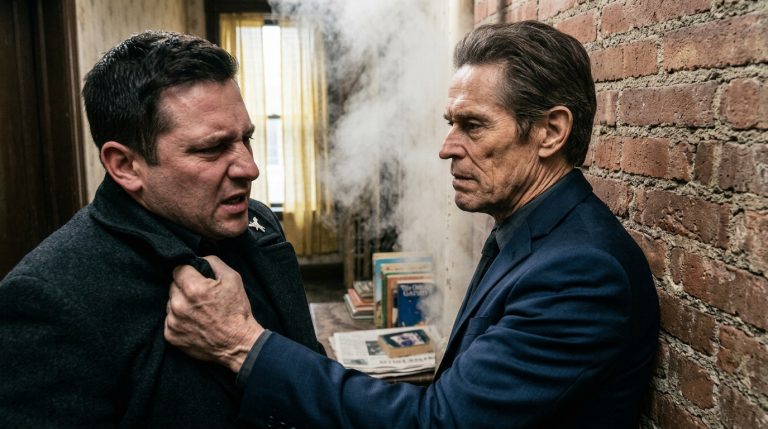
Tony’s reaction was instantaneous; he spun, the rifle swinging wildly, but Rocco was already inside the swing, his palm striking the base of Tony’s rifle, forcing the barrel toward the ceiling. The weapon discharged, the muzzle flash illuminating the space in a brilliant, violent strobe.
Rocco didn’t pull back. He drove the angle iron into the frame of the catwalk railing, pinning Tony against the steel. The sound of metal against metal rang out—a sharp, clear bell of finality. He held his subordinate there, their faces inches apart, the older man’s eyes hard as mountain stone.
“You forgot the most important rule of the empire, Tony,” Rocco whispered, his grip tightening as Tony struggled for breath. “You never betray the hand that keeps you fed, because when the food runs out, the hand becomes a fist.”
Tony’s face darkened, his resistance flickering as the reality of the stalemate settled over them. Rocco hadn’t come to talk. He had come to dismantle the architecture of his own betrayal, one brick at a time.
CHAPTER 5: The Ghost from the Past
Rocco’s knuckles were white, the strain of the hold radiating through his forearm. Tony was struggling, his boots scuffing against the corrugated metal of the catwalk, trying to find leverage to break the hold, but Rocco was immovable. He kept his eyes fixed on Tony’s, searching for the crack in the facade.
“The warehouse was supposed to be a burial site, Tony,” Rocco said, his voice a low vibration against the chaos of the rain hammering the roof. “I left the mistakes of 1996 in the concrete. I didn’t think I’d have to exhume them to find out who turned my right hand into a traitor.”
Tony laughed, a wet, choking sound. “You think I’m the only one, Rocco? Look at the dates on those ledgers. You weren’t protecting a neighborhood. You were just pruning the weeds so the flowers could grow. But the garden… the garden was poisoned from the start.”
A sudden, sharp metallic screech—the warehouse door below being forced open—interrupted them. Rocco’s eyes flickered toward the opening. He hadn’t sent for reinforcements. If it wasn’t his men, it was the cleanup crew.
“You called them,” Rocco said, the realization settling like ice in his veins.
“I didn’t have to,” Tony gasped. “The organization has a memory, Rocco. It doesn’t like loose ends. And you, with your fund and your bicycle repairs? You’re the biggest loose end of all.”
Rocco didn’t wait. He drove Tony backward, slamming him against a structural support beam with enough force to send a shockwave through the catwalk. Tony slumped, dazed, and Rocco shifted his focus to the floor below. Through the gaps in the grating, he saw three figures moving with the clinical efficiency of soldiers. They weren’t wearing masks, but they were carrying long-barreled suppressors.
He pulled his sidearm, the weight familiar and cold, and began a tactical descent. He knew the warehouse like the back of his hand—he had designed the sightlines for this very contingency thirty years ago. He moved along the shadows, using the pillars as cover, the sound of his own breathing a muted hiss.
He caught a glimpse of a silhouette near the central storage crates—a man in a dark tactical jacket. Rocco fired twice. The man dropped, a quiet thud in the dust. The other two reacted instantly, scattering into the maze of crates.
“Rocco!” one of them shouted, his voice hard, authoritative. “You’re an architect of a dead era! Just put the weapon down and we’ll make it quick. We’ve already cleared the hospital. The girl is gone.”
The world tilted. Rocco stopped moving. The sting of iron filings in the air, the rhythmic drip of water from the ceiling, all seemed to fade into a singular point of focus. The hospital.
His grip on his pistol loosened for a fraction of a second, his mind flashing to Emma, to her small hand reaching toward him from the hospital bed. It was a tactical error—a moment of vulnerability—and the gunman on his left exploited it immediately. A burst of gunfire chewed through the crate beside him, forcing Rocco to dive behind a heavy steel forklift.
He was pinned. The dust from the floor coated his tongue, metallic and dry. He was trapped in the very infrastructure he had built to ensure his safety. His exhaustion was setting in; his hands, usually steady as iron, showed a tremor he couldn’t suppress. He looked at the shadows creeping toward him, the shapes of men who had been raised in the system he created, men who knew his tactics as well as he did.
He realized then that the decoy was gone. The betrayal of his security chief wasn’t the secret; it was the entry point. The real threat was the institutional rot that had been festering for decades, a beast that had learned to emulate its creator’s violence while shedding his conscience.
He shifted the magazine, his movements methodical despite the adrenaline. He had one chance. He couldn’t just fight his way out—he had to destroy the board. He looked toward the ceiling, toward the primary gas line valve he’d installed in the early days, a failsafe against arson. If he could reach it, he could trigger an emergency vent, flooding the lower level with a high-concentration suppressant that would drop anyone caught in the draft.
But to reach the valve, he’d have to leave the cover. He’d have to step into the killing floor, into the crossfire. He stood, his jaw set in a line of grim, iron-willed resolve. The ghost of the past was no longer a phantom; it was a reality, and he was ready to face it in the fire.
CHAPTER 6: The Descent into the Foundation
The warehouse floor became a landscape of shifting shadows and lethal geometry. Every step Rocco took was an act of brutal defiance against the encroaching silence of the mercenaries. He could hear them—the sharp, practiced rhythm of tactical boots, the faint whispers of coordinated movement—as they fanned out through the maze of crates, their flashlights carving harsh white tunnels through the suspended dust.
He reached the base of the pillar where the gas valve was housed. It was an antique piece of ironwork, rusted into place by thirty years of humidity. He lunged for it, his hands slick with sweat and the chemical grit of the fire extinguisher’s discharge.
Clang.
A bullet sparked off the metal casing inches from his fingers. The impact sent a jolt of vibration through his arm that numbed his hand to the elbow. He ignored it, his mind tunneling down into a singular, animalistic focus. He wrenched the valve, his boots sliding on the greasy concrete. With a low, guttural growl of exertion, he forced the iron wheel to rotate.
A high-pitched hiss signaled the release of the pressure—not the gas he had intended, but the long-dormant coolant system. Within seconds, a dense, frigid fog erupted from the overhead ducts, cascading down like a winter storm, turning the warehouse into a blinding, icy shroud.
“The cooling line!” one of the mercenaries shouted, his voice muffled by the sudden plunge in temperature. “He’s venting the system!”
Rocco didn’t wait for the confusion to peak. He dropped to his knees, his hands navigating the familiar layout of the warehouse floor by touch alone. He found the hatch—a heavy, circular iron grate that led to the city’s ancient, subterranean drainage network. It was his ultimate insurance policy, a tunnel he had built in the days when he thought he might one day have to disappear.
He heaved the grate open, the smell of brackish water and damp earth rising to meet him. Below, the city’s veins moved with a sluggish, rhythmic pulse. He vaulted into the dark, his body striking the slick concrete of the tunnel below with a jar that shuddered through his spine.
As he scrambled to pull the grate shut, a flashlight beam cut through the freezing fog above, briefly illuminating his face. A suppressed rifle barked, the bullet pinging off the rim of the hatch just as it slammed into place. Rocco slid the locking pin home and collapsed back into the darkness of the tunnel, his breath hitching in his chest.
The tunnel was narrow, its walls coated in a thick, slick layer of river moss and urban grime. The sound of the warehouse conflict became a distant, muffled tremor overhead. He was breathing hard, his body protesting the toll of the last hour, but his mind remained clear, tactical, and cold. He crawled forward, his flashlight flickering as the battery began to fail, revealing the passage ahead—a labyrinthine crawlspace that snaked beneath the city’s heart, connecting every property he had ever owned.
He realized then that he hadn’t just been running from the mercenaries; he had been retreating into his own history. Each turn he took in the dark, each rusted support beam he navigated, was a memory of a transaction, a threat, or a moment of calculated violence.
He stopped, resting his head against the cold, damp stone of the tunnel wall. He heard the faint sound of the mercenaries above, their voices distorted by the echoing void of the drainage system. They weren’t just clearing the warehouse; they were hunting him because he knew the truth that the ledgers held. He had been the architect, the builder, the king—but he had also been the blind man, unaware that his empire was a hollow shell, sustained only by the very rot he had claimed to despise.
He pulled the ledger he had salvaged from the crate out of his jacket. The pages were damp, the ink bleeding into the fibers of the paper. He shone his light on the entries again, his fingers tracing the names. These weren’t just business contacts. They were the names of families he had systematically displaced in the late nineties, people whose lives had been erased so he could build his power.
The weight of it hit him—the guilt was a physical manifestation, a crushing pressure in his chest that felt heavier than the weight of the warehouse above. He had spent the last six months trying to balance the scales for Emma and her family, but the scale wasn’t tipped; it was broken.
He stood, his legs trembling with fatigue, and moved deeper into the dark. He had to reach the central hub—the one place in the city where the paper trail ended. He had to know the full extent of the rot, not just for his own sake, but because he was the only one left who could burn it down. He wasn’t the protector anymore. He was the arsonist returning to the site of the original sin.
CHAPTER 7: The Altar of Remorse
The deeper Rocco went into the subterranean network, the more the air grew thick with the scent of stagnant water and old secrets. His flashlight’s beam, now reduced to a dying, yellow flicker, cast long, distorted shadows against the moss-slicked tunnel walls. Every step was a negotiation with gravity; his legs felt like lead, his exhaustion gnawing at his resolve like a scavenger in the dark.
He reached the convergence point—the central nexus where the city’s drainage lines intersected with the forgotten foundation of the original Moretti compound. This was the place that didn’t exist on any city map, a subterranean vault beneath the old harbor warehouses. He pushed through a heavy, rusted storm gate, his lungs burning with the effort, and stepped into the vault’s central chamber.
It was not a tomb of gold or weapons, but a library of failures. Racks of climate-controlled, sealed filing cabinets lined the damp walls. He approached the central desk, the flashlight finally giving one last, frantic pulse before dying completely. He was plunged into absolute, crushing darkness.
Rocco didn’t panic. He reached into his jacket, pulling out a small emergency lighter, the flame blooming like a tiny, flickering star in the void. He lit the heavy candles staged around the room—an old habit, a ritual of the men who had built this place long before he took control.
As the light danced across the room, the walls seemed to shift. He saw the faces on the files—families, children, names he had signed the order to displace decades ago. The truth wasn’t just a betrayal by Tony; it was the realization that he had presided over a system that was designed to consume the innocent from the very beginning. The ledger he had brought with him was just one thread of a tapestry he had woven himself.
“Rocco,” a voice whispered.
It wasn’t Tony’s voice. It wasn’t the voice of the mercenaries. It was small, fragile, and sounded like wind through a cracked window. He spun, his hand hovering over his sidearm, but there was no one there. Only the shadows, dancing in the candlelight.
“You look for someone to blame,” the voice continued, echoing off the damp stone. “But you were the hand that signed the papers. You were the shadow that blocked the light.”
Rocco felt a phantom weight on his shoulder—a small, trembling hand. He looked down, his breath hitching. For a split second, he saw her: the girl in the yellow raincoat from 1996, the one he had pushed aside to get to the crates, the one he had left behind in the burning warehouse. She was standing there, silent, her eyes reflecting the cold judgment of a life he had extinguished without a second thought.
“I tried to protect them,” Rocco whispered to the dark, his voice cracking. “I tried to build something better.”
“You built a monument to yourself,” the ghost whispered back, fading into the gloom.
The reality hit him—not as a physical attack, but as a total collapse of his internal logic. The ‘broken bird’ symbol wasn’t a warning from a rival; it was a mark of the victims he had left in his wake. Every extortion, every displaced family, every child who had gone hungry—they were the bricks he had used to build his empire. Tony hadn’t betrayed him; Tony was just the mirror that Rocco had finally been forced to look into.
He slumped against the metal desk, the lighter falling from his hand and extinguishing in the damp grit of the floor. He was alone in the dark, surrounded by the paper trail of his own cruelty. But as the silence settled, he heard something else—a mechanical hum, a low-frequency vibration coming from the floorboards beneath him.
He moved toward the center of the room, feeling with his boots until he found the hollow section of the floor. He prised it open. Beneath the concrete, a sophisticated, self-destruct mechanism—a set of thermite charges—was already burning. The faint, sweet smell of ozone filled the air.
He didn’t move to stop it. He watched the sparks crawl toward the detonator. He realized that the warehouse wasn’t just his history; it was the final cleanup. If he didn’t escape, the fire would consume the evidence, and the world would never know the scope of what he had done. But if he did escape, he would be the one to carry the truth.
He reached down, his fingers brushing the hot metal of the charge. He could disarm it, but he would have to pay the price. He would have to expose everything—to the police, to the families, to the city. He would lose his empire, his status, and perhaps his life.
He looked at the small pile of ledgers, then at the burning fuse. The path was clear, but it wasn’t the path of a boss. It was the path of a man finally choosing to be human. He grabbed the ledgers, shoved them into his coat, and lunged for the tunnel exit just as the charges flared with the intensity of a dying star.
CHAPTER 8: The Ashes of the Architect
The explosion didn’t sound like a roar; it sounded like the earth itself cracking open. Rocco was thrown forward, his body slamming against the wet, iron-slick floor of the drainage pipe, the ledger clutched to his chest like a holy relic. The heat arrived a fraction of a second later, a searing wall of fire that licked at the damp walls, turning the stagnant water into a blinding, scalding mist.
He scrambled upward, his fingernails clawing at the concrete transition toward the harbor’s exit. He had to surface. He had to be seen. He had to make sure the evidence didn’t burn with him.
He burst out of the storm-drain exit, tumbling onto the rain-slicked concrete of the harbor pier. He was a wreck of a man—soaked, covered in ash, his clothes shredded and stained with the grime of the city’s underbelly. Above him, the warehouse was a skeletal monument of twisted steel and orange flame, lighting up the night sky in a display that signaled the end of the Moretti dynasty.
The harbor was already swarming with sirens. Police cruisers, ambulances, and unmarked vehicles converged on the pier, their lights painting the scene in frantic pulses of red and blue. Tony and the surviving mercenaries were there, standing by a waiting black sedan, watching the fire with the detached air of professionals who had finished a job.
They saw him.
Rocco stood, his legs trembling, his vision swimming. He held the ledger up, a sodden, charred lump of paper that held the names of everyone he had betrayed. The mercenaries moved toward him, their weapons raised, but they froze as a floodlight from a police helicopter swept across the pier, pinning them in a blinding, white glare.
“Rocco Moretti!” a voice amplified through a megaphone boomed across the pier—Detective Maria Santos.
He didn’t run. He didn’t fight. He walked forward, his pace heavy and deliberate, into the center of the light. He placed the ledger on the ground at the feet of the first officer who reached him, his movements stiff with tactical exhaustion.
“It’s all there,” Rocco said, his voice raw, barely audible over the crackling of the nearby inferno. “The lists, the dates, the connection to the harbor administration. It was never just business. It was a harvest.”
Tony watched from the car, his face a mask of cold, calculating fury. He realized then that Rocco hadn’t just destroyed the warehouse—he had surrendered. By exposing the truth, he had stripped Tony of the leverage he had spent years cultivating. The mercenaries hesitated, their weapons wavering as the police line formed, the weight of the evidence becoming a barrier they couldn’t cross without inviting an open war they weren’t prepared to win.
Rocco watched as Tony’s car turned and accelerated, disappearing into the dark of the shipping district. He didn’t care. The king had stepped down from the throne, and the kingdom was already burning.
He let the officers take his arms. He didn’t resist as the handcuffs clicked into place, the cold steel biting into his wrists—a final, ironic closure to a life spent shackled by his own choices. He looked toward the hospital, imagining Emma finally safe, the weight of her future no longer tied to the shadows of his past.
As he was led toward the back of the cruiser, the fire reflected in his eyes, he noticed a small object on the pier—a toy, a tiny, crushed metal bicycle dropped in the chaos of the night. He stopped, his gaze lingering on it for a moment, a profound sense of peace settling over him. The poetic justice wasn’t in the flames or the arrest; it was in the silence that followed. The cycle was broken.
The rain continued to fall, washing the ash from the pier, smoothing over the jagged edges of the night. He sat in the back of the cruiser, the heater hummed, and for the first time in thirty years, the architect of the shadows closed his eyes and felt nothing but the steady, rhythmic pulse of a world moving on without him. He had repaired the damage as best he could, one ledger at a time, one child at a time. The rest was for the light.