A Sovereign Defense: The Unyielding Survey and the Slow Collapse of the Clearbrook Shores Fraud
CHAPTER 1: THE WEIGHT OF THE LINE
The silence after the tow truck retreated was not a victory. It was a vacuum.
I stood by the gate until the dust settled, the metal latch cold and biting under my palm. My pulse, which had remained a flat, steady line during the standoff, finally allowed itself a jagged rhythm. The court order was a shield, yes, but in Missouri, a shield only works if the person behind it is ready to hold it until their arms give out.
I didn’t turn back toward the house. Instead, I walked the perimeter of the pond. My boots crunched over dry, brittle grass—a sound like grinding teeth in the evening quiet. I didn’t care about the fading light. I cared about the geometry of my world.
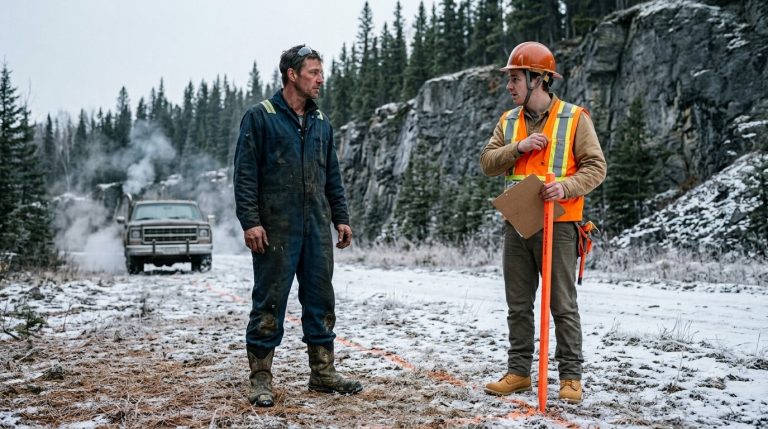
I stopped near the lower trail, the same spot where Karen’s “compliance” goons had stood with their clipboards. The ground here was uneven, scarred by the tracks of the truck that hadn’t quite committed to its threat. I knelt, my fingers pressing into the dry earth, feeling for the cold, hard reality of the soil.
My flashlight beam cut through the encroaching dark, illuminating a piece of rebar sticking inches out of the ground. It was weathered, rusted to the color of dried blood, and partially obscured by a clump of dead sage. I didn’t remember putting a marker there. I had walked this boundary line a dozen times since the harassment began, cataloging every inch of the six acres.
I reached out, tugging at the iron. It was buried deep, anchored in stone.
I leaned closer, my breath hitching. Etched into the flat head of the rebar was a set of numbers—survey coordinates. They didn’t match the plat map I had pulled from the recorder’s office yesterday. They didn’t even match the original land grant I’d kept in my safe.
A coldness that had nothing to do with the night air settled in my chest.
This marker was new. Not the iron itself, but the placement. The rust was uneven, as if it had been exposed to the elements for years, but the earth around it was loose, fresh. Someone had dug this up, moved it, and pounded it back into the ground with the precision of a surgeon.
I stood up, the rebar still trembling under my touch. They weren’t just playing at authority; they were physically altering the landscape to rewrite the records.
My phone buzzed in my pocket—a text from an unknown number. Just a picture. It was a shot of my own property, taken from the woods on the northern ridge, with a red digital circle drawn around my front porch.
The HOA wasn’t retreating. They were repositioning. And the survey map I had staked my life on was suddenly a map to a lie.
CHAPTER 2: THE ANCHORS DECEPTION
The rebar did not yield. It held fast, a stubborn, jagged tooth erupting from the earth where nothing of the sort should have existed. I stood over it, the flashlight in my left hand casting long, erratic shadows that danced between the trees like specters.
The silence of the woods, usually a comfort, now felt heavy—a pressurized atmospheric weight. My thumb traced the numbers etched into the iron. They were fresh, the metal’s oxidation minimal, a stark contrast to the decades of decay I had expected to find in this soil. Someone had been here. Recently. They had not just trespassed; they had attempted to re-engineer the physical boundaries of my reality while I slept.
The intrusive thought hit me with the force of a physical blow: the day I bought this land. I remembered the feeling of the heavy, cream-colored document paper in the county recorder’s office, the way the notary’s stamp had felt like a seal of permanent sanctuary. I had bought six acres of absolute, unfettered silence. But as I looked at the rusted rebar, a phantom memory surfaced—a fleeting moment during the final walk-through where the previous owner had looked at this exact cluster of trees, his gaze lingering a second too long, a subtle, nervous twitch in his jaw that I had dismissed as the exhaustion of a closing. Had he known? Had the “peaceful” solitude of this tract been a carefully manicured lie even then?
I stood up, the movement causing a sharp pop in my knee. I had to be methodical. I couldn’t afford to be the panicked landowner they expected. If they were rewriting the map, they were doing it on the assumption that I would rely on the versions of the world they wanted me to see.
I took out my phone, the screen’s light bleaching the color from my skin, and snapped a photo of the rebar against the backdrop of the treeline. Then, I pulled up the GPS app—the same tool I used to track the property lines during the initial brush clearing. I stepped back, my boots sinking into the dry, unyielding ground.
According to the digital grid, I was three feet inside my boundary. According to the rebar, I was already encroaching on whatever the HOA had decided to invent.
I didn’t head back to the house. That would be playing the victim, and victims are easily cornered. I walked the opposite direction, toward the lower trail, my movements deliberate. I needed to see if there were others. If they were changing the map, they wouldn’t stop at one marker.
Every rustle of the leaves felt amplified. I found myself calculating distances, not for gardening or fishing, but for defense. If they moved the markers, they were preparing for a legal filing, a “correction” that would strip the pond—and my privacy—away in one stroke of a clerk’s pen. The realization made the air feel thinner, the metallic scent of the earth sharper.
They weren’t just fighting for the pond. They were fighting for the narrative. If they could successfully argue that these markers had been there for twenty years, the court would have to accept the new survey. It wouldn’t matter that the older plats disagreed; in the eyes of the law, a visible, physical boundary mark often holds more sway than a forgotten sheet of paper in a dusty file.
I reached the edge of the lower trail and paused, my back against the rough bark of a pine. I waited, counting the seconds. A minute passed. Two. Then, the low, rhythmic hum of a vehicle engine drifted up from the road below. It was the black sedan. It hadn’t left; it was patrolling, a slow, predatory orbit around my perimeter.
I didn’t move. I watched the dull glow of its headlights wash over the edge of my fence line, seeing the way the beams lingered on the entrance to the trail. They were waiting for me to panic, to run, to scream, or to call the sheriff again so they could document my “instability.”
Instead, I took a deep breath, the cold air grounding me, and turned toward the dark house. I had the photo of the rebar. I had the knowledge of their patrol. I would head inside, pull the digital files, and start building a map of my own—not a map of what they claimed the land was, but a record of every lie they’d planted in the soil. They wanted to play surveyor? I would make sure the audit they triggered would be the one that ended them.
CHAPTER 3: THE FABRICATED EASEMENT
I did not head back to the house. That would be playing the victim, and victims are easily cornered. I turned instead toward the lower trail, my movements deliberate. I needed to see if there were others. If they were changing the map, they would not stop at one marker. The cold dampness of the evening air clung to my skin, but it was nothing compared to the chill of realization that settled into my marrow.
Every rustle of the dry leaves felt amplified. I found myself calculating distances, not for gardening or fishing, but for defense. If they moved the markers, they were preparing for a legal filing, a “correction” that would strip the pond—and my privacy—away in one stroke of a clerk’s pen. The realization made the air feel thinner, the metallic scent of the earth sharper.
They weren’t just fighting for the pond. They were fighting for the narrative. If they could successfully argue that these markers had been there for twenty years, the court would have to accept the new survey. It wouldn’t matter that the older plats disagreed; in the eyes of the law, a visible, physical boundary mark often holds more sway than a forgotten sheet of paper in a dusty file.
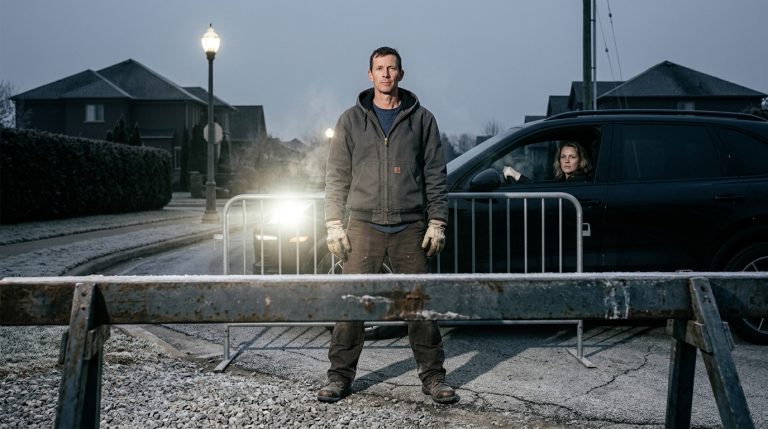
I reached the edge of the lower trail and paused, my back against the rough, peeling bark of a pine. I waited, counting the seconds. A minute passed. Two. Then, the low, rhythmic hum of a vehicle engine drifted up from the road below. It was the black sedan. It hadn’t left; it was patrolling, a slow, predatory orbit around my perimeter. I didn’t move. I watched the dull glow of its headlights wash over the edge of my fence line, seeing the way the beams lingered on the entrance to the trail. They were waiting for me to panic, to run, to scream, or to call the sheriff again so they could document my “instability.”
Instead, I lowered my center of gravity, my boots sinking into the loose soil of the embankment. I began to crawl, staying beneath the line of sight of the headlamps. I moved with a predator’s economy, my eyes scanning the ground not for the path, but for the irregularities I now knew to look for: disturbed earth, unnatural pile-ups of stone, the precise, artificial geometry of their tampering.
Twenty yards down, nestled between two ancient oaks, I found it: a small, plasticized box anchored to a post, partially buried in dead foliage. It was a weather-resistant document sleeve, the kind used for survey notices. My heart hammered a rhythmic warning against my ribs. I pulled it free.
Inside wasn’t a county notice. It was a draft—a forged, preliminary easement claim, notarized by a name I didn’t recognize, dated for the upcoming Monday. It claimed that this specific stretch of land was subject to a “permanent community access agreement.” The ink was still slightly tacky, the edges of the paper crisp. It was a raw, unfiltered piece of bureaucratic violence.
They weren’t just moving markers; they were creating the paper trail to justify the movement. The pond wasn’t just a bone of contention; it was the leverage. If they could get a judge to see this “easement,” the game would be over before I even stepped into the courtroom.
I didn’t take the box. I took a photo of it, meticulously documenting the serial number stamped on the back of the plastic sleeve, and then carefully tucked it back into the mud exactly as I had found it. I had to leave it there. If I removed it, they would know I was onto the decoy. I needed them to believe I was still playing the game on their terms.
As I retreated toward the house, the sedan’s lights flickered one last time, a mechanical wink in the dark. I climbed through my back window, the house suddenly feeling like a fortress rather than a home. I sat at my desk, the glow of my monitor lighting the maps I had printed out earlier. I pinned the photo of the rebar and the photo of the easement box side-by-side.
The pieces were falling into place, but the picture they formed was far larger than a dispute over pond access. This was systematic. It was cold, calculated, and it had deep roots in the county’s own digital filing system. I reached for my phone and dialed Gina’s number, the tone rhythmic and sharp.
“I have the physical evidence of the forgery,” I said, my voice steady, stripped of all emotion. “They’re filing a fake easement. And it’s not just a bluff, Gina. They’re using it to justify moving the survey pins. We need to stop the audit and push for a full-scale forensic examination of the entire development’s plat records. They’re hiding something under the dirt.”
There was a long silence on the other end, the kind of silence that happens when a lawyer realizes the scale of the war has just shifted.
“I’ll handle the filing,” Gina replied, her tone dropping into the pragmatic, no-nonsense register that had convinced me to hire her in the first place. “But you need to be careful. If they know you’re looking at the plat records, they’ll stop the physical tampering and start trying to neutralize the source. Keep your doors locked. Do not go back to that trail at night.”
I hung up, the silence of the house pressing against my eardrums. I looked at the maps again. The trees on the southern edge, the pond, the trail—it all looked the same, but the geometry was wrong. Somewhere beneath that dirt, there was a truth they were terrified would be unearthed. And I was going to be the one to dig it up.
CHAPTER 4: THE ARCHIVE OF DUST
The drive to the county recorder’s office was a masterclass in controlled paranoia. Every truck that pulled up behind me, every set of headlights that lingered too long in my rearview mirror, felt like an extension of the HOA’s reach. I didn’t take the main road. I took the back routes, the ones where the asphalt cracked under the weight of passing tractor-trailers, letting the landscape swallow my car in the gray gloom of the early morning.
When I stepped into the recorder’s office, the air was stagnant, heavy with the scent of aging paper and floor wax. It was a place designed to hold history, but as I walked toward the clerk’s desk, I realized it was also a place designed to hide it.
“I need access to the 2006 tract integration files for the Clearbrook corridor,” I said, keeping my voice low, matter-of-fact. I didn’t want to sound like a man on a mission; I wanted to sound like a man doing a boring, bureaucratic check.
The clerk, a woman with tired eyes and a name tag that read ‘Brenda’, didn’t even look up from her screen. “Those are restricted, unless you’re a title researcher or have a court order.”
I slid a copy of the temporary injunction I’d secured the day before across the desk. “I am the property owner, and this court order grants me full access to all records pertaining to the current dispute. The audit is already authorized.”
She studied the document, her lips thinning. She tapped a few keys, the fluorescent lights above us buzzing in a sickly, uneven rhythm. “Give me ten minutes.”
I sat in the plastic chairs lining the wall, my gaze fixed on the double doors. I was waiting for the ‘fail-safe’—the moment when the HOA’s tentacles in the local administration would realize I was pulling the thread that held their mask in place.
Five minutes in, the power in the office flickered. Not a simple dip, but a sharp, violent surge that sent the monitors into a black-screen reset. The clerk groaned, reaching under her desk to cycle the power.
“System maintenance,” she muttered, clearly annoyed. “Happens every time the load on the grid shifts. Won’t take long.”
But it did. The ‘maintenance’ stretched, the screens remained stubbornly dark, and the soft, rhythmic clicking of the server room behind the desk turned into a jagged, erratic stutter. My pulse spiked. This wasn’t an accident. This was a targeted digital block. They weren’t just watching the perimeter; they were monitoring the architecture of the record itself.
I didn’t wait for her to fix it. I stood up, walked to the back door, and pushed it open before she could protest. “Hey! You can’t be in there!”
I ignored her. The server room was cold, the air thick with the smell of ozone. I went straight for the primary terminal, the one that interfaced with the public archives. A rogue script was running on the main display, scrolling through files at a speed no human eye could track, deleting, overwriting, and encrypting. They were wiping the trail.
I grabbed a flash drive from my pocket—a habit from my days in logistics—and jammed it into the port. I didn’t need to read the files; I needed to intercept the stream. I frantically hammered at the keyboard, forcing a partition break, trying to mirror the data before the system wiped the original source.
The screen flashed red: ACCESS DENIED. But it was too late. I had snagged a fragment. I pulled the drive as the terminal went completely dead, the room falling into a suffocating, absolute silence.
I walked back out, my face a mask of practiced indifference. Brenda was staring at me, her hands trembling.
“I think your system just crashed,” I said calmly, nodding toward the door. “I’ll try back later.”
I walked out into the bright, harsh daylight, my hand clutching the drive in my pocket like a live grenade. The walk to the car felt like a gauntlet. When I finally hit the ignition, my hands were finally shaking. I hadn’t just uncovered an easement; I had caught them in the act of destroying the past. They didn’t just want the pond. They were terrified of the twenty-year-old survey error—the fundamental flaw that proved the entire development was built on land that didn’t technically belong to the corporation.
I looked at the house in the distance, my home, and realized I was no longer a landowner. I was a target.
CHAPTER 5: THE WEIGHT OF THE TRUTH
The drive sat on my desk, a small, obsidian sliver of plastic that felt as heavy as a gravestone. Outside, the world had gone quiet. The late afternoon sun stretched long, amber fingers across my floorboards, but the warmth didn’t reach me. I kept seeing the flicker of that red ‘ACCESS DENIED’ screen, the way the HOA’s digital scrubbers had moved with the efficiency of a state-sponsored hit squad.
I slotted the drive into my laptop. The transfer was agonizingly slow, a progress bar that seemed to mock the urgency hammering in my chest. When the files finally populated, they weren’t documents in the traditional sense. They were CAD overlays—layered, high-resolution digital surveys of the entire Clearbrook area, dating back to before the development had even broken ground.
I leaned in, my eyes stinging. I began to cycle through the layers, peeling back the current ‘community’ map to reveal the foundation underneath. And there, buried in a sub-layer labeled ‘Pre-Development Feasibility,’ I found the truth. It wasn’t just a survey error. It was a deliberate, institutional erasure.
The original tracts, including my six acres, had been designated as a protected flood mitigation zone—land that, by law, could never be subdivided or developed. To build Clearbrook, the developers hadn’t just ‘misinterpreted’ the boundaries; they had systematically fabricated a new geological reality, altering contour lines and burying the old survey markers under thousands of tons of fill dirt. My pond wasn’t just an amenity; it was the original drainage basin for the entire north ridge.
The HOA’s aggression, their obsession with ‘quiet hours’ and ‘access,’ wasn’t just about controlling the neighbors. It was about controlling the water table. If someone—like me—started digging too deep, if they started running their own surveys, the entire precarious lie of the development would shift, the drainage would fail, and the value of every home in Clearbrook would plummet toward zero.
A sudden, sharp nausea washed over me. I had been looking at this as a property dispute. I had been thinking in terms of deeds and fences. But I was standing on top of a multi-million dollar catastrophe that they were desperately trying to bury.
The phone rang. It was Gina. I didn’t even say hello.
“They’re going to try to burn it down,” I said, my voice sounding hollow even to my own ears. “Gina, it’s not a mistake. The whole development is a fraud. The land was never zoned for housing. They moved the entire ridge’s elevation markers to keep the flood plains off the books.”
“That’s impossible,” she started, but the skepticism in her voice wavered as I began to dictate the file codes I was seeing on the screen. The silence that followed was different this time—not the silence of a lawyer finding a loophole, but the silence of someone watching the ground disappear beneath them.
“If you have proof of that,” she whispered, “you don’t just have an easement issue. You have a case for the Attorney General. But you also just painted a target on your back that’s going to draw in every major developer in the state.”
I looked out the window. A car was parked at the edge of the woods—a different one this time, a nondescript gray sedan, idling in the shadows. They weren’t just patrolling anymore. They were waiting for me to make the next move, waiting for me to realize that I couldn’t walk into a courtroom with this. The system they had rigged wasn’t just for show; it was designed to protect the very fraud I had just decoded.
I stood up, the chair scraping harshly against the wood. I realized then that my focus on the ‘easement’ had been a failure of imagination. I had been trying to beat them at their own game, using their own rules, their own courts, their own paper trails. But the game wasn’t meant to be won. It was meant to be broken.
I grabbed my jacket. I didn’t reach for the files to take to court. I reached for them to take to the one place they couldn’t control: the public. I had the truth, but the truth was a fragile, burning thing. If I stayed here, waiting for the ‘legal process’ to catch up, I’d be dead before the first motion was filed.
I left the laptop open, the evidence blinking on the screen like an accusation. I headed toward the back door, stepping out into the cooling dusk. The gray sedan didn’t move as I emerged, but the headlights suddenly snapped on, blindingly bright, pinning me against the frame of my own house. I didn’t flinch. I kept walking toward the pond, toward the only part of this property that hadn’t been poisoned, lied to, or manipulated. I knew what I had to do now. The truth didn’t need a lawyer. It just needed to be seen.
CHAPTER 6: THE SETTLED LINE
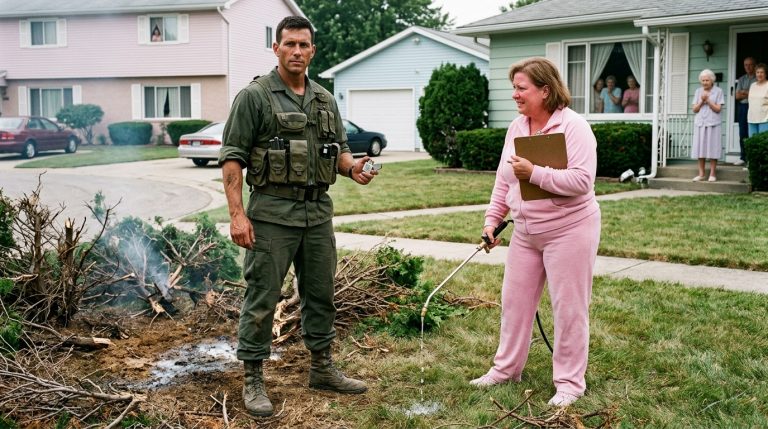
I didn’t turn away from the light. I stepped forward, into the halo of the gray sedan’s high beams. The engine cut, and the driver’s door opened. Karen Mckllen stepped out, her movements sharp and brittle, looking less like a neighborhood president and more like a woman whose composure was held together by scotch tape. Behind her, her son followed, his swagger replaced by the tentative, pacing gait of someone who realized they were out of their depth.
“You’re finished,” Karen said, her voice tight, echoing across the open grass. “Whatever you think you found, it’s nothing but a technical dispute. This is a private community. You’re trespassing on our managed landscape.”
I didn’t reach for my phone. I didn’t reach for a weapon. I reached into my coat and pulled out a single, laminated copy of the plat records I’d mirrored from the county terminal—the ones showing the original drainage basin and the suppressed flood mitigation status of the entire Clearbrook tract. I held it out, not toward her, but toward the ground where the rebar had been driven.
“This isn’t a dispute, Karen,” I said, my voice carrying the weight of the last few days. “It’s a criminal liability. Every house in Clearbrook was sold based on a map that you knowingly altered to hide the fact that this entire development is legally unbuildable. The easement was your distraction, a fairy tale you told the neighbors to keep them from asking why their basements kept flooding and why the insurance premiums are rising.”
Her son laughed, but it was a thin, hollow sound. “You’re a crank with a grudge. Nobody cares about old maps.”
“The Attorney General will,” I replied, my eyes fixed on Karen. “The forensic audit is already triggered. The digital footprint you left when you tried to scrub the archives this morning? That’s not a property dispute. That’s obstruction and fraud. And it’s traceable back to your personal server.”
Karen’s face drained of color. The predatory mask—the one that had successfully intimidated a dozen homeowners—shattered. She looked at me, not with anger, but with a sudden, devastating recognition. She knew. She had known all along that the ground beneath them was a lie, and that the only thing holding it up was the sheer force of their collective bullying.
She turned to her son, her hand trembling as she reached for his arm. “Get in the car,” she whispered, the command lacking its usual authority.
“What?” he asked, his bravado finally fracturing. “Mom, we have to—”
“Get in the car!” she snapped, and for the first time, she looked afraid.
They scrambled back into the sedan. The tires spun on the gravel, spraying dirt against my boots, before the car swerved and sped back toward the entrance of the subdivision. They didn’t look back at the pond. They didn’t look back at the trail. They were already running, already trying to outpace the consequences that were currently being uploaded to a server they couldn’t touch.
I stood there for a long time after the taillights vanished into the darkness. The air was cool, the smell of damp, turned earth rising from the pond. The tension that had defined every waking hour for the last month—the constant, grinding friction of their presence—suddenly evaporated.
I walked down to the water’s edge. The moon was reflected on the surface, a perfect, steady mirror of the sky. I knelt by the rocks where the poisoned fish had floated just days ago. The water was clear now, the sediment settling.
I took the rusted rebar I had pulled from the ground and laid it flat on the bank. Then, I took my heavy work knife and, with deliberate, slow strokes, began to smooth the mud over the scar where they had pounded it in. It wasn’t about property anymore. It was about the silence. I wasn’t reclaiming my land; I was simply restoring the order that had been there long before they arrived.
The following week, the sheriff’s deputies arrived, not with tow trucks or clipboards, but with investigators and heavy, metal-cased equipment. They didn’t talk to me about HOA bylaws. They talked to me about surveyors, geological strata, and historical drainage.
I watched from my porch as they dismantled the infrastructure of the ‘community.’ It was a quiet, clinical destruction. The fake signs came down first. Then, the barricades. Finally, the developers themselves appeared, their suits looking hopelessly out of place in the mud, trying to negotiate terms with officials who were no longer interested in neighborhood harmony.
On a Sunday morning, the air was crisp and smelled of autumn. The house felt settled, the weight of the ordeal lifted like a fever breaking. I went to the shed, pulled out the tools I had used to build the porch, and spent the afternoon repairing the gate latch—the one Karen’s crew had tried to force.
My daughter, Lily, walked down to the dock as I finished. She didn’t ask about the HOA. She didn’t ask about the court orders. She just picked up a fishing pole, her movements as natural as the water itself.
I sat back, my hands calloused and stained with the honest work of the land, and took a long, slow breath. The silence was absolute. No more clipboards, no more fake politeness, no more threats. Just the wind in the trees and the steady, rhythmic lap of water against the dock. The mystery was gone, the truth was out, and for the first time in a long time, the land felt like it was finally, truly, mine.