The Paper Archive: A Quiet War Against the Quiet Erosion of Property and Purpose
CHAPTER 1: THE PERIMETER SHIFT
The sound of the locksmith van’s tires crunching over the gravel driveway was the only victory I’d get for now. It was a rhythmic, departing sound, fading into the heat haze of the afternoon until the silence rushed back in, heavy and thick. I stood in the doorway, my hand resting on the frame where the lock had been subjected to the locksmith’s heavy-handed attempt to breach the estate’s security. The wood was splintered around the strike plate—a small, ragged tear in the house’s armor.
I didn’t turn around. I didn’t go to the kitchen to add another entry to my log. Instead, I stayed where I was, listening to the house. It was an old place, a farmhouse that had seen decades of dust and wind, and it had a way of settling that felt like a long, slow sigh. My aunt June had loved the way it held its breath in the quiet hours. Now, that quiet felt brittle, like thin ice over deep water.
My phone vibrated against my palm, a sharp, buzzing intrusion that made the fine hairs on my arm stand up. I looked down, expecting another veiled threat from the HOA’s management portal. Instead, it was an anonymous file drop. A map of the parcel, but not the one I’d seen in the probate documents. This one was marked with topographical contours and dated months before the estate entered the legal system. A crimson circle, precise and ugly, was centered over the old storm cellar—the one spot on the property I hadn’t touched yet because the ground around it was always perpetually damp, resisting even the dry summer heat.
I walked back into the kitchen, the floorboards groaning under my boots. I avoided the window. If Melissa or her “safety liaisons” were watching from the street, they needed to see a house that was closed off, impenetrable, and calm. I set my phone on the table beside the stack of papers. The sunlight hitting the kitchen table revealed a fine layer of dust I’d missed, and for a second, I just focused on that—the way the dust motes danced in the stagnant air. It was easier to think about the grit on the surface than the implications of that red circle.
I pulled out a fresh sheet of paper. My handwriting was controlled, the ink biting into the fibers of the page. 14:45. Perimeter clear. An anonymous file received regarding the property survey.
I looked up at the clock on the wall. The second hand ticked forward with a relentless, mechanical precision. Every tick was a reminder that the war wasn’t about winning a single battle—it was about maintaining the line. The locksmith was gone, but the pressure hadn’t dissipated; it had just shifted from a direct shove to a subtle, creeping weight.
There was a light tap at the window. I didn’t jump. I didn’t reach for anything. I just stared at the pane, watching the reflection of the empty kitchen. A slip of paper was tucked under the latch. I walked over, my movements deliberate, and pulled it free. It wasn’t an HOA notice. It was a note, handwritten on the back of a grocery receipt: Check the cellar foundation before they do.
My breath caught in my throat, cold and sharp. I looked out toward the cellar door, tucked behind the overgrown lilac bushes. The structure was supposed to be empty, a relic of the past, but the note suggested it was the center of everything. I reached for my flashlight, my fingers brushing the cool, rusted metal of the door handle.
CHAPTER 2: THE FRICTION OF RECORDS
The cellar door groaned, a long, low protest of rusted hinges that sounded like metal grinding against bone. I didn’t push it all the way open. I let the beam of my light snake into the darkness, playing over the damp concrete steps. The smell hit me first—not just the expected musk of stagnant earth and mildew, but something sharper, more metallic. Like iron filings left out in the rain.
I took the first step down, the beam dancing across the walls. The foundation was stone, but the lower half, closer to the dirt floor, had been reinforced with newer concrete. It looked slapped on, an amateurish job that didn’t match the craftsmanship of the rest of the house. My thumb brushed the surface of the new pour, and the texture was gritty, uneven. It felt wrong, a scar on the house’s skin.
A sudden, sharp memory flickered: my uncle, five years ago, standing near this exact spot with a roll of blueprints, his brow furrowed in a way I didn’t understand then. He’d talked about “drainage issues” and “unseen water tables,” but he had always been a man who spoke in riddles when it came to the property’s maintenance. I had dismissed it as the ramblings of a man who loved his land a bit too much. Now, standing in the cold dark, the memory wasn’t a comfort; it was a warning.
I moved the light toward the center of the floor. There, tucked under a heavy, water-warped piece of plywood, was a small, plastic-wrapped envelope. My heart hammered against my ribs—a frantic, uneven rhythm. I reached down, the movement heavy with the weight of the unknown, and pulled it free. The plastic was brittle, cracking under my touch.
Inside, there was a single document: an addendum to the property survey, marked with a municipal stamp that looked legitimate, yet somehow out of place. It detailed a maintenance easement that hadn’t been in the standard title paperwork I’d processed through probate. It granted the “local community association” the right to perform emergency site stabilization.
“Emergency site stabilization.” The phrase tasted like ash. It was the same bureaucratic doublespeak Gavin Reed had used when he talked about “community safety.”
A heavy thud sounded from above—the back screen door. Someone was on the porch.
I didn’t panic, but a cold, clinical clarity washed over me. I stuffed the envelope into my jacket, my movements practiced and silent. I killed the flashlight, plunging the cellar into an absolute, suffocating dark. I crouched behind a rusted shelving unit, my breath coming in slow, rhythmic hitches. My grip tightened on the edge of a steel shelf, the cold metal biting into my palms. I wasn’t just hiding; I was calculating. If they had come this far, if they were bold enough to step onto the porch, then the game had moved beyond the street.
The footsteps were measured, deliberate. They didn’t sound like a neighbor’s casual stroll. They were the steps of someone who knew exactly where they were going. The screen door creaked again, and a voice—low, filtered through the thick glass of the back door—drifted into the cellar.
“The perimeter is secure. No signs of activity, but the lock was tampered with.”
Gavin.
I stayed motionless, the darkness pressing against my eyes until I saw flashes of light that weren’t there. My pulse thrummed in my ears, a steady, driving beat that kept me focused on the present. They weren’t looking for a person; they were looking for a timeline, a record, an anchor. And right now, I was the only thing standing between them and the truth buried beneath the concrete.
The footsteps retreated, back toward the driveway. I didn’t move for ten minutes, letting the silence settle until I was certain they weren’t coming back. When I finally climbed back up to the kitchen, the house felt different. It felt like a fortress under siege, and for the first time, I realized that my collection of papers on the counter wasn’t just evidence. It was a target.
I sat down at the table, the moonlight casting long, jagged shadows across the room. I opened the envelope. The easement was dated two weeks after my uncle died—a legal impossibility if the trust was handled correctly. I reached for my pen and a fresh sheet of paper. I didn’t need a lawyer to see the pattern anymore. I just needed to start documenting the corruption of the paper itself.
The first line of the new page was simple: Found unauthorized easement. Municipal stamp falsified.
I looked at the house around me, the creaks of the floorboards now sounding like whispers. I wasn’t just fighting for the land anymore. I was fighting to keep the history of it from being rewritten by the people who wanted to bury the truth in the damp, dark earth of the cellar.
CHAPTER 3: THE PROPERTY WALK
I didn’t turn on the kitchen lights. I moved by the pale, slate-gray light filtering through the window, my fingers tracing the edge of the kitchen island. The paper in my pocket felt like a brand. I sat in the hard-backed chair at the table, placing the forged easement document next to the rest of the timeline. The ink of the municipal stamp looked crisp under the moonlight, too crisp for a document that was supposedly buried in historical files. Someone had gone to significant trouble to manufacture this, and that level of effort meant they weren’t just guessing. They were executing a plan.
The house creaked, the foundation settling as the temperature dropped outside. It was a rhythmic, familiar sound, but tonight it felt like a countdown. I needed to see the edges of the property—not just the cellar, but the boundary lines that the easement specifically targeted.
I grabbed my jacket and stepped out the back door. The air was sharp, smelling of pine needles and damp earth. My flashlight beam cut a narrow, dust-choked path through the darkness. I began at the western fence line, where the old-growth oaks met the edge of the Maplerest development.
Everything looked normal at first glance. The wire fencing was rusted, covered in thick patches of lichen that felt like dry, flaking skin under my touch. I walked the length of it, my boots crunching on the dry leaves. But as I reached the northwest corner, near the drainage ditch that ran toward the storm cellar, I noticed a discrepancy.
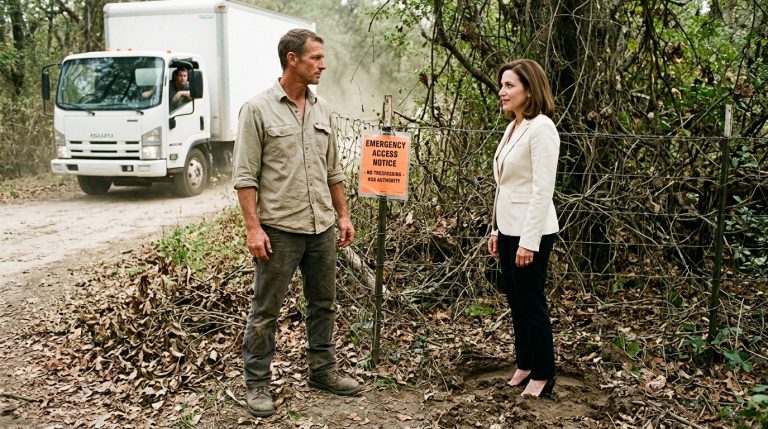
There was a series of small, orange-painted stakes driven into the soft mud along the interior side of the fence. They were fresh. Someone had been surveying the land during the day while I was occupied with the locksmith. I knelt, the mud soaking through my jeans, and examined the nearest stake. It wasn’t just a survey marker; it was marked with a code I didn’t recognize—a series of alphanumeric strings followed by an HOA emblem.
CHAPTER 3: THE PROPERTY WALK
The kitchen remained cast in the same silver moonlight as before, but the air felt heavier, saturated with the metallic scent of the cellar. I didn’t turn on the lights. I didn’t need them. I knew the dimensions of this house as well as I knew my own heartbeat. I walked to the counter and smoothed out the forged easement document again. The paper was thicker than the standard forms I’d pulled for probate—too thick, too white. It had the synthetic, polished feel of a corporate document designed to intimidate, not to inform.
I needed to see the edges. If the HOA was claiming an “emergency site stabilization” easement, there had to be a physical justification on the property—a failing retaining wall, a sinkhole, or some artificial instability they could point to if a city inspector ever showed up. But I had walked these grounds a dozen times. The soil was firm, if damp, and the perimeter was defined by the same thick, overgrown hedge line that had stood since my aunt first bought the place.
I slipped into my boots, the leather worn and familiar, and stepped out onto the porch. The night was cooling rapidly, the heat of the day trapped in the gravel driveway starting to release into the evening. I moved toward the treeline. My flashlight remained in my pocket; I wanted to navigate by the texture of the ground and the layout I knew by memory. The HOA’s reliance on cameras and digital notices was their weakness—they viewed the world through lenses and filters. I viewed it through the friction of the terrain.
As I neared the eastern property line, the ground began to change. The firm, packed earth turned softer, more yielding. I crouched, my hands pressing into the soil. It was cool, wet, and oddly pliable. I dug my fingers in, feeling for the cause of the moisture. Under the topsoil, the earth was dense with a strange, oily residue. It wasn’t organic decay. It had a sharp, chemical tang that burned the back of my throat.
I stood up, wiping my hands on my jeans. This wasn’t a natural drainage issue. It was a man-made saturation.
A twig snapped—sharp, deliberate—from the direction of the neighboring lot. I didn’t flinch. I turned, my posture balanced and ready, waiting for the shadows to resolve themselves into a shape.
Gavin Reed stepped out from behind a large oak tree. He didn’t have his folder or his polo shirt. He was dressed in a dark, nondescript jacket, looking more like an intruder than a management representative. He held a phone, but the screen was dark. He wasn’t recording; he was patrolling.
“You’re out late, for a property owner,” Gavin said, his voice stripped of the corporate, training-video polish. It was flatter, more dangerous.
“I’m walking my boundary,” I replied, my voice steady. “Is there a reason you’re standing on it?”
Gavin walked closer, his boots making a soft, rhythmic sound on the damp grass. He stopped just short of the property line. He didn’t look at me; he looked at the ground where I had been kneeling. “You’re looking for things that aren’t your concern. This neighborhood has standards. When people move into an estate, they get curious. Curiosity creates liability.”
“Liability for who, Gavin? The HOA, or the people who forged an easement on a dead woman’s property?”
Gavin paused. The air between us seemed to vibrate with the tension. He didn’t deny it. He didn’t even blink. He just tilted his head, a gesture of mock contemplation. “You have a lot of paper, but you don’t have a context. You think this is about winning a house. You don’t even know what the ground is holding.”
“I know it’s holding something that makes you walk around in the dark,” I said.
Gavin’s face tightened. The mask of the professional manager slipped, revealing a tired, sharp-eyed man underneath—someone who was clearly following orders he didn’t necessarily enjoy. “Go inside. Keep your logs. Keep your little timeline. But stop digging. The storm cellar isn’t the only thing that’s unstable here, and if you keep pulling at the threads, you’re going to find that the foundation doesn’t just need stabilization. It needs to be erased.”
He turned on his heel and walked back into the darkness. He didn’t look back, and he didn’t hurry. He moved with the confidence of a man who believed the system was already tilting in his favor.
I remained on the edge of the property, the dampness seeping through my boots. I didn’t chase him. I didn’t shout. I stood in the quiet, watching the shadows where he had vanished. My theory about the cellar was too small. This wasn’t just about an easement or a property line dispute. The oil-soaked soil, the urgency of their rekeying attempts, the deliberate isolation—they weren’t trying to evict me because I was an nuisance. They were trying to get me to abandon the property before I discovered whatever was happening under the surface.
I walked back to the house, the weight of the night pressing in on me. I went to the kitchen and added the encounter to my timeline: 19:30. Gavin Reed encountered at east property line. Implied threat regarding property stability.
I sat in the dark for a long time, the only sound the rhythmic ticking of the wall clock. I had to get someone to analyze that soil. Not a standard inspector, not a contractor—someone who wouldn’t be swayed by an HOA vendor advisory. I reached for my phone, scrolling through my contacts until I found a name I hadn’t called in years: Elias Thorne, a retired environmental consultant my aunt had trusted for years.
If the ground was lying, I needed someone who knew how to read the truth in the dirt.
CHAPTER 4: THE DISCLOSURE TRAP
I didn’t wait for morning. Sunlight was a luxury that Maplerest used to frame their narratives; the night, however, belonged to the evidence. I grabbed my toolkit and a heavy-duty canvas bag, returning to the eastern property line where Gavin Reed had stood earlier. The ground was still damp, smelling of that sharp, synthetic oil.
I began to dig. I didn’t use a shovel—it was too loud, too conspicuous. I used a handheld trowel, cutting through the grass in a tight, precise circle. My movements were rhythmic, a machine-like labor that kept my mind from spiraling into the implications of what I might find. As I went deeper, the soil grew darker, turning a greasy, charcoal black that clung to my gloves like pitch.
Four feet down, the blade of the trowel struck something hard. It wasn’t stone, and it wasn’t earth. It was a flat, metallic sheet, cold and unyielding.
I cleared the surrounding dirt with my hands, my breath shallow and ragged. It was a copper plate, heavily oxidized, with a series of alphanumeric codes etched deeply into the surface—the same codes I had seen on the orange stakes earlier that day. It wasn’t a survey marker. It was a grounding plate, part of a massive, buried network of sensors designed to monitor seismic activity or structural shifting.
My heart stalled. This wasn’t a “drainage issue.” The HOA wasn’t stabilizing the ground; they were keeping it from collapsing. They were monitoring the degradation of the soil beneath the entire neighborhood, and my aunt’s property sat at the epicenter of the failure. The easement wasn’t about “emergency stabilization”; it was about the legal authority to bury the sensors, suppress the data, and eventually, clear the land to prevent anyone from noticing the ground was giving way beneath their own foundation.
I pulled the copper plate out, the edges sharp enough to slice through my work gloves. As I hauled it from the hole, the earth shifted. A soft, wet sound—like air escaping a lung—rose from the depths. The foundation of the land was hollow.
A beam of light swept over the property line, cutting through the trees and hitting the mud I had displaced. I didn’t reach for my flashlight. I dropped to the ground, pulling the canvas bag over my head and shoulders, blending into the shadow of the tall, overgrown hedges.
“You’re not supposed to be out here, neighbor.”
It was a new voice. Older, strained, but with the same sharp, transactional tone Gavin used. I stayed perfectly still, watching through the weave of the hedge. A man in a high-visibility utility vest stood over the hole, a digital tablet in his hand. He wasn’t HOA management; he was a contractor, one of the many who had likely been sworn to silence regarding the true state of the land.
“I said, you’re not supposed to be out here.” He stepped closer, his boots heavy on the grass. He held a scanner, its screen flickering with a blue, pulsing light that mapped the contours of the earth around him.
I didn’t answer. I watched his hands. He was agitated, his movements disjointed. He wasn’t a security guard; he was a technician who knew he was working on borrowed time. He hovered the scanner over the hole where the plate had been, and the device emitted a long, low-frequency hum that vibrated in my teeth.
“Damn it,” he hissed, his voice just loud enough for me to hear. “The breach is active. We’re losing the sync.”
He reached for a radio on his shoulder. “Control, we have a signal drift at Sector Four. The containment is compromised. We need a team on the perimeter, now.”
I realized then that the HOA hadn’t just been gaslighting me. They were acting as a front for a much larger, darker necessity—the maintenance of an illusion that held this entire community together. If the ground failed, their property values would be the least of their worries. The entire neighborhood would become a sinkhole of liability.
I crept backward, my movements slow, calculated, and silent. I had the plate in the bag. It was the only proof I had, the only piece of hardware that proved the “easement” was a lie. I reached the back porch just as the man in the vest moved toward the house, his scanner sweeping the trees.
I slipped inside, the screen door clicking shut with a finality that sounded like a lock being thrown. I moved to the kitchen table and cleared the space, setting the copper plate down. It looked innocuous—just a piece of cold, damp metal—but it was the key to everything.
I took my notebook and began to map the coordinates from the plate against the forged easement. The pieces were starting to align, but the reality was worse than I had imagined. I wasn’t just defending a house; I was standing in the middle of a systemic, ongoing collapse.
I opened my laptop and moved the timeline into a secure, off-site drive. I was done waiting for the HOA to make the next move. If they wanted to bury the truth, I would make it impossible to hide. I started an email to Tessa, my attorney, but before I could hit send, the power in the house cut out.
The silence that followed was absolute. Then, a slow, methodical knock sounded on the front door. Not an intruder’s kick, not a neighbor’s tap. It was a formal, chilling summons.
I looked at the copper plate, then at the darkened hallway. I didn’t go to the door. I went to the cellar entrance. If they were cutting the power to force me out, I was going to use the darkness to see exactly how deep the “stabilization” really went.
CHAPTER 5: THE PROXY WAR
The knock came again, heavier this time, vibrating through the floorboards. I stood in the center of the kitchen, the copper plate weighing down the canvas bag at my side. Every instinct screamed at me to answer, to confront whoever stood on the other side of that threshold, but the power outage was too strategic to be a coincidence. They wanted me to move. They wanted me to expose myself.
I ignored the door. I turned toward the cellar hatch. If the house was a cage, the cellar was the breach.
I descended the stairs, the air becoming noticeably colder, the scent of damp iron intensifying. My flashlight, now back in my hand, was a weak, trembling beam in the absolute dark. I didn’t head for the storage shelves this time. I moved toward the back wall, where the new, amateurish concrete pour met the original stone foundation.
I pressed my ear against the concrete. Beneath the hum of the house’s own settling, there was a faint, high-pitched whine—the sound of active circuitry, deep underground. My hands trembled slightly as I pulled a flat-head screwdriver from my bag, the metal feeling icy against my skin. I began to chip away at the mortar along the edge of the new pour.
As I worked, the rhythmic knocking above stopped.
The silence that followed was worse. It wasn’t the silence of someone giving up; it was the silence of a predator waiting for the prey to make a mistake. I redoubled my efforts, the screwdriver biting into the concrete until a chunk of it fell away, revealing a hollow space behind the wall.
I leaned in, flashing the light into the gap. It wasn’t just a void. It was a shaft, lined with industrial-grade cabling and fiber-optic bundles that disappeared into the deep, wet earth. This wasn’t an easement for stabilization; it was an infrastructure hub for the entire development. The HOA was using the estate as a central node for the grid that monitored the soil, and they had likely been doing it since before my aunt had even passed away.
My mind began to spiral. If they were this integrated, the “emergency stabilization” wasn’t just a cover—it was a necessity. The ground was failing, and the HOA was using a network of sensors to keep the neighborhood standing, all while keeping the residents in the dark to maintain property values. The “unauthorized occupancy” wasn’t about me; it was about the fact that I was a variable they couldn’t control.
A scraping sound came from the cellar hatch above.
I spun around, the flashlight beam sweeping across the damp walls. I hadn’t locked the hatch. A shadow detached itself from the frame of the door—a silhouette, broad and motionless.
“You really should have left when the power went out,” the visitor said. It wasn’t Gavin. It was a voice I didn’t recognize—deeper, raspy, as if the air in the cellar was drying his throat out.
He descended the first three steps, his presence filling the confined space. He didn’t carry a light, but he moved with a disturbing, predatory confidence. He knew the layout of the cellar better than I did.
“Who are you?” I asked, my voice steady, though my heart was a drum in my chest. I shifted my stance, positioning myself between him and the wall breach.
“Someone who doesn’t like loose ends,” the man replied. He stopped on the middle step. “The property wasn’t supposed to be occupied during the transition. Your aunt was a quiet woman. She knew how to keep her mouth shut in exchange for the extra privacy. You? You’re a liability.”
I gripped the screwdriver, the handle digging into my palm. My perception of the room flickered—the walls seemed to pulse, the shadows lengthening and warping in the low, erratic light. Was the cellar really this cramped, or was the room closing in on me? I felt a sudden, dizzying wave of vertigo, as if the floor beneath us was tilting, shifting in rhythm with the electronic whine from the wall.
“The HOA doesn’t have the authority to act as a private security firm,” I said, trying to anchor myself to the legal reality.
The man laughed—a dry, hacking sound. “The HOA is just the committee that manages the optics. The real authority is the integrity of the ground you’re standing on. You keep digging, you’re going to find out that the truth is a lot heavier than a few forged papers.”
He lunged.
It wasn’t a clumsy move. He moved with a brutal, focused efficiency. I dodged, my back hitting the damp stone wall, and swung the screwdriver in a sharp, defensive arc. The tip scraped against the leather of his jacket, but he deflected it with a heavy forearm, the impact jarring my entire arm.
I scrambled past him, back toward the steps, but he caught my shoulder, his grip like a vice. I twisted, using the momentum to force him against the storage shelves. The metal buckled, jars of preserved, dusty fruit shattering as we crashed into them. The smell of sugar and rot filled the air.
I scrambled up the stairs, my boots slipping on the slick wood. I threw the hatch open and burst back into the kitchen, the darkness of the house feeling like a reprieve. I slammed the hatch shut, throwing the bolt, but I knew it was only a temporary barrier.
I ran to the kitchen window and looked out. A black SUV was parked in the driveway, its headlights doused. Two more figures were moving toward the house, their silhouettes sharp against the moonlight.
I had no power, no way to contact Tessa, and the truth I had uncovered was now a target on my back. I looked down at the canvas bag I had managed to keep hold of. The copper plate was still there.
I had been playing a game of documentation, assuming that the truth would be my shield. But the people I was fighting didn’t care about the record. They cared about the physical reality. If I couldn’t use the law to stop them, I had to use the one thing they were most afraid of: the truth, visible and undeniable, right in the middle of their perfect, manufactured world.
I grabbed my keys and the bag. I wasn’t going to hide in the house anymore. I was going to take the evidence to the one place where they couldn’t hide it: the HOA’s own neighborhood meeting, starting in less than an hour.
CHAPTER 6: THE EROSION
The rain wasn’t a cleansing deluge; it was a cold, driving mist that turned the dust of the driveway into a treacherous, iron-scented slurry. My boots skidded on the mud as I sprinted toward my car, the canvas bag tucked tight against my side like a vital organ. The black SUV sat at the end of the drive, its headlights still dark, but I could hear the low, throaty rumble of its engine—a predatory sound that seemed to vibrate through the soles of my feet.
They didn’t move to block me. They just watched.
I threw the bag into the passenger seat and started the engine. My hands were shaking, not from fear, but from the sudden, sharp drop in temperature and the sheer, accumulated weight of the night. I backed out, the tires spinning on the slick gravel, spraying mud against the side of the house. As I pulled onto the road, the SUV didn’t follow immediately. It lingered, a dark, hulking shadow in the rearview mirror, letting me get just far enough to feel the phantom relief of an escape.
I didn’t drive toward the town center. I turned onto the service roads that skirted the edge of the Maplerest development. My mind was racing, trying to reconstruct the timeline I had been keeping. The “stabilization” efforts were failing. That technician’s panic—the mention of a “containment breach”—meant the ground wasn’t just soft; it was fundamentally compromised. The HOA wasn’t just managing land; they were managing a disaster that was happening in real-time, one that threatened to swallow their entire balance sheet, their reputation, and their control over the neighborhood.
The memory of the cellar—the sound of the air escaping the hollow ground—pushed into my awareness, sharper than before. Was the cellar even a cellar? Or was it just an access point for the network of sensors they were using to keep the neighborhood’s sinking foundation from tearing itself apart?
I reached the community center just as the meeting was getting underway. The parking lot was filled with luxury sedans and family SUVs, the owners inside discussing curb appeal and property values, oblivious to the fact that their homes were resting on a hollow, industrial-grade mess.
I parked at the far end of the lot, under the flickering hum of a streetlamp. I grabbed the canvas bag and stepped out into the rain. My clothes were soaked, my hair plastered to my forehead, but I felt strangely, dangerously clear.
The main entrance to the community center was glass, offering a view of the foyer. I saw Melissa Hart standing near the front, her posture rigid, her hands occupied with a tablet—no clipboard tonight, just the digital, glowing interface of her control. Gavin Reed stood beside her, his head turned toward the door as if he were expecting an arrival.
I walked up the path, the sound of the rain drumming against my coat.
As I reached the doors, a private security guard stepped out, his hand resting on his radio. He didn’t look surprised to see me. He looked expectant.
“The meeting is private,” he said, his voice flat, professional. “You’re not a resident in good standing, and your property is under legal review. You’re trespassing.”
“I have a maintenance update,” I said, holding up the canvas bag. I didn’t reach inside; I just kept it visible, a blunt, heavy presence in the sterile, well-lit foyer.
The guard’s gaze flicked to the bag, then back to my eyes. He looked conflicted, his training warring with the visible tension radiating from the interior of the building.
“Melissa said you might try this,” he murmured, his voice barely audible over the rain. “She said if you showed up, I was to wait for the authorities to arrive. They’re already on the way.”
“The authorities aren’t going to be interested in property law when they see what’s beneath the storm cellar,” I said, my voice cutting through the damp, cold air.
I took a step forward. The guard didn’t move to stop me, but he moved his radio to his mouth. “Control, the subject is at the entrance. We have a breach.”
Inside, Melissa’s head snapped around. She saw me through the glass. The composure she had cultivated—the mask of the community leader—didn’t slip. It dissolved. She spoke into her tablet, her fingers moving in a frantic, tapping motion, and the lights in the foyer dimmed, then died, plunging the entry into a murky, half-lit shadow.
The door was locked.
I didn’t bang on the glass. I didn’t shout. I stood in the rain, the weight of the copper plate in my bag an anchor. I looked through the glass, locking eyes with Melissa. She was trapped, just like I was, by the exact same truth she was trying so desperately to bury.
The sound of sirens began to rise in the distance—not a single, distant wail, but a coordinated, encroaching chorus. They weren’t coming for the HOA. They were coming for me, the “unauthorized occupant” who had stumbled onto a secret that was, literally, shifting under their feet.
I turned around, facing the dark, rain-slicked parking lot. I had one move left, and it didn’t involve the community center. If they wanted to play for the integrity of the ground, I would give them the stage they deserved.
I walked back to my car, my movements deliberate. As the sirens neared, I started the engine, backed out, and instead of speeding away, I drove straight toward the edge of the development, toward the site where the main drainage pipe—the one that drained the water into the hollow ground—was located.
I was going to prove the sinkhole existed, and I was going to do it while the entire board was watching.
CHAPTER 7: THE MIRROR IMAGE
The rain was coming down in sheets now, a relentless, drumming roar against the roof of my car. I drove with my hands locked onto the wheel, feeling every tremor of the suspension as the tires fought for traction on the flooded service roads. The drainage pipe was located in a restricted zone near the northern boundary of the development, an area marked by chain-link fencing and “Authorized Personnel Only” signs.
I didn’t slow down as I reached the gate. I drove until the headlights illuminated the yellow warning tape stretched across the access point. I didn’t need to break the gate; the emergency services were already here. A series of orange utility cones and portable floodlights had been set up in a wide, desperate arc around a section of the road that had begun to buckle.
The pavement was sagging inward, a deep, ominous crack snaking across the asphalt.
I pulled the car to a stop, the engine ticking as the heat hit the cool rain. I grabbed the canvas bag and stepped out. The air here was different—charged, smelling sharply of ozone and wet, rotting earth. The ground under my feet vibrated with a low-frequency hum, a physical sensation that made my teeth ache.
A figure stepped out from behind a utility truck. It was Gavin Reed. He was wearing a high-visibility vest now, his face pale, eyes wide with a frantic, uncharacteristic energy. He wasn’t playing the corporate manager anymore. He was a man watching his world come apart.
“Get back,” he shouted, his voice cracking. “The ground is failing! You don’t have any idea what you’re doing!”
“I know exactly what I’m doing,” I said, walking toward the subsidence. The vibration grew stronger, a rhythmic pulsing that seemed to match the thrum of the sensors I had seen buried beneath my aunt’s land. “You’ve been suppressing the data for years, Gavin. You’ve been monitoring the collapse of the bedrock under this entire development, using my property as the baseline to keep the neighborhood from knowing they’re living on a ticking time bomb.”
Gavin stopped. He didn’t deny it. He didn’t even try to reach for his phone or call for help. He just stared at the buckling asphalt. “We were keeping it stable. We were buying time, trying to find a way to reinforce the grid without triggering a mass evacuation. If people knew, the property values would have crashed before we could secure the site. It wasn’t about greed; it was about preventing a total collapse of the market.”
“You were protecting an illusion,” I said, moving to the edge of the sinkhole. The hole was deeper than I imagined—a black, gaping maw that swallowed the light of the floodlamps.
I reached into the bag and pulled out the copper plate. I held it up, the metal gleaming in the harsh, artificial light. “The sensors are failing, Gavin. I pulled this from the ground at the cellar access. The containment is compromised. The ground isn’t just settling; it’s dissolving.”
Gavin reached for me, a desperate, lunging motion, but he was too late. I threw the plate toward the center of the sinkhole. It clattered against the jagged edge of the asphalt and vanished into the darkness below. A moment later, the hum beneath our feet escalated to a high-pitched, piercing shriek.
The ground shuddered.
The utility truck parked near the edge groaned, its rear tires slipping as the asphalt began to crumble. Gavin scrambled back, his face a mask of pure, unadulterated terror. He realized then that he couldn’t control this. He couldn’t manage the optics of a geological failure.
The sirens reached the edge of the access road. Three patrol cars pulled up, their blue and red lights painting the storm in frantic, strobing colors. Melissa Hart was in the lead car, her face pressed against the glass. As she stepped out, she didn’t look at the police. She looked at me.
“You have no idea what you’ve just triggered,” she said, her voice shaking. “We weren’t just managing land. We were managing the only foundation left in this county.”
“Then you should have built it on something more solid than lies,” I replied.
The earth beneath the truck gave way with a sound like a gunshot. The truck tipped, its front end nose-diving into the sinkhole, and the impact sent a shockwave through the ground that knocked us all off balance. The sensors, exposed by the shift, began to flare—a sequence of brilliant, blinding blue lights igniting deep within the earth, one after another, all the way back toward my aunt’s farmhouse.
The entire development was wired. The grid was a web of artificial support, and I had just snapped the primary link.
I stood in the rain, watching the trucks and the lights, the sheer scale of the deception becoming clear. My aunt hadn’t left me a house; she had left me a warning. She had known the land was failing, and she had fought to keep the HOA from using her home as the keystone to their failing structure.
The police officers were yelling, their hands on their weapons, but they were hesitant, paralyzed by the instability of the ground they were standing on.
I didn’t run. I didn’t fight. I stood by the edge of the widening sinkhole and waited for the world to settle. The battle was over. The truth was out, and there was nothing left for them to manage.
CHAPTER 8: THE DUST SETTLES
The silence that followed the final collapse was absolute, a stark contrast to the shrieking of the sensors and the chaos of the sirens. I stood at the edge of the breach, my boots dusted in the fine, gray silt of the failing bedrock. The floodlights cast long, jagged shadows across the landscape, turning the site into a hollowed-out stage. Melissa Hart stood a few yards away, her posture finally broken, her tablet lying face down in the mud where she had dropped it.
She didn’t try to explain. She didn’t try to negotiate. She looked at the yawning black hole that had swallowed the utility truck and the elaborate network of sensors that had held their secret together. The blue, pulsing lights deep in the earth had flickered out, leaving only the darkness of the sinkhole.
I took a breath, the air cold and biting. The truth wasn’t an explosive revelation that shattered the sky; it was a slow, agonizing realization for the people gathering at the perimeter. Neighbors were emerging from their houses, drawn by the sirens and the sound of the collapse, their faces pale in the strobing lights of the police cars. They were seeing it now—not just the hole in the ground, but the reality of their own homes, perched on a foundation that had been rotting from the inside out for years.
“It wasn’t a choice,” Melissa said, her voice small, stripped of its corporate, protective polish. She wasn’t talking to me anymore; she was talking to the space between us. “The bedrock was compromised during the original development. The board knew. We all knew. We thought if we could just keep it monitored, keep it stable, we could eventually find a way to fix it without anyone ever knowing it was there. We were protecting the only thing we had.”
“You were protecting an asset,” I corrected, my voice steady. “You weren’t protecting the people living here. You were keeping them in the dark so you wouldn’t have to face the liability of your own architecture.”
I turned my back on her and walked toward the line of police officers. I didn’t feel like a hero. I felt tired—a deep, marrow-level exhaustion that comes from carrying a truth that no one else was willing to hold. I pulled my notebook from my pocket—the timeline, the logs, the evidence—and handed it to the lead officer. He took it, his expression unreadable, and began to read the pages with a growing sense of gravity.
The payoff wasn’t a triumphant speech. It was the sight of the HOA’s authority physically dissolving. Gavin Reed stood off to the side, leaning against a cruiser, his head in his hands. He looked old. He looked exactly like what he was: a man who had sacrificed his conscience to maintain a lie that was never going to hold.
Poetic justice arrived not with a verdict, but with the quiet, inevitable sound of the land continuing to settle. The ground groaned again, a deep, resonant sound, and the house nearest to the sinkhole tilted, its foundation shifting inches to the left. The residents didn’t cheer. They didn’t scream. They just watched, their world narrowing down to the realization that they were going to have to start over.
The cool-down lasted for hours. The police moved through the crowd, taking statements, while surveyors began to mark the perimeter of the failure zone. I found myself walking back toward the farmhouse, the path familiar even in the dark. The house stood silent, its windows dark.
I went to the back porch and sat on the wooden steps. My hands were stained with the same gray silt that covered the site of the sinkhole. I reached into my pocket and pulled out the small, rusted skeleton key my aunt had kept by the kitchen door. I leaned forward and began to scrub the silt from the grooves of the key, the movement slow and rhythmic. I wasn’t fixing the ground; I was just cleaning the history.
Elias Thorne would be here soon. There were going to be reports to write, soil samples to analyze, and years of litigation ahead. But for now, the farmhouse was mine, and for the first time since the locksmith had turned the bolt on the front door, the silence felt honest.
A shadow moved on the porch. I looked up to see a neighbor—one of the families I’d seen lingering from a distance in the early days—standing at the edge of the steps. They held a thermos of coffee, the steam rising in the cold air. They didn’t speak. They just set the thermos down, turned, and walked back into the night.
It wasn’t a deep emotional connection, not yet. But it was a start. A shared acknowledgement of the ground we were standing on, and a quiet, fragile acceptance of the work that lay ahead. I leaned back against the porch railing, looking out toward the northern ridge where the lights of the Maplerest development were beginning to blink out, one by one. The house settled, the wood holding its breath in the stillness. I closed my eyes and finally, for the first time in weeks, I let the quiet do its job.